Guidance for industry for IND application
Presented by
Mr. Bharat Kumar
17mph202
Guided by
Dr. Shraddha Bhadada
Assistant professor
Department of Pharmacology,
Institute of Pharmacy,
Nirma university, Ahmedabad
1
Introduction
• Application to FDA to request permission to begin human testing is called investigational new
drug application or IND.
• The IND is the means through which the sponsor technically obtains this exemption from the
FDA.
• Sponsor’s primary goal is to determine if the product is reasonably safe for initial use in humans,
and if the compound exhibits pharmacological activity that justifies commercial development.
2
Types of IND
“Investigators IND”
This INDA is one that is submitted by the physician who is initiated an investigation and is
conducted it, and who is in charge of the study
“Treatment” IND
Drug intended to treat or diagnose serious or life-threatening condition,
Controlled clinical trials in progress under IND or when trials completed & FDA review of
request to market is pending
Sponsor actively pursuing device marketing approval with FDA
3
• “Emergency use” IND
Need FDA authorization to use experimental drug in an emergency situation that does not allow
time for submission of an IND in accordance with 21 CFR part 312
May be used for patients ineligible per existing study protocol(s), or if approved study protocol does
not exist
4
IND categories
• Commercial
• Research (non-commercial)
5
IND application must contain information in three
broad areas
• Animal pharmacology and toxicology studies - Preclinical data to permit an assessment as to whether the
product is reasonably safe for initial testing in humans.
Also included are any previous experience with the drug in humans (often foreign use).
• Manufacturing information - Information pertaining to the composition, manufacturer, stability, and
controls used for manufacturing the drug substance and the drug product.
This information is assessed to ensure that the company can adequately produce and supply consistent batches
of the drug.
• Clinical protocols and investigator information
6
Regulations apply to the IND application process
21CFR Part 312 Investigational New Drug Application
21CFR Part 314 INDA and NDAApplications for FDAApproval to
Market a New Drug (New Drug Approval)
21CFR Part 316 Orphan Drugs
21CFR Part 58 Good Lab Practice for Nonclinical Laboratory
[Animal] Studies
21CFR Part 50 Protection of Human Subjects
21CFR Part 56 Institutional Review Boards
21CFR Part 201 Drug Labeling
21CFR Part 54 Financial Disclosure by Clinical Investigators
7
IND Content & format
1. Cover sheet (FORM FDA 1571)
2. Table of contents
3. Introductory statement and a general investigational plan
4. Investigators brochure
5. Protocols
6. Chemistry , manufacturing and control information
7. Pharmacology and toxicology information
8. Previous human experience with the investigational drug
9. Other relevant information like no of IND submissions,
10. Protocol amendments, any changes in the protocol.
• No of copies to be submitted (1 + 2)-the ind application is always submitted in 1+ 2
format i.E. 1 original & 2 additional copies of each application.
8
Coversheet
• FORMAT OF COVER SHEET.PDF
9
Table of content
• Comprehensive listing of contents of IND application broken in volumes & page number
sections, appendices, attachments, reports & other reference material
• A well drafted TOC will facilitate the task of review & decrease the review time.
10
Introductory statement and general investigation plan
• The name of the drug and all active ingredients,
• The drug's pharmacological class,
• The structural formula of the drug (if known),
• The formulation of the dosage form(s) to be used, the route of administration, and
• The broad objectives and planned duration of the proposed clinical investigation(s).
• A brief summary of previous human experience with the drug, with reference to other IND's if pertinent
• If the drug has been withdrawn from investigation or marketing in any country for any reason related to
safety or effectiveness
• Identification of the countries where the drug was withdrawn and the reasons for the withdrawal.
11
• Overall plan for investigating the drug product for the following year
(A ) the rationale for the drug or the research study;
(b ) the indication(s) to be studied;
(c ) the general approach to be followed in evaluating the drug;
(d ) the kinds of clinical trials to be conducted in the first year following the submission (if plans
are not developed for the entire year, the sponsor should so indicate);
(e ) the estimated number of patients to be given the drug in those studies; and
(f ) any risks of particular severity or seriousness anticipated on the basis of the toxicological
data in animals or prior studies in humans with the drug or related drugs.
12
Investigator’s brochure
Key document provided to each investigator & IRB at each of the clinical site.
It includes-
• All about the investigational Drug
• IB is a living document & must be updated by the sponsor.
13
Clinical protocols and investigator information
• Detailed protocols for proposed clinical studies to assess whether the initial-phase trials will expose
subjects to unnecessary risks information on the qualifications of clinical investigators--
professionals (generally physicians) who oversee the administration of the experimental compound--
to assess whether they are qualified to fulfill their clinical trial duties
14
Pharmacology and toxicology information
• Laboratory animals or in vitro test reports
• Pharmacology and drug disposition-ADME
• Toxicology -include the results of acute, subacute, and chronic toxicity tests; tests of the drug's
effects on reproduction and the developing fetus; any special toxicity test related to the drug's
particular mode of administration or conditions of use (e.g., Inhalation, dermal, or ocular
toxicology); and any in vitro studies intended to evaluate drug toxicity.
15
Chemistry, manufacturing, and control information
• Drug substance
• Drug product-a list of all components
• Composition, manufacture, and control of any placebo used in a controlled clinical trial.
• Labeling.
• Environmental analysis requirements
16
Previous human experience with the investigational drug
• Integrated summary report of any human studies Conducted on the
investigational drug
• Relevant to the safety of the investigations to be done – pk studies, pd
studies
• Observed adverse event profile
17
Additional information
• Drug dependence and abuse potential
• Radioactive drugs
• Pediatric studies
18
Submission of IND safety reports.
• The sponsor must submit each IND safety report in a narrative format or in an electronic format
that FDA can process, review, and archive
• Findings from animal or in vitro testing
• Findings from other studies-from epidemiological studies, pooled analysis of multiple studies, or
clinical studies
19
Annual reports
• A sponsor shall within 60 days of the anniversary date that the IND went into effect, submit a brief
report of the progress of the investigation that includes:
• Individual study information.
• Summary information
-Tabular summary showing the most frequent and most serious adverse experiences
-Safety reports
-A list of subjects who died during participation
-A list of subjects who dropped out
20
Withdrawal of an IND
• At any time a sponsor may withdraw an effective IND without prejudice.
• If an IND is withdrawn, FDA shall be so notified, all clinical investigations conducted under the
IND shall be ended, all current investigators notified, and all stocks of the drug returned to the
sponsor
• If an IND is withdrawn because of a safety reason, the sponsor shall promptly so inform FDA, all
participating investigators, and all reviewing institutional review boards, together with the reasons
for such withdrawal.
21
The IND process and review procedures
A. Clinical holds and requests for modifications
B. IND amendments
22
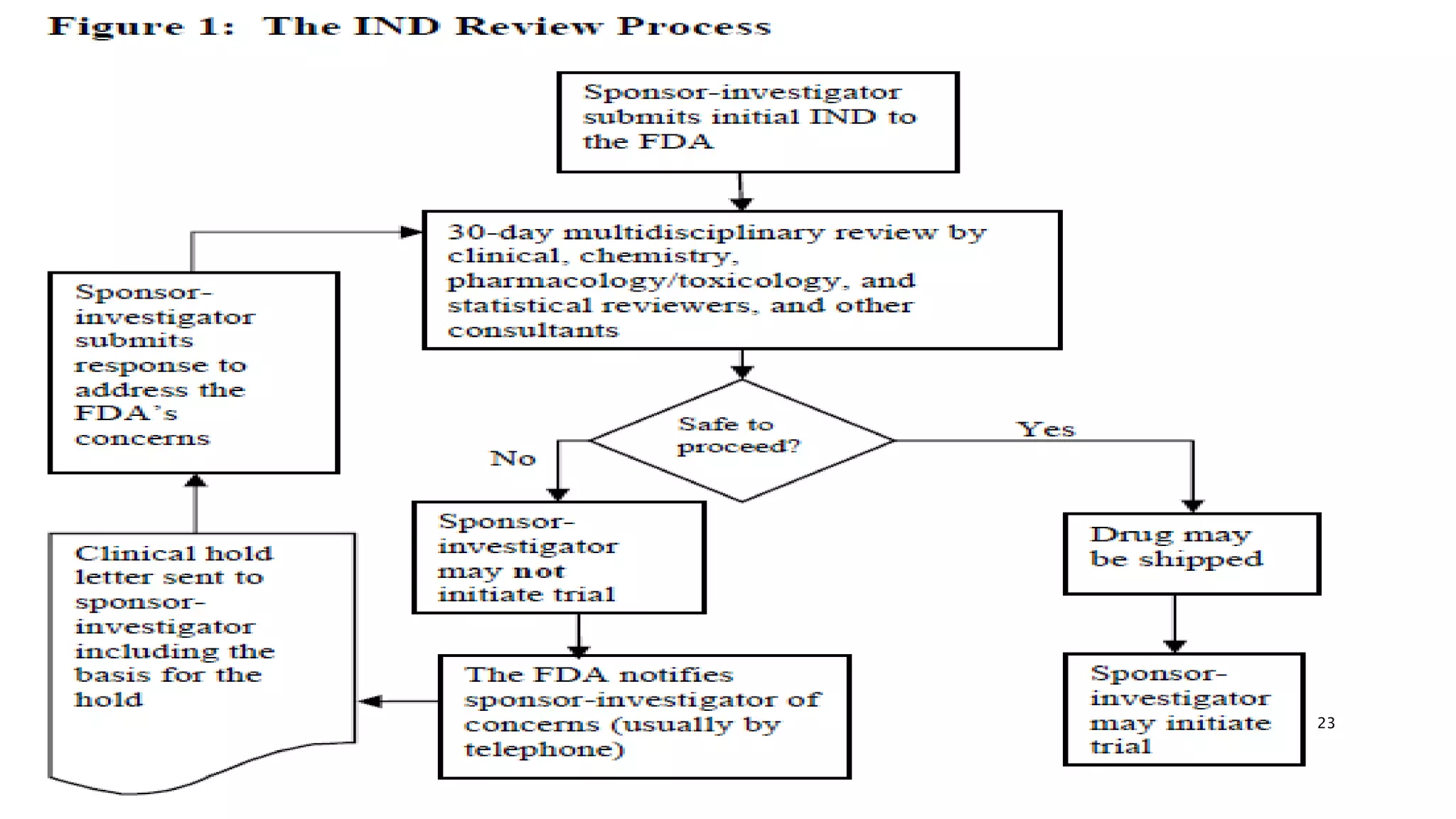
23
A. Clinical holds and requests for modifications
The FDA may place a proposed or ongoing trial on clinical hold if the FDA makes certain findings,
including that:
human subjects are or would be exposed to an unreasonable and significant risk of illness or
injury
the sponsor-investigator is not qualified, by reason of his or her scientific training and expertise
to conduct the trial
the investigator’s brochure is misleading, erroneous, or incomplete (where applicable)
the IND contains insufficient information for the FDA to assess the risks to subjects of the
proposed trial
Under certain circumstances, the FDA may also place on clinical hold a proposed or ongoing trial
that is not designed to be adequate and well-controlled, or if the criteria for a trial involving an
exception from informed consent
24
B. IND amendments
• After the initial IND is submitted and is in effect, a sponsor-investigator must make changes to
the IND as needed to ensure that the clinical investigations are conducted according to protocols
included in the application.
• Sponsor-investigators also need to provide essential information on the IND that is not within the
scope of any protocol amendment, IND safety report, or annual report. All these written
communications to the FDA are called amendments to the IND.
• The division will review these amendments as they are received.
25
• In contrast to the initial IND submission, if the IND is not on clinical hold, the sponsor
investigator may implement changes to the IND immediately after sending the amendment to the
FDA, without waiting 30 days
26
THANK YOU
27

Guidance for industry for IND application

  • 1.
    Guidance for industryfor IND application Presented by Mr. Bharat Kumar 17mph202 Guided by Dr. Shraddha Bhadada Assistant professor Department of Pharmacology, Institute of Pharmacy, Nirma university, Ahmedabad 1
  • 2.
    Introduction • Application toFDA to request permission to begin human testing is called investigational new drug application or IND. • The IND is the means through which the sponsor technically obtains this exemption from the FDA. • Sponsor’s primary goal is to determine if the product is reasonably safe for initial use in humans, and if the compound exhibits pharmacological activity that justifies commercial development. 2
  • 3.
    Types of IND “InvestigatorsIND” This INDA is one that is submitted by the physician who is initiated an investigation and is conducted it, and who is in charge of the study “Treatment” IND Drug intended to treat or diagnose serious or life-threatening condition, Controlled clinical trials in progress under IND or when trials completed & FDA review of request to market is pending Sponsor actively pursuing device marketing approval with FDA 3
  • 4.
    • “Emergency use”IND Need FDA authorization to use experimental drug in an emergency situation that does not allow time for submission of an IND in accordance with 21 CFR part 312 May be used for patients ineligible per existing study protocol(s), or if approved study protocol does not exist 4
  • 5.
    IND categories • Commercial •Research (non-commercial) 5
  • 6.
    IND application mustcontain information in three broad areas • Animal pharmacology and toxicology studies - Preclinical data to permit an assessment as to whether the product is reasonably safe for initial testing in humans. Also included are any previous experience with the drug in humans (often foreign use). • Manufacturing information - Information pertaining to the composition, manufacturer, stability, and controls used for manufacturing the drug substance and the drug product. This information is assessed to ensure that the company can adequately produce and supply consistent batches of the drug. • Clinical protocols and investigator information 6
  • 7.
    Regulations apply tothe IND application process 21CFR Part 312 Investigational New Drug Application 21CFR Part 314 INDA and NDAApplications for FDAApproval to Market a New Drug (New Drug Approval) 21CFR Part 316 Orphan Drugs 21CFR Part 58 Good Lab Practice for Nonclinical Laboratory [Animal] Studies 21CFR Part 50 Protection of Human Subjects 21CFR Part 56 Institutional Review Boards 21CFR Part 201 Drug Labeling 21CFR Part 54 Financial Disclosure by Clinical Investigators 7
  • 8.
    IND Content &format 1. Cover sheet (FORM FDA 1571) 2. Table of contents 3. Introductory statement and a general investigational plan 4. Investigators brochure 5. Protocols 6. Chemistry , manufacturing and control information 7. Pharmacology and toxicology information 8. Previous human experience with the investigational drug 9. Other relevant information like no of IND submissions, 10. Protocol amendments, any changes in the protocol. • No of copies to be submitted (1 + 2)-the ind application is always submitted in 1+ 2 format i.E. 1 original & 2 additional copies of each application. 8
  • 9.
    Coversheet • FORMAT OFCOVER SHEET.PDF 9
  • 10.
    Table of content •Comprehensive listing of contents of IND application broken in volumes & page number sections, appendices, attachments, reports & other reference material • A well drafted TOC will facilitate the task of review & decrease the review time. 10
  • 11.
    Introductory statement andgeneral investigation plan • The name of the drug and all active ingredients, • The drug's pharmacological class, • The structural formula of the drug (if known), • The formulation of the dosage form(s) to be used, the route of administration, and • The broad objectives and planned duration of the proposed clinical investigation(s). • A brief summary of previous human experience with the drug, with reference to other IND's if pertinent • If the drug has been withdrawn from investigation or marketing in any country for any reason related to safety or effectiveness • Identification of the countries where the drug was withdrawn and the reasons for the withdrawal. 11
  • 12.
    • Overall planfor investigating the drug product for the following year (A ) the rationale for the drug or the research study; (b ) the indication(s) to be studied; (c ) the general approach to be followed in evaluating the drug; (d ) the kinds of clinical trials to be conducted in the first year following the submission (if plans are not developed for the entire year, the sponsor should so indicate); (e ) the estimated number of patients to be given the drug in those studies; and (f ) any risks of particular severity or seriousness anticipated on the basis of the toxicological data in animals or prior studies in humans with the drug or related drugs. 12
  • 13.
    Investigator’s brochure Key documentprovided to each investigator & IRB at each of the clinical site. It includes- • All about the investigational Drug • IB is a living document & must be updated by the sponsor. 13
  • 14.
    Clinical protocols andinvestigator information • Detailed protocols for proposed clinical studies to assess whether the initial-phase trials will expose subjects to unnecessary risks information on the qualifications of clinical investigators-- professionals (generally physicians) who oversee the administration of the experimental compound-- to assess whether they are qualified to fulfill their clinical trial duties 14
  • 15.
    Pharmacology and toxicologyinformation • Laboratory animals or in vitro test reports • Pharmacology and drug disposition-ADME • Toxicology -include the results of acute, subacute, and chronic toxicity tests; tests of the drug's effects on reproduction and the developing fetus; any special toxicity test related to the drug's particular mode of administration or conditions of use (e.g., Inhalation, dermal, or ocular toxicology); and any in vitro studies intended to evaluate drug toxicity. 15
  • 16.
    Chemistry, manufacturing, andcontrol information • Drug substance • Drug product-a list of all components • Composition, manufacture, and control of any placebo used in a controlled clinical trial. • Labeling. • Environmental analysis requirements 16
  • 17.
    Previous human experiencewith the investigational drug • Integrated summary report of any human studies Conducted on the investigational drug • Relevant to the safety of the investigations to be done – pk studies, pd studies • Observed adverse event profile 17
  • 18.
    Additional information • Drugdependence and abuse potential • Radioactive drugs • Pediatric studies 18
  • 19.
    Submission of INDsafety reports. • The sponsor must submit each IND safety report in a narrative format or in an electronic format that FDA can process, review, and archive • Findings from animal or in vitro testing • Findings from other studies-from epidemiological studies, pooled analysis of multiple studies, or clinical studies 19
  • 20.
    Annual reports • Asponsor shall within 60 days of the anniversary date that the IND went into effect, submit a brief report of the progress of the investigation that includes: • Individual study information. • Summary information -Tabular summary showing the most frequent and most serious adverse experiences -Safety reports -A list of subjects who died during participation -A list of subjects who dropped out 20
  • 21.
    Withdrawal of anIND • At any time a sponsor may withdraw an effective IND without prejudice. • If an IND is withdrawn, FDA shall be so notified, all clinical investigations conducted under the IND shall be ended, all current investigators notified, and all stocks of the drug returned to the sponsor • If an IND is withdrawn because of a safety reason, the sponsor shall promptly so inform FDA, all participating investigators, and all reviewing institutional review boards, together with the reasons for such withdrawal. 21
  • 22.
    The IND processand review procedures A. Clinical holds and requests for modifications B. IND amendments 22
  • 23.
  • 24.
    A. Clinical holdsand requests for modifications The FDA may place a proposed or ongoing trial on clinical hold if the FDA makes certain findings, including that: human subjects are or would be exposed to an unreasonable and significant risk of illness or injury the sponsor-investigator is not qualified, by reason of his or her scientific training and expertise to conduct the trial the investigator’s brochure is misleading, erroneous, or incomplete (where applicable) the IND contains insufficient information for the FDA to assess the risks to subjects of the proposed trial Under certain circumstances, the FDA may also place on clinical hold a proposed or ongoing trial that is not designed to be adequate and well-controlled, or if the criteria for a trial involving an exception from informed consent 24
  • 25.
    B. IND amendments •After the initial IND is submitted and is in effect, a sponsor-investigator must make changes to the IND as needed to ensure that the clinical investigations are conducted according to protocols included in the application. • Sponsor-investigators also need to provide essential information on the IND that is not within the scope of any protocol amendment, IND safety report, or annual report. All these written communications to the FDA are called amendments to the IND. • The division will review these amendments as they are received. 25
  • 26.
    • In contrastto the initial IND submission, if the IND is not on clinical hold, the sponsor investigator may implement changes to the IND immediately after sending the amendment to the FDA, without waiting 30 days 26
  • 27.