CHAPTER 6: BASIC SKILLS FOR
GROUP LEADERS
By: Joshua Miguel Y. Manzano
ACTIVE LISTENING
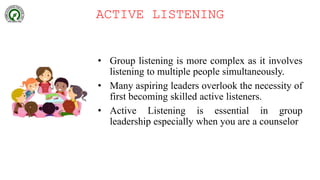
• Group listening is more complex as it involves
listening to multiple people simultaneously.
• Many aspiring leaders overlook the necessity of
first becoming skilled active listeners.
• Active Listening is essential in group
leadership especially when you are a counselor
ACTIVE LISTENING
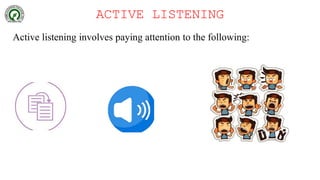
Active listening involves paying attention to the following:
REMINDERS
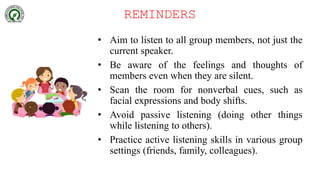
• Aim to listen to all group members, not just the
current speaker.
• Be aware of the feelings and thoughts of
members even when they are silent.
• Scan the room for nonverbal cues, such as
facial expressions and body shifts.
• Avoid passive listening (doing other things
while listening to others).
• Practice active listening skills in various group
settings (friends, family, colleagues).
REFLECTION
• Group leaders use reflection with individual
members, between multiple members
discussing a topic, and to reflect the group's
overall experience.
• In counseling, reflecting a comment means
restating it to show understanding of the
content, the feeling behind it, or both.
• Group leaders need to reflect both content and
feeling.
• Reflecting helps the speaker become more
aware of their message. Reflecting
communicates to the speaker that you
understand their feelings.
REMINDEER
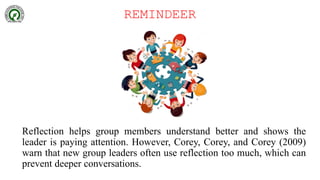
Reflection helps group members understand better and shows the
leader is paying attention. However, Corey, Corey, and Corey (2009)
warn that new group leaders often use reflection too much, which can
prevent deeper conversations.
CLARIFICATION AND
QUESTIONING
• Clarification may be done for the benefit of the entire group or for the
speaker’s benefit—that is, to help the member become more aware of
what he or she is trying to say.
• There are several techniques for clarification that you may find useful:
questioning, restating, and using other members to clarify.
SUMMARIZING
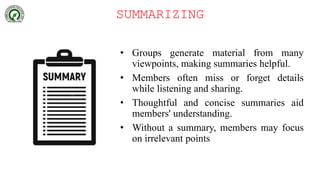
• Groups generate material from many
viewpoints, making summaries helpful.
• Members often miss or forget details
while listening and sharing.
• Thoughtful and concise summaries aid
members' understanding.
• Without a summary, members may focus
on irrelevant points
SUMMARIZING
• Summaries tighten the focus, allowing the
leader to stay with the issue or move on.
• Summaries help transition between topics.
• Especially important when discussions are
diffuse or overlapping.
• Good summaries pull together major
points and deepen focus.
• It is done mostly at the end of the
discussion.
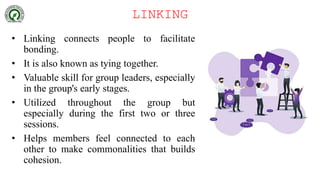
LINKING
• Linking connects people to facilitate
bonding.
• It is also known as tying together.
• Valuable skill for group leaders, especially
in the group's early stages.
• Utilized throughout the group but
especially during the first two or three
sessions.
• Helps members feel connected to each
other to make commonalities that builds
cohesion.
MULTI-LECTURING AND INFORMATION
GIVING
Group leaders sometimes need to provide information, especially in
educational settings where they act as experts on topics like diet, health,
birth control, or education. When giving a mini-lecture, leaders should
follow several key practices.
• Make it interesting.
• Make it relevant.
• Make sure you have considered cultural and gender differences.
• Make it short (usually no more than 5–8 minutes).
• Make it energizing.
• Make sure you have current, correct, and objective information
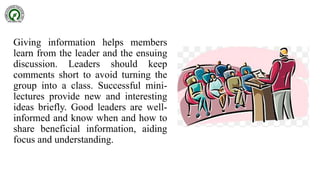
Giving information helps members
learn from the leader and the ensuing
discussion. Leaders should keep
comments short to avoid turning the
group into a class. Successful mini-
lectures provide new and interesting
ideas briefly. Good leaders are well-
informed and know when and how to
share beneficial information, aiding
focus and understanding.
ENCOURAGING AND
SUPPORTING
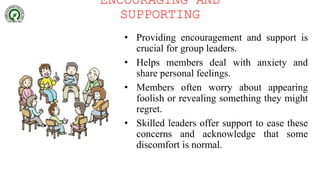
• Providing encouragement and support is
crucial for group leaders.
• Helps members deal with anxiety and
share personal feelings.
• Members often worry about appearing
foolish or revealing something they might
regret.
• Skilled leaders offer support to ease these
concerns and acknowledge that some
discomfort is normal.
ENCOURAGING AND
SUPPORTING
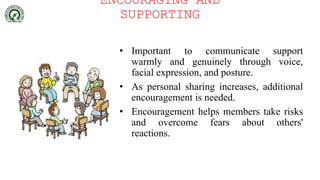
• Important to communicate support
warmly and genuinely through voice,
facial expression, and posture.
• As personal sharing increases, additional
encouragement is needed.
• Encouragement helps members take risks
and overcome fears about others'
reactions.
TONE SETTING
• Tone setting involves creating the group's
mood.
• Some beginners unintentionally set a dull
or overly serious tone.
• Others may set a light tone to be liked,
leading to frustration.
• The leader's actions and words dictate the
tone and what is permissible.
TONE SETTING
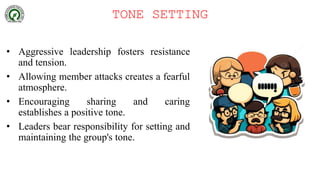
• Aggressive leadership fosters resistance
and tension.
• Allowing member attacks creates a fearful
atmosphere.
• Encouraging sharing and caring
establishes a positive tone.
• Leaders bear responsibility for setting and
maintaining the group's tone.
REMINDERS
• Environment, including lighting, seating, and decorations, affects
the group's tone.
• Chairs in a circle without tables create a different atmosphere than
those around a conference table.
• Elements like friendly notes, music, or soft lighting can influence
the tone.
• The leader's responsibility includes setting the right tone for
effectiveness.
• A proper tone enhances group effectiveness significantly.
MODELING AND SELF-
DISCLOSURE
• Modeling and self-disclosure are vital skills
for group leaders.
• They encourage members to share thoughts
and feelings.
• Effective communication, listening skills, and
encouragement serve as models for members.
• Leader's energy and interest in the group set
examples for others.
MODELING AND SELF-
DISCLOSURE
• Self-disclosure demonstrates how to share
and shows willingness to take risks.
• It humanizes the leader and shows shared
experiences with group members.
• Self-disclosure should be selective; excessive
disclosure can distract or confuse members.
• Intensity of self-disclosure should not make
the leader the focus of the group.
USE OF EYES
Using your eyes well is very important when
leading groups. A leader can use their eyes to:
• Gather useful information by observing
members
• Encourage people to speak by making eye
contact
• Deter people from speaking by avoiding eye
contact
This helps the leader manage the group and
create a good environment for discussion.
USE OF EYES
(Harvill, Masson, & Jacobs, 1983). The leader
can use his eyes in four ways:
1. Scanning for nonverbal cues
2. Getting members to look at other members
3. Drawing out members
4. Cutting off members
1. Scanning for Non-
Verbal Cues
Leaders gather valuable information by
scanning the group, but new leaders often
struggle because they naturally focus on the
speaker. For example, a new leader might only
look at a speaker and nearby members for 2
minutes, missing observations of others, which
can cause problems.
1. Scanning for Non-
Verbal Cues
• Some of the other members may feel excluded because the leader did
not make eye contact with them.
• The leader has no idea how most of the members were reacting to
what was being said.
• The leader has no idea who may want to speak next.
• Some of the other members may have lost interest because the
member talked only to the leader.
Generally, leaders should keep their eyes moving to pick up on
nonverbal cues like head nods, facial expressions, tears, and body shifts.
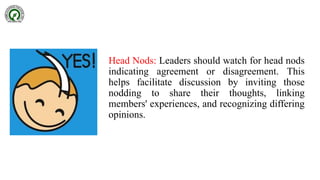
Head Nods: Leaders should watch for head nods
indicating agreement or disagreement. This
helps facilitate discussion by inviting those
nodding to share their thoughts, linking
members' experiences, and recognizing differing
opinions.
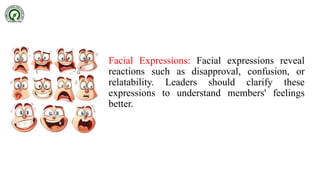
Facial Expressions: Facial expressions reveal
reactions such as disapproval, confusion, or
relatability. Leaders should clarify these
expressions to understand members' feelings
better.
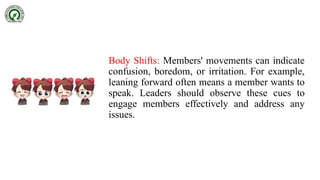
Body Shifts: Members' movements can indicate
confusion, boredom, or irritation. For example,
leaning forward often means a member wants to
speak. Leaders should observe these cues to
engage members effectively and address any
issues.
2. Getting members to look at
other members
• Leaders can use eye signals to encourage
members to look at each other.
• Inform members that you won't always look
at them when they talk, prompting them to
look around.
• Scanning helps the talking member seek eye
contact with others, aiding group
development.
• Immigrant and non-U.S. members may not
maintain eye contact the same way, which
can be a sign of respect, not low self-esteem
or poor social skills.
3. Drawing out members
• Use eye contact to invite quiet members to speak.
• Scan the group and make eye contact with specific members to
encourage participation.
• Kind, encouraging eye contact helps shy or scared members start
talking.
• Gradually encourage these members to address the whole group.
• Maintain eye contact during personal disclosures to offer support.
• Repeated eye contact with a member while addressing the group
helps draw them out.
4. Cutting Off
• Redirect attention from a talkative member by using eye contact to
engage others first.
• Begin by looking at the talkative member while posing a question,
then shift focus to others to encourage their input.
• This approach subtly invites varied responses and limits the
talkative member's dominance in discussions.
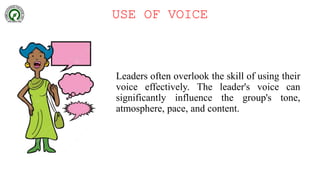
USE OF VOICE
Leaders often overlook the skill of using their
voice effectively. The leader's voice can
significantly influence the group's tone,
atmosphere, pace, and content.
1. Use of voice to set
the tone
• Strong, stern voice: May intimidate and
discourage sharing.
• Nonassertive voice: May lead to a lack of
respect or belief in the leader.
• Warm, encouraging voice: Helps support
scared, troubled, or withdrawn members.
2. Use of Voice to
Energize the Group
• Enthusiastic voice: Shows interest and
energizes members.
• At the start of sessions: Generates interest
and energy.
• Practice: Vary energy levels to enhance
group dynamics.
3. Pacing the group
• Slow-talking leader: Can slow down the
group's pace.
• Manipulating speech rate: Controls the
group's pace effectively.
• Evaluate effectiveness: Regular practice
and evaluation improve leadership.
USE OF THE LEADER’S
ENERGY
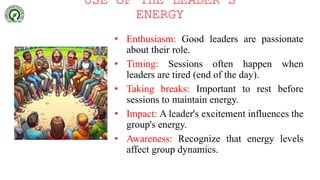
• Enthusiasm: Good leaders are passionate
about their role.
• Timing: Sessions often happen when
leaders are tired (end of the day).
• Taking breaks: Important to rest before
sessions to maintain energy.
• Impact: A leader's excitement influences the
group's energy.
• Awareness: Recognize that energy levels
affect group dynamics.
IDENTIFYING ALLIES
• Discover which members are cooperative
and helpful.
• Allies are important for starting
discussions, exercises, and taking risks.
• In emotional situations, allies can support
distressed members, allowing the leader to
focus on others.
IDENTIFYING ALLIES
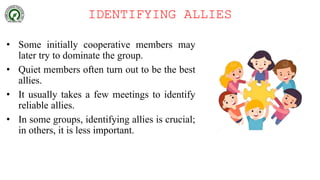
• Some initially cooperative members may
later try to dominate the group.
• Quiet members often turn out to be the best
allies.
• It usually takes a few meetings to identify
reliable allies.
• In some groups, identifying allies is crucial;
in others, it is less important.
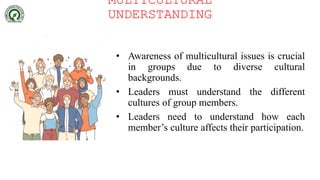
MULTICULTURAL
UNDERSTANDING
• Awareness of multicultural issues is crucial
in groups due to diverse cultural
backgrounds.
• Leaders must understand the different
cultures of group members.
• Leaders need to understand how each
member’s culture affects their participation.
Corey (2008)
Cultural context, acculturation, and racial identity development
are essential for understanding individuals. Culture influences
both group members' and leaders' behavior, as well as the group
process. Ignoring cultural variations results in less effective
group counseling.
CONCLUSION
This chapter covers essential group leadership skills: active
listening, reflection, clarification, summarizing, mini-lecturing,
encouragement, and modeling. These skills are crucial for
effective leadership. Leaders use observation to engage members
and interpret nonverbal cues. Voice modulation shapes group
dynamics, and cultural understanding is vital in diverse
environments.
THANK YOU!

Guidance Counseling - 214_CHAPTER-6.pptx

  • 1.
    CHAPTER 6: BASICSKILLS FOR GROUP LEADERS By: Joshua Miguel Y. Manzano
  • 2.
    ACTIVE LISTENING • Grouplistening is more complex as it involves listening to multiple people simultaneously. • Many aspiring leaders overlook the necessity of first becoming skilled active listeners. • Active Listening is essential in group leadership especially when you are a counselor
  • 3.
    ACTIVE LISTENING Active listeninginvolves paying attention to the following:
  • 4.
    REMINDERS • Aim tolisten to all group members, not just the current speaker. • Be aware of the feelings and thoughts of members even when they are silent. • Scan the room for nonverbal cues, such as facial expressions and body shifts. • Avoid passive listening (doing other things while listening to others). • Practice active listening skills in various group settings (friends, family, colleagues).
  • 5.
    REFLECTION • Group leadersuse reflection with individual members, between multiple members discussing a topic, and to reflect the group's overall experience. • In counseling, reflecting a comment means restating it to show understanding of the content, the feeling behind it, or both. • Group leaders need to reflect both content and feeling. • Reflecting helps the speaker become more aware of their message. Reflecting communicates to the speaker that you understand their feelings.
  • 6.
    REMINDEER Reflection helps groupmembers understand better and shows the leader is paying attention. However, Corey, Corey, and Corey (2009) warn that new group leaders often use reflection too much, which can prevent deeper conversations.
  • 7.
    CLARIFICATION AND QUESTIONING • Clarificationmay be done for the benefit of the entire group or for the speaker’s benefit—that is, to help the member become more aware of what he or she is trying to say. • There are several techniques for clarification that you may find useful: questioning, restating, and using other members to clarify.
  • 8.
    SUMMARIZING • Groups generatematerial from many viewpoints, making summaries helpful. • Members often miss or forget details while listening and sharing. • Thoughtful and concise summaries aid members' understanding. • Without a summary, members may focus on irrelevant points
  • 9.
    SUMMARIZING • Summaries tightenthe focus, allowing the leader to stay with the issue or move on. • Summaries help transition between topics. • Especially important when discussions are diffuse or overlapping. • Good summaries pull together major points and deepen focus. • It is done mostly at the end of the discussion.
  • 10.
    LINKING • Linking connectspeople to facilitate bonding. • It is also known as tying together. • Valuable skill for group leaders, especially in the group's early stages. • Utilized throughout the group but especially during the first two or three sessions. • Helps members feel connected to each other to make commonalities that builds cohesion.
  • 11.
    MULTI-LECTURING AND INFORMATION GIVING Groupleaders sometimes need to provide information, especially in educational settings where they act as experts on topics like diet, health, birth control, or education. When giving a mini-lecture, leaders should follow several key practices. • Make it interesting. • Make it relevant. • Make sure you have considered cultural and gender differences. • Make it short (usually no more than 5–8 minutes). • Make it energizing. • Make sure you have current, correct, and objective information
  • 12.
    Giving information helpsmembers learn from the leader and the ensuing discussion. Leaders should keep comments short to avoid turning the group into a class. Successful mini- lectures provide new and interesting ideas briefly. Good leaders are well- informed and know when and how to share beneficial information, aiding focus and understanding.
  • 13.
    ENCOURAGING AND SUPPORTING • Providingencouragement and support is crucial for group leaders. • Helps members deal with anxiety and share personal feelings. • Members often worry about appearing foolish or revealing something they might regret. • Skilled leaders offer support to ease these concerns and acknowledge that some discomfort is normal.
  • 14.
    ENCOURAGING AND SUPPORTING • Importantto communicate support warmly and genuinely through voice, facial expression, and posture. • As personal sharing increases, additional encouragement is needed. • Encouragement helps members take risks and overcome fears about others' reactions.
  • 15.
    TONE SETTING • Tonesetting involves creating the group's mood. • Some beginners unintentionally set a dull or overly serious tone. • Others may set a light tone to be liked, leading to frustration. • The leader's actions and words dictate the tone and what is permissible.
  • 16.
    TONE SETTING • Aggressiveleadership fosters resistance and tension. • Allowing member attacks creates a fearful atmosphere. • Encouraging sharing and caring establishes a positive tone. • Leaders bear responsibility for setting and maintaining the group's tone.
  • 17.
    REMINDERS • Environment, includinglighting, seating, and decorations, affects the group's tone. • Chairs in a circle without tables create a different atmosphere than those around a conference table. • Elements like friendly notes, music, or soft lighting can influence the tone. • The leader's responsibility includes setting the right tone for effectiveness. • A proper tone enhances group effectiveness significantly.
  • 18.
    MODELING AND SELF- DISCLOSURE •Modeling and self-disclosure are vital skills for group leaders. • They encourage members to share thoughts and feelings. • Effective communication, listening skills, and encouragement serve as models for members. • Leader's energy and interest in the group set examples for others.
  • 19.
    MODELING AND SELF- DISCLOSURE •Self-disclosure demonstrates how to share and shows willingness to take risks. • It humanizes the leader and shows shared experiences with group members. • Self-disclosure should be selective; excessive disclosure can distract or confuse members. • Intensity of self-disclosure should not make the leader the focus of the group.
  • 20.
    USE OF EYES Usingyour eyes well is very important when leading groups. A leader can use their eyes to: • Gather useful information by observing members • Encourage people to speak by making eye contact • Deter people from speaking by avoiding eye contact This helps the leader manage the group and create a good environment for discussion.
  • 21.
    USE OF EYES (Harvill,Masson, & Jacobs, 1983). The leader can use his eyes in four ways: 1. Scanning for nonverbal cues 2. Getting members to look at other members 3. Drawing out members 4. Cutting off members
  • 22.
    1. Scanning forNon- Verbal Cues Leaders gather valuable information by scanning the group, but new leaders often struggle because they naturally focus on the speaker. For example, a new leader might only look at a speaker and nearby members for 2 minutes, missing observations of others, which can cause problems.
  • 23.
    1. Scanning forNon- Verbal Cues • Some of the other members may feel excluded because the leader did not make eye contact with them. • The leader has no idea how most of the members were reacting to what was being said. • The leader has no idea who may want to speak next. • Some of the other members may have lost interest because the member talked only to the leader. Generally, leaders should keep their eyes moving to pick up on nonverbal cues like head nods, facial expressions, tears, and body shifts.
  • 24.
    Head Nods: Leadersshould watch for head nods indicating agreement or disagreement. This helps facilitate discussion by inviting those nodding to share their thoughts, linking members' experiences, and recognizing differing opinions.
  • 25.
    Facial Expressions: Facialexpressions reveal reactions such as disapproval, confusion, or relatability. Leaders should clarify these expressions to understand members' feelings better.
  • 26.
    Body Shifts: Members'movements can indicate confusion, boredom, or irritation. For example, leaning forward often means a member wants to speak. Leaders should observe these cues to engage members effectively and address any issues.
  • 27.
    2. Getting membersto look at other members • Leaders can use eye signals to encourage members to look at each other. • Inform members that you won't always look at them when they talk, prompting them to look around. • Scanning helps the talking member seek eye contact with others, aiding group development. • Immigrant and non-U.S. members may not maintain eye contact the same way, which can be a sign of respect, not low self-esteem or poor social skills.
  • 28.
    3. Drawing outmembers • Use eye contact to invite quiet members to speak. • Scan the group and make eye contact with specific members to encourage participation. • Kind, encouraging eye contact helps shy or scared members start talking. • Gradually encourage these members to address the whole group. • Maintain eye contact during personal disclosures to offer support. • Repeated eye contact with a member while addressing the group helps draw them out.
  • 29.
    4. Cutting Off •Redirect attention from a talkative member by using eye contact to engage others first. • Begin by looking at the talkative member while posing a question, then shift focus to others to encourage their input. • This approach subtly invites varied responses and limits the talkative member's dominance in discussions.
  • 30.
    USE OF VOICE Leadersoften overlook the skill of using their voice effectively. The leader's voice can significantly influence the group's tone, atmosphere, pace, and content.
  • 31.
    1. Use ofvoice to set the tone • Strong, stern voice: May intimidate and discourage sharing. • Nonassertive voice: May lead to a lack of respect or belief in the leader. • Warm, encouraging voice: Helps support scared, troubled, or withdrawn members.
  • 32.
    2. Use ofVoice to Energize the Group • Enthusiastic voice: Shows interest and energizes members. • At the start of sessions: Generates interest and energy. • Practice: Vary energy levels to enhance group dynamics.
  • 33.
    3. Pacing thegroup • Slow-talking leader: Can slow down the group's pace. • Manipulating speech rate: Controls the group's pace effectively. • Evaluate effectiveness: Regular practice and evaluation improve leadership.
  • 34.
    USE OF THELEADER’S ENERGY • Enthusiasm: Good leaders are passionate about their role. • Timing: Sessions often happen when leaders are tired (end of the day). • Taking breaks: Important to rest before sessions to maintain energy. • Impact: A leader's excitement influences the group's energy. • Awareness: Recognize that energy levels affect group dynamics.
  • 35.
    IDENTIFYING ALLIES • Discoverwhich members are cooperative and helpful. • Allies are important for starting discussions, exercises, and taking risks. • In emotional situations, allies can support distressed members, allowing the leader to focus on others.
  • 36.
    IDENTIFYING ALLIES • Someinitially cooperative members may later try to dominate the group. • Quiet members often turn out to be the best allies. • It usually takes a few meetings to identify reliable allies. • In some groups, identifying allies is crucial; in others, it is less important.
  • 37.
    MULTICULTURAL UNDERSTANDING • Awareness ofmulticultural issues is crucial in groups due to diverse cultural backgrounds. • Leaders must understand the different cultures of group members. • Leaders need to understand how each member’s culture affects their participation.
  • 38.
    Corey (2008) Cultural context,acculturation, and racial identity development are essential for understanding individuals. Culture influences both group members' and leaders' behavior, as well as the group process. Ignoring cultural variations results in less effective group counseling.
  • 39.
    CONCLUSION This chapter coversessential group leadership skills: active listening, reflection, clarification, summarizing, mini-lecturing, encouragement, and modeling. These skills are crucial for effective leadership. Leaders use observation to engage members and interpret nonverbal cues. Voice modulation shapes group dynamics, and cultural understanding is vital in diverse environments.
  • 40.