The Transformation battle
December 7th, 2012
Guadalcanal was one of the major
turning points in WWII. While both sides
fought to the death to take over
Guadalcanal, the Allies proved to be
powerful in their strategy to take over the
island.
The Allies that landed in
                                              August (US &
                                              Australian troops) were
                                              able to seize the airfield
                                              surprising many of the
                                              Japanese defenders.
                                              To attempt to reclaim to
                                              the airfield Japanese
                                              ship more
                                              troops, unfortunately, th
  US Marines landed in Guadalcanal in         e Americans are able to
  August 1942, and their mission was to
seize an airfield that the Japanese were in
                                              send more troops
            the middle building.              quicker than the
                                              Japanese.
Guadalcanal’s location isn’t
the most easiest
environment. According to
Guadalcanal Journal: A
personal history of the
Battle of Guadalcanal, the
jungle was thick and it took
three days to go six
miles, and the insects were
terrific (meaning in a
                               “Photographed from a USS Saratoga (CV-3)
sarcastic tone). A few         plane in the latter part of August 1942, after U.S.
Japanese surprise attacks      aircraft had begun to use the airfield. The view
                               looks about northwest, with the Lunga River
occurred at night causing      running across the upper portion of the image.
many deaths also due to        Iron Bottom Sound is just out of view at the top.
                               Several planes are parked to the left, and
air raids during night and     numerous bomb and shell craters are visible.” –
                               US Navy, National Archives
day.
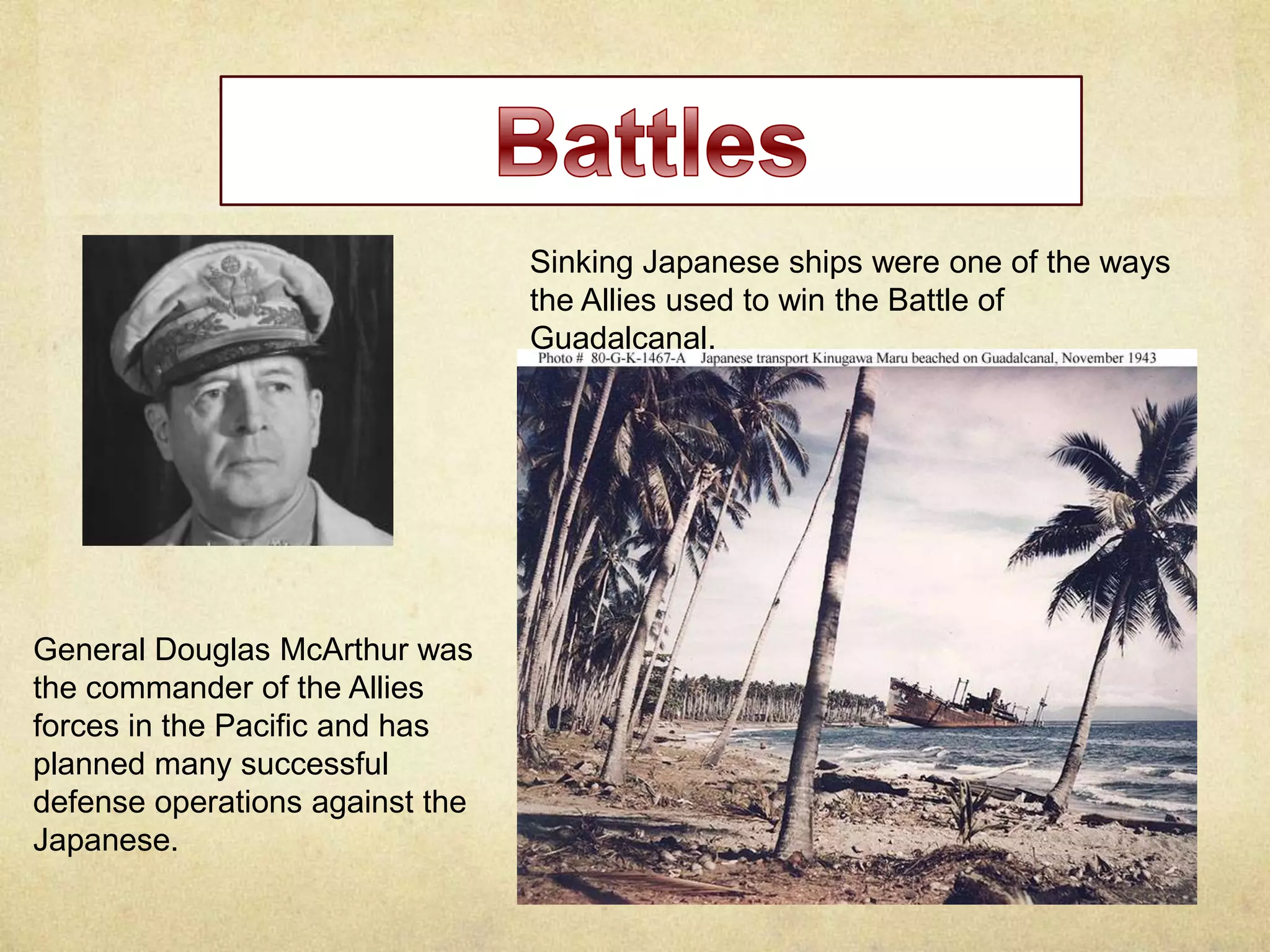
Sinking Japanese ships were one of the ways
                                 the Allies used to win the Battle of
                                 Guadalcanal.


General Douglas McArthur was
the commander of the Allies
forces in the Pacific and has
planned many successful
defense operations against the
Japanese.
When the Japanese
wanted attention so they
could try to recover what
remained of
Guadalcanal, they would
make mini sculptures that
people wanted to see
(such as some on the right
). In January of
1943, American troops
outnumbered Japanese          This particular picture refers to the
troops and in the end the     Japanese trying to get a crowd of
                              an Ally troops and form a group so
Japanese were forced to       Japanese air raids would be able
evacuate due to the Allies’   to kill troops.
armies being too large to
fight.
National Archives. Battle of Tassafaronga, 30 November 1942. Digital image. Guadalcanal Campaign, August 1942-
February 1943. Naval History & Heritage *Command*, n.d. Web. 9 Dec. 2012.

US Navy National Archives. Guadalcanal Campaign, August 1942 - February 1943. Digital image. Guadalcanal
Campaign, August 1942- February 1943. National Archives, 2012. Web. 9 Dec. 2012.

"Battle of Guadalcanal (World War II)." Encyclopedia Britannica Online. Encyclopedia Britannica, 2012. Web. 10 Dec.
2012.

Google+. "Guadalcanal Journal: A Personal History of the Battle For Guadalcanal." Web log post. Guadalcanal Journal.
LIFE, 2012. Web. 10 Dec. 2012.

"Guadalcanal Campaign, August 1942 - February 1943." Guadalcanal Campaign, August 1942 - February 1943.
National Archives, 2012. Web. 10 Dec. 2012.

"Guadalcanal." Guadalcanal. CMH Online, 2012. Web. 10 Dec. 2012.
Morse, Ralph. "Life." LIFE. LIFE, 2012. Web. 10 Dec. 2012. <http://life.time.com/history/guadalcanal-world-war-ii-rare-
photos/>.

National Archives. Battle of Tassafaronga, 30 November 1942. Digital image. Guadalcanal Campaign, August 1942-
February 1943. Naval History & Heritage *Command*, n.d. Web. 9 Dec. 2012.

US Navy National Archives. Guadalcanal Campaign, August 1942 - February 1943. Digital image. Guadalcanal
Campaign, August 1942- February 1943. National Archives, 2012. Web. 9 Dec. 2012.

Bio. True Story. Douglas McArthur. Digital image. Douglas McArthur Biography- Facts, Birthday, Lifestory. Bio- True
Story, 1996-2012. Web. 10 Dec. 2012.

Guadalcanal

  • 1.
  • 2.
    Guadalcanal was oneof the major turning points in WWII. While both sides fought to the death to take over Guadalcanal, the Allies proved to be powerful in their strategy to take over the island.
  • 3.
    The Allies thatlanded in August (US & Australian troops) were able to seize the airfield surprising many of the Japanese defenders. To attempt to reclaim to the airfield Japanese ship more troops, unfortunately, th US Marines landed in Guadalcanal in e Americans are able to August 1942, and their mission was to seize an airfield that the Japanese were in send more troops the middle building. quicker than the Japanese.
  • 4.
    Guadalcanal’s location isn’t themost easiest environment. According to Guadalcanal Journal: A personal history of the Battle of Guadalcanal, the jungle was thick and it took three days to go six miles, and the insects were terrific (meaning in a “Photographed from a USS Saratoga (CV-3) sarcastic tone). A few plane in the latter part of August 1942, after U.S. Japanese surprise attacks aircraft had begun to use the airfield. The view looks about northwest, with the Lunga River occurred at night causing running across the upper portion of the image. many deaths also due to Iron Bottom Sound is just out of view at the top. Several planes are parked to the left, and air raids during night and numerous bomb and shell craters are visible.” – US Navy, National Archives day.
  • 5.
    Sinking Japanese shipswere one of the ways the Allies used to win the Battle of Guadalcanal. General Douglas McArthur was the commander of the Allies forces in the Pacific and has planned many successful defense operations against the Japanese.
  • 6.
    When the Japanese wantedattention so they could try to recover what remained of Guadalcanal, they would make mini sculptures that people wanted to see (such as some on the right ). In January of 1943, American troops outnumbered Japanese This particular picture refers to the troops and in the end the Japanese trying to get a crowd of an Ally troops and form a group so Japanese were forced to Japanese air raids would be able evacuate due to the Allies’ to kill troops. armies being too large to fight.
  • 7.
    National Archives. Battleof Tassafaronga, 30 November 1942. Digital image. Guadalcanal Campaign, August 1942- February 1943. Naval History & Heritage *Command*, n.d. Web. 9 Dec. 2012. US Navy National Archives. Guadalcanal Campaign, August 1942 - February 1943. Digital image. Guadalcanal Campaign, August 1942- February 1943. National Archives, 2012. Web. 9 Dec. 2012. "Battle of Guadalcanal (World War II)." Encyclopedia Britannica Online. Encyclopedia Britannica, 2012. Web. 10 Dec. 2012. Google+. "Guadalcanal Journal: A Personal History of the Battle For Guadalcanal." Web log post. Guadalcanal Journal. LIFE, 2012. Web. 10 Dec. 2012. "Guadalcanal Campaign, August 1942 - February 1943." Guadalcanal Campaign, August 1942 - February 1943. National Archives, 2012. Web. 10 Dec. 2012. "Guadalcanal." Guadalcanal. CMH Online, 2012. Web. 10 Dec. 2012. Morse, Ralph. "Life." LIFE. LIFE, 2012. Web. 10 Dec. 2012. <http://life.time.com/history/guadalcanal-world-war-ii-rare- photos/>. National Archives. Battle of Tassafaronga, 30 November 1942. Digital image. Guadalcanal Campaign, August 1942- February 1943. Naval History & Heritage *Command*, n.d. Web. 9 Dec. 2012. US Navy National Archives. Guadalcanal Campaign, August 1942 - February 1943. Digital image. Guadalcanal Campaign, August 1942- February 1943. National Archives, 2012. Web. 9 Dec. 2012. Bio. True Story. Douglas McArthur. Digital image. Douglas McArthur Biography- Facts, Birthday, Lifestory. Bio- True Story, 1996-2012. Web. 10 Dec. 2012.