Australian Food and Grocery Council
GS1 RECALL
BETTER, FASTER, SMARTER FOOD RECALLS
World of Food Safety 2013
Bangkok, Thailand
Australian Food and Grocery Council
OVERVIEW
• WHERE IS THE PROBLEM
• CRISIS MANAGEMENT
• INDUSTRY RECALL PROCESS
• GS1 RECALLNET CONCEPT
• GS1 RECALLNET PERFORMANCE
• FUTURE DEVELOPMENTS
2
Australian Food and Grocery Council
“ He who fails to plan is
planning to fail”
- Winston Churchill
BE PREPARED
3
Australian Food and Grocery Council
INTERNAL AND EXTERNAL RISKS
• Processing & production failure
• Product contamination
• Malcontent
• Transport and logistic failure
• Economic adulteration and fraud
• Counterfeit product
• Sabotage and tampering
• Extortion
• Bioterrorism
• Global pandemic
Internal
External
4
Australian Food and Grocery Council
• Food recalls by
attributable cause.
• undeclared allergens
average 28% of total in
2008 - 2013 period
• second most common
cause after bacterial
contamination
• Issues:
– supplier of ingredients
– change to source
– uncontrolled cross contact
– method of analysis
– label design error
– packing error
FOOD RECALLS – SOURCE OF THE PROBLEM
*source, FSANZ official recall notifications as at 17 April 2013
5
Microbial
33%
Foreign
matter
22%
Chemicals
& Toxins
7%
Processing
Faults &
Illegal
Ingredients
8%
Labels -
undeclared
allergens
29%
Other
labelling
faults
1%
Australian food recalls
2008 to 2013
Australian Food and Grocery Council
FOOD RECALLS – ALLERGENS
• Most common
category of allergens
being recalled are:
– Peanut
– Dairy
– Gluten in gluten free*
– Egg
• Decision to recall?
– consumer complaints
– Implications for most
vulnerable age group
6
dairy
17%
egg
9%
fish
2%
crustacea
1%
gluten
10%
peanut
23%
sesame
4%
soy
5%
tree nut
6%
sulphite
4%
multiple
19%
Proportion of allergens in food recalls
2008 - 2013
*source, FSANZ official recall notifications as at 17 April 2013
Australian Food and Grocery Council
THREE STAGES - EIGHT STEPS
READINESS
Step 1 Preparation & planning to identify & respond to a crisis
RESPONSIVENESS
Step 2 Initiate response protocol
Step 3 Determine the facts and assess the risk
Step 4 Maintain confidentiality
Step 5 Decide appropriate action [ recall / withdrawal ]
Step 6 Coordinate action throughout the supply chain
Step 7 Communicate clearly and precisely
RECOVERY
Step 8 Evaluate effectiveness
Readiness Responsiveness Recovery
7
Australian Food and Grocery Council
CONFIDENCE IN RECOVERY
8
+7%
-15%
Share price of
companies that
handle a crisis well
one year later
Share price of
companies that
mishandle a crisis
one year later
Source: The impact of catastrophe on Shareholder value. Sedgwick Group, Knight and Pretty
Effective management of the consequences of catastrophes is
the most significant factor in recovery and economic impact
Australian Food and Grocery Council
INDUSTRY RESPONSIBILITIES
• Documented recall plan and operational procedures
• Traceability – one step forward, one step back
• Train staff to execute the food recall plan
• Determine the facts and assess the risk
9
• Close-out recall with government authority
• Evaluate food recall plan, consider effectiveness and
lessons learned to revise the recall plan if needed
Readiness
• Initiate food recall to remove food from the market
• Notify relevant food business across supply chain
• Notify relevant government authorities
• Inform consumers via media and advertisements
• Respond to queries – media / consumer hotline
• Dispose or re-process recalled product appropriately
Response
Recovery
Australian Food and Grocery Council
RECALL / WITHDRAWAL FLOWCHART
Is there any product on sale
at retail outlets ?
YES
NO
Is the consumer likely to
have the product at home ?
Health/safety concern ?
YES
NO
Quality concern ?
YES
Is there any product on
sale at retail outlets ?
Initiate Recall Initiate Withdrawal
YES
YES
Advise Retailers and Trade
Alert
consumers
Cease distribution
Advise Government
Authorities about recalls
Identify quantity and location of stock
Advise retailers when compliant stock is available
Close-out and report
Monitor completion & effectiveness
Implement corrective action
NO
Determine disposal options
NO
10
Australian Food and Grocery Council
ISO STANDARD FOR PRODUCT RECALL
• ISO 10393:2013, Consumer product recall –
Guidelines for suppliers, April 15 2013
– WHAT is needed to establish, implement and manage a
consumer product recall program
– plan and execute cost-effective recall programs, minimize
legal risks, protect consumers from unsafe or dangerous
products
– apply a consistent and repeatable processes for handling
product recalls within one or across multiple retail
jurisdictions.
• Global Standards One (GS1) provide the HOW:
GS1 standards provide globally unique product
identification, supply chain traceability and multi-
jurisdictional product recall.
– Miguel Lopera, President & CEO of GS1
11
Australian Food and Grocery Council
CASE STUDIES
• Beef – horse meat contamination
– Contamination and economic substitution
– complexity of supply chain and coordination or action
– Dutch, Irish, British, French, Swedish, Greek recalls
• Chinese dairy / infant formula
– melamine contamination and economic adulteration
– Complexity of supply chain, traceability and laboratory detection
• Kraft peanut butter
– Salmonella contamination
– Wide distribution, target market high proportion of children, competitor impact
• Garibaldi metwurst
– Entertoxic E.coli 0111 – causing haemolytic uraemic syndrome and renal failure
– Company denial, diverse range of suppliers, government intervention
12
Australian Food and Grocery Council
THE MAPLE LEAF RECALL
• 20 dead – 38 other confirmed cases across Canada/US
• $203 million spent by Maple Leaf (compensation costs)
• Consumer confidence ↓ 20 points (2007 food safety survey)
• 246 Food Recalls in 2006-2007
• Sub-optimal notification processes
• Lack of an audit trail
The president and CEO of Maple Leaf
Foods said Sunday he is determined to
put public health first with a massive
meat recall because of an outbreak of
the potentially deadly bacterium Listeria
monocytogenes at a Toronto plant.
August 25, 2008
13
Australian Food and Grocery Council
SPEED OF RESPONSE
14
We live in world of real-time
Expectation that news travels much faster
in a world connected by Social Web
The longer a crisis is drawn
out, the more bad press and
negative association
Act quickly and decisively
to protect consumers
Australian Food and Grocery Council
 Detailed review of recall practices with
industry & peak bodies
 Initial development of online portal with
automatic notifications – GS1 Canada
 Industry Pilots with 25 food manufacturers
and retailers
 Further tailored deployment in the US,
Canada, Australia, New Zealand, South
Africa, Germany…
Industry collaboration to develop a new
way of managing recall notifications
GS1 PRODUCT RECALL DEVELOPMENT
15
Australia
Australian Food and Grocery Council
Move from the current
manual, paper form
To a standards based,
secure, auditable web
based portal
Developed by ECRA in 2005
In June 2009, the GS1 Recallnet Initiative was
started in Australia with leadership from the
AFGC, leading manufacturers, wholesalers,
retailers and government
16
Australia
Australian Food and Grocery Council
 Ensure rapid removal of unsafe food
from retail sale, catering and institutions
 Decrease resource required for a recall
 Time and cost efficiency to manage
recalls
 Increased business preparedness
 Ensure competency of businesses with
training and mock recall
 Lower insurance premiums for
businesses
GS1 RECALLNET OBJECTIVE
17
Australia
Australian Food and Grocery Council
 Standard form and notification
workflow
 B2B, B2G communications, not B2C
 Targeted communication with retail
customers
 Notification to regulators (FSANZ,
ACCC)
 Response notification of customer action
 Audit trail reduces risk and confusion
 Decreases risk of inaction
 Enables Mock Recall and staff training
GS1 RECALLNET ADVANTAGE
18
Australia
Australian Food and Grocery Council
FSANZ/ACCC
RECEIVERS
Retailer
Broker
Food Service
Manufacturer
Wholesaler
RECALLNET NOTIFICATION PROCESS
INITIATOR
(SPONSOR)
Initiator Approver
  


19
Australia
Australian Food and Grocery Council
• Web portal accessible by any browser on any
device
• common GS1 standards for identification and
traceability
• standard web forms with validation to ensure
completeness and accuracy
• each field with “mouse over” explanations and
workflow guidelines for easy, intuitive workflow
• capability for text message as an immediate
form of notification
• report back functions to show progress and
status on each recall or withdrawal
GS1 RECALLNET FEATURES
20
Australia
Australian Food and Grocery Council
EASY OF USE
Overall 4-Step
Process to issue
notifications
Drop down lists,
online help and
definitions to
minimise data entry
Mandatory data
requirements
Broad set
of data for
multiple
processes
FSANZ
specific data
requirement
s
21
Australia
Australian Food and Grocery Council
BUSINESS SUITABILITY
Applicable to all business in the Food & Grocery sector,
from small suppliers to large multinational companies:
• raw material and ingredient suppliers
• manufacturers and processors
• retailers and restaurants
• distributors and food service companies
• hospitals, nursing homes, schools, airline caterers.
Australia
22
Australian Food and Grocery Council
• Established system - recall and withdrawal
notifications:
– based on filling out separate forms for each customer
– manual process time-consuming and error-prone
• Evaluation of GS1 Recallnet web portal:
– Increased speed and accuracy of recall - withdrawal
– decreases business and consumer risk
– reduced cost and staff time
• Efficiency at the core of GS1 Recallnet.
– portal provides a simple workflow completing a
standard notification form.
– data is validated as it is being entered to ensure the
accuracy and completeness.
– improved security and checking with internal
authorization
– single form rather than using multiple manual forms
DRURY ORCHARDS CASE-STUDY
23
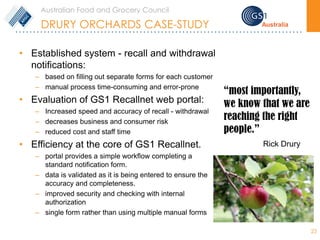
“most importantly,
we know that we are
reaching the right
people.”
Rick Drury
Australia
Australian Food and Grocery Council
GS1 RECALLNET ENHANCEMENT
• GS1 Recallnet system in the Food
Sector to meet requirements of
Consumer Goods
– No need to subscribe for another service
– Lower overall development and service
costs
– Extend the reach for food recalls to
general merchandising retailers
– Faster turnaround
– Update existing Food Service with new
functionality and capability
• Healthcare enhancements
– new functions Healthcare (upgrade of
Food service with new enhancements
part of Consumer Goods project)
24
Australia
Australian Food and Grocery Council
LINKS AND INFORMATION
• Find out more about Recallnet, register for Webinars and access
online tutorials at:
http://www.gs1au.org/services/recallnet/
Special thanks
Marcel Sieira
GS1australia
http://www.gs1au.org/services/recallnet/
Australian Food and Grocery Council
KIM LEIGHTON
DIRECTOR – POLICY AND REGULATION
AFRIS. AsianFoodRegulationInformationService.
We have the largest database of Asian food regulations in the world and it’s
FREE to use.
We publish a range of communication services, list a very large number of
food events and online educational webinars and continue to grow our Digital
Library.
We look forward to hearing from you soon!
www.asianfoodreg.com
adrienna@asianfoodreg.com

GS1 Recall

  • 1.
    Australian Food andGrocery Council Australian Food and Grocery Council GS1 RECALL BETTER, FASTER, SMARTER FOOD RECALLS World of Food Safety 2013 Bangkok, Thailand
  • 2.
    Australian Food andGrocery Council OVERVIEW • WHERE IS THE PROBLEM • CRISIS MANAGEMENT • INDUSTRY RECALL PROCESS • GS1 RECALLNET CONCEPT • GS1 RECALLNET PERFORMANCE • FUTURE DEVELOPMENTS 2
  • 3.
    Australian Food andGrocery Council “ He who fails to plan is planning to fail” - Winston Churchill BE PREPARED 3
  • 4.
    Australian Food andGrocery Council INTERNAL AND EXTERNAL RISKS • Processing & production failure • Product contamination • Malcontent • Transport and logistic failure • Economic adulteration and fraud • Counterfeit product • Sabotage and tampering • Extortion • Bioterrorism • Global pandemic Internal External 4
  • 5.
    Australian Food andGrocery Council • Food recalls by attributable cause. • undeclared allergens average 28% of total in 2008 - 2013 period • second most common cause after bacterial contamination • Issues: – supplier of ingredients – change to source – uncontrolled cross contact – method of analysis – label design error – packing error FOOD RECALLS – SOURCE OF THE PROBLEM *source, FSANZ official recall notifications as at 17 April 2013 5 Microbial 33% Foreign matter 22% Chemicals & Toxins 7% Processing Faults & Illegal Ingredients 8% Labels - undeclared allergens 29% Other labelling faults 1% Australian food recalls 2008 to 2013
  • 6.
    Australian Food andGrocery Council FOOD RECALLS – ALLERGENS • Most common category of allergens being recalled are: – Peanut – Dairy – Gluten in gluten free* – Egg • Decision to recall? – consumer complaints – Implications for most vulnerable age group 6 dairy 17% egg 9% fish 2% crustacea 1% gluten 10% peanut 23% sesame 4% soy 5% tree nut 6% sulphite 4% multiple 19% Proportion of allergens in food recalls 2008 - 2013 *source, FSANZ official recall notifications as at 17 April 2013
  • 7.
    Australian Food andGrocery Council THREE STAGES - EIGHT STEPS READINESS Step 1 Preparation & planning to identify & respond to a crisis RESPONSIVENESS Step 2 Initiate response protocol Step 3 Determine the facts and assess the risk Step 4 Maintain confidentiality Step 5 Decide appropriate action [ recall / withdrawal ] Step 6 Coordinate action throughout the supply chain Step 7 Communicate clearly and precisely RECOVERY Step 8 Evaluate effectiveness Readiness Responsiveness Recovery 7
  • 8.
    Australian Food andGrocery Council CONFIDENCE IN RECOVERY 8 +7% -15% Share price of companies that handle a crisis well one year later Share price of companies that mishandle a crisis one year later Source: The impact of catastrophe on Shareholder value. Sedgwick Group, Knight and Pretty Effective management of the consequences of catastrophes is the most significant factor in recovery and economic impact
  • 9.
    Australian Food andGrocery Council INDUSTRY RESPONSIBILITIES • Documented recall plan and operational procedures • Traceability – one step forward, one step back • Train staff to execute the food recall plan • Determine the facts and assess the risk 9 • Close-out recall with government authority • Evaluate food recall plan, consider effectiveness and lessons learned to revise the recall plan if needed Readiness • Initiate food recall to remove food from the market • Notify relevant food business across supply chain • Notify relevant government authorities • Inform consumers via media and advertisements • Respond to queries – media / consumer hotline • Dispose or re-process recalled product appropriately Response Recovery
  • 10.
    Australian Food andGrocery Council RECALL / WITHDRAWAL FLOWCHART Is there any product on sale at retail outlets ? YES NO Is the consumer likely to have the product at home ? Health/safety concern ? YES NO Quality concern ? YES Is there any product on sale at retail outlets ? Initiate Recall Initiate Withdrawal YES YES Advise Retailers and Trade Alert consumers Cease distribution Advise Government Authorities about recalls Identify quantity and location of stock Advise retailers when compliant stock is available Close-out and report Monitor completion & effectiveness Implement corrective action NO Determine disposal options NO 10
  • 11.
    Australian Food andGrocery Council ISO STANDARD FOR PRODUCT RECALL • ISO 10393:2013, Consumer product recall – Guidelines for suppliers, April 15 2013 – WHAT is needed to establish, implement and manage a consumer product recall program – plan and execute cost-effective recall programs, minimize legal risks, protect consumers from unsafe or dangerous products – apply a consistent and repeatable processes for handling product recalls within one or across multiple retail jurisdictions. • Global Standards One (GS1) provide the HOW: GS1 standards provide globally unique product identification, supply chain traceability and multi- jurisdictional product recall. – Miguel Lopera, President & CEO of GS1 11
  • 12.
    Australian Food andGrocery Council CASE STUDIES • Beef – horse meat contamination – Contamination and economic substitution – complexity of supply chain and coordination or action – Dutch, Irish, British, French, Swedish, Greek recalls • Chinese dairy / infant formula – melamine contamination and economic adulteration – Complexity of supply chain, traceability and laboratory detection • Kraft peanut butter – Salmonella contamination – Wide distribution, target market high proportion of children, competitor impact • Garibaldi metwurst – Entertoxic E.coli 0111 – causing haemolytic uraemic syndrome and renal failure – Company denial, diverse range of suppliers, government intervention 12
  • 13.
    Australian Food andGrocery Council THE MAPLE LEAF RECALL • 20 dead – 38 other confirmed cases across Canada/US • $203 million spent by Maple Leaf (compensation costs) • Consumer confidence ↓ 20 points (2007 food safety survey) • 246 Food Recalls in 2006-2007 • Sub-optimal notification processes • Lack of an audit trail The president and CEO of Maple Leaf Foods said Sunday he is determined to put public health first with a massive meat recall because of an outbreak of the potentially deadly bacterium Listeria monocytogenes at a Toronto plant. August 25, 2008 13
  • 14.
    Australian Food andGrocery Council SPEED OF RESPONSE 14 We live in world of real-time Expectation that news travels much faster in a world connected by Social Web The longer a crisis is drawn out, the more bad press and negative association Act quickly and decisively to protect consumers
  • 15.
    Australian Food andGrocery Council  Detailed review of recall practices with industry & peak bodies  Initial development of online portal with automatic notifications – GS1 Canada  Industry Pilots with 25 food manufacturers and retailers  Further tailored deployment in the US, Canada, Australia, New Zealand, South Africa, Germany… Industry collaboration to develop a new way of managing recall notifications GS1 PRODUCT RECALL DEVELOPMENT 15 Australia
  • 16.
    Australian Food andGrocery Council Move from the current manual, paper form To a standards based, secure, auditable web based portal Developed by ECRA in 2005 In June 2009, the GS1 Recallnet Initiative was started in Australia with leadership from the AFGC, leading manufacturers, wholesalers, retailers and government 16 Australia
  • 17.
    Australian Food andGrocery Council  Ensure rapid removal of unsafe food from retail sale, catering and institutions  Decrease resource required for a recall  Time and cost efficiency to manage recalls  Increased business preparedness  Ensure competency of businesses with training and mock recall  Lower insurance premiums for businesses GS1 RECALLNET OBJECTIVE 17 Australia
  • 18.
    Australian Food andGrocery Council  Standard form and notification workflow  B2B, B2G communications, not B2C  Targeted communication with retail customers  Notification to regulators (FSANZ, ACCC)  Response notification of customer action  Audit trail reduces risk and confusion  Decreases risk of inaction  Enables Mock Recall and staff training GS1 RECALLNET ADVANTAGE 18 Australia
  • 19.
    Australian Food andGrocery Council FSANZ/ACCC RECEIVERS Retailer Broker Food Service Manufacturer Wholesaler RECALLNET NOTIFICATION PROCESS INITIATOR (SPONSOR) Initiator Approver      19 Australia
  • 20.
    Australian Food andGrocery Council • Web portal accessible by any browser on any device • common GS1 standards for identification and traceability • standard web forms with validation to ensure completeness and accuracy • each field with “mouse over” explanations and workflow guidelines for easy, intuitive workflow • capability for text message as an immediate form of notification • report back functions to show progress and status on each recall or withdrawal GS1 RECALLNET FEATURES 20 Australia
  • 21.
    Australian Food andGrocery Council EASY OF USE Overall 4-Step Process to issue notifications Drop down lists, online help and definitions to minimise data entry Mandatory data requirements Broad set of data for multiple processes FSANZ specific data requirement s 21 Australia
  • 22.
    Australian Food andGrocery Council BUSINESS SUITABILITY Applicable to all business in the Food & Grocery sector, from small suppliers to large multinational companies: • raw material and ingredient suppliers • manufacturers and processors • retailers and restaurants • distributors and food service companies • hospitals, nursing homes, schools, airline caterers. Australia 22
  • 23.
    Australian Food andGrocery Council • Established system - recall and withdrawal notifications: – based on filling out separate forms for each customer – manual process time-consuming and error-prone • Evaluation of GS1 Recallnet web portal: – Increased speed and accuracy of recall - withdrawal – decreases business and consumer risk – reduced cost and staff time • Efficiency at the core of GS1 Recallnet. – portal provides a simple workflow completing a standard notification form. – data is validated as it is being entered to ensure the accuracy and completeness. – improved security and checking with internal authorization – single form rather than using multiple manual forms DRURY ORCHARDS CASE-STUDY 23 “most importantly, we know that we are reaching the right people.” Rick Drury Australia
  • 24.
    Australian Food andGrocery Council GS1 RECALLNET ENHANCEMENT • GS1 Recallnet system in the Food Sector to meet requirements of Consumer Goods – No need to subscribe for another service – Lower overall development and service costs – Extend the reach for food recalls to general merchandising retailers – Faster turnaround – Update existing Food Service with new functionality and capability • Healthcare enhancements – new functions Healthcare (upgrade of Food service with new enhancements part of Consumer Goods project) 24 Australia
  • 25.
    Australian Food andGrocery Council LINKS AND INFORMATION • Find out more about Recallnet, register for Webinars and access online tutorials at: http://www.gs1au.org/services/recallnet/ Special thanks Marcel Sieira GS1australia http://www.gs1au.org/services/recallnet/
  • 26.
    Australian Food andGrocery Council Australian Food and Grocery Council KIM LEIGHTON DIRECTOR – POLICY AND REGULATION
  • 27.
    AFRIS. AsianFoodRegulationInformationService. We havethe largest database of Asian food regulations in the world and it’s FREE to use. We publish a range of communication services, list a very large number of food events and online educational webinars and continue to grow our Digital Library. We look forward to hearing from you soon! www.asianfoodreg.com adrienna@asianfoodreg.com