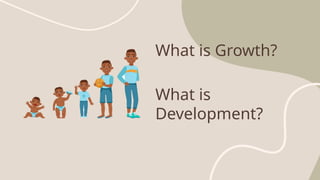
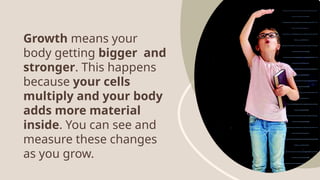
Growth means your
bodygetting bigger and
stronger. This happens
because your cells
multiply and your body
adds more material
inside. You can see and
measure these changes
as you grow.
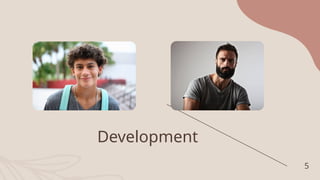
Development is theprocess of
change in living organisms as
they grow and reach a more
mature stage. It involves not only
an increase in size, but also
changes in structure and function
that make the organism more
complex and able to live
independently. Development
includes the formation and
specialization of cells, the
organization of tissues and
organs, and the improvement of
body systems so they can work
properly.
7.
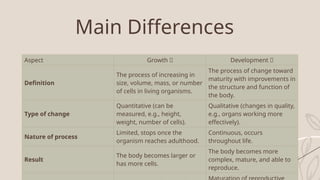
Main Differences
Aspect Growth🌱 Development 🌿
Definition
The process of increasing in
size, volume, mass, or number
of cells in living organisms.
The process of change toward
maturity with improvements in
the structure and function of
the body.
Type of change
Quantitative (can be
measured, e.g., height,
weight, number of cells).
Qualitative (changes in quality,
e.g., organs working more
effectively).
Nature of process
Limited, stops once the
organism reaches adulthood.
Continuous, occurs
throughout life.
Result
The body becomes larger or
has more cells.
The body becomes more
complex, mature, and able to
reproduce.
14
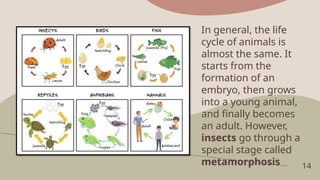
In general, thelife
cycle of animals is
almost the same. It
starts from the
formation of an
embryo, then grows
into a young animal,
and finally becomes
an adult. However,
insects go through a
special stage called
metamorphosis
15.
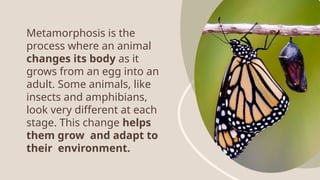
Metamorphosis is the
processwhere an animal
changes its body as it
grows from an egg into an
adult. Some animals, like
insects and amphibians,
look very different at each
stage. This change helps
them grow and adapt to
their environment.
16.
16
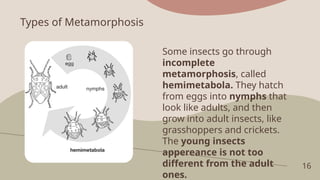
Types of Metamorphosis
Someinsects go through
incomplete
metamorphosis, called
hemimetabola. They hatch
from eggs into nymphs that
look like adults, and then
grow into adult insects, like
grasshoppers and crickets.
The young insects
appereance is not too
different from the adult
ones.
17.
17
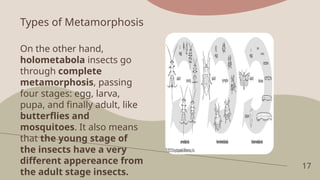
Types of Metamorphosis
Onthe other hand,
holometabola insects go
through complete
metamorphosis, passing
four stages: egg, larva,
pupa, and finally adult, like
butterflies and
mosquitoes. It also means
that the young stage of
the insects have a very
different appereance from
the adult stage insects.
20
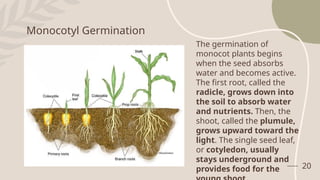
Monocotyl Germination
The germinationof
monocot plants begins
when the seed absorbs
water and becomes active.
The first root, called the
radicle, grows down into
the soil to absorb water
and nutrients. Then, the
shoot, called the plumule,
grows upward toward the
light. The single seed leaf,
or cotyledon, usually
stays underground and
provides food for the





![Polymer [ बहुलक ] Chemistry Notes PDF - Irfanullah Mehar - JJ Sir Chemistry.pdf](https://cdn.slidesharecdn.com/ss_thumbnails/polymerchemistrynotespdf-irfanullahmehar-jjsirchemistry-260210172118-3f9b37f7-thumbnail.jpg?width=640&height=640&fit=bounds)


