Why Does Mindset Matter?
Designed by GA-CTL Workgroup: Crystal Edenfield
Rhonda Porter
Deborah Walker
Joyce Weinsheimer
Lisa Yount
Learning Outcomes:
Participants will:
 Identify and apply the concepts of fixed mindset and growth mindset.
 Explore the impact of mindset on both students and faculty.
 Recognize and discuss effective classroom strategies for encouraging growth mindset.
 Build awareness of additional resources and foster an interest in topics related to mindset.
What is mindset?
Mindsets are beliefs and perceptions about learning.
Fixed vs. Growth
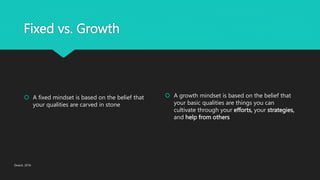
 A fixed mindset is based on the belief that
your qualities are carved in stone
 A growth mindset is based on the belief that
your basic qualities are things you can
cultivate through your efforts, your strategies,
and help from others
Dweck, 2016
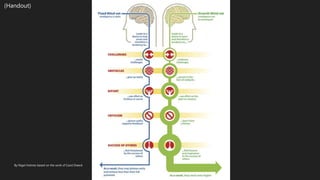
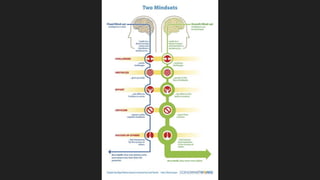
By Nigel Holmes based on the work of Carol Dweck
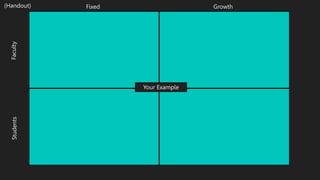
(Handout)
Faculty
Fixed Growth
Students
FEEDBACK
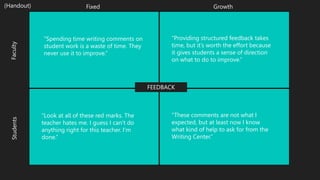
“Spending time writing comments on
student work is a waste of time. They
never use it to improve.”
“Providing structured feedback takes
time, but it’s worth the effort because
it gives students a sense of direction
on what to do to improve.”
“Look at all of these red marks. The
teacher hates me. I guess I can’t do
anything right for this teacher. I’m
done.”
“These comments are not what I
expected, but at least now I know
what kind of help to ask for from the
Writing Center.”
(Handout)
Faculty
Fixed Growth
Students
Your Example
(Handout)
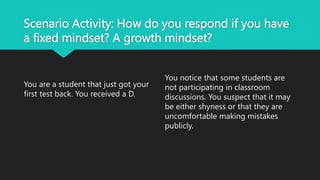
Scenario Activity: How do you respond if you have
a fixed mindset? A growth mindset?
You are a student that just got your
first test back. You received a D.
You notice that some students are
not participating in classroom
discussions. You suspect that it may
be either shyness or that they are
uncomfortable making mistakes
publicly.
Why does mindset matter?
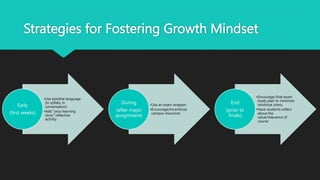
Strategies for Fostering Growth Mindset
•Use positive language
(in syllabi, in
conversation)
•Add “your learning
story” reflective
activity
Early
(first weeks)
•Use an exam wrapper
•Encourage/Incentivize
campus resources
During
(after major
assignment)
•Encourage final exam
study plan to minimize
minimize stress
•Have students reflect
about the
value/relevance of
course
End
(prior to
finals)
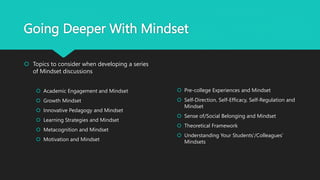
Going Deeper With Mindset
 Topics to consider when developing a series
of Mindset discussions
 Academic Engagement and Mindset
 Growth Mindset
 Innovative Pedagogy and Mindset
 Learning Strategies and Mindset
 Metacognition and Mindset
 Motivation and Mindset
 Pre-college Experiences and Mindset
 Self-Direction, Self-Efficacy, Self-Regulation and
Mindset
 Sense of/Social Belonging and Mindset
 Theoretical Framework
 Understanding Your Students’/Colleagues’
Mindsets
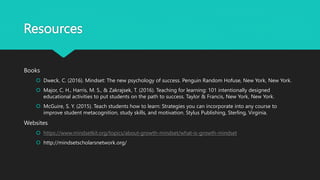
Resources
Books
 Dweck, C. (2016). Mindset: The new psychology of success. Penguin Random Hofuse, New York, New York.
 Major, C. H., Harris, M. S., & Zakrajsek, T. (2016). Teaching for learning: 101 intentionally designed
educational activities to put students on the path to success. Taylor & Francis, New York, New York.
 McGuire, S. Y. (2015). Teach students how to learn: Strategies you can incorporate into any course to
improve student metacognition, study skills, and motivation. Stylus Publishing, Sterling, Virginia.
Websites
 https://www.mindsetkit.org/topics/about-growth-mindset/what-is-growth-mindset
 http://mindsetscholarsnetwork.org/

Growth _ Mindset_Presentation_Final.pptx

  • 1.
    Why Does MindsetMatter? Designed by GA-CTL Workgroup: Crystal Edenfield Rhonda Porter Deborah Walker Joyce Weinsheimer Lisa Yount
  • 2.
    Learning Outcomes: Participants will: Identify and apply the concepts of fixed mindset and growth mindset.  Explore the impact of mindset on both students and faculty.  Recognize and discuss effective classroom strategies for encouraging growth mindset.  Build awareness of additional resources and foster an interest in topics related to mindset.
  • 3.
    What is mindset? Mindsetsare beliefs and perceptions about learning.
  • 4.
    Fixed vs. Growth A fixed mindset is based on the belief that your qualities are carved in stone  A growth mindset is based on the belief that your basic qualities are things you can cultivate through your efforts, your strategies, and help from others Dweck, 2016
  • 5.
    By Nigel Holmesbased on the work of Carol Dweck (Handout)
  • 6.
    Faculty Fixed Growth Students FEEDBACK “Spending timewriting comments on student work is a waste of time. They never use it to improve.” “Providing structured feedback takes time, but it’s worth the effort because it gives students a sense of direction on what to do to improve.” “Look at all of these red marks. The teacher hates me. I guess I can’t do anything right for this teacher. I’m done.” “These comments are not what I expected, but at least now I know what kind of help to ask for from the Writing Center.” (Handout)
  • 7.
  • 9.
    Scenario Activity: Howdo you respond if you have a fixed mindset? A growth mindset? You are a student that just got your first test back. You received a D. You notice that some students are not participating in classroom discussions. You suspect that it may be either shyness or that they are uncomfortable making mistakes publicly.
  • 10.
  • 11.
    Strategies for FosteringGrowth Mindset •Use positive language (in syllabi, in conversation) •Add “your learning story” reflective activity Early (first weeks) •Use an exam wrapper •Encourage/Incentivize campus resources During (after major assignment) •Encourage final exam study plan to minimize minimize stress •Have students reflect about the value/relevance of course End (prior to finals)
  • 12.
    Going Deeper WithMindset  Topics to consider when developing a series of Mindset discussions  Academic Engagement and Mindset  Growth Mindset  Innovative Pedagogy and Mindset  Learning Strategies and Mindset  Metacognition and Mindset  Motivation and Mindset  Pre-college Experiences and Mindset  Self-Direction, Self-Efficacy, Self-Regulation and Mindset  Sense of/Social Belonging and Mindset  Theoretical Framework  Understanding Your Students’/Colleagues’ Mindsets
  • 13.
    Resources Books  Dweck, C.(2016). Mindset: The new psychology of success. Penguin Random Hofuse, New York, New York.  Major, C. H., Harris, M. S., & Zakrajsek, T. (2016). Teaching for learning: 101 intentionally designed educational activities to put students on the path to success. Taylor & Francis, New York, New York.  McGuire, S. Y. (2015). Teach students how to learn: Strategies you can incorporate into any course to improve student metacognition, study skills, and motivation. Stylus Publishing, Sterling, Virginia. Websites  https://www.mindsetkit.org/topics/about-growth-mindset/what-is-growth-mindset  http://mindsetscholarsnetwork.org/

Editor's Notes

  • #6 Discuss infographic.
  • #7 We give example.
  • #8 1. Come up with your own example of mindset in action. Our example was feedback, but use any classroom or co-curricular example to illustrate fixed or growth mindset. ½ student/ 1/2 teacher. (5 minutes). Now discuss with a partner and categorize based on graphic. Discuss. {Think, Pair, Share}
  • #9 Discuss example. Categorize. (2 minutes). Large group
  • #11 To students To faculty
  • #12 Review this strategies worksheet, Others? Examples of positive language: “I like how you tried a new way to solve that.” “You’ve been practicing and I can see it’s paying off.” “I love mistakes because they’re an opportunity to learn – being challenged is when the brain grows most.”