The Role ofthe
Oncology Patient
Navigator
Module 4: The Basics of Patient
Navigation Oncology Patient Navigator
Training
2.
Acknowledgments
This work wassupported by Cooperative Agreement
#1U38DP004972-02 from the Centers for Disease
Control and Prevention. Its contents are solely the
responsibility of the authors and do not necessarily
represent the official views of the Centers for Disease
Control and Prevention.
Portions of this lesson are adapted from the Patient
Navigator Training Collaborative of the Colorado
School of Public Health.
3.
Competencies
5.4 Demonstrate responsivenessto patient
needs within scope of practice and
professional boundaries
6.1 Support a smooth transition of patients
across screening, diagnosis, active
treatment, survivorship and/or end-of-life
care, working with the patient’s clinical team
4.
Learning Objectives
• Describethe role of the patient navigator
• Compare and contrast roles across patient
navigator types
5.
Navigator Functions
Professional Rolesand Responsibilities
Barriers to Care/ Health Disparities
Patient Empowerment
Communication
Community Resources
Education, Prevention and Health Promotion
Ethics and Professional Conduct
Cultural Competency
Outreach
Care Coordination
Psychosocial Support Services/ Assessment
Advocacy
Willis et al., 2013
6.
Professional Roles andResponsibilities
Community
(Community Health Worker)
Community/Health Care
Institution
(Patient Navigator)
Health Care Institution
(Nurse Navigator/
Social Work Navigator)
General knowledge base on health
issues such as diabetes, obesity,
heart disease, stroke, HIV/AIDS
and other chronic diseases.
Active documentation in client
record.
Conduct evaluation focused on
community needs assessment and
health behaviors.
Knowledge of cancer screening,
diagnosis, treatment, and
survivorship and related physical,
psychological, and social issues.
Active documentation of encounter
with patient, barriers to care, and
resources or referrals to resolve
barriers, which may be noted in the
client record and/or the medical
record.
Conduct evaluation focused on
barriers to care, health disparities
and quality indicators.
Knowledge and maintenance of
knowledge (e.g., license
certification, continuing education)
of cancer clinical impacts on
patient, caregivers and families and
ability to intervene (e.g., symptom
management, assessment of
functional status and psychosocial
health).
Active documentation in medical
record.
Conduct evaluation focused on
clinical outcomes and quality
indicators.
Willis et al., 2013
7.
Barriers to Care/HealthDisparities
Community
(Community Health Worker)
Community/Health Care
Institution
(Patient Navigator)
Health Care Institution
(Nurse Navigator/
Social Work Navigator)
Address barriers to accessing
the health care system.
Focus on reduction of general
health disparities.
Address structural, cultural,
social, emotional and
administrative barriers to care.
Focus on reduction of cancer
health disparities in medically
underserved patients and
timely access to care across
the continuum.
Address clinical and service
delivery barriers to care.
Provision of services to at-risk
populations, which may be
defined by individual need,
high acuity or high volume at
institutional level.
Willis et al., 2013
8.
Community Resources
Community
(Community HealthWorker)
Community/Health Care
Institution
(Patient Navigator)
Health Care Institution
(Nurse Navigator/
Social Work Navigator)
Provide referral to evidence-based
health promotion programs.
Provide assistance accessing
health insurance.
Provide assistance with scheduling
appointments and facilitate request
and follow-up with specialists or
supportive care based on clinical
referral.
Provide assistance accessing
health insurance, copay programs
and financial assistance.
Focus on clinically oriented
resources, such as referrals for
second opinions, treatment or
testing that may not be offered at
the patient’s institution, as well as
supportive or specialty referrals
within or external to the institution
(Nurse Navigators).
Provide assistance in identifying
community resources to access
psychosocial support throughout
treatment (Social Work Navigators).
Willis et al., 2013
9.
Patient Empowerment
Community
(Community HealthWorker)
Community/Health Care
Institution
(Patient Navigator)
Health Care Institution (Nurse
Navigator/
Social Work Navigator)
Motivate individual and community to
make positive changes in health
behaviors.
Activate and empower individuals and
communities to self-advocate and make
healthy decisions.
Assist patient with identifying
administrative, structural, social and
practical issues to participate in decision-
making and solutions.
Empower patients by ensuring they know
all their options: identify their preferences
and priorities, and assist them to access
healthcare services and self-manage their
health.
Educate patients on their rights and
preferences and ensure they are able to
participate in the decision-making process
throughout their care and into
survivorship or end-of-life care. Work in
collaboration with licensed team
members.
Assist patients in decision-making
regarding diagnostic testing and
treatment options (Nurse Navigators).
Provide patients with strategies to cope
with disease, treatment and stress (Social
Work Navigators).
Educate patients on their rights and
preferences and ensure they are able to
participate in the decision-making process
throughout their care and into
survivorship or end-of-life care.
Willis et al., 2013
10.
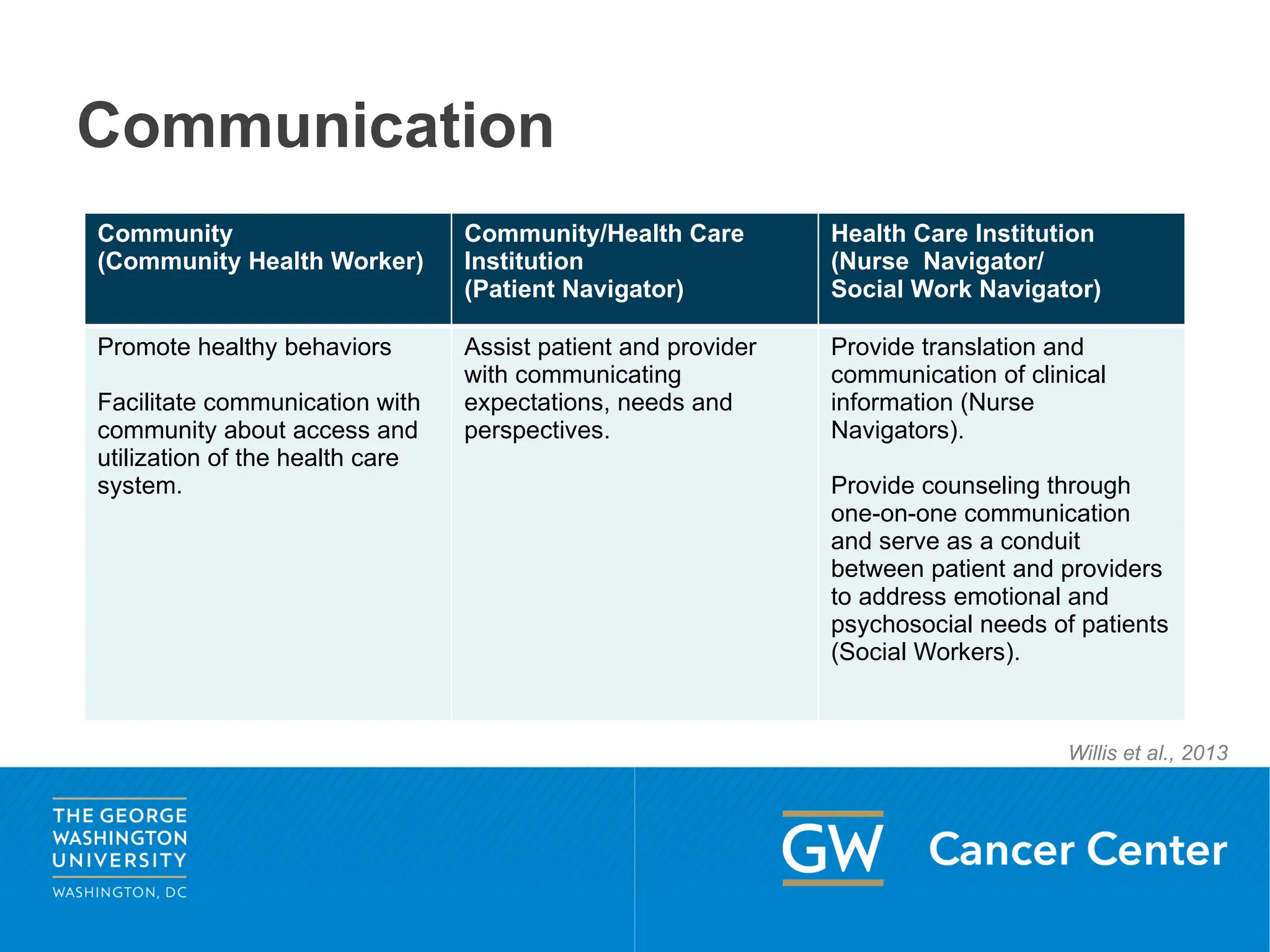
Communication
Community
(Community Health Worker)
Community/HealthCare
Institution
(Patient Navigator)
Health Care Institution
(Nurse Navigator/
Social Work Navigator)
Promote healthy behaviors
Facilitate communication with
community about access and
utilization of the health care
system.
Assist patient and provider
with communicating
expectations, needs and
perspectives.
Provide translation and
communication of clinical
information (Nurse
Navigators).
Provide counseling through
one-on-one communication
and serve as a conduit
between patient and providers
to address emotional and
psychosocial needs of patients
(Social Workers).
Willis et al., 2013
11.
Education, Prevention andHealth
Promotion
Community
(Community Health Worker)
Community/Health Care
Institution
(Patient Navigator)
Health Care Institution
(Nurse Navigator/
Social Work Navigator)
Provide general health promotion at
the individual and community level
including:
physical activity
healthy eating habits
stress reduction
sunscreen use
tobacco cessation
reduction of other risky behaviors
Educate patients on practical
concerns and next steps in
treatment with regard to what to
expect.
Identify the educational needs of
patients to advocate on their behalf
with the care team.
Inform patients of the importance
and benefit of clinical trials and
connect them with additional
resources.
Assess educational needs of
patient.
Identify the educational needs of
patients to advocate on their behalf
with the care team.
Inform patients of the importance
and benefit of clinical trials and
connect them with additional
resources.
Provide clinical education (Nurse
Navigators).
Willis et al., 2013
12.
Ethics and ProfessionalConduct
Community
(Community Health Worker)
Community/Health Care
Institution
(Patient Navigator)
Health Care Institution
(Nurse Navigator/
Social Work Navigator)
Abide by state-defined
scope of practice
Understand differences in
scope of practice between
licensed professionals and
non-licensed professionals
Abide by the ethical
principals in the
profession’s scope of
practices and code of
conduct according to
licensure
Willis et al., 2013
13.
Cultural Competency
Community
(Community HealthWorker)
Community/Health Care
Institution
(Patient Navigator)
Health Care Institution
(Nurse Navigator/
Social Work Navigator)
Act as community/cultural
liaison and mediator between
community and healthcare
system using culturally
appropriate educational
materials.
Provide navigation services in
a culturally competent manner
(e.g., National Culturally and
Linguistically Appropriate
Services [CLAS] Standards in
Health and Health Care).
Educate providers to increase
their understanding of
community’s history, culture
and needs.
Provide clinical care and
education materials in culturally
competent manner.
Willis et al., 2013
14.
Outreach
Community
(Community Health Worker)
Community/Health Care
Institution (Patient
Navigator)
Healthcare Institution
(Nurse Navigator/
Social Work Navigator)
Work with the community to
identify education needs and
opportunities.
Educate on cancer-related
topics to reduce fears and
barriers related to cancer
screening.
Effectively link patients
referred from the community to
resources that can improve
care coordination and
timeliness to treatment.
Consult and counsel patients
on their unique risks.
Willis et al., 2013; Johns Hopkins School of Nursing,
n.d.; Community Toolbox, 2014
15.
Checkpoint
• Mary isa patient navigator in urology. The
urologist who works with Mary is very busy.
He has a patient who has a lot of questions
and does not seem to understand what the
doctor is telling him. The urologist asked Mary
to explain to the patient that he has prostate
cancer and what his treatment options are.
• What should Mary do?
16.
Care Coordination
Community
(Community HealthWorker)
Community/ Health Care
Institution (Patient Navigator)
Healthcare Institution
(Nurse Navigator/
Social Work Navigator)
Provide case management,
service coordination, and
system navigation.
Assist with access to care or
transition from community
organization to health system.
Identify the pathway in the
continuum and document the
next steps to ensure the
patient’s optimal outcomes.
Identify unmet needs and
facilitate cancer care resources
to eliminate barriers along the
cancer continuum.
Assess and facilitate
coordination of psychosocial
and medical/clinical care along
the care continuum.
Willis et al., 2013; Agency for Healthcare
Research and Quality, 2014
17.
Psychosocial Support Services/
Assessment
HealthcareInstitution
(Nurse Navigator/
Social Work Navigator)
Assess educational needs of patient.
Identify the educational needs of patients to advocate on their
behalf with the care team.
Inform patients of the importance and benefit of clinical trials
and connect them with additional resources.
Provide clinical education (Nurse Navigators).
Educate patients and caregivers on their biopsychosocial
concerns regarding their diagnosis and treatment (Social Work
Navigators).
Community
(Community Health
Worker)
Community/ Health
Care Institution
(Patient Navigator)
Identify resources in the
community for
emotional and social
support.
Administer distress
screening and provide
assistance with
administrative, practical
or social issues
identified.
Willis et al., 2013
18.
Checkpoint
• Brenda isa patient navigator in radiology. A patient
comes into her office and starts crying, telling
Brenda that she was just diagnosed with breast
cancer. Brenda tells the patient "I am so sorry for
your news. We are all here to support you and will
be with you every step of the way." The patient tells
Brenda she is scared of going home because she
does not want to tell her children.
• What should Brenda do?
19.
Advocacy
Community
(Community Health Worker)
Community/Health Care
Institution (Patient Navigator)
Healthcare Institution
(Nurse Navigator/
Social Work Navigator)
Speak up for individual and
community needs.
Educate providers on individual
preferences of care and needs.
Assure patients’ needs and
preferences are integrated into
treatment and care delivery.
Willis et al., 2013
20.
Navigation Based onthe Cancer Care
Continuum
Primary
Prevention
Screening/
Early Detection
Treatment Survivorship
Focus on healthy
lifestyle/ disease
prevention
Remove barriers to
screening and
diagnosis
Education, support,
assist with care
coordination,
resource referrals
Referrals for wellness/
nutrition, education, support
groups and other services
Hopkins & Mumber, 2009
21.
What are Barriersto Care?
Practical Personal Provider
Psychosocial Systems
Other Tasks
• Chartingto track navigation activities
• Supporting research through
administrative duties
• Filing papers
• Collaborating with Nurse Navigators (If
applicable)
33.
Navigation Network Duties
Patientinteractions
Provider interactions
Non-clinical staff
Supportive services
Paper or Electronic Medical Records
34.
A Day inthe Life of a Navigator
Case 1
• Call from patient who has
surgery in 2 days. Patient
would like to speak with
anesthesiologist about nerve
block. Patient also needs
information about
bras/garments she should
wear after surgery.
• ACTION: Mail patient
information on camisole
Case 2
• Newly diagnosed patient (68
year old, came alone).
• ACTION: Complete
distress screening, assess
barriers to care, help
patient identify support;
next step: BSG (refer to
nurse to explain
procedure).
Case 3
• Patient currently finishing
chemo, needs PET/CT. Has
questions about survivorship
clinic. Needs emotional
support referrals.
• ACTION: Assist patient
with scheduling procedure;
discuss survivorship;
assess patient for
emotional distress and
refer to appropriate
resource
35.
A Day inthe Life of a Navigator
Case 4
• Patient has concerns about 6
month follow-up screening
plan given to her by doctor.
She is supposed to have a
mammogram, but one of her
cancers was not visible on
mammography.
• ACTION: Ask physician to
clarify screening plan with
patient: supply patient with
correct order if needed and
tell her how to schedule
procedure(s).
Case 5
• Patient calls with questions
about radiation (has not been
in for her consult yet).
• ACTION: Assist patient
with scheduling
appointment and give
general information.
Case 6
• Newly diagnosed patient
(mid-30s, has young
children) comes in for first
appointment.
• ACTION: Complete
distress screening, assess
barriers to care, help
identify support; assist in
finding oncologist close to
patient’s home; give basic
information about breast
cancer and chemotherapy;
refer to nurse to explain
Mediport and tests needed
before starting treatment.
36.
A Day inthe Life of a Navigator
Case 7
• Advanced stage patient
experiencing pain and
concerned about maintaining
quality of life in end stages of
disease.
• ACTION: Refer to Social
Worker and Nurse who
refers to pain clinic.
Case 8
• Patient beginning chemo
needs her doctor to speak
with surgeon ASAP regarding
recommendations. Other
doctor is going on vacation
tomorrow.
• ACTION: Get doctor’s
direct phone number, track
down surgeon, ask her to
call doctor.
Case 9
• Patient applying for disability
and Medicaid, needs referral
to infectious disease,
psychiatry. Needs PET/CT.
• ACTION: Fax MER form to
PCP’s office; task
infectious disease
administrative staff to call
patient with appointment
time; give patient number
to schedule PET/CT;
follow-up on psychiatry
referral.
37.
A Day inthe Life of a Navigator
Case 10
• Patient planning mastectomy
surgery, would like to speak
with former patient who had
the same procedure.
• ACTION: Work with
surgeon to identify former
patient; contact former
patient and ask if she
would like to participate:
contact current patient
former patient’s contact
info.
Case 11
• Patient needs documentation
for employer regarding her
ability to work.
• ACTION: Create letter from
surgeon to patient’s
employer; get letter signed
& fax letter to patient’s
employer; scan letter to
EMR.
Case 12
• Patient lives far away and
would like a consult with
radiation on the same day as
her appointment with
surgeon.
• ACTION: Assist patient
with scheduling
appointment; call patient
back with info.
38.
A Day inthe Life of a Navigator
Case 13
• Referral from medical oncologist for patient
to see dietitian.
• ACTION: Call patient and set up time to
meet with dietitian; add patient to
dietitian’s schedule.
Case 14
• Patient needs appointment with physical
therapist.
• ACTION: Discuss role of rehabilitation
clinic; schedule patient appointments.
Conclusion
• Describe therole of the Patient Navigator
• Compare and contrast roles across Patient
Navigator types
41.
References
• Agency forHealthcare Research and Quality. (2014). Care coordination measures atlas: Chapter
2: What is care coordination. 2014.
http://www.ahrq.gov/professionals/prevention chronic care/improve/coordination/atlas2014/
‐ ‐
chapter2.html.
• Bone, L. R., Edington, K., Rosenberg, J., Wenzel, J., Garza, M. A., Klein, C., Schmitt, L., & Ford,
J. G. (2013). Building a navigation system to reduce cancer disparities among urban black older
adults. Progress in Community Health Partnerships, 7(2):209 218. doi: 10.1353/cpr.2013.0018.
‐
• Community Toolbox. (2014). Chapter 23: Modifying access, barriers, and opportunities. Section
6: Using Outreach to Increase Access. http://ctb.ku.edu/en/table of contents/implement/access
‐ ‐ ‐
barriers opportunities/outreach to increase access/main.
‐ ‐ ‐ ‐
• Fiore, M. C., Bailey, W. C., Cohen, S. J., et al. (2000). Treating tobacco use and dependence.
Clinical Practice Guideline. Rockville, MD: U.S. Department of Health and Human Services.
Public Health Service.
• Hopkins, J., & Mumber, M. P. (2009). Patient navigation through the cancer care continuum: An
overview. Journal of Oncology Practice, 5(4):150 152. doi: 10.1200/JOP.0943501.
‐
42.
References (Cont.)
• JohnsHopkins School of Nursing. (n.d.). Community outreach program.
http://nursing.jhu.edu/excellence/community/outreach.html.
• National Cancer Institute. (2008). Cancer health disparities fact sheet.
http://www.cancer.gov/aboutnci/organization/crchd/cancer health disparities fact sheet.
‐ ‐ ‐ ‐
• Parker, V. A., Clark, J. A., Leyson, J., Calhoun, E., Carroll, J. K., Freund, K. M., & Battaglia, T. A.
(2010). Patient navigation: Development of a protocol for describing what navigators do. Health
Services Research, 45(2):514 531. doi: 10.1111/j.1475 6773.2009.01079.x.
‐ ‐
• Patient Navigator Training Collaborative. (n.d.). http://patientnavigatortraining.org/.
• The Office of Minority Health. (2013). What is cultural competency.
http://minorityhealth.hhs.gov/omh/browse.aspx?lvl=1&lvlid=6.
• Willis, A., Reed, E., Pratt Chapman, M., Kapp, H., Hatcher, E., Vaitones, V., Bires, J., Collins, S.,
‐
& Washington, E-C. (2013). Development of a framework for patient navigation: Delineating roles
across navigator types. Journal of Oncology Navigation & Survivorship, 4(6):20 26. Retrieved
‐
April 15, 2021, from https://www.jons-online.com/issues/2013/december-2013-vol-4-no-6/1249-
development-of-a-framework-for-patient-navigation-delineating-roles-across-navigator-types.
43.
Thank you!
Follow uson Twitter: @GWCancer
www.gwcancercenter.org
Sign-up for the GW Cancer Center’s Patient Navigation
and Survivorship E-Newsletter: bit.ly/PNSurvEnews
Sign-up for the GW Cancer Center’s Cancer Control
Technical Assistance E-Newsletter: bit.ly/TAPenews
Editor's Notes
#2 We would like to acknowledge the Centers for Disease Control and Prevention for supporting this work.
We would also like to thank the Patient Navigator Training Collaborative of the Colorado School of Public Health for generously sharing materials from their in-person training, which we have adapted for this online training.
#3 This lesson covers the following Core Competencies for Patient Navigators:
5.4 Demonstrate responsiveness to patient needs within scope of practice and professional boundaries
6.1 Support a smooth transition of patients across screening, diagnosis, active treatment, survivorship and/or end-of-life care, working with the patient’s clinical team
#4 After completing this section of the lesson, you will be able to:
Describe the role of the patient navigator
Compare and contrast roles across patient navigator types
#5 There are many functions that you may have as a patient navigator. Here are the main functions that have been identified. We will walk through each one now, highlighting how the functions of a navigator are similar to and different from community health workers, nurse navigators or social workers.
#6 Professional Roles and Responsibilities is the first functional area you saw highlighted on the previous slide. This refers to the knowledge and skills needed to do job-related duties and tasks, including understanding scope of practice, supporting evaluation efforts and identifying and exercising self-care strategies. It also includes organizational skills, office skills, interpersonal skills, time management, problem solving, multitasking and critical thinking.
It is important for all health care professionals to understand and remain within their scope of practice. This means that there are some things you can do as a navigator and other things that you should not do, because clinical training or other training is required. Remaining within your scope of practice protects you and the patient. It also protects the institution, since there may be liability risks if you perform duties that someone with a clinical license is required to perform. We will talk more about scope of practice in module six.
Here you see a summary of knowledge and roles for community health workers, patient navigators and clinically-licensed navigators such as nurse navigators or social workers. Each of these navigator types needs a general knowledge of health issues, but community health workers might have a broader knowledge base while patient navigators have knowledge more focused on a specific disease—like cancer. Nurse navigators need knowledge of clinical impacts of the disease and treatments, including symptom management. Social workers need to know potential psychosocial impacts of the disease on patients. Psychosocial means emotional and social issues that impact a patient such as financial concerns that cause stress or family issues that increase anxiety. Nurse navigators and social workers also must have a clinical license that means they are allowed to do clinical duties.
All of these navigator types should document their encounters with patients.
#7 The core function that all navigators have in common is addressing barriers to care to reduce health disparities.
Barriers to care and/or health disparities refers to identifying and addressing barriers to care and reducing health disparities as defined by age, disability, education, ethnicity, gender, sexual identification, geographic location, income, or race and populations that often bear a greater burden of disease than the general population.
We talked in greater detail about health disparities in module 2.
Community health workers might address barriers to accessing the health care system and focus on reducing health disparities in general. Patient navigators address structural, cultural, social, emotional, and administrative barriers to care. They focus on reducing health disparities in cancer for medically underserved patients and helping patients get timely access to care across the continuum.
Nurse and Social Work navigators address clinical and service delivery barriers to care. They make certain at-risk populations, which may be defined by individual need, how much care patients need based on their sickness, or high volume, get the care they need.
#8 To address barriers to care, another important duty of a patient navigator is to find helpful resources and refer patients and caregivers to those resources. This might include referral to individuals--like a social worker or counselor--or to organizations—like the American Cancer Society or the Cancer Support Community. Patient navigators also connect patients to services in their local community. These might include social services, exercise classes, support groups or other programs.
While community health workers provide referrals to evidence-based health promotion programs and assistance accessing health insurance, patient navigators may help with requests and follow-ups with specialists or supportive care based on a clinical referral. Sometimes navigators help with scheduling for these follow up appointments, but often this is the role of administrative staff. They might also provide assistance accessing health insurance, copay programs, patient assistance programs and financial assistance.
Nurse Navigators and social work navigators focus on clinically-oriented resources, such as referrals for second opinions, treatment or testing that may not be offered where the patient gets care. Nurse navigators may refer patients to supportive care or specialty referrals within or outside of the institution. Social workers can help identify community resources for psychosocial support throughout treatment.
#9 Navigators also support empowered patients, which means that they help patients identify problems and resources to solve problems and help them be part of the decision-making process. Good patient rapport is essential for this, which we will talk more about in module 5.
Community health workers motivate individuals and the community to make positive changes in health behaviors. They activate and empower individuals and communities to self-advocate and make healthy decisions.
Patient navigators help patients identify administrative, structural, social, and practical issues so they can better participate in decision-making and solutions. They empower patients by making sure they know all their options; helping patients identify their preferences and priorities; and helping patients to get healthcare services and self-manage their health. Patient navigators also educate patients on their rights and preferences and make sure they are able to participate in the decision-making process throughout their care and into survivorship or end-of-life.
Nurse navigators help patients in decision-making for diagnostic testing and treatment options. Social workers help patients with strategies to cope with disease, treatment and stress.
#10 All navigator types must have strong communication skills. Navigators communicate with a many different types of individuals, including patients and caregivers, health care colleagues and external health- and social-service organizations.
The primary focus of community health worker communication is around promoting healthy behaviors and helping communities access and use healthcare services. Community health workers might also help patients with self-management or the things they can manage on their own without going to a hospital or doctor’s office.
Patient navigators help the patient and their health care provider clearly communicate expectations, needs and perspectives.
Nurse navigators provide clinical education and social workers counsel patients and help them find ways to manage their emotional and psychosocial needs.
#11 Navigators are part of the multidisciplinary team that provides education. This includes educating patients on how to live as healthy as possible and how to reduce risks of cancer being diagnosed or recurring.
A community health worker can provide broad and general health promotion information to individuals within specific communities. One of the key strengths of community health workers is knowledge OF the community. This can help community health workers know best how to motivate community members to increase physical activity, eat healthfully, reduce stress and adopt health-promoting behaviors like regularly using sunscreen and not smoking.
Patient navigators educate patients on practical concerns and what to expect from their health care team and the health care system. Patient navigators might generally explain to patients the steps of the treatment process, leaving clinical education to nurses and doctors. Patient navigators can identify the educational needs of patients to encourage them to voice concerns with their care team. Sometimes the patient navigator advocates directly on the behalf of patients to the care team. Patient navigators can also provide important information to patients on the importance and benefit of clinical trials and connect them with additional resources to assess whether a clinical trial is right for them.
Nurse navigators provide clinical education about diagnosis, treatment, side effects and post-treatment care. Social work navigators educate patients and caregivers on their biopsychosocial concerns regarding their diagnosis and treatment.
#12 Working with patients is a special privilege. All members of the health care team are expected to act ethically and professionally. For patient navigators, this means understanding their scope of practice and understanding professional boundaries—in other words what they can and should be doing for patients and when they should refer to another team member for help. Ethical behavior also means always maintaining the confidentiality of patients and following legal requirements. By behaving ethically and professionally, patients and colleagues will trust you and you will show that you are reliable.
Community health workers must follow a state-defined scope of practice.
Nurse navigators and social workers must follow the ethical principles in their profession’s scope of practice and code of conduct according to their licensure.
#13 Cultural Competency refers to health care services that recognize, respect and respond to cultural and social differences related to beliefs, practices, behaviors and needs of diverse community and/or population served. No one can be an expert on every ethnic, racial or religious group. We all have biases and we will discuss how to identify your own biases in module 5. But even though we cannot know every culture well, we can continually learn to increase our cultural sensitivity and respect patient preferences for their care.
Community health workers serve as liaisons and mediators between the community and health care system. They often come from the community they serve and best understand how to educate that community based on the routines, beliefs and priorities of that community. As a patient navigator it is your responsibility to provide services in a culturally competent manner.
We will talk in module 5 about the National Culturally and Linguistically Appropriate Services Standards in Health and Health Care and other resources and tools. Patient navigators also educate health care providers about a particular community's history, culture, and needs which may impact patient care preferences and decisions. Nurse navigators and social workers like all members of the health care team also should provide clinical services in a culturally sensitive manner.
#14 Outreach means giving healthcare education to individuals and communities to address health disparities. This might mean going out into the community – particularly if you are a community health worker. Or this might mean reaching out to patients in the clinical setting to identify education needs and opportunities. Patient navigators can educate on broad cancer-related topics, like the basic cancer information you learned about in the last module. Navigators can help to reduce fears and barriers related to cancer screening. They also link patients referred from the community to resources that can improve care coordination and timeliness to treatment.
Nurse navigators and social workers are licensed to counsel patients on their unique risks—nurses educate patients on physical risks while social workers focus on psychosocial risks, like the risk of becoming depressed, for example. Educating patients on cancer related topics can be tricky, so let's pause for a minute for a check point.
#15 Mary is a patient navigator in urology. The urologist who works with Mary is very busy. He has a patient who has a lot of questions and does not seem to understand what the doctor is telling him. The urologist asked Mary to explain to the patient that he has prostate cancer and what his treatment options are. What should Mary do?
A: take the patient into her office and explain the cancer diagnosis to the patient;
B: tell the doctor that this is not within her scope of practice and offered to ask someone on the clinical team to speak with the patient;
C: give the patient a pamphlet about prostate cancer and suggest that they read it and ask the doctor questions during the next appointment;
D: send the patient home without any additional information.
The correct answer is B: educating patients about their diagnosis and treatment options is not within Mary's scope of practice. It can be very difficult but Mary can maintain the integrity of her profession and protect the patient and the institution by telling the doctor that she cannot do what he has asked. The patient is the priority, so it is important that he speaks with someone who was clinically licensed to make sure he understands his diagnosis and treatment options. If the urologist must see another patient and truly does not have time to talk more with the patient, Mary can help by offering to ask if another member of the clinical care team such as a nurse, a nurse educator, a nurse navigator, or a nurse practitioner can help by answering the patient's questions.
#16 Care Coordination means organizing patient care activities to help make sure the patient gets the appropriate delivery of healthcare services.
Community health workers, patient navigators, social workers and nurse navigators all help coordinate care. So do front-desk staff and doctors! Community health workers can provide case management, service coordination and system navigation. Community health workers can also help with access to care issues or with the transition from community organizations to the health system. Patient navigators help patients get to the next step in the cancer continuum by reinforcing the recommendations of the clinical care team. Navigators identify unmet needs and facilitate cancer care resources to address barriers along the cancer continuum. Nurse navigators assess and help with coordination of medical/clinical care, and social workers are the key point of contact for psychosocial care of patients along the care continuum.
#17 Psychosocial Support Services/Assessment means providing and/or connecting patients to resources for psychosocial support services like mental health counseling, group support or education.
This is another tricky function for navigators. Community health workers and patient navigators can identify resources in the community for emotional and social support. Patient navigators might help with screening patients for distress by using a tool like the NCCN Distress Thermometer and provide assistance with administrative, practical or social issues identified. Social workers and nurse navigators can also screen and assess for psychosocial distress.
Nurse navigators can refer patients to social work or psychosocial treatment as needed.
Social workers are the only one of these navigator types who is licensed to provide counseling services to a patient.
#18 Let's pause and think about a patient scenario. Brenda is a patient navigator in radiology. A patient comes into her office and starts crying, telling Brenda that she was just diagnosed with breast cancer. Brenda tells the patient "I am so sorry for your news. We are all here to support you and will be with you every step of the way." The patient tells Brenda she is scared of going home because she does not want to tell her children.
What should Brenda do?
A: Brenda should reassure the patient that she will be okay and that she does not have to tell her children;
B: Brenda should tell the patient that she should talk to the nurse about her concerns;
C: Brenda should call the oncology social worker and ask her for help;
D: Brenda should called the Cancer Care hotline and let the patient speak to a social worker on the telephone.
The best option for Brenda and the patient is option C. If a social worker is available at the Cancer Center, this patient should be connected with the social worker immediately before she goes home. If there is no social worker available, Brenda could also call an external organization like Cancer Care or the Cancer Support Community. The important thing is to make sure that someone licensed to counsel patients through emotional concerns helps Brenda's patient before she goes home.
#19 The last functional area is advocacy. This means advocating on behalf of the patient within the community and health care system.
Community health workers advocate by speaking up for individual and community needs. Patient navigators educate providers on individual preferences of care and needs. Nurse navigators and social workers make sure patients’ needs and preferences are included treatment and care delivery.
#20 Your job duties as a patient navigator may also depend on whether you navigate patients at one stage or various stages of the cancer care continuum.
Navigators working in primary prevention focus on the adoption of healthy lifestyle choices and disease prevention.
At the screening and early detection stage, navigators address barriers to accessing screening and timely diagnosis. They may also make sure patients are connected to oncologists to provide necessary treatment.
Navigators who support patients undergoing treatment can provide education, support, coordination of multi-disciplinary care with the help of other members of the care team, and resource referrals. Remember that it is not your role to refer patients to other clinical providers—those recommendations come from a doctor or nurse. But you may help arrange appointments or facilitate timely scheduling to make sure patients receive an appointment with the clinician that the doctor or nurse recommends.
For patients in survivorship, navigators provide referrals for wellness or nutrition, stress management, education, survivorship care plans, support groups, retreats and other services.
Depending on the size of your institution and the number of patients coming through your cancer center, you may be responsible for only one part of the cancer continuum or you may navigate patients across the full cancer care continuum.
Finally, although specific activities may differ across the cancer continuum, all patient navigators focus on removing barriers to care
#21 As discussed in the previous lesson, the main role that all patient navigators have in common is addressing barriers to care. The patient navigator helps patients identify and overcome potential challenges to getting the needed medical care. Sometimes the navigator directly removes barriers for patients, but oftentimes the navigator helps the patients remove barriers themselves.
#22 Practical barriers may be related to a patient’s environment or daily activities. For example:
Treatment costs, including copays, coinsurance and deductibles, may be too high
A patient may not have reliable transportation or money to use public transportation
Language barriers may prevent patients from really understanding their diagnosis or treatment plan
Patients may have work difficulties, such as problems getting time off from work to go to appointments or difficulty keeping a job if they spend the time out of the office for necessary medical care
They might not have access to food
Insurance problems are common. Patients may not have insurance, the insurance they have may not cover what they need or they may have a problem with a claim. Navigators can be very helpful in getting claims paid that are initially denied by the insurance company.
Some patients may not have stable housing
And immigration status may be a barrier that prevents some patients from getting screening or care
#23 Personal barriers are another type of barrier that a patient may experience. These obstacles may arise from a patients’ emotions, values, beliefs and/or culture. They include:
Lack of knowledge about health and health care
Mistrust of providers
Low priority placed on health, and
Belief in health myths. For example, some communities believe that hospitals are places where people die and avoid getting necessary care. If a large number of individuals do not go to the hospital at the earliest presence of symptoms for their cancer because of this myth, when they do go to the hospital with advanced cancer, they have less chance of survival. This may reinforce the myth that hospitals are places where people die.
#24 System barriers can result from inefficiencies within the healthcare setting. Some examples of these types of barriers are:
Lack of interpreters
Long wait times
Lack of appropriate providers
Inconvenient appointment times
#25 Some barriers stem from providers and may lead to poor communication between the patient and the care team. Such barriers may included:
Biases in medical recommendations, such as offering clinical trials to more white patients than minority patients
Poor communication with patients with low-literacy
Poor communication with limited English-proficient patients
Cultural dissonance, which is discomfort from differences between cultural expectations and reality, such as when someone from a culture that uses traditional healers feels uncomfortable at an institution that does not mention healers as part of treatment
#26 Psychosocial barriers also exist. Some patients may experience
Anxiety and depression
Changes in relationships and roles in family
Family and social support challenges, such as divorce or lack of support
Stigma, fear and social isolation or
Mental health challenges
#27 Another way of thinking about your duties as a navigator is to think about what actions you take to help patients, or “tasks”, and what ways you interact with others to eventually complete those, or how you “network”.
#28 Navigator tasks can be categorized as navigating, facilitating, maintaining systems, documenting activities, and receiving information or other. Let's walk through each one.
#29 Your navigating tasks are those that specifically involve identifying and addressing barriers with patients. Such tasks may include explaining, like explaining health insurance. You will ask questions, such as “what barriers make it difficult to attend appointments or adhere to the treatment plan?” Navigators engage in active listening. This means you should listen attentively to the patient as they discuss their fears or goals. Finally, navigators coach the patient to be involved in their treatment and decision making. A form of coaching is when you discuss questions with patients to help them prepare for appointments.
#30 The next category of tasks, facilitating tasks, encompass activities completed for the patient. These include:
Finding patients who need navigation to follow up and ensure they are adhering to treatment, and finding those lost to treatment
Coordinating team communication by updating members of the health care team on patient concerns
Integrating information through documentation and sharing with team, and
Collaborating by referring patients to appropriate members of the health care team to address their needs and concerns.
#31 Maintaining systems are tasks that you complete that benefit all of the patients you assist. These include:
Identifying potential patients who can benefit from navigation services
Building networks and referral routines, which includes helping clinicians understand the navigator role and criteria for referral and
Reviewing cases
#32 Documenting navigation activities and receiving information is the fourth navigating task. Depending on your institution, this may include:
Charting to track navigation activities in the patient’s record or navigation software or tools.
We will talk more about this in module 7.
The “other” category includes tasks that may not be directly related to navigating a patient, but may be important in supporting your organization. Examples could be
administrative duties to support research, such as collecting informed consent forms
helping to file papers or
supporting Nurse Navigators
These duties can vary based on your skill, background and the needs of your organization.
#33 Network duties of navigators include:
Your patient interactions, or your communications with patients. These can be face-to-face or by phone call.
You will also interact with health care providers. You will need to communicate patient concerns with the health care team and establish procedures for referrals.
Your network activities will extend to non-clinical staff as well, such as receptionists or administrators. You may work with these professionals to facilitate financial paperwork or to schedule appointments.
To further address patient barriers, you may need to connect with formal support services such as social workers, certified medical interpreters or transportation staff, or with informal support sources like family or friends.
Finally, although documenting navigation activities has been covered as a navigator task, it is important to know that you also interact with paper or electronic medical records. You may need to consult these documents before determining the best course of action.
#34 Patient Navigator duties vary by institution and by patient population. Let’s look at one day in the life of Erika, a Patient Navigator that works with breast cancer patients before and after surgery.
Erika does a variety of activities every day. Let’s look at a few.
#35 Here are some more encounters with patients that may come up the same day. Notice that for clinical questions, Erika refers to a physician or nurse.
#37 Here you can see the navigator is critical and making sure that patients get timely care for making a connection between physicians before one of them goes on vacation, so following up on necessary referrals and helping patients understand how to schedule appointments.
#38 The Navigator can also help connect patients to those who have gone through what they are about to go through with the permission of both patients of course.
#39 So how do you know what to do as a patient navigator? This framework – called the 5 A’s can help you. The 5 A’s is a model developed by the National Cancer Institute to help people quit smoking. But you can use it for navigating patients, too. We’ll introduce the As now and walk through them in the next lesson. We’ve included them here because they are core strategies for patient navigators to best help patients.
Ask – Ask the patient questions so you can understand what challenges they are facing and their perceptions
Assess – Assess the patient’s needs, goals and abilities
Advise – Advise the patient on developing a plan
Assist – Assist patients in removing barriers and implementing the plan and
Arrange – Arrange to follow up with the patient
#40 In this lesson you learned to:
Describe the role of the patient navigator
Compare and contrast roles across patient navigator types
In the resources section you will see an example of a patient navigator job description. Feel free to use or refer to that when creating job descriptions at your own institution.




![Cultural Competency
Community
(Community Health Worker)
Community/Health Care
Institution
(Patient Navigator)
Health Care Institution
(Nurse Navigator/
Social Work Navigator)
Act as community/cultural
liaison and mediator between
community and healthcare
system using culturally
appropriate educational
materials.
Provide navigation services in
a culturally competent manner
(e.g., National Culturally and
Linguistically Appropriate
Services [CLAS] Standards in
Health and Health Care).
Educate providers to increase
their understanding of
community’s history, culture
and needs.
Provide clinical care and
education materials in culturally
competent manner.
Willis et al., 2013](https://image.slidesharecdn.com/theroleoftheoncologypatientnavigator-250410032419-24cae22b/75/The-Role-of-the-Oncology-Patient-Navigator-pptx-13-2048.jpg)