Living with Uncertainty: Attachment
and Narratives of Care
Dr Christopher Groves
Social Sciences, Cardiff University
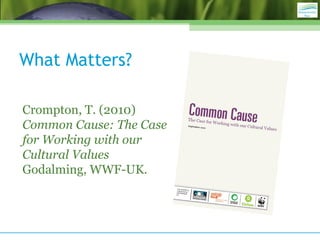
What Matters?
Crompton, T. (2010)
Common Cause: The Case
for Working with our
Cultural Values
Godalming, WWF-UK.
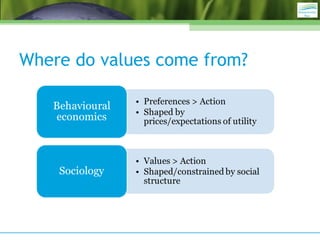
Where do values come from?
“with the precarious and perilous character
of existence”
Michael Jackson (1989),
Paths toward a clearing, p. 17
A universal concern…
“It is in the context of capability, vulnerability and
precarious well-being or flourishing, and our
tendency to form attachments and commitments, that
both values and reason in everyday life need to be
understood.”
Andrew Sayer (2011),
Why things matter to people, p. 6
Survival and meaning
“The meaning of our lives cannot, therefore, be
understood as a search to satisfy generalizable
needs for food, shelter, sex, company and so on,
as if our particular relationships were simply
how we had provided for them. It is more the
other way round: without attachments we lose
our appetite for life.”
Peter Marris (1996), The politics of uncertainty, p. 45
From ‘holding’ to internalised secure
space
Thus what is communicated by the caregiver
is a complex relation of literal holding to
psychic holding or containment. It is this […]
that provides a sense of continuity of being in
which a young child is gradually able to
replace literal physical holding with a sense
of being whole and continuous.
Valerie Walkerdine, (2010). "Communal Beingness and Affect: An
Exploration of Trauma in an Ex-industrial Community“, Body &
Society 16(1): 91-116.
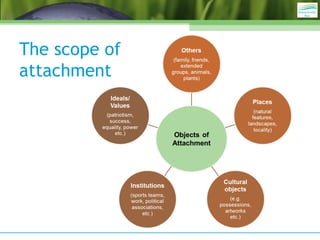
The scope of
attachment
Broken attachments
“This constructed world of predictable
relationships is the context of our
actions. But it is subject to constant
revision, and always more or less
vulnerable to loss, self-doubts,
experiences which make no sense to us.
Then we no longer know what to
do.”
Peter Marris (1996), The politics of uncertainty, p. 4
‘Mourning social injury’
“We are now a people with a broken culture”, said Simon
Fobister, the chief of the Grassy Narrows Band, to a
government delegation visiting the reserve in December
1978. […] The Ojibwa people have been counting on their
native culture for hundreds of years to tune their moral and
conceptual reflexes, to organize and give rhythm to their
everyday lives, to give shape to things. That old mould was
simply broken, and the result was a kind of
bewilderment and disorientation that the usual
sociological concepts – anomie, estrangement,
alienation – are not rich enough to capture or
reflect.
Kai Erikson (1995), A New Species of Trouble, pp. 34-35.
Take-home points
1. Conditioning all other concerns: concern with
the uncertain future
2. Attachment tames uncertainty, sustains
meaning, identity and agency
3. Human development > internalisation of
secure space, trust in world
4. Narratives of care extend agency and identity
5. Loss of attachment can threaten individual and
collective agency & identity

Living with Uncertainty: Attachment and Narratives of Care

  • 1.
    Living with Uncertainty:Attachment and Narratives of Care Dr Christopher Groves Social Sciences, Cardiff University
  • 2.
    What Matters? Crompton, T.(2010) Common Cause: The Case for Working with our Cultural Values Godalming, WWF-UK.
  • 3.
    Where do valuescome from?
  • 4.
    “with the precariousand perilous character of existence” Michael Jackson (1989), Paths toward a clearing, p. 17 A universal concern… “It is in the context of capability, vulnerability and precarious well-being or flourishing, and our tendency to form attachments and commitments, that both values and reason in everyday life need to be understood.” Andrew Sayer (2011), Why things matter to people, p. 6
  • 5.
    Survival and meaning “Themeaning of our lives cannot, therefore, be understood as a search to satisfy generalizable needs for food, shelter, sex, company and so on, as if our particular relationships were simply how we had provided for them. It is more the other way round: without attachments we lose our appetite for life.” Peter Marris (1996), The politics of uncertainty, p. 45
  • 6.
    From ‘holding’ tointernalised secure space Thus what is communicated by the caregiver is a complex relation of literal holding to psychic holding or containment. It is this […] that provides a sense of continuity of being in which a young child is gradually able to replace literal physical holding with a sense of being whole and continuous. Valerie Walkerdine, (2010). "Communal Beingness and Affect: An Exploration of Trauma in an Ex-industrial Community“, Body & Society 16(1): 91-116.
  • 7.
  • 8.
    Broken attachments “This constructedworld of predictable relationships is the context of our actions. But it is subject to constant revision, and always more or less vulnerable to loss, self-doubts, experiences which make no sense to us. Then we no longer know what to do.” Peter Marris (1996), The politics of uncertainty, p. 4
  • 9.
    ‘Mourning social injury’ “Weare now a people with a broken culture”, said Simon Fobister, the chief of the Grassy Narrows Band, to a government delegation visiting the reserve in December 1978. […] The Ojibwa people have been counting on their native culture for hundreds of years to tune their moral and conceptual reflexes, to organize and give rhythm to their everyday lives, to give shape to things. That old mould was simply broken, and the result was a kind of bewilderment and disorientation that the usual sociological concepts – anomie, estrangement, alienation – are not rich enough to capture or reflect. Kai Erikson (1995), A New Species of Trouble, pp. 34-35.
  • 10.
    Take-home points 1. Conditioningall other concerns: concern with the uncertain future 2. Attachment tames uncertainty, sustains meaning, identity and agency 3. Human development > internalisation of secure space, trust in world 4. Narratives of care extend agency and identity 5. Loss of attachment can threaten individual and collective agency & identity