PANTALOON CASE
Group 6
QUESTION 1
 The traditional retailer’s model of inventory
management(EOQ) seems to be rendered obsolete
by contemporary retails stores such as Pantaloon.
Discuss.
The EOQ Model is valid under the following assumptions:
 The rate of demand is known, constant and spread evenly
throughout the year.
 Order quantity remains fixed.
 Purchase price of the item is constant i.e., no quantity
dicounts
 The lead time is fixed.
Present scenario of Indian retail:
 Ever changing customer preferences 
(i) order quantity cannot be fixed
(ii) Rate of demand might not be known
 Product lifecycle has become shorter
QUESTION 2
 Is there a scope of applying the ABC classification
of inventory in the modern retails stores?
 ABC classification is based on annual consumption and
annual value of the items.
 We obtain the quantity of inventory item consumed during the
year and multiply it by unit cost to obtain annual usage cost.
 Then items are arranged in descending order of annual usage
cost.
 Pantaloon has already implemented the RFID project, which
has enabled Pantaloon to:
 Track information like purchase and delivery orders.
 Real time visibility of items during all stages is now possible
easily.
 The quantity of inventory item consumed can easily be
tracked and other related info can be extracted from the RFID
technology being used. Therefore, ABC can be applied.
QUESTION 3
 What should Kishore Biyani do further to match
Spanish retailer Zara’s 15 day lead time?
 Have his own factories
 Faster manufacturing
 Accurate forecasting of what all trends would be
coming in market.
 Ensure fast arrival of fresh stock
QUESTION 4
 What should ‘local small retailers’ do to safeguard
themselves from the onslaught of big players such
as Pantaloon?
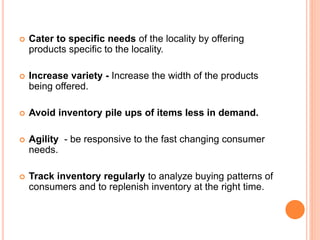
 Cater to specific needs of the locality by offering
products specific to the locality.
 Increase variety - Increase the width of the products
being offered.
 Avoid inventory pile ups of items less in demand.
 Agility - be responsive to the fast changing consumer
needs.
 Track inventory regularly to analyze buying patterns of
consumers and to replenish inventory at the right time.
QUESTION 5
 Discuss the significance of Inventory turnover ratio
in Inventory Management.
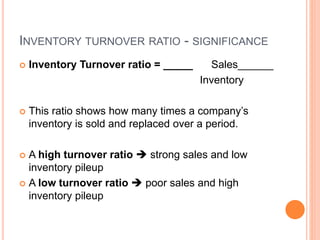
INVENTORY TURNOVER RATIO - SIGNIFICANCE
 Inventory Turnover ratio = _____ Sales______
Inventory
 This ratio shows how many times a company’s
inventory is sold and replaced over a period.
 A high turnover ratio  strong sales and low
inventory pileup
 A low turnover ratio  poor sales and high
inventory pileup

Group6 pantaloon case

  • 1.
  • 2.
    QUESTION 1  Thetraditional retailer’s model of inventory management(EOQ) seems to be rendered obsolete by contemporary retails stores such as Pantaloon. Discuss.
  • 3.
    The EOQ Modelis valid under the following assumptions:  The rate of demand is known, constant and spread evenly throughout the year.  Order quantity remains fixed.  Purchase price of the item is constant i.e., no quantity dicounts  The lead time is fixed. Present scenario of Indian retail:  Ever changing customer preferences  (i) order quantity cannot be fixed (ii) Rate of demand might not be known  Product lifecycle has become shorter
  • 4.
    QUESTION 2  Isthere a scope of applying the ABC classification of inventory in the modern retails stores?
  • 5.
     ABC classificationis based on annual consumption and annual value of the items.  We obtain the quantity of inventory item consumed during the year and multiply it by unit cost to obtain annual usage cost.  Then items are arranged in descending order of annual usage cost.  Pantaloon has already implemented the RFID project, which has enabled Pantaloon to:  Track information like purchase and delivery orders.  Real time visibility of items during all stages is now possible easily.  The quantity of inventory item consumed can easily be tracked and other related info can be extracted from the RFID technology being used. Therefore, ABC can be applied.
  • 6.
    QUESTION 3  Whatshould Kishore Biyani do further to match Spanish retailer Zara’s 15 day lead time?
  • 7.
     Have hisown factories  Faster manufacturing  Accurate forecasting of what all trends would be coming in market.  Ensure fast arrival of fresh stock
  • 8.
    QUESTION 4  Whatshould ‘local small retailers’ do to safeguard themselves from the onslaught of big players such as Pantaloon?
  • 9.
     Cater tospecific needs of the locality by offering products specific to the locality.  Increase variety - Increase the width of the products being offered.  Avoid inventory pile ups of items less in demand.  Agility - be responsive to the fast changing consumer needs.  Track inventory regularly to analyze buying patterns of consumers and to replenish inventory at the right time.
  • 10.
    QUESTION 5  Discussthe significance of Inventory turnover ratio in Inventory Management.
  • 11.
    INVENTORY TURNOVER RATIO- SIGNIFICANCE  Inventory Turnover ratio = _____ Sales______ Inventory  This ratio shows how many times a company’s inventory is sold and replaced over a period.  A high turnover ratio  strong sales and low inventory pileup  A low turnover ratio  poor sales and high inventory pileup