PRE-COLONIAL
PHILIPPINES
PRE-COLONIALPHILIPPINES
The pre-colonial Philippines was considered one of the most
progressive societies to exist.
The pre-colonial Philippines had a powerful and egalitarian
society, with women holding significant power in family hierarchy,
leadership, and professionalism.
What was happening on pre-colonial period?
 The Philippines' pre-colonial period was filled with indigenous
peoples engaged in healthy trade with various cultures and
economies in the region and the foreign traders.
Sub-Topics
Political
Social
Economic System
Arrival of Magellan
Political
 Basic unit of government was the BARANGAY, consisting of 30 to 100
families. The term came from the Malay word BALANGAY, meaning
BOAT, SAILBOAT.
• Barangays were headed by chieftains called DATU.
• The subjects served their chieftain during wars, voyages, planting and
harvest, and when his house needs to be built or repaired; they also paid
tributes called BUWIS.
 The CHIEF or DATU
o was the chief executive, the legislator, and the judge; he was also the
supreme commander in times of war
o Chieftain's children and other relatives were highly respected in the
community
o exercised the powers of the Executive, the legislative, and the judiciary.
o a lawmaker.
Council of elders
- This council gave the chieftain some wise pieces of advice.
SANGDUGUAN
- is an alliances among barangays were common and these were formalized in a
ritual.
- blood compact, ritual. "blood-brothers" : Having drunk each others blood.
How a Law Was Made
-The chieftain of a barangay, made the laws of the community.
Umalohokan
- Town cryer or the announcer
Deciding Cases
- court of justice was composed of the chieftain as judge and the elders of the barangay
as members of the jury arbitration.
- A board composed of elders from neutral barangays acted as arbiter.
The Trial by Ordeal
• The trial by ordeal was not unique to the ancient Filipinos.
• In the case of theft, dip their hands into a pot of boiling water. The suspect
whose hand was scalded the most was judged guilty.
Social
Sub-Topics
1. Social Classes
There are three conditions of persons among the native of the islands
namely:
• Chiefs
• Timaguas – who are equivalent to plebeians.
• Slaves- worker of both chiefs and timaguas.
Slaves have several Classes:
 Saguiguilires
 Namamahays
2. Status of Women
• The right to inherit property, engage in trade and industry, and succeed to
the chieftainship of the barangay in the absence of a male heir.
• The exclusive right to name their children.
• Men walked behind them as a sign of respect.
3. Marriage Customs
• Chiefs < --- > Women Chiefs
• Timaguas < --- > Those of that rank
• Slaves < --- > Those of their own class
BUT NOTE: These classes may intermarry with one another.
 Men were in general, monogamous; their wives are called “asawa”, while
concubines are called “friends”.
 In order to win the hand of his lady, the man has to show his patience and
dedication to both lady and her parents.
4. Mixed Marriages, Child Inheritance
and Succession
• Mixed Marriages were allowed in Pre-
colonial society
• The status of children were
dependent upon the status of the
parents
EconomicSystem
• Agriculture
• Livestock
• Fishing
• Mining
• Lumbering and Shipbuilding
• Weaving
• Trade
C
U
R
R
E
N
C
Y
The means of purchase and
trade before the Spanish era mainly
evolved in exchanging of goods, a
system known as barter. However,
barter trade in Philippines’ history
proved to be inconvenient, hence
the development and use of cowry
shells as a medium of exchange.
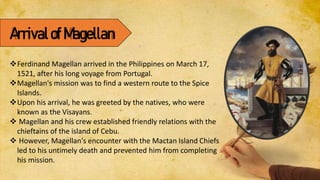
ArrivalofMagellan
Ferdinand Magellan arrived in the Philippines on March 17,
1521, after his long voyage from Portugal.
Magellan's mission was to find a western route to the Spice
Islands.
Upon his arrival, he was greeted by the natives, who were
known as the Visayans.
 Magellan and his crew established friendly relations with the
chieftains of the island of Cebu.
 However, Magellan's encounter with the Mactan Island Chiefs
led to his untimely death and prevented him from completing
his mission.
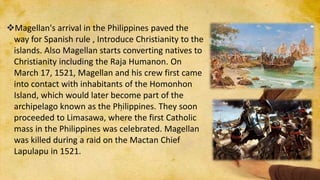
Magellan's arrival in the Philippines paved the
way for Spanish rule , Introduce Christianity to the
islands. Also Magellan starts converting natives to
Christianity including the Raja Humanon. On
March 17, 1521, Magellan and his crew first came
into contact with inhabitants of the Homonhon
Island, which would later become part of the
archipelago known as the Philippines. They soon
proceeded to Limasawa, where the first Catholic
mass in the Philippines was celebrated. Magellan
was killed during a raid on the Mactan Chief
Lapulapu in 1521.
10reasonWhylifeisbetterin
Pre-colonialPhilippines:
1. Women shared equal status with Men.
2. Society was tolerant back then.
3. Higher standard of the government.
4. Working judicial and legislative system.
5. Self-sufficient.
6. Smoother foreigner relations.
7. They know how to make advanced weapons.
8. Several professions already existed.
9. The high literacy rate was high.
10. Advanced civilization.
group-1-presentation-in-RPHIS.pptx Hello

group-1-presentation-in-RPHIS.pptx Hello

  • 1.
  • 2.
    PRE-COLONIALPHILIPPINES The pre-colonial Philippineswas considered one of the most progressive societies to exist. The pre-colonial Philippines had a powerful and egalitarian society, with women holding significant power in family hierarchy, leadership, and professionalism. What was happening on pre-colonial period?  The Philippines' pre-colonial period was filled with indigenous peoples engaged in healthy trade with various cultures and economies in the region and the foreign traders.
  • 3.
  • 4.
    Political  Basic unitof government was the BARANGAY, consisting of 30 to 100 families. The term came from the Malay word BALANGAY, meaning BOAT, SAILBOAT. • Barangays were headed by chieftains called DATU. • The subjects served their chieftain during wars, voyages, planting and harvest, and when his house needs to be built or repaired; they also paid tributes called BUWIS.  The CHIEF or DATU o was the chief executive, the legislator, and the judge; he was also the supreme commander in times of war o Chieftain's children and other relatives were highly respected in the community o exercised the powers of the Executive, the legislative, and the judiciary. o a lawmaker.
  • 5.
    Council of elders -This council gave the chieftain some wise pieces of advice. SANGDUGUAN - is an alliances among barangays were common and these were formalized in a ritual. - blood compact, ritual. "blood-brothers" : Having drunk each others blood. How a Law Was Made -The chieftain of a barangay, made the laws of the community. Umalohokan - Town cryer or the announcer Deciding Cases - court of justice was composed of the chieftain as judge and the elders of the barangay as members of the jury arbitration. - A board composed of elders from neutral barangays acted as arbiter. The Trial by Ordeal • The trial by ordeal was not unique to the ancient Filipinos. • In the case of theft, dip their hands into a pot of boiling water. The suspect whose hand was scalded the most was judged guilty.
  • 6.
    Social Sub-Topics 1. Social Classes Thereare three conditions of persons among the native of the islands namely: • Chiefs • Timaguas – who are equivalent to plebeians. • Slaves- worker of both chiefs and timaguas. Slaves have several Classes:  Saguiguilires  Namamahays
  • 7.
    2. Status ofWomen • The right to inherit property, engage in trade and industry, and succeed to the chieftainship of the barangay in the absence of a male heir. • The exclusive right to name their children. • Men walked behind them as a sign of respect. 3. Marriage Customs • Chiefs < --- > Women Chiefs • Timaguas < --- > Those of that rank • Slaves < --- > Those of their own class BUT NOTE: These classes may intermarry with one another.  Men were in general, monogamous; their wives are called “asawa”, while concubines are called “friends”.  In order to win the hand of his lady, the man has to show his patience and dedication to both lady and her parents.
  • 8.
    4. Mixed Marriages,Child Inheritance and Succession • Mixed Marriages were allowed in Pre- colonial society • The status of children were dependent upon the status of the parents
  • 9.
    EconomicSystem • Agriculture • Livestock •Fishing • Mining • Lumbering and Shipbuilding • Weaving • Trade
  • 10.
    C U R R E N C Y The means ofpurchase and trade before the Spanish era mainly evolved in exchanging of goods, a system known as barter. However, barter trade in Philippines’ history proved to be inconvenient, hence the development and use of cowry shells as a medium of exchange.
  • 11.
    ArrivalofMagellan Ferdinand Magellan arrivedin the Philippines on March 17, 1521, after his long voyage from Portugal. Magellan's mission was to find a western route to the Spice Islands. Upon his arrival, he was greeted by the natives, who were known as the Visayans.  Magellan and his crew established friendly relations with the chieftains of the island of Cebu.  However, Magellan's encounter with the Mactan Island Chiefs led to his untimely death and prevented him from completing his mission.
  • 12.
    Magellan's arrival inthe Philippines paved the way for Spanish rule , Introduce Christianity to the islands. Also Magellan starts converting natives to Christianity including the Raja Humanon. On March 17, 1521, Magellan and his crew first came into contact with inhabitants of the Homonhon Island, which would later become part of the archipelago known as the Philippines. They soon proceeded to Limasawa, where the first Catholic mass in the Philippines was celebrated. Magellan was killed during a raid on the Mactan Chief Lapulapu in 1521.
  • 13.
    10reasonWhylifeisbetterin Pre-colonialPhilippines: 1. Women sharedequal status with Men. 2. Society was tolerant back then. 3. Higher standard of the government. 4. Working judicial and legislative system. 5. Self-sufficient. 6. Smoother foreigner relations. 7. They know how to make advanced weapons. 8. Several professions already existed. 9. The high literacy rate was high. 10. Advanced civilization.