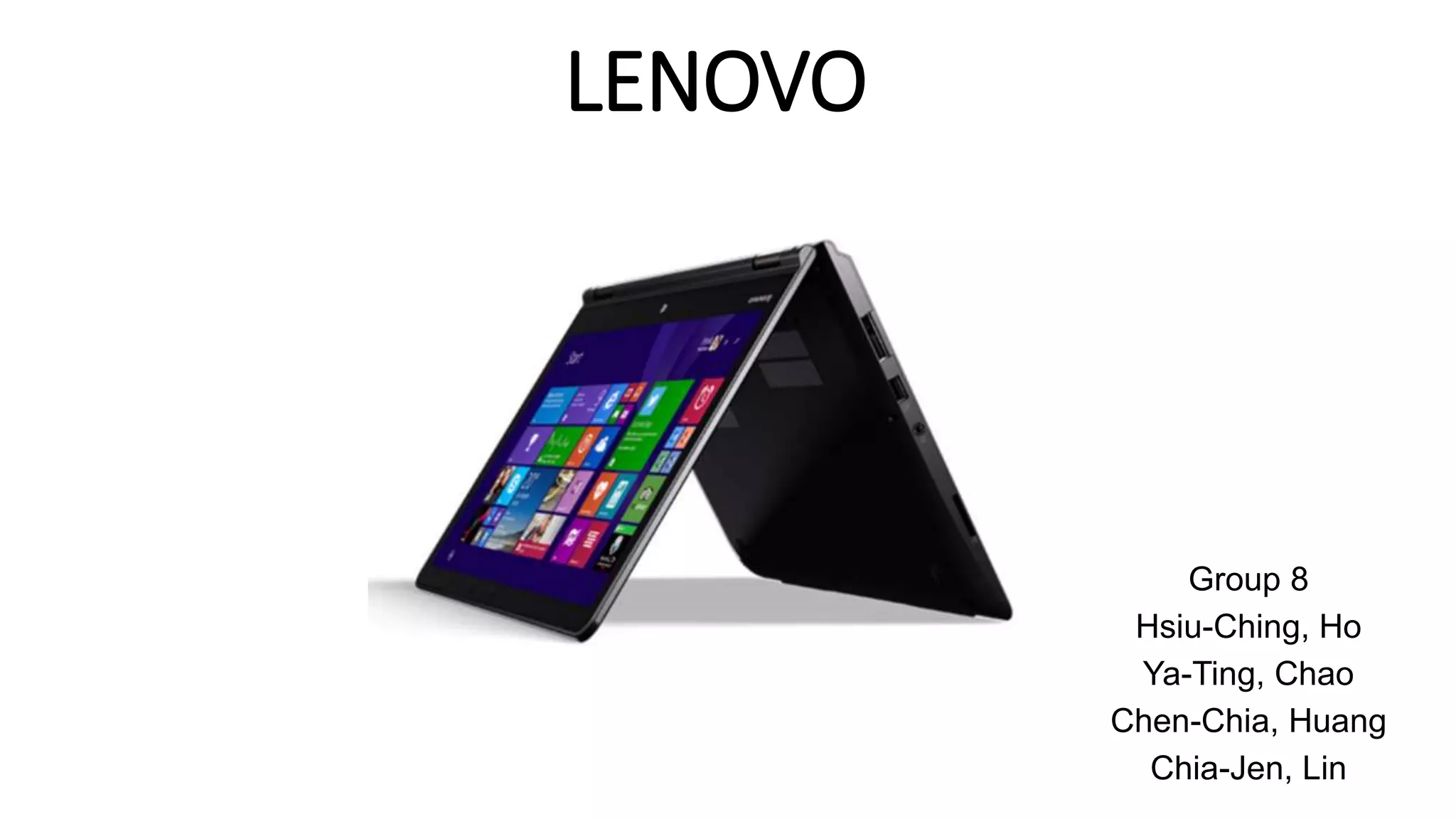
LENOVO
Group 8
Hsiu-Ching, Ho
Ya-Ting, Chao
Chen-Chia, Huang
Chia-Jen, Lin
Company Overview
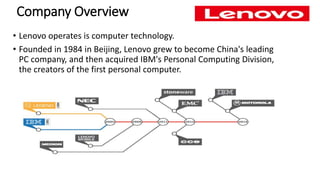
• Lenovo operates is computer technology.
• Founded in 1984 in Beijing, Lenovo grew to become China's leading
PC company, and then acquired IBM's Personal Computing Division,
the creators of the first personal computer.
Lenovo’s Prescription for Supply Chain Success
• Qualitative and Quantitative
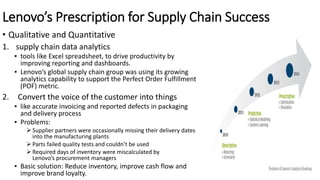
1. supply chain data analytics
▪ tools like Excel spreadsheet, to drive productivity by
improving reporting and dashboards.
▪ Lenovo’s global supply chain group was using its growing
analytics capability to support the Perfect Order Fulfillment
(POF) metric.
2. Convert the voice of the customer into things
▪ like accurate invoicing and reported defects in packaging
and delivery process
▪ Problems:
 Supplier partners were occasionally missing their delivery dates
into the manufacturing plants
 Parts failed quality tests and couldn’t be used
 Required days of inventory were miscalculated by
Lenovo’s procurement managers
▪ Basic solution: Reduce inventory, improve cash flow and
improve brand loyalty.
Lenovo goes global
• China is the largest market
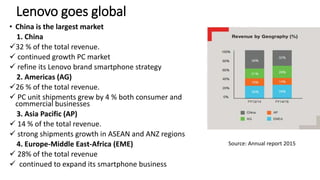
1. China
32 % of the total revenue.
 continued growth PC market
 refine its Lenovo brand smartphone strategy
2. Americas (AG)
26 % of the total revenue.
 PC unit shipments grew by 4 % both consumer and
commercial businesses
3. Asia Pacific (AP)
 14 % of the total revenue.
 strong shipments growth in ASEAN and ANZ regions
4. Europe-Middle East-Africa (EME)
 28% of the total revenue
 continued to expand its smartphone business
Source: Annual report 2015
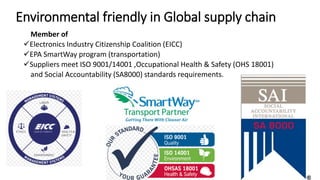
Environmental friendly in Global supply chain
Member of
Electronics Industry Citizenship Coalition (EICC)
EPA SmartWay program (transportation)
Suppliers meet ISO 9001/14001 ,Occupational Health & Safety (OHS 18001)
and Social Accountability (SA8000) standards requirements.
Lessons from the case
• The innovation and strategic acquisition
- With the potential for integrating two disparate east and west markets, Lenovo
created a unified global PC leader with growing market position by acquiring the IBM
and Motorola.
- Due to the acquisition, the company significantly expanded its market share.
• Synchronize the strategies among all the stages
- From facilities, transportation, sourcing, inventory to pricing and information, all the
strategies that are performed in each stage are affected by each other.
- We have to develop the strategy carefully to assure each strategy can create
maximized effects.
• Utilize the strategy defensively and offensively
- The company uses the strategy “Protect and attack” not only to dedicate to
protecting its core legacy but also to attack new market opportunities in regions with
high growth potential
Lessons from the case
• All member in the network should participate
- The strategies need to be performed by all the members in the network to make sure that
each step is being done effectively and efficiently.
- Especially the leader of the team should all involve in the protect and attack strategy to
optimize the objective since strategy across all geographies, customer segments and product
lines as the organization continues to build its business worldwide.
• Product diversification
- From the strategy “PC+”, we can tell that the company won’t be satisfied with only
one successful product line. Therefore, the team develop multiple product availability
under the production constraints.
• Keep improving and maximize the supply chain surplus
- The successful company knows that they not only need to sustain the position but
also must keep improving so as to maximize the supply chain surplus.
Reference
• http://scnavigator.avnet.com/article/january-2015/lenovos-prescription-for-supply-chain-success/
• Lenovo (2015), “Annual reports 2014-2015”, available at:
http://www.lenovo.com/ww/lenovo/investor_relations.html
• http://news.lenovo.com/news-releases/lenovo-plans-to-acquire-ibms-x86-server-business.htm

Group project-by-group-8-2

  • 1.
    LENOVO Group 8 Hsiu-Ching, Ho Ya-Ting,Chao Chen-Chia, Huang Chia-Jen, Lin
  • 2.
    Company Overview • Lenovooperates is computer technology. • Founded in 1984 in Beijing, Lenovo grew to become China's leading PC company, and then acquired IBM's Personal Computing Division, the creators of the first personal computer.
  • 3.
    Lenovo’s Prescription forSupply Chain Success • Qualitative and Quantitative 1. supply chain data analytics ▪ tools like Excel spreadsheet, to drive productivity by improving reporting and dashboards. ▪ Lenovo’s global supply chain group was using its growing analytics capability to support the Perfect Order Fulfillment (POF) metric. 2. Convert the voice of the customer into things ▪ like accurate invoicing and reported defects in packaging and delivery process ▪ Problems:  Supplier partners were occasionally missing their delivery dates into the manufacturing plants  Parts failed quality tests and couldn’t be used  Required days of inventory were miscalculated by Lenovo’s procurement managers ▪ Basic solution: Reduce inventory, improve cash flow and improve brand loyalty.
  • 4.
    Lenovo goes global •China is the largest market 1. China 32 % of the total revenue.  continued growth PC market  refine its Lenovo brand smartphone strategy 2. Americas (AG) 26 % of the total revenue.  PC unit shipments grew by 4 % both consumer and commercial businesses 3. Asia Pacific (AP)  14 % of the total revenue.  strong shipments growth in ASEAN and ANZ regions 4. Europe-Middle East-Africa (EME)  28% of the total revenue  continued to expand its smartphone business Source: Annual report 2015
  • 5.
    Environmental friendly inGlobal supply chain Member of Electronics Industry Citizenship Coalition (EICC) EPA SmartWay program (transportation) Suppliers meet ISO 9001/14001 ,Occupational Health & Safety (OHS 18001) and Social Accountability (SA8000) standards requirements.
  • 6.
    Lessons from thecase • The innovation and strategic acquisition - With the potential for integrating two disparate east and west markets, Lenovo created a unified global PC leader with growing market position by acquiring the IBM and Motorola. - Due to the acquisition, the company significantly expanded its market share. • Synchronize the strategies among all the stages - From facilities, transportation, sourcing, inventory to pricing and information, all the strategies that are performed in each stage are affected by each other. - We have to develop the strategy carefully to assure each strategy can create maximized effects. • Utilize the strategy defensively and offensively - The company uses the strategy “Protect and attack” not only to dedicate to protecting its core legacy but also to attack new market opportunities in regions with high growth potential
  • 7.
    Lessons from thecase • All member in the network should participate - The strategies need to be performed by all the members in the network to make sure that each step is being done effectively and efficiently. - Especially the leader of the team should all involve in the protect and attack strategy to optimize the objective since strategy across all geographies, customer segments and product lines as the organization continues to build its business worldwide. • Product diversification - From the strategy “PC+”, we can tell that the company won’t be satisfied with only one successful product line. Therefore, the team develop multiple product availability under the production constraints. • Keep improving and maximize the supply chain surplus - The successful company knows that they not only need to sustain the position but also must keep improving so as to maximize the supply chain surplus.
  • 8.
    Reference • http://scnavigator.avnet.com/article/january-2015/lenovos-prescription-for-supply-chain-success/ • Lenovo(2015), “Annual reports 2014-2015”, available at: http://www.lenovo.com/ww/lenovo/investor_relations.html • http://news.lenovo.com/news-releases/lenovo-plans-to-acquire-ibms-x86-server-business.htm