WORKING STAGE OF
A GROUP
P R E S E N T E R : D E S I R E E O . L A B I O
LEARNING OBJECTIVES
1. Describe The Dynamics Associated With Group Process
And Development
2. Demonstrate Various Leader Interventions For Exploring A
Member’s Fears At Various Stages Of A Group
3. Identify And Define The Key Characteristics Of A Group
During The Working Stage
4. Highlight The Differences Between A Working Group And A
Nonworking Group
5. Identify Ethical And Culturally Relevant Strategies For
Designing And Facilitating Groups
LEARNING OBJECTIVES
6. Become Familiar With Choices To Be Made During The
Working Stage
7. Discuss The Specific Therapeutic Factors And How They
Contribute To Group Effectiveness
8. Present Guidelines For Member Self-disclosure
9. Present Guidelines For Leader Self-disclosure
10. Describe Guidelines For Giving And Receiving Feedback
11. Identify Co-leader Issues At The Working Stage
INTRODUCTION
The WORKING STAGE is characterized by :
The commitment of members to explore significant
problems.
Participants have learned how to involve
themselves in group interactions.
No arbitrary dividing lines between each phase.
Work can occur at every stage—not just the working
stage.
Not all groups may reach the working stage.
Not all members function at the same level.
PROGRESSING TO THE
WORKING STAGE
For a group to reach the working stage, it is
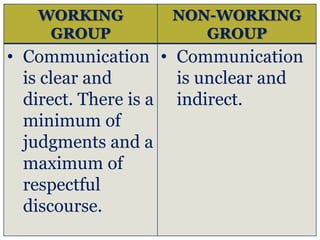
essential that members make a commitment to
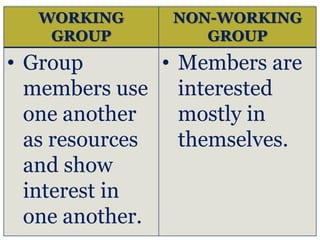
face and work through barriers that interfere
with the group’s progress.
Meaningful work and learning occur at every
stage of a group; however, deeper exploration
and an increased level of group cohesion are
typical of the working stage of a group.
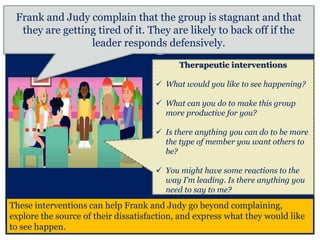
These interventions can help Frank and Judy go beyond complaining,
explore the source of their dissatisfaction, and express what they would like
to see happen.
Therapeutic interventions
 What would you like to see happening?
 What can you do to make this group
more productive for you?
 Is there anything you can do to be more
the type of member you want others to
be?
 You might have some reactions to the
way I’m leading. Is there anything you
need to say to me?
Frank and Judy complain that the group is stagnant and that
they are getting tired of it. They are likely to back off if the
leader responds defensively.
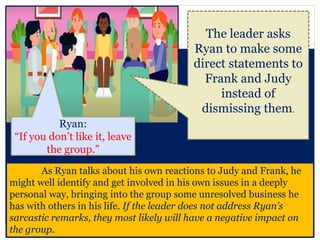
As Ryan talks about his own reactions to Judy and Frank, he
might well identify and get involved in his own issues in a deeply
personal way, bringing into the group some unresolved business he
has with others in his life. If the leader does not address Ryan’s
sarcastic remarks, they most likely will have a negative impact on
the group.
The leader asks
Ryan to make some
direct statements to
Frank and Judy
instead of
dismissing them.
Ryan:
“If you don’t like it, leave
the group.”
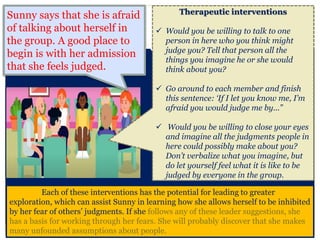
Each of these interventions has the potential for leading to greater
exploration, which can assist Sunny in learning how she allows herself to be inhibited
by her fear of others’ judgments. If she follows any of these leader suggestions, she
has a basis for working through her fears. She will probably discover that she makes
many unfounded assumptions about people.
Therapeutic interventions
 Would you be willing to talk to one
person in here who you think might
judge you? Tell that person all the
things you imagine he or she would
think about you?
 Go around to each member and finish
this sentence: ‘If I let you know me, I’m
afraid you would judge me by...”
 Would you be willing to close your eyes
and imagine all the judgments people in
here could possibly make about you?
Don’t verbalize what you imagine, but
do let yourself feel what it is like to be
judged by everyone in the group.
Sunny says that she is afraid
of talking about herself in
the group. A good place to
begin is with her admission
that she feels judged.
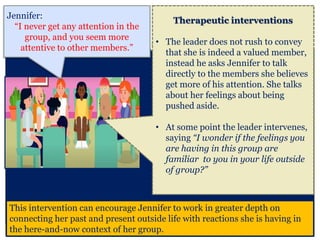
This intervention can encourage Jennifer to work in greater depth on
connecting her past and present outside life with reactions she is having in
the here-and-now context of her group.
Therapeutic interventions
• The leader does not rush to convey
that she is indeed a valued member,
instead he asks Jennifer to talk
directly to the members she believes
get more of his attention. She talks
about her feelings about being
pushed aside.
• At some point the leader intervenes,
saying “I wonder if the feelings you
are having in this group are
familiar to you in your life outside
of group?”
Jennifer:
“I never get any attention in the
group, and you seem more
attentive to other members.”
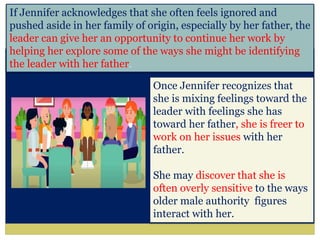
If Jennifer acknowledges that she often feels ignored and
pushed aside in her family of origin, especially by her father, the
leader can give her an opportunity to continue her work by
helping her explore some of the ways she might be identifying
the leader with her father.
Once Jennifer recognizes that
she is mixing feelings toward the
leader with feelings she has
toward her father, she is freer to
work on her issues with her
father.
She may discover that she is
often overly sensitive to the ways
older male authority figures
interact with her.
Jennifer’s declaration that she does not get proper attention in the group is a typical
reaction during the transition stage.
As the leader works with this feeling, Jennifer ends up having new insight regarding
how she is making the group leader (and others) into her father. Jennifer’s insights
and behavior changes are indicative of significant interaction in the working stage.
The leader’s intervention did not entrench her feelings
of being ignored further but resulted in some
significant work on her part.
In addition, she might well experience intense
emotions over her feelings about her father, and she is
likely to express and explore such painful feelings in
the group.
As a result of her work in the group, Jennifer now pays
attention to how she feels when she is with her father
and tries out new ways of responding to him.
Because she is aware of her tendency to attribute
certain qualities to men in authority, she is now in a
position to react differently toward them.
LEADER INTERVENTION IN WORKING
WITH A MEMBER’S FEAR
She states that her fears get in the way of freely participating in the group.
We find that group members often express a range of apprehensions similar to
those disclosed by Grace, fearing that others will see them as stupid, incoherent,
weird, selfish, and the like.
The techniques we describe in working with Grace’s particular fear of being judged
can easily be applied to these other fears. The way we work with her differs
according to the depth of the relationship we have established with her.
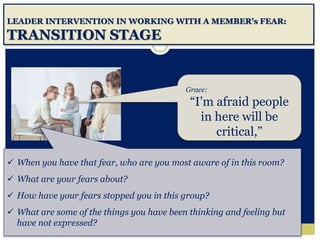
Grace: “I’m afraid people in
here will be critical. I
rehearse endlessly before I
speak because I want to
express myself clearly so
others won’t think I’m
incoherent.”
LEADER INTERVENTION IN WORKING
WITH A MEMBER’S FEAR
Interventions at different stages
Initial Stage - interventions are aimed at providing
encouragement
Transition Stage - interventions demand more from the
member than at the initial stage
Working Stage - involves the entire group in a
member’s personal work
Final Stage - encourage members to see how the
changes practiced in the group might
affect significant people in their life
LEADER INTERVENTION IN WORKING WITH A MEMBER’s FEAR:
INITIAL STAGE
 We encourage other members to talk about any fears they have.
If Susan also says that she fears others’ reactions, we
can ask her to talk directly to Grace about her fears.
(Aim: teaching member-to-member interaction.)
 After the exchange between Susan and Grace, we ask,
“Do any of the rest of you have similar feelings?”
(Aim: to involve others in this interaction by stating ways in
which they identify with Susan and Grace.)
 Members who have fears that they would like to explore are
invited to share their fears with Grace. We leave the structure
open ended, so they can talk about whatever fears they are
experiencing.
(Aim: In a non-threatening way we link Grace’s work with that of
others, and both trust and cohesion are being established.)
During the initial stage, our interventions are aimed at providing encouragement for
Grace to say more about her fear of being judged and to talk about how this fear is affecting
what she is doing in the group. We facilitate a deeper exploration of her concern in any of the
following ways:
LEADER INTERVENTION IN WORKING WITH A MEMBER’s FEAR:
TRANSITION STAGE
Grace:
“I’m afraid people
in here will be
critical,”
 When you have that fear, who are you most aware of in this room?
 What are your fears about?
 How have your fears stopped you in this group?
 What are some of the things you have been thinking and feeling but
have not expressed?
LEADER INTERVENTION IN WORKING WITH A MEMBER’S FEAR:
TRANSITION STAGE
 We can bring group members into this interaction
by inviting them to give their reactions to what
Grace has just said. The interchange between her
and other members can lead to further exploration.
Grace has probably created some distance between
herself and others in the group by avoiding them out
of fear of their negative reactions. By talking about
her reactions to others, she is taking responsibility
for the distance she has partially created. She can
work out a new stance with those she has been
avoiding.
 Grace eventually indicates she is concerned about how
three group members in particular will think about her
and about how they might judge her. We suggest to Grace
that she speak to the people she feels would most likely
judge her and tell them what she imagines they are
thinking and feeling about her. In this way we get Grace
to acknowledge her possible projections and to learn how
to check out her assumptions. We are also gathering data
that can be useful for exploration later in the group.
 The work that we have just
described could be done
during any stage. What
makes this scenario
characteristic of the
transition stage is the fact
that members are beginning
to express reactions and
perceptions that they have
been aware of but have kept
to themselves.
LEADER INTERVENTION IN WORKING WITH A MEMBER’S FEAR:
WORKING STAGE
If Grace discloses her fear during the working
stage, we look for ways to involve the entire group
in her work.
Members may acknowledge how they feel put off by her,
how they feel judged by her, or how they really do not know
her.
 By expressing feelings that they have kept to themselves, members are
moving out of the transition stage and into the working stage.
 They acknowledge reactions and perceptions, clear up projections and
misunderstandings, and work through any possible conflict.
 The group can get stuck in the transition stage if people do not go
further and express reactions that have undermined their level of trust.
A group moves into the working stage as members
commit to working through an impasse, particularly their
own end of it.
LEADER INTERVENTION IN WORKING WITH A MEMBER’s FEAR:
WORKING STAGE
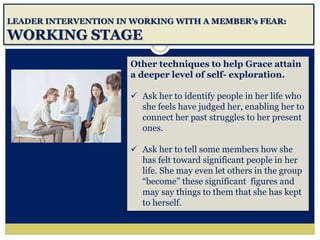
Other techniques to help Grace attain
a deeper level of self- exploration.
 Ask her to identify people in her life who
she feels have judged her, enabling her to
connect her past struggles to her present
ones.
 Ask her to tell some members how she
has felt toward significant people in her
life. She may even let others in the group
“become” these significant figures and
may say things to them that she has kept
to herself.
LEADER INTERVENTION IN WORKING WITH A MEMBER’s FEAR:
WORKING STAGE
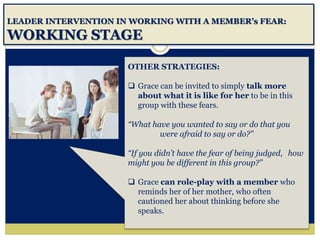
OTHER STRATEGIES:
 Grace can be invited to simply talk more
about what it is like for her to be in this
group with these fears.
“What have you wanted to say or do that you
were afraid to say or do?”
“If you didn’t have the fear of being judged, how
might you be different in this group?”
 Grace can role-play with a member who
reminds her of her mother, who often
cautioned her about thinking before she
speaks.
LEADER INTERVENTION IN WORKING WITH A MEMBER’s FEAR:
WORKING STAGE
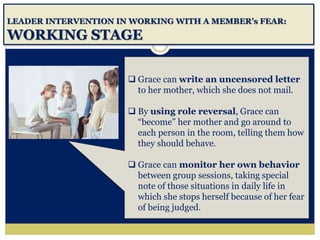
 Grace can write an uncensored letter
to her mother, which she does not mail.
 By using role reversal, Grace can
“become” her mother and go around to
each person in the room, telling them how
they should behave.
 Grace can monitor her own behavior
between group sessions, taking special
note of those situations in daily life in
which she stops herself because of her fear
of being judged.
LEADER INTERVENTION IN WORKING WITH A MEMBER’s FEAR:
WORKING STAGE
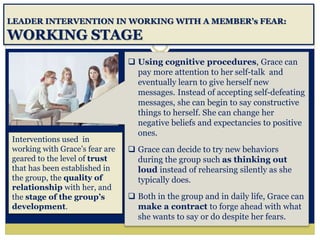
 Using cognitive procedures, Grace can
pay more attention to her self-talk and
eventually learn to give herself new
messages. Instead of accepting self-defeating
messages, she can begin to say constructive
things to herself. She can change her
negative beliefs and expectancies to positive
ones.
 Grace can decide to try new behaviors
during the group such as thinking out
loud instead of rehearsing silently as she
typically does.
 Both in the group and in daily life, Grace can
make a contract to forge ahead with what
she wants to say or do despite her fears.
Interventions used in
working with Grace’s fear are
geared to the level of trust
that has been established in
the group, the quality of
relationship with her, and
the stage of the group’s
development.
LEADER INTERVENTION IN WORKING WITH A MEMBER’s FEAR:
FINAL STAGE
 We ask Grace to reflect on how the changes
she has practiced in the group might affect
significant people in her life.
 Although Grace’s work may be effective in
her group, we caution her that these new
behaviors may not work as well in her
everyday life.
 In the final stage of the group, we emphasize
the importance for Grace to review what
she has learned, to understand how
she acquired these insights, and to
continue to translate her insights into
behavioral changes outside of the
group.
TASKS OF THE WORKING STAGE
Group Norms and Behavior
During the working stage, group norms that were formed in earlier stages
are further developed and solidified. Members are more aware of
facilitative behaviors, and unspoken norms become more explicit.
Both support and challenges to take risks in
group
Use of variety of therapeutic interventions
More direct interactions between members
Healing capacity within the group develops
Increased group cohesion fosters action-
oriented behaviors
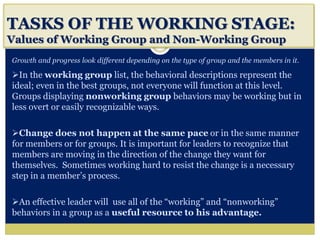
TASKS OF THE WORKING STAGE:
Values of Working Group and Non-Working Group
Growth and progress look different depending on the type of group and the members in it.
In the working group list, the behavioral descriptions represent the
ideal; even in the best groups, not everyone will function at this level.
Groups displaying nonworking group behaviors may be working but in
less overt or easily recognizable ways.
Change does not happen at the same pace or in the same manner
for members or for groups. It is important for leaders to recognize that
members are moving in the direction of the change they want for
themselves. Sometimes working hard to resist the change is a necessary
step in a member’s process.
An effective leader will use all of the “working” and “nonworking”
behaviors in a group as a useful resource to his advantage.
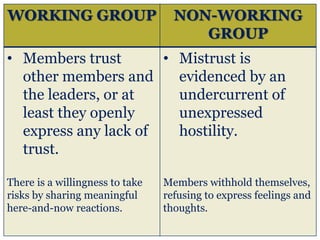
WORKING GROUP NON-WORKING
GROUP
• Members trust
other members and
the leaders, or at
least they openly
express any lack of
trust.
There is a willingness to take
risks by sharing meaningful
here-and-now reactions.
• Mistrust is
evidenced by an
undercurrent of
unexpressed
hostility.
Members withhold themselves,
refusing to express feelings and
thoughts.
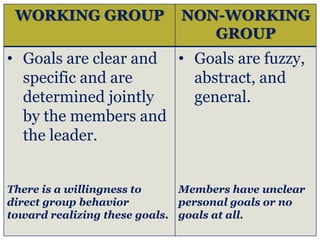
WORKING GROUP NON-WORKING
GROUP
• Goals are clear and
specific and are
determined jointly
by the members and
the leader.
There is a willingness to
direct group behavior
toward realizing these goals.
• Goals are fuzzy,
abstract, and
general.
Members have unclear
personal goals or no
goals at all.
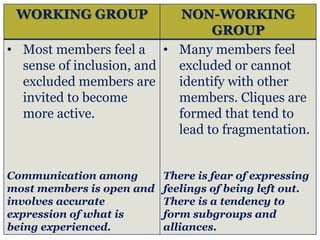
WORKING GROUP NON-WORKING
GROUP
• Most members feel a
sense of inclusion, and
excluded members are
invited to become
more active.
Communication among
most members is open and
involves accurate
expression of what is
being experienced.
• Many members feel
excluded or cannot
identify with other
members. Cliques are
formed that tend to
lead to fragmentation.
There is fear of expressing
feelings of being left out.
There is a tendency to
form subgroups and
alliances.
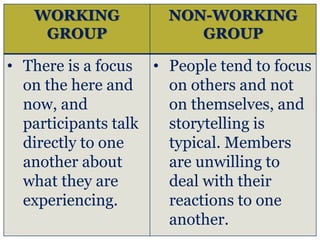
WORKING
GROUP
NON-WORKING
GROUP
• There is a focus
on the here and
now, and
participants talk
directly to one
another about
what they are
experiencing.
• People tend to focus
on others and not
on themselves, and
storytelling is
typical. Members
are unwilling to
deal with their
reactions to one
another.
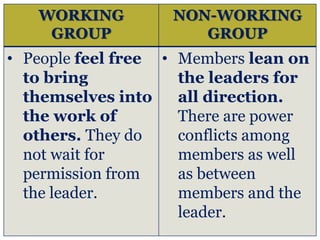
WORKING
GROUP
NON-WORKING
GROUP
• People feel free
to bring
themselves into
the work of
others. They do
not wait for
permission from
the leader.
• Members lean on
the leaders for
all direction.
There are power
conflicts among
members as well
as between
members and the
leader.
WORKING
GROUP
NON-WORKING
GROUP
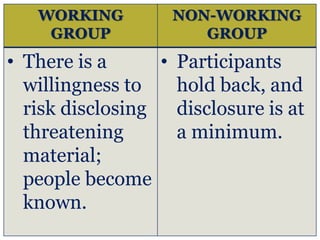
• There is a
willingness to
risk disclosing
threatening
material;
people become
known.
• Participants
hold back, and
disclosure is at
a minimum.
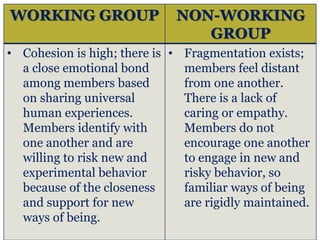
WORKING GROUP NON-WORKING
GROUP
• Cohesion is high; there is
a close emotional bond
among members based
on sharing universal
human experiences.
Members identify with
one another and are
willing to risk new and
experimental behavior
because of the closeness
and support for new
ways of being.
• Fragmentation exists;
members feel distant
from one another.
There is a lack of
caring or empathy.
Members do not
encourage one another
to engage in new and
risky behavior, so
familiar ways of being
are rigidly maintained.
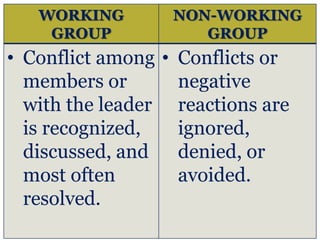
WORKING
GROUP
NON-WORKING
GROUP
• Conflict among
members or
with the leader
is recognized,
discussed, and
most often
resolved.
• Conflicts or
negative
reactions are
ignored,
denied, or
avoided.
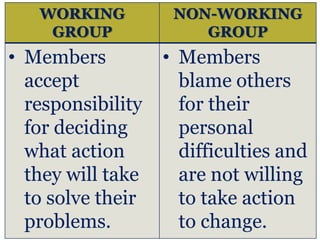
WORKING
GROUP
NON-WORKING
GROUP
• Members
accept
responsibility
for deciding
what action
they will take
to solve their
problems.
• Members
blame others
for their
personal
difficulties and
are not willing
to take action
to change.
WORKING GROUP NON-WORKING
GROUP
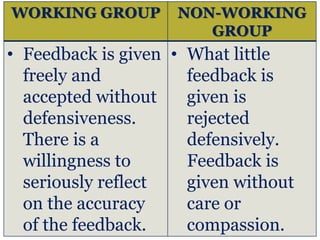
• Feedback is given
freely and
accepted without
defensiveness.
There is a
willingness to
seriously reflect
on the accuracy
of the feedback.
• What little
feedback is
given is
rejected
defensively.
Feedback is
given without
care or
compassion.
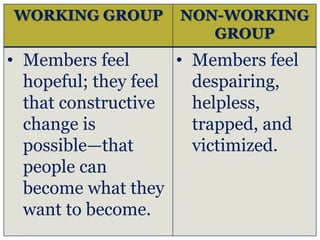
WORKING GROUP NON-WORKING
GROUP
• Members feel
hopeful; they feel
that constructive
change is
possible—that
people can
become what they
want to become.
• Members feel
despairing,
helpless,
trapped, and
victimized.
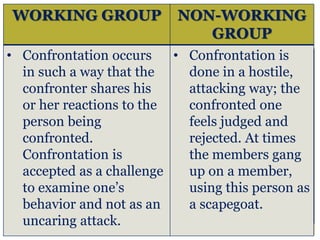
WORKING GROUP NON-WORKING
GROUP
• Confrontation occurs
in such a way that the
confronter shares his
or her reactions to the
person being
confronted.
Confrontation is
accepted as a challenge
to examine one’s
behavior and not as an
uncaring attack.
• Confrontation is
done in a hostile,
attacking way; the
confronted one
feels judged and
rejected. At times
the members gang
up on a member,
using this person as
a scapegoat.
WORKING
GROUP
NON-WORKING
GROUP
• Communication
is clear and
direct. There is a
minimum of
judgments and a
maximum of
respectful
discourse.
• Communication
is unclear and
indirect.
WORKING
GROUP
NON-WORKING
GROUP
• Group
members use
one another
as resources
and show
interest in
one another.
• Members are
interested
mostly in
themselves.
WORKING
GROUP
NON-WORKING
GROUP
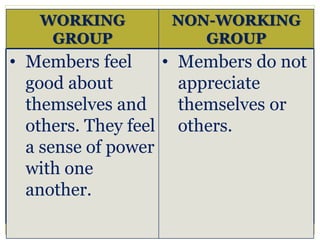
• Members feel
good about
themselves and
others. They feel
a sense of power
with one
another.
• Members do not
appreciate
themselves or
others.
WORKING
GROUP
NON-WORKING
GROUP
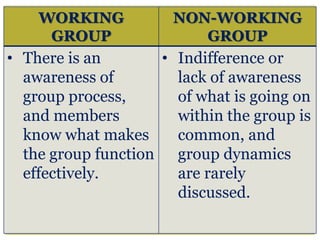
• There is an
awareness of
group process,
and members
know what makes
the group function
effectively.
• Indifference or
lack of awareness
of what is going on
within the group is
common, and
group dynamics
are rarely
discussed.
WORKING
GROUP
NON-WORKING
GROUP
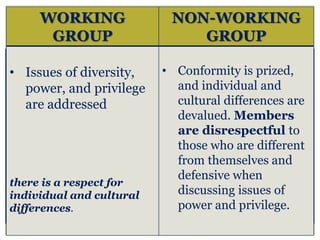
• Issues of diversity,
power, and privilege
are addressed
there is a respect for
individual and cultural
differences.
• Conformity is prized,
and individual and
cultural differences are
devalued. Members
are disrespectful to
those who are different
from themselves and
defensive when
discussing issues of
power and privilege.
WORKING
GROUP
NON-WORKING
GROUP
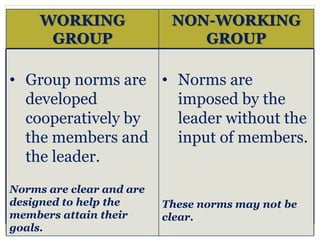
• Group norms are
developed
cooperatively by
the members and
the leader.
Norms are clear and are
designed to help the
members attain their
goals.
• Norms are
imposed by the
leader without the
input of members.
These norms may not be
clear.
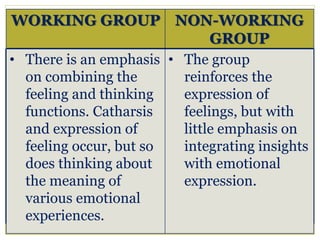
WORKING GROUP NON-WORKING
GROUP
• There is an emphasis
on combining the
feeling and thinking
functions. Catharsis
and expression of
feeling occur, but so
does thinking about
the meaning of
various emotional
experiences.
• The group
reinforces the
expression of
feelings, but with
little emphasis on
integrating insights
with emotional
expression.
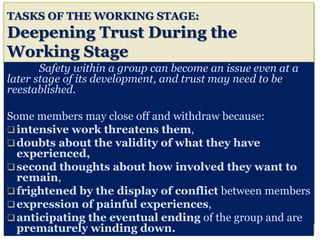
TASKS OF THE WORKING STAGE:
Deepening Trust During the
Working Stage
Safety within a group can become an issue even at a
later stage of its development, and trust may need to be
reestablished.
Some members may close off and withdraw because:
intensive work threatens them,
doubts about the validity of what they have
experienced,
second thoughts about how involved they want to
remain,
frightened by the display of conflict between members
expression of painful experiences,
anticipating the eventual ending of the group and are
prematurely winding down.
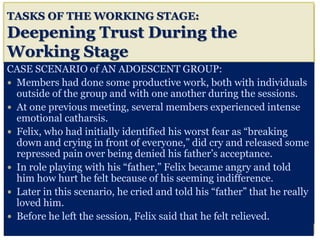
TASKS OF THE WORKING STAGE:
Deepening Trust During the
Working Stage
CASE SCENARIO of AN ADOESCENT GROUP:
 Members had done some productive work, both with individuals
outside of the group and with one another during the sessions.
 At one previous meeting, several members experienced intense
emotional catharsis.
 Felix, who had initially identified his worst fear as “breaking
down and crying in front of everyone,” did cry and released some
repressed pain over being denied his father’s acceptance.
 In role playing with his “father,” Felix became angry and told
him how hurt he felt because of his seeming indifference.
 Later in this scenario, he cried and told his “father” that he really
loved him.
 Before he left the session, Felix said that he felt relieved.
TASKS OF THE WORKING STAGE:
Deepening Trust During the
Working Stage
CASE SCENARIO:
 The session just described was characterized by a high level
of trust, risk-taking, caring, and cohesion.
 At the next session, however, the group leader was
surprised at how difficult it was to draw people out.
 Members were hesitant to speak. Felix said very little. The
leader described what she saw in the room and asked the
members what made it so hard to talk, especially in light of
the fact that the previous session had gone so well.
 Several members expressed annoyance, making comments
such as these: “Do we always have to bring up problems?”
“Do we need to cry to show that we’re good members?” “I
think you’re pushing people too hard.”
TASKS OF THE WORKING STAGE:
Deepening Trust During the
Working Stage
 Felix finally admitted that he had felt very embarrassed
over “breaking down” and that during the week he had
convinced himself that the other group members saw him
as weak and foolish.
 He added that in his culture men never show their tears in
public. Some others admitted that although they saw value
in what Felix had done they would not want to go through
what he had out of fear of what others might think of them.
 Again, the task of this group was to deal with the lack of
trust that members had in one another (“I’m afraid of what
others will think of me”).
 Several of the members’ statements implied a lack of trust
in the leader, which made it imperative that she encourage
the members to discuss this dynamic.
TASKS OF THE WORKING STAGE:
Deepening Trust During the
Working Stage
 In retrospect, what could the leader have done differently? It
is possible that Felix might have felt less embarrassed had the
leader remembered his original fear and dealt with it, and also
checked out some possible cultural injunctions against public
display of emotions.
 She might have said: “Felix, I remember that one of your fears was crying in the
presence of others. You just did. How was it for you to have done this?” She could
also have invited others to tell him how they had been affected by his work.
 Assume that Felix had said: “I feel good, and I got a lot from what I did.” Then the
leader might have replied: “Imagine two days from now, when you think about what
you did this morning. What do you imagine you might think, feel, or say to yourself?”
Felix might say: “I am likely to be critical of what I did here.”
 The leader could then suggest that if he catches himself
discounting his work it would be helpful to remember the
support he felt from everyone in the room and how they had
acknowledged his courage.
TASKS OF THE WORKING STAGE:
Deepening Trust During the
Working Stage
 On the other hand, assume that Felix had responded to
the leader’s inquiry by saying “I feel embarrassed” while
looking down at the floor.
 She might have replied: “I know how hard it was for you
to express yourself in this way. I really hope you won’t
run away. Would you be willing to look at different
people in this room, especially the ones whom you feel
most embarrassed with? What do you imagine they’re
saying about you right now?”
 After Felix told others what the imagined they were
thinking of him, they could be invited to give their honest
reactions.
 Typically, members do not make disparaging remarks
after someone has done significant work.
TASKS OF THE WORKING STAGE:
Deepening Trust During the
Working Stage
 As this example shows, it is not uncommon for the issue
of trust to resurface in an intense and productive session.
 After times like this, members may be frightened and
may have a tendency to retreat.
 Leaders who are aware of this tendency can take some
preventive measures. When a group does appear to
regress, the most critical intervention is for the leader to
describe what is happening and to get members to put to
words what they are observing, thinking, and feeling.
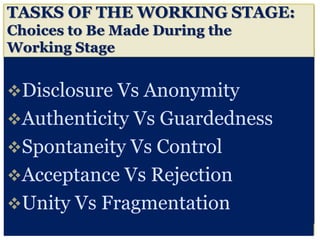
TASKS OF THE WORKING STAGE:
Choices to Be Made During the
Working Stage
Disclosure Vs Anonymity
Authenticity Vs Guardedness
Spontaneity Vs Control
Acceptance Vs Rejection
Unity Vs Fragmentation
TASKS OF THE WORKING STAGE:
Homework During the Working Stage
Group is not an end in itself
Group is a place to learn new behaviors and
acquire a range of skills in living. It is training
ground for everyday life.
Homework is a means for maximizing what is
learned in group.
 Members can device their own homework
assignments
 Ideally homework is designed collaboratively
between members and the leader
THERAPEUTIC FACTORS THAT
OPERATE IN A GROUP
Self-Disclosure and the Group
Member
Self-Disclosure and the Group
Leader
Feedback
Confrontation
Cohesion and Universality
Hope
Willing to Risk and to Trust
THERAPEUTIC FACTORS THAT
OPERATE IN A GROUP
Caring and Acceptance
Power
Catharsis
The Cognitive Component
Commitment to Change
Freedom to Experiment
Humor
i
THERAPEUTIC FACTORS THAT OPERATE IN A GROUP:
SELF-DISCLOSURE AND THE GROUP MEMBER
At a working stage, self-disclosure is more frequent and more
personal
Members are expected to self-disclose in a group; leaders
needs to teach and facilitate self-disclosure
Too much or too little disclosure can be counterproductive
Disclosure is not an end in itself; it is the means which opens
communication within the group
Group members develop a richer and more integrated
picture of who they are ; they recognize the impact they have
on others
Participants experience a healing force and gain new insights
i
THERAPEUTIC FACTORS THAT OPERATE IN A GROUP:
SELF-DISCLOSURE AND THE GROUP MEMBER
Self-disclosure entails revealing current struggles with
unresolved personal issues; goals and aspirations; fears and
expectations; hopes, pains, and joys; strengths and
weaknesses; and personal experiences.
Disclosure is not limited simply to reveal personal concerns
but it is equally important to disclose ongoing persistent
reactions toward other members and the leader
Self-disclosure among members are not equal because of
the many background differences
i
WHAT DISCLOSURE IS NOT
Self-disclosure is not merely telling
stories about one’s past in a rehearsed
and mechanical manner. It is not a
mere reporting of there-and-then
events.
A client needs to ask the question, “How
is what I reveal related to my present
conflicts?”
i
WHAT DISCLOSURE IS NOT
In the name of being open and honest and as
a result of the pressure of other group
members, people often say more than is
necessary for others to understand them.
They confuse being self-disclosing with
being open to the extent that nothing
remains private. As a result, they may feel
overly exposed in front of others
i
WHAT DISCLOSURE IS NOT
Expressing every fleeting feeling or reaction
to others is not to be confused with self-
disclosure.
Judgment is needed in deciding how
appropriate it is to share certain reactions.
Persistent reactions are generally best
shared, but people can be honest without
being tactless and insensitive.
i
GUIDELINES FOR APPROPRATE
MEMBER SELF-DISCLOSURE
The degree of self-disclosure should be related to the
purposes, goals, and type of the group.
If members have persistent reactions to certain people in
the group, members are encouraged to bring them out
into the open without blaming, especially when these
reactions are inhibiting their level of participation.
Members must determine what and how much they want
others to know about them. They also have to decide
what they are willing to risk and how far they are willing
to go.
i
GUIDELINES FOR APPROPRATE
MEMBER SELF-DISCLOSURE
Reasonable risks can be expected to accompany
self-disclosure. If groups are restricted to overly
safe disclosures, the interactions can become fairly
meaningless.
The stage of group development has some bearing
on the appropriateness of self-disclosure. Certain
disclosures may be too deep for an initial session
but quite appropriate during the working stage.
i
THERAPEUTIC FACTORS THAT OPERATE IN A GROUP:
SELF-DISCLOSURE AND THE GROUP LEADER
Appropriate leader self-disclosure can be used to model
risk-taking; may be a key element in joining and building
trust.
Decision to disclose is thought out by the leader ahead of
time; other times it is a more spontaneous contribution.
Some group leaders keep a minimum personal involvement
to avoid transference.
Experiential group leaders use self-disclosure for
therapeutic use
Person-centered/Existentialist/Gestalt group leaders use
SD to deepen the trust between members and leader; and to
provide modeling
i
THERAPEUTIC FACTORS THAT OPERATE IN A GROUP:
SELF-DISCLOSURE AND THE GROUP LEADER
Too much leader SD blurs the boundaries ; avoid becoming
a group member.
Leaders SDs should be appropriate, timely, helpful,
purposeful and done for the good of the group members.
GLs need to accurately assess their motivations for
engaging in SD and the impact of it on the group members.
Timing of SD and consider the type of group
The decision to SD should be based on your theoretical
orientation, your clinical intuition and the potential benefit
to the members.
i
THERAPEUTIC FACTORS THAT OPERATE IN A GROUP:
SELF-DISCLOSURE AND THE GROUP LEADER
4 GUIDELINES IN DETERMINING YOUR OWN
POSITION ON THE ISSUE OF LEADER SELF-
DISCLOSURE
1. If you determine that you have problems you wish
to explore, consider finding your own therapeutic
group.
2. Ask yourself why you are disclosing certain
personal material
3. Disclose that is related to what is going on in the
group is the most productive.
4. Ask yourself how much you want to reveal about
your private life
i
THERAPEUTIC FACTORS THAT OPERATE IN A GROUP:
SELF-DISCLOSURE AND THE GROUP LEADER
FORMULATION OF VIEWS
 How willing are you to share aspects of your personal life if
members ask you questions?
 How can you decide if revealing aspects of yourself would be
helpful to members?
 Do you consider it important to disclose what you are
experiencing if you are being triggered by the work of certain
members?
 How open would you want to be in letting members know of
your ongoing reactions to what is happening within the
group?
 • If you are having difficulty with a group member, are you
willing to let this member know how you are being affected?
i
THERAPEUTIC FACTORS THAT OPERATE IN A GROUP:
FEEDBACK
• Interpersonal feedback influences the development of many
therapeutic factors.
• Feedback occurs when group members or leaders share their
observations and personal reactions regarding the behavior
of another.
• Feedback has been associated with increased motivation for
change, greater insight into how one’s behavior affects
others, increased willingness to take risks, and group
members evaluating their group experience more positively.
• When feedback is given honestly and with sensitivity,
members are able to understand the impact they have on
others and decide what, if anything, they want to change
about their interpersonal style.
i
THERAPEUTIC FACTORS THAT OPERATE IN A GROUP:
FEEDBACK
• Through a process of feedback exchange, members
have opportunities to view their interpersonal style
from new perspectives and are able to make
meaningful changes in their behavior.
• The process of interpersonal feedback encourages
members to accept responsibility for the outcomes
of a group and for changing the style in which they
relate to others.
• Effective feedback is an important component of
the working stage.
i
THERAPEUTIC FACTORS THAT OPERATE IN A GROUP:
FEEDBACK
GUIDELINES FOT TEACHING FEEDBACK
 Clear and concise feedback is more helpful than
statements with qualifiers.
 In offering feedback to other group members,
share with them how they affect you rather than
giving them advice or judging them.
 Specific here-and-now feedback that pertains to
behavior in the group is especially useful.
i
THERAPEUTIC FACTORS THAT OPERATE IN A GROUP:
FEEDBACK
GUIDELINES FOT TEACHING FEEDBACK
 Feedback that is given in a timely and non-
judgmental way increases the chances that the
person receiving it will reflect on this information.
 Feedback that pertains to the interpersonal
relationship can be powerful.
 Addressing a person’s strengths rather than
concentrating exclusively on the difficulties you
are experiencing with this person can improve
reactions to that feedback
i
THERAPEUTIC FACTORS THAT OPERATE IN A GROUP:
CONFRONTATION
 Constructive confrontation is a form of
feedback that is a basic part of a productive
group, and also of any healthy relationship.
 It is through acts of caring and respectful
confrontation that members are invited to
examine discrepancies between what they
say and do, to become aware of potentials
that are dormant, and to find ways of
putting their insights into action.
i
THERAPEUTIC FACTORS THAT OPERATE IN A GROUP:
CONFRONTATION
 Sensitive confrontation by others helps
members develop the capacity for self-
confrontation, a skill they will need in
applying what they have learned to the
problems they face in their daily lives.
 This kind of feedback can result in
sustained behavior change.
i
THERAPEUTIC FACTORS THAT OPERATE IN A GROUP:
COHESION AND UNIVERSALITY
 Group cohesion is also a therapeutic factor in an effective working
group, providing a climate in which members feel free to do meaningful
work.
 Characteristics of a cohesive group include a climate of support,
bonding, sharing of experiences, mutuality within the group, a sense of
belonging, warmth and closeness, and caring and acceptance. Members’
willingness to let others know them in meaningful ways deepens the
level of trust, which allows for increased cohesion.
 Group cohesion fosters action-oriented behaviors such as self-disclosure,
giving and receiving feedback, discussion of here-and-now interactions,
the constructive expression of conflicts in the group, a willingness to
take risks, and translating insight into action.
i
THERAPEUTIC FACTORS THAT OPERATE IN A GROUP:
COHESION AND UNIVERSALITY
Highly cohesive groups tend to be characterized by
better attendance and less turnover.
Members of a cohesive group show greater
acceptance, intimacy, and understanding; cohesion
also helps members recognize and work through
conflicts. Members feel free to express anger and
deal with conflict if they feel a sense of commitment
to the group and if they perceive the group as a safe
place.
i
THERAPEUTIC FACTORS THAT OPERATE IN A GROUP:
COHESION AND UNIVERSALITY
At the working stage, members are able to see
commonalities, and they are often struck by the universality
of their life issues. The members come from all walks of life,
and they differ in many respects: age, sexual orientation,
social and cultural backgrounds, career paths, and level of
education.
In this stage, the group increased cohesion, the differences
recede into the background.
The leader can help the group achieve this level of cohesion
by focusing on the underlying issues, feelings, and needs
that the members seem to share.
i
THERAPEUTIC FACTORS THAT OPERATE IN A GROUP:
COHESION AND UNIVERSALITY
The leader can foster the development of cohesion by
pointing out the common themes that unite members of the
group.
Universal themes include remembering painful experiences
of childhood and adolescence, experiencing loneliness and
abandonment, becoming aware of the need for and fear of
love, learning to express feelings that have been blocked
from awareness, searching for meaning in life, recognizing
universal themes that link us together as humans,
recognizing unfinished business with parents, and seeking
meaningful connections with significant people.
i
THERAPEUTIC FACTORS THAT OPERATE IN A GROUP:
HOPE
Hope is the belief that change is possible.
Some people approach a group convinced
that they have absolutely no control of
external circumstances.
Members who are mandated to attend group
may feel extremely hopeless and be
convinced that nothing will really change.
i
THERAPEUTIC FACTORS THAT OPERATE IN A GROUP:
HOPE
In the group, however, they may encounter others
who have struggled and found ways to assume
effective control over their lives. Seeing and being
associated with such people can inspire a new sense
of optimism that their lives can be different.
Hope is therapeutic in itself because it gives
members confidence that they have the power to
choose to be different, or to change their life
circumstances.
i
THERAPEUTIC FACTORS THAT OPERATE IN A GROUP:
WILLINGNESS TO RISK AND TRUST
Risking involves opening oneself to others, being
vulnerable, and actively doing in a group what is
necessary for change.
Taking risks requires moving past what is known
and secure toward more uncertain terrain. If
members are primarily motivated to remain
comfortable, or if they are unwilling to risk
challenging themselves and others, they stand to
gain very little from the group.
i
THERAPEUTIC FACTORS THAT OPERATE IN A GROUP:
WILLINGNESS TO RISK AND TRUST
Members’ willingness to reveal themselves is largely
a function of how much they trust the other group
members and the leader.
The higher the level of trust in a group, the more
likely members are to push themselves beyond their
comfort level.
 From the outset, members can be invited to risk by
talking about their feelings of being in the group.
i
THERAPEUTIC FACTORS THAT OPERATE IN A GROUP:
WILLINGNESS TO RISK AND TRUST
By taking risks in disclosing here-and-now
observations and reactions, members are
actively creating trust and making it possible
to engage in deeper self-exploration.
Trust is a healing agent; it enables people to
show the many facets of themselves,
encourages experimental behavior, and
allows people to look at themselves in new
ways.
i
THERAPEUTIC FACTORS THAT OPERATE IN A GROUP:
CARING A ND ACCEPTANCE
Caring is demonstrated by listening and by
involvement. It can be expressed by
tenderness, compassion, support, and even
confrontation.
Caring implies acceptance, a genuine support
from others.
Acceptance involves affirming each person’s
right to have and express feelings and values.
i
THERAPEUTIC FACTORS THAT OPERATE IN A GROUP:
CARING A ND ACCEPTANCE
Caring and acceptance develop into empathy, a
deep understanding of another’s struggles.
Commonalities emerge in groups that unite the
members. The realization that certain problems are
universal—loneliness, the need for acceptance, the
fear of rejection, the fear of intimacy, hurt over past
experiences—lessens the feelings that we are alone.
Moreover, through identification with others we are
able to see ourselves more clearly.
i
THERAPEUTIC FACTORS THAT OPERATE IN A GROUP:
POWER
A feeling of power emerges from the recognition that one
has untapped internal reserves of spontaneity, creativity,
courage, and strength.
This strength is not a power over others; rather, it is the
sense that one has the resources necessary to direct one’s
own life.
In groups personal power is experienced in ways that were
formerly denied.
However, it is crucial for leaders to understand and
appreciate the context surrounding the lack of power that
some members may experience.
i
THERAPEUTIC FACTORS THAT OPERATE IN A GROUP:
CATHARSIS
Energy is tied up in withholding threatening
feelings. Unexpressed feelings often result in
physical symptoms such as chronic
headaches, stomach pains, muscle tension,
and high blood pressure. At times group
members say that they do not want to
remember painful feelings, not
understanding that the body can be carrying
the pain and giving expression to it with
various physical symptoms.
i
THERAPEUTIC FACTORS THAT OPERATE IN A GROUP:
CATHARSIS
When people finally do express their stored-up pain and
other unexpressed feelings, they typically report a
tremendous physical and emotional release, known as
catharsis.
Catharsis is frequently associated with the experiential
approaches, especially Gestalt therapy and psychodrama.
Although it is often healing, catharsis by itself is limited in
terms of producing long-lasting changes. Members need to
learn how to make sense of their catharsis, and one way of
doing so is by putting words to those intense emotions and
attempting to understand how they influence and control
their everyday behavior.
i
THERAPEUTIC FACTORS THAT OPERATE IN A GROUP:
THE COGNITIVE COMPONENT
The cognitive component includes explaining, clarifying,
interpreting, formulating ideas, and providing the cognitive
framework for creating a new perspective on problems.
The cognitive behavioral approaches stress the thinking and
doing aspects of behavior, and this emphasis can be
productively integrated into experientially oriented groups.
When asking members to cognitively process an emotional
experience, timing is crucial. If members are asked to make
sense of an intense emotional experience too quickly, they
may feel that the leader is insensitive.
i
THERAPEUTIC FACTORS THAT OPERATE IN A GROUP:
COMMITMENT TO CHANGE
The commitment to change involves members’
being willing to make use of the tools offered by
group process to explore ways of modifying their
behavior.
Participants need to remind themselves why they
are in the group, and they need to formulate action
plans and strategies to employ in their day-to-day
existence to implement change.
i
THERAPEUTIC FACTORS THAT OPERATE IN A GROUP:
COMMITMENT TO CHANGE
The group affords them the opportunity to plan realistically
and responsibly and offers members the opportunity to
evaluate the effectiveness of their actions.
 It is crucial for members to commit themselves to following
through on their plans, and the group itself can help
members develop the motivation to follow through with
their commitments.
If members find that carrying out some of their plans is
difficult or if they do not do what they had planned, it is
essential that they talk about these difficulties in the group
sessions.
i
THERAPEUTIC FACTORS THAT OPERATE IN A GROUP:
FREEDOM TO EXPERIMENT
The group situation provides a safe place for
experimentation with new behavior.
Members are able to show facets of themselves that they
often keep hidden in everyday situations.
In the accepting environment of a group, a shy member can
exhibit spontaneous behavior and be outgoing.
 A person who typically is very quiet may experiment with
being more verbal. After trying new behaviors, members can
gauge how much they want to change their existing
behavior.
i
THERAPEUTIC FACTORS THAT OPERATE IN A GROUP:
HUMOR
Humor can help group members get insight or a new
perspective on their problems, and it can be a source of
healing.
But humor should never be used to embarrass a group
member. Effective feedback can sometimes be given in a
humorous way.
Laughing at oneself and with others can be extremely
therapeutic. As a matter of fact, much has been written
about the healing effects of humor, and some workshops
focus on the therapeutic aspects of humor.
i
THERAPEUTIC FACTORS THAT OPERATE IN A GROUP:
HUMOR
Humor requires seeing one’s problems in a new perspective.
Laughter and humor can draw everyone in the group closer.
 Humor often puts problems in a new light, and it sets a tone
in a group indicating that work can occur in a context of fun.
The power of humor as a therapeutic tool is often
underrated. Humor often balances the relationship between
members and leaders, it can empower members, and it
establishes an environment that is maximally therapeutic to
members.
i
THERAPEUTIC FACTORS THAT OPERATE IN A GROUP:
HUMOR
Humor is a coping strategy that enables group members to
find the absurd or ironic aspects in their situations.
It also has a transformational character in that it enables
members to gain a sense of perspective and control over
situations not under their direct control.
Spontaneity seems to be the key to using humor effectively,
for “planned humor” can certainly fall at. A level of trust
must be established before taking too many liberties with
humor. This brand of humor is not laughing at people but
laughing with them out of a sense of affection and caring.
CO-LEADER ISSUES DURING THE
WORKING STAGE
Topics for Co-leader Meetings
Ongoing Evaluation of the Group
Discussion of Techniques
Theoretical Orientations
Self-Disclosure Issues
Confrontation Issues
Group Process:  Working Stage of a Group

Group Process: Working Stage of a Group

  • 1.
    WORKING STAGE OF AGROUP P R E S E N T E R : D E S I R E E O . L A B I O
  • 2.
    LEARNING OBJECTIVES 1. DescribeThe Dynamics Associated With Group Process And Development 2. Demonstrate Various Leader Interventions For Exploring A Member’s Fears At Various Stages Of A Group 3. Identify And Define The Key Characteristics Of A Group During The Working Stage 4. Highlight The Differences Between A Working Group And A Nonworking Group 5. Identify Ethical And Culturally Relevant Strategies For Designing And Facilitating Groups
  • 3.
    LEARNING OBJECTIVES 6. BecomeFamiliar With Choices To Be Made During The Working Stage 7. Discuss The Specific Therapeutic Factors And How They Contribute To Group Effectiveness 8. Present Guidelines For Member Self-disclosure 9. Present Guidelines For Leader Self-disclosure 10. Describe Guidelines For Giving And Receiving Feedback 11. Identify Co-leader Issues At The Working Stage
  • 4.
    INTRODUCTION The WORKING STAGEis characterized by : The commitment of members to explore significant problems. Participants have learned how to involve themselves in group interactions. No arbitrary dividing lines between each phase. Work can occur at every stage—not just the working stage. Not all groups may reach the working stage. Not all members function at the same level.
  • 5.
    PROGRESSING TO THE WORKINGSTAGE For a group to reach the working stage, it is essential that members make a commitment to face and work through barriers that interfere with the group’s progress. Meaningful work and learning occur at every stage of a group; however, deeper exploration and an increased level of group cohesion are typical of the working stage of a group.
  • 6.
    These interventions canhelp Frank and Judy go beyond complaining, explore the source of their dissatisfaction, and express what they would like to see happen. Therapeutic interventions  What would you like to see happening?  What can you do to make this group more productive for you?  Is there anything you can do to be more the type of member you want others to be?  You might have some reactions to the way I’m leading. Is there anything you need to say to me? Frank and Judy complain that the group is stagnant and that they are getting tired of it. They are likely to back off if the leader responds defensively.
  • 7.
    As Ryan talksabout his own reactions to Judy and Frank, he might well identify and get involved in his own issues in a deeply personal way, bringing into the group some unresolved business he has with others in his life. If the leader does not address Ryan’s sarcastic remarks, they most likely will have a negative impact on the group. The leader asks Ryan to make some direct statements to Frank and Judy instead of dismissing them. Ryan: “If you don’t like it, leave the group.”
  • 8.
    Each of theseinterventions has the potential for leading to greater exploration, which can assist Sunny in learning how she allows herself to be inhibited by her fear of others’ judgments. If she follows any of these leader suggestions, she has a basis for working through her fears. She will probably discover that she makes many unfounded assumptions about people. Therapeutic interventions  Would you be willing to talk to one person in here who you think might judge you? Tell that person all the things you imagine he or she would think about you?  Go around to each member and finish this sentence: ‘If I let you know me, I’m afraid you would judge me by...”  Would you be willing to close your eyes and imagine all the judgments people in here could possibly make about you? Don’t verbalize what you imagine, but do let yourself feel what it is like to be judged by everyone in the group. Sunny says that she is afraid of talking about herself in the group. A good place to begin is with her admission that she feels judged.
  • 9.
    This intervention canencourage Jennifer to work in greater depth on connecting her past and present outside life with reactions she is having in the here-and-now context of her group. Therapeutic interventions • The leader does not rush to convey that she is indeed a valued member, instead he asks Jennifer to talk directly to the members she believes get more of his attention. She talks about her feelings about being pushed aside. • At some point the leader intervenes, saying “I wonder if the feelings you are having in this group are familiar to you in your life outside of group?” Jennifer: “I never get any attention in the group, and you seem more attentive to other members.”
  • 10.
    If Jennifer acknowledgesthat she often feels ignored and pushed aside in her family of origin, especially by her father, the leader can give her an opportunity to continue her work by helping her explore some of the ways she might be identifying the leader with her father. Once Jennifer recognizes that she is mixing feelings toward the leader with feelings she has toward her father, she is freer to work on her issues with her father. She may discover that she is often overly sensitive to the ways older male authority figures interact with her.
  • 11.
    Jennifer’s declaration thatshe does not get proper attention in the group is a typical reaction during the transition stage. As the leader works with this feeling, Jennifer ends up having new insight regarding how she is making the group leader (and others) into her father. Jennifer’s insights and behavior changes are indicative of significant interaction in the working stage. The leader’s intervention did not entrench her feelings of being ignored further but resulted in some significant work on her part. In addition, she might well experience intense emotions over her feelings about her father, and she is likely to express and explore such painful feelings in the group. As a result of her work in the group, Jennifer now pays attention to how she feels when she is with her father and tries out new ways of responding to him. Because she is aware of her tendency to attribute certain qualities to men in authority, she is now in a position to react differently toward them.
  • 12.
    LEADER INTERVENTION INWORKING WITH A MEMBER’S FEAR She states that her fears get in the way of freely participating in the group. We find that group members often express a range of apprehensions similar to those disclosed by Grace, fearing that others will see them as stupid, incoherent, weird, selfish, and the like. The techniques we describe in working with Grace’s particular fear of being judged can easily be applied to these other fears. The way we work with her differs according to the depth of the relationship we have established with her. Grace: “I’m afraid people in here will be critical. I rehearse endlessly before I speak because I want to express myself clearly so others won’t think I’m incoherent.”
  • 13.
    LEADER INTERVENTION INWORKING WITH A MEMBER’S FEAR Interventions at different stages Initial Stage - interventions are aimed at providing encouragement Transition Stage - interventions demand more from the member than at the initial stage Working Stage - involves the entire group in a member’s personal work Final Stage - encourage members to see how the changes practiced in the group might affect significant people in their life
  • 14.
    LEADER INTERVENTION INWORKING WITH A MEMBER’s FEAR: INITIAL STAGE  We encourage other members to talk about any fears they have. If Susan also says that she fears others’ reactions, we can ask her to talk directly to Grace about her fears. (Aim: teaching member-to-member interaction.)  After the exchange between Susan and Grace, we ask, “Do any of the rest of you have similar feelings?” (Aim: to involve others in this interaction by stating ways in which they identify with Susan and Grace.)  Members who have fears that they would like to explore are invited to share their fears with Grace. We leave the structure open ended, so they can talk about whatever fears they are experiencing. (Aim: In a non-threatening way we link Grace’s work with that of others, and both trust and cohesion are being established.) During the initial stage, our interventions are aimed at providing encouragement for Grace to say more about her fear of being judged and to talk about how this fear is affecting what she is doing in the group. We facilitate a deeper exploration of her concern in any of the following ways:
  • 15.
    LEADER INTERVENTION INWORKING WITH A MEMBER’s FEAR: TRANSITION STAGE Grace: “I’m afraid people in here will be critical,”  When you have that fear, who are you most aware of in this room?  What are your fears about?  How have your fears stopped you in this group?  What are some of the things you have been thinking and feeling but have not expressed?
  • 16.
    LEADER INTERVENTION INWORKING WITH A MEMBER’S FEAR: TRANSITION STAGE  We can bring group members into this interaction by inviting them to give their reactions to what Grace has just said. The interchange between her and other members can lead to further exploration. Grace has probably created some distance between herself and others in the group by avoiding them out of fear of their negative reactions. By talking about her reactions to others, she is taking responsibility for the distance she has partially created. She can work out a new stance with those she has been avoiding.  Grace eventually indicates she is concerned about how three group members in particular will think about her and about how they might judge her. We suggest to Grace that she speak to the people she feels would most likely judge her and tell them what she imagines they are thinking and feeling about her. In this way we get Grace to acknowledge her possible projections and to learn how to check out her assumptions. We are also gathering data that can be useful for exploration later in the group.  The work that we have just described could be done during any stage. What makes this scenario characteristic of the transition stage is the fact that members are beginning to express reactions and perceptions that they have been aware of but have kept to themselves.
  • 17.
    LEADER INTERVENTION INWORKING WITH A MEMBER’S FEAR: WORKING STAGE If Grace discloses her fear during the working stage, we look for ways to involve the entire group in her work. Members may acknowledge how they feel put off by her, how they feel judged by her, or how they really do not know her.  By expressing feelings that they have kept to themselves, members are moving out of the transition stage and into the working stage.  They acknowledge reactions and perceptions, clear up projections and misunderstandings, and work through any possible conflict.  The group can get stuck in the transition stage if people do not go further and express reactions that have undermined their level of trust. A group moves into the working stage as members commit to working through an impasse, particularly their own end of it.
  • 18.
    LEADER INTERVENTION INWORKING WITH A MEMBER’s FEAR: WORKING STAGE Other techniques to help Grace attain a deeper level of self- exploration.  Ask her to identify people in her life who she feels have judged her, enabling her to connect her past struggles to her present ones.  Ask her to tell some members how she has felt toward significant people in her life. She may even let others in the group “become” these significant figures and may say things to them that she has kept to herself.
  • 19.
    LEADER INTERVENTION INWORKING WITH A MEMBER’s FEAR: WORKING STAGE OTHER STRATEGIES:  Grace can be invited to simply talk more about what it is like for her to be in this group with these fears. “What have you wanted to say or do that you were afraid to say or do?” “If you didn’t have the fear of being judged, how might you be different in this group?”  Grace can role-play with a member who reminds her of her mother, who often cautioned her about thinking before she speaks.
  • 20.
    LEADER INTERVENTION INWORKING WITH A MEMBER’s FEAR: WORKING STAGE  Grace can write an uncensored letter to her mother, which she does not mail.  By using role reversal, Grace can “become” her mother and go around to each person in the room, telling them how they should behave.  Grace can monitor her own behavior between group sessions, taking special note of those situations in daily life in which she stops herself because of her fear of being judged.
  • 21.
    LEADER INTERVENTION INWORKING WITH A MEMBER’s FEAR: WORKING STAGE  Using cognitive procedures, Grace can pay more attention to her self-talk and eventually learn to give herself new messages. Instead of accepting self-defeating messages, she can begin to say constructive things to herself. She can change her negative beliefs and expectancies to positive ones.  Grace can decide to try new behaviors during the group such as thinking out loud instead of rehearsing silently as she typically does.  Both in the group and in daily life, Grace can make a contract to forge ahead with what she wants to say or do despite her fears. Interventions used in working with Grace’s fear are geared to the level of trust that has been established in the group, the quality of relationship with her, and the stage of the group’s development.
  • 22.
    LEADER INTERVENTION INWORKING WITH A MEMBER’s FEAR: FINAL STAGE  We ask Grace to reflect on how the changes she has practiced in the group might affect significant people in her life.  Although Grace’s work may be effective in her group, we caution her that these new behaviors may not work as well in her everyday life.  In the final stage of the group, we emphasize the importance for Grace to review what she has learned, to understand how she acquired these insights, and to continue to translate her insights into behavioral changes outside of the group.
  • 23.
    TASKS OF THEWORKING STAGE Group Norms and Behavior During the working stage, group norms that were formed in earlier stages are further developed and solidified. Members are more aware of facilitative behaviors, and unspoken norms become more explicit. Both support and challenges to take risks in group Use of variety of therapeutic interventions More direct interactions between members Healing capacity within the group develops Increased group cohesion fosters action- oriented behaviors
  • 24.
    TASKS OF THEWORKING STAGE: Values of Working Group and Non-Working Group Growth and progress look different depending on the type of group and the members in it. In the working group list, the behavioral descriptions represent the ideal; even in the best groups, not everyone will function at this level. Groups displaying nonworking group behaviors may be working but in less overt or easily recognizable ways. Change does not happen at the same pace or in the same manner for members or for groups. It is important for leaders to recognize that members are moving in the direction of the change they want for themselves. Sometimes working hard to resist the change is a necessary step in a member’s process. An effective leader will use all of the “working” and “nonworking” behaviors in a group as a useful resource to his advantage.
  • 25.
    WORKING GROUP NON-WORKING GROUP •Members trust other members and the leaders, or at least they openly express any lack of trust. There is a willingness to take risks by sharing meaningful here-and-now reactions. • Mistrust is evidenced by an undercurrent of unexpressed hostility. Members withhold themselves, refusing to express feelings and thoughts.
  • 26.
    WORKING GROUP NON-WORKING GROUP •Goals are clear and specific and are determined jointly by the members and the leader. There is a willingness to direct group behavior toward realizing these goals. • Goals are fuzzy, abstract, and general. Members have unclear personal goals or no goals at all.
  • 27.
    WORKING GROUP NON-WORKING GROUP •Most members feel a sense of inclusion, and excluded members are invited to become more active. Communication among most members is open and involves accurate expression of what is being experienced. • Many members feel excluded or cannot identify with other members. Cliques are formed that tend to lead to fragmentation. There is fear of expressing feelings of being left out. There is a tendency to form subgroups and alliances.
  • 28.
    WORKING GROUP NON-WORKING GROUP • There isa focus on the here and now, and participants talk directly to one another about what they are experiencing. • People tend to focus on others and not on themselves, and storytelling is typical. Members are unwilling to deal with their reactions to one another.
  • 29.
    WORKING GROUP NON-WORKING GROUP • People feelfree to bring themselves into the work of others. They do not wait for permission from the leader. • Members lean on the leaders for all direction. There are power conflicts among members as well as between members and the leader.
  • 30.
    WORKING GROUP NON-WORKING GROUP • There isa willingness to risk disclosing threatening material; people become known. • Participants hold back, and disclosure is at a minimum.
  • 31.
    WORKING GROUP NON-WORKING GROUP •Cohesion is high; there is a close emotional bond among members based on sharing universal human experiences. Members identify with one another and are willing to risk new and experimental behavior because of the closeness and support for new ways of being. • Fragmentation exists; members feel distant from one another. There is a lack of caring or empathy. Members do not encourage one another to engage in new and risky behavior, so familiar ways of being are rigidly maintained.
  • 32.
    WORKING GROUP NON-WORKING GROUP • Conflict among membersor with the leader is recognized, discussed, and most often resolved. • Conflicts or negative reactions are ignored, denied, or avoided.
  • 33.
    WORKING GROUP NON-WORKING GROUP • Members accept responsibility for deciding whataction they will take to solve their problems. • Members blame others for their personal difficulties and are not willing to take action to change.
  • 34.
    WORKING GROUP NON-WORKING GROUP •Feedback is given freely and accepted without defensiveness. There is a willingness to seriously reflect on the accuracy of the feedback. • What little feedback is given is rejected defensively. Feedback is given without care or compassion.
  • 35.
    WORKING GROUP NON-WORKING GROUP •Members feel hopeful; they feel that constructive change is possible—that people can become what they want to become. • Members feel despairing, helpless, trapped, and victimized.
  • 36.
    WORKING GROUP NON-WORKING GROUP •Confrontation occurs in such a way that the confronter shares his or her reactions to the person being confronted. Confrontation is accepted as a challenge to examine one’s behavior and not as an uncaring attack. • Confrontation is done in a hostile, attacking way; the confronted one feels judged and rejected. At times the members gang up on a member, using this person as a scapegoat.
  • 37.
    WORKING GROUP NON-WORKING GROUP • Communication is clearand direct. There is a minimum of judgments and a maximum of respectful discourse. • Communication is unclear and indirect.
  • 38.
    WORKING GROUP NON-WORKING GROUP • Group members use oneanother as resources and show interest in one another. • Members are interested mostly in themselves.
  • 39.
    WORKING GROUP NON-WORKING GROUP • Members feel goodabout themselves and others. They feel a sense of power with one another. • Members do not appreciate themselves or others.
  • 40.
    WORKING GROUP NON-WORKING GROUP • There isan awareness of group process, and members know what makes the group function effectively. • Indifference or lack of awareness of what is going on within the group is common, and group dynamics are rarely discussed.
  • 41.
    WORKING GROUP NON-WORKING GROUP • Issues ofdiversity, power, and privilege are addressed there is a respect for individual and cultural differences. • Conformity is prized, and individual and cultural differences are devalued. Members are disrespectful to those who are different from themselves and defensive when discussing issues of power and privilege.
  • 42.
    WORKING GROUP NON-WORKING GROUP • Group normsare developed cooperatively by the members and the leader. Norms are clear and are designed to help the members attain their goals. • Norms are imposed by the leader without the input of members. These norms may not be clear.
  • 43.
    WORKING GROUP NON-WORKING GROUP •There is an emphasis on combining the feeling and thinking functions. Catharsis and expression of feeling occur, but so does thinking about the meaning of various emotional experiences. • The group reinforces the expression of feelings, but with little emphasis on integrating insights with emotional expression.
  • 44.
    TASKS OF THEWORKING STAGE: Deepening Trust During the Working Stage Safety within a group can become an issue even at a later stage of its development, and trust may need to be reestablished. Some members may close off and withdraw because: intensive work threatens them, doubts about the validity of what they have experienced, second thoughts about how involved they want to remain, frightened by the display of conflict between members expression of painful experiences, anticipating the eventual ending of the group and are prematurely winding down.
  • 45.
    TASKS OF THEWORKING STAGE: Deepening Trust During the Working Stage CASE SCENARIO of AN ADOESCENT GROUP:  Members had done some productive work, both with individuals outside of the group and with one another during the sessions.  At one previous meeting, several members experienced intense emotional catharsis.  Felix, who had initially identified his worst fear as “breaking down and crying in front of everyone,” did cry and released some repressed pain over being denied his father’s acceptance.  In role playing with his “father,” Felix became angry and told him how hurt he felt because of his seeming indifference.  Later in this scenario, he cried and told his “father” that he really loved him.  Before he left the session, Felix said that he felt relieved.
  • 46.
    TASKS OF THEWORKING STAGE: Deepening Trust During the Working Stage CASE SCENARIO:  The session just described was characterized by a high level of trust, risk-taking, caring, and cohesion.  At the next session, however, the group leader was surprised at how difficult it was to draw people out.  Members were hesitant to speak. Felix said very little. The leader described what she saw in the room and asked the members what made it so hard to talk, especially in light of the fact that the previous session had gone so well.  Several members expressed annoyance, making comments such as these: “Do we always have to bring up problems?” “Do we need to cry to show that we’re good members?” “I think you’re pushing people too hard.”
  • 47.
    TASKS OF THEWORKING STAGE: Deepening Trust During the Working Stage  Felix finally admitted that he had felt very embarrassed over “breaking down” and that during the week he had convinced himself that the other group members saw him as weak and foolish.  He added that in his culture men never show their tears in public. Some others admitted that although they saw value in what Felix had done they would not want to go through what he had out of fear of what others might think of them.  Again, the task of this group was to deal with the lack of trust that members had in one another (“I’m afraid of what others will think of me”).  Several of the members’ statements implied a lack of trust in the leader, which made it imperative that she encourage the members to discuss this dynamic.
  • 48.
    TASKS OF THEWORKING STAGE: Deepening Trust During the Working Stage  In retrospect, what could the leader have done differently? It is possible that Felix might have felt less embarrassed had the leader remembered his original fear and dealt with it, and also checked out some possible cultural injunctions against public display of emotions.  She might have said: “Felix, I remember that one of your fears was crying in the presence of others. You just did. How was it for you to have done this?” She could also have invited others to tell him how they had been affected by his work.  Assume that Felix had said: “I feel good, and I got a lot from what I did.” Then the leader might have replied: “Imagine two days from now, when you think about what you did this morning. What do you imagine you might think, feel, or say to yourself?” Felix might say: “I am likely to be critical of what I did here.”  The leader could then suggest that if he catches himself discounting his work it would be helpful to remember the support he felt from everyone in the room and how they had acknowledged his courage.
  • 49.
    TASKS OF THEWORKING STAGE: Deepening Trust During the Working Stage  On the other hand, assume that Felix had responded to the leader’s inquiry by saying “I feel embarrassed” while looking down at the floor.  She might have replied: “I know how hard it was for you to express yourself in this way. I really hope you won’t run away. Would you be willing to look at different people in this room, especially the ones whom you feel most embarrassed with? What do you imagine they’re saying about you right now?”  After Felix told others what the imagined they were thinking of him, they could be invited to give their honest reactions.  Typically, members do not make disparaging remarks after someone has done significant work.
  • 50.
    TASKS OF THEWORKING STAGE: Deepening Trust During the Working Stage  As this example shows, it is not uncommon for the issue of trust to resurface in an intense and productive session.  After times like this, members may be frightened and may have a tendency to retreat.  Leaders who are aware of this tendency can take some preventive measures. When a group does appear to regress, the most critical intervention is for the leader to describe what is happening and to get members to put to words what they are observing, thinking, and feeling.
  • 51.
    TASKS OF THEWORKING STAGE: Choices to Be Made During the Working Stage Disclosure Vs Anonymity Authenticity Vs Guardedness Spontaneity Vs Control Acceptance Vs Rejection Unity Vs Fragmentation
  • 52.
    TASKS OF THEWORKING STAGE: Homework During the Working Stage Group is not an end in itself Group is a place to learn new behaviors and acquire a range of skills in living. It is training ground for everyday life. Homework is a means for maximizing what is learned in group.  Members can device their own homework assignments  Ideally homework is designed collaboratively between members and the leader
  • 53.
    THERAPEUTIC FACTORS THAT OPERATEIN A GROUP Self-Disclosure and the Group Member Self-Disclosure and the Group Leader Feedback Confrontation Cohesion and Universality Hope Willing to Risk and to Trust
  • 54.
    THERAPEUTIC FACTORS THAT OPERATEIN A GROUP Caring and Acceptance Power Catharsis The Cognitive Component Commitment to Change Freedom to Experiment Humor
  • 55.
    i THERAPEUTIC FACTORS THATOPERATE IN A GROUP: SELF-DISCLOSURE AND THE GROUP MEMBER At a working stage, self-disclosure is more frequent and more personal Members are expected to self-disclose in a group; leaders needs to teach and facilitate self-disclosure Too much or too little disclosure can be counterproductive Disclosure is not an end in itself; it is the means which opens communication within the group Group members develop a richer and more integrated picture of who they are ; they recognize the impact they have on others Participants experience a healing force and gain new insights
  • 56.
    i THERAPEUTIC FACTORS THATOPERATE IN A GROUP: SELF-DISCLOSURE AND THE GROUP MEMBER Self-disclosure entails revealing current struggles with unresolved personal issues; goals and aspirations; fears and expectations; hopes, pains, and joys; strengths and weaknesses; and personal experiences. Disclosure is not limited simply to reveal personal concerns but it is equally important to disclose ongoing persistent reactions toward other members and the leader Self-disclosure among members are not equal because of the many background differences
  • 57.
    i WHAT DISCLOSURE ISNOT Self-disclosure is not merely telling stories about one’s past in a rehearsed and mechanical manner. It is not a mere reporting of there-and-then events. A client needs to ask the question, “How is what I reveal related to my present conflicts?”
  • 58.
    i WHAT DISCLOSURE ISNOT In the name of being open and honest and as a result of the pressure of other group members, people often say more than is necessary for others to understand them. They confuse being self-disclosing with being open to the extent that nothing remains private. As a result, they may feel overly exposed in front of others
  • 59.
    i WHAT DISCLOSURE ISNOT Expressing every fleeting feeling or reaction to others is not to be confused with self- disclosure. Judgment is needed in deciding how appropriate it is to share certain reactions. Persistent reactions are generally best shared, but people can be honest without being tactless and insensitive.
  • 60.
    i GUIDELINES FOR APPROPRATE MEMBERSELF-DISCLOSURE The degree of self-disclosure should be related to the purposes, goals, and type of the group. If members have persistent reactions to certain people in the group, members are encouraged to bring them out into the open without blaming, especially when these reactions are inhibiting their level of participation. Members must determine what and how much they want others to know about them. They also have to decide what they are willing to risk and how far they are willing to go.
  • 61.
    i GUIDELINES FOR APPROPRATE MEMBERSELF-DISCLOSURE Reasonable risks can be expected to accompany self-disclosure. If groups are restricted to overly safe disclosures, the interactions can become fairly meaningless. The stage of group development has some bearing on the appropriateness of self-disclosure. Certain disclosures may be too deep for an initial session but quite appropriate during the working stage.
  • 62.
    i THERAPEUTIC FACTORS THATOPERATE IN A GROUP: SELF-DISCLOSURE AND THE GROUP LEADER Appropriate leader self-disclosure can be used to model risk-taking; may be a key element in joining and building trust. Decision to disclose is thought out by the leader ahead of time; other times it is a more spontaneous contribution. Some group leaders keep a minimum personal involvement to avoid transference. Experiential group leaders use self-disclosure for therapeutic use Person-centered/Existentialist/Gestalt group leaders use SD to deepen the trust between members and leader; and to provide modeling
  • 63.
    i THERAPEUTIC FACTORS THATOPERATE IN A GROUP: SELF-DISCLOSURE AND THE GROUP LEADER Too much leader SD blurs the boundaries ; avoid becoming a group member. Leaders SDs should be appropriate, timely, helpful, purposeful and done for the good of the group members. GLs need to accurately assess their motivations for engaging in SD and the impact of it on the group members. Timing of SD and consider the type of group The decision to SD should be based on your theoretical orientation, your clinical intuition and the potential benefit to the members.
  • 64.
    i THERAPEUTIC FACTORS THATOPERATE IN A GROUP: SELF-DISCLOSURE AND THE GROUP LEADER 4 GUIDELINES IN DETERMINING YOUR OWN POSITION ON THE ISSUE OF LEADER SELF- DISCLOSURE 1. If you determine that you have problems you wish to explore, consider finding your own therapeutic group. 2. Ask yourself why you are disclosing certain personal material 3. Disclose that is related to what is going on in the group is the most productive. 4. Ask yourself how much you want to reveal about your private life
  • 65.
    i THERAPEUTIC FACTORS THATOPERATE IN A GROUP: SELF-DISCLOSURE AND THE GROUP LEADER FORMULATION OF VIEWS  How willing are you to share aspects of your personal life if members ask you questions?  How can you decide if revealing aspects of yourself would be helpful to members?  Do you consider it important to disclose what you are experiencing if you are being triggered by the work of certain members?  How open would you want to be in letting members know of your ongoing reactions to what is happening within the group?  • If you are having difficulty with a group member, are you willing to let this member know how you are being affected?
  • 66.
    i THERAPEUTIC FACTORS THATOPERATE IN A GROUP: FEEDBACK • Interpersonal feedback influences the development of many therapeutic factors. • Feedback occurs when group members or leaders share their observations and personal reactions regarding the behavior of another. • Feedback has been associated with increased motivation for change, greater insight into how one’s behavior affects others, increased willingness to take risks, and group members evaluating their group experience more positively. • When feedback is given honestly and with sensitivity, members are able to understand the impact they have on others and decide what, if anything, they want to change about their interpersonal style.
  • 67.
    i THERAPEUTIC FACTORS THATOPERATE IN A GROUP: FEEDBACK • Through a process of feedback exchange, members have opportunities to view their interpersonal style from new perspectives and are able to make meaningful changes in their behavior. • The process of interpersonal feedback encourages members to accept responsibility for the outcomes of a group and for changing the style in which they relate to others. • Effective feedback is an important component of the working stage.
  • 68.
    i THERAPEUTIC FACTORS THATOPERATE IN A GROUP: FEEDBACK GUIDELINES FOT TEACHING FEEDBACK  Clear and concise feedback is more helpful than statements with qualifiers.  In offering feedback to other group members, share with them how they affect you rather than giving them advice or judging them.  Specific here-and-now feedback that pertains to behavior in the group is especially useful.
  • 69.
    i THERAPEUTIC FACTORS THATOPERATE IN A GROUP: FEEDBACK GUIDELINES FOT TEACHING FEEDBACK  Feedback that is given in a timely and non- judgmental way increases the chances that the person receiving it will reflect on this information.  Feedback that pertains to the interpersonal relationship can be powerful.  Addressing a person’s strengths rather than concentrating exclusively on the difficulties you are experiencing with this person can improve reactions to that feedback
  • 70.
    i THERAPEUTIC FACTORS THATOPERATE IN A GROUP: CONFRONTATION  Constructive confrontation is a form of feedback that is a basic part of a productive group, and also of any healthy relationship.  It is through acts of caring and respectful confrontation that members are invited to examine discrepancies between what they say and do, to become aware of potentials that are dormant, and to find ways of putting their insights into action.
  • 71.
    i THERAPEUTIC FACTORS THATOPERATE IN A GROUP: CONFRONTATION  Sensitive confrontation by others helps members develop the capacity for self- confrontation, a skill they will need in applying what they have learned to the problems they face in their daily lives.  This kind of feedback can result in sustained behavior change.
  • 72.
    i THERAPEUTIC FACTORS THATOPERATE IN A GROUP: COHESION AND UNIVERSALITY  Group cohesion is also a therapeutic factor in an effective working group, providing a climate in which members feel free to do meaningful work.  Characteristics of a cohesive group include a climate of support, bonding, sharing of experiences, mutuality within the group, a sense of belonging, warmth and closeness, and caring and acceptance. Members’ willingness to let others know them in meaningful ways deepens the level of trust, which allows for increased cohesion.  Group cohesion fosters action-oriented behaviors such as self-disclosure, giving and receiving feedback, discussion of here-and-now interactions, the constructive expression of conflicts in the group, a willingness to take risks, and translating insight into action.
  • 73.
    i THERAPEUTIC FACTORS THATOPERATE IN A GROUP: COHESION AND UNIVERSALITY Highly cohesive groups tend to be characterized by better attendance and less turnover. Members of a cohesive group show greater acceptance, intimacy, and understanding; cohesion also helps members recognize and work through conflicts. Members feel free to express anger and deal with conflict if they feel a sense of commitment to the group and if they perceive the group as a safe place.
  • 74.
    i THERAPEUTIC FACTORS THATOPERATE IN A GROUP: COHESION AND UNIVERSALITY At the working stage, members are able to see commonalities, and they are often struck by the universality of their life issues. The members come from all walks of life, and they differ in many respects: age, sexual orientation, social and cultural backgrounds, career paths, and level of education. In this stage, the group increased cohesion, the differences recede into the background. The leader can help the group achieve this level of cohesion by focusing on the underlying issues, feelings, and needs that the members seem to share.
  • 75.
    i THERAPEUTIC FACTORS THATOPERATE IN A GROUP: COHESION AND UNIVERSALITY The leader can foster the development of cohesion by pointing out the common themes that unite members of the group. Universal themes include remembering painful experiences of childhood and adolescence, experiencing loneliness and abandonment, becoming aware of the need for and fear of love, learning to express feelings that have been blocked from awareness, searching for meaning in life, recognizing universal themes that link us together as humans, recognizing unfinished business with parents, and seeking meaningful connections with significant people.
  • 76.
    i THERAPEUTIC FACTORS THATOPERATE IN A GROUP: HOPE Hope is the belief that change is possible. Some people approach a group convinced that they have absolutely no control of external circumstances. Members who are mandated to attend group may feel extremely hopeless and be convinced that nothing will really change.
  • 77.
    i THERAPEUTIC FACTORS THATOPERATE IN A GROUP: HOPE In the group, however, they may encounter others who have struggled and found ways to assume effective control over their lives. Seeing and being associated with such people can inspire a new sense of optimism that their lives can be different. Hope is therapeutic in itself because it gives members confidence that they have the power to choose to be different, or to change their life circumstances.
  • 78.
    i THERAPEUTIC FACTORS THATOPERATE IN A GROUP: WILLINGNESS TO RISK AND TRUST Risking involves opening oneself to others, being vulnerable, and actively doing in a group what is necessary for change. Taking risks requires moving past what is known and secure toward more uncertain terrain. If members are primarily motivated to remain comfortable, or if they are unwilling to risk challenging themselves and others, they stand to gain very little from the group.
  • 79.
    i THERAPEUTIC FACTORS THATOPERATE IN A GROUP: WILLINGNESS TO RISK AND TRUST Members’ willingness to reveal themselves is largely a function of how much they trust the other group members and the leader. The higher the level of trust in a group, the more likely members are to push themselves beyond their comfort level.  From the outset, members can be invited to risk by talking about their feelings of being in the group.
  • 80.
    i THERAPEUTIC FACTORS THATOPERATE IN A GROUP: WILLINGNESS TO RISK AND TRUST By taking risks in disclosing here-and-now observations and reactions, members are actively creating trust and making it possible to engage in deeper self-exploration. Trust is a healing agent; it enables people to show the many facets of themselves, encourages experimental behavior, and allows people to look at themselves in new ways.
  • 81.
    i THERAPEUTIC FACTORS THATOPERATE IN A GROUP: CARING A ND ACCEPTANCE Caring is demonstrated by listening and by involvement. It can be expressed by tenderness, compassion, support, and even confrontation. Caring implies acceptance, a genuine support from others. Acceptance involves affirming each person’s right to have and express feelings and values.
  • 82.
    i THERAPEUTIC FACTORS THATOPERATE IN A GROUP: CARING A ND ACCEPTANCE Caring and acceptance develop into empathy, a deep understanding of another’s struggles. Commonalities emerge in groups that unite the members. The realization that certain problems are universal—loneliness, the need for acceptance, the fear of rejection, the fear of intimacy, hurt over past experiences—lessens the feelings that we are alone. Moreover, through identification with others we are able to see ourselves more clearly.
  • 83.
    i THERAPEUTIC FACTORS THATOPERATE IN A GROUP: POWER A feeling of power emerges from the recognition that one has untapped internal reserves of spontaneity, creativity, courage, and strength. This strength is not a power over others; rather, it is the sense that one has the resources necessary to direct one’s own life. In groups personal power is experienced in ways that were formerly denied. However, it is crucial for leaders to understand and appreciate the context surrounding the lack of power that some members may experience.
  • 84.
    i THERAPEUTIC FACTORS THATOPERATE IN A GROUP: CATHARSIS Energy is tied up in withholding threatening feelings. Unexpressed feelings often result in physical symptoms such as chronic headaches, stomach pains, muscle tension, and high blood pressure. At times group members say that they do not want to remember painful feelings, not understanding that the body can be carrying the pain and giving expression to it with various physical symptoms.
  • 85.
    i THERAPEUTIC FACTORS THATOPERATE IN A GROUP: CATHARSIS When people finally do express their stored-up pain and other unexpressed feelings, they typically report a tremendous physical and emotional release, known as catharsis. Catharsis is frequently associated with the experiential approaches, especially Gestalt therapy and psychodrama. Although it is often healing, catharsis by itself is limited in terms of producing long-lasting changes. Members need to learn how to make sense of their catharsis, and one way of doing so is by putting words to those intense emotions and attempting to understand how they influence and control their everyday behavior.
  • 86.
    i THERAPEUTIC FACTORS THATOPERATE IN A GROUP: THE COGNITIVE COMPONENT The cognitive component includes explaining, clarifying, interpreting, formulating ideas, and providing the cognitive framework for creating a new perspective on problems. The cognitive behavioral approaches stress the thinking and doing aspects of behavior, and this emphasis can be productively integrated into experientially oriented groups. When asking members to cognitively process an emotional experience, timing is crucial. If members are asked to make sense of an intense emotional experience too quickly, they may feel that the leader is insensitive.
  • 87.
    i THERAPEUTIC FACTORS THATOPERATE IN A GROUP: COMMITMENT TO CHANGE The commitment to change involves members’ being willing to make use of the tools offered by group process to explore ways of modifying their behavior. Participants need to remind themselves why they are in the group, and they need to formulate action plans and strategies to employ in their day-to-day existence to implement change.
  • 88.
    i THERAPEUTIC FACTORS THATOPERATE IN A GROUP: COMMITMENT TO CHANGE The group affords them the opportunity to plan realistically and responsibly and offers members the opportunity to evaluate the effectiveness of their actions.  It is crucial for members to commit themselves to following through on their plans, and the group itself can help members develop the motivation to follow through with their commitments. If members find that carrying out some of their plans is difficult or if they do not do what they had planned, it is essential that they talk about these difficulties in the group sessions.
  • 89.
    i THERAPEUTIC FACTORS THATOPERATE IN A GROUP: FREEDOM TO EXPERIMENT The group situation provides a safe place for experimentation with new behavior. Members are able to show facets of themselves that they often keep hidden in everyday situations. In the accepting environment of a group, a shy member can exhibit spontaneous behavior and be outgoing.  A person who typically is very quiet may experiment with being more verbal. After trying new behaviors, members can gauge how much they want to change their existing behavior.
  • 90.
    i THERAPEUTIC FACTORS THATOPERATE IN A GROUP: HUMOR Humor can help group members get insight or a new perspective on their problems, and it can be a source of healing. But humor should never be used to embarrass a group member. Effective feedback can sometimes be given in a humorous way. Laughing at oneself and with others can be extremely therapeutic. As a matter of fact, much has been written about the healing effects of humor, and some workshops focus on the therapeutic aspects of humor.
  • 91.
    i THERAPEUTIC FACTORS THATOPERATE IN A GROUP: HUMOR Humor requires seeing one’s problems in a new perspective. Laughter and humor can draw everyone in the group closer.  Humor often puts problems in a new light, and it sets a tone in a group indicating that work can occur in a context of fun. The power of humor as a therapeutic tool is often underrated. Humor often balances the relationship between members and leaders, it can empower members, and it establishes an environment that is maximally therapeutic to members.
  • 92.
    i THERAPEUTIC FACTORS THATOPERATE IN A GROUP: HUMOR Humor is a coping strategy that enables group members to find the absurd or ironic aspects in their situations. It also has a transformational character in that it enables members to gain a sense of perspective and control over situations not under their direct control. Spontaneity seems to be the key to using humor effectively, for “planned humor” can certainly fall at. A level of trust must be established before taking too many liberties with humor. This brand of humor is not laughing at people but laughing with them out of a sense of affection and caring.
  • 93.
    CO-LEADER ISSUES DURINGTHE WORKING STAGE Topics for Co-leader Meetings Ongoing Evaluation of the Group Discussion of Techniques Theoretical Orientations Self-Disclosure Issues Confrontation Issues