GROUP DISCUSSION
ON
ADDRESSING HARASSMENT
“Children should be
able to live a life free
from bullying and
harassment and it is
time that we all took a
stand against this”.
Katherine Jenkins
Student harassment and bullying are very real and
often overlooked problems among children. It can
happen to anyone in any environment, and it doesn’t
always take the shape of physical violence.
In fact, it’s more common for bullies to be
psychological perpetrators who use words and actions
to put others down or even hurt them emotionally.
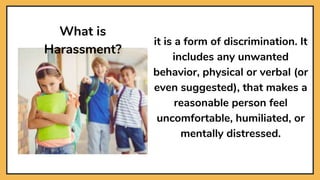
it is a form of discrimination. It
includes any unwanted
behavior, physical or verbal (or
even suggested), that makes a
reasonable person feel
uncomfortable, humiliated, or
mentally distressed.
What is
Harassment?
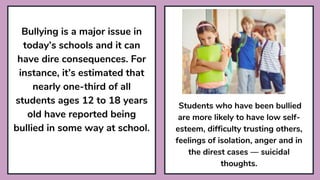
Bullying is a major issue in
today’s schools and it can
have dire consequences. For
instance, it’s estimated that
nearly one-third of all
students ages 12 to 18 years
old have reported being
bullied in some way at school.
Students who have been bullied
are more likely to have low self-
esteem, difficulty trusting others,
feelings of isolation, anger and in
the direst cases — suicidal
thoughts.
Harassment occurs when someone:
• Makes unwelcome remarks or jokes about your race,
religion, sex, age, disability or any other of the grounds
of discrimination;
• Threatens or intimidates you because of your race,
religion, sex, age, disability or any other of the grounds
of discrimination;
• Makes unwelcome physical contact with you, such as
touching, patting, or pinching.
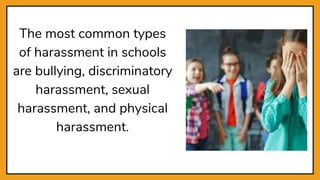
The most common types
of harassment in schools
are bullying, discriminatory
harassment, sexual
harassment, and physical
harassment.
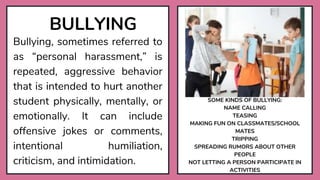
BULLYING
Bullying, sometimes referred to
as “personal harassment,” is
repeated, aggressive behavior
that is intended to hurt another
student physically, mentally, or
emotionally. It can include
offensive jokes or comments,
intentional humiliation,
criticism, and intimidation.
SOME KINDS OF BULLYING:
NAME CALLING
TEASING
MAKING FUN ON CLASSMATES/SCHOOL
MATES
TRIPPING
SPREADING RUMORS ABOUT OTHER
PEOPLE
NOT LETTING A PERSON PARTICIPATE IN
ACTIVITIES
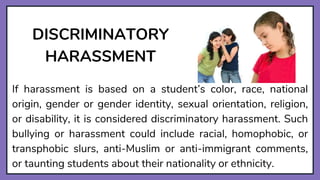
DISCRIMINATORY
HARASSMENT
If harassment is based on a student’s color, race, national
origin, gender or gender identity, sexual orientation, religion,
or disability, it is considered discriminatory harassment. Such
bullying or harassment could include racial, homophobic, or
transphobic slurs, anti-Muslim or anti-immigrant comments,
or taunting students about their nationality or ethnicity.
SEXUAL
HARASSMENT
Sexual harassment is defined as
unwanted and unwelcome
behavior of a sexual nature that
interferes with a student’s right to
receive an education. Sexual
harassment can include a broad
range of behavior, including
inappropriate comments, obscene
gestures, unwanted physical
contact, and sexual assault.
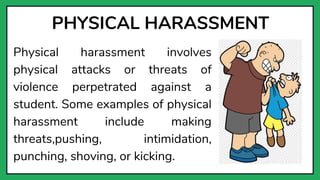
PHYSICAL HARASSMENT
Physical harassment involves
physical attacks or threats of
violence perpetrated against a
student. Some examples of physical
harassment include making
threats,pushing, intimidation,
punching, shoving, or kicking.
WAYS TO ADDRESS HARASSMENT:
Yes, bullying is serious, which is
why more school are taking active
measures to address the issue. A lot
of this can start in the classroom
with the teacher. Teachers can
make a difference in terms of
student behavior when it comes to
bullying.
WAYS TO ADDRESS HARASSMENT:
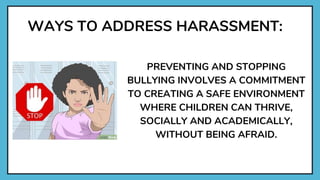
PREVENTING AND STOPPING
BULLYING INVOLVES A COMMITMENT
TO CREATING A SAFE ENVIRONMENT
WHERE CHILDREN CAN THRIVE,
SOCIALLY AND ACADEMICALLY,
WITHOUT BEING AFRAID.
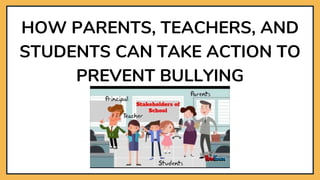
HOW PARENTS, TEACHERS, AND
STUDENTS CAN TAKE ACTION TO
PREVENT BULLYING
PARENTS OF
THE STUDENTS
BEING BULLIED
•Observe your child for signs they might be being
bullied
Children may not always be vocal about being bullied.
Signs include: ripped clothing, hesitation about going
to school, decreased appetite, nightmares, crying, or
general depression and anxiety.
If you discover your child is being bullied, don’t tell
them to “let it go” or “suck it up.” Instead, have open-
ended conversations where you can learn what is
really going on at school so that you can take the
appropriate steps to rectify the situation. Most
importantly, let your child know you will help them and
that they should try not to fight back.
PARENTS OF
THE STUDENTS
BEING BULLIED
•Teach your child how to handle being
bullied.
Practice scenarios at home where your child
learns how to ignore a bully and/or develop
assertive strategies for coping with
bullying. Help your child identify teachers
and friends that can help them if they’re
worried about being bullied.
•Set boundaries with technology
PARENTS OF
THE STUDENTS
ENGAGED IN
BULLYING
•Stop bullying before it starts
Educate your children about bullying. It is
possible that your child is having trouble
reading social signs and does not know
what they are doing is hurtful. Remind your
child that bullying others can have legal
consequences.
PARENTS OF
THE STUDENTS
ENGAGED IN
BULLYING
•Look for self-esteem issues
Children with low self-esteem often
bully to feel better about
themselves. Even children who
seem popular and well-liked can
have mean tendencies. Mean
behavior should be addressed by
parents and disciplined.
PARENTS OF
THE STUDENTS
ENGAGED IN
BULLYING
•Make your home “BULLY FREE”
Children learn behavior through their
parents. Being exposed to aggressive
behavior or an overly strict environment
at home makes kids more prone to bully
at school. Parents/caregivers should
model positive examples for your child
in your relationships with other people
and with them.
STUDENTS
•Report bullying and cyberbullying
It is important for students to report any
bullying to a parent or an adult they trust.
Often kids don’t report cyberbullying
because they fear their parents will take
away their phone or computer. Parents will
support their child’s reports of bullying and
not take away their phones as a
consequence.
It is important for kids to remember that
bullying is wrong and should be handled by
an adult.
STUDENTS
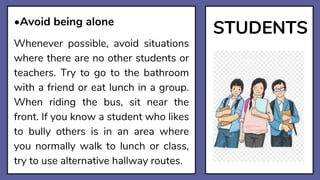
•Avoid being alone
Whenever possible, avoid situations
where there are no other students or
teachers. Try to go to the bathroom
with a friend or eat lunch in a group.
When riding the bus, sit near the
front. If you know a student who likes
to bully others is in an area where
you normally walk to lunch or class,
try to use alternative hallway routes.
STUDENTS
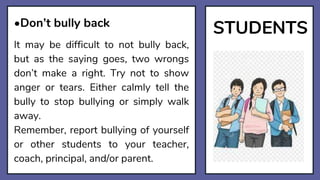
•Don’t bully back
It may be difficult to not bully back,
but as the saying goes, two wrongs
don’t make a right. Try not to show
anger or tears. Either calmly tell the
bully to stop bullying or simply walk
away.
Remember, report bullying of yourself
or other students to your teacher,
coach, principal, and/or parent.
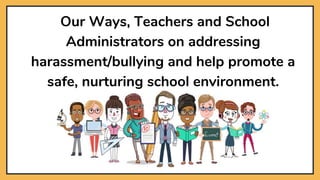
Our Ways, Teachers and School
Administrators on addressing
harassment/bullying and help promote a
safe, nurturing school environment.
• MAKE A LIST.
As a teacher, it’s your job to create a
safe, nurturing, learning
environment for your students. So
at the start of each school year,
make a list of what type of behavior
(verbal, physical, etc.) is appropriate
and not appropriate in your
classroom. Make sure each student
understands your list. This can stop
problems before they even begin.
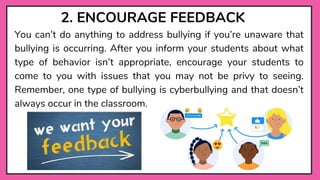
2. ENCOURAGE FEEDBACK
You can’t do anything to address bullying if you’re unaware that
bullying is occurring. After you inform your students about what
type of behavior isn’t appropriate, encourage your students to
come to you with issues that you may not be privy to seeing.
Remember, one type of bullying is cyberbullying and that doesn’t
always occur in the classroom.
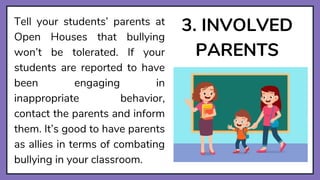
3. INVOLVED
PARENTS
Tell your students’ parents at
Open Houses that bullying
won’t be tolerated. If your
students are reported to have
been engaging in
inappropriate behavior,
contact the parents and inform
them. It’s good to have parents
as allies in terms of combating
bullying in your classroom.
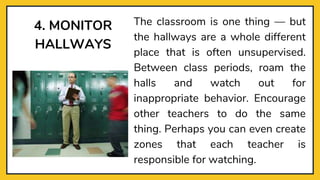
4. MONITOR
HALLWAYS
The classroom is one thing — but
the hallways are a whole different
place that is often unsupervised.
Between class periods, roam the
halls and watch out for
inappropriate behavior. Encourage
other teachers to do the same
thing. Perhaps you can even create
zones that each teacher is
responsible for watching.
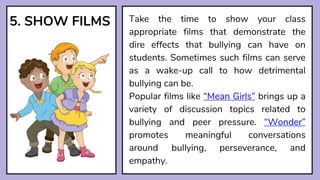
5. SHOW FILMS Take the time to show your class
appropriate films that demonstrate the
dire effects that bullying can have on
students. Sometimes such films can serve
as a wake-up call to how detrimental
bullying can be.
Popular films like “Mean Girls” brings up a
variety of discussion topics related to
bullying and peer pressure. “Wonder”
promotes meaningful conversations
around bullying, perseverance, and
empathy.
6. BE FIRM AND
CONSISTENT
Be sure that you stay firm and consistent on your anti-bullying stance
in your classroom. Drifting from your original stance can show
students that you may not have been serious about your stance on
bullying, which can encourage inappropriate behavior. Make sure that
you, your colleagues, and your administrators are all aligned on this
very important issue so that there’s consistency across the board.
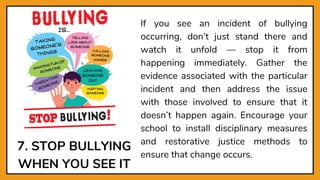
7. STOP BULLYING
WHEN YOU SEE IT
If you see an incident of bullying
occurring, don’t just stand there and
watch it unfold — stop it from
happening immediately. Gather the
evidence associated with the particular
incident and then address the issue
with those involved to ensure that it
doesn’t happen again. Encourage your
school to install disciplinary measures
and restorative justice methods to
ensure that change occurs.
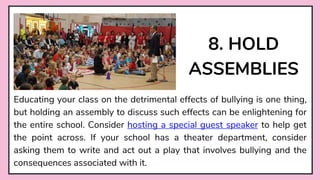
8. HOLD
ASSEMBLIES
Educating your class on the detrimental effects of bullying is one thing,
but holding an assembly to discuss such effects can be enlightening for
the entire school. Consider hosting a special guest speaker to help get
the point across. If your school has a theater department, consider
asking them to write and act out a play that involves bullying and the
consequences associated with it.
9. BE SUPPORTIVE
Offer support and
encouragement to lift each
other up during both good
and challenging times.
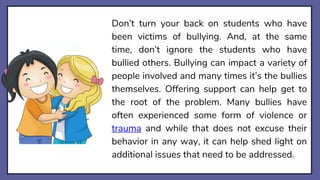
Don’t turn your back on students who have
been victims of bullying. And, at the same
time, don’t ignore the students who have
bullied others. Bullying can impact a variety of
people involved and many times it’s the bullies
themselves. Offering support can help get to
the root of the problem. Many bullies have
often experienced some form of violence or
trauma and while that does not excuse their
behavior in any way, it can help shed light on
additional issues that need to be addressed.
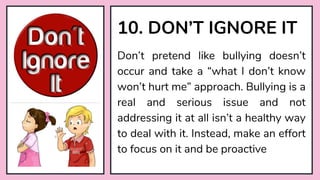
Don’t pretend like bullying doesn’t
occur and take a “what I don’t know
won’t hurt me” approach. Bullying is a
real and serious issue and not
addressing it at all isn’t a healthy way
to deal with it. Instead, make an effort
to focus on it and be proactive
10. DON’T IGNORE IT
THANK YOU
FOR
LISTENING!!!

Group discussion on addressing harassment.pptx

  • 1.
  • 2.
    “Children should be ableto live a life free from bullying and harassment and it is time that we all took a stand against this”. Katherine Jenkins
  • 3.
    Student harassment andbullying are very real and often overlooked problems among children. It can happen to anyone in any environment, and it doesn’t always take the shape of physical violence. In fact, it’s more common for bullies to be psychological perpetrators who use words and actions to put others down or even hurt them emotionally.
  • 4.
    it is aform of discrimination. It includes any unwanted behavior, physical or verbal (or even suggested), that makes a reasonable person feel uncomfortable, humiliated, or mentally distressed. What is Harassment?
  • 5.
    Bullying is amajor issue in today’s schools and it can have dire consequences. For instance, it’s estimated that nearly one-third of all students ages 12 to 18 years old have reported being bullied in some way at school. Students who have been bullied are more likely to have low self- esteem, difficulty trusting others, feelings of isolation, anger and in the direst cases — suicidal thoughts.
  • 6.
    Harassment occurs whensomeone: • Makes unwelcome remarks or jokes about your race, religion, sex, age, disability or any other of the grounds of discrimination; • Threatens or intimidates you because of your race, religion, sex, age, disability or any other of the grounds of discrimination; • Makes unwelcome physical contact with you, such as touching, patting, or pinching.
  • 7.
    The most commontypes of harassment in schools are bullying, discriminatory harassment, sexual harassment, and physical harassment.
  • 8.
    BULLYING Bullying, sometimes referredto as “personal harassment,” is repeated, aggressive behavior that is intended to hurt another student physically, mentally, or emotionally. It can include offensive jokes or comments, intentional humiliation, criticism, and intimidation. SOME KINDS OF BULLYING: NAME CALLING TEASING MAKING FUN ON CLASSMATES/SCHOOL MATES TRIPPING SPREADING RUMORS ABOUT OTHER PEOPLE NOT LETTING A PERSON PARTICIPATE IN ACTIVITIES
  • 9.
    DISCRIMINATORY HARASSMENT If harassment isbased on a student’s color, race, national origin, gender or gender identity, sexual orientation, religion, or disability, it is considered discriminatory harassment. Such bullying or harassment could include racial, homophobic, or transphobic slurs, anti-Muslim or anti-immigrant comments, or taunting students about their nationality or ethnicity.
  • 10.
    SEXUAL HARASSMENT Sexual harassment isdefined as unwanted and unwelcome behavior of a sexual nature that interferes with a student’s right to receive an education. Sexual harassment can include a broad range of behavior, including inappropriate comments, obscene gestures, unwanted physical contact, and sexual assault.
  • 11.
    PHYSICAL HARASSMENT Physical harassmentinvolves physical attacks or threats of violence perpetrated against a student. Some examples of physical harassment include making threats,pushing, intimidation, punching, shoving, or kicking.
  • 12.
    WAYS TO ADDRESSHARASSMENT: Yes, bullying is serious, which is why more school are taking active measures to address the issue. A lot of this can start in the classroom with the teacher. Teachers can make a difference in terms of student behavior when it comes to bullying.
  • 13.
    WAYS TO ADDRESSHARASSMENT: PREVENTING AND STOPPING BULLYING INVOLVES A COMMITMENT TO CREATING A SAFE ENVIRONMENT WHERE CHILDREN CAN THRIVE, SOCIALLY AND ACADEMICALLY, WITHOUT BEING AFRAID.
  • 14.
    HOW PARENTS, TEACHERS,AND STUDENTS CAN TAKE ACTION TO PREVENT BULLYING
  • 15.
    PARENTS OF THE STUDENTS BEINGBULLIED •Observe your child for signs they might be being bullied Children may not always be vocal about being bullied. Signs include: ripped clothing, hesitation about going to school, decreased appetite, nightmares, crying, or general depression and anxiety. If you discover your child is being bullied, don’t tell them to “let it go” or “suck it up.” Instead, have open- ended conversations where you can learn what is really going on at school so that you can take the appropriate steps to rectify the situation. Most importantly, let your child know you will help them and that they should try not to fight back.
  • 16.
    PARENTS OF THE STUDENTS BEINGBULLIED •Teach your child how to handle being bullied. Practice scenarios at home where your child learns how to ignore a bully and/or develop assertive strategies for coping with bullying. Help your child identify teachers and friends that can help them if they’re worried about being bullied. •Set boundaries with technology
  • 17.
    PARENTS OF THE STUDENTS ENGAGEDIN BULLYING •Stop bullying before it starts Educate your children about bullying. It is possible that your child is having trouble reading social signs and does not know what they are doing is hurtful. Remind your child that bullying others can have legal consequences.
  • 18.
    PARENTS OF THE STUDENTS ENGAGEDIN BULLYING •Look for self-esteem issues Children with low self-esteem often bully to feel better about themselves. Even children who seem popular and well-liked can have mean tendencies. Mean behavior should be addressed by parents and disciplined.
  • 19.
    PARENTS OF THE STUDENTS ENGAGEDIN BULLYING •Make your home “BULLY FREE” Children learn behavior through their parents. Being exposed to aggressive behavior or an overly strict environment at home makes kids more prone to bully at school. Parents/caregivers should model positive examples for your child in your relationships with other people and with them.
  • 20.
    STUDENTS •Report bullying andcyberbullying It is important for students to report any bullying to a parent or an adult they trust. Often kids don’t report cyberbullying because they fear their parents will take away their phone or computer. Parents will support their child’s reports of bullying and not take away their phones as a consequence. It is important for kids to remember that bullying is wrong and should be handled by an adult.
  • 21.
    STUDENTS •Avoid being alone Wheneverpossible, avoid situations where there are no other students or teachers. Try to go to the bathroom with a friend or eat lunch in a group. When riding the bus, sit near the front. If you know a student who likes to bully others is in an area where you normally walk to lunch or class, try to use alternative hallway routes.
  • 22.
    STUDENTS •Don’t bully back Itmay be difficult to not bully back, but as the saying goes, two wrongs don’t make a right. Try not to show anger or tears. Either calmly tell the bully to stop bullying or simply walk away. Remember, report bullying of yourself or other students to your teacher, coach, principal, and/or parent.
  • 23.
    Our Ways, Teachersand School Administrators on addressing harassment/bullying and help promote a safe, nurturing school environment.
  • 24.
    • MAKE ALIST. As a teacher, it’s your job to create a safe, nurturing, learning environment for your students. So at the start of each school year, make a list of what type of behavior (verbal, physical, etc.) is appropriate and not appropriate in your classroom. Make sure each student understands your list. This can stop problems before they even begin.
  • 25.
    2. ENCOURAGE FEEDBACK Youcan’t do anything to address bullying if you’re unaware that bullying is occurring. After you inform your students about what type of behavior isn’t appropriate, encourage your students to come to you with issues that you may not be privy to seeing. Remember, one type of bullying is cyberbullying and that doesn’t always occur in the classroom.
  • 26.
    3. INVOLVED PARENTS Tell yourstudents’ parents at Open Houses that bullying won’t be tolerated. If your students are reported to have been engaging in inappropriate behavior, contact the parents and inform them. It’s good to have parents as allies in terms of combating bullying in your classroom.
  • 27.
    4. MONITOR HALLWAYS The classroomis one thing — but the hallways are a whole different place that is often unsupervised. Between class periods, roam the halls and watch out for inappropriate behavior. Encourage other teachers to do the same thing. Perhaps you can even create zones that each teacher is responsible for watching.
  • 28.
    5. SHOW FILMSTake the time to show your class appropriate films that demonstrate the dire effects that bullying can have on students. Sometimes such films can serve as a wake-up call to how detrimental bullying can be. Popular films like “Mean Girls” brings up a variety of discussion topics related to bullying and peer pressure. “Wonder” promotes meaningful conversations around bullying, perseverance, and empathy.
  • 29.
    6. BE FIRMAND CONSISTENT Be sure that you stay firm and consistent on your anti-bullying stance in your classroom. Drifting from your original stance can show students that you may not have been serious about your stance on bullying, which can encourage inappropriate behavior. Make sure that you, your colleagues, and your administrators are all aligned on this very important issue so that there’s consistency across the board.
  • 30.
    7. STOP BULLYING WHENYOU SEE IT If you see an incident of bullying occurring, don’t just stand there and watch it unfold — stop it from happening immediately. Gather the evidence associated with the particular incident and then address the issue with those involved to ensure that it doesn’t happen again. Encourage your school to install disciplinary measures and restorative justice methods to ensure that change occurs.
  • 31.
    8. HOLD ASSEMBLIES Educating yourclass on the detrimental effects of bullying is one thing, but holding an assembly to discuss such effects can be enlightening for the entire school. Consider hosting a special guest speaker to help get the point across. If your school has a theater department, consider asking them to write and act out a play that involves bullying and the consequences associated with it.
  • 32.
    9. BE SUPPORTIVE Offersupport and encouragement to lift each other up during both good and challenging times.
  • 33.
    Don’t turn yourback on students who have been victims of bullying. And, at the same time, don’t ignore the students who have bullied others. Bullying can impact a variety of people involved and many times it’s the bullies themselves. Offering support can help get to the root of the problem. Many bullies have often experienced some form of violence or trauma and while that does not excuse their behavior in any way, it can help shed light on additional issues that need to be addressed.
  • 34.
    Don’t pretend likebullying doesn’t occur and take a “what I don’t know won’t hurt me” approach. Bullying is a real and serious issue and not addressing it at all isn’t a healthy way to deal with it. Instead, make an effort to focus on it and be proactive 10. DON’T IGNORE IT
  • 36.