INSTRUCTION
AL
CONTINUUM
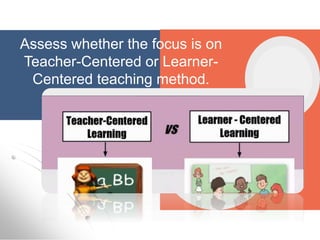
Assess whether the focus is on
Teacher-Centered or Learner-
Centered teaching method.
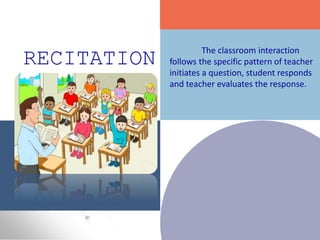
RECITATION
The classroom interaction
follows the specific pattern of teacher
initiates a question, student responds
and teacher evaluates the response.
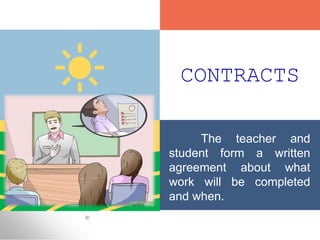
CONTRACTS
The teacher and
student form a written
agreement about what
work will be completed
and when.
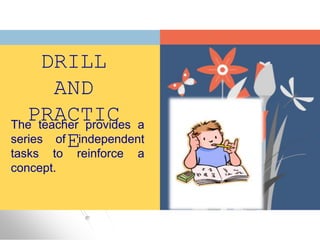
DRILL
AND
PRACTIC
E
The teacher provides a
series of independent
tasks to reinforce a
concept.
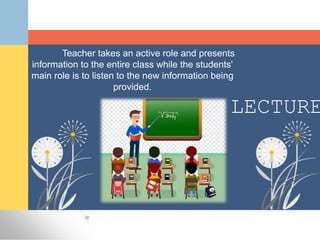
LECTURE
Teacher takes an active role and presents
information to the entire class while the students'
main role is to listen to the new information being
provided.
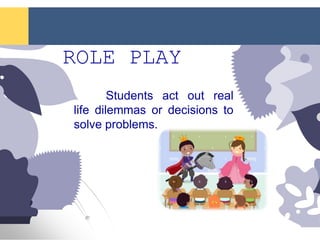
ROLE PLAY
Students act out real
life dilemmas or decisions to
solve problems.
ROLE PLAY
Students act out real
life dilemmas or decisions to
solve problems.
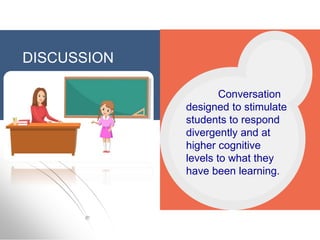
DISCUSSION
Conversation
designed to stimulate
students to respond
divergently and at
higher cognitive
levels to what they
have been learning.
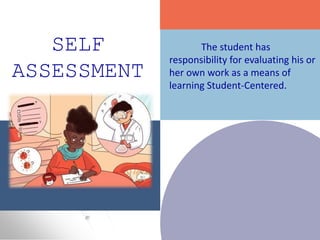
SELF
ASSESSMENT
The student has
responsibility for evaluating his or
her own work as a means of
learning Student-Centered.
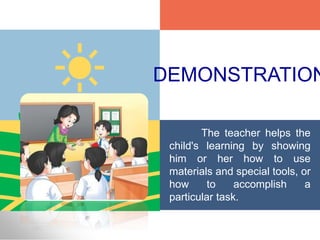
DEMONSTRATION
The teacher helps the
child's learning by showing
him or her how to use
materials and special tools, or
how to accomplish a
particular task.
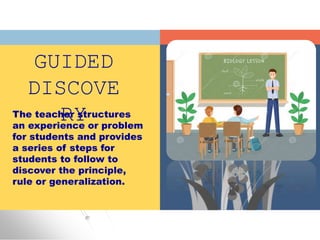
GUIDED
DISCOVE
RY
The teacher structures
an experience or problem
for students and provides
a series of steps for
students to follow to
discover the principle,
rule or generalization.
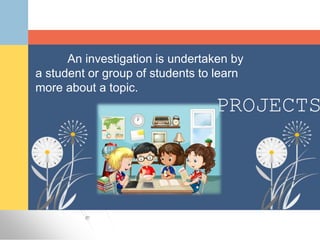
PROJECTS
An investigation is undertaken by
a student or group of students to learn
more about a topic.
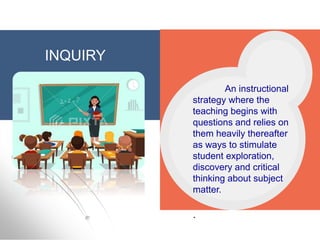
INQUIRY
An instructional
strategy where the
teaching begins with
questions and relies on
them heavily thereafter
as ways to stimulate
student exploration,
discovery and critical
thinking about subject
matter.
.
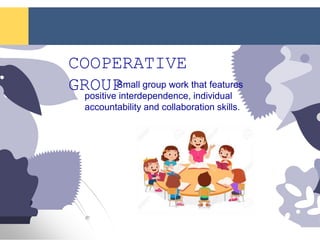
COOPERATIVE
GROUP
Small group work that features
positive interdependence, individual
accountability and collaboration skills.
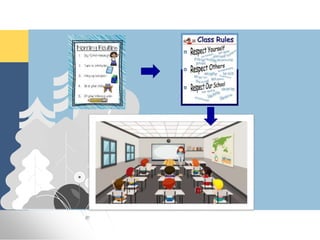
CLASSROOM
MANAGEMENT
“For example, Willower (1975) found that educators vary along a
continuum of beliefs about the way children learn to behave and
conceptualized this as one’s pupil-control ideology.”
At one end of the continuum is the custodial (teacher-centered)
educator and at the other end is the humanistic (student centered)
educator. The extremes in the continuum of beliefs are described in
the following way:
*The educator with a custodial orientation is likely to be highly
controlling, employing punitive sanctions, moralistic perceptions,
highly impersonal relationships with students, attitudes of general
mistrust and a major focus on the maintenance of order.
*In teacher-centered classrooms, control is of primary importance
and “authority is transmitted hierarchically” (Dollard & Christensen,
1996), meaning the teacher exerts control over the students.
(Teacher-centered)-humanistic
(Student-centered)-humanistic
*The educator with a more humanistic orientation is likely to maintain a
classroom climate in which active interaction and communication, close
personal relationships with students, mutual respect, positive attitudes,
and flexibility of rules, as well as student self-discipline, self-
determination and independence are fostered (Willower, Eidell, & Hoy,
1967)
*One of the primary goals management strategies of a student-
centered classroom is to empower students and strengthen their sense
of responsibility. One way teachers may share their control with their
students is to elicit student participation when generating the classroom
rules.
*Finally, advocates of a student-centered approach to classroom
management propose that teachers minimize the use of extrinsic
rewards because they may adversely affect student motivation,
create reliance on the teacher and encourage appropriate behavior
for the sake of a reward rather than for the good of the group
(DeVries & Zan, 1994).
-The core of Person-centered classroom management is self-discipline which is attained through proactive
management techniques. The emphasis here is on preventing misbehavior rather than reacting to
it. Literature identifies four pro-social dimensions of person-centered classrooms, which are:
1. Social Emotional Emphasis: Teachers demonstrate caring for students social and
emotional need and for who they are as people
2. School Connectedness: Teachers ensure that students fell a sense of belonging to the
school, their classroom and their peers
3. Positive School and Classroom environment: Students feel safe in school, developing
trust for their peers and their teacher
4. Student Self-discipline: Students learn through responsible consequences and
Person-Centered Classroom Management
THANK YOU!!!

group 5 - Presentation.ppt

  • 1.
  • 2.
    Assess whether thefocus is on Teacher-Centered or Learner- Centered teaching method.
  • 3.
    RECITATION The classroom interaction followsthe specific pattern of teacher initiates a question, student responds and teacher evaluates the response.
  • 4.
    CONTRACTS The teacher and studentform a written agreement about what work will be completed and when.
  • 5.
    DRILL AND PRACTIC E The teacher providesa series of independent tasks to reinforce a concept.
  • 6.
    LECTURE Teacher takes anactive role and presents information to the entire class while the students' main role is to listen to the new information being provided.
  • 7.
    ROLE PLAY Students actout real life dilemmas or decisions to solve problems.
  • 8.
    ROLE PLAY Students actout real life dilemmas or decisions to solve problems.
  • 9.
    DISCUSSION Conversation designed to stimulate studentsto respond divergently and at higher cognitive levels to what they have been learning.
  • 10.
    SELF ASSESSMENT The student has responsibilityfor evaluating his or her own work as a means of learning Student-Centered.
  • 11.
    DEMONSTRATION The teacher helpsthe child's learning by showing him or her how to use materials and special tools, or how to accomplish a particular task.
  • 12.
    GUIDED DISCOVE RY The teacher structures anexperience or problem for students and provides a series of steps for students to follow to discover the principle, rule or generalization.
  • 13.
    PROJECTS An investigation isundertaken by a student or group of students to learn more about a topic.
  • 14.
    INQUIRY An instructional strategy wherethe teaching begins with questions and relies on them heavily thereafter as ways to stimulate student exploration, discovery and critical thinking about subject matter. .
  • 15.
    COOPERATIVE GROUP Small group workthat features positive interdependence, individual accountability and collaboration skills.
  • 16.
  • 18.
    “For example, Willower(1975) found that educators vary along a continuum of beliefs about the way children learn to behave and conceptualized this as one’s pupil-control ideology.” At one end of the continuum is the custodial (teacher-centered) educator and at the other end is the humanistic (student centered) educator. The extremes in the continuum of beliefs are described in the following way:
  • 19.
    *The educator witha custodial orientation is likely to be highly controlling, employing punitive sanctions, moralistic perceptions, highly impersonal relationships with students, attitudes of general mistrust and a major focus on the maintenance of order. *In teacher-centered classrooms, control is of primary importance and “authority is transmitted hierarchically” (Dollard & Christensen, 1996), meaning the teacher exerts control over the students. (Teacher-centered)-humanistic
  • 20.
    (Student-centered)-humanistic *The educator witha more humanistic orientation is likely to maintain a classroom climate in which active interaction and communication, close personal relationships with students, mutual respect, positive attitudes, and flexibility of rules, as well as student self-discipline, self- determination and independence are fostered (Willower, Eidell, & Hoy, 1967) *One of the primary goals management strategies of a student- centered classroom is to empower students and strengthen their sense of responsibility. One way teachers may share their control with their students is to elicit student participation when generating the classroom rules.
  • 21.
    *Finally, advocates ofa student-centered approach to classroom management propose that teachers minimize the use of extrinsic rewards because they may adversely affect student motivation, create reliance on the teacher and encourage appropriate behavior for the sake of a reward rather than for the good of the group (DeVries & Zan, 1994).
  • 22.
    -The core ofPerson-centered classroom management is self-discipline which is attained through proactive management techniques. The emphasis here is on preventing misbehavior rather than reacting to it. Literature identifies four pro-social dimensions of person-centered classrooms, which are: 1. Social Emotional Emphasis: Teachers demonstrate caring for students social and emotional need and for who they are as people 2. School Connectedness: Teachers ensure that students fell a sense of belonging to the school, their classroom and their peers 3. Positive School and Classroom environment: Students feel safe in school, developing trust for their peers and their teacher 4. Student Self-discipline: Students learn through responsible consequences and Person-Centered Classroom Management
  • 23.