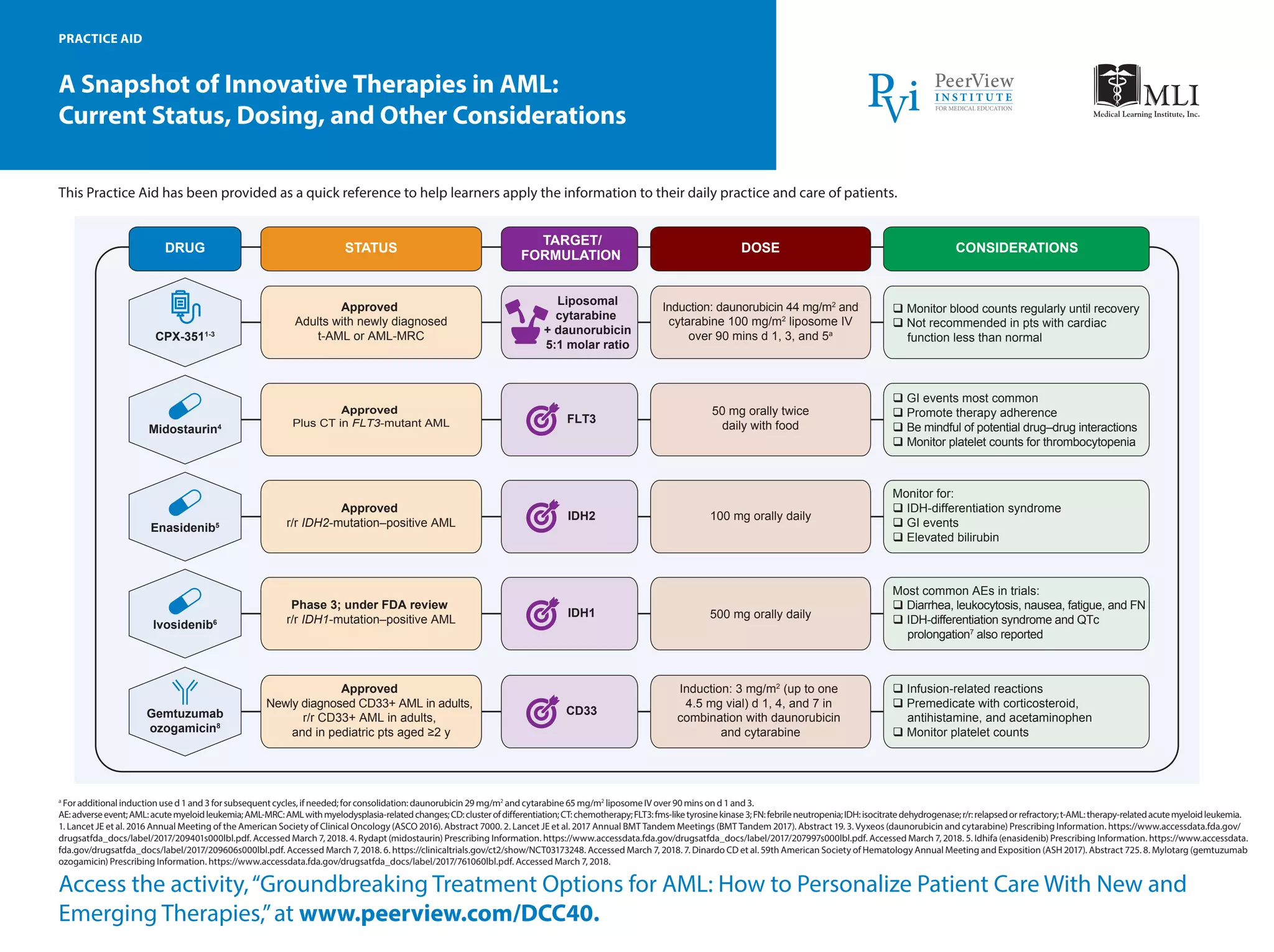
A Snapshot of Innovative Therapies in AML:
Current Status, Dosing, and Other Considerations
PRACTICE AID
DRUG
Midostaurin4
STATUS
TARGET/
FORMULATION
DOSE CONSIDERATIONS
Approved
Plus CT in FLT3-mutant AML FLT3
50 mg orally twice
daily with food
q GI events most common
q Promote therapy adherence
q Be mindful of potential drug–drug interactions
q Monitor platelet counts for thrombocytopenia
Enasidenib5
Approved
r/r IDH2-mutation–positive AML
IDH2 100 mg orally daily
Monitor for:
q IDH-differentiation syndrome
q GI events
q Elevated bilirubin
Ivosidenib6
Phase 3; under FDA review
r/r IDH1-mutation–positive AML
IDH1 500 mg orally daily
Most common AEs in trials:
q Diarrhea, leukocytosis, nausea, fatigue, and FN
q IDH-differentiation syndrome and QTc
prolongation7
also reported
CPX-3511-3
Approved
Adults with newly diagnosed
t-AML or AML-MRC
Liposomal
cytarabine
+ daunorubicin
5:1 molar ratio
Induction: daunorubicin 44 mg/m2
and
cytarabine 100 mg/m2
liposome IV
over 90 mins d 1, 3, and 5a
q Monitor blood counts regularly until recovery
q Not recommended in pts with cardiac
function less than normal
Gemtuzumab
ozogamicin8
Approved
Newly diagnosed CD33+ AML in adults,
r/r CD33+ AML in adults,
and in pediatric pts aged ≥2 y
CD33
Induction: 3 mg/m2
(up to one
4.5 mg vial) d 1, 4, and 7 in
combination with daunorubicin
and cytarabine
q Infusion-related reactions
q Premedicate with corticosteroid,
antihistamine, and acetaminophen
q Monitor platelet counts
This Practice Aid has been provided as a quick reference to help learners apply the information to their daily practice and care of patients.
a
For additional induction use d 1 and 3 for subsequent cycles, if needed; for consolidation: daunorubicin 29 mg/m2
and cytarabine 65 mg/m2
liposome IV over 90 mins on d 1 and 3.
AE:adverseevent;AML:acutemyeloidleukemia;AML-MRC:AMLwithmyelodysplasia-relatedchanges;CD:clusterofdifferentiation;CT:chemotherapy;FLT3:fms-liketyrosinekinase3;FN:febrileneutropenia;IDH:isocitratedehydrogenase;r/r:relapsedorrefractory;t-AML:therapy-relatedacutemyeloidleukemia.
1. Lancet JE et al. 2016 Annual Meeting of the American Society of Clinical Oncology (ASCO 2016). Abstract 7000. 2. Lancet JE et al. 2017 Annual BMT Tandem Meetings (BMT Tandem 2017). Abstract 19. 3. Vyxeos (daunorubicin and cytarabine) Prescribing Information. https://www.accessdata.fda.gov/
drugsatfda_docs/label/2017/209401s000lbl.pdf. Accessed March 7, 2018. 4. Rydapt (midostaurin) Prescribing Information. https://www.accessdata.fda.gov/drugsatfda_docs/label/2017/207997s000lbl.pdf. Accessed March 7, 2018. 5. Idhifa (enasidenib) Prescribing Information. https://www.accessdata.
fda.gov/drugsatfda_docs/label/2017/209606s000lbl.pdf. Accessed March 7, 2018. 6. https://clinicaltrials.gov/ct2/show/NCT03173248. Accessed March 7, 2018. 7. Dinardo CD et al. 59th American Society of Hematology Annual Meeting and Exposition (ASH 2017). Abstract 725. 8. Mylotarg (gemtuzumab
ozogamicin) Prescribing Information. https://www.accessdata.fda.gov/drugsatfda_docs/label/2017/761060lbl.pdf. Accessed March 7, 2018.
Access the activity,“Groundbreaking Treatment Options for AML: How to Personalize Patient Care With New and
Emerging Therapies,”at www.peerview.com/DCC40.
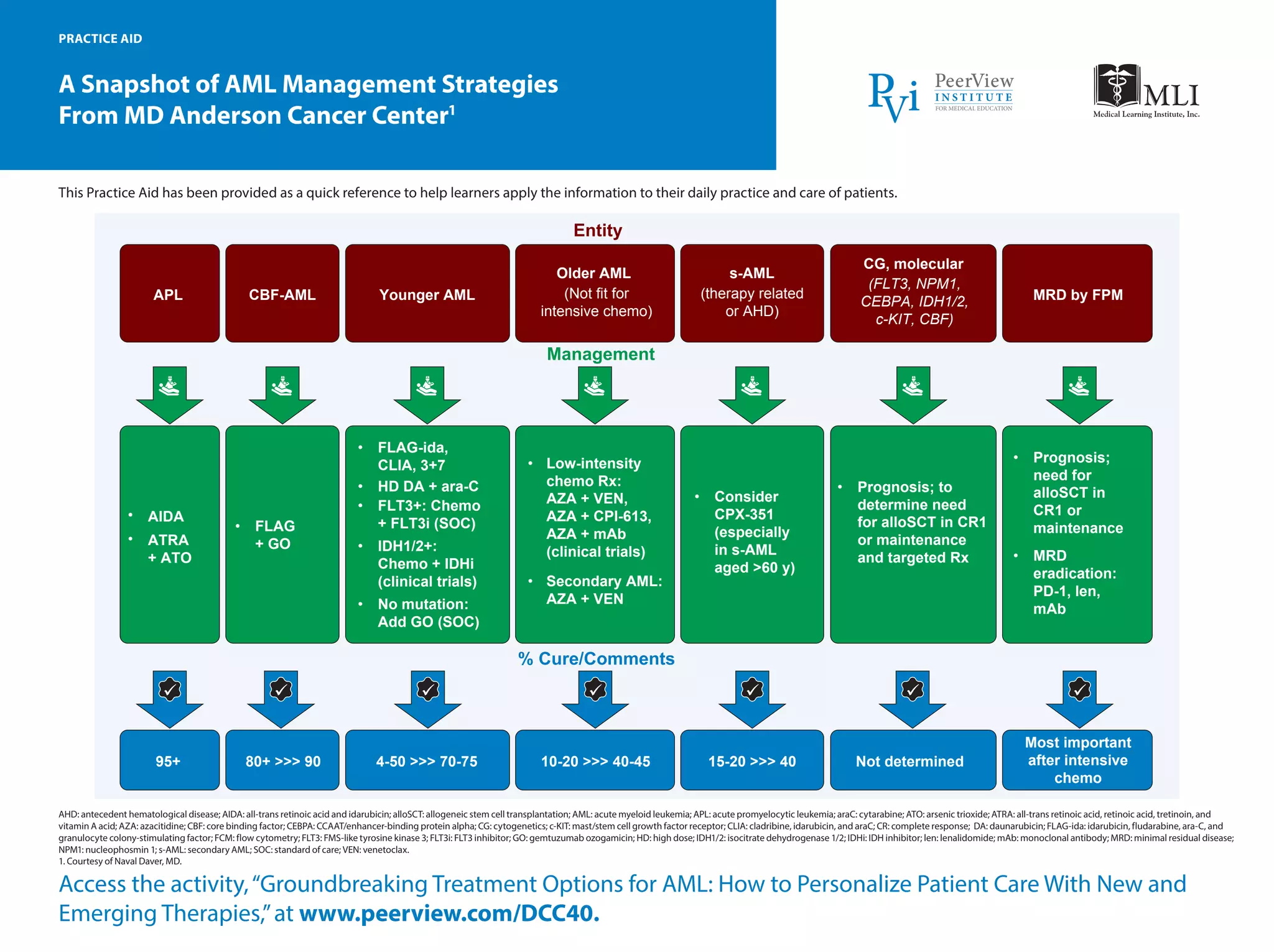
A Snapshot of AML Management Strategies
From MD Anderson Cancer Center1
PRACTICE AID
s-AML
(therapy related
or AHD)
CG, molecular
(FLT3, NPM1,
CEBPA, IDH1/2,
c-KIT, CBF)
MRD by FPM
Entity
• Consider
CPX-351
(especially
in s-AML
aged >60 y)
• Prognosis; to
determine need
for alloSCT in CR1
or maintenance
and targeted Rx
• Prognosis;
need for
alloSCT in
CR1 or
maintenance
• MRD
eradication:
PD-1, len,
mAb
95+ 80+ >>> 90 4-50 >>> 70-75 10-20 >>> 40-45 15-20 >>> 40 Not determined
Most important
after intensive
chemo
Management
% Cure/Comments
• AIDA
• ATRA
+ ATO
Older AML
(Not fit for
intensive chemo)
APL CBF-AML Younger AML
• FLAG
+ GO
• FLAG-ida,
CLIA, 3+7
• HD DA + ara-C
• FLT3+: Chemo
+ FLT3i (SOC)
• IDH1/2+:
Chemo + IDHi
(clinical trials)
• No mutation:
Add GO (SOC)
• Low-intensity
chemo Rx:
AZA + VEN,
AZA + CPI-613,
AZA + mAb
(clinical trials)
• Secondary AML:
AZA + VEN
ü üüüüüü
AHD: antecedent hematological disease; AIDA: all-trans retinoic acid and idarubicin; alloSCT: allogeneic stem cell transplantation; AML: acute myeloid leukemia; APL: acute promyelocytic leukemia; araC: cytarabine; ATO: arsenic trioxide; ATRA: all-trans retinoic acid, retinoic acid, tretinoin, and
vitamin A acid; AZA: azacitidine; CBF: core binding factor; CEBPA: CCAAT/enhancer-binding protein alpha; CG: cytogenetics; c-KIT: mast/stem cell growth factor receptor; CLIA: cladribine, idarubicin, and araC; CR: complete response; DA: daunarubicin; FLAG-ida: idarubicin, fludarabine, ara-C, and
granulocyte colony-stimulating factor; FCM: flow cytometry; FLT3: FMS-like tyrosine kinase 3; FLT3i: FLT3 inhibitor; GO: gemtuzumab ozogamicin; HD: high dose; IDH1/2: isocitrate dehydrogenase 1/2; IDHi: IDH inhibitor; len: lenalidomide; mAb: monoclonal antibody; MRD: minimal residual disease;
NPM1: nucleophosmin 1; s-AML: secondary AML; SOC: standard of care; VEN: venetoclax.
1. Courtesy of Naval Daver, MD.
Access the activity,“Groundbreaking Treatment Options for AML: How to Personalize Patient Care With New and
Emerging Therapies,”at www.peerview.com/DCC40.
This Practice Aid has been provided as a quick reference to help learners apply the information to their daily practice and care of patients.

Groundbreaking Treatment Options for AML: How to Personalize Patient Care With New and Emerging Therapies

  • 1.
    A Snapshot ofInnovative Therapies in AML: Current Status, Dosing, and Other Considerations PRACTICE AID DRUG Midostaurin4 STATUS TARGET/ FORMULATION DOSE CONSIDERATIONS Approved Plus CT in FLT3-mutant AML FLT3 50 mg orally twice daily with food q GI events most common q Promote therapy adherence q Be mindful of potential drug–drug interactions q Monitor platelet counts for thrombocytopenia Enasidenib5 Approved r/r IDH2-mutation–positive AML IDH2 100 mg orally daily Monitor for: q IDH-differentiation syndrome q GI events q Elevated bilirubin Ivosidenib6 Phase 3; under FDA review r/r IDH1-mutation–positive AML IDH1 500 mg orally daily Most common AEs in trials: q Diarrhea, leukocytosis, nausea, fatigue, and FN q IDH-differentiation syndrome and QTc prolongation7 also reported CPX-3511-3 Approved Adults with newly diagnosed t-AML or AML-MRC Liposomal cytarabine + daunorubicin 5:1 molar ratio Induction: daunorubicin 44 mg/m2 and cytarabine 100 mg/m2 liposome IV over 90 mins d 1, 3, and 5a q Monitor blood counts regularly until recovery q Not recommended in pts with cardiac function less than normal Gemtuzumab ozogamicin8 Approved Newly diagnosed CD33+ AML in adults, r/r CD33+ AML in adults, and in pediatric pts aged ≥2 y CD33 Induction: 3 mg/m2 (up to one 4.5 mg vial) d 1, 4, and 7 in combination with daunorubicin and cytarabine q Infusion-related reactions q Premedicate with corticosteroid, antihistamine, and acetaminophen q Monitor platelet counts This Practice Aid has been provided as a quick reference to help learners apply the information to their daily practice and care of patients. a For additional induction use d 1 and 3 for subsequent cycles, if needed; for consolidation: daunorubicin 29 mg/m2 and cytarabine 65 mg/m2 liposome IV over 90 mins on d 1 and 3. AE:adverseevent;AML:acutemyeloidleukemia;AML-MRC:AMLwithmyelodysplasia-relatedchanges;CD:clusterofdifferentiation;CT:chemotherapy;FLT3:fms-liketyrosinekinase3;FN:febrileneutropenia;IDH:isocitratedehydrogenase;r/r:relapsedorrefractory;t-AML:therapy-relatedacutemyeloidleukemia. 1. Lancet JE et al. 2016 Annual Meeting of the American Society of Clinical Oncology (ASCO 2016). Abstract 7000. 2. Lancet JE et al. 2017 Annual BMT Tandem Meetings (BMT Tandem 2017). Abstract 19. 3. Vyxeos (daunorubicin and cytarabine) Prescribing Information. https://www.accessdata.fda.gov/ drugsatfda_docs/label/2017/209401s000lbl.pdf. Accessed March 7, 2018. 4. Rydapt (midostaurin) Prescribing Information. https://www.accessdata.fda.gov/drugsatfda_docs/label/2017/207997s000lbl.pdf. Accessed March 7, 2018. 5. Idhifa (enasidenib) Prescribing Information. https://www.accessdata. fda.gov/drugsatfda_docs/label/2017/209606s000lbl.pdf. Accessed March 7, 2018. 6. https://clinicaltrials.gov/ct2/show/NCT03173248. Accessed March 7, 2018. 7. Dinardo CD et al. 59th American Society of Hematology Annual Meeting and Exposition (ASH 2017). Abstract 725. 8. Mylotarg (gemtuzumab ozogamicin) Prescribing Information. https://www.accessdata.fda.gov/drugsatfda_docs/label/2017/761060lbl.pdf. Accessed March 7, 2018. Access the activity,“Groundbreaking Treatment Options for AML: How to Personalize Patient Care With New and Emerging Therapies,”at www.peerview.com/DCC40.
  • 2.
    A Snapshot ofAML Management Strategies From MD Anderson Cancer Center1 PRACTICE AID s-AML (therapy related or AHD) CG, molecular (FLT3, NPM1, CEBPA, IDH1/2, c-KIT, CBF) MRD by FPM Entity • Consider CPX-351 (especially in s-AML aged >60 y) • Prognosis; to determine need for alloSCT in CR1 or maintenance and targeted Rx • Prognosis; need for alloSCT in CR1 or maintenance • MRD eradication: PD-1, len, mAb 95+ 80+ >>> 90 4-50 >>> 70-75 10-20 >>> 40-45 15-20 >>> 40 Not determined Most important after intensive chemo Management % Cure/Comments • AIDA • ATRA + ATO Older AML (Not fit for intensive chemo) APL CBF-AML Younger AML • FLAG + GO • FLAG-ida, CLIA, 3+7 • HD DA + ara-C • FLT3+: Chemo + FLT3i (SOC) • IDH1/2+: Chemo + IDHi (clinical trials) • No mutation: Add GO (SOC) • Low-intensity chemo Rx: AZA + VEN, AZA + CPI-613, AZA + mAb (clinical trials) • Secondary AML: AZA + VEN ü üüüüüü AHD: antecedent hematological disease; AIDA: all-trans retinoic acid and idarubicin; alloSCT: allogeneic stem cell transplantation; AML: acute myeloid leukemia; APL: acute promyelocytic leukemia; araC: cytarabine; ATO: arsenic trioxide; ATRA: all-trans retinoic acid, retinoic acid, tretinoin, and vitamin A acid; AZA: azacitidine; CBF: core binding factor; CEBPA: CCAAT/enhancer-binding protein alpha; CG: cytogenetics; c-KIT: mast/stem cell growth factor receptor; CLIA: cladribine, idarubicin, and araC; CR: complete response; DA: daunarubicin; FLAG-ida: idarubicin, fludarabine, ara-C, and granulocyte colony-stimulating factor; FCM: flow cytometry; FLT3: FMS-like tyrosine kinase 3; FLT3i: FLT3 inhibitor; GO: gemtuzumab ozogamicin; HD: high dose; IDH1/2: isocitrate dehydrogenase 1/2; IDHi: IDH inhibitor; len: lenalidomide; mAb: monoclonal antibody; MRD: minimal residual disease; NPM1: nucleophosmin 1; s-AML: secondary AML; SOC: standard of care; VEN: venetoclax. 1. Courtesy of Naval Daver, MD. Access the activity,“Groundbreaking Treatment Options for AML: How to Personalize Patient Care With New and Emerging Therapies,”at www.peerview.com/DCC40. This Practice Aid has been provided as a quick reference to help learners apply the information to their daily practice and care of patients.