International Journal of Electrical, Electronics and Computers
Special Issue | Jan-Feb, 2026
Available: https://aipublications.com/ijeec/
Peer-Reviewed Journal
ISSN: 2456-2319 National Conference on Advances in Science, Technology, Engineering and Management (NCASTEM-2025)
https://dx.doi.org/10.22161/eec.ncastem.2025-6 45
Grievance redressal system for educational institution
Asha S Manek, Shalini KV, Kritik Munot, Sri Harsha T, Bindhu Monika, Shivalingayya
Department of Artificial Intelligence and Machine Learning, T. John Institute of Technology, Bangalore,India
Received: 20 Nov 2025; Accepted: 05 Feb 2025; Date of Publication: 07 Feb 2026
©2026 The Author(s). Published by Infogain Publication. This is an open-access article under the CC BY license
(https://creativecommons.org/licenses/by/4.0/).
Abstract—This paper focuses on developing a web-based college grievance and feedback management
system to replace the existing manual and time-consuming complaint process. The proposed system
enables students, faculty, and staff to file, track, and manage complaints efficiently through a user-
friendly interface. It is built using three main components: a JSON database for secure complaint storage
and retrieval, a backend developed with Node.js and Flask to handle the logic, and a frontend using
HTML and CSS for accessibility and ease of use. Key features such as role-based access, notifications, and
report generation enhance transparency, accountability, and data-driven decision-making. This system
ensures quick and fair redressal of grievances while improving campus facilities, faculty performance,
and overall satisfaction. In the future, AI automation such as complaint categorization and routing using
large language models (LLMs) can further enhance efficiency, responsiveness, and create a more
student-centered and transparent campus experience.
Keywords— Grievance Management System, Complaint Redressal, Web-Based Application,
Student Feedback, Transparency, Accountability, Node.js, JSON, Automation, Campus
Management, User-Friendly Interface.
I. INTRODUCTION
Grievances and complaints are an inevitable and
perpetual part of any educational institution, arising
from the diverse needs, experiences, and concerns of
students, faculty, and other stakeholders. A grievance,
at its core, represents a
formal expression of discontent or a perception of
injustice, whether it is a valid complaint or not.
Establishing an efficient and effective system for
addressing these grievances is not merely an
administrative convenience but is paramount for
maintaining a harmonious and productive campus
environment. A well-structured system provides a
vital platform for students to voice their concerns,
seek resolutions, and obtain fair outcomes. It is a
critical tool for institutional governance, serving as an
important indicator of both institutional effectiveness
and the overall quality of education. The fundamental
purpose of such a system is to ensure that all
stakeholder concerns are not only heard but are also
promptly and impartially acted upon, a process that is
designed to uphold and reinforce principles of
transparency, fairness, and accountability.[1][2].
The function of a grievance system extends well
beyond simple dispute resolution. Research indicates a
progression in the understanding of a grievance
system's purpose, from a basic reactive mechanism to a
strategic tool for cultivating a healthy campus climate.
Documents on the subject describe its role as a "moral
and ethical imperative" for institutions that are
committed to creating a supportive and inclusive
learning environment. In essence, the system
functions as a proactive feedback loop, providing the
administration with a mechanism to identify its own
strengths and weaknesses as an educational service
organization. By centralizing complaints and analyzing
the data they provide, institutions can make informed
decisions to improve the educational experience for all
students, transforming a reactive process into a data-
driven mechanism for continuous institutional
improvement and accountability.[3].
Modern higher education institutions commonly
employ a tiered, multi-level system for grievance
resolution, which strategically encourages informal
processes before escalating to a formal review. The
Manek et al. Grievance redressal system for educational institution
ISSN: 2456-2319 National Conference on Advances in Science, Technology, Engineering and Management (NCASTEM-2025)
https://dx.doi.org/10.22161/eec.ncastem.2025-6 46
"informal first" approach is a foundational principle of
this model, designed to resolve misunderstandings
and disputes at the "lowest possible level". This initial
phase typically involves direct communication
between the student and the employee or department
head with whom the issue originated. This de-
escalation strategy is an effort to minimize
bureaucratic involvement and resolve conflicts
efficiently and with minimal institutional overhead. To
facilitate this, institutions often provide confidential,
thirdparty resources such as an ombuds or a student
advocate who can offer guidance and support without
fear of reprisal. This is a crucial mechanism for
overcoming psychological barriers to reporting, such
as the fear of retaliation.[5].
The organizational structure of a grievance system is a
critical factor in its effectiveness, and institutions
grapple with the choice between centralized and
decentralized models. In a decentralized structure,
individual academic units, colleges, or departments
maintain control over their own complaint resolution
processes and platforms. While this approach may
appear to align with traditional academic autonomy, it
often leads to significant inefficiencies, including a lack
of consistent navigation and disjointed
communication efforts. Complaints data can become
fragmented and difficult to aggregate, making it
challenging to identify and address systemic issues
across the institution. Furthermore, decentralization
can disperse accountability so widely that no single
group is responsible for the overall success or failure
of the system.[4][6]
II. RELATED WORKS
Brady, M., Rosenthal, J. L., Forest, C. P., & Hocevar,
D. (2022). [1] Anonymous versus public student
feedback systems: Metacognition and achievement
with graduate learners. Educational Technology
Research and Development, 68(6), 2853–2872.
Ibitomisin, R. P., & Oghenekaro, L. (2023).[2] Web
Based Integrated Student Complaint System.
International Journal of Computer Applications,
182(20), 25-30.
Lee, C.-H., & Zhao, X. (2024). [3] Data Collection, Data
Mining and Transfer of Learning based on Customer
Temperament-centered Complaint Handling System
and One-of-a-kind Complaint Handling Dataset.
Advanced Engineering Informatics, 60, 102520.
Oguntosin, V., Oluwadurotimi, M., Adoghe, A.,
Abdulkareem, A., & Adeyemi, G. (2021).[4]
Development of a Web-Based Complaint Management
Platform for a University Community. Journal of
Engineering Science and Technology Review, 14(1),
150159.
Sheth, H., Solanki, S., Parmar, A., Dave, J., &
Raithatha, H. (2024). [5] Addressing Student
Grievances: A Comprehensive Analysis of Grievance
Management Systems. International Journal of Science,
Engineering and Technology, 12(2), 541.
Strydom, F., & Loots, S. (2022).[6] The student voice
as contributor to quality education through
institutional design. South African Journal of Higher
Education, 34(5), 20–34.
Winstone, N. E., Nash, R. A., Rowntree, J., & Parker,
M. (2023). [7] "Conditions that enable effective
feedback". Journal of the Scholarship of Teaching and
Learning, 17(2), 29-45.
Student Complaint Management System —Al-Waeli
& Hassan(2022) [8]
Project developed for a university context (Yemen)
describing a web-based complaint management system
that enables students to submit complaints, and the
university to track and resolve them using a MySQL
database and web interface .Directly aligned with your
domain (student complaints, online system) which
makes it a strong fit.
Web-based Campus Complaint Management
System (WCCMS) — Fabiyi et al. (2022)[9].This
paper presents a campus-wide complaint management
system in a higher education setting, discussing
design, stakeholders (students & staff), tracking and
resolution. Very relevant to your system for
educational institutions; good for comparison of
functionalities.
Design and Development of a Web-Based
Complaints Management System at Syiah Kuala
University
Integrated Laboratory— Mutiawani, Hafist &
Dawood(2024)[10].
Describes the design and development of a web-based
complaints management system in a university
laboratory context. Good for showing recent work
(2024) in educational institutions; you can compare
technology stacks, user roles, features.
A Literature Review of a Web-Based Complaint
Management System — Nandini et al. (2025)[11].A
review paper that surveys web-based complaint
Manek et al. Grievance redressal system for educational institution
ISSN: 2456-2319 National Conference on Advances in Science, Technology, Engineering and Management (NCASTEM-2025)
https://dx.doi.org/10.22161/eec.ncastem.2025-6 47
management systems, their architectures, key features
such as role-based access, dashboards, tracking,
analytics. Useful for your “related work” section to
show thematic trends (e.g., role-based access,
analytics) and identify gaps your system addresses.
Grievance Management System in PHP — Devkule
& Palkar (2024)[12].Paper describing an online
grievance management system (not limited to
student complaints) using PHP and highlighting
improved process efficiency. While not exclusively
student-centred, it offers insights into generic
grievance system features which you can adapt.
III. METHODOLOGY
3.1 Architecture and Technology Stack The project
employs a three-tier architecture simplified for a mini-
project scope: Frontend (Presentation Layer):
Standard HTML5 and CSS3 (with inline styling for the
feedback module) providing the user interface.
Backend (Application Logic): Node.js runtime
environment utilizing the lightweight Express.js
framework .
Fig 3.1 System workflow
Database (Data Layer): Local file system persistence
using the built-in fs module and JSON files
(complaints.json, feedback.json) instead of a
traditional relational database, prioritizing simplicity
and rapid prototyping.
3.2 Complaint Submission Flow
The backend system executed via
Node.js/Express completely manages this process to
guarantee that the submitted data is valid and
unique. Frontend Request: The user completes a
complaint, fills in the required details of the
complaint form (frontend), and then sends a POST
request with the completed complaint data (in JSON
format) via the /api/submit-complaint URL. Server
Processing and Validation: The Express route
handler receives the request body (req.body). The
logic (as confirmed in server.js) performs basic
validation to check for the presence of mandatory
fields, specifically title and description. A 400 Bad
Request status is returned if validation fails.
To maintain the data file in sync and intact,
fs.promises.writeFile is used to handle writing back
the updated array to the data file. Upon confirmation
of complaint submission, the server will send a
response of "200 OK" back to the user with an
indication of successful submission along with a
generated Complaint ID assigned to the complaint
submitted for subsequent tracking purposes.
3.3 System Workflow Implementation
The system facilitates complaint management
between students and administrators, following a
structured flow: Student Workflow
1. Login Page: o Students authenticate to access
the system.
2. Student Home Page: o Provides navigation
to complaint submission.
3. Complaint Page:
o Students fill out a form with title and
description 4. Complaint Submission:
o A POST request is sent to
/api/submitcomplaint.
o Server validates input, assigns a unique
id (Date.now()), and adds a createdAt
timestamp.
o Complaint is appended to complaints.json.
Admin Workflow
1. Login Page:
o Admin authenticate to access
administrative tools.
2. Admin Home Page: o Provides access to
complaint management features.
3. View Complaints:
Manek et al. Grievance redressal system for educational institution
ISSN: 2456-2319 National Conference on Advances in Science, Technology, Engineering and Management (NCASTEM-2025)
https://dx.doi.org/10.22161/eec.ncastem.2025-6 48
o Admins retrieve and review complaints
from complaints.json.
4. Solve Complaint:
o Admins mark complaints as resolved
(status update logic can be added).
5. Send Feedback Form:
o Admins trigger feedback form delivery to
the student.
3.4 Satisfaction Feedback Flow
This flow closes the loop by assessing the efficacy of
the redressal process:
1.Trigger: Once the complaint's status is
administratively updated to 'Resolved,' the system
prompts the user to access the dedicated Feedback
Form.
2.Data Capture: The form captures two critical types of
data:
Quantitative Data: The user's selection on the 5-star
rating scale (e.g., a numerical value from 1 to 5)
measures satisfaction level.
Qualitative Data: The input from the description box
captures detailed, actionable suggestions or reasons
behind the rating.
3.Persistence: This feedback data is sent via a separate
API request and is securely saved to the dedicated
feedback.json file, ensuring that redressal metrics are
segregated from the initial grievance records for clear
analysis.
IV. IMPLEMENTATION
The three-tier architecture of the system is
implemented by means of functional code (Node.js) on
the back end for reliable operation and operations for
storing the system’s data. This section covers how to
configure the server, the specific Application
Programming Interface (API) endpoints to be used by
the system, and how to structure the data persistence
layer of the application
4.1 Backend Implementation (Node.js & Express.js)
The backend application logic is managed by an
Express.js server, which handles all client requests and
file operations. The core implementation involves
setting up the server, defining middleware, and
creating the API endpoint for complaint submission.
A. Server Setup and Middleware
The server.js file initializes the Express application and
sets up necessary middleware for processing JSON
requests and serving static frontend files:
B. ComplaintSubmission API Endpoint
The primary function of the backend is executed by
the POST /api/submit-complaint endpoint. This
asynchronous route handles the complete complaint
lifecycle described in the methodology: validation,
unique ID assignment, and data persistence.
4.2 Data Layer Implementation (JSON Persistence)
The data layer is implemented using structured JSON
files for
storage, providing a simple, readable, and highly
accessible database structure for the prototype.
A. Data Structure (complaints.json)The primary
data file, complaints.json, stores all grievances as an
array of JSON objects. Each object maintains a
consistent schema that supports the tracking and
analysis requirements
B. Feedback Data Structure (feedback.json)A
separate file, feedback.json, is allocated for the
satisfaction data captured post-resolution. While the
API endpoint for this is not shown, the
implementation requires a structure that links the
feedback to the original complaint and stores the
quantitative and qualitative data
4.3 Frontend Implementation (Feedback Module) The
frontend's implementation focuses on providing a
clean, accessible interface using basic HTML and CSS.
The crucial component is the post-resolution
satisfaction feedback page, which was designed to
capture both a numerical rating and detailed text
input.
5-Star Rating: The 5-star rating system is implemented
using CSS radio buttons (<input type="radio">) and
Unicode star characters (★) within <label> elements
Description Box: A standard HTML <textarea>
element is used to provide the open-ended text input,
allowing users to provide detailed, qualitative
feedback that is essential for understanding the
context behind their numerical rating.
V. RESULTS AND CONCLUSION
5.1 Functional Results
The completed prototype has produced a working
solution for users utilizing the HTML/CSS front-end
framework and React.js as an enhancement that
provides one simple, unified platform to allow
individuals to submit their issues or
recommendations. Additionally, direct access includes
Manek et al. Grievance redressal system for educational institution
ISSN: 2456-2319 National Conference on Advances in Science, Technology, Engineering and Management (NCASTEM-2025)
https://dx.doi.org/10.22161/eec.ncastem.2025-6 49
a dedicated entry for both students and administrators
for easy access and management of the associated flow
of information between users and within the system.
The Node.js/Express server is used to host the API and
provide application logic and provides an interface for
handling any requests. The API has been developed to
handle submissions of complaints and validate them
for integrity before being stored in the database.
Every entry is stored with a unique identifier (ID, e.g.,
Date.now()) and a timestamp, fulfilling the
requirement for transparency and accountability
through secured data storage.
The system includes a data view that allows
categorization and status tracking, showing both
"Unsolved" and "Solved" complaints (e.g., 19 Unsolved,
50 Solved in the prototype dashboard).
Structured Feedback and Anonymity Module: The
system successfully implemented a dedicated final
feedback interface featuring a custom 5-star rating
and a description box, allowing for the collection of
structured, quantifiable user satisfaction data on the
resolution process.
5.2 Impact and Discussion
A. Operational Efficiency and Time SavingsThe
replacement of manual processes (i.e. physical
letters, verbal communication and email) with a
CGFMS has resulted in a significant reduction in
both the amount of time and the complexity
associated with registering and processing a
complaint. Time for Submission Reduced: Instead of
needing to visit the physical location and engage in
a time-consuming process, the submission of
complaints can now be completed online and in
real- time. Therefore, the amount of time it takes for
a complaint to reach the appropriate authority has
been reduced greatly. Automated Notifications of
Resolution: The design of the CGFMS also contains
support for the ability to automatically notify
appropriate authorities of receipt of a complaint
and provide them with an immediate response
regarding that complaint. When done in
conjunction with the System's ability to assign time
limits for the purposes of expediting dependencies,
this functionality will greatly increase the speed at
which complaints are resolved and ensure a more
accurate process.
B. Enhanced Transparency and AccountabilityThe
digital platform enforces clarity and oversight
across the entire grievance lifecycle, addressing a
major weakness of manual systems.
Auditable Records: The centralized JSON data store
ensures no loss of data and maintains a clear, secured
record of all problems and solutions done by
administration, fulfilling the need for auditable
recordkeeping.
Status Monitoring: The system promotes
accountability by providing the necessary structure
(IDs, timestamps, status) for future implementation of
real-time updates on complaint status. This assurance
that issues are being actively handled enhances user
trust.
C. Data-Driven Institutional Improvement
The CGFMS transforms unstructured feedback into
actionable data, promoting continuous improvement
in campus quality.
Simplified Trend Analysis: Centralization of data
simplifies the process of gathering previous complaint
history and analyzing trends by category (e.g.,
academic, facilities). This allows the college to make
data-driven decisions to improve college governance
and the overall student experience.
D. Discussion of Limitations and Future ScopeWhile
the prototype successfully demonstrated core
functionalities, the decision to use a JSON file as the
database prioritized rapid development and
simplicity for the prototype stage.
Scalability Trade-off: This approach, however, poses a
scalability limitation for a production environment
with high traffic, as flat-file databases can suffer from
concurrency issues and performance degradation.
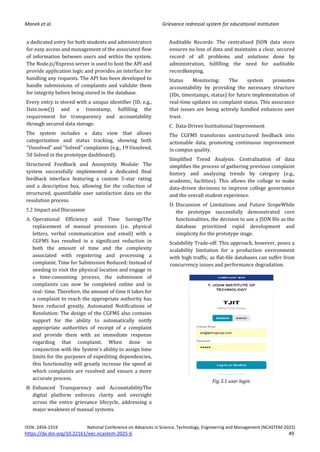
Fig 5.1 user login
Manek et al. Grievance redressal system for educational institution
ISSN: 2456-2319 National Conference on Advances in Science, Technology, Engineering and Management (NCASTEM-2025)
https://dx.doi.org/10.22161/eec.ncastem.2025-6 50
Fig 5.2 Student homepage
Fig 5.3 complaint successful registration
Fig 5.4 feedback forum after complaint resolved
Future Work: The next logical steps for the CGFMS
involve migrating the data store to a more robust,
dedicated database (SQL or NoSQL) to handle
concurrent user operations and ensure long-term data
security and integrity. Further enhancements will
include the full implementation of automated
notifications and real-time status tracking to meet the
objective of faster resolution times
VI. CONCLUSION AND FUTURE WORK
The developed Web-Based College Grievance and
Feedback Management System successfully meets its
core objectives by providing a centralized,
accessible, and accountable digital platform for
handling student, faculty, and staff grievances. The use
of the Node.js/Express stack with JSON file persistence
proved to be an efficient and costeffective approach for
creating a functional prototype that is superior to slow,
manual methods.
6.1 Future Enhancements
To fully realize the potential benefits outlined in the
project aims, future work should focus on the
following:
• Role-Based Access Control (RBAC):
Implementing secure login and access
restrictions for administrators, faculty, and
general users to view only relevant information.
• Notification System: Integrating email or in-app
notifications to update users when their
complaint status changes.
• Reporting Module: Developing a dashboard to
generate analytical reports on common
complaint categories, resolution times, and
average satisfaction scores.
• Scalable Database: Migrating the data layer from
local JSON files to a more robust, scalable
database (e.g., MongoDB, PostgreSQL) to handle
high volumes of data securely.
REFERENCES
[1] Kuhan, S., & Grace, L. J. (2023, May). Design and
implementation of students grievance and database. In
2023 2nd International Conference on Applied Artificial
Intelligence and Computing (ICAAIC) (pp. 1065- 1068).
IEEE.
[2] Rawat, R. S., Singh, V., & Dumka, A. (2022, November).
Complaint Management in Ethiopian Vocational and
Technical Education Institutions: A Framework and
Implementation of a Decision Support System. In 2022
Manek et al. Grievance redressal system for educational institution
ISSN: 2456-2319 National Conference on Advances in Science, Technology, Engineering and Management (NCASTEM-2025)
https://dx.doi.org/10.22161/eec.ncastem.2025-6 51
International Conference on Fourth Industrial Revolution
Based Technology and Practices (ICFIRTP) (pp. 73-79).
IEEE.
[3] Sharma, K., Gomathi, R. M., & Imtiaz, Y. I. (2022, April). A
centralised portal for a student support system based on
web application. In 2022 6th International Conference on
Trends in Electronics and Informatics (ICOEI) (pp. 74-81).
IEEE.
[4] Vinothini, K., Kiruthika, V., Hariram, M. A., Gayathri, K., &
Keerthana, S. (2022, June). Web based Feedback
Supervision System. In 2022 7th International
Conference on Communication and Electronics Systems
(ICCES) (pp. 1560-1563). IEEE.
[5] Meshram, E. A., Palandurkar, V., Zade, H., Masram, A., &
Manmode, N. (2023). A Survey on Student Grievance
Redressal System. International Journal for Research in
Applied Science and Engineering Technology, 11(2), 715-
720.
[6] Bind, C., Goyal, C., & Rai, A. (2024). Beyond Complaints: A
Strategic Analysis of College Grievance Redressal
System. system, 8(06).
[7] Agarwal, R., Soni, P., Agrawal, P., Rathor, S., Sisodiya, S., &
Sharma, J. (2022). Student Grievance Redressal System.
International Journal of Advanced Research in Computer
Science, 13.
[8] Alex, A. O. I. (2023). An Automated and Robust Tertiary
Institution Web- Based Student Complaint Management
System. International Research Journal of Innovations in
Engineering and Technology (IRJIET), 7(12), 110-124.
[9] Santosa, A. B. (2025). Analysis of Student Satisfaction
with School Administration Services. EDUKASIA Jurnal
Pendidikan dan Pembelajaran, 6(1), 1-14.
[10] Phratama, O. M., Handhayani, T., & Perdana, N. J. (2024).
Student Feedback Systems: Developing a Web-Based
Solution for Efficient Complaint Processing at Faculty of
Information Technology Tarumanagara University.
Internet of Things and Artificial Intelligence Journal, 4(4).
[11] Kapoor, S. (2025). A Java-Based System for Collecting
and Analyzing College Feedback. Journal of Integrated
Engineering Sciences, 1(1), 12-18.
[12] Alifat, F. A., Biodun, O. A., Oluwatobi, O. A., & Jennifer, U.
(2022). Web-based Campus Complaint Management
System (WCCMS). International Journal of Computer
Trends and Technology, 70(10), 28-36.

Grievance redressal system for educational institution

  • 1.
    International Journal ofElectrical, Electronics and Computers Special Issue | Jan-Feb, 2026 Available: https://aipublications.com/ijeec/ Peer-Reviewed Journal ISSN: 2456-2319 National Conference on Advances in Science, Technology, Engineering and Management (NCASTEM-2025) https://dx.doi.org/10.22161/eec.ncastem.2025-6 45 Grievance redressal system for educational institution Asha S Manek, Shalini KV, Kritik Munot, Sri Harsha T, Bindhu Monika, Shivalingayya Department of Artificial Intelligence and Machine Learning, T. John Institute of Technology, Bangalore,India Received: 20 Nov 2025; Accepted: 05 Feb 2025; Date of Publication: 07 Feb 2026 ©2026 The Author(s). Published by Infogain Publication. This is an open-access article under the CC BY license (https://creativecommons.org/licenses/by/4.0/). Abstract—This paper focuses on developing a web-based college grievance and feedback management system to replace the existing manual and time-consuming complaint process. The proposed system enables students, faculty, and staff to file, track, and manage complaints efficiently through a user- friendly interface. It is built using three main components: a JSON database for secure complaint storage and retrieval, a backend developed with Node.js and Flask to handle the logic, and a frontend using HTML and CSS for accessibility and ease of use. Key features such as role-based access, notifications, and report generation enhance transparency, accountability, and data-driven decision-making. This system ensures quick and fair redressal of grievances while improving campus facilities, faculty performance, and overall satisfaction. In the future, AI automation such as complaint categorization and routing using large language models (LLMs) can further enhance efficiency, responsiveness, and create a more student-centered and transparent campus experience. Keywords— Grievance Management System, Complaint Redressal, Web-Based Application, Student Feedback, Transparency, Accountability, Node.js, JSON, Automation, Campus Management, User-Friendly Interface. I. INTRODUCTION Grievances and complaints are an inevitable and perpetual part of any educational institution, arising from the diverse needs, experiences, and concerns of students, faculty, and other stakeholders. A grievance, at its core, represents a formal expression of discontent or a perception of injustice, whether it is a valid complaint or not. Establishing an efficient and effective system for addressing these grievances is not merely an administrative convenience but is paramount for maintaining a harmonious and productive campus environment. A well-structured system provides a vital platform for students to voice their concerns, seek resolutions, and obtain fair outcomes. It is a critical tool for institutional governance, serving as an important indicator of both institutional effectiveness and the overall quality of education. The fundamental purpose of such a system is to ensure that all stakeholder concerns are not only heard but are also promptly and impartially acted upon, a process that is designed to uphold and reinforce principles of transparency, fairness, and accountability.[1][2]. The function of a grievance system extends well beyond simple dispute resolution. Research indicates a progression in the understanding of a grievance system's purpose, from a basic reactive mechanism to a strategic tool for cultivating a healthy campus climate. Documents on the subject describe its role as a "moral and ethical imperative" for institutions that are committed to creating a supportive and inclusive learning environment. In essence, the system functions as a proactive feedback loop, providing the administration with a mechanism to identify its own strengths and weaknesses as an educational service organization. By centralizing complaints and analyzing the data they provide, institutions can make informed decisions to improve the educational experience for all students, transforming a reactive process into a data- driven mechanism for continuous institutional improvement and accountability.[3]. Modern higher education institutions commonly employ a tiered, multi-level system for grievance resolution, which strategically encourages informal processes before escalating to a formal review. The
  • 2.
    Manek et al.Grievance redressal system for educational institution ISSN: 2456-2319 National Conference on Advances in Science, Technology, Engineering and Management (NCASTEM-2025) https://dx.doi.org/10.22161/eec.ncastem.2025-6 46 "informal first" approach is a foundational principle of this model, designed to resolve misunderstandings and disputes at the "lowest possible level". This initial phase typically involves direct communication between the student and the employee or department head with whom the issue originated. This de- escalation strategy is an effort to minimize bureaucratic involvement and resolve conflicts efficiently and with minimal institutional overhead. To facilitate this, institutions often provide confidential, thirdparty resources such as an ombuds or a student advocate who can offer guidance and support without fear of reprisal. This is a crucial mechanism for overcoming psychological barriers to reporting, such as the fear of retaliation.[5]. The organizational structure of a grievance system is a critical factor in its effectiveness, and institutions grapple with the choice between centralized and decentralized models. In a decentralized structure, individual academic units, colleges, or departments maintain control over their own complaint resolution processes and platforms. While this approach may appear to align with traditional academic autonomy, it often leads to significant inefficiencies, including a lack of consistent navigation and disjointed communication efforts. Complaints data can become fragmented and difficult to aggregate, making it challenging to identify and address systemic issues across the institution. Furthermore, decentralization can disperse accountability so widely that no single group is responsible for the overall success or failure of the system.[4][6] II. RELATED WORKS Brady, M., Rosenthal, J. L., Forest, C. P., & Hocevar, D. (2022). [1] Anonymous versus public student feedback systems: Metacognition and achievement with graduate learners. Educational Technology Research and Development, 68(6), 2853–2872. Ibitomisin, R. P., & Oghenekaro, L. (2023).[2] Web Based Integrated Student Complaint System. International Journal of Computer Applications, 182(20), 25-30. Lee, C.-H., & Zhao, X. (2024). [3] Data Collection, Data Mining and Transfer of Learning based on Customer Temperament-centered Complaint Handling System and One-of-a-kind Complaint Handling Dataset. Advanced Engineering Informatics, 60, 102520. Oguntosin, V., Oluwadurotimi, M., Adoghe, A., Abdulkareem, A., & Adeyemi, G. (2021).[4] Development of a Web-Based Complaint Management Platform for a University Community. Journal of Engineering Science and Technology Review, 14(1), 150159. Sheth, H., Solanki, S., Parmar, A., Dave, J., & Raithatha, H. (2024). [5] Addressing Student Grievances: A Comprehensive Analysis of Grievance Management Systems. International Journal of Science, Engineering and Technology, 12(2), 541. Strydom, F., & Loots, S. (2022).[6] The student voice as contributor to quality education through institutional design. South African Journal of Higher Education, 34(5), 20–34. Winstone, N. E., Nash, R. A., Rowntree, J., & Parker, M. (2023). [7] "Conditions that enable effective feedback". Journal of the Scholarship of Teaching and Learning, 17(2), 29-45. Student Complaint Management System —Al-Waeli & Hassan(2022) [8] Project developed for a university context (Yemen) describing a web-based complaint management system that enables students to submit complaints, and the university to track and resolve them using a MySQL database and web interface .Directly aligned with your domain (student complaints, online system) which makes it a strong fit. Web-based Campus Complaint Management System (WCCMS) — Fabiyi et al. (2022)[9].This paper presents a campus-wide complaint management system in a higher education setting, discussing design, stakeholders (students & staff), tracking and resolution. Very relevant to your system for educational institutions; good for comparison of functionalities. Design and Development of a Web-Based Complaints Management System at Syiah Kuala University Integrated Laboratory— Mutiawani, Hafist & Dawood(2024)[10]. Describes the design and development of a web-based complaints management system in a university laboratory context. Good for showing recent work (2024) in educational institutions; you can compare technology stacks, user roles, features. A Literature Review of a Web-Based Complaint Management System — Nandini et al. (2025)[11].A review paper that surveys web-based complaint
  • 3.
    Manek et al.Grievance redressal system for educational institution ISSN: 2456-2319 National Conference on Advances in Science, Technology, Engineering and Management (NCASTEM-2025) https://dx.doi.org/10.22161/eec.ncastem.2025-6 47 management systems, their architectures, key features such as role-based access, dashboards, tracking, analytics. Useful for your “related work” section to show thematic trends (e.g., role-based access, analytics) and identify gaps your system addresses. Grievance Management System in PHP — Devkule & Palkar (2024)[12].Paper describing an online grievance management system (not limited to student complaints) using PHP and highlighting improved process efficiency. While not exclusively student-centred, it offers insights into generic grievance system features which you can adapt. III. METHODOLOGY 3.1 Architecture and Technology Stack The project employs a three-tier architecture simplified for a mini- project scope: Frontend (Presentation Layer): Standard HTML5 and CSS3 (with inline styling for the feedback module) providing the user interface. Backend (Application Logic): Node.js runtime environment utilizing the lightweight Express.js framework . Fig 3.1 System workflow Database (Data Layer): Local file system persistence using the built-in fs module and JSON files (complaints.json, feedback.json) instead of a traditional relational database, prioritizing simplicity and rapid prototyping. 3.2 Complaint Submission Flow The backend system executed via Node.js/Express completely manages this process to guarantee that the submitted data is valid and unique. Frontend Request: The user completes a complaint, fills in the required details of the complaint form (frontend), and then sends a POST request with the completed complaint data (in JSON format) via the /api/submit-complaint URL. Server Processing and Validation: The Express route handler receives the request body (req.body). The logic (as confirmed in server.js) performs basic validation to check for the presence of mandatory fields, specifically title and description. A 400 Bad Request status is returned if validation fails. To maintain the data file in sync and intact, fs.promises.writeFile is used to handle writing back the updated array to the data file. Upon confirmation of complaint submission, the server will send a response of "200 OK" back to the user with an indication of successful submission along with a generated Complaint ID assigned to the complaint submitted for subsequent tracking purposes. 3.3 System Workflow Implementation The system facilitates complaint management between students and administrators, following a structured flow: Student Workflow 1. Login Page: o Students authenticate to access the system. 2. Student Home Page: o Provides navigation to complaint submission. 3. Complaint Page: o Students fill out a form with title and description 4. Complaint Submission: o A POST request is sent to /api/submitcomplaint. o Server validates input, assigns a unique id (Date.now()), and adds a createdAt timestamp. o Complaint is appended to complaints.json. Admin Workflow 1. Login Page: o Admin authenticate to access administrative tools. 2. Admin Home Page: o Provides access to complaint management features. 3. View Complaints:
  • 4.
    Manek et al.Grievance redressal system for educational institution ISSN: 2456-2319 National Conference on Advances in Science, Technology, Engineering and Management (NCASTEM-2025) https://dx.doi.org/10.22161/eec.ncastem.2025-6 48 o Admins retrieve and review complaints from complaints.json. 4. Solve Complaint: o Admins mark complaints as resolved (status update logic can be added). 5. Send Feedback Form: o Admins trigger feedback form delivery to the student. 3.4 Satisfaction Feedback Flow This flow closes the loop by assessing the efficacy of the redressal process: 1.Trigger: Once the complaint's status is administratively updated to 'Resolved,' the system prompts the user to access the dedicated Feedback Form. 2.Data Capture: The form captures two critical types of data: Quantitative Data: The user's selection on the 5-star rating scale (e.g., a numerical value from 1 to 5) measures satisfaction level. Qualitative Data: The input from the description box captures detailed, actionable suggestions or reasons behind the rating. 3.Persistence: This feedback data is sent via a separate API request and is securely saved to the dedicated feedback.json file, ensuring that redressal metrics are segregated from the initial grievance records for clear analysis. IV. IMPLEMENTATION The three-tier architecture of the system is implemented by means of functional code (Node.js) on the back end for reliable operation and operations for storing the system’s data. This section covers how to configure the server, the specific Application Programming Interface (API) endpoints to be used by the system, and how to structure the data persistence layer of the application 4.1 Backend Implementation (Node.js & Express.js) The backend application logic is managed by an Express.js server, which handles all client requests and file operations. The core implementation involves setting up the server, defining middleware, and creating the API endpoint for complaint submission. A. Server Setup and Middleware The server.js file initializes the Express application and sets up necessary middleware for processing JSON requests and serving static frontend files: B. ComplaintSubmission API Endpoint The primary function of the backend is executed by the POST /api/submit-complaint endpoint. This asynchronous route handles the complete complaint lifecycle described in the methodology: validation, unique ID assignment, and data persistence. 4.2 Data Layer Implementation (JSON Persistence) The data layer is implemented using structured JSON files for storage, providing a simple, readable, and highly accessible database structure for the prototype. A. Data Structure (complaints.json)The primary data file, complaints.json, stores all grievances as an array of JSON objects. Each object maintains a consistent schema that supports the tracking and analysis requirements B. Feedback Data Structure (feedback.json)A separate file, feedback.json, is allocated for the satisfaction data captured post-resolution. While the API endpoint for this is not shown, the implementation requires a structure that links the feedback to the original complaint and stores the quantitative and qualitative data 4.3 Frontend Implementation (Feedback Module) The frontend's implementation focuses on providing a clean, accessible interface using basic HTML and CSS. The crucial component is the post-resolution satisfaction feedback page, which was designed to capture both a numerical rating and detailed text input. 5-Star Rating: The 5-star rating system is implemented using CSS radio buttons (<input type="radio">) and Unicode star characters (★) within <label> elements Description Box: A standard HTML <textarea> element is used to provide the open-ended text input, allowing users to provide detailed, qualitative feedback that is essential for understanding the context behind their numerical rating. V. RESULTS AND CONCLUSION 5.1 Functional Results The completed prototype has produced a working solution for users utilizing the HTML/CSS front-end framework and React.js as an enhancement that provides one simple, unified platform to allow individuals to submit their issues or recommendations. Additionally, direct access includes
  • 5.
    Manek et al.Grievance redressal system for educational institution ISSN: 2456-2319 National Conference on Advances in Science, Technology, Engineering and Management (NCASTEM-2025) https://dx.doi.org/10.22161/eec.ncastem.2025-6 49 a dedicated entry for both students and administrators for easy access and management of the associated flow of information between users and within the system. The Node.js/Express server is used to host the API and provide application logic and provides an interface for handling any requests. The API has been developed to handle submissions of complaints and validate them for integrity before being stored in the database. Every entry is stored with a unique identifier (ID, e.g., Date.now()) and a timestamp, fulfilling the requirement for transparency and accountability through secured data storage. The system includes a data view that allows categorization and status tracking, showing both "Unsolved" and "Solved" complaints (e.g., 19 Unsolved, 50 Solved in the prototype dashboard). Structured Feedback and Anonymity Module: The system successfully implemented a dedicated final feedback interface featuring a custom 5-star rating and a description box, allowing for the collection of structured, quantifiable user satisfaction data on the resolution process. 5.2 Impact and Discussion A. Operational Efficiency and Time SavingsThe replacement of manual processes (i.e. physical letters, verbal communication and email) with a CGFMS has resulted in a significant reduction in both the amount of time and the complexity associated with registering and processing a complaint. Time for Submission Reduced: Instead of needing to visit the physical location and engage in a time-consuming process, the submission of complaints can now be completed online and in real- time. Therefore, the amount of time it takes for a complaint to reach the appropriate authority has been reduced greatly. Automated Notifications of Resolution: The design of the CGFMS also contains support for the ability to automatically notify appropriate authorities of receipt of a complaint and provide them with an immediate response regarding that complaint. When done in conjunction with the System's ability to assign time limits for the purposes of expediting dependencies, this functionality will greatly increase the speed at which complaints are resolved and ensure a more accurate process. B. Enhanced Transparency and AccountabilityThe digital platform enforces clarity and oversight across the entire grievance lifecycle, addressing a major weakness of manual systems. Auditable Records: The centralized JSON data store ensures no loss of data and maintains a clear, secured record of all problems and solutions done by administration, fulfilling the need for auditable recordkeeping. Status Monitoring: The system promotes accountability by providing the necessary structure (IDs, timestamps, status) for future implementation of real-time updates on complaint status. This assurance that issues are being actively handled enhances user trust. C. Data-Driven Institutional Improvement The CGFMS transforms unstructured feedback into actionable data, promoting continuous improvement in campus quality. Simplified Trend Analysis: Centralization of data simplifies the process of gathering previous complaint history and analyzing trends by category (e.g., academic, facilities). This allows the college to make data-driven decisions to improve college governance and the overall student experience. D. Discussion of Limitations and Future ScopeWhile the prototype successfully demonstrated core functionalities, the decision to use a JSON file as the database prioritized rapid development and simplicity for the prototype stage. Scalability Trade-off: This approach, however, poses a scalability limitation for a production environment with high traffic, as flat-file databases can suffer from concurrency issues and performance degradation. Fig 5.1 user login
  • 6.
    Manek et al.Grievance redressal system for educational institution ISSN: 2456-2319 National Conference on Advances in Science, Technology, Engineering and Management (NCASTEM-2025) https://dx.doi.org/10.22161/eec.ncastem.2025-6 50 Fig 5.2 Student homepage Fig 5.3 complaint successful registration Fig 5.4 feedback forum after complaint resolved Future Work: The next logical steps for the CGFMS involve migrating the data store to a more robust, dedicated database (SQL or NoSQL) to handle concurrent user operations and ensure long-term data security and integrity. Further enhancements will include the full implementation of automated notifications and real-time status tracking to meet the objective of faster resolution times VI. CONCLUSION AND FUTURE WORK The developed Web-Based College Grievance and Feedback Management System successfully meets its core objectives by providing a centralized, accessible, and accountable digital platform for handling student, faculty, and staff grievances. The use of the Node.js/Express stack with JSON file persistence proved to be an efficient and costeffective approach for creating a functional prototype that is superior to slow, manual methods. 6.1 Future Enhancements To fully realize the potential benefits outlined in the project aims, future work should focus on the following: • Role-Based Access Control (RBAC): Implementing secure login and access restrictions for administrators, faculty, and general users to view only relevant information. • Notification System: Integrating email or in-app notifications to update users when their complaint status changes. • Reporting Module: Developing a dashboard to generate analytical reports on common complaint categories, resolution times, and average satisfaction scores. • Scalable Database: Migrating the data layer from local JSON files to a more robust, scalable database (e.g., MongoDB, PostgreSQL) to handle high volumes of data securely. REFERENCES [1] Kuhan, S., & Grace, L. J. (2023, May). Design and implementation of students grievance and database. In 2023 2nd International Conference on Applied Artificial Intelligence and Computing (ICAAIC) (pp. 1065- 1068). IEEE. [2] Rawat, R. S., Singh, V., & Dumka, A. (2022, November). Complaint Management in Ethiopian Vocational and Technical Education Institutions: A Framework and Implementation of a Decision Support System. In 2022
  • 7.
    Manek et al.Grievance redressal system for educational institution ISSN: 2456-2319 National Conference on Advances in Science, Technology, Engineering and Management (NCASTEM-2025) https://dx.doi.org/10.22161/eec.ncastem.2025-6 51 International Conference on Fourth Industrial Revolution Based Technology and Practices (ICFIRTP) (pp. 73-79). IEEE. [3] Sharma, K., Gomathi, R. M., & Imtiaz, Y. I. (2022, April). A centralised portal for a student support system based on web application. In 2022 6th International Conference on Trends in Electronics and Informatics (ICOEI) (pp. 74-81). IEEE. [4] Vinothini, K., Kiruthika, V., Hariram, M. A., Gayathri, K., & Keerthana, S. (2022, June). Web based Feedback Supervision System. In 2022 7th International Conference on Communication and Electronics Systems (ICCES) (pp. 1560-1563). IEEE. [5] Meshram, E. A., Palandurkar, V., Zade, H., Masram, A., & Manmode, N. (2023). A Survey on Student Grievance Redressal System. International Journal for Research in Applied Science and Engineering Technology, 11(2), 715- 720. [6] Bind, C., Goyal, C., & Rai, A. (2024). Beyond Complaints: A Strategic Analysis of College Grievance Redressal System. system, 8(06). [7] Agarwal, R., Soni, P., Agrawal, P., Rathor, S., Sisodiya, S., & Sharma, J. (2022). Student Grievance Redressal System. International Journal of Advanced Research in Computer Science, 13. [8] Alex, A. O. I. (2023). An Automated and Robust Tertiary Institution Web- Based Student Complaint Management System. International Research Journal of Innovations in Engineering and Technology (IRJIET), 7(12), 110-124. [9] Santosa, A. B. (2025). Analysis of Student Satisfaction with School Administration Services. EDUKASIA Jurnal Pendidikan dan Pembelajaran, 6(1), 1-14. [10] Phratama, O. M., Handhayani, T., & Perdana, N. J. (2024). Student Feedback Systems: Developing a Web-Based Solution for Efficient Complaint Processing at Faculty of Information Technology Tarumanagara University. Internet of Things and Artificial Intelligence Journal, 4(4). [11] Kapoor, S. (2025). A Java-Based System for Collecting and Analyzing College Feedback. Journal of Integrated Engineering Sciences, 1(1), 12-18. [12] Alifat, F. A., Biodun, O. A., Oluwatobi, O. A., & Jennifer, U. (2022). Web-based Campus Complaint Management System (WCCMS). International Journal of Computer Trends and Technology, 70(10), 28-36.