Servant Leadership:
The Theories of Robert Greenleaf


           Fawn Russell
            LIBR 282
             Fall 2012
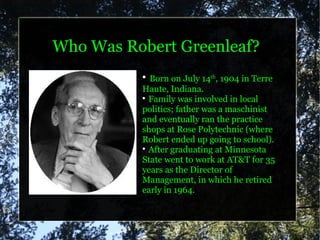
Who Was Robert Greenleaf?
          
            Born on July 14th, 1904 in Terre
          Haute, Indiana.
          
            Family was involved in local
          politics; father was a maschinist
          and eventually ran the practice
          shops at Rose Polytechnic (where
          Robert ended up going to school).
          
            After graduating at Minnesota
          State went to work at AT&T for 35
          years as the Director of
          Management, in which he retired
          early in 1964.
A Second Career

  Became a consultant and
speaker on the role of leaders
throughout the 1960's; spoke at
several universities/Nonprofits
including M.I.T., Dartmouth and
Harvard business schools.

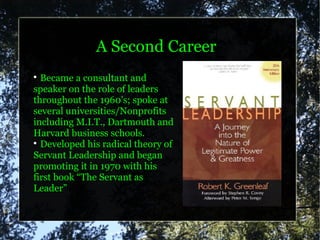
  Developed his radical theory of
Servant Leadership and began
promoting it in 1970 with his
first book “The Servant as
Leader”
What is Servant Leadership?

  1960's mainstream leadership as a pyramid, with the
bosses at the top and employees/volunteers underneath,
following instructions given from above; Greenleaf flipped
the model of power-oriented management style.

  "The servant-leader is servant first… It begins with the
natural feeling that one wants to serve, to serve first. Then
conscious choice brings one to aspire to lead. That person is
sharply different from one who is leader first, perhaps
because of the need to assuage an unusual power drive or
to acquire material possessions…The leader-first and the
servant-first are two extreme types. Between them there
are shadings and blends that are part of the infinite variety
of human nature.” (Greenleaf Center website)
What is Servant Leadership?

  In Greenleaf's next essay, “The Institute as Servant”, Greenleaf
shows how it is not just up to the individual but organizations as a
whole to serve the customer; instead of viewing them simply as
cash flow.

  “This is my thesis: caring for persons, the more able and the
less able serving each other, is the rock upon which a good
society is built. Whereas, until recently, caring was largely
person to person, now most of it is mediated through institutions
- often large, complex, powerful, impersonal; not always
competent; sometimes corrupt. If a better society is to be built,
one that is more just and more loving, one that provides greater
creative opportunity for its people, then the most open course is
to raise both the capacity to serve and the very performance as
servant of existing major institutions by new regenerative forces
operating within them.” (Robert Greenleaf, from “Servant
Leadership” page 62)
The Greenleaf Center
         
           A nonprofit organization
         established originally in 1964 as the
         Center for Applied Ethics.
         
           Greenleaf served as the President
         until 1985.
         
           Now known as The Greenleaf
         Center, the organization promotes
         the theories of Robert Greenleaf and
         compassionate ways of leading which
         empower all.
         
           The mission of the center's service
         is that it “promotes the awareness,
         understanding, and practice of
         servant leadership by individuals
         and organizations.” (Greenleaf
         Center Mission)
What is most valuable to us, as practicing
leaders/managers, from Robert K. Greenleaf's work?

Seeing the potential for growth professionally and personally is
  a huge benefit in adapting this managing philosophy.

It promotes community ethics, a sense of self and individuality
   without being ego-centered, and shared empowerment.

Over-arching theme of empathy: “The ability to mentally
  project one’s own consciousness into that of another
  individual. Greenleaf wrote, 'The servant always accepts
  and empathizes, never rejects' (1970, p. 12), and 'Men grow
  taller when those who lead themempathize, and when they
  are accepted for who they are…' (1970, p. 14)”. (Smith)
References

Greenleaf, Robert K. & Spears, Larry C. (1977 & 2002).
Servant leadership: a journey into the nature of
legitimate power and greatness. New Jersey: Paulist
Press.

Greenleaf center for servant leadership. Retrieved
9/19/2012 from www.Greenleaf.org

Smith, Carol. (2005). Servant leadership: the
leadership theory of Robert K. Greenleaf. Retrieved
9/19/2012 from
www.carolsmith.us/downloads/640greenleaf.pdf

Greenleaf Leadership

  • 1.
    Servant Leadership: The Theoriesof Robert Greenleaf Fawn Russell LIBR 282 Fall 2012
  • 2.
    Who Was RobertGreenleaf?  Born on July 14th, 1904 in Terre Haute, Indiana.  Family was involved in local politics; father was a maschinist and eventually ran the practice shops at Rose Polytechnic (where Robert ended up going to school).  After graduating at Minnesota State went to work at AT&T for 35 years as the Director of Management, in which he retired early in 1964.
  • 3.
    A Second Career  Became a consultant and speaker on the role of leaders throughout the 1960's; spoke at several universities/Nonprofits including M.I.T., Dartmouth and Harvard business schools.  Developed his radical theory of Servant Leadership and began promoting it in 1970 with his first book “The Servant as Leader”
  • 4.
    What is ServantLeadership?  1960's mainstream leadership as a pyramid, with the bosses at the top and employees/volunteers underneath, following instructions given from above; Greenleaf flipped the model of power-oriented management style.  "The servant-leader is servant first… It begins with the natural feeling that one wants to serve, to serve first. Then conscious choice brings one to aspire to lead. That person is sharply different from one who is leader first, perhaps because of the need to assuage an unusual power drive or to acquire material possessions…The leader-first and the servant-first are two extreme types. Between them there are shadings and blends that are part of the infinite variety of human nature.” (Greenleaf Center website)
  • 5.
    What is ServantLeadership?  In Greenleaf's next essay, “The Institute as Servant”, Greenleaf shows how it is not just up to the individual but organizations as a whole to serve the customer; instead of viewing them simply as cash flow.  “This is my thesis: caring for persons, the more able and the less able serving each other, is the rock upon which a good society is built. Whereas, until recently, caring was largely person to person, now most of it is mediated through institutions - often large, complex, powerful, impersonal; not always competent; sometimes corrupt. If a better society is to be built, one that is more just and more loving, one that provides greater creative opportunity for its people, then the most open course is to raise both the capacity to serve and the very performance as servant of existing major institutions by new regenerative forces operating within them.” (Robert Greenleaf, from “Servant Leadership” page 62)
  • 6.
    The Greenleaf Center  A nonprofit organization established originally in 1964 as the Center for Applied Ethics.  Greenleaf served as the President until 1985.  Now known as The Greenleaf Center, the organization promotes the theories of Robert Greenleaf and compassionate ways of leading which empower all.  The mission of the center's service is that it “promotes the awareness, understanding, and practice of servant leadership by individuals and organizations.” (Greenleaf Center Mission)
  • 7.
    What is mostvaluable to us, as practicing leaders/managers, from Robert K. Greenleaf's work? Seeing the potential for growth professionally and personally is a huge benefit in adapting this managing philosophy. It promotes community ethics, a sense of self and individuality without being ego-centered, and shared empowerment. Over-arching theme of empathy: “The ability to mentally project one’s own consciousness into that of another individual. Greenleaf wrote, 'The servant always accepts and empathizes, never rejects' (1970, p. 12), and 'Men grow taller when those who lead themempathize, and when they are accepted for who they are…' (1970, p. 14)”. (Smith)
  • 8.
    References Greenleaf, Robert K.& Spears, Larry C. (1977 & 2002). Servant leadership: a journey into the nature of legitimate power and greatness. New Jersey: Paulist Press. Greenleaf center for servant leadership. Retrieved 9/19/2012 from www.Greenleaf.org Smith, Carol. (2005). Servant leadership: the leadership theory of Robert K. Greenleaf. Retrieved 9/19/2012 from www.carolsmith.us/downloads/640greenleaf.pdf