THE GREEN REVOLUTION
§ (The Third
Agricultural
Revolution)
§ And Biotechnology
THOMAS MALTHUS
§ 19th century economist
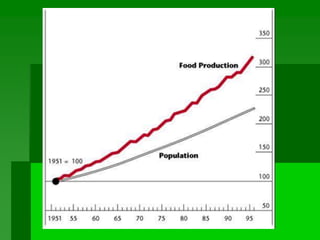
§ Believed that because population grows
geometrically and food production
arithmetically famine was inevitable.
§ Slowing the growth of population was the only
possibility to prevent starvation
History (so far) has proven Malthus wrong . . .
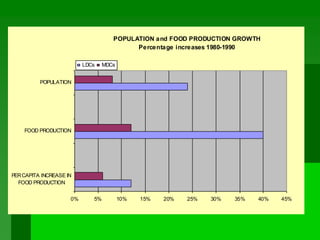
POPULATION and FOOD PRODUCTION GROWTH
Percentage increases 1980-1990
0% 5% 10% 15% 20% 25% 30% 35% 40% 45%
PERCAPITA INCREASE IN
FOOD PRODUCTION
FOOD PRODUCTION
POPULATION
LDCs MDCs
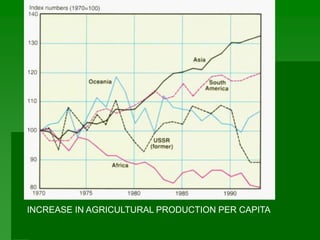
INCREASE IN AGRICULTURAL PRODUCTION PER CAPITA
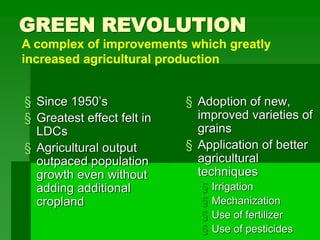
GREEN REVOLUTION
§ Adoption of new,
improved varieties of
grains
§ Application of better
agricultural
techniques
§ Irrigation
§ Mechanization
§ Use of fertilizer
§ Use of pesticides
§ Since 1950’s
§ Greatest effect felt in
LDCs
§ Agricultural output
outpaced population
growth even without
adding additional
cropland
A complex of improvements which greatly
increased agricultural production
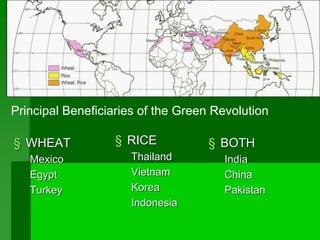
§ WHEAT
Mexico
Egypt
Turkey
§ RICE
Thailand
Vietnam
Korea
Indonesia
Principal Beneficiaries of the Green Revolution
§ BOTH
India
China
Pakistan
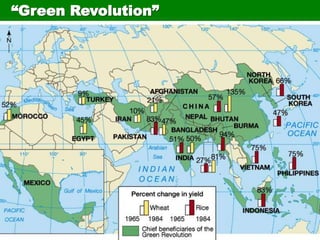
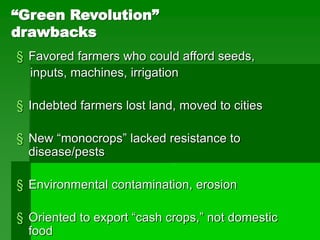
“Green Revolution”
“Green Revolution”
drawbacks
§ Favored farmers who could afford seeds,
inputs, machines, irrigation
§ Indebted farmers lost land, moved to cities
§ New “monocrops” lacked resistance to
disease/pests
§ Environmental contamination, erosion
§ Oriented to export “cash crops,” not domestic
food
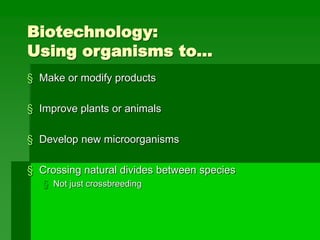
Biotechnology:
Using organisms to…
§ Make or modify products
§ Improve plants or animals
§ Develop new microorganisms
§ Crossing natural divides between species
§ Not just crossbreeding
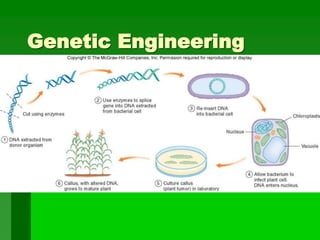
Genetic Engineering
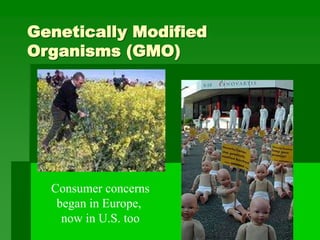
Genetically Modified
Organisms (GMO)
Consumer concerns
began in Europe,
now in U.S. too
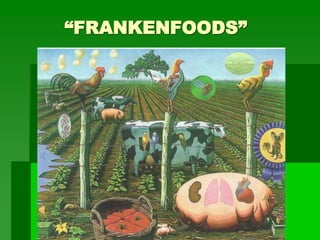
“FRANKENFOODS”
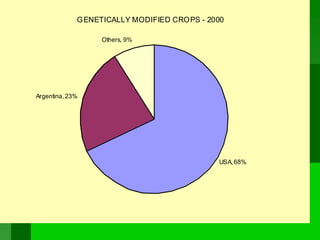
GENETICALLY MODIFIED CROPS - 2000
Others, 9%
Argentina, 23%
USA,68%
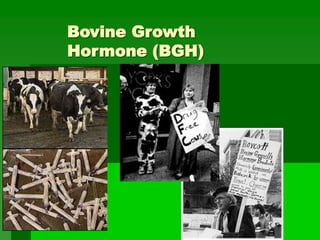
Bovine Growth
Hormone (BGH)

Green Revolution Notes.ppt