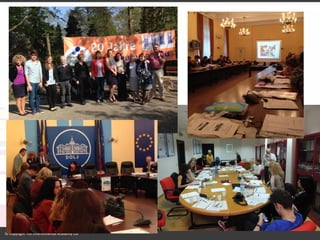
GREEN HERO 
Let me take you on the Journey 
Las Palmas Conference 
11th September 2014
WELCOME AND INTRODUCTION 
•Rita Callender 
•Lead Project Co-ordinator 
•The Environmental Academy 
•UK Partner 
Green Hero has been partially funded under the Lifelong Learning programmeProject No. 528064-LLP-1-2012- UK-CMP
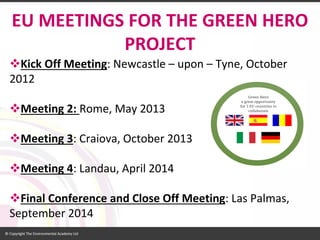
Kick Off Meeting: Newcastle –upon –Tyne, October 2012 
Meeting 2: Rome, May 2013 
Meeting 3: Craiova, October 2013 
Meeting 4: Landau, April 2014 
Final Conference and Close Off Meeting: Las Palmas, September 2014 
EU MEETINGSFOR THE GREEN HERO PROJECT
PARTNER INTRODUCTIONS 
Spain, Consulta-Europa–NoheliaMartinez and Lucie Milcent 
Italy, IPRSS–Dr PatriziaGrifoniand Dr Fernando Ferri 
Germany, University of Koblenz-Landau –Professor GuntherSeeber 
Romania, InTEMA, International Education and Management Association –DorinaGoiceanu 
United Kingdom, Pareto UK Ltd –Mr Tom Scott
•A detailed curriculum analysis was undertaken as the first stage in the project 
•This involved each country undertaking country research 
•Report produced with the findings 
CURRICULUM ANALYSIS
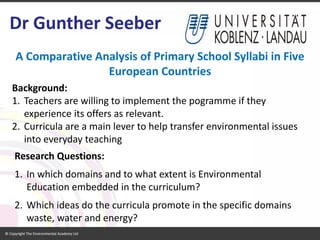
A Comparative Analysis of Primary School Syllabi in Five European Countries 
Research Questions: 
1.In which domains and to what extent is Environmental Education embedded in the curriculum? 
2.Which ideas do the curricula promote in the specific domains waste, water and energy? 
Dr Gunther Seeber 
Background: 
1.Teachers are willing to implement the pogramme if they experience its offers as relevant. 
2.Curricula are a main lever to help transfer environmental issues into everyday teaching
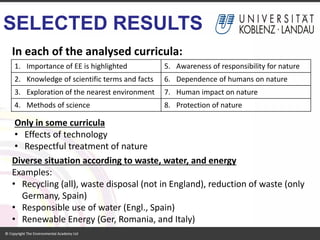
SELECTED RESULTS 
In each of the analysed curricula: 
1.ImportanceofEE ishighlighted 
5.Awareness ofresponsibilityfornature 
2.Knowledge of scientific terms and facts 
6.Dependenceofhumanson nature 
3.Exploration ofthenearestenvironment 
7.Human impacton nature 
4.Methodsofscience 
8.Protectionofnature 
Onlyin somecurricula 
•Effectsoftechnology 
•Respectfultreatmentofnature 
Diverse situationaccordingtowaste, water, andenergy 
Examples: 
•Recycling (all), wastedisposal(not in England), reductionofwaste(onlyGermany, Spain) 
•Responsibleuseofwater(Engl., Spain) 
•Renewable Energy (Ger, Romania, and Italy)
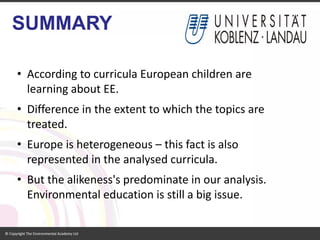
SUMMARY 
•According to curricula European children are learning about EE. 
•Difference in the extent to which the topics are treated. 
•Europe is heterogeneous –this fact is also represented in the analysed curricula. 
•But the alikeness's predominate in our analysis. Environmental education is still a big issue.
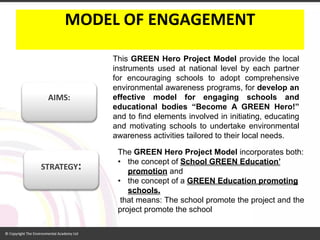
MODEL OF ENGAGEMENT 
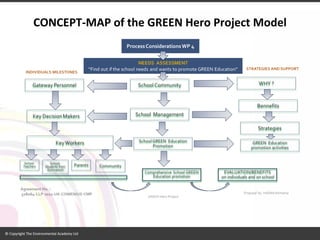
ThisGREENHeroProjectModelprovidethelocalinstrumentsusedatnationallevelbyeachpartnerforencouragingschoolstoadoptcomprehensiveenvironmentalawarenessprograms,fordevelopaneffectivemodelforengagingschoolsandeducationalbodies“BecomeAGREENHero!” andtofindelementsinvolvedininitiating,educatingandmotivatingschoolstoundertakeenvironmentalawarenessactivitiestailoredtotheirlocalneeds. 
The GREEN Hero Project Modelincorporates both: 
•the concept of School GREEN Education’ promotionand 
•the concept of a GREEN Education promoting schools. 
thatmeans:Theschoolpromotetheprojectandtheprojectpromotetheschool 
STRATEGY: 
AIMS:
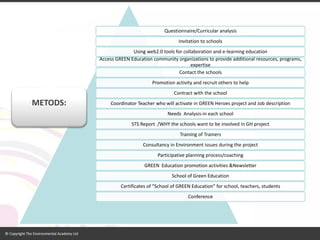
Questionnaire/Curricular analysis 
Invitation to schools 
Usingweb2.0 toolsfor collaborationande-learningeducation 
Access GREEN Educationcommunityorganizationstoprovideadditionalresources, programs, expertise 
Contact the schools 
Promotionactivityandrecruitotherstohelp 
Contract with the school 
Coordinator Teacher who will activate in GREEN Heroes project and Job description 
Needs Analysis-in each school 
STS Report /WHY the schools want to be involved in GH project 
Training of Trainers 
Consultancyin Environmentissuesduringtheproject 
Participative planning process/coaching 
GREEN Education promotion activities &Newsletter 
School of Green Education 
Certificatesof “SchoolofGREEN Education” for school, teachers, students 
Conference 
METODS:
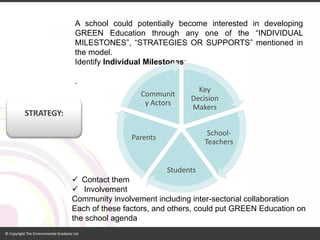
AschoolcouldpotentiallybecomeinterestedindevelopingGREENEducationthroughanyoneofthe“INDIVIDUALMILESTONES”,“STRATEGIESORSUPPORTS”mentionedinthemodel. 
IdentifyIndividualMilestones: 
. 
STRATEGY: 
KeyDecisionMakers 
School- Teachers 
Students 
Parents 
CommunityActors 
Contact them 
Involvement 
Communityinvolvementincludinginter-sectorial collaboration 
Each of these factors, and others, could put GREEN Education on the school agenda
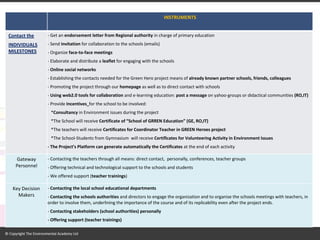
INSTRUMENTS Contact the INDIVIDUALS MILESTONES - Get an endorsement letter from Regional authority in charge of primary education - Send invitation for collaboration to the schools (emails) - Organize face-to-face meetings - Elaborate and distribute a leaflet for engaging with the schools - Online social networks - Establishing the contacts needed for the Green Hero project means of already known partner schools, friends, colleagues - Promoting the project through our homepage as well as to direct contact with schools - Using web2.0 tools for collaboration and e-learning education: post a message on yahoo-groups or didactical communities (RO,IT) - Provide Incentives for the school to be involved: *Consultancy in Environment issues during the project *The School will receive Certificate of “School of GRREN Education” (GE, RO,IT) *The teachers will receive Certificates for Coordinator Teacher in GREEN Heroes project *The School-Students from Gymnasium will receive Certificates for Volunteering Activity in Environment Issues - The Project’s Platform can generate automatically the Certificates at the end of each activity Gateway Personnel - Contacting the teachers through all means: direct contact, personally, conferences, teacher groups - Offering technical and technological support to the schools and students - We offered support (teacher trainings) Key Decision Makers - Contacting the local school educational departments - Contacting the schools authorities and directors to engage the organization and to organise the schools meetings with teachers, in order to involve them, underlining the importance of the course and of its replicability even after the project ends. - Contacting stakeholders (school authorities) personally - Offering support (teacher trainings)
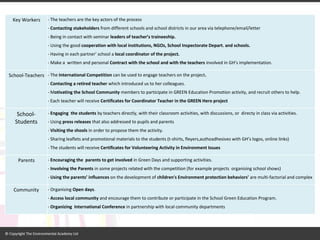
Key Workers - The teachers are the key actors of the process - Contacting stakeholders from different schools and school districts in our area via telephone/email/letter - Being in contact with seminar leaders of teacher’s traineeship. - Using the good cooperation with local institutions, NGOs, School Inspectorate Depart. and schools. - Having in each partner’ school a local coordinator of the project. - Make a written and personal Contract with the school and with the teachers involved in GH’s implementation. School-Teachers - The International Competition can be used to engage teachers on the project. - Contacting a retired teacher which introduced us to her colleagues. - Motivating the School Community members to participate in GREEN Education Promotion activity, and recruit others to help. - Each teacher will receive Certificates for Coordinator Teacher in the GREEN Hero project School- Students - Engaging the students by teachers directly, with their classroom activities, with discussions, or directy in class via activities. - Using press releases that also addressed to pupils and parents - Visiting the shools in order to propose them the activity. - Sharing leaflets and promotional materials to the students (t-shirts, fleyers,authoadhesives with GH’s logos, online links) - The students will receive Certificates for Volunteering Activity in Environment Issues Parents - Encouraging the parents to get involved in Green Days and supporting activities. - Involving the Parents in some projects related with the competition (for example projects organising school shows) - Using the parents’ influences on the development of children's Environment protection behaviors’ are multi-factorial and complex Community - Organising Open days. - Access local community and encourage them to contribute or participate in the School Green Education Program. - Organizing International Conference in partnership with local community departments
CONCEPT-MAP of theGREEN Hero Project Model
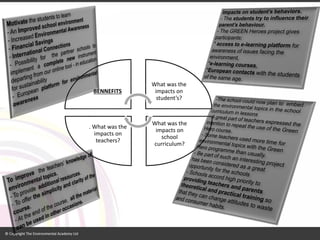
BENNEFITS 
What was the impacts on student’s? 
What was the impacts on school curriculum? 
. What was the impacts on teachers?
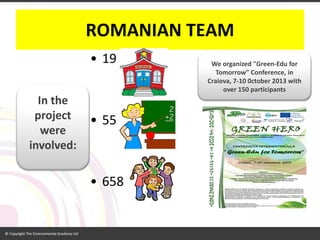
ROMANIAN TEAM 
•19 
•55 
•658 
In the project were involved: 
We organized "Green-Edufor Tomorrow" Conference, in Craiova, 7-10 0ctober 2013 with over 150 participants
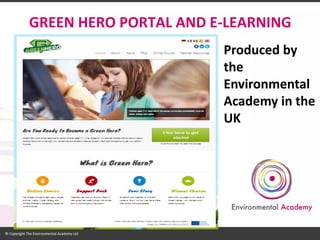
GREEN HERO PORTAL AND E-LEARNING 
Produced by the Environmental Academy in the UK
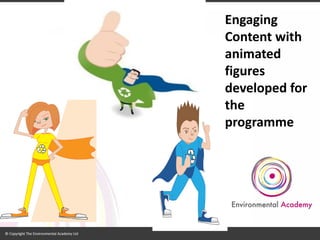
Engaging 
Content with 
animated 
figures 
developed for 
the 
programme
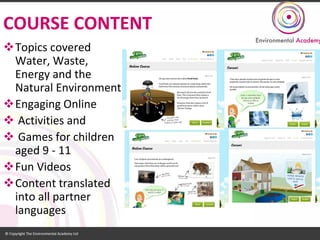
COURSE CONTENT 
Topics covered Water, Waste, Energy and the Natural Environment 
Engaging Online 
Activities and 
Games for children aged 9 -11 
Fun Videos 
Content translated into all partner languages
GREEN HERO TEACHER SUPPORT PACK 
Produced by Italian Partner CNR-IRPPS 
Rome
It has supported teachers explaining them how to combine: 
–On-line course modules 
–Classroom activities 
–On-line game competition 
–Homeworks 
It has provided: 
–a suggested lesson plan for teachers using the Green Hero resources 
–Contact details of the Green Hero team for each country 
ItwasavailableinEnglish,Spanish,Romanian,ItalianandGermanlanguage.Itisavailableon-lineandonapaperversion 
TEACHER SUPPORT PACK
LESSONS LEARNED 
•Thedetaileddescription&step-by-stepinstructionsoftheproposedcombinedactionsbytheon-lineactivitieswiththeotheractivitieswasveryuseful. 
•Thetrainingpackisagoodtoolforfutureuseofthecourse,aftertheendoftheGreenheroproject. 
•Itisthebaseforincludingthecourseindifferentcurricula. 
•Thetrainingpackcanbesharedamongon-linecommunitiesofteachersinordertoenrichthistrainingpackwithexperiencestobeadded.
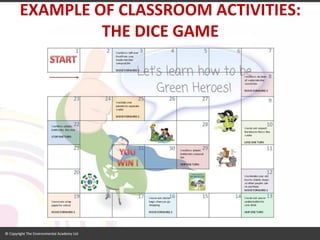
EXAMPLE OF CLASSROOM ACTIVITIES: THE DICE GAME
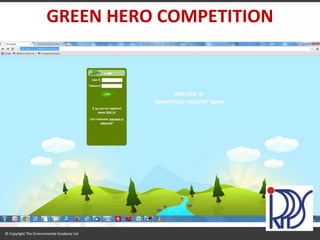
GREEN HERO COMPETITION
THE COMPETITION 
Teacherswereinvitedtoplaywithchildrenparticipatingatthe“GreenReportergame” sharingmaterialsproducedinclassalsoonthebaseofhomework,organisingtheminanarticleoragalleryofpicturesforattendingatthecompetitionassociatedwithit.
THE COMPETITION 
•The competition was for classes of schools; it aimed to design a sustainability project. 
•A list of example of projects types was provided in the training pack, but schools were free to propose their own topic for the environmental project. 
•Schools had the possibility to send their project by e- mail or directly at the url: www.greehero.cnr.itusing the online platform implemented by CNR-IRPPS
THE COMPETITION 
•Eachcountryhasselectedthe best project. 
•The projectsthatpassedthe selectionhavebeenevaluatedfordecidingthe winner
COMPETITION RESULTS 
•22 projects were submitted to the Green Hero reporter game. 
•They have implemented different ideas, from re-using of objects to produce a new one, to a theatre representation on the environmental sustainability
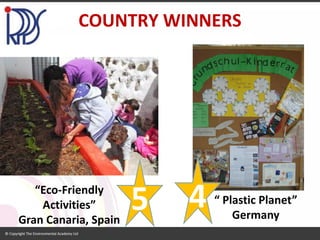
COUNTRY WINNERS 
“Eco-Friendly Activities” 
Gran Canaria, Spain 
5 
4 
“ Plastic Planet” 
Germany
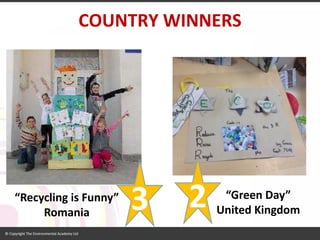
“Recycling is Funny” Romania 
2 
“Green Day” 
United Kingdom 
3 
COUNTRY WINNERS
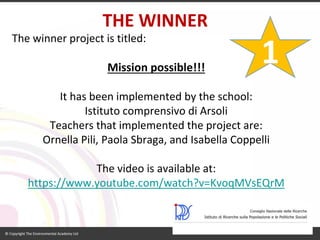
THE WINNER 
The winner project is titled: 
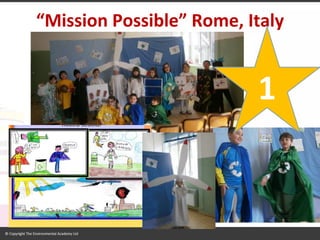
Missionpossible!!! 
It has been implemented by the school: 
Istituto comprensivo di Arsoli 
Teachers that implemented the project are: 
Ornella Pili, Paola Sbraga, and Isabella Coppelli 
The video isavailableat: 
https://www.youtube.com/watch?v=KvoqMVsEQrM 
1
“Mission Possible” Rome, Italy 
1
Dissemination Strategy 
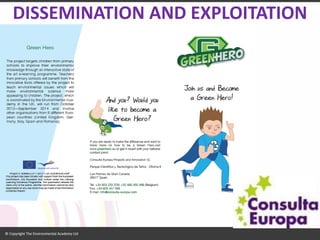
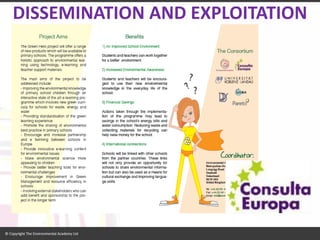
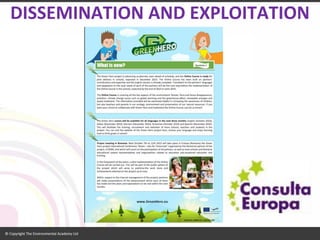
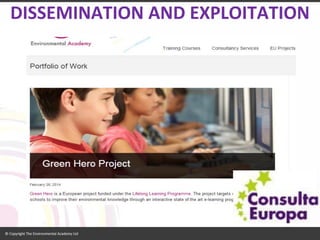
DISSEMINATION AND EXPLOITATION 
Dissemination Target Groups
DISSEMINATION AND EXPLOITATION
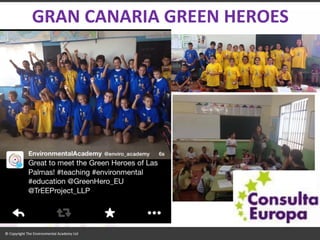
GRAN CANARIA GREEN HEROES
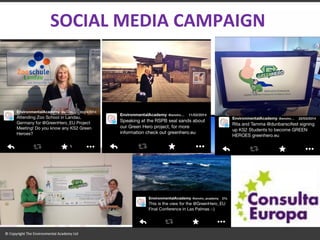
SOCIAL MEDIA CAMPAIGN
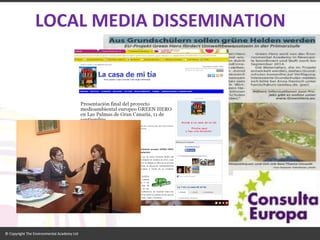
LOCAL MEDIA DISSEMINATION
PROJECT EVALUATION – THE CONTEXT 
•Independent of the project partners 
•Qualitative and quantitative. 
•‘Process’ as well as ‘outcomes’. 
•Formative and summative results 
•Evaluator as ‘critical friend’.
WHAT THE EVALUATION COVERED.... 
•Partnership 
•Project Methodology 
•European Added Value 
•Budget and Cost -effectiveness 
•Project Aims and Objectives 
•Impact 
•Dissemination and Exploitation
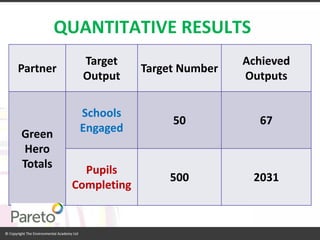
QUANTITATIVE RESULTS 
Partner 
Target Output 
Target Number 
Achieved Outputs 
Green Hero Totals 
Schools Engaged 
50 
67 
Pupils Completing 
500 
2031
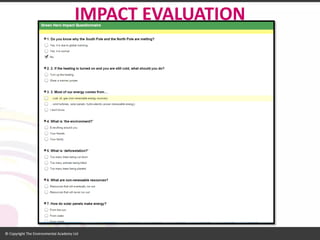
IMPACT EVALUATION
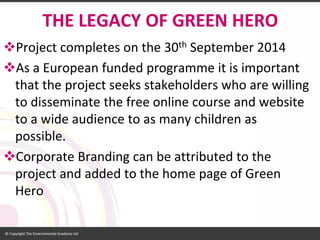
THE LEGACY OF GREEN HERO 
Project completes on the 30thSeptember 2014 
As a European funded programme it is important that the project seeks stakeholders who are willing to disseminate the free online course and website to a wide audience to as many children as possible. 
Corporate Branding can be attributed to the project and added to the home page of Green Hero
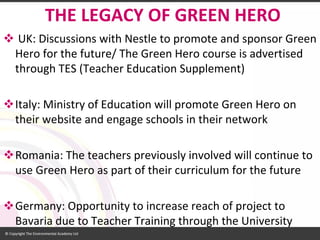
UK: Discussions with Nestle to promote and sponsor Green Hero for the future/ The Green Hero course is advertised through TES (Teacher Education Supplement) 
Italy: Ministry of Education will promote Green Hero on their website and engage schools in their network 
Romania: The teachers previously involved will continue to use Green Hero as part of their curriculum for the future 
Germany: Opportunity to increase reach of project to Bavaria due to Teacher Training through the University 
THE LEGACY OF GREEN HERO
www.greenhero.eu 
We hope you enjoy the course. 
Happy viewing!
Thank you for listening!

Green Hero - final project presentation

  • 1.
    GREEN HERO Letme take you on the Journey Las Palmas Conference 11th September 2014
  • 2.
    WELCOME AND INTRODUCTION •Rita Callender •Lead Project Co-ordinator •The Environmental Academy •UK Partner Green Hero has been partially funded under the Lifelong Learning programmeProject No. 528064-LLP-1-2012- UK-CMP
  • 4.
    Kick Off Meeting:Newcastle –upon –Tyne, October 2012 Meeting 2: Rome, May 2013 Meeting 3: Craiova, October 2013 Meeting 4: Landau, April 2014 Final Conference and Close Off Meeting: Las Palmas, September 2014 EU MEETINGSFOR THE GREEN HERO PROJECT
  • 6.
    PARTNER INTRODUCTIONS Spain,Consulta-Europa–NoheliaMartinez and Lucie Milcent Italy, IPRSS–Dr PatriziaGrifoniand Dr Fernando Ferri Germany, University of Koblenz-Landau –Professor GuntherSeeber Romania, InTEMA, International Education and Management Association –DorinaGoiceanu United Kingdom, Pareto UK Ltd –Mr Tom Scott
  • 8.
    •A detailed curriculumanalysis was undertaken as the first stage in the project •This involved each country undertaking country research •Report produced with the findings CURRICULUM ANALYSIS
  • 9.
    A Comparative Analysisof Primary School Syllabi in Five European Countries Research Questions: 1.In which domains and to what extent is Environmental Education embedded in the curriculum? 2.Which ideas do the curricula promote in the specific domains waste, water and energy? Dr Gunther Seeber Background: 1.Teachers are willing to implement the pogramme if they experience its offers as relevant. 2.Curricula are a main lever to help transfer environmental issues into everyday teaching
  • 10.
    SELECTED RESULTS Ineach of the analysed curricula: 1.ImportanceofEE ishighlighted 5.Awareness ofresponsibilityfornature 2.Knowledge of scientific terms and facts 6.Dependenceofhumanson nature 3.Exploration ofthenearestenvironment 7.Human impacton nature 4.Methodsofscience 8.Protectionofnature Onlyin somecurricula •Effectsoftechnology •Respectfultreatmentofnature Diverse situationaccordingtowaste, water, andenergy Examples: •Recycling (all), wastedisposal(not in England), reductionofwaste(onlyGermany, Spain) •Responsibleuseofwater(Engl., Spain) •Renewable Energy (Ger, Romania, and Italy)
  • 11.
    SUMMARY •According tocurricula European children are learning about EE. •Difference in the extent to which the topics are treated. •Europe is heterogeneous –this fact is also represented in the analysed curricula. •But the alikeness's predominate in our analysis. Environmental education is still a big issue.
  • 13.
    MODEL OF ENGAGEMENT ThisGREENHeroProjectModelprovidethelocalinstrumentsusedatnationallevelbyeachpartnerforencouragingschoolstoadoptcomprehensiveenvironmentalawarenessprograms,fordevelopaneffectivemodelforengagingschoolsandeducationalbodies“BecomeAGREENHero!” andtofindelementsinvolvedininitiating,educatingandmotivatingschoolstoundertakeenvironmentalawarenessactivitiestailoredtotheirlocalneeds. The GREEN Hero Project Modelincorporates both: •the concept of School GREEN Education’ promotionand •the concept of a GREEN Education promoting schools. thatmeans:Theschoolpromotetheprojectandtheprojectpromotetheschool STRATEGY: AIMS:
  • 14.
    Questionnaire/Curricular analysis Invitationto schools Usingweb2.0 toolsfor collaborationande-learningeducation Access GREEN Educationcommunityorganizationstoprovideadditionalresources, programs, expertise Contact the schools Promotionactivityandrecruitotherstohelp Contract with the school Coordinator Teacher who will activate in GREEN Heroes project and Job description Needs Analysis-in each school STS Report /WHY the schools want to be involved in GH project Training of Trainers Consultancyin Environmentissuesduringtheproject Participative planning process/coaching GREEN Education promotion activities &Newsletter School of Green Education Certificatesof “SchoolofGREEN Education” for school, teachers, students Conference METODS:
  • 15.
    AschoolcouldpotentiallybecomeinterestedindevelopingGREENEducationthroughanyoneofthe“INDIVIDUALMILESTONES”,“STRATEGIESORSUPPORTS”mentionedinthemodel. IdentifyIndividualMilestones: . STRATEGY: KeyDecisionMakers School- Teachers Students Parents CommunityActors Contact them Involvement Communityinvolvementincludinginter-sectorial collaboration Each of these factors, and others, could put GREEN Education on the school agenda
  • 16.
    INSTRUMENTS Contact theINDIVIDUALS MILESTONES - Get an endorsement letter from Regional authority in charge of primary education - Send invitation for collaboration to the schools (emails) - Organize face-to-face meetings - Elaborate and distribute a leaflet for engaging with the schools - Online social networks - Establishing the contacts needed for the Green Hero project means of already known partner schools, friends, colleagues - Promoting the project through our homepage as well as to direct contact with schools - Using web2.0 tools for collaboration and e-learning education: post a message on yahoo-groups or didactical communities (RO,IT) - Provide Incentives for the school to be involved: *Consultancy in Environment issues during the project *The School will receive Certificate of “School of GRREN Education” (GE, RO,IT) *The teachers will receive Certificates for Coordinator Teacher in GREEN Heroes project *The School-Students from Gymnasium will receive Certificates for Volunteering Activity in Environment Issues - The Project’s Platform can generate automatically the Certificates at the end of each activity Gateway Personnel - Contacting the teachers through all means: direct contact, personally, conferences, teacher groups - Offering technical and technological support to the schools and students - We offered support (teacher trainings) Key Decision Makers - Contacting the local school educational departments - Contacting the schools authorities and directors to engage the organization and to organise the schools meetings with teachers, in order to involve them, underlining the importance of the course and of its replicability even after the project ends. - Contacting stakeholders (school authorities) personally - Offering support (teacher trainings)
  • 17.
    Key Workers -The teachers are the key actors of the process - Contacting stakeholders from different schools and school districts in our area via telephone/email/letter - Being in contact with seminar leaders of teacher’s traineeship. - Using the good cooperation with local institutions, NGOs, School Inspectorate Depart. and schools. - Having in each partner’ school a local coordinator of the project. - Make a written and personal Contract with the school and with the teachers involved in GH’s implementation. School-Teachers - The International Competition can be used to engage teachers on the project. - Contacting a retired teacher which introduced us to her colleagues. - Motivating the School Community members to participate in GREEN Education Promotion activity, and recruit others to help. - Each teacher will receive Certificates for Coordinator Teacher in the GREEN Hero project School- Students - Engaging the students by teachers directly, with their classroom activities, with discussions, or directy in class via activities. - Using press releases that also addressed to pupils and parents - Visiting the shools in order to propose them the activity. - Sharing leaflets and promotional materials to the students (t-shirts, fleyers,authoadhesives with GH’s logos, online links) - The students will receive Certificates for Volunteering Activity in Environment Issues Parents - Encouraging the parents to get involved in Green Days and supporting activities. - Involving the Parents in some projects related with the competition (for example projects organising school shows) - Using the parents’ influences on the development of children's Environment protection behaviors’ are multi-factorial and complex Community - Organising Open days. - Access local community and encourage them to contribute or participate in the School Green Education Program. - Organizing International Conference in partnership with local community departments
  • 18.
    CONCEPT-MAP of theGREENHero Project Model
  • 19.
    BENNEFITS What wasthe impacts on student’s? What was the impacts on school curriculum? . What was the impacts on teachers?
  • 20.
    ROMANIAN TEAM •19 •55 •658 In the project were involved: We organized "Green-Edufor Tomorrow" Conference, in Craiova, 7-10 0ctober 2013 with over 150 participants
  • 22.
    GREEN HERO PORTALAND E-LEARNING Produced by the Environmental Academy in the UK
  • 23.
    Engaging Content with animated figures developed for the programme
  • 24.
    COURSE CONTENT Topicscovered Water, Waste, Energy and the Natural Environment Engaging Online Activities and Games for children aged 9 -11 Fun Videos Content translated into all partner languages
  • 26.
    GREEN HERO TEACHERSUPPORT PACK Produced by Italian Partner CNR-IRPPS Rome
  • 27.
    It has supportedteachers explaining them how to combine: –On-line course modules –Classroom activities –On-line game competition –Homeworks It has provided: –a suggested lesson plan for teachers using the Green Hero resources –Contact details of the Green Hero team for each country ItwasavailableinEnglish,Spanish,Romanian,ItalianandGermanlanguage.Itisavailableon-lineandonapaperversion TEACHER SUPPORT PACK
  • 28.
    LESSONS LEARNED •Thedetaileddescription&step-by-stepinstructionsoftheproposedcombinedactionsbytheon-lineactivitieswiththeotheractivitieswasveryuseful. •Thetrainingpackisagoodtoolforfutureuseofthecourse,aftertheendoftheGreenheroproject. •Itisthebaseforincludingthecourseindifferentcurricula. •Thetrainingpackcanbesharedamongon-linecommunitiesofteachersinordertoenrichthistrainingpackwithexperiencestobeadded.
  • 29.
    EXAMPLE OF CLASSROOMACTIVITIES: THE DICE GAME
  • 30.
  • 31.
    THE COMPETITION Teacherswereinvitedtoplaywithchildrenparticipatingatthe“GreenReportergame”sharingmaterialsproducedinclassalsoonthebaseofhomework,organisingtheminanarticleoragalleryofpicturesforattendingatthecompetitionassociatedwithit.
  • 32.
    THE COMPETITION •Thecompetition was for classes of schools; it aimed to design a sustainability project. •A list of example of projects types was provided in the training pack, but schools were free to propose their own topic for the environmental project. •Schools had the possibility to send their project by e- mail or directly at the url: www.greehero.cnr.itusing the online platform implemented by CNR-IRPPS
  • 33.
    THE COMPETITION •Eachcountryhasselectedthebest project. •The projectsthatpassedthe selectionhavebeenevaluatedfordecidingthe winner
  • 34.
    COMPETITION RESULTS •22projects were submitted to the Green Hero reporter game. •They have implemented different ideas, from re-using of objects to produce a new one, to a theatre representation on the environmental sustainability
  • 35.
    COUNTRY WINNERS “Eco-FriendlyActivities” Gran Canaria, Spain 5 4 “ Plastic Planet” Germany
  • 36.
    “Recycling is Funny”Romania 2 “Green Day” United Kingdom 3 COUNTRY WINNERS
  • 37.
    THE WINNER Thewinner project is titled: Missionpossible!!! It has been implemented by the school: Istituto comprensivo di Arsoli Teachers that implemented the project are: Ornella Pili, Paola Sbraga, and Isabella Coppelli The video isavailableat: https://www.youtube.com/watch?v=KvoqMVsEQrM 1
  • 38.
  • 40.
    Dissemination Strategy DISSEMINATIONAND EXPLOITATION Dissemination Target Groups
  • 41.
  • 42.
  • 43.
  • 44.
  • 45.
  • 46.
  • 47.
  • 49.
    PROJECT EVALUATION –THE CONTEXT •Independent of the project partners •Qualitative and quantitative. •‘Process’ as well as ‘outcomes’. •Formative and summative results •Evaluator as ‘critical friend’.
  • 50.
    WHAT THE EVALUATIONCOVERED.... •Partnership •Project Methodology •European Added Value •Budget and Cost -effectiveness •Project Aims and Objectives •Impact •Dissemination and Exploitation
  • 51.
    QUANTITATIVE RESULTS Partner Target Output Target Number Achieved Outputs Green Hero Totals Schools Engaged 50 67 Pupils Completing 500 2031
  • 53.
  • 54.
    THE LEGACY OFGREEN HERO Project completes on the 30thSeptember 2014 As a European funded programme it is important that the project seeks stakeholders who are willing to disseminate the free online course and website to a wide audience to as many children as possible. Corporate Branding can be attributed to the project and added to the home page of Green Hero
  • 55.
    UK: Discussions withNestle to promote and sponsor Green Hero for the future/ The Green Hero course is advertised through TES (Teacher Education Supplement) Italy: Ministry of Education will promote Green Hero on their website and engage schools in their network Romania: The teachers previously involved will continue to use Green Hero as part of their curriculum for the future Germany: Opportunity to increase reach of project to Bavaria due to Teacher Training through the University THE LEGACY OF GREEN HERO
  • 56.
    www.greenhero.eu We hopeyou enjoy the course. Happy viewing!
  • 57.
    Thank you forlistening!