Many countries have introduced new rating tools over the past
few years in order to improve the knowledge about the level of
sustainability in each country’s building stock.
On one hand, it can be argued that the individual characteristics
of each country, such as the climate and type of building stock,
necessitate an individual sustainability rating tool for that
country.
The downside is that to varying degrees the rating tools for
different countries are constructed on different parameters.
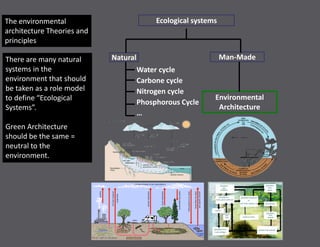
Ecological systems
Natural Man-Made
Water cycle
Carbone cycle
Nitrogen cycle
Phosphorous Cycle
…
Environmental
Architecture
There are many natural
systems in the
environment that should
be taken as a role model
to define “Ecological
Systems”.
Green Architecture
should be the same =
neutral to the
environment.
The environmental
architecture Theories and
principles
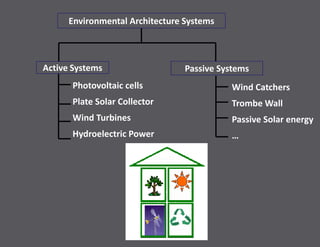
Environmental Architecture Systems
Active Systems Passive Systems
Photovoltaic cells
Plate Solar Collector
Wind Turbines
Hydroelectric Power
Wind Catchers
Trombe Wall
Passive Solar energy
…
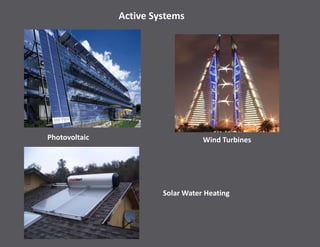
Active Systems
Photovoltaic Wind Turbines
Solar Water Heating
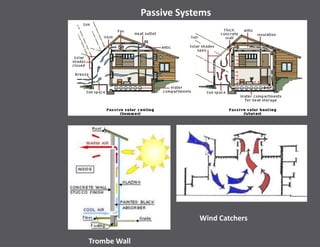
Passive Systems
Wind Catchers
Trombe Wall
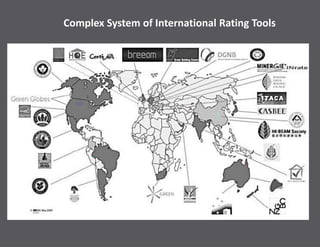
Complex System of International Rating Tools
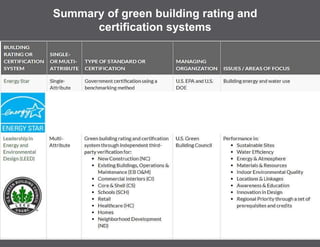
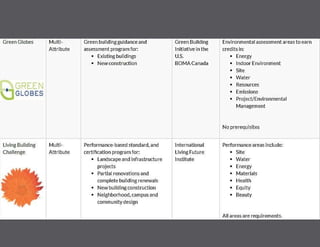
Summary of green building rating and
certification systems
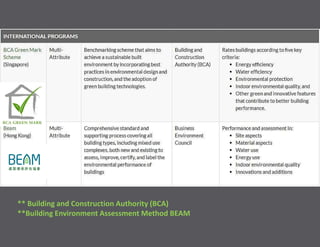
** Building and Construction Authority (BCA)
**Building Environment Assessment Method BEAM
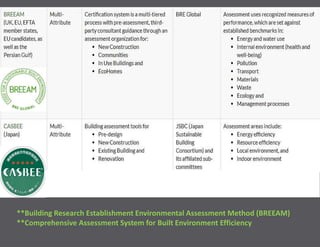
**Building Research Establishment Environmental Assessment Method (BREEAM)
**Comprehensive Assessment System for Built Environment Efficiency
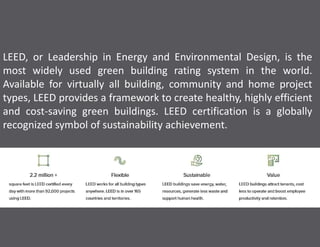
LEED, or Leadership in Energy and Environmental Design, is the
most widely used green building rating system in the world.
Available for virtually all building, community and home project
types, LEED provides a framework to create healthy, highly efficient
and cost-saving green buildings. LEED certification is a globally
recognized symbol of sustainability achievement.
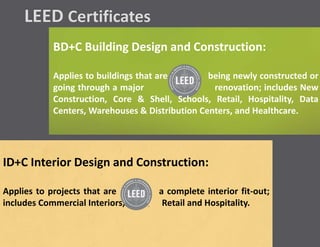
BD+C Building Design and Construction:
Applies to buildings that are being newly constructed or
going through a major renovation; includes New
Construction, Core & Shell, Schools, Retail, Hospitality, Data
Centers, Warehouses & Distribution Centers, and Healthcare.
ID+C Interior Design and Construction:
Applies to projects that are a complete interior fit-out;
includes Commercial Interiors, Retail and Hospitality.
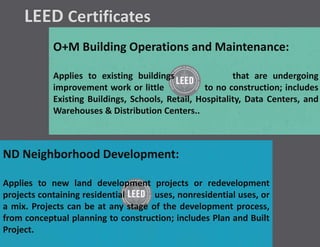
O+M Building Operations and Maintenance:
Applies to existing buildings that are undergoing
improvement work or little to no construction; includes
Existing Buildings, Schools, Retail, Hospitality, Data Centers, and
Warehouses & Distribution Centers..
ND Neighborhood Development:
Applies to new land development projects or redevelopment
projects containing residential uses, nonresidential uses, or
a mix. Projects can be at any stage of the development process,
from conceptual planning to construction; includes Plan and Built
Project.
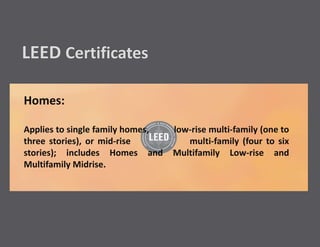
Homes:
Applies to single family homes, low-rise multi-family (one to
three stories), or mid-rise multi-family (four to six
stories); includes Homes and Multifamily Low-rise and
Multifamily Midrise.
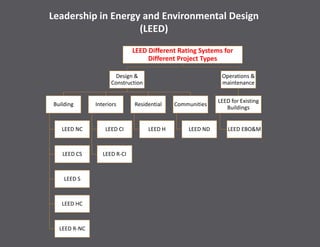
Leadership in Energy and Environmental Design
(LEED)
LEED Different Rating Systems for
Different Project Types
Design &
Construction
Building
LEED NC
LEED CS
LEED S
LEED HC
LEED R-NC
Interiors
LEED CI
LEED R-CI
Residential
LEED H
Communities
LEED ND
Operations &
maintenance
LEED for Existing
Buildings
LEED EBO&M
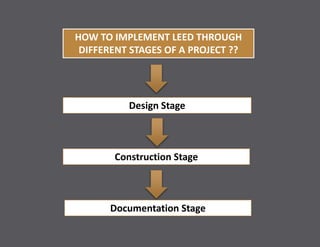
HOW TO IMPLEMENT LEED THROUGH
DIFFERENT STAGES OF A PROJECT ??
Design Stage
Construction Stage
Documentation Stage
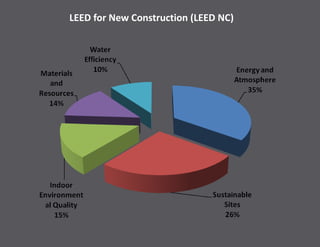
1-Sustainable Sites 26 Possible points
• Construction Activity Pollution Prevention
• Site Selection
• Development Density & Community Connectivity
• Brownfield Redevelopment
• Alternative Transportation
• Site Development
• Storm water Design
• Heat Island Effect
• Light Pollution Reduction
2-Water Efficiency 14 Possible Points
• Water Efficient Landscaping
• Innovative Wastewater Technologies
• Water Use Reduction
3-Energy and Atmosphere 35 Possible Points
• Commissioning of the Building Energy
Systems
• Energy Performance
• Refrigerant Management
• On-Site Renewable Energy
• Measurement & Verification
• Green Power
4- Materials and Resources 10 Possible Points
• Storage and Collection of Recyclables
• Building Reuse
• Construction Waste Management
• Materials Reuse
• Recycled Content
• Regional Materials
• Rapidly Renewable Materials
• Certified Wood
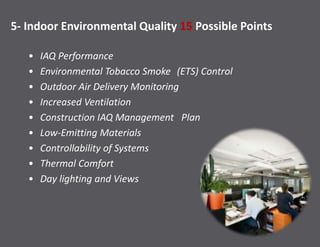
5- Indoor Environmental Quality 15 Possible Points
• IAQ Performance
• Environmental Tobacco Smoke (ETS) Control
• Outdoor Air Delivery Monitoring
• Increased Ventilation
• Construction IAQ Management Plan
• Low-Emitting Materials
• Controllability of Systems
• Thermal Comfort
• Day lighting and Views
LEED for New Construction (LEED NC)
Thank You

Green Buildings-Rating system.pptx

  • 2.
    Many countries haveintroduced new rating tools over the past few years in order to improve the knowledge about the level of sustainability in each country’s building stock. On one hand, it can be argued that the individual characteristics of each country, such as the climate and type of building stock, necessitate an individual sustainability rating tool for that country. The downside is that to varying degrees the rating tools for different countries are constructed on different parameters.
  • 3.
    Ecological systems Natural Man-Made Watercycle Carbone cycle Nitrogen cycle Phosphorous Cycle … Environmental Architecture There are many natural systems in the environment that should be taken as a role model to define “Ecological Systems”. Green Architecture should be the same = neutral to the environment. The environmental architecture Theories and principles
  • 4.
    Environmental Architecture Systems ActiveSystems Passive Systems Photovoltaic cells Plate Solar Collector Wind Turbines Hydroelectric Power Wind Catchers Trombe Wall Passive Solar energy …
  • 5.
    Active Systems Photovoltaic WindTurbines Solar Water Heating
  • 6.
  • 7.
    Complex System ofInternational Rating Tools
  • 8.
    Summary of greenbuilding rating and certification systems
  • 10.
    ** Building andConstruction Authority (BCA) **Building Environment Assessment Method BEAM
  • 11.
    **Building Research EstablishmentEnvironmental Assessment Method (BREEAM) **Comprehensive Assessment System for Built Environment Efficiency
  • 14.
    LEED, or Leadershipin Energy and Environmental Design, is the most widely used green building rating system in the world. Available for virtually all building, community and home project types, LEED provides a framework to create healthy, highly efficient and cost-saving green buildings. LEED certification is a globally recognized symbol of sustainability achievement.
  • 16.
    BD+C Building Designand Construction: Applies to buildings that are being newly constructed or going through a major renovation; includes New Construction, Core & Shell, Schools, Retail, Hospitality, Data Centers, Warehouses & Distribution Centers, and Healthcare. ID+C Interior Design and Construction: Applies to projects that are a complete interior fit-out; includes Commercial Interiors, Retail and Hospitality.
  • 17.
    O+M Building Operationsand Maintenance: Applies to existing buildings that are undergoing improvement work or little to no construction; includes Existing Buildings, Schools, Retail, Hospitality, Data Centers, and Warehouses & Distribution Centers.. ND Neighborhood Development: Applies to new land development projects or redevelopment projects containing residential uses, nonresidential uses, or a mix. Projects can be at any stage of the development process, from conceptual planning to construction; includes Plan and Built Project.
  • 18.
    Homes: Applies to singlefamily homes, low-rise multi-family (one to three stories), or mid-rise multi-family (four to six stories); includes Homes and Multifamily Low-rise and Multifamily Midrise.
  • 19.
    Leadership in Energyand Environmental Design (LEED) LEED Different Rating Systems for Different Project Types Design & Construction Building LEED NC LEED CS LEED S LEED HC LEED R-NC Interiors LEED CI LEED R-CI Residential LEED H Communities LEED ND Operations & maintenance LEED for Existing Buildings LEED EBO&M
  • 20.
    HOW TO IMPLEMENTLEED THROUGH DIFFERENT STAGES OF A PROJECT ?? Design Stage Construction Stage Documentation Stage
  • 21.
    1-Sustainable Sites 26Possible points • Construction Activity Pollution Prevention • Site Selection • Development Density & Community Connectivity • Brownfield Redevelopment • Alternative Transportation • Site Development • Storm water Design • Heat Island Effect • Light Pollution Reduction
  • 22.
    2-Water Efficiency 14Possible Points • Water Efficient Landscaping • Innovative Wastewater Technologies • Water Use Reduction
  • 23.
    3-Energy and Atmosphere35 Possible Points • Commissioning of the Building Energy Systems • Energy Performance • Refrigerant Management • On-Site Renewable Energy • Measurement & Verification • Green Power
  • 24.
    4- Materials andResources 10 Possible Points • Storage and Collection of Recyclables • Building Reuse • Construction Waste Management • Materials Reuse • Recycled Content • Regional Materials • Rapidly Renewable Materials • Certified Wood
  • 25.
    5- Indoor EnvironmentalQuality 15 Possible Points • IAQ Performance • Environmental Tobacco Smoke (ETS) Control • Outdoor Air Delivery Monitoring • Increased Ventilation • Construction IAQ Management Plan • Low-Emitting Materials • Controllability of Systems • Thermal Comfort • Day lighting and Views
  • 26.
    LEED for NewConstruction (LEED NC)
  • 29.

Editor's Notes

  • #11  Building and Construction Authority (BCA) Building Environment Assessment Method BEAM
  • #12 Building Research Establishment Environmental Assessment Method (BREEAM) Comprehensive Assessment System for Built Environment Efficiency