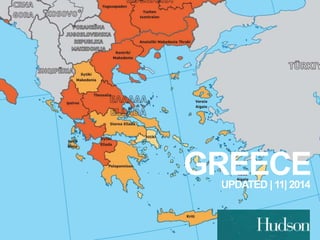
GREECE 
UPDATED | 11| 2014
EU BUDGETS 
2014 | 2020
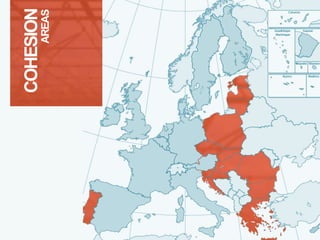
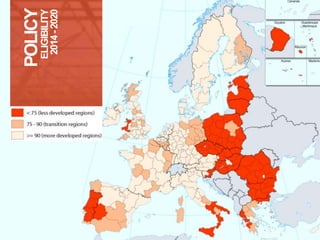
COHESION 
AREAS
POLICY 
ELIGIBILITY 
2014 - 2020
ALL AMOUNTS x 1.000.000 
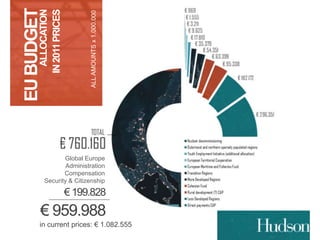
EU BUDGET 
ALLOCATION 
IN 2011 PRICES 
Global Europe 
Administration 
Compensation 
Security & Citizenship 
€ 199.828 
€ 959.988 
in current prices: € 1.082.555
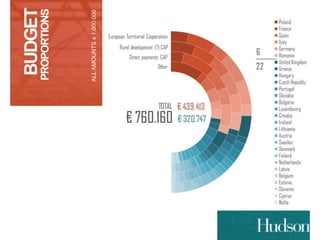
BUDGET 
PROPORTIONS 
ALL AMOUNTS x 1.000.000
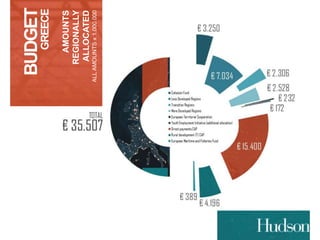
BUDGET 
GREECE 
AMOUNTS 
REGIONALLY 
ALLOCATED 
ALL AMOUNTS x 1.000.000
THE 5 
ESI FUNDS 
The five European Structural and Investment Funds; 
| The European Regional Development Fund 
| The European Social Fund 
| The Cohesion Fund 
| The European Maritime and Fisheries Fund 
| The European Agricultural Fund for Rural Development
PARTNERSHIP 
AGREEMENTS 
| EU Member States are required to draw up and implement 
strategic plans with investment priorities covering the five ESI 
Funds. 
| These Partnership Agreements (PAs) are negotiated between the 
European Commission and national authorities, following their 
consultation of various levels of governance, representatives from 
interest groups, civil society and local 
and regional representatives.
MAXIMUM 
AID PERCENTAGES 
The regional aid map defines the regions of a Member State eligible for 
national regional investment aid under EU state aid rules. It will be in force 
between 1 July 2014 and 31 December 2020. 
The map also sets the maximum levels of aid (so-called "aid intensities") that can be 
granted to regional investment projects carried out by large enterprises in the 
assisted areas at between 10% and 25% of total investment costs, depending on 
the area concerned. 
These intensities can be increased for investments carried out by medium sized 
enterprises by 10% and for small enterprises by 20%.
MAXIMUM 
AID PERCENTAGES 
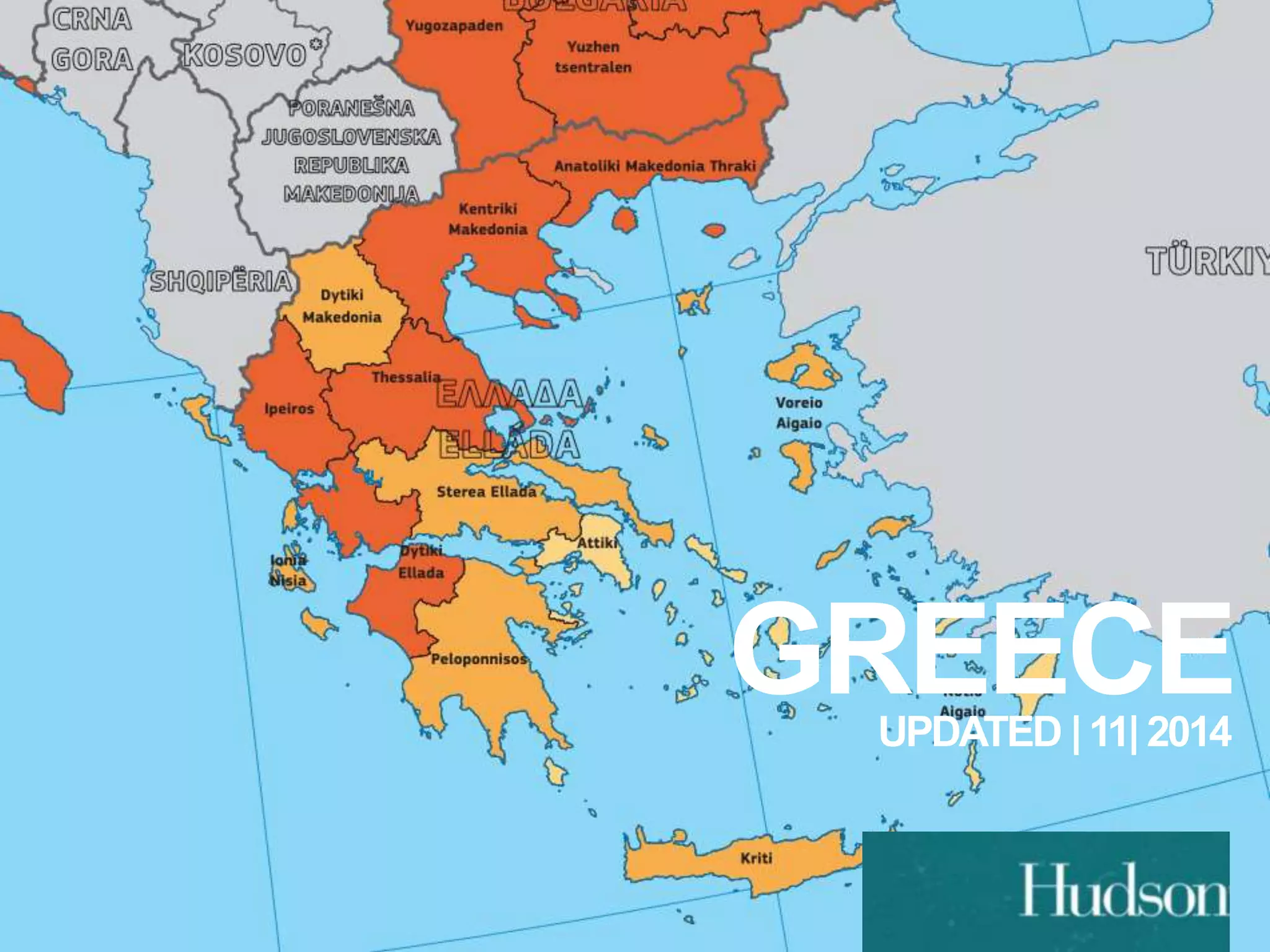
The new regional aid map for Greece will cover its entire territory and 100 
% of its population, because the country benefits from the European 
Stability Mechanism. 
Under the new map, seven areas which have a GDP per capita below 75% of the 
EU average - covering 56.1% of the population of Greece - will be eligible for 
regional investment aid: 
Anatoliki Makedonia and Thraki, Kentriki Makedonia, Thessalia, Ipeiros, Dytiki 
Ellada, Peloponnisos and Vorio Aigaio 
In the previous period, four more areas had a GDP below 75% of the EU average.
MAXIMUM 
AID PERCENTAGES 
In order to ensure a smooth transition, the regions of, Ionia Nisia, Kriti, 
Dytiki Makedonia and Attiki covering 43.9% of the population of Greece, 
will continue to be eligible for regional aid until 2020. 
As from 2018, the maximum aid intensities will be reduced, except for the areas of 
Kastoria and Florina that share land borders with a country outside the European 
Economic Area (EEA) and are therefore entitled to keep higher aid intensities. 
The maximum aid intensities for regional investment aid in the Greek assisted 
regions have slightly decreased as compared to the previous aid map (by 5 to 15 
percentage points, depending on the region).
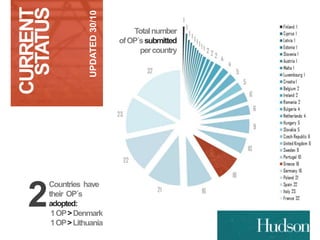
STATUS 
CURRENT 
UPDATED 30/10 
Total number 
of OP´s submitted 
per country 
Countries have 
their OP´s 
adopted: 21 OP >Denmark 
1 OP >Lithuania
PLANNING 
| Partnership agreement adopted end of May 2014 
| Adoption of OP’s by European commission in Q4 2014 
| Expected first grant calls Q1 2015 for funding priorities related to 
Op’s 
OPs should be submitted by Member States within 3 months following the 
submission of the Partnership Agreement. 
The Commission makes observations within 3 months and adopts the OP 
no later than 6 months from the date of its submission.
FUNDING 
PRIORITIES 
Priorities for Greece are set out in the Partnership Agreement 
approved by the European Commission on 23 May 2014. 
The principal objectives are: 
| Support and promote competitiveness and innovation 
| Tackle and mitigate the severe effects of the economic, and social crisis 
with particular focus on high unemployment (especially youth) 
| Trigger and pursue reforms to modernise and ensure an efficient public 
administration.
FUNDING 
PRIORITIES 
The strategy identifies five pillars to build upon the "exit strategy" 
from the crisis, namely: 
| Competiveness and openness of SMEs 
| Development of human resources & active social inclusion, 
| Low carbon economy, 
| Key network infrastructure and 
| Modernization of the state.
FINANCIAL 
ALLOCATIONS 
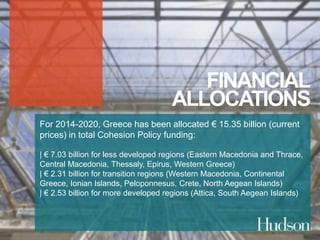
For 2014-2020, Greece has been allocated € 15.35 billion (current 
prices) in total Cohesion Policy funding: 
| € 7.03 billion for less developed regions (Eastern Macedonia and Thrace, 
Central Macedonia, Thessaly, Epirus, Western Greece) 
| € 2.31 billion for transition regions (Western Macedonia, Continental 
Greece, Ionian Islands, Peloponnesus, Crete, North Aegean Islands) 
| € 2.53 billion for more developed regions (Attica, South Aegean Islands)
FINANCIAL 
ALLOCATIONS 
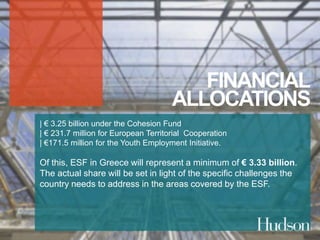
| € 3.25 billion under the Cohesion Fund 
| € 231.7 million for European Territorial Cooperation 
| €171.5 million for the Youth Employment Initiative. 
Of this, ESF in Greece will represent a minimum of € 3.33 billion. 
The actual share will be set in light of the specific challenges the 
country needs to address in the areas covered by the ESF.
PROGRAMME 
ARCHITECTURE 
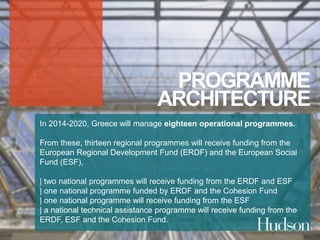
In 2014-2020, Greece will manage eighteen operational programmes. 
From these, thirteen regional programmes will receive funding from the 
European Regional Development Fund (ERDF) and the European Social 
Fund (ESF), 
| two national programmes will receive funding from the ERDF and ESF 
| one national programme funded by ERDF and the Cohesion Fund 
| one national programme will receive funding from the ESF 
| a national technical assistance programme will receive funding from the 
ERDF, ESF and the Cohesion Fund.
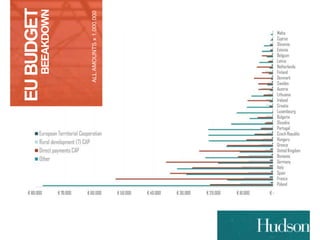
EU BUDGET 
BEEAKDOWN 
ALL AMOUNTS x 1.000.000
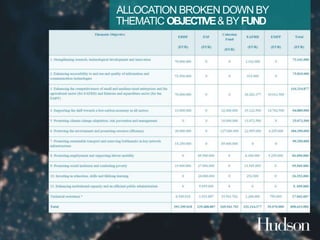
ALLOCATION BROKEN DOWN BY 
THEMATIC OBJECTIVE& BY FUND
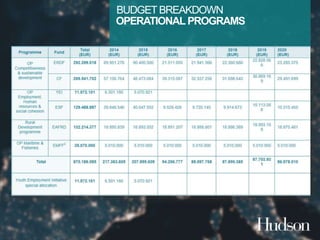
BUDGET BREAKDOWN 
OPERATIONAL PROGRAMS
EU Budget Greece 2014-2020 update November 2014

EU Budget Greece 2014-2020 update November 2014

  • 1.
  • 2.
  • 3.
  • 4.
  • 5.
    ALL AMOUNTS x1.000.000 EU BUDGET ALLOCATION IN 2011 PRICES Global Europe Administration Compensation Security & Citizenship € 199.828 € 959.988 in current prices: € 1.082.555
  • 6.
    BUDGET PROPORTIONS ALLAMOUNTS x 1.000.000
  • 7.
    BUDGET GREECE AMOUNTS REGIONALLY ALLOCATED ALL AMOUNTS x 1.000.000
  • 8.
    THE 5 ESIFUNDS The five European Structural and Investment Funds; | The European Regional Development Fund | The European Social Fund | The Cohesion Fund | The European Maritime and Fisheries Fund | The European Agricultural Fund for Rural Development
  • 9.
    PARTNERSHIP AGREEMENTS |EU Member States are required to draw up and implement strategic plans with investment priorities covering the five ESI Funds. | These Partnership Agreements (PAs) are negotiated between the European Commission and national authorities, following their consultation of various levels of governance, representatives from interest groups, civil society and local and regional representatives.
  • 10.
    MAXIMUM AID PERCENTAGES The regional aid map defines the regions of a Member State eligible for national regional investment aid under EU state aid rules. It will be in force between 1 July 2014 and 31 December 2020. The map also sets the maximum levels of aid (so-called "aid intensities") that can be granted to regional investment projects carried out by large enterprises in the assisted areas at between 10% and 25% of total investment costs, depending on the area concerned. These intensities can be increased for investments carried out by medium sized enterprises by 10% and for small enterprises by 20%.
  • 11.
    MAXIMUM AID PERCENTAGES The new regional aid map for Greece will cover its entire territory and 100 % of its population, because the country benefits from the European Stability Mechanism. Under the new map, seven areas which have a GDP per capita below 75% of the EU average - covering 56.1% of the population of Greece - will be eligible for regional investment aid: Anatoliki Makedonia and Thraki, Kentriki Makedonia, Thessalia, Ipeiros, Dytiki Ellada, Peloponnisos and Vorio Aigaio In the previous period, four more areas had a GDP below 75% of the EU average.
  • 12.
    MAXIMUM AID PERCENTAGES In order to ensure a smooth transition, the regions of, Ionia Nisia, Kriti, Dytiki Makedonia and Attiki covering 43.9% of the population of Greece, will continue to be eligible for regional aid until 2020. As from 2018, the maximum aid intensities will be reduced, except for the areas of Kastoria and Florina that share land borders with a country outside the European Economic Area (EEA) and are therefore entitled to keep higher aid intensities. The maximum aid intensities for regional investment aid in the Greek assisted regions have slightly decreased as compared to the previous aid map (by 5 to 15 percentage points, depending on the region).
  • 13.
    STATUS CURRENT UPDATED30/10 Total number of OP´s submitted per country Countries have their OP´s adopted: 21 OP >Denmark 1 OP >Lithuania
  • 14.
    PLANNING | Partnershipagreement adopted end of May 2014 | Adoption of OP’s by European commission in Q4 2014 | Expected first grant calls Q1 2015 for funding priorities related to Op’s OPs should be submitted by Member States within 3 months following the submission of the Partnership Agreement. The Commission makes observations within 3 months and adopts the OP no later than 6 months from the date of its submission.
  • 15.
    FUNDING PRIORITIES Prioritiesfor Greece are set out in the Partnership Agreement approved by the European Commission on 23 May 2014. The principal objectives are: | Support and promote competitiveness and innovation | Tackle and mitigate the severe effects of the economic, and social crisis with particular focus on high unemployment (especially youth) | Trigger and pursue reforms to modernise and ensure an efficient public administration.
  • 16.
    FUNDING PRIORITIES Thestrategy identifies five pillars to build upon the "exit strategy" from the crisis, namely: | Competiveness and openness of SMEs | Development of human resources & active social inclusion, | Low carbon economy, | Key network infrastructure and | Modernization of the state.
  • 17.
    FINANCIAL ALLOCATIONS For2014-2020, Greece has been allocated € 15.35 billion (current prices) in total Cohesion Policy funding: | € 7.03 billion for less developed regions (Eastern Macedonia and Thrace, Central Macedonia, Thessaly, Epirus, Western Greece) | € 2.31 billion for transition regions (Western Macedonia, Continental Greece, Ionian Islands, Peloponnesus, Crete, North Aegean Islands) | € 2.53 billion for more developed regions (Attica, South Aegean Islands)
  • 18.
    FINANCIAL ALLOCATIONS |€ 3.25 billion under the Cohesion Fund | € 231.7 million for European Territorial Cooperation | €171.5 million for the Youth Employment Initiative. Of this, ESF in Greece will represent a minimum of € 3.33 billion. The actual share will be set in light of the specific challenges the country needs to address in the areas covered by the ESF.
  • 19.
    PROGRAMME ARCHITECTURE In2014-2020, Greece will manage eighteen operational programmes. From these, thirteen regional programmes will receive funding from the European Regional Development Fund (ERDF) and the European Social Fund (ESF), | two national programmes will receive funding from the ERDF and ESF | one national programme funded by ERDF and the Cohesion Fund | one national programme will receive funding from the ESF | a national technical assistance programme will receive funding from the ERDF, ESF and the Cohesion Fund.
  • 20.
    EU BUDGET BEEAKDOWN ALL AMOUNTS x 1.000.000
  • 21.
    ALLOCATION BROKEN DOWNBY THEMATIC OBJECTIVE& BY FUND
  • 22.