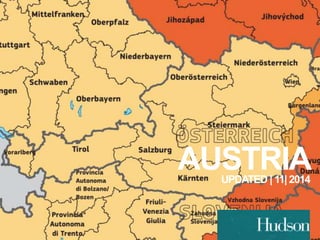
AUSTRIA 
UPDATED | 11| 2014
EU BUDGETS 
2014 | 2020
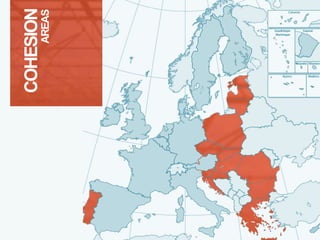
COHESION 
AREAS
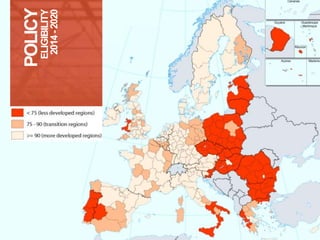
POLICY 
ELIGIBILITY 
2014 - 2020
ALL AMOUNTS x 1.000.000 
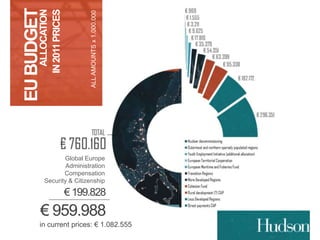
Global Europe 
Administration 
Compensation 
ALLOCATION 
IN 2011 PRICES 
Security & Citizenship 
€ 199.828 
EU BUDGET 
€ 959.988 
in current prices: € 1.082.555
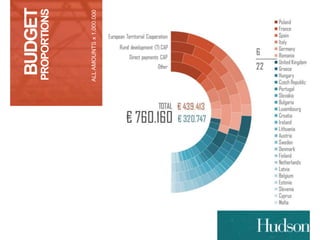
BUDGET 
PROPORTIONS 
ALL AMOUNTS x 1.000.000
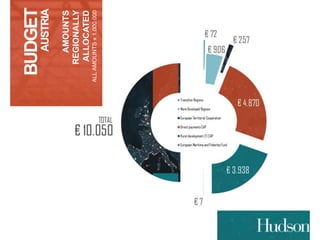
BUDGET 
AUSTRIA 
AMOUNTS 
REGIONALLY 
ALLOCATED 
ALL AMOUNTS x 1.000.000
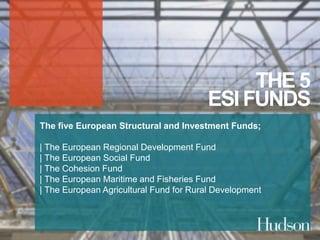
THE 5 
ESI FUNDS 
The five European Structural and Investment Funds; 
| The European Regional Development Fund 
| The European Social Fund 
| The Cohesion Fund 
| The European Maritime and Fisheries Fund 
| The European Agricultural Fund for Rural Development
PARTNERSHIP 
AGREEMENTS 
| EU Member States are required to draw up and implement 
strategic plans with investment priorities covering the five ESI 
Funds. 
| These Partnership Agreements (PAs) are negotiated between the 
European Commission and national authorities, following their 
consultation of various levels of governance, representatives from 
interest groups, civil society and local 
and regional representatives.
MAXIMUM 
AID PERCENTAGES 
| The designated areas, a list of regions with 2,186,465 inhabitants, 
cover 25.87% of Austria's population. 
| Austria has proposed its assisted areas across the country on the 
basis of a wide range of criteria, including those that reflect the 
socioeconomic situation (i.e. GDP per capita, below EU average or 
high unemployment compared to national average), the 
geographical situation (e.g. mountain areas) or structural problems 
at national level.
MAXIMUM 
AID PERCENTAGES 
| The maximum level of aid that can be granted to investment 
projects carried out by large companies is 10%. For investments 
carried out by SMEs, these percentages can be increased by up to 
10 percentage points for medium-sized enterprises and 20 
percentage points for small enterprises. 
| While the population coverage has increased by around 3.4 
percentage points compared to the previous aid map, the aid 
intensities have slightly decreased. This is in line with the 
objectives of the new regional aid guidelines, which aim at focusing 
support on the most disadvantaged regions of Europe.
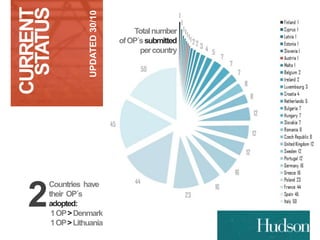
STATUS 
CURRENT 
UPDATED 30/10 
Total number 
of OP´s submitted 
per country 
Countries have 
their OP´s 
adopted: 21 OP >Denmark 
1 OP >Lithuania
PLANNING 
| Partnership Agreement Adopted 17 – 10 – 2014 
| 1 Operational Programmme submitted 
| Adoption of OP’s by European commission in Q4 2014 
| Exp.1st grant calls Q1 2015 for funding priorities related to OP’s 
OPs should be submitted by Member States within 3 months following the 
submission of the Partnership Agreement. 
The Commission makes observations within 3 months and adopts the OP 
no later than 6 months from the date of its submission.
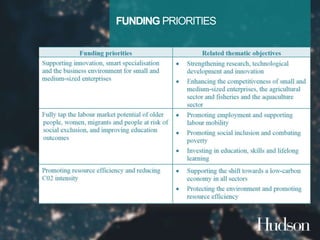
FUNDING 
PRIORITIES 
The PA focusses in particular on the following thematic objectives: 
| Preserving and protecting the environment and promoting resource 
efficiency (26% of ESI-Funds, EAFRD and ERDF) 
| Promoting climate change adaptation, risk prevention and management 
(26% of ESI-Funds, exclusively EAFRD) 
| Enhancing innovation and the competiveness of SMEs and of the 
agricultural sector (16.5% of ESI-Funds, EAFRD and ERDF) 
| Promoting social inclusion, combating poverty and any discrimination 
(11% of ESI-Funds, in particular from the EAFRD and the ESF).
FUNDING 
PRIORITIES 
Other thematic objectives will be supported by the ERDF and the ESF, 
while the EMFF allocation of EUR 7 million will be focussed on 
investments that should increase the competiveness of the aquaculture 
sector. 
As the EAFRD contributes to 80% of total ESI-Funds in Austria, the relative 
weight of the fund and of the thematic objectives under which the EAFRD 
operates is high.
EXPECTED 
RESULTS 
ESI-Funds will support Austria in achieving its targets: 
| RTDI expenditure in relation to GDP is to increase from 2.84 (2012) to 
3.76% (2020) with a focus on private spending. 
| ESI-Funds will contribute to a CO² reduction (from -12.7% in 2012 to - 
16% in 2020) and to improved energy efficiency and lower energy 
consumption (-7.16 million tons by 2020). 
| ESI-Funds are to help to increase the employment rate (to 77-78%), 
reduce the early school leaving rate (to 9,5%) and to reduce the number of 
people at risk of poverty or exclusion by 235,000 persons by 2020.
FINANCIAL 
ALLOCATIONS 
| Austria will receive 4,923 million EUR from ESI-Funds and 257 million 
EUR for European Territorial Cooperation. 
| 26.8 million EUR (5% of the ERDF allocation) will be invested in 
integrated sustainable urban development actions mainly to be 
implemented in Vienna. A small share of ERDF will be reserved for CLLD 
in Tirol. 
| An amount of 1,595 million EUR (32.4% of the total ESIF allocation) will 
be invested to support climate related investments, which exceeds the 
required 20% share.
FINANCIAL 
ALLOCATIONS 
For the ERDF, indicative regional allocations to each of the 
Bundesländer have been determined by Austria, while for the 
EAFRD, ESF and EMFF, the respective allocations are in principle 
Austrian-wide without a pre-determined regional allocation, with the 
exception however for the transitional region Burgenland and for 
the ESF investment priority on social inclusion.
PROGRAMME 
ARCHITECTURE 
Cohesion policy will be delivered by four operational programmes (OPs), 
one for each fund. As compared to 2007-2013, a reduction from nine to 
one ERDF programme, and from two to one ESF programme, has been 
achieved. The EAFRD and the EMFF contributions will be delivered by one 
national programme as before. 
Following the reduction of the number of ERDF programmes, which takes 
place in the framework of the Austrian ERDF Reform Agenda, the number 
of managing authorities will diminish by eight, as there will be no regional 
programmes (one for each Bundesland) any more.
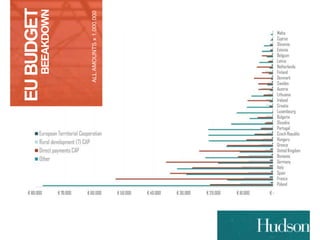
EU BUDGET 
BEEAKDOWN 
ALL AMOUNTS x 1.000.000
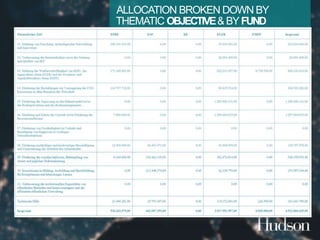
ALLOCATION BROKEN DOWN BY 
THEMATIC OBJECTIVE& BY FUND 
FRANCE 
UPDATED | 09 | 2014
FUNDINGPRIORITIES 
FRANCE 
UPDATED | 09 | 2014
EU Budget Austria 2014-2020 update november 2014

EU Budget Austria 2014-2020 update november 2014

  • 1.
  • 2.
  • 3.
  • 4.
  • 5.
    ALL AMOUNTS x1.000.000 Global Europe Administration Compensation ALLOCATION IN 2011 PRICES Security & Citizenship € 199.828 EU BUDGET € 959.988 in current prices: € 1.082.555
  • 6.
    BUDGET PROPORTIONS ALLAMOUNTS x 1.000.000
  • 7.
    BUDGET AUSTRIA AMOUNTS REGIONALLY ALLOCATED ALL AMOUNTS x 1.000.000
  • 8.
    THE 5 ESIFUNDS The five European Structural and Investment Funds; | The European Regional Development Fund | The European Social Fund | The Cohesion Fund | The European Maritime and Fisheries Fund | The European Agricultural Fund for Rural Development
  • 9.
    PARTNERSHIP AGREEMENTS |EU Member States are required to draw up and implement strategic plans with investment priorities covering the five ESI Funds. | These Partnership Agreements (PAs) are negotiated between the European Commission and national authorities, following their consultation of various levels of governance, representatives from interest groups, civil society and local and regional representatives.
  • 10.
    MAXIMUM AID PERCENTAGES | The designated areas, a list of regions with 2,186,465 inhabitants, cover 25.87% of Austria's population. | Austria has proposed its assisted areas across the country on the basis of a wide range of criteria, including those that reflect the socioeconomic situation (i.e. GDP per capita, below EU average or high unemployment compared to national average), the geographical situation (e.g. mountain areas) or structural problems at national level.
  • 11.
    MAXIMUM AID PERCENTAGES | The maximum level of aid that can be granted to investment projects carried out by large companies is 10%. For investments carried out by SMEs, these percentages can be increased by up to 10 percentage points for medium-sized enterprises and 20 percentage points for small enterprises. | While the population coverage has increased by around 3.4 percentage points compared to the previous aid map, the aid intensities have slightly decreased. This is in line with the objectives of the new regional aid guidelines, which aim at focusing support on the most disadvantaged regions of Europe.
  • 12.
    STATUS CURRENT UPDATED30/10 Total number of OP´s submitted per country Countries have their OP´s adopted: 21 OP >Denmark 1 OP >Lithuania
  • 13.
    PLANNING | PartnershipAgreement Adopted 17 – 10 – 2014 | 1 Operational Programmme submitted | Adoption of OP’s by European commission in Q4 2014 | Exp.1st grant calls Q1 2015 for funding priorities related to OP’s OPs should be submitted by Member States within 3 months following the submission of the Partnership Agreement. The Commission makes observations within 3 months and adopts the OP no later than 6 months from the date of its submission.
  • 14.
    FUNDING PRIORITIES ThePA focusses in particular on the following thematic objectives: | Preserving and protecting the environment and promoting resource efficiency (26% of ESI-Funds, EAFRD and ERDF) | Promoting climate change adaptation, risk prevention and management (26% of ESI-Funds, exclusively EAFRD) | Enhancing innovation and the competiveness of SMEs and of the agricultural sector (16.5% of ESI-Funds, EAFRD and ERDF) | Promoting social inclusion, combating poverty and any discrimination (11% of ESI-Funds, in particular from the EAFRD and the ESF).
  • 15.
    FUNDING PRIORITIES Otherthematic objectives will be supported by the ERDF and the ESF, while the EMFF allocation of EUR 7 million will be focussed on investments that should increase the competiveness of the aquaculture sector. As the EAFRD contributes to 80% of total ESI-Funds in Austria, the relative weight of the fund and of the thematic objectives under which the EAFRD operates is high.
  • 16.
    EXPECTED RESULTS ESI-Fundswill support Austria in achieving its targets: | RTDI expenditure in relation to GDP is to increase from 2.84 (2012) to 3.76% (2020) with a focus on private spending. | ESI-Funds will contribute to a CO² reduction (from -12.7% in 2012 to - 16% in 2020) and to improved energy efficiency and lower energy consumption (-7.16 million tons by 2020). | ESI-Funds are to help to increase the employment rate (to 77-78%), reduce the early school leaving rate (to 9,5%) and to reduce the number of people at risk of poverty or exclusion by 235,000 persons by 2020.
  • 17.
    FINANCIAL ALLOCATIONS |Austria will receive 4,923 million EUR from ESI-Funds and 257 million EUR for European Territorial Cooperation. | 26.8 million EUR (5% of the ERDF allocation) will be invested in integrated sustainable urban development actions mainly to be implemented in Vienna. A small share of ERDF will be reserved for CLLD in Tirol. | An amount of 1,595 million EUR (32.4% of the total ESIF allocation) will be invested to support climate related investments, which exceeds the required 20% share.
  • 18.
    FINANCIAL ALLOCATIONS Forthe ERDF, indicative regional allocations to each of the Bundesländer have been determined by Austria, while for the EAFRD, ESF and EMFF, the respective allocations are in principle Austrian-wide without a pre-determined regional allocation, with the exception however for the transitional region Burgenland and for the ESF investment priority on social inclusion.
  • 19.
    PROGRAMME ARCHITECTURE Cohesionpolicy will be delivered by four operational programmes (OPs), one for each fund. As compared to 2007-2013, a reduction from nine to one ERDF programme, and from two to one ESF programme, has been achieved. The EAFRD and the EMFF contributions will be delivered by one national programme as before. Following the reduction of the number of ERDF programmes, which takes place in the framework of the Austrian ERDF Reform Agenda, the number of managing authorities will diminish by eight, as there will be no regional programmes (one for each Bundesland) any more.
  • 20.
    EU BUDGET BEEAKDOWN ALL AMOUNTS x 1.000.000
  • 21.
    ALLOCATION BROKEN DOWNBY THEMATIC OBJECTIVE& BY FUND FRANCE UPDATED | 09 | 2014
  • 22.