Advanced
Transportation Engineering
The Four-Step Model:
II. Trip Distribution
The
Gravity
Model
The Gravity Model
The bigger the friction factor,
the more trips that are encouraged
Tij = Qij =
Pi Aj FijKij
ΣAzFizKi
j
Fij = 1 / Wc
ij
(Productions)(Attractions)(Friction Factor)
Sum of the (Attractions x Friction Factors) of the Zones
=
= Pipij
& ln F = - c ln W
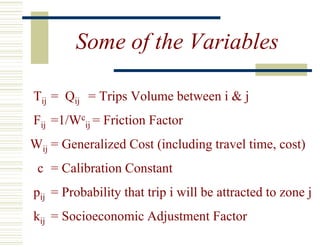
Some of the Variables
Tij = Qij = Trips Volume between i & j
Fij =1/Wc
ij = Friction Factor
Wij = Generalized Cost (including travel time, cost)
c = Calibration Constant
pij = Probability that trip i will be attracted to zone j
kij = Socioeconomic Adjustment Factor
To Apply the Gravity Model
What we need…
1. Productions, {Pi}
2. Attractions, {Aj}
3. Skim Tables {Wij)
 Target-Year Interzonal Impedances
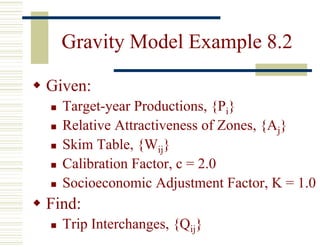
Gravity Model Example 8.2
 Given:
 Target-year Productions, {Pi}
 Relative Attractiveness of Zones, {Aj}
 Skim Table, {Wij}
 Calibration Factor, c = 2.0
 Socioeconomic Adjustment Factor, K = 1.0
 Find:
 Trip Interchanges, {Qij}
Attractions vs. Attractiveness
 The number of attractions to a particular zone
depends upon the zone’s attractiveness
 As compared to the attractiveness of all the other
competing zones and
 The distance between them
 Two zones with identical attractiveness may
have a different number of attractions due to one’s
remote location
 Thus, substituting attractions for attractiveness
can lead to incorrect results
Σ(AzFizKij)
Calculate Friction Factors, {Fij}
TAZ Productions
1 1500
2 0
3 2600
4 0
Σ 4100
TAZ "Attractiveness"
1 0
2 3
3 2
4 5
Σ 10
TAZ 1 2 3 4
1 5 10 15 20
2 10 5 10 15
3 15 10 5 10
4 20 15 10 5
Calibration Factor
c = 2.0
Socioeconomic Adj. Factor
K = 1.0
TAZ 1 2 3 4
1 0.0400 0.0100 0.0044 0.0025
2 0.0100 0.0400 0.0100 0.0044
3 0.0044 0.0100 0.0400 0.0100
4 0.0025 0.0044 0.0100 0.0400
TAZ 1 2 3 4 Σ
1 0.0000 0.0300 0.0089 0.0125 0.0514
2 0.0000 0.1200 0.0200 0.0222 0.1622
3 0.0000 0.0300 0.0800 0.0500 0.1600
4 0.0000 0.0133 0.0200 0.2000 0.2333
TAZ 1 2 3 4
1 0.0000 0.5838 0.1730 0.2432
2 0.0000 0.7397 0.1233 0.1370
3 0.0000 0.1875 0.5000 0.3125
4 0.0000 0.0571 0.0857 0.8571
TAZ 1 2 3 4 Σ
1 0 876 259 365 1500
2 0 0 0 0 0
3 0 488 1300 813 2600
4 0 0 0 0 0
Σ 0 1363 1559 1177 4100
Target-Year Inter-zonal
Impedances, {Wij}
F11=
1
52 = 0.04
AjFijKij=A4F34K34= (5)(0.01)(1.0)
= 0.05
Given…
Find Denominator of Gravity Model Equation {AjFijKij}
Find Probability that Trip i will be attracted to Zone j, {pij}
Find Trip Interchanges, {Qij}
pij =
AjFijKij
0.16
=
0.05
= 0.3125
Qij = Pipij = (2600)(0.3125) = 813
Fij =
1
Wc
ij
=
Keep in mind that the socioeconomic
factor, K, can be a matrix of value
rather than just one value
TAZ 1 2 3 4
1 1.4 1.2 1.7 1.9
2 1.2 1.1 1.1 1.4
3 1.7 1.1 1.5 1.3
4 1.9 1.4 1.3 1.6
Calibration of
the Gravity Model
 When we talk about calibrating the
gravity model, we are referring to
determining the numerical value c
 The reason we do this is to fix the
relationship between the travel-time
factor and the inter-zonal impedance
Calibration of
the Gravity Model
 Calibration is an iterative process
 We first assume a value of c and then use:
Qij = Pi
Aj Fij
Σ(Ax Fix)
[ ]
Qij = Tij = Trips Volume between i & j
Fij =1 / Wc
ij = Friction Factor
Wij = Generalized Cost (including travel time, cost)
c = Calibration Constant
Calibration of
the Gravity Model
 The results are then compared with the
observed values during the base year
 If the values are sufficiently close, keep c
 The results are expressed in terms of the
appropriate equation relating F and W with c
 If not, then adjust c and redo the procedure
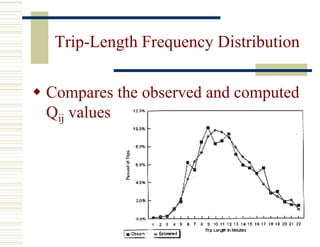
Trip-Length Frequency Distribution
 Compares the observed and computed
Qij values
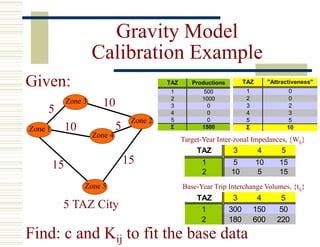
Gravity Model
Calibration Example
Given:
Zone 2
Zone 3
Zone 4
Zone 5
Zone 1
5 TAZ City
TAZ Productions
1 500
2 1000
3 0
4 0
5 0
Σ 1500
TAZ "Attractiveness"
1 0
2 0
3 2
4 3
5 5
Σ 10
TAZ 3 4 5
1 5 10 15
2 10 5 15
Target-Year Inter-zonal Impedances, {Wij}
5
5
10
10
15
15
Find: c and Kij to fit the base data
TAZ 3 4 5
1 300 150 50
2 180 600 220
Base-Year Trip Interchange Volumes, {tij}
Relating F & W
 Starting with:
 Take the natural log of both sides
 Now c is the slope of a straight
line relating ln F and ln W
Fij =
1
Wc
ij
ln F = - c ln W
ln
F
ln W
Trip-Length Frequency Distribution
 Group zone pairs by max Wij
 Sum Interchange Volumes for each set of zone pairs
 Find f = (Σtix) / (Σtij)
TAZ 3 4 5
1 5 10 15
2 10 5 15
Target-Year Inter-zonal Impedances, {Wij}
TAZ 3 4 5
1 300 150 50
2 180 600 220
Base-Year Trip Interchange Volumes, {tij}
W Σtij f
5 300 600 900 0.60
10 150 180 330 0.22
15 50 220 270 0.18
Σ 1500 1.00
tij Values
Zone Pairs
13, 24
14, 23
15, 25
Let’s assume c = 2.0
TAZ 3 4 5
1 5 10 15
2 10 5 15
Target-Year Inter-zonal
Impedances, {Wij} Base-Year Trip Interchange Volumes, {tij}
First Iteration
TAZ 3 4 5 Σ
1 300 150 50 500
2 180 600 220 1000
Friction Factor, {Fij} with c = 2.0
TAZ 3 4 5
1 0.040 0.010 0.004
2 0.010 0.040 0.004
Fij =
1
Wc
ij
= F13=
1
52 = 0.04
c = 2.0
First Iteration
Aj Fij
TAZ 3 4 5 Σ
1 0.605 0.227 0.168 1.000
2 0.123 0.740 0.137 1.000
TAZ 3 4 5 Σ
1 0.080 0.030 0.022 0.132
2 0.020 0.120 0.022 0.162
Aj Fij
Σ(Ax Fix)
[ ]
TAZ "Attractiveness"
1 0
2 0
3 2
4 3
5 5
Σ 10
Friction Factor, {Fij} with c = 2.0
TAZ 3 4 5
1 0.040 0.010 0.004
2 0.010 0.040 0.004
c = 2.0
First Iteration
TAZ 3 4 5 Σ
1 0.605 0.227 0.168 1.000
2 0.123 0.740 0.137 1.000
TAZ 3 4 5 Σ
1 303 113 84 500
2 123 740 137 1000
W Σtij f
5 303 740 1042.2 0.69
10 113 123 236.73 0.16
15 84 137 221.02 0.15
Σ
1 5 0 0 1 . 0 0
15, 25
Zone Pairs tij Values
13, 24
14, 23
Aj Fij
Σ(Ax Fix)
[ ]
Qij = Pi
Aj Fij
Σ(Ax Fix)
[ ]
TAZ Productions
1 500
2 1000
3 0
4 0
5 0
Σ 1500
Trip-Length FrequencyDistribution
0
0.1
0.2
0.3
0.4
0.5
0.6
0.7
0.8
0.9
1
5 10 15
Base Year Iteration 2 (c=1.5)
Let’s assume c = 1.5
TAZ 3 4 5
1 5 10 15
2 10 5 15
Target-Year Inter-zonal
Impedances, {Wij} Base-Year Trip Interchange Volumes, {tij}
Second Iteration
TAZ 3 4 5 Σ
1 300 150 50 500
2 180 600 220 1000
Friction Factor, {Fij} with c = 1.5
Fij =
1
Wc
ij
= F13=
1
51.5 = 0.089
TAZ 3 4 5
1 0.089 0.032 0.017
2 0.032 0.089 0.017
c = 1.5
Second Iteration
Aj Fij
Aj Fij
Σ(Ax Fix)
[ ]
TAZ "Attractiveness"
1 0
2 0
3 2
4 3
5 5
Σ 10
Friction Factor, {Fij} with c = 1.5
TAZ 3 4 5
1 0.089 0.032 0.017
2 0.032 0.089 0.017
TAZ 3 4 5 Σ
1 0.179 0.095 0.086 0.360
2 0.063 0.268 0.086 0.418
TAZ 3 4 5 Σ
1 0.497 0.264 0.239 1.000
2 0.151 0.642 0.206 1.000
c = 1.5
Second Iteration
Aj Fij
Σ(Ax Fix)
[ ]
Qij = Pi
Aj Fij
Σ(Ax Fix)
[ ]
TAZ Productions
1 500
2 1000
3 0
4 0
5 0
Σ 1500
TAZ 3 4 5 Σ
1 0.497 0.264 0.239 1.000
2 0.151 0.642 0.206 1.000
TAZ 3 4 5 Σ
1 249 132 120 500
2 151 642 206 1000
W Σtij f
5 249 642 891.06 0.59
10 132 151 283.26 0.19
15 120 206 325.67 0.22
Σ
1 5 0 0 1 . 0 0
Zone Pairs tij Values
13, 24
14, 23
15, 25
Trip-Length FrequencyDistribution
0
0.1
0.2
0.3
0.4
0.5
0.6
0.7
0.8
0.9
1
5 10 15
Base Year Iteration 1 (c=2.0) Iteration 2 (c=1.5)
K Factors
 Even after calibration, there will typically still be
discrepancies between the observed & calculated data
 To “fine-tune” the model, some employ socioeconomic
adjustment factors, also known as K-Factors
 The intent is to capture special local conditions between some
zonal pairs such as the need to cross a river
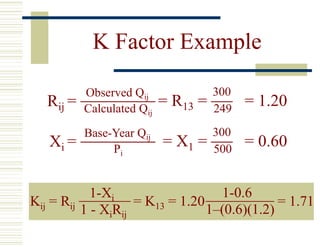
Kij = Rij
1-Xi
1 - XiRij
Rij = ratio of observed to calculated Qij (or Tij)
Xi = ratio of the base-year Qij to Pi (total productions of zone i)
K Factor Example
Rij =
Observed Qij
Calculated Qij
= R13 =
300
249
= 1.20
Xi =
Base-Year Qij
Pi
= X1 =
300
500
= 0.60
Kij = Rij
1-Xi
1 - XiRij
= K13 = 1.20
1-0.6
1–(0.6)(1.2)
= 1.71
The Problem with K-Factors
 Although K-Factors may improve the model
in the base year, they assume that these
special conditions will carry over to future
years and scenarios
 This limits model sensitivity and undermines the
model’s ability to predict future travel behavior
 The need for K-factors often is a symptom
of other model problems.
 Additionally, the use of K-factors makes it more
difficult to figure out the real problems
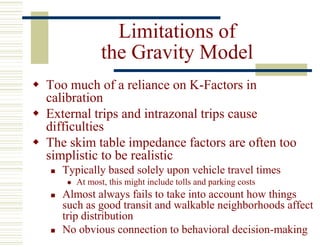
Limitations of
the Gravity Model
 Too much of a reliance on K-Factors in
calibration
 External trips and intrazonal trips cause
difficulties
 The skim table impedance factors are often too
simplistic to be realistic
 Typically based solely upon vehicle travel times
 At most, this might include tolls and parking costs
 Almost always fails to take into account how things
such as good transit and walkable neighborhoods affect
trip distribution
 No obvious connection to behavioral decision-making

Gravity Model Calibration.ppt

  • 1.
  • 2.
  • 3.
    The Gravity Model Thebigger the friction factor, the more trips that are encouraged Tij = Qij = Pi Aj FijKij ΣAzFizKi j Fij = 1 / Wc ij (Productions)(Attractions)(Friction Factor) Sum of the (Attractions x Friction Factors) of the Zones = = Pipij & ln F = - c ln W
  • 4.
    Some of theVariables Tij = Qij = Trips Volume between i & j Fij =1/Wc ij = Friction Factor Wij = Generalized Cost (including travel time, cost) c = Calibration Constant pij = Probability that trip i will be attracted to zone j kij = Socioeconomic Adjustment Factor
  • 5.
    To Apply theGravity Model What we need… 1. Productions, {Pi} 2. Attractions, {Aj} 3. Skim Tables {Wij)  Target-Year Interzonal Impedances
  • 6.
    Gravity Model Example8.2  Given:  Target-year Productions, {Pi}  Relative Attractiveness of Zones, {Aj}  Skim Table, {Wij}  Calibration Factor, c = 2.0  Socioeconomic Adjustment Factor, K = 1.0  Find:  Trip Interchanges, {Qij}
  • 7.
    Attractions vs. Attractiveness The number of attractions to a particular zone depends upon the zone’s attractiveness  As compared to the attractiveness of all the other competing zones and  The distance between them  Two zones with identical attractiveness may have a different number of attractions due to one’s remote location  Thus, substituting attractions for attractiveness can lead to incorrect results
  • 8.
    Σ(AzFizKij) Calculate Friction Factors,{Fij} TAZ Productions 1 1500 2 0 3 2600 4 0 Σ 4100 TAZ "Attractiveness" 1 0 2 3 3 2 4 5 Σ 10 TAZ 1 2 3 4 1 5 10 15 20 2 10 5 10 15 3 15 10 5 10 4 20 15 10 5 Calibration Factor c = 2.0 Socioeconomic Adj. Factor K = 1.0 TAZ 1 2 3 4 1 0.0400 0.0100 0.0044 0.0025 2 0.0100 0.0400 0.0100 0.0044 3 0.0044 0.0100 0.0400 0.0100 4 0.0025 0.0044 0.0100 0.0400 TAZ 1 2 3 4 Σ 1 0.0000 0.0300 0.0089 0.0125 0.0514 2 0.0000 0.1200 0.0200 0.0222 0.1622 3 0.0000 0.0300 0.0800 0.0500 0.1600 4 0.0000 0.0133 0.0200 0.2000 0.2333 TAZ 1 2 3 4 1 0.0000 0.5838 0.1730 0.2432 2 0.0000 0.7397 0.1233 0.1370 3 0.0000 0.1875 0.5000 0.3125 4 0.0000 0.0571 0.0857 0.8571 TAZ 1 2 3 4 Σ 1 0 876 259 365 1500 2 0 0 0 0 0 3 0 488 1300 813 2600 4 0 0 0 0 0 Σ 0 1363 1559 1177 4100 Target-Year Inter-zonal Impedances, {Wij} F11= 1 52 = 0.04 AjFijKij=A4F34K34= (5)(0.01)(1.0) = 0.05 Given… Find Denominator of Gravity Model Equation {AjFijKij} Find Probability that Trip i will be attracted to Zone j, {pij} Find Trip Interchanges, {Qij} pij = AjFijKij 0.16 = 0.05 = 0.3125 Qij = Pipij = (2600)(0.3125) = 813 Fij = 1 Wc ij =
  • 9.
    Keep in mindthat the socioeconomic factor, K, can be a matrix of value rather than just one value TAZ 1 2 3 4 1 1.4 1.2 1.7 1.9 2 1.2 1.1 1.1 1.4 3 1.7 1.1 1.5 1.3 4 1.9 1.4 1.3 1.6
  • 10.
    Calibration of the GravityModel  When we talk about calibrating the gravity model, we are referring to determining the numerical value c  The reason we do this is to fix the relationship between the travel-time factor and the inter-zonal impedance
  • 11.
    Calibration of the GravityModel  Calibration is an iterative process  We first assume a value of c and then use: Qij = Pi Aj Fij Σ(Ax Fix) [ ] Qij = Tij = Trips Volume between i & j Fij =1 / Wc ij = Friction Factor Wij = Generalized Cost (including travel time, cost) c = Calibration Constant
  • 12.
    Calibration of the GravityModel  The results are then compared with the observed values during the base year  If the values are sufficiently close, keep c  The results are expressed in terms of the appropriate equation relating F and W with c  If not, then adjust c and redo the procedure
  • 13.
    Trip-Length Frequency Distribution Compares the observed and computed Qij values
  • 14.
    Gravity Model Calibration Example Given: Zone2 Zone 3 Zone 4 Zone 5 Zone 1 5 TAZ City TAZ Productions 1 500 2 1000 3 0 4 0 5 0 Σ 1500 TAZ "Attractiveness" 1 0 2 0 3 2 4 3 5 5 Σ 10 TAZ 3 4 5 1 5 10 15 2 10 5 15 Target-Year Inter-zonal Impedances, {Wij} 5 5 10 10 15 15 Find: c and Kij to fit the base data TAZ 3 4 5 1 300 150 50 2 180 600 220 Base-Year Trip Interchange Volumes, {tij}
  • 15.
    Relating F &W  Starting with:  Take the natural log of both sides  Now c is the slope of a straight line relating ln F and ln W Fij = 1 Wc ij ln F = - c ln W ln F ln W
  • 16.
    Trip-Length Frequency Distribution Group zone pairs by max Wij  Sum Interchange Volumes for each set of zone pairs  Find f = (Σtix) / (Σtij) TAZ 3 4 5 1 5 10 15 2 10 5 15 Target-Year Inter-zonal Impedances, {Wij} TAZ 3 4 5 1 300 150 50 2 180 600 220 Base-Year Trip Interchange Volumes, {tij} W Σtij f 5 300 600 900 0.60 10 150 180 330 0.22 15 50 220 270 0.18 Σ 1500 1.00 tij Values Zone Pairs 13, 24 14, 23 15, 25
  • 17.
    Let’s assume c= 2.0 TAZ 3 4 5 1 5 10 15 2 10 5 15 Target-Year Inter-zonal Impedances, {Wij} Base-Year Trip Interchange Volumes, {tij} First Iteration TAZ 3 4 5 Σ 1 300 150 50 500 2 180 600 220 1000 Friction Factor, {Fij} with c = 2.0 TAZ 3 4 5 1 0.040 0.010 0.004 2 0.010 0.040 0.004 Fij = 1 Wc ij = F13= 1 52 = 0.04
  • 18.
    c = 2.0 FirstIteration Aj Fij TAZ 3 4 5 Σ 1 0.605 0.227 0.168 1.000 2 0.123 0.740 0.137 1.000 TAZ 3 4 5 Σ 1 0.080 0.030 0.022 0.132 2 0.020 0.120 0.022 0.162 Aj Fij Σ(Ax Fix) [ ] TAZ "Attractiveness" 1 0 2 0 3 2 4 3 5 5 Σ 10 Friction Factor, {Fij} with c = 2.0 TAZ 3 4 5 1 0.040 0.010 0.004 2 0.010 0.040 0.004
  • 19.
    c = 2.0 FirstIteration TAZ 3 4 5 Σ 1 0.605 0.227 0.168 1.000 2 0.123 0.740 0.137 1.000 TAZ 3 4 5 Σ 1 303 113 84 500 2 123 740 137 1000 W Σtij f 5 303 740 1042.2 0.69 10 113 123 236.73 0.16 15 84 137 221.02 0.15 Σ 1 5 0 0 1 . 0 0 15, 25 Zone Pairs tij Values 13, 24 14, 23 Aj Fij Σ(Ax Fix) [ ] Qij = Pi Aj Fij Σ(Ax Fix) [ ] TAZ Productions 1 500 2 1000 3 0 4 0 5 0 Σ 1500
  • 20.
  • 21.
    Let’s assume c= 1.5 TAZ 3 4 5 1 5 10 15 2 10 5 15 Target-Year Inter-zonal Impedances, {Wij} Base-Year Trip Interchange Volumes, {tij} Second Iteration TAZ 3 4 5 Σ 1 300 150 50 500 2 180 600 220 1000 Friction Factor, {Fij} with c = 1.5 Fij = 1 Wc ij = F13= 1 51.5 = 0.089 TAZ 3 4 5 1 0.089 0.032 0.017 2 0.032 0.089 0.017
  • 22.
    c = 1.5 SecondIteration Aj Fij Aj Fij Σ(Ax Fix) [ ] TAZ "Attractiveness" 1 0 2 0 3 2 4 3 5 5 Σ 10 Friction Factor, {Fij} with c = 1.5 TAZ 3 4 5 1 0.089 0.032 0.017 2 0.032 0.089 0.017 TAZ 3 4 5 Σ 1 0.179 0.095 0.086 0.360 2 0.063 0.268 0.086 0.418 TAZ 3 4 5 Σ 1 0.497 0.264 0.239 1.000 2 0.151 0.642 0.206 1.000
  • 23.
    c = 1.5 SecondIteration Aj Fij Σ(Ax Fix) [ ] Qij = Pi Aj Fij Σ(Ax Fix) [ ] TAZ Productions 1 500 2 1000 3 0 4 0 5 0 Σ 1500 TAZ 3 4 5 Σ 1 0.497 0.264 0.239 1.000 2 0.151 0.642 0.206 1.000 TAZ 3 4 5 Σ 1 249 132 120 500 2 151 642 206 1000 W Σtij f 5 249 642 891.06 0.59 10 132 151 283.26 0.19 15 120 206 325.67 0.22 Σ 1 5 0 0 1 . 0 0 Zone Pairs tij Values 13, 24 14, 23 15, 25
  • 24.
    Trip-Length FrequencyDistribution 0 0.1 0.2 0.3 0.4 0.5 0.6 0.7 0.8 0.9 1 5 1015 Base Year Iteration 1 (c=2.0) Iteration 2 (c=1.5)
  • 25.
    K Factors  Evenafter calibration, there will typically still be discrepancies between the observed & calculated data  To “fine-tune” the model, some employ socioeconomic adjustment factors, also known as K-Factors  The intent is to capture special local conditions between some zonal pairs such as the need to cross a river Kij = Rij 1-Xi 1 - XiRij Rij = ratio of observed to calculated Qij (or Tij) Xi = ratio of the base-year Qij to Pi (total productions of zone i)
  • 26.
    K Factor Example Rij= Observed Qij Calculated Qij = R13 = 300 249 = 1.20 Xi = Base-Year Qij Pi = X1 = 300 500 = 0.60 Kij = Rij 1-Xi 1 - XiRij = K13 = 1.20 1-0.6 1–(0.6)(1.2) = 1.71
  • 27.
    The Problem withK-Factors  Although K-Factors may improve the model in the base year, they assume that these special conditions will carry over to future years and scenarios  This limits model sensitivity and undermines the model’s ability to predict future travel behavior  The need for K-factors often is a symptom of other model problems.  Additionally, the use of K-factors makes it more difficult to figure out the real problems
  • 28.
    Limitations of the GravityModel  Too much of a reliance on K-Factors in calibration  External trips and intrazonal trips cause difficulties  The skim table impedance factors are often too simplistic to be realistic  Typically based solely upon vehicle travel times  At most, this might include tolls and parking costs  Almost always fails to take into account how things such as good transit and walkable neighborhoods affect trip distribution  No obvious connection to behavioral decision-making