 A Graph is a non-linear data
structure consisting of nodes and
edges.
 The set of edges describes
relationships among the vertices.
 So, A Graph is a finite set of
vertices(or nodes) and set of Edges
which connect a pair of nodes.
Graphs
 A graph G is defined as follows:
G=(V,E)
V(G): a finite, nonempty set of
vertices
E(G): a set of edges (pairs of
vertices)
Graphs
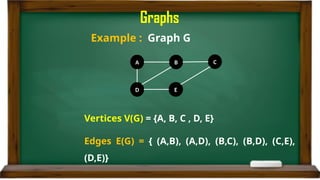
Example : Graph G
Graphs
A B C
D E
Vertices V(G) = {A, B, C , D, E}
Edges E(G) = { (A,B), (A,D), (B,C), (B,D), (C,E),
(D,E)}
According to Path or Flow:
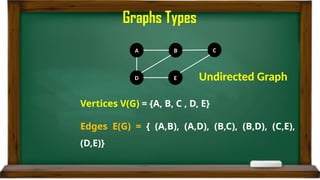
 Undirected: In a graph if edges
have no direction then it is called
Undirected Graph.
 Directed: In a graph if edges have
direction then it is called Directed
Graph.
Graphs Types
Graphs Types
A B C
D E Undirected Graph
Vertices V(G) = {A, B, C , D, E}
Edges E(G) = { (A,B), (A,D), (B,C), (B,D), (C,E),
(D,E)}
Graphs Types
Directed Graph
A
B C
D E
Vertices V(G) = {A, B, C , D, E}
Edges E(G) = { (A,B), (A,D), (B,C), (D,B), (D,E),
(E,C)}
Graph Terminology
Adjacent Nodes: Two nodes are
adjacent if they are connected
with an edge.
A is Adjacent to B
B is adjacent From A
Path: A sequence of vertices
that connect two nodes in a
graph.
A B
Graph Terminology
Complete Graph: A graph in
which every vertex is directly
connected to every other
vertex.
if Number of vertices (v) are n then
Number of edges (e) are
In Directed Graph e=n*(n-1)
In Undirected Graph e=(n*(n-1))/2
Graph Terminology
Complete Graph:
A B
C
Directed Complete Graph
e= n*(n-1)= 3*2 = 6
Vertices V(G) = {A, B, C }
Edges E(G) = {(A,B), (A,C), (B,A), (B,C), (C,A),
(C,B)}
Graph Terminology
Complete Graph:
A B
C
Undirected Complete Graph
e= (n*(n-1))/2= 6/2=3
Vertices V(G) = {A, B, C }
Edges E(G) = {(A,B), (A,C), (B,C)}
Graph Terminology
Weighted Graph: A graph in
which every edge carries a
value.
A B C
D E
50
30
20
40
30 50
Graph Terminology
Loop: In graph loop (also called
a self-loop) is an edge that
connects a vertex to itself. A
simple graph contains no
loops..
A B C
D E
In this graph vertex C having
loop
Graph Terminology
Graph Degree:
Degree of the Vertex
In-Degree of the vertex
Out-Degree of the vertex
 In this Degree works on
undirected Graph
 In-Degree and Out-Degree works
on Directed Graph
Graph Terminology
Degree: the number of
relations a particular node /
Vertex makes with the other
node / Vertex in the graph.
d(v).
In this graph at vertex D out degree is d(D) =
3
A B C
D E
Graph Terminology
Out-Degree: if V is vertex of a
directed graph D number of
edges for which v is the initial
vertex is called out- degree. It is
denoted by d+
(v).
A B
D
In this graph at vertex A out degree is d+
(A) =
2
Graph Terminology
In-Degree: if V is vertex of a
directed graph D number of
edges for which v is the
terminal vertex is called in
degree. It is denoted by d-
(v).
A B
D
In this graph at vertex D in degree is d-
(D) = 1
Graph Terminology
Note1: in an undirected graph
Degree of total Graph is sum of
all the vertex degrees.
d(G)=∑ d(v)
Note2: in a directed graph
Degree of total Graph is sum of
in-degree and out-degree.
d(G)=∑ d+
(v) + ∑ d-
(v)
Graph Terminology
Note3: all vertex in-degree and
out-degree always same.
∑ d+
(v) = ∑ d-
(v)
Note4: in a graph Total number
of edges is equal to the half of
the tree degree.
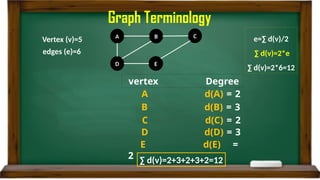
e= ∑ d(v) / 2
Graph Terminology
Note5: in a Directed graph Total
number of edges is equal to all vertex
in-degree or out-degree.
e = ∑ d+
(v) = ∑ d-
(v)
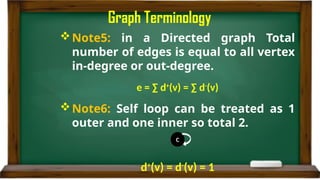
Note6: Self loop can be treated as 1
outer and one inner so total 2.
d+
(v) = d-
(v) = 1
C
Graph Terminology
A d(A) = 2
vertex Degree
B d(B) = 3
C d(C) = 2
D d(D) = 3
E d(E) =
2
A B C
D E
Vertex (v)=5
edges (e)=6
e=∑ d(v)/2
∑ d(v)=2*e
∑ d(v)=2*6=12
∑ d(v)=2+3+2+3+2=12
Graph Terminology
A B C
D E
A d+
(A) = 2 d-
(A) = 0
vertex Out-Degree In-Degree
B d+
(B) = 1 d-
(B) = 2
C d+
(C) = 0 d-
(C) = 2
D d+
(D) = 2 d-
(D) = 1
E d+
(E) = 1 d-
(E) = 1
e=∑ d+
(v)=∑ d-
(v)
∑ d+
(v)=2+1+0+2+1=6 ∑ d-
(v)=0+2+2+1+1=6
Vertex (v)=5
edges (e)=6
Graph Terminology
A B C
D E
A d+
(A) = 2 d-
(A) = 0
vertex Out-Degree In-Degree
B d+
(B) = 1 d-
(B) = 2
C d+
(C) = 1 d-
(C) = 3
D d+
(D) = 2 d-
(D) = 1
E d+
(E) = 1 d-
(E) = 1
e=∑ d+
(v)=∑ d-
(v)
∑ d+
(v)=2+1+1+2+1=7 ∑ d-
(v)=0+2+3+1+1=7
Vertex (v)=5
edges (e)=7
Tree Vs Graph
In Tree only path allowed
between nodes but in Graph
nodes can have directional or
unidirectional.
In Tree each node having only
one parent but in Graph there is
no such concept.
In tree there is no concept loops
and self loops unlike graphs.
Tree Vs Graph
Tree uses traversed using in-
order, pre-order, post-order but
Graph uses BFS(Breadth First
Search) and DFS(Depth First
Search).
Tree is a hierarchical structure
and Graph has a network
model.
Graphs Basics.pptx

  • 1.
     A Graphis a non-linear data structure consisting of nodes and edges.  The set of edges describes relationships among the vertices.  So, A Graph is a finite set of vertices(or nodes) and set of Edges which connect a pair of nodes. Graphs
  • 2.
     A graphG is defined as follows: G=(V,E) V(G): a finite, nonempty set of vertices E(G): a set of edges (pairs of vertices) Graphs
  • 3.
    Example : GraphG Graphs A B C D E Vertices V(G) = {A, B, C , D, E} Edges E(G) = { (A,B), (A,D), (B,C), (B,D), (C,E), (D,E)}
  • 4.
    According to Pathor Flow:  Undirected: In a graph if edges have no direction then it is called Undirected Graph.  Directed: In a graph if edges have direction then it is called Directed Graph. Graphs Types
  • 5.
    Graphs Types A BC D E Undirected Graph Vertices V(G) = {A, B, C , D, E} Edges E(G) = { (A,B), (A,D), (B,C), (B,D), (C,E), (D,E)}
  • 6.
    Graphs Types Directed Graph A BC D E Vertices V(G) = {A, B, C , D, E} Edges E(G) = { (A,B), (A,D), (B,C), (D,B), (D,E), (E,C)}
  • 7.
    Graph Terminology Adjacent Nodes:Two nodes are adjacent if they are connected with an edge. A is Adjacent to B B is adjacent From A Path: A sequence of vertices that connect two nodes in a graph. A B
  • 8.
    Graph Terminology Complete Graph:A graph in which every vertex is directly connected to every other vertex. if Number of vertices (v) are n then Number of edges (e) are In Directed Graph e=n*(n-1) In Undirected Graph e=(n*(n-1))/2
  • 9.
    Graph Terminology Complete Graph: AB C Directed Complete Graph e= n*(n-1)= 3*2 = 6 Vertices V(G) = {A, B, C } Edges E(G) = {(A,B), (A,C), (B,A), (B,C), (C,A), (C,B)}
  • 10.
    Graph Terminology Complete Graph: AB C Undirected Complete Graph e= (n*(n-1))/2= 6/2=3 Vertices V(G) = {A, B, C } Edges E(G) = {(A,B), (A,C), (B,C)}
  • 11.
    Graph Terminology Weighted Graph:A graph in which every edge carries a value. A B C D E 50 30 20 40 30 50
  • 12.
    Graph Terminology Loop: Ingraph loop (also called a self-loop) is an edge that connects a vertex to itself. A simple graph contains no loops.. A B C D E In this graph vertex C having loop
  • 13.
    Graph Terminology Graph Degree: Degreeof the Vertex In-Degree of the vertex Out-Degree of the vertex  In this Degree works on undirected Graph  In-Degree and Out-Degree works on Directed Graph
  • 14.
    Graph Terminology Degree: thenumber of relations a particular node / Vertex makes with the other node / Vertex in the graph. d(v). In this graph at vertex D out degree is d(D) = 3 A B C D E
  • 15.
    Graph Terminology Out-Degree: ifV is vertex of a directed graph D number of edges for which v is the initial vertex is called out- degree. It is denoted by d+ (v). A B D In this graph at vertex A out degree is d+ (A) = 2
  • 16.
    Graph Terminology In-Degree: ifV is vertex of a directed graph D number of edges for which v is the terminal vertex is called in degree. It is denoted by d- (v). A B D In this graph at vertex D in degree is d- (D) = 1
  • 17.
    Graph Terminology Note1: inan undirected graph Degree of total Graph is sum of all the vertex degrees. d(G)=∑ d(v) Note2: in a directed graph Degree of total Graph is sum of in-degree and out-degree. d(G)=∑ d+ (v) + ∑ d- (v)
  • 18.
    Graph Terminology Note3: allvertex in-degree and out-degree always same. ∑ d+ (v) = ∑ d- (v) Note4: in a graph Total number of edges is equal to the half of the tree degree. e= ∑ d(v) / 2
  • 19.
    Graph Terminology Note5: ina Directed graph Total number of edges is equal to all vertex in-degree or out-degree. e = ∑ d+ (v) = ∑ d- (v) Note6: Self loop can be treated as 1 outer and one inner so total 2. d+ (v) = d- (v) = 1 C
  • 20.
    Graph Terminology A d(A)= 2 vertex Degree B d(B) = 3 C d(C) = 2 D d(D) = 3 E d(E) = 2 A B C D E Vertex (v)=5 edges (e)=6 e=∑ d(v)/2 ∑ d(v)=2*e ∑ d(v)=2*6=12 ∑ d(v)=2+3+2+3+2=12
  • 21.
    Graph Terminology A BC D E A d+ (A) = 2 d- (A) = 0 vertex Out-Degree In-Degree B d+ (B) = 1 d- (B) = 2 C d+ (C) = 0 d- (C) = 2 D d+ (D) = 2 d- (D) = 1 E d+ (E) = 1 d- (E) = 1 e=∑ d+ (v)=∑ d- (v) ∑ d+ (v)=2+1+0+2+1=6 ∑ d- (v)=0+2+2+1+1=6 Vertex (v)=5 edges (e)=6
  • 22.
    Graph Terminology A BC D E A d+ (A) = 2 d- (A) = 0 vertex Out-Degree In-Degree B d+ (B) = 1 d- (B) = 2 C d+ (C) = 1 d- (C) = 3 D d+ (D) = 2 d- (D) = 1 E d+ (E) = 1 d- (E) = 1 e=∑ d+ (v)=∑ d- (v) ∑ d+ (v)=2+1+1+2+1=7 ∑ d- (v)=0+2+3+1+1=7 Vertex (v)=5 edges (e)=7
  • 23.
    Tree Vs Graph InTree only path allowed between nodes but in Graph nodes can have directional or unidirectional. In Tree each node having only one parent but in Graph there is no such concept. In tree there is no concept loops and self loops unlike graphs.
  • 24.
    Tree Vs Graph Treeuses traversed using in- order, pre-order, post-order but Graph uses BFS(Breadth First Search) and DFS(Depth First Search). Tree is a hierarchical structure and Graph has a network model.