Graph-Based Question Answering Diego Moll á -Aliod 30 August 2004
Outline Question Answering and AnswerFinder Conceptual Graphs Graph Comparison
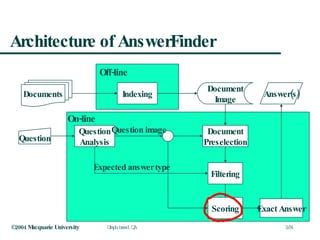
Architecture of AnswerFinder On-line Scoring Documents Indexing Off-line Document Image Question Analysis Question Document Preselection Question image Filtering Expected answer type Exact Answer Answer(s)
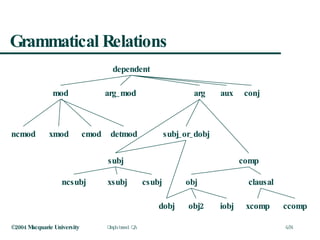
Grammatical Relations dependent mod arg_mod arg ncmod xmod detmod subj_or_dobj subj ncsubj xsubj csubj obj dobj obj2 iobj comp clausal xcomp ccomp cmod aux conj
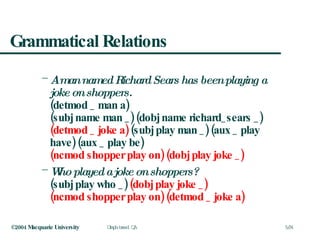
Grammatical Relations A man named Richard Sears has been playing a joke on shoppers. (detmod _ man a)  (subj name man _) (dobj name richard_sears _)  (detmod _ joke a)  (subj play man _) (aux _ play have) (aux _ play be)  (ncmod shopper play on)   (dobj play joke _) Who played a joke on shoppers? (subj play who _)  (dobj play joke _)   (ncmod shopper play on)   (detmod _ joke a)
Minimal Logical Forms Called  Minimal Logical forms  because they encode the minimum information required for AE Flat expressions that use  reification Example:  cp will quickly copy files holds(e4), object(cp,o1,[x1]), object(s_command,o2,[x1]), evt(s_copy,e4,[x1,x6]), object(s_file,o3,[x6]), prop(quickly,p3,[e4]). Example:  the man that came ate bananas and apples with a fork holds(e1), object(s_man,o2,[x2]), evt(s_come,e4,[x2]), evt(s_eat,e5,[x7]), x6@<x7, x8@<x7, object(s_banana,o6,[x6]), object(s_apple,o8,[x8]), prop(with,p9,[e5,x11]), object(s_fork,o11,[x11]).
Minimal Logical Forms A man named Richard Sears has been playing a joke on shoppers.   holds(o10),  object('man',o2,[x2]), evt('name',e3,[X3,x2,x4]), object('richard_sears',o4,[x4]),  evt(‘play’,e8,[x2,x10]),   object('joke',o10,[x10]), prop(‘on’,p11,[e8,x12]),   object('shopper',o12,[x12]) Who played a joke on shoppers? holds(e2),  object('who',o1,[x1]),  evt('play',e2,[x1,x4]), object('joke',o4,[x4]), prop(‘on’,p5,[e2,x6]),   object('shopper',o6,[x6])
Outline Question Answering and AnswerFinder Conceptual Graphs Graph Comparison
Conceptual Graphs Concept Node [Cat:Tom], [Mat] Entities, attributes, or events (actions) Concept nodes have two attributes: Type (e.g. Cat) Referent (e.g. Tom) Relation Node (On) The kind of relationship between two concept nodes Cat: Tom On Mat
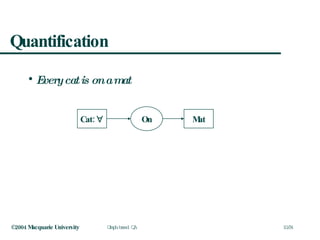
Quantification Every cat is on a mat Cat:   On Mat
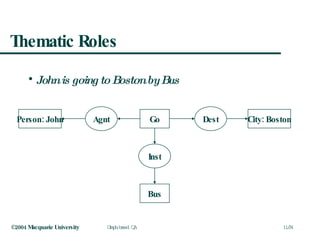
Thematic Roles John is going to Boston by Bus Person: John Agnt Go Dest City: Boston Inst Bus
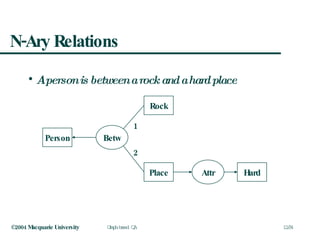
N-Ary Relations A person is between a rock and a hard place Betw Person Rock Place Hard Attr 1 2
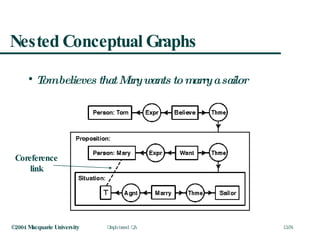
Nested Conceptual Graphs Tom believes that Mary wants to marry a sailor Coreference link
How does it Compare with AnswerFinder? John is going to Boston by bus holds(e3), prop('by',p6,[e3,x7]), prop('to',p4,[e3,x5]), object('john',o1,[x1]), evt('go',e3,[x1]), object('bus',o7,[x7]), object('boston',o5,[x5]) john:x1 boston:x5 go:e3 to 1 by bus:x7
How does it Compare with AnswerFinder? A person is between a rock and a hard place holds(e3), object('rock',o6,[x6]), evt('be',e3,[x2]), prop('hard',p9,[x10]), object('person',o2,[x2]), prop('between',p4,[e3,x7]), object('place',o10,[x10]), x2  x7, x10  x7 be:e3 person:x2 1 between rock:x6 place:x10 x7   prop ? hard:p9
How does it Compare with AnswerFinder? Tom believes that Mary wants to marry a sailor   holds(e2), evt('marry',e7,[x4,x9]), object('sailor',o9,[x9]), evt('believe',e2,[x1,e5]), object('tom',o1,[x1]), object('mary',o4,[x4]), evt('want',e5,[x4,e7]) believe:e2 1 tom:x1 2 want:e5 1 mary:x4 2 marry:e7 1 2 sailor:x9
Outline Question Answering and AnswerFinder Conceptual Graphs Graph Comparison
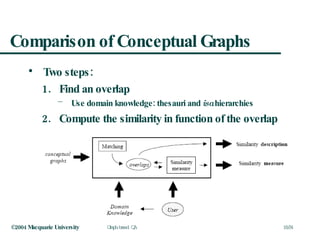
Comparison of Conceptual Graphs Two steps: Find an overlap Use domain knowledge: thesauri and  isa  hierarchies Compute the similarity in function of the overlap
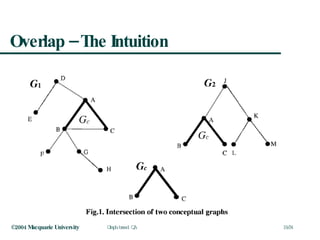
Overlap – The Intuition
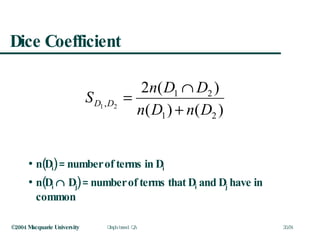
Dice Coefficient n(D i ) = number of terms in D i n(D i     D j ) = number of terms that D i  and D j  have in common
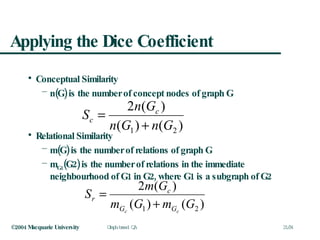
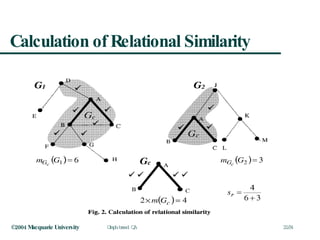
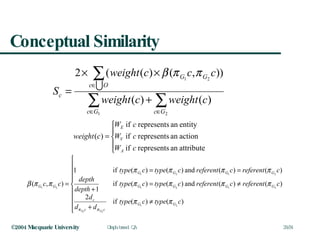
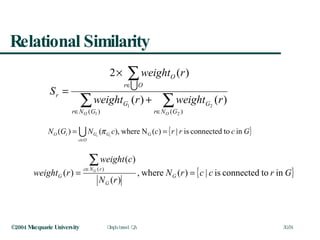
Applying the Dice Coefficient Conceptual Similarity n(G) is the number of concept nodes of graph G Relational Similarity m(G) is the number of relations of graph G m G1 (G2) is the number of relations in the immediate neighbourhood of G1 in G2, where G1 is a subgraph of G2
Calculation of Relational Similarity
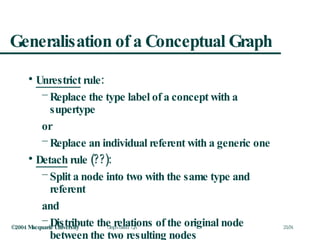
Generalisation of a Conceptual Graph Unrestrict  rule: Replace the type label of a concept with a supertype or Replace an individual referent with a generic one Detach  rule (??): Split a node into two with the same type and referent and Distribute the relations of the original node between the two resulting nodes
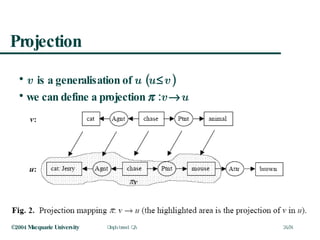
Projection v   is a generalisation of  u  ( u   v  ) we can define a projection     : v    u
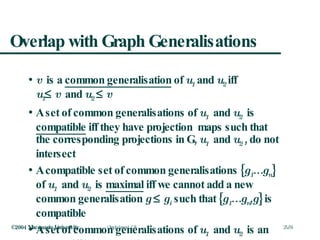
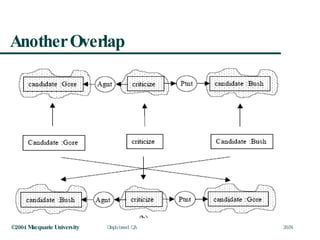
Overlap with Graph Generalisations v   is a  common generalisation  of  u 1  and  u 2  iff  u 1    v   and  u 2      v A set of common generalisations of  u 1   and  u 2   is  compatible  iff they have projection  maps such that the corresponding projections in G,  u 1   and  u 2  , do not intersect A compatible set of common generalisations { g 1 … g n } of  u 1   and  u 2   is  maximal  iff we cannot add a new common generalisation  g      g i   such that { g 1 … g n , g } is compatible A set of common generalisations of  u 1   and  u 2   is an  overlap  iff it is compatible and maximal
Finding an Overlap There may be several overlaps Finding an overlap is NP-complete Still, workable for small graphs
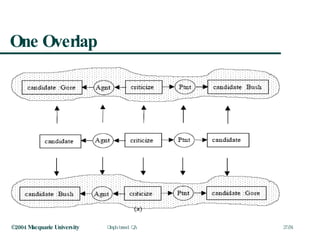
One Overlap
Another Overlap
Conceptual Similarity
Relational Similarity
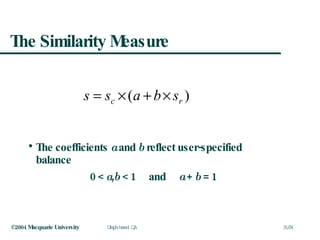
The Similarity Measure The coefficients  a  and  b  reflect user-specified balance 0 <  a , b  < 1  and  a  +  b  = 1
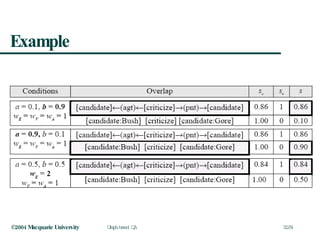
Example
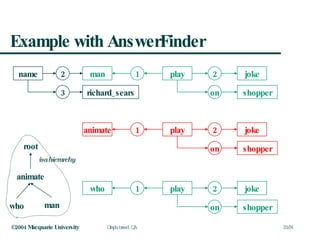
Example with AnswerFinder who play 1 2 joke on shopper man name 2 3 richard_sears play 1 2 joke on shopper play 1 2 joke on shopper animate root animate who man isa hierarchy
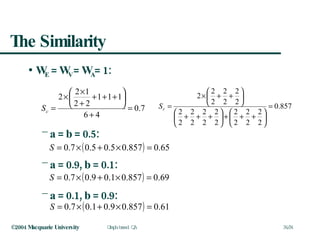
The Similarity W E  = W V  = W A = 1: a = b = 0.5: a = 0.9, b = 0.1: a = 0.1, b = 0.9:

Graph-based Question Answering

  • 1.
    Graph-Based Question AnsweringDiego Moll á -Aliod 30 August 2004
  • 2.
    Outline Question Answeringand AnswerFinder Conceptual Graphs Graph Comparison
  • 3.
    Architecture of AnswerFinderOn-line Scoring Documents Indexing Off-line Document Image Question Analysis Question Document Preselection Question image Filtering Expected answer type Exact Answer Answer(s)
  • 4.
    Grammatical Relations dependentmod arg_mod arg ncmod xmod detmod subj_or_dobj subj ncsubj xsubj csubj obj dobj obj2 iobj comp clausal xcomp ccomp cmod aux conj
  • 5.
    Grammatical Relations Aman named Richard Sears has been playing a joke on shoppers. (detmod _ man a) (subj name man _) (dobj name richard_sears _) (detmod _ joke a) (subj play man _) (aux _ play have) (aux _ play be) (ncmod shopper play on) (dobj play joke _) Who played a joke on shoppers? (subj play who _) (dobj play joke _) (ncmod shopper play on) (detmod _ joke a)
  • 6.
    Minimal Logical FormsCalled Minimal Logical forms because they encode the minimum information required for AE Flat expressions that use reification Example: cp will quickly copy files holds(e4), object(cp,o1,[x1]), object(s_command,o2,[x1]), evt(s_copy,e4,[x1,x6]), object(s_file,o3,[x6]), prop(quickly,p3,[e4]). Example: the man that came ate bananas and apples with a fork holds(e1), object(s_man,o2,[x2]), evt(s_come,e4,[x2]), evt(s_eat,e5,[x7]), x6@<x7, x8@<x7, object(s_banana,o6,[x6]), object(s_apple,o8,[x8]), prop(with,p9,[e5,x11]), object(s_fork,o11,[x11]).
  • 7.
    Minimal Logical FormsA man named Richard Sears has been playing a joke on shoppers. holds(o10), object('man',o2,[x2]), evt('name',e3,[X3,x2,x4]), object('richard_sears',o4,[x4]), evt(‘play’,e8,[x2,x10]), object('joke',o10,[x10]), prop(‘on’,p11,[e8,x12]), object('shopper',o12,[x12]) Who played a joke on shoppers? holds(e2), object('who',o1,[x1]), evt('play',e2,[x1,x4]), object('joke',o4,[x4]), prop(‘on’,p5,[e2,x6]), object('shopper',o6,[x6])
  • 8.
    Outline Question Answeringand AnswerFinder Conceptual Graphs Graph Comparison
  • 9.
    Conceptual Graphs ConceptNode [Cat:Tom], [Mat] Entities, attributes, or events (actions) Concept nodes have two attributes: Type (e.g. Cat) Referent (e.g. Tom) Relation Node (On) The kind of relationship between two concept nodes Cat: Tom On Mat
  • 10.
    Quantification Every catis on a mat Cat:  On Mat
  • 11.
    Thematic Roles Johnis going to Boston by Bus Person: John Agnt Go Dest City: Boston Inst Bus
  • 12.
    N-Ary Relations Aperson is between a rock and a hard place Betw Person Rock Place Hard Attr 1 2
  • 13.
    Nested Conceptual GraphsTom believes that Mary wants to marry a sailor Coreference link
  • 14.
    How does itCompare with AnswerFinder? John is going to Boston by bus holds(e3), prop('by',p6,[e3,x7]), prop('to',p4,[e3,x5]), object('john',o1,[x1]), evt('go',e3,[x1]), object('bus',o7,[x7]), object('boston',o5,[x5]) john:x1 boston:x5 go:e3 to 1 by bus:x7
  • 15.
    How does itCompare with AnswerFinder? A person is between a rock and a hard place holds(e3), object('rock',o6,[x6]), evt('be',e3,[x2]), prop('hard',p9,[x10]), object('person',o2,[x2]), prop('between',p4,[e3,x7]), object('place',o10,[x10]), x2  x7, x10  x7 be:e3 person:x2 1 between rock:x6 place:x10 x7   prop ? hard:p9
  • 16.
    How does itCompare with AnswerFinder? Tom believes that Mary wants to marry a sailor holds(e2), evt('marry',e7,[x4,x9]), object('sailor',o9,[x9]), evt('believe',e2,[x1,e5]), object('tom',o1,[x1]), object('mary',o4,[x4]), evt('want',e5,[x4,e7]) believe:e2 1 tom:x1 2 want:e5 1 mary:x4 2 marry:e7 1 2 sailor:x9
  • 17.
    Outline Question Answeringand AnswerFinder Conceptual Graphs Graph Comparison
  • 18.
    Comparison of ConceptualGraphs Two steps: Find an overlap Use domain knowledge: thesauri and isa hierarchies Compute the similarity in function of the overlap
  • 19.
    Overlap – TheIntuition
  • 20.
    Dice Coefficient n(Di ) = number of terms in D i n(D i  D j ) = number of terms that D i and D j have in common
  • 21.
    Applying the DiceCoefficient Conceptual Similarity n(G) is the number of concept nodes of graph G Relational Similarity m(G) is the number of relations of graph G m G1 (G2) is the number of relations in the immediate neighbourhood of G1 in G2, where G1 is a subgraph of G2
  • 22.
  • 23.
    Generalisation of aConceptual Graph Unrestrict rule: Replace the type label of a concept with a supertype or Replace an individual referent with a generic one Detach rule (??): Split a node into two with the same type and referent and Distribute the relations of the original node between the two resulting nodes
  • 24.
    Projection v is a generalisation of u ( u  v ) we can define a projection  : v  u
  • 25.
    Overlap with GraphGeneralisations v is a common generalisation of u 1 and u 2 iff u 1  v and u 2  v A set of common generalisations of u 1 and u 2 is compatible iff they have projection maps such that the corresponding projections in G, u 1 and u 2 , do not intersect A compatible set of common generalisations { g 1 … g n } of u 1 and u 2 is maximal iff we cannot add a new common generalisation g  g i such that { g 1 … g n , g } is compatible A set of common generalisations of u 1 and u 2 is an overlap iff it is compatible and maximal
  • 26.
    Finding an OverlapThere may be several overlaps Finding an overlap is NP-complete Still, workable for small graphs
  • 27.
  • 28.
  • 29.
  • 30.
  • 31.
    The Similarity MeasureThe coefficients a and b reflect user-specified balance 0 < a , b < 1 and a + b = 1
  • 32.
  • 33.
    Example with AnswerFinderwho play 1 2 joke on shopper man name 2 3 richard_sears play 1 2 joke on shopper play 1 2 joke on shopper animate root animate who man isa hierarchy
  • 34.
    The Similarity WE = W V = W A = 1: a = b = 0.5: a = 0.9, b = 0.1: a = 0.1, b = 0.9:

Editor's Notes

  • #15 It said prop(&apos;by&apos;,p6,[X6,x7]), I don’t know why the error. The sentence is pretty simple…
  • #16 The bit x2  x7, x10  x7 was missing in the original…
  • #26 Perhaps the common generalisation must be maximal (we don’t want to overgeneralise) – see my comments on Montes:2001.
  • #30 depth = number of levels of the isa hierarchy di = distance (number of nodes) from the type i to the root of the hierarchy
  • #34 The variables can go, since the graph expresses the relations that we need (assuming that two different nodes can have the same name, is that possible? e.g. how do we know what is the projection of the overlap when a graph has two nodes with the same name as one node in the overlap?)