RDF and Graph benchmarking
www.ldbc.eu
GRAPH-TA
Barcelona
Feb 19, 2013
Graph-TA, Barcelona Feb 19th, 2013
Agenda
- Why benchmarking
- Presentation of LDBC
-

Remarks
Who is who
Project overview: WP and Task Forces
TUC, Technical Users Community

- Benchmarking RDF and GDB
- Common issues
- Open questions
Why benchmarking
• Two main objectives:
– Allow final users to assess the performance of the
software they want to buy
– Push the technology to the limit to allow for
progress

• Main effort in DB benchmarking up to now
– TPC: Transaction Processing Performance Council
• Relational DBs: Transactional and DSS
LDBC
• Objectives:
– Benchmarks for the emerging field of RDF and
Graph database management systems (GDBs)
– Spur industry cooperation around benchmarks
– Create LDBC foundation during 1Q 2013.
– Become a technology push effort, making
improvements measurable
– Become the de-facto research benchmark, usable,
interesting and open to inputs.
Preliminary remarks
• Nature:

– LDBC is different from other EC projects.
– The objective for LDBC is to survive after the end.

• Opportunity:

– Have a benchmarking effort sponsored by EC.
– Focal point for the vendor community.
– Showcase to the user community.

• Collaboration:

– LDBC should lead to great achievements and world
recognition, with the help of all the community:
industry, technologists and users.
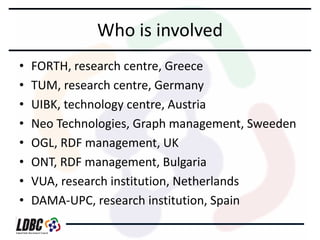
Who is involved
•
•
•
•
•
•
•
•

FORTH, research centre, Greece
TUM, research centre, Germany
UIBK, technology centre, Austria
Neo Technologies, Graph management, Sweeden
OGL, RDF management, UK
ONT, RDF management, Bulgaria
VUA, research institution, Netherlands
DAMA-UPC, research institution, Spain
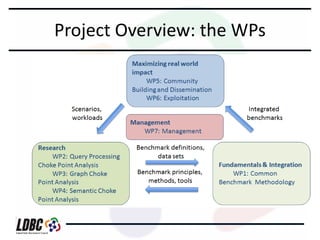
Project Overview: the WPs
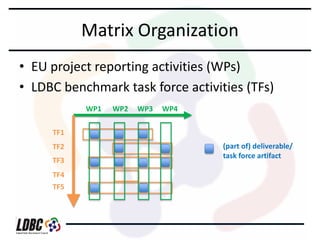
Matrix Organization
• EU project reporting activities (WPs)
• LDBC benchmark task force activities (TFs)
WP1

WP2

WP3

WP4

TF1
TF2
TF3
TF4
TF5

(part of) deliverable/
task force artifact
Task forces
• Focusses on specific benchmarking effort (i.e.
transactional, analytical, integration for RDF/GDB)
• Decides on the Use Case to be used
• Procedure:
– Designs and implements data generation (characteristics,
scale, etc.)
– Incorporates the generic methodology
– Designs specific workload
• Choke points specific for the effort
• Incorporating the needs from users
• Incorporating the opinions from industry
Technical User Community (TUC)
• It will be the driving force for LDBC:
– To help understand users needs and decide use cases
– To decide the type of problem/scenarios to be tackled,
i.e. task forces to be deployed
– To provide typical queries placed to RDF and GDBs

• First TUC meeting, Barcelona 19-20 Nov.
– Start with an on-line questionaire:
http://goo.gl/PwGtK
– The outcomes will determine important directions
Common issues
• Use case for RDF and GDBs:

• Social Network Analysis
• Semantic Publishing, specific for RDF (SP)

• Methodology:

• Audited benchmarks
• Specific rules, similar to TPC

•

Workload for RDF
–
–
–
–
–
–

Throughput, concurrency
Traversals
Reasoning
Data updates
Integration: LOD, geonames, etc.
SP: semantic annotation support,
relationship btwn ontologies and
instances, links to other content, text
and metadata.

•

Workload for GDBs

– Throughput, concurrency
– Traversals, shortest paths, pattern
matching, clustering algorithms
– Data updates, transactionality
– Update semantics (serializable/acid vs
delayed commit vs batch)
– Raw traversal speed, use of indexes
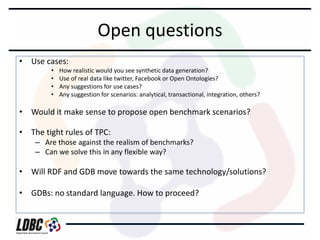
Open questions
• Use cases:
•
•
•
•

How realistic would you see synthetic data generation?
Use of real data like twitter, Facebook or Open Ontologies?
Any suggestions for use cases?
Any suggestion for scenarios: analytical, transactional, integration, others?

• Would it make sense to propose open benchmark scenarios?
• The tight rules of TPC:

– Are those against the realism of benchmarks?
– Can we solve this in any flexible way?

• Will RDF and GDB move towards the same technology/solutions?
• GDBs: no standard language. How to proceed?

GRAPH-TA 2013 - RDF and Graph benchmarking - Jose Lluis Larriba Pey

  • 1.
    RDF and Graphbenchmarking www.ldbc.eu GRAPH-TA Barcelona Feb 19, 2013 Graph-TA, Barcelona Feb 19th, 2013
  • 2.
    Agenda - Why benchmarking -Presentation of LDBC - Remarks Who is who Project overview: WP and Task Forces TUC, Technical Users Community - Benchmarking RDF and GDB - Common issues - Open questions
  • 3.
    Why benchmarking • Twomain objectives: – Allow final users to assess the performance of the software they want to buy – Push the technology to the limit to allow for progress • Main effort in DB benchmarking up to now – TPC: Transaction Processing Performance Council • Relational DBs: Transactional and DSS
  • 4.
    LDBC • Objectives: – Benchmarksfor the emerging field of RDF and Graph database management systems (GDBs) – Spur industry cooperation around benchmarks – Create LDBC foundation during 1Q 2013. – Become a technology push effort, making improvements measurable – Become the de-facto research benchmark, usable, interesting and open to inputs.
  • 5.
    Preliminary remarks • Nature: –LDBC is different from other EC projects. – The objective for LDBC is to survive after the end. • Opportunity: – Have a benchmarking effort sponsored by EC. – Focal point for the vendor community. – Showcase to the user community. • Collaboration: – LDBC should lead to great achievements and world recognition, with the help of all the community: industry, technologists and users.
  • 6.
    Who is involved • • • • • • • • FORTH,research centre, Greece TUM, research centre, Germany UIBK, technology centre, Austria Neo Technologies, Graph management, Sweeden OGL, RDF management, UK ONT, RDF management, Bulgaria VUA, research institution, Netherlands DAMA-UPC, research institution, Spain
  • 7.
  • 8.
    Matrix Organization • EUproject reporting activities (WPs) • LDBC benchmark task force activities (TFs) WP1 WP2 WP3 WP4 TF1 TF2 TF3 TF4 TF5 (part of) deliverable/ task force artifact
  • 9.
    Task forces • Focusseson specific benchmarking effort (i.e. transactional, analytical, integration for RDF/GDB) • Decides on the Use Case to be used • Procedure: – Designs and implements data generation (characteristics, scale, etc.) – Incorporates the generic methodology – Designs specific workload • Choke points specific for the effort • Incorporating the needs from users • Incorporating the opinions from industry
  • 10.
    Technical User Community(TUC) • It will be the driving force for LDBC: – To help understand users needs and decide use cases – To decide the type of problem/scenarios to be tackled, i.e. task forces to be deployed – To provide typical queries placed to RDF and GDBs • First TUC meeting, Barcelona 19-20 Nov. – Start with an on-line questionaire: http://goo.gl/PwGtK – The outcomes will determine important directions
  • 11.
    Common issues • Usecase for RDF and GDBs: • Social Network Analysis • Semantic Publishing, specific for RDF (SP) • Methodology: • Audited benchmarks • Specific rules, similar to TPC • Workload for RDF – – – – – – Throughput, concurrency Traversals Reasoning Data updates Integration: LOD, geonames, etc. SP: semantic annotation support, relationship btwn ontologies and instances, links to other content, text and metadata. • Workload for GDBs – Throughput, concurrency – Traversals, shortest paths, pattern matching, clustering algorithms – Data updates, transactionality – Update semantics (serializable/acid vs delayed commit vs batch) – Raw traversal speed, use of indexes
  • 12.
    Open questions • Usecases: • • • • How realistic would you see synthetic data generation? Use of real data like twitter, Facebook or Open Ontologies? Any suggestions for use cases? Any suggestion for scenarios: analytical, transactional, integration, others? • Would it make sense to propose open benchmark scenarios? • The tight rules of TPC: – Are those against the realism of benchmarks? – Can we solve this in any flexible way? • Will RDF and GDB move towards the same technology/solutions? • GDBs: no standard language. How to proceed?