Understand your customers deeply ... Engage with a personal touch! #ItsPersonal
Debdoot Mukherjee
Personalization & Customer Insights @
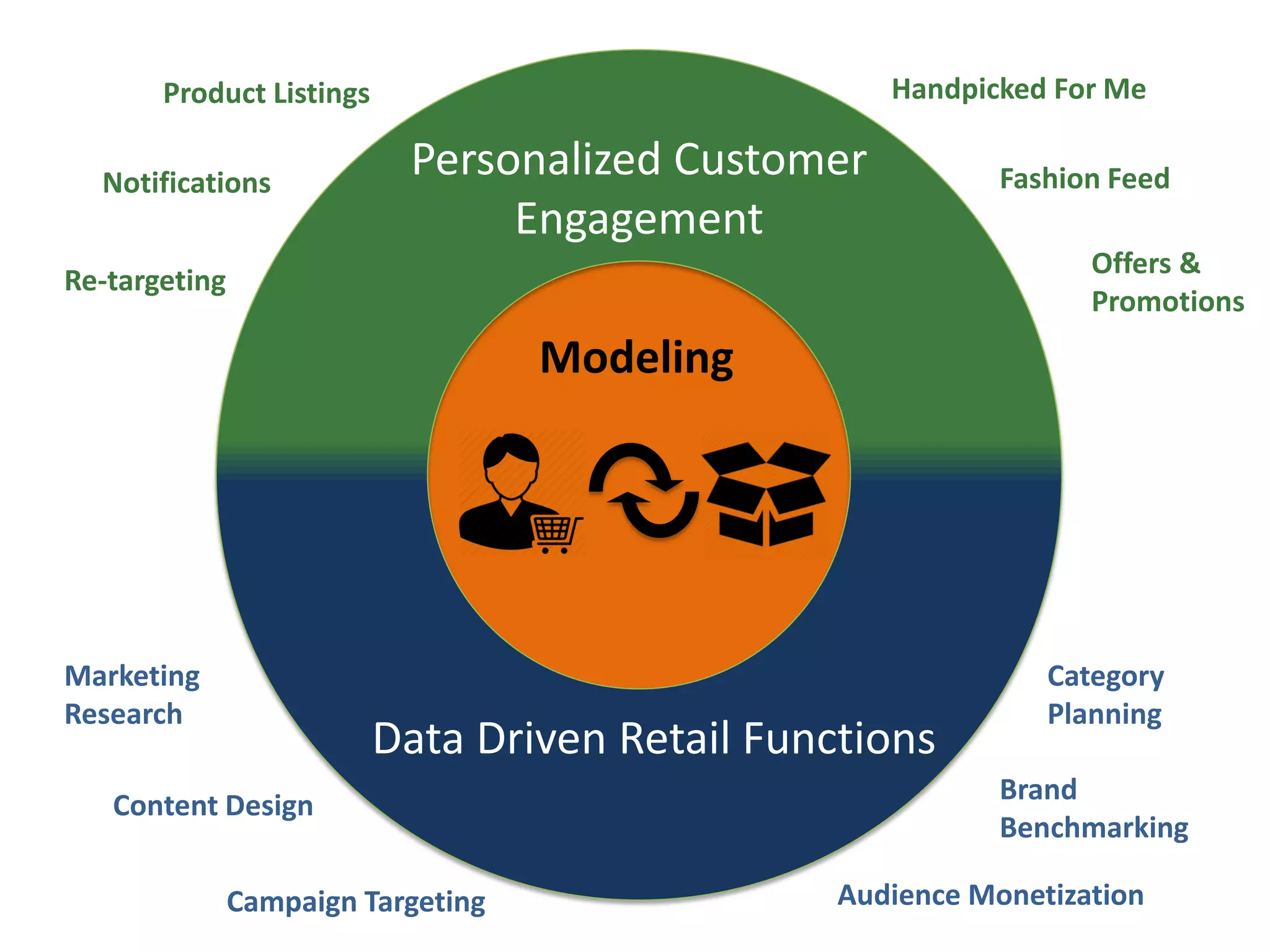
Modeling
Personalized Customer
Engagement
Data Driven Retail Functions
Product Listings Handpicked For Me
Notifications Fashion Feed
Offers &
Promotions
Re-targeting
Marketing
Research
Campaign Targeting Audience Monetization
Category
Planning
Brand
Benchmarking
Content Design
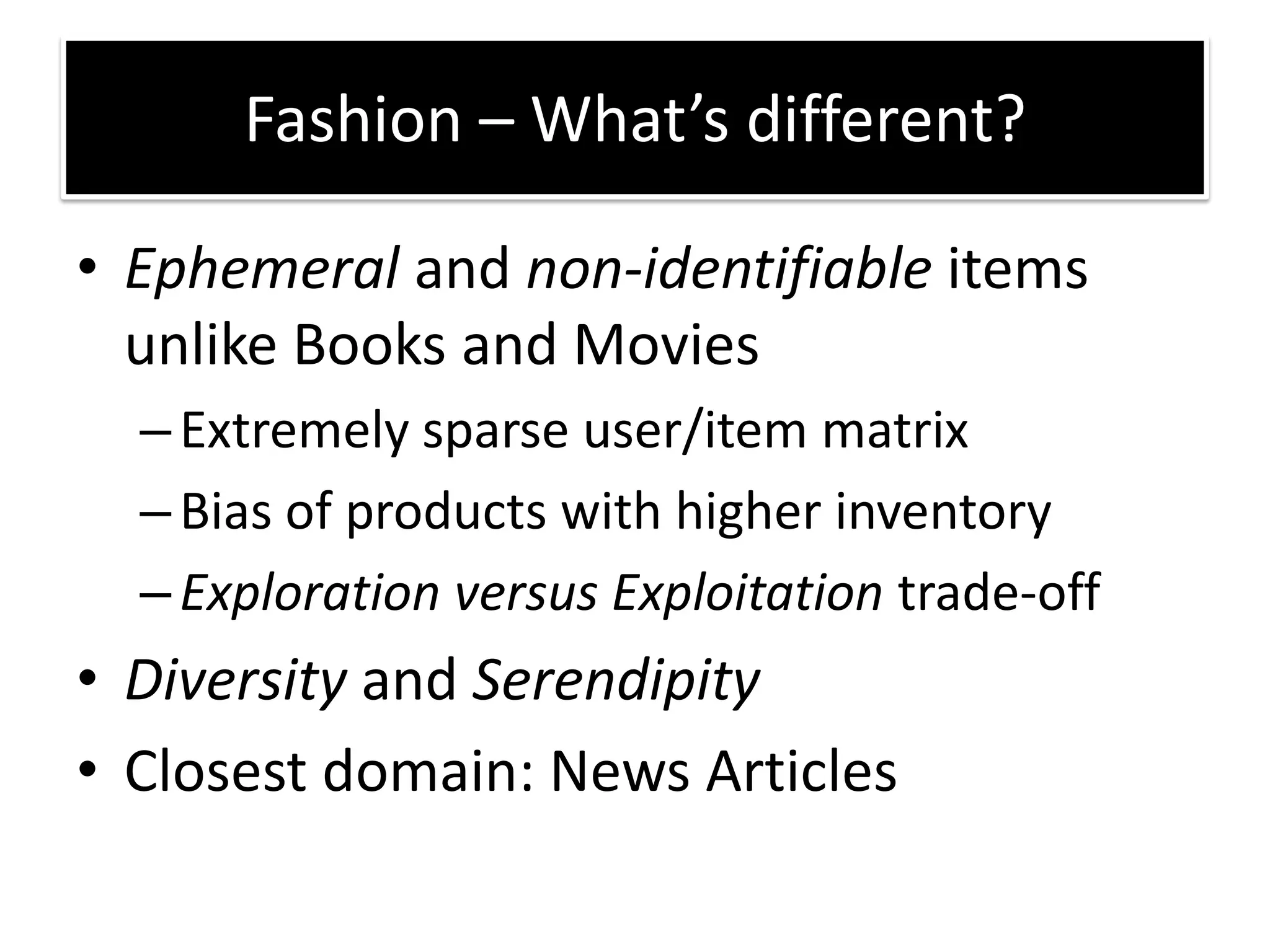
• Ephemeral and non-identifiable items
unlike Books and Movies
–Extremely sparse user/item matrix
–Bias of products with higher inventory
–Exploration versus Exploitation trade-off
• Diversity and Serendipity
• Closest domain: News Articles
Fashion – What s diffe e t?
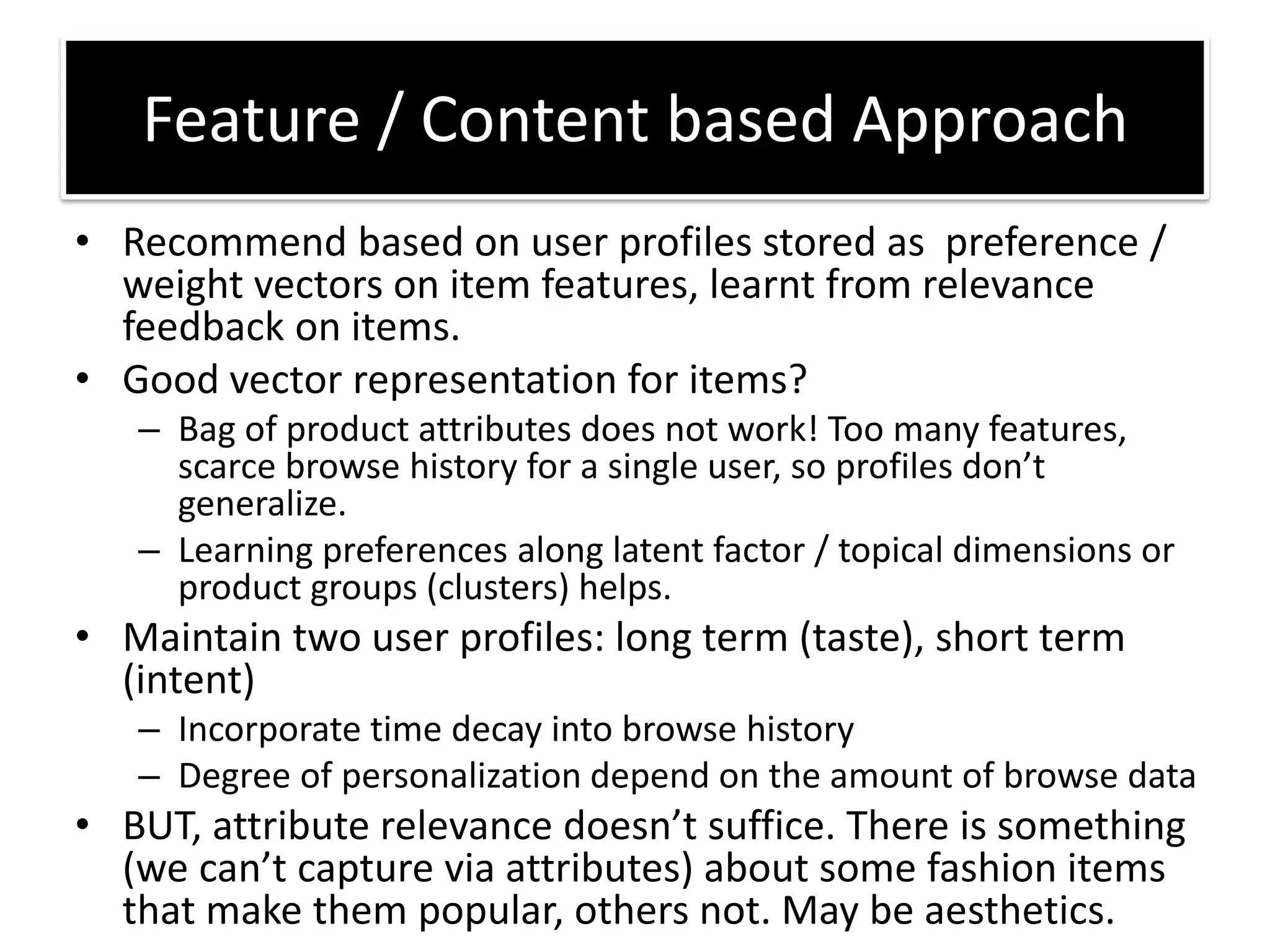
• Recommend based on user profiles stored as preference /
weight vectors on item features, learnt from relevance
feedback on items.
• Good vector representation for items?
– Bag of product attributes does not work! Too many features,
s a e o se histo y fo a si gle use , so p ofiles do t
generalize.
– Learning preferences along latent factor / topical dimensions or
product groups (clusters) helps.
• Maintain two user profiles: long term (taste), short term
(intent)
– Incorporate time decay into browse history
– Degree of personalization depend on the amount of browse data
• BUT, att i ute ele a e does t suffi e. The e is so ethi g
e a t aptu e ia att i utes a out so e fashio ite s
that make them popular, others not. May be aesthetics.
Feature / Content based Approach
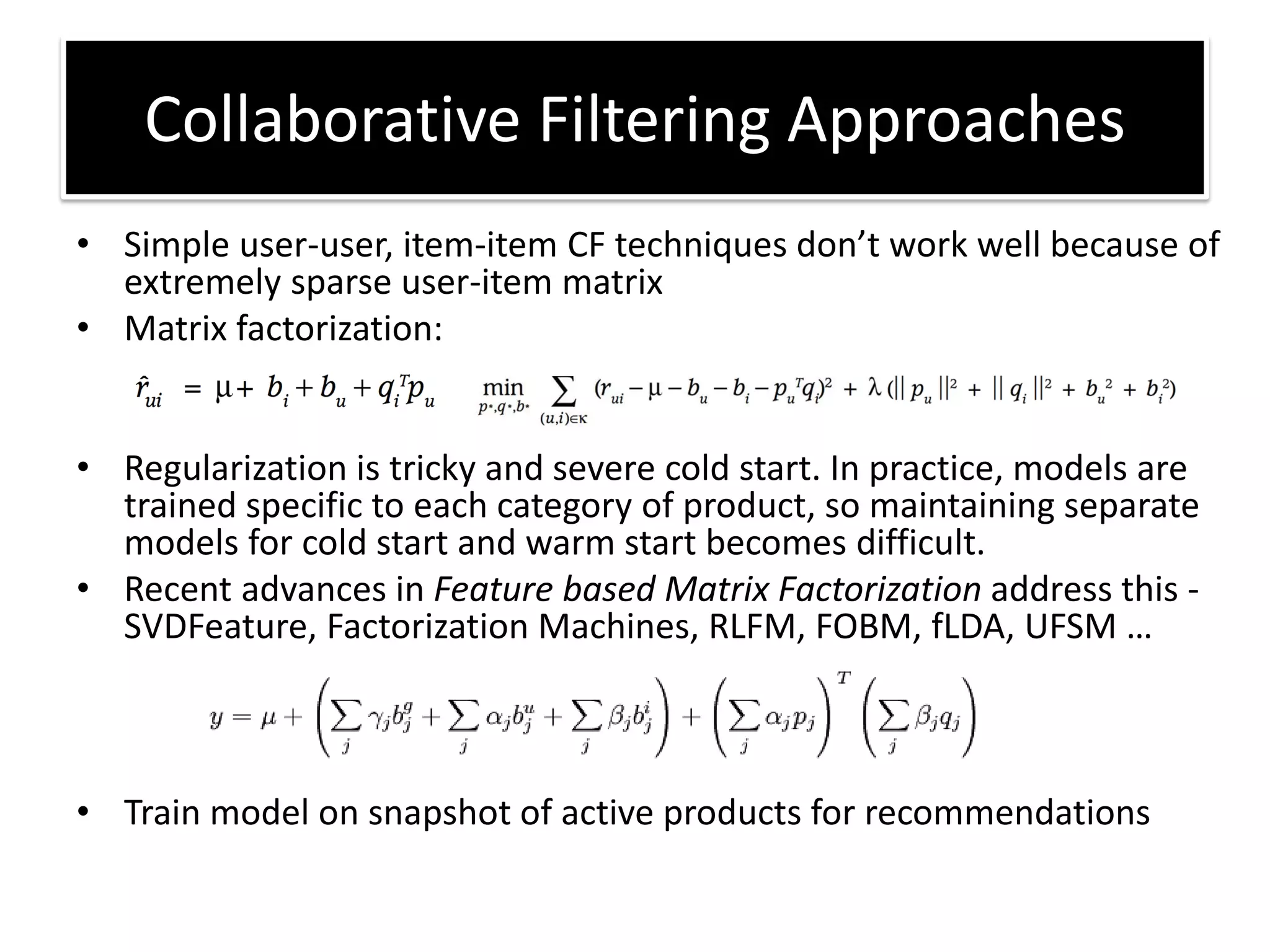
• Simple user-user, item-ite CF te h i ues do t o k ell e ause of
extremely sparse user-item matrix
• Matrix factorization:
• Regularization is tricky and severe cold start. In practice, models are
trained specific to each category of product, so maintaining separate
models for cold start and warm start becomes difficult.
• Recent advances in Feature based Matrix Factorization address this -
SVDFeature, Factorization Machines, RLFM, FOBM, fLDA, UFSM …
• Train model on snapshot of active products for recommendations
Collaborative Filtering Approaches
• A good vector representation for items would make
si ila ite s eigh o s i the e to spa e. #di e sio s
should be not very high.
• Co-browse of items in a session is (weakly) indicative of
si ila ity . “u h a sig al ei fo ed a oss a y sessio s
becomes strong.
• Inferring substitutable and complementary products –
Leskovic et al. KDD15
– Train a logistic regressor with features defined on the similarity
of item vectors represented as topics to predict whether two
products are similar. LDA using the analogy (Item Document,
Item Attribute Word)
– Core Idea: Joint training of logistic regressor and item topics by
simultaneously optimizing both topic distributions and logistic
parameters to maximize the joint likelihood of topic
memberships and product similarity.
Vector Representation for Items
• We use this analogy so that existing models for finding
representations in text / IR become applicable:
– Browse Session Document, Items Clicked Sentences, Item
Attributes Words
• Evaluate LDA, Word2Vec, GloVe …
– Yields varying levels of topical and functional similarities along
dimensions of the item vector
• “ea h fo si ila te s fo nike :
– Topical Similarity: adidas, puma, sports, dry-fit, polyeste … spo ts elated te s
– Functional Similarity: adidas, puma, fila, merrell, hrx …
– Mining interesting relationships between entities of interest viz.
brand, price band, pattern, item collection etc.
• Spherical clustering to create product groups – a better unit of
analyses than individual products.
• Create user profiles by aggregating their preferences on such item
dimensions and product groups across all browsing sessions.
Vector Representation for Items (2)
• Explore/Exploit trade off
– Popularity scoring of items (normalized for each
category / product group)
• Use Thomson Sampling in a context free bandit formulation
that assumes Gaussian reward (CTR)
• Adjust CTR with rank to formulate reward
– Contextual bandits can help in choosing the right
recommendation strategy given page and session
context
• Use of LSH to ensure diversity of
recommendations
Explore / Exploit, Diversity ..
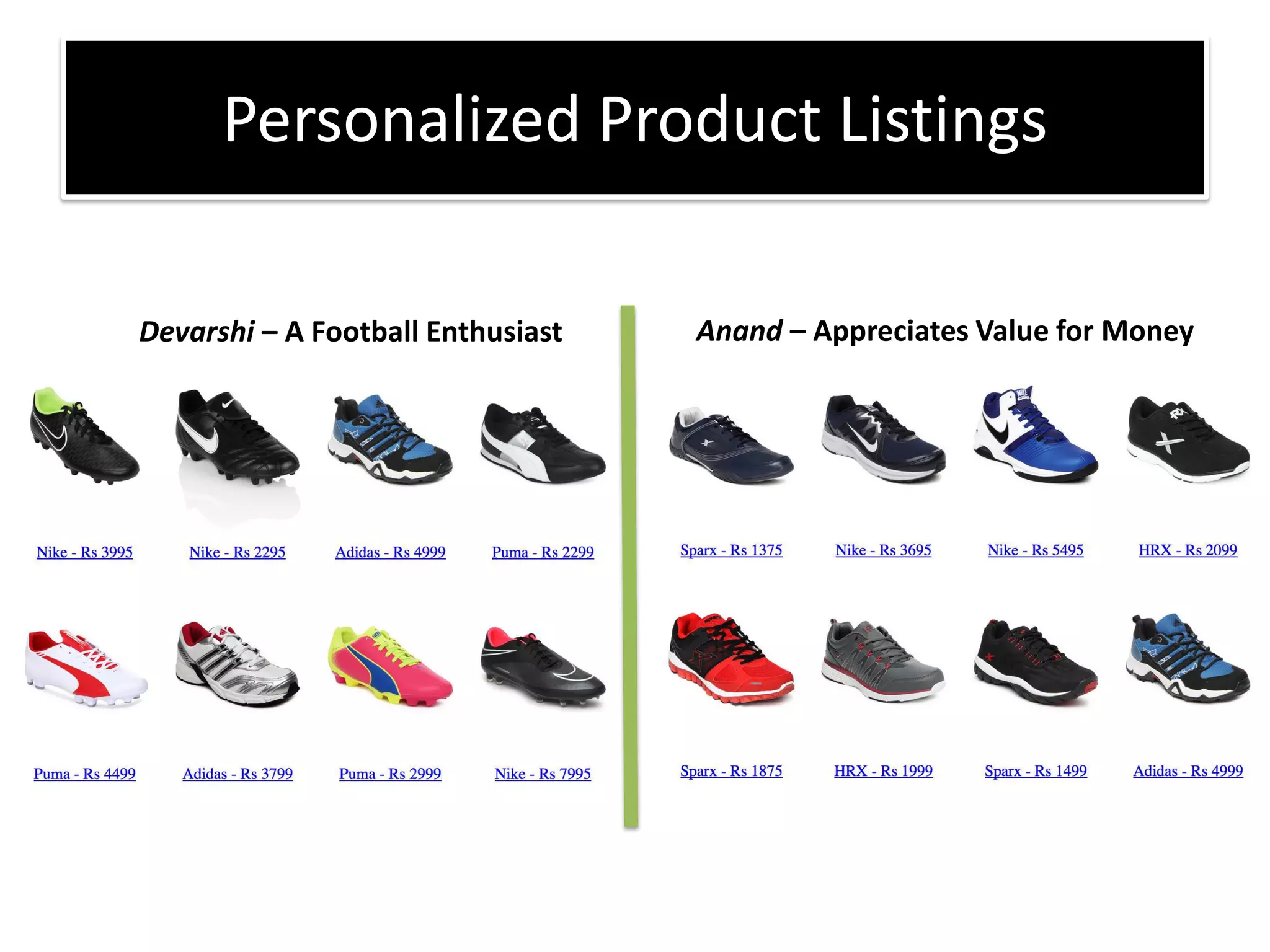
Personalized Product Listings
Devarshi – A Football Enthusiast Anand – Appreciates Value for Money
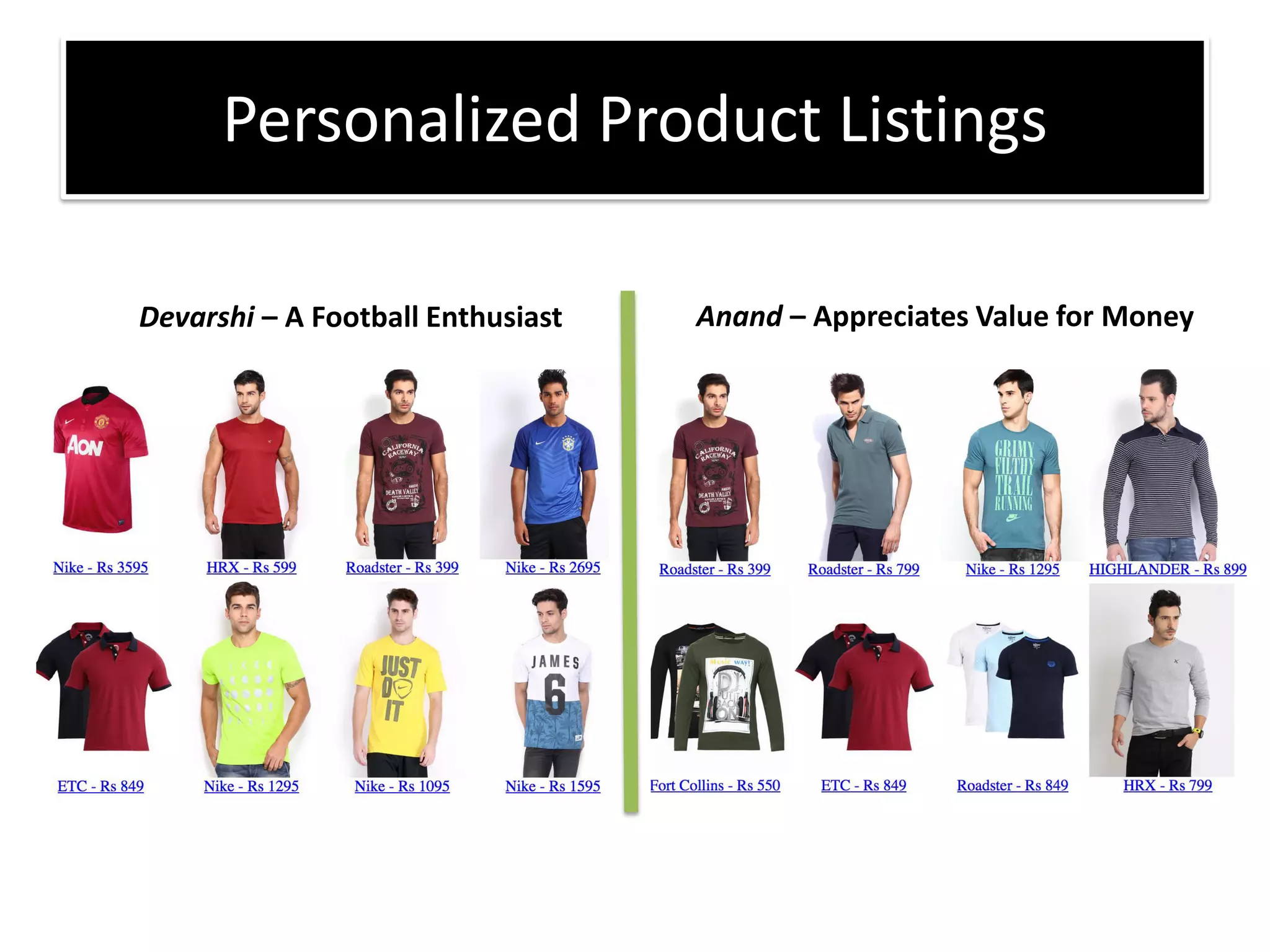
Personalized Product Listings
Devarshi – A Football Enthusiast Anand – Appreciates Value for Money
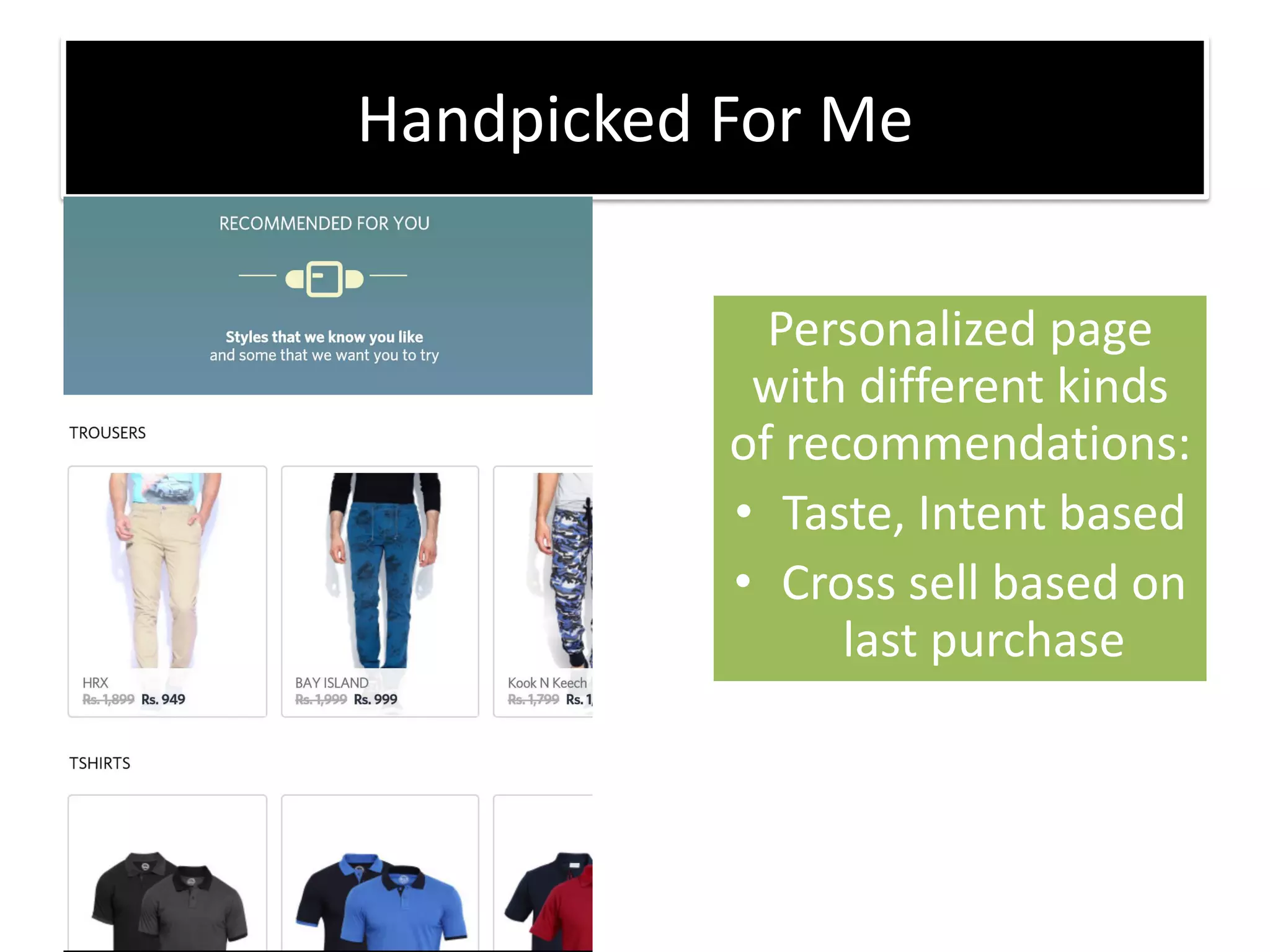
Handpicked For Me
Personalized page
with different kinds
of recommendations:
• Taste, Intent based
• Cross sell based on
last purchase
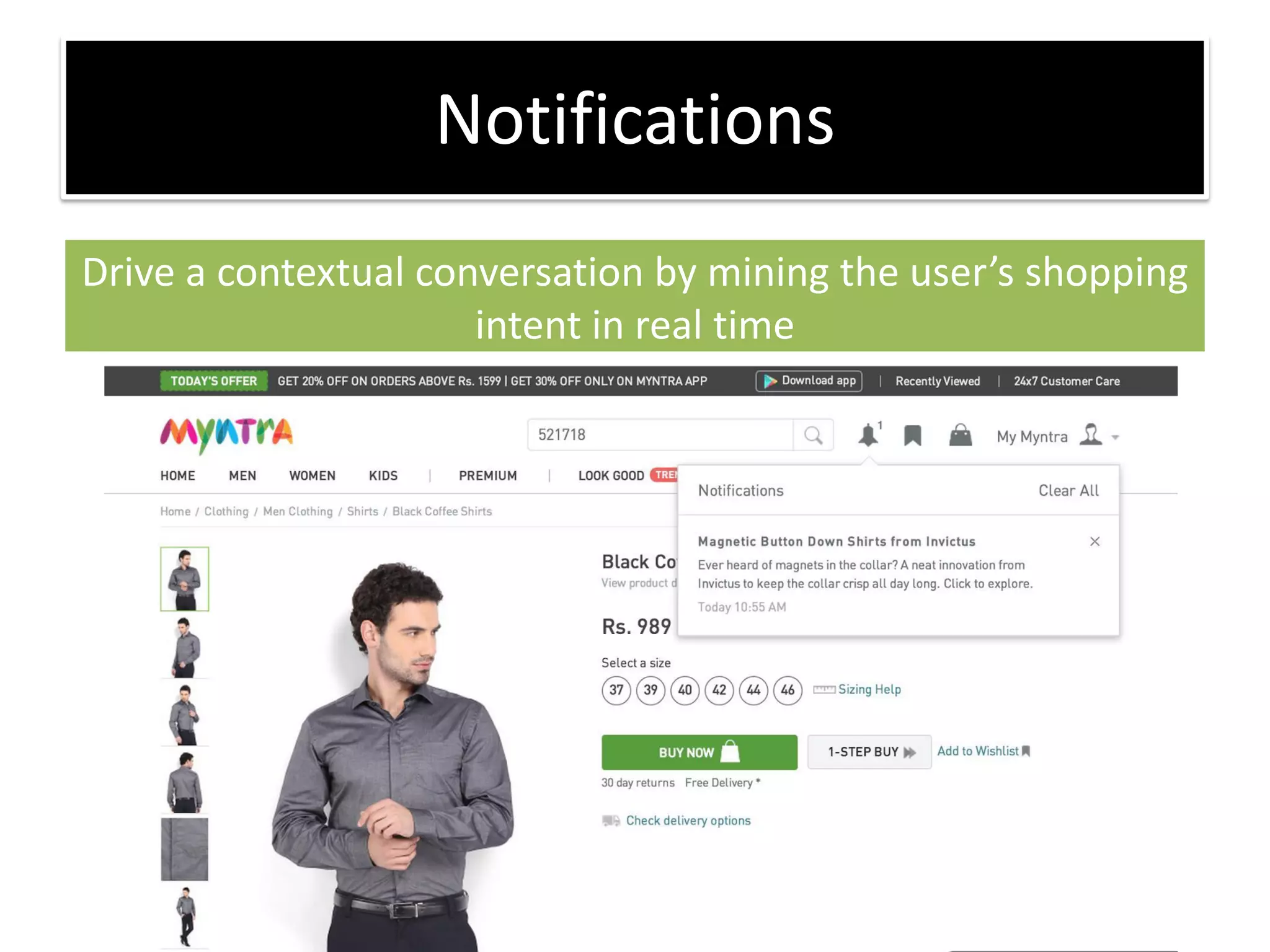
Notifications
Drive a contextual conversation y i i g the use s shoppi g
intent in real time
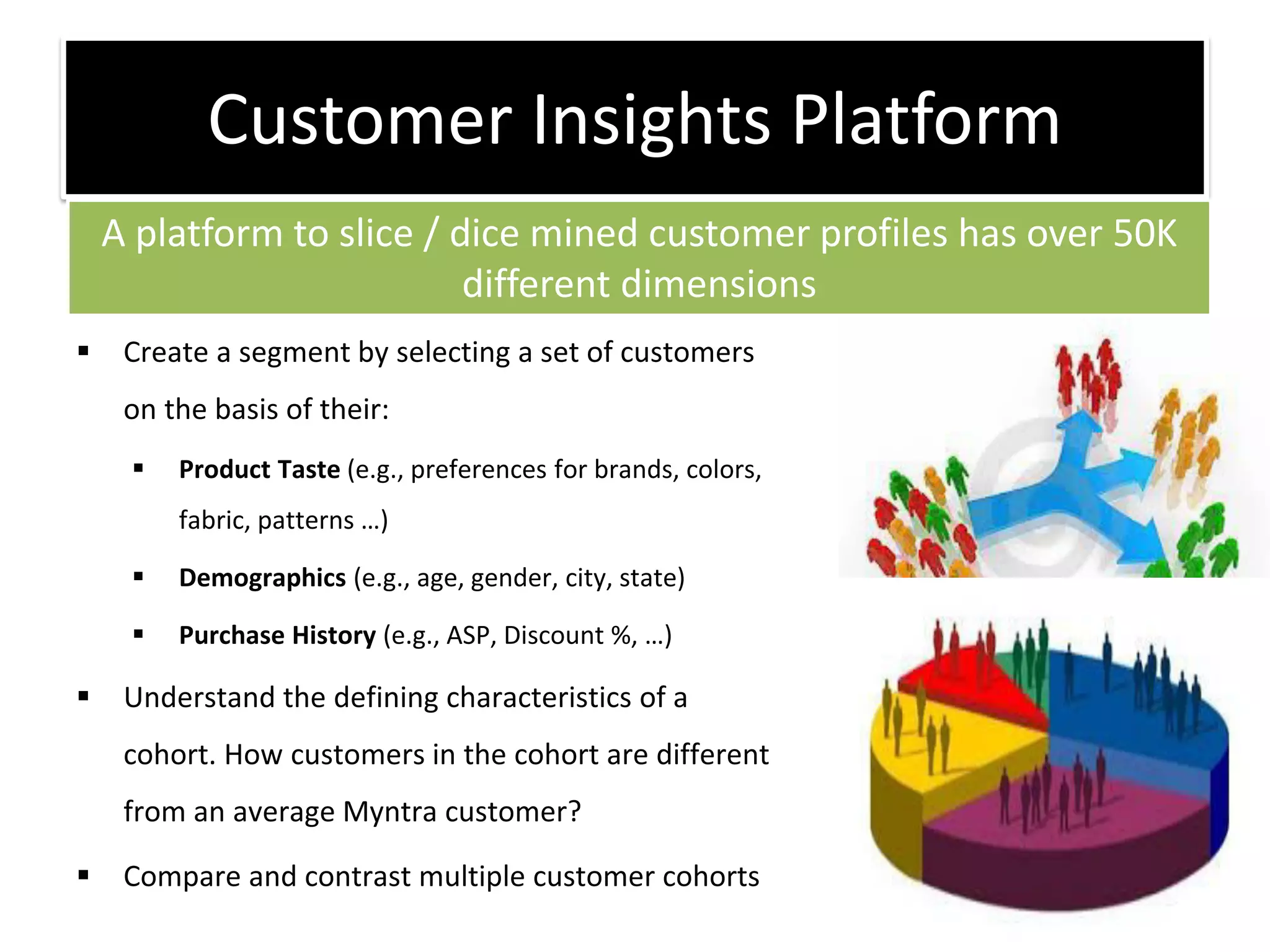
Customer Insights Platform
A platform to slice / dice mined customer profiles has over 50K
different dimensions
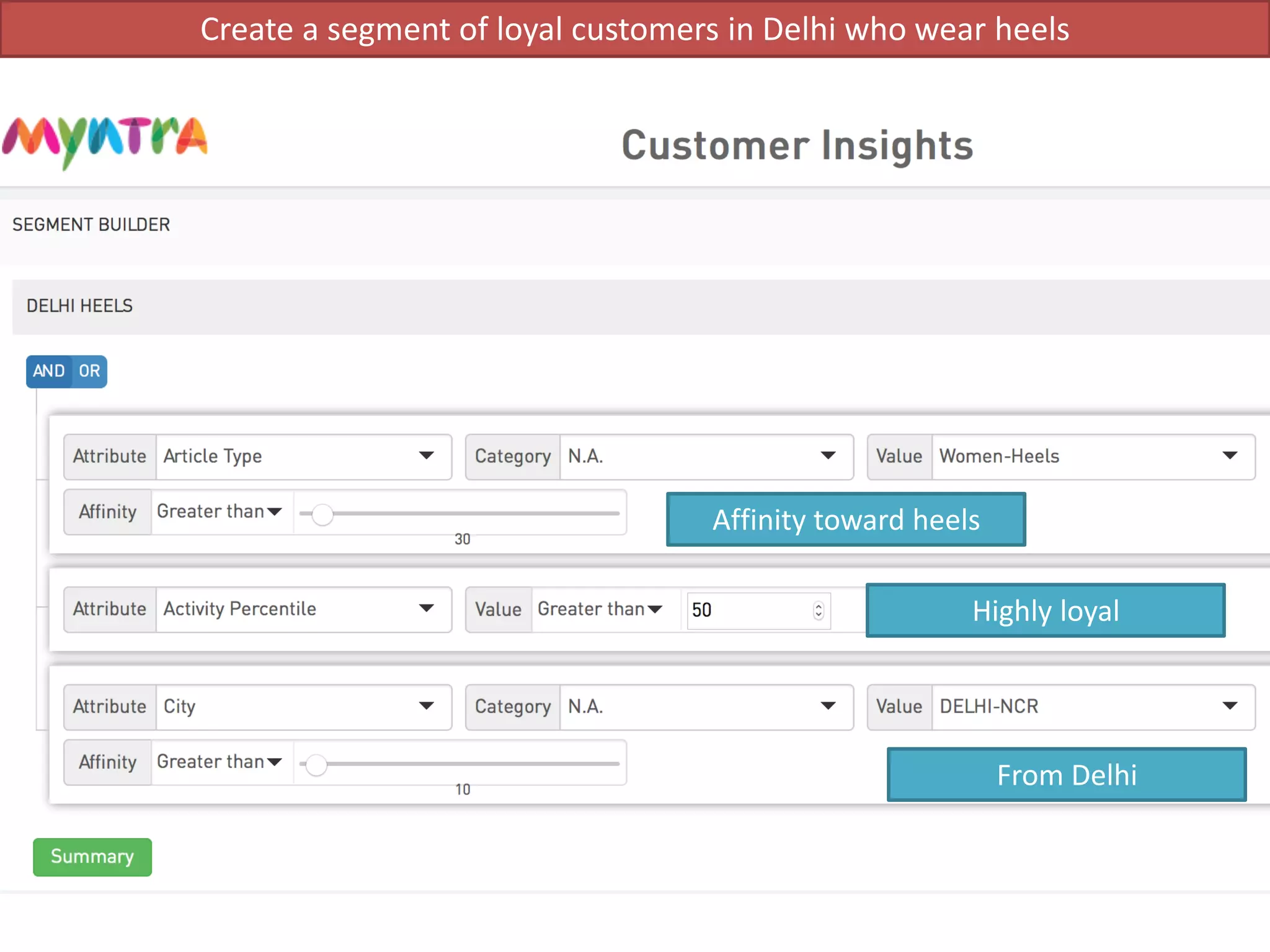
Create a segment of loyal customers in Delhi who wear heels
Affinity toward heels
Highly loyal
From Delhi
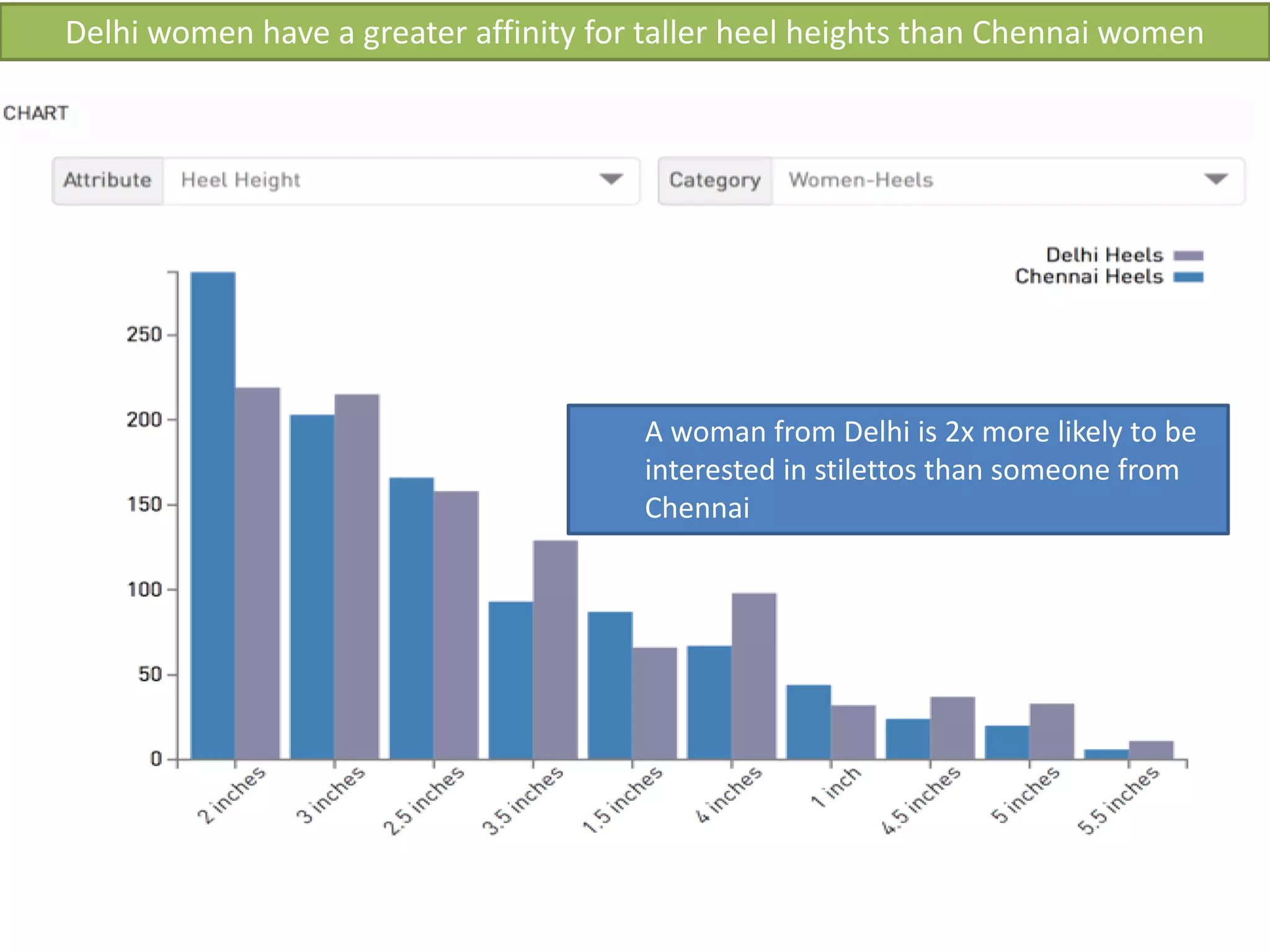
Delhi women have a greater affinity for taller heel heights than Chennai women
A woman from Delhi is 2x more likely to be
interested in stilettos than someone from
Chennai
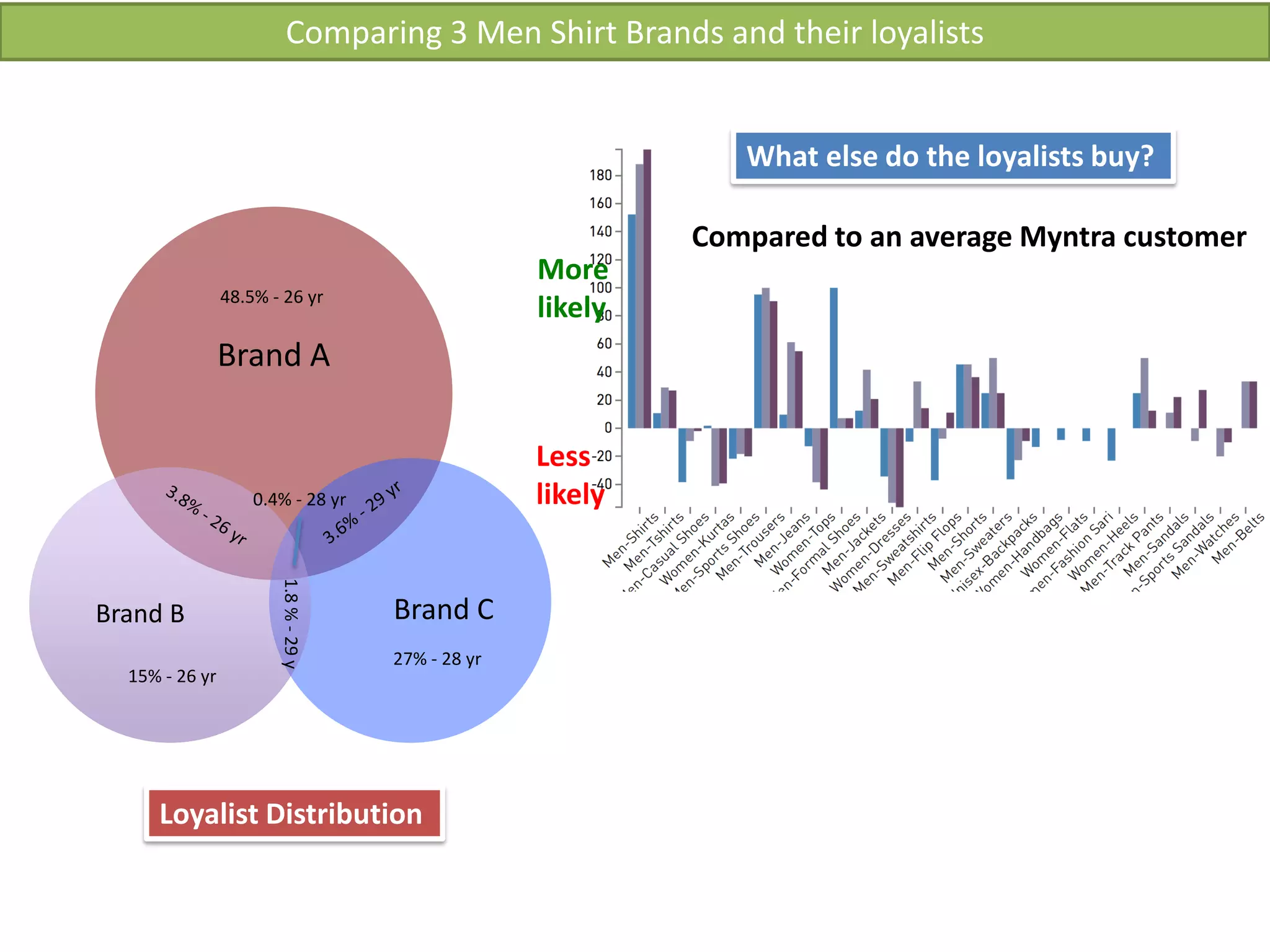
Brand A
Brand CBrand B
48.5% - 26 yr
27% - 28 yr
15% - 26 yr
1.8%-29y
Loyalist Distribution
0.4% - 28 yr
Comparing 3 Men Shirt Brands and their loyalists
Compared to an average Myntra customer
What else do the loyalists buy?
Less
likely
More
likely
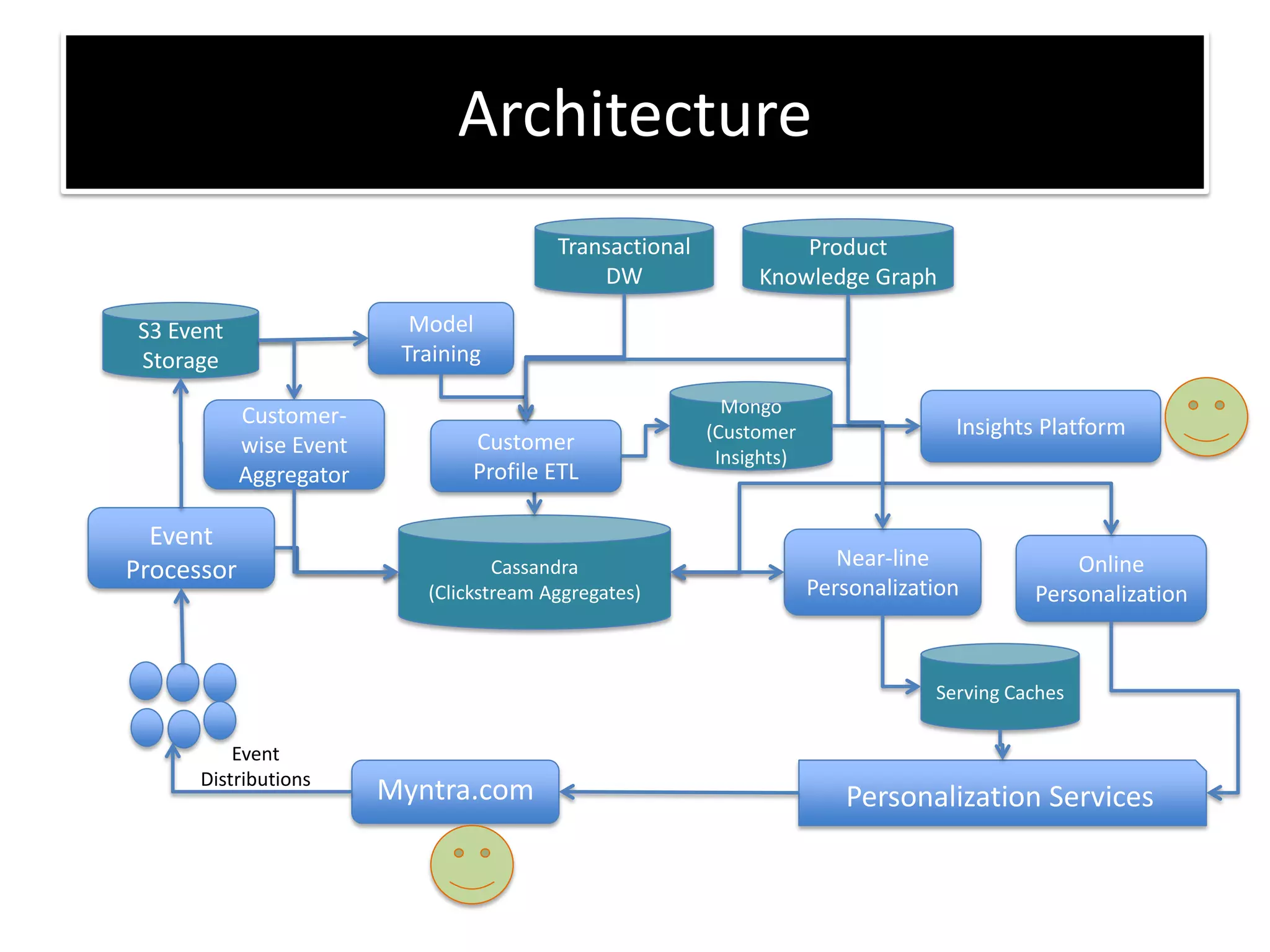
Personalization ServicesMyntra.com
Event
Distributions
Event
Processor
S3 Event
Storage
Cassandra
(Clickstream Aggregates)
Model
Training
Serving Caches
Near-line
Personalization
Online
Personalization
Customer
Profile ETL
Customer-
wise Event
Aggregator
Mongo
(Customer
Insights)
Insights Platform
Architecture
Transactional
DW
Product
Knowledge Graph
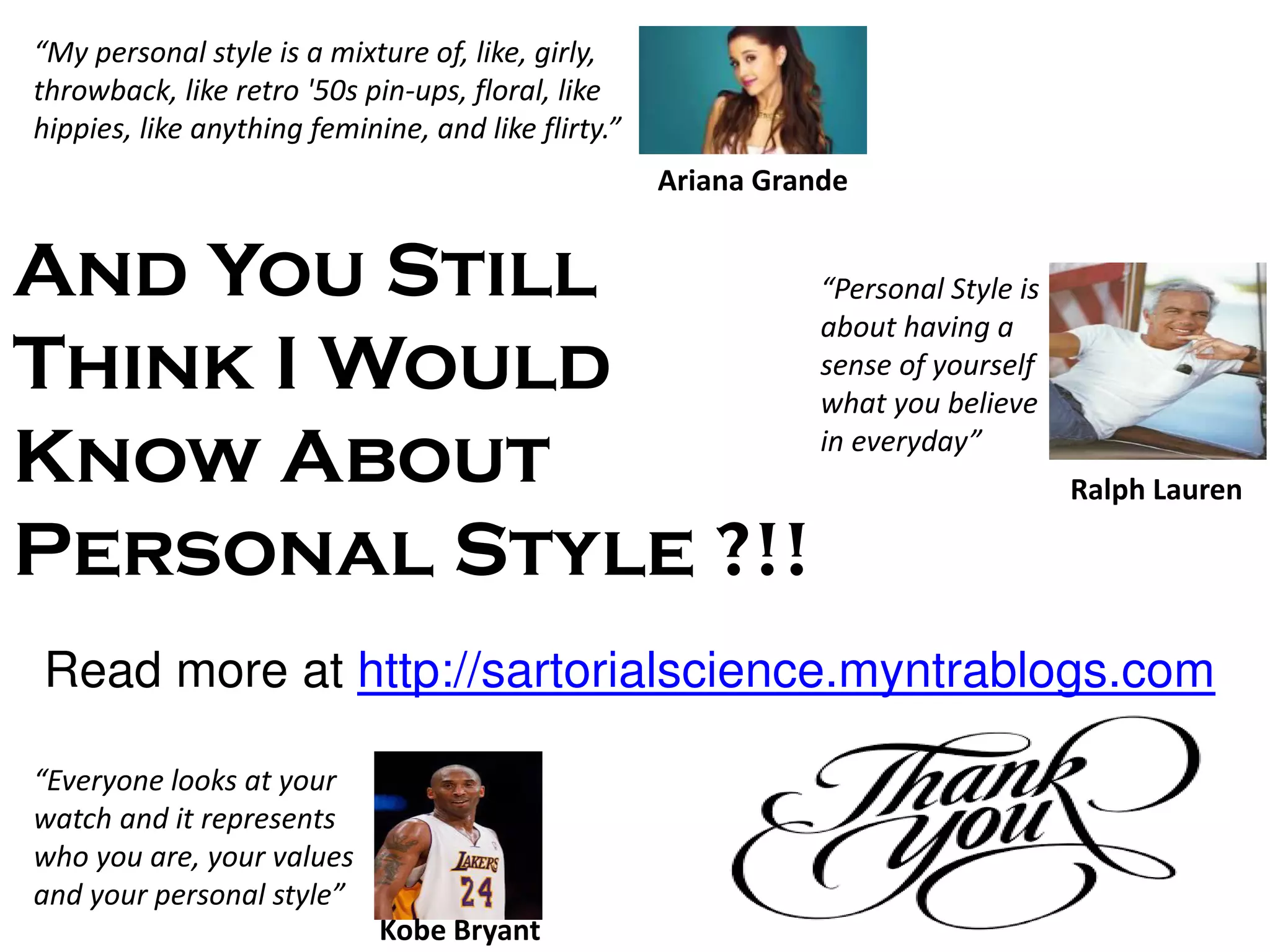
Ariana Grande
M perso al st le is a i ture of, like, girl ,
throwback, like retro '50s pin-ups, floral, like
hippies, like a thi g fe i i e, a d like flirt .
Perso al “t le is
about having a
sense of yourself
what you believe
i ever da
Ralph Lauren
Ever o e looks at your
watch and it represents
who you are, your values
and your personal st le
Kobe Bryant
And You Still
Think I Would
Know About
Personal Style ?!!
Read more at http://sartorialscience.myntrablogs.com

meetup-talk

  • 1.
    Understand your customersdeeply ... Engage with a personal touch! #ItsPersonal Debdoot Mukherjee Personalization & Customer Insights @
  • 2.
    Modeling Personalized Customer Engagement Data DrivenRetail Functions Product Listings Handpicked For Me Notifications Fashion Feed Offers & Promotions Re-targeting Marketing Research Campaign Targeting Audience Monetization Category Planning Brand Benchmarking Content Design
  • 3.
    • Ephemeral andnon-identifiable items unlike Books and Movies –Extremely sparse user/item matrix –Bias of products with higher inventory –Exploration versus Exploitation trade-off • Diversity and Serendipity • Closest domain: News Articles Fashion – What s diffe e t?
  • 4.
    • Recommend basedon user profiles stored as preference / weight vectors on item features, learnt from relevance feedback on items. • Good vector representation for items? – Bag of product attributes does not work! Too many features, s a e o se histo y fo a si gle use , so p ofiles do t generalize. – Learning preferences along latent factor / topical dimensions or product groups (clusters) helps. • Maintain two user profiles: long term (taste), short term (intent) – Incorporate time decay into browse history – Degree of personalization depend on the amount of browse data • BUT, att i ute ele a e does t suffi e. The e is so ethi g e a t aptu e ia att i utes a out so e fashio ite s that make them popular, others not. May be aesthetics. Feature / Content based Approach
  • 5.
    • Simple user-user,item-ite CF te h i ues do t o k ell e ause of extremely sparse user-item matrix • Matrix factorization: • Regularization is tricky and severe cold start. In practice, models are trained specific to each category of product, so maintaining separate models for cold start and warm start becomes difficult. • Recent advances in Feature based Matrix Factorization address this - SVDFeature, Factorization Machines, RLFM, FOBM, fLDA, UFSM … • Train model on snapshot of active products for recommendations Collaborative Filtering Approaches
  • 6.
    • A goodvector representation for items would make si ila ite s eigh o s i the e to spa e. #di e sio s should be not very high. • Co-browse of items in a session is (weakly) indicative of si ila ity . “u h a sig al ei fo ed a oss a y sessio s becomes strong. • Inferring substitutable and complementary products – Leskovic et al. KDD15 – Train a logistic regressor with features defined on the similarity of item vectors represented as topics to predict whether two products are similar. LDA using the analogy (Item Document, Item Attribute Word) – Core Idea: Joint training of logistic regressor and item topics by simultaneously optimizing both topic distributions and logistic parameters to maximize the joint likelihood of topic memberships and product similarity. Vector Representation for Items
  • 7.
    • We usethis analogy so that existing models for finding representations in text / IR become applicable: – Browse Session Document, Items Clicked Sentences, Item Attributes Words • Evaluate LDA, Word2Vec, GloVe … – Yields varying levels of topical and functional similarities along dimensions of the item vector • “ea h fo si ila te s fo nike : – Topical Similarity: adidas, puma, sports, dry-fit, polyeste … spo ts elated te s – Functional Similarity: adidas, puma, fila, merrell, hrx … – Mining interesting relationships between entities of interest viz. brand, price band, pattern, item collection etc. • Spherical clustering to create product groups – a better unit of analyses than individual products. • Create user profiles by aggregating their preferences on such item dimensions and product groups across all browsing sessions. Vector Representation for Items (2)
  • 8.
    • Explore/Exploit tradeoff – Popularity scoring of items (normalized for each category / product group) • Use Thomson Sampling in a context free bandit formulation that assumes Gaussian reward (CTR) • Adjust CTR with rank to formulate reward – Contextual bandits can help in choosing the right recommendation strategy given page and session context • Use of LSH to ensure diversity of recommendations Explore / Exploit, Diversity ..
  • 9.
    Personalized Product Listings Devarshi– A Football Enthusiast Anand – Appreciates Value for Money
  • 10.
    Personalized Product Listings Devarshi– A Football Enthusiast Anand – Appreciates Value for Money
  • 11.
    Handpicked For Me Personalizedpage with different kinds of recommendations: • Taste, Intent based • Cross sell based on last purchase
  • 12.
    Notifications Drive a contextualconversation y i i g the use s shoppi g intent in real time
  • 13.
    Customer Insights Platform Aplatform to slice / dice mined customer profiles has over 50K different dimensions
  • 14.
    Create a segmentof loyal customers in Delhi who wear heels Affinity toward heels Highly loyal From Delhi
  • 15.
    Delhi women havea greater affinity for taller heel heights than Chennai women A woman from Delhi is 2x more likely to be interested in stilettos than someone from Chennai
  • 16.
    Brand A Brand CBrandB 48.5% - 26 yr 27% - 28 yr 15% - 26 yr 1.8%-29y Loyalist Distribution 0.4% - 28 yr Comparing 3 Men Shirt Brands and their loyalists Compared to an average Myntra customer What else do the loyalists buy? Less likely More likely
  • 17.
    Personalization ServicesMyntra.com Event Distributions Event Processor S3 Event Storage Cassandra (ClickstreamAggregates) Model Training Serving Caches Near-line Personalization Online Personalization Customer Profile ETL Customer- wise Event Aggregator Mongo (Customer Insights) Insights Platform Architecture Transactional DW Product Knowledge Graph
  • 18.
    Ariana Grande M persoal st le is a i ture of, like, girl , throwback, like retro '50s pin-ups, floral, like hippies, like a thi g fe i i e, a d like flirt . Perso al “t le is about having a sense of yourself what you believe i ever da Ralph Lauren Ever o e looks at your watch and it represents who you are, your values and your personal st le Kobe Bryant And You Still Think I Would Know About Personal Style ?!! Read more at http://sartorialscience.myntrablogs.com