GNP
Graph Neural Prompting with Large Language
Models
AAAI, 2024
Yijun Tian, Huan Song, Zichen Wang et al.
Speaker: Po-Chuan Chen
Jun 4, 2024
1 / 38
GNP
Table of contents
1 Abstract
2 Introduction
3 Preliminary
4 Methodology
5 Experiments
6 Conclusion
2 / 38
GNP
Abstract
Table of contents
1 Abstract
2 Introduction
3 Preliminary
4 Methodology
5 Experiments
6 Conclusion
3 / 38
GNP
Abstract
Abstract
To reduce the limitation of the large language model, the existing
work enhances pre-trained LLMs using grounded knowledge.
For example, retrieval-augmented generation, remains an open
question, knowledge graphs (KG).
In this paper, they propose graph neural prompting (GNP), a
plug-and-play method to help pre-trained LLMs gain beneficial
knowledge from KGs.
4 / 38
GNP
Introduction
Table of contents
1 Abstract
2 Introduction
3 Preliminary
4 Methodology
5 Experiments
6 Conclusion
5 / 38
GNP
Introduction
Introduction
Knowledge graphs (KGs) store enormous facts and serve as a
systematic way of presenting knowledge [2].
Existing methods [4] have incorporated KGs with language models by
designing customized model architectures to accommodate both
textual data and KGs.
The joint training model becomes challenging due to the parameter
size of the language model.
6 / 38
GNP
Introduction
Introduction (Cont.)
A direct way to combine the benefit of KGs and the language model
feeding the KG triples1 into LLMs [1].
However, this method can introduce substantial noise since KGs might
contain various extraneous contexts.
Can we learn beneficial knowledge from KGs
and integrate them into pre-trained LLMs?
1KG triples are structured data elements consisting of a subject, predicate, and
object, representing relationships between entities in a Knowledge Graph.
7 / 38
GNP
Introduction
Graph Neural Prompting
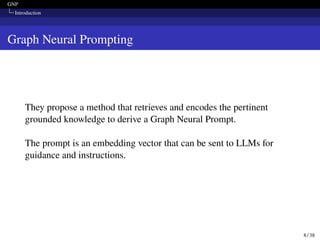
They propose a method that retrieves and encodes the pertinent
grounded knowledge to derive a Graph Neural Prompt.
The prompt is an embedding vector that can be sent to LLMs for
guidance and instructions.
8 / 38
GNP
Introduction
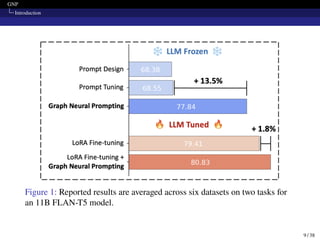
Figure 1: Reported results are averaged across six datasets on two tasks for
an 11B FLAN-T5 model.
9 / 38
GNP
Preliminary
Table of contents
1 Abstract
2 Introduction
3 Preliminary
4 Methodology
5 Experiments
6 Conclusion
10 / 38
GNP
Preliminary
Knowledge Graph
A knowledge graph is defined as G = (E, R, T).
E is the set of entities.
R is the set of relations.
T is the collection of fact tripes {(eh, r, et)} ∈ E × R × E, where
eh is the head entity, r is the relation, and et is the tail entity.
11 / 38
GNP
Preliminary
Multiple Choice Question Answering
Given a question Q, a set of answer options A = {ak}K
k=1, and an
optional context C. The ground truth label y ∈ A is the correct answer.
We need to design a model FΘ that selects the best option to answer
the question. In addition, this paper uses knowledge graph G to
provide external knowledge and help the model to answer the question.
12 / 38
GNP
Methodology
Table of contents I
1 Abstract
2 Introduction
3 Preliminary
4 Methodology
Prompting LLMs for Question Answering
Subgraph Retrieval
Graph Neural Prompting
5 Experiments
13 / 38
GNP
Methodology
Table of contents II
6 Conclusion
14 / 38
GNP
Methodology
Prompting LLMs for Question Answering
Below are the steps:
1 Tokenizing the concatenation of C, Q, A into a sequence of input
text tokens X.
2 Designing a series of prompt tokens P, pretending it to the input
tokens X. Using it as input for the LLM model to generate
prediction y′ = f ([P, X]).
3 The model can be trained for downstream task adaptation using
standard maximum likelihood loss using teacher forcing and a
cross-entropy loss Lllm = − log p(y | X, Θ).
15 / 38
GNP
Methodology
Prompting LLMs for Question Answering
Prompting LLMs for Question Answering (Cont.)
This paper provides a prompt method not using text, but structural and
factual information contained in the knowledge graph G into a soft
prompt.
They concatenate the soft prompt with the token embeddings of X.
16 / 38
GNP
Methodology
Subgraph Retrieval
Subgraph Retrieval
They retrieve subgraphs of G that contain the relevant entities to the
token in X.
Based on corresponding context C and question Q, each answer
option ak. They find a set of matched entities Ematch via entity linking
to match tokens in X to the entity in G.
After that, they retrieve a subgraph G′ by using Ematch with their
two-hop neighbors and the relations that connect them.
17 / 38
GNP
Methodology
Graph Neural Prompting
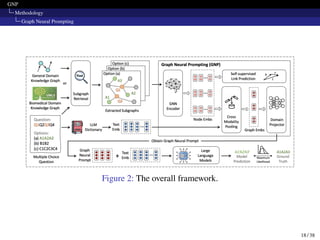
Figure 2: The overall framework.
18 / 38
GNP
Methodology
Graph Neural Prompting
GNP’s Module
1 Graph Neural Network Encoder
2 Cross-modality pooling
3 Domain Projector
4 Self-supervised Link Prediction
19 / 38
GNP
Methodology
Graph Neural Prompting
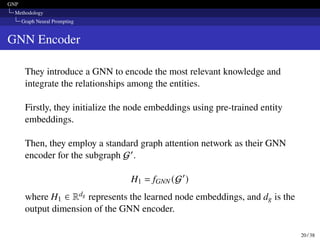
GNN Encoder
They introduce a GNN to encode the most relevant knowledge and
integrate the relationships among the entities.
Firstly, they initialize the node embeddings using pre-trained entity
embeddings.
Then, they employ a standard graph attention network as their GNN
encoder for the subgraph G′.
H1 = fGNN (G′
)
where H1 ∈ Rdg represents the learned node embeddings, and dg is the
output dimension of the GNN encoder.
20 / 38
GNP
Methodology
Graph Neural Prompting
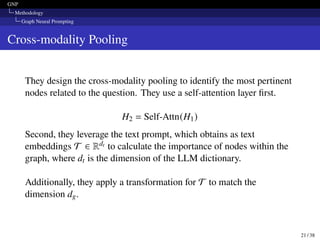
Cross-modality Pooling
They design the cross-modality pooling to identify the most pertinent
nodes related to the question. They use a self-attention layer first.
H2 = Self-Attn(H1)
Second, they leverage the text prompt, which obtains as text
embeddings T ∈ Rdt to calculate the importance of nodes within the
graph, where dt is the dimension of the LLM dictionary.
Additionally, they apply a transformation for T to match the
dimension dg.
21 / 38
GNP
Methodology
Graph Neural Prompting
Cross-modality Pooling (Cont.)
Then, they calculate the cross-modality attention using H2 and T′.
H3 = softmax[H2 · (T′
)T
/
√︁
dg] · T ′
where T′ = FFN1(𝜎(FFN2(T))), 𝜎 is the GELU activation function.
Finally, they generate graph-level embedding by average pooling the
node embeddings H3 in G′.
H4 = POOL(H3)
22 / 38
GNP
Methodology
Graph Neural Prompting
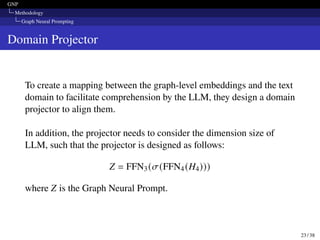
Domain Projector
To create a mapping between the graph-level embeddings and the text
domain to facilitate comprehension by the LLM, they design a domain
projector to align them.
In addition, the projector needs to consider the dimension size of
LLM, such that the projector is designed as follows:
Z = FFN3(𝜎(FFN4(H4)))
where Z is the Graph Neural Prompt.
23 / 38
GNP
Methodology
Graph Neural Prompting
Self-supervised Link Prediction
In this section, they design an objective function to enable the model
to learn and adapt to the target dataset.
They mask some edges from G′ and enforce the model to predict
them, which the set of masked-out edges as Emask ⊆ E.
They adopt a widely used knowledge graph embedding method
DistMult [3] to map the entity embeddings and relation in the KG to
vectors, h, r, t, where entity from H3.
24 / 38
GNP
Methodology
Graph Neural Prompting
Self-supervised Link Prediction (Cont.)
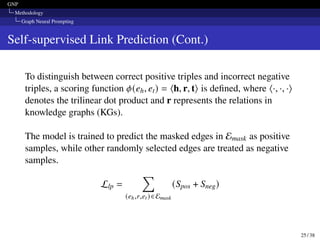
To distinguish between correct positive triples and incorrect negative
triples, a scoring function 𝜙(eh, et) = ⟨h, r, t⟩ is defined, where ⟨·, ·, ·⟩
denotes the trilinear dot product and r represents the relations in
knowledge graphs (KGs).
The model is trained to predict the masked edges in Emask as positive
samples, while other randomly selected edges are treated as negative
samples.
Llp =
∑︁
(eh,r,et )∈Emask
(Spos + Sneg)
25 / 38
GNP
Methodology
Graph Neural Prompting
Self-supervised Link Prediction (Cont.)
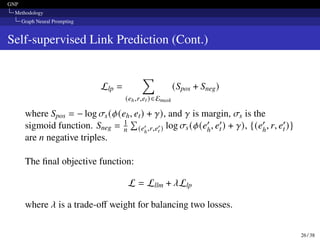
Llp =
∑︁
(eh,r,et )∈Emask
(Spos + Sneg)
where Spos = − log 𝜎s(𝜙(eh, et) + 𝛾), and 𝛾 is margin, 𝜎s is the
sigmoid function. Sneg = 1
n
Í
(e′
h
,r,e′
t ) log 𝜎s(𝜙(e′
h, e′
t) + 𝛾), {(e′
h, r, e′
t)}
are n negative triples.
The final objective function:
L = Lllm + 𝜆Llp
where 𝜆 is a trade-off weight for balancing two losses.
26 / 38
GNP
Experiments
Table of contents
1 Abstract
2 Introduction
3 Preliminary
4 Methodology
5 Experiments
6 Conclusion
27 / 38
GNP
Experiments
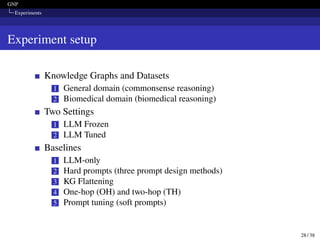
Experiment setup
Knowledge Graphs and Datasets
1 General domain (commonsense reasoning)
2 Biomedical domain (biomedical reasoning)
Two Settings
1 LLM Frozen
2 LLM Tuned
Baselines
1 LLM-only
2 Hard prompts (three prompt design methods)
3 KG Flattening
4 One-hop (OH) and two-hop (TH)
5 Prompt tuning (soft prompts)
28 / 38
GNP
Experiments
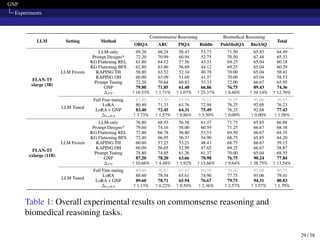
Table 1: Overall experimental results on commonsense reasoning and
biomedical reasoning tasks.
29 / 38
GNP
Experiments
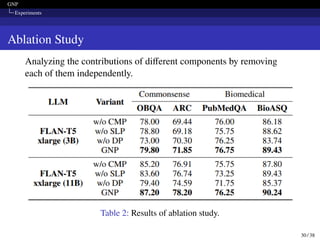
Ablation Study
Analyzing the contributions of different components by removing
each of them independently.
Table 2: Results of ablation study.
30 / 38
GNP
Experiments
Model Design Comparison
For prompt tuning, they use dataset-level prompt (DLP). For modeling
relations, they use Relational GNN (RGNN) [5].
Table 3: Results of integrating different model designs.
31 / 38
GNP
Experiments
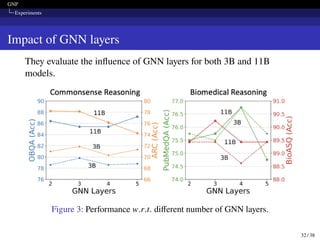
Impact of GNN layers
They evaluate the influence of GNN layers for both 3B and 11B
models.
Figure 3: Performance w.r.t. different number of GNN layers.
32 / 38
GNP
Experiments
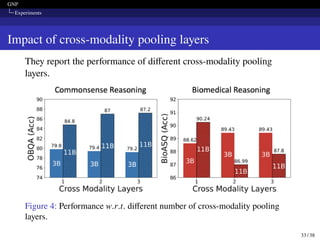
Impact of cross-modality pooling layers
They report the performance of different cross-modality pooling
layers.
Figure 4: Performance w.r.t. different number of cross-modality pooling
layers.
33 / 38
GNP
Experiments
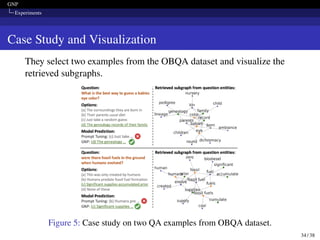
Case Study and Visualization
They select two examples from the OBQA dataset and visualize the
retrieved subgraphs.
Figure 5: Case study on two QA examples from OBQA dataset.
34 / 38
GNP
Conclusion
Table of contents
1 Abstract
2 Introduction
3 Preliminary
4 Methodology
5 Experiments
6 Conclusion
35 / 38
GNP
Conclusion
Conclusion
They propose Graph Neural Prompting (GNP), a novel plug-and-play
method to assist pre-trained LLMs in learning beneficial knowledge
from KGs.
36 / 38
GNP
Conclusion
References I
[1] Jinheon Baek, Alham Fikri Aji, et al. “Knowledge-Augmented
Language Model Prompting for Zero-Shot Knowledge Graph
Question Answering”. In: Proceedings of the 1st Workshop on
Natural Language Reasoning and Structured Explanations
(NLRSE). Association for Computational Linguistics, 2023,
pp. 78–106.
[2] Shaoxiong Ji, Shirui Pan, et al. “A Survey on Knowledge
Graphs: Representation, Acquisition, and Applications”. In:
IEEE Transactions on Neural Networks and Learning Systems
(2022), pp. 494–514.
37 / 38
GNP
Conclusion
References II
[3] Bishan Yang, Scott Wen-tau Yih, et al. “Embedding Entities and
Relations for Learning and Inference in Knowledge Bases”. In:
Proceedings of the International Conference on Learning
Representations (ICLR) 2015. 2015.
[4] Michihiro Yasunaga, Antoine Bosselut, et al. “Deep
Bidirectional Language-Knowledge Graph Pretraining”. In:
Advances in Neural Information Processing Systems. 2022,
pp. 37309–37323.
[5] Xikun Zhang et al. “GreaseLM: Graph REASoning Enhanced
Language Models”. In: International Conference on Learning
Representations. 2021.
38 / 38

Graph Neural Prompting with Large Language Models.pdf

  • 1.
    GNP Graph Neural Promptingwith Large Language Models AAAI, 2024 Yijun Tian, Huan Song, Zichen Wang et al. Speaker: Po-Chuan Chen Jun 4, 2024 1 / 38
  • 2.
    GNP Table of contents 1Abstract 2 Introduction 3 Preliminary 4 Methodology 5 Experiments 6 Conclusion 2 / 38
  • 3.
    GNP Abstract Table of contents 1Abstract 2 Introduction 3 Preliminary 4 Methodology 5 Experiments 6 Conclusion 3 / 38
  • 4.
    GNP Abstract Abstract To reduce thelimitation of the large language model, the existing work enhances pre-trained LLMs using grounded knowledge. For example, retrieval-augmented generation, remains an open question, knowledge graphs (KG). In this paper, they propose graph neural prompting (GNP), a plug-and-play method to help pre-trained LLMs gain beneficial knowledge from KGs. 4 / 38
  • 5.
    GNP Introduction Table of contents 1Abstract 2 Introduction 3 Preliminary 4 Methodology 5 Experiments 6 Conclusion 5 / 38
  • 6.
    GNP Introduction Introduction Knowledge graphs (KGs)store enormous facts and serve as a systematic way of presenting knowledge [2]. Existing methods [4] have incorporated KGs with language models by designing customized model architectures to accommodate both textual data and KGs. The joint training model becomes challenging due to the parameter size of the language model. 6 / 38
  • 7.
    GNP Introduction Introduction (Cont.) A directway to combine the benefit of KGs and the language model feeding the KG triples1 into LLMs [1]. However, this method can introduce substantial noise since KGs might contain various extraneous contexts. Can we learn beneficial knowledge from KGs and integrate them into pre-trained LLMs? 1KG triples are structured data elements consisting of a subject, predicate, and object, representing relationships between entities in a Knowledge Graph. 7 / 38
  • 8.
    GNP Introduction Graph Neural Prompting Theypropose a method that retrieves and encodes the pertinent grounded knowledge to derive a Graph Neural Prompt. The prompt is an embedding vector that can be sent to LLMs for guidance and instructions. 8 / 38
  • 9.
    GNP Introduction Figure 1: Reportedresults are averaged across six datasets on two tasks for an 11B FLAN-T5 model. 9 / 38
  • 10.
    GNP Preliminary Table of contents 1Abstract 2 Introduction 3 Preliminary 4 Methodology 5 Experiments 6 Conclusion 10 / 38
  • 11.
    GNP Preliminary Knowledge Graph A knowledgegraph is defined as G = (E, R, T). E is the set of entities. R is the set of relations. T is the collection of fact tripes {(eh, r, et)} ∈ E × R × E, where eh is the head entity, r is the relation, and et is the tail entity. 11 / 38
  • 12.
    GNP Preliminary Multiple Choice QuestionAnswering Given a question Q, a set of answer options A = {ak}K k=1, and an optional context C. The ground truth label y ∈ A is the correct answer. We need to design a model FΘ that selects the best option to answer the question. In addition, this paper uses knowledge graph G to provide external knowledge and help the model to answer the question. 12 / 38
  • 13.
    GNP Methodology Table of contentsI 1 Abstract 2 Introduction 3 Preliminary 4 Methodology Prompting LLMs for Question Answering Subgraph Retrieval Graph Neural Prompting 5 Experiments 13 / 38
  • 14.
    GNP Methodology Table of contentsII 6 Conclusion 14 / 38
  • 15.
    GNP Methodology Prompting LLMs forQuestion Answering Prompting LLMs for Question Answering Below are the steps: 1 Tokenizing the concatenation of C, Q, A into a sequence of input text tokens X. 2 Designing a series of prompt tokens P, pretending it to the input tokens X. Using it as input for the LLM model to generate prediction y′ = f ([P, X]). 3 The model can be trained for downstream task adaptation using standard maximum likelihood loss using teacher forcing and a cross-entropy loss Lllm = − log p(y | X, Θ). 15 / 38
  • 16.
    GNP Methodology Prompting LLMs forQuestion Answering Prompting LLMs for Question Answering (Cont.) This paper provides a prompt method not using text, but structural and factual information contained in the knowledge graph G into a soft prompt. They concatenate the soft prompt with the token embeddings of X. 16 / 38
  • 17.
    GNP Methodology Subgraph Retrieval Subgraph Retrieval Theyretrieve subgraphs of G that contain the relevant entities to the token in X. Based on corresponding context C and question Q, each answer option ak. They find a set of matched entities Ematch via entity linking to match tokens in X to the entity in G. After that, they retrieve a subgraph G′ by using Ematch with their two-hop neighbors and the relations that connect them. 17 / 38
  • 18.
    GNP Methodology Graph Neural Prompting Figure2: The overall framework. 18 / 38
  • 19.
    GNP Methodology Graph Neural Prompting GNP’sModule 1 Graph Neural Network Encoder 2 Cross-modality pooling 3 Domain Projector 4 Self-supervised Link Prediction 19 / 38
  • 20.
    GNP Methodology Graph Neural Prompting GNNEncoder They introduce a GNN to encode the most relevant knowledge and integrate the relationships among the entities. Firstly, they initialize the node embeddings using pre-trained entity embeddings. Then, they employ a standard graph attention network as their GNN encoder for the subgraph G′. H1 = fGNN (G′ ) where H1 ∈ Rdg represents the learned node embeddings, and dg is the output dimension of the GNN encoder. 20 / 38
  • 21.
    GNP Methodology Graph Neural Prompting Cross-modalityPooling They design the cross-modality pooling to identify the most pertinent nodes related to the question. They use a self-attention layer first. H2 = Self-Attn(H1) Second, they leverage the text prompt, which obtains as text embeddings T ∈ Rdt to calculate the importance of nodes within the graph, where dt is the dimension of the LLM dictionary. Additionally, they apply a transformation for T to match the dimension dg. 21 / 38
  • 22.
    GNP Methodology Graph Neural Prompting Cross-modalityPooling (Cont.) Then, they calculate the cross-modality attention using H2 and T′. H3 = softmax[H2 · (T′ )T / √︁ dg] · T ′ where T′ = FFN1(𝜎(FFN2(T))), 𝜎 is the GELU activation function. Finally, they generate graph-level embedding by average pooling the node embeddings H3 in G′. H4 = POOL(H3) 22 / 38
  • 23.
    GNP Methodology Graph Neural Prompting DomainProjector To create a mapping between the graph-level embeddings and the text domain to facilitate comprehension by the LLM, they design a domain projector to align them. In addition, the projector needs to consider the dimension size of LLM, such that the projector is designed as follows: Z = FFN3(𝜎(FFN4(H4))) where Z is the Graph Neural Prompt. 23 / 38
  • 24.
    GNP Methodology Graph Neural Prompting Self-supervisedLink Prediction In this section, they design an objective function to enable the model to learn and adapt to the target dataset. They mask some edges from G′ and enforce the model to predict them, which the set of masked-out edges as Emask ⊆ E. They adopt a widely used knowledge graph embedding method DistMult [3] to map the entity embeddings and relation in the KG to vectors, h, r, t, where entity from H3. 24 / 38
  • 25.
    GNP Methodology Graph Neural Prompting Self-supervisedLink Prediction (Cont.) To distinguish between correct positive triples and incorrect negative triples, a scoring function 𝜙(eh, et) = ⟨h, r, t⟩ is defined, where ⟨·, ·, ·⟩ denotes the trilinear dot product and r represents the relations in knowledge graphs (KGs). The model is trained to predict the masked edges in Emask as positive samples, while other randomly selected edges are treated as negative samples. Llp = ∑︁ (eh,r,et )∈Emask (Spos + Sneg) 25 / 38
  • 26.
    GNP Methodology Graph Neural Prompting Self-supervisedLink Prediction (Cont.) Llp = ∑︁ (eh,r,et )∈Emask (Spos + Sneg) where Spos = − log 𝜎s(𝜙(eh, et) + 𝛾), and 𝛾 is margin, 𝜎s is the sigmoid function. Sneg = 1 n Í (e′ h ,r,e′ t ) log 𝜎s(𝜙(e′ h, e′ t) + 𝛾), {(e′ h, r, e′ t)} are n negative triples. The final objective function: L = Lllm + 𝜆Llp where 𝜆 is a trade-off weight for balancing two losses. 26 / 38
  • 27.
    GNP Experiments Table of contents 1Abstract 2 Introduction 3 Preliminary 4 Methodology 5 Experiments 6 Conclusion 27 / 38
  • 28.
    GNP Experiments Experiment setup Knowledge Graphsand Datasets 1 General domain (commonsense reasoning) 2 Biomedical domain (biomedical reasoning) Two Settings 1 LLM Frozen 2 LLM Tuned Baselines 1 LLM-only 2 Hard prompts (three prompt design methods) 3 KG Flattening 4 One-hop (OH) and two-hop (TH) 5 Prompt tuning (soft prompts) 28 / 38
  • 29.
    GNP Experiments Table 1: Overallexperimental results on commonsense reasoning and biomedical reasoning tasks. 29 / 38
  • 30.
    GNP Experiments Ablation Study Analyzing thecontributions of different components by removing each of them independently. Table 2: Results of ablation study. 30 / 38
  • 31.
    GNP Experiments Model Design Comparison Forprompt tuning, they use dataset-level prompt (DLP). For modeling relations, they use Relational GNN (RGNN) [5]. Table 3: Results of integrating different model designs. 31 / 38
  • 32.
    GNP Experiments Impact of GNNlayers They evaluate the influence of GNN layers for both 3B and 11B models. Figure 3: Performance w.r.t. different number of GNN layers. 32 / 38
  • 33.
    GNP Experiments Impact of cross-modalitypooling layers They report the performance of different cross-modality pooling layers. Figure 4: Performance w.r.t. different number of cross-modality pooling layers. 33 / 38
  • 34.
    GNP Experiments Case Study andVisualization They select two examples from the OBQA dataset and visualize the retrieved subgraphs. Figure 5: Case study on two QA examples from OBQA dataset. 34 / 38
  • 35.
    GNP Conclusion Table of contents 1Abstract 2 Introduction 3 Preliminary 4 Methodology 5 Experiments 6 Conclusion 35 / 38
  • 36.
    GNP Conclusion Conclusion They propose GraphNeural Prompting (GNP), a novel plug-and-play method to assist pre-trained LLMs in learning beneficial knowledge from KGs. 36 / 38
  • 37.
    GNP Conclusion References I [1] JinheonBaek, Alham Fikri Aji, et al. “Knowledge-Augmented Language Model Prompting for Zero-Shot Knowledge Graph Question Answering”. In: Proceedings of the 1st Workshop on Natural Language Reasoning and Structured Explanations (NLRSE). Association for Computational Linguistics, 2023, pp. 78–106. [2] Shaoxiong Ji, Shirui Pan, et al. “A Survey on Knowledge Graphs: Representation, Acquisition, and Applications”. In: IEEE Transactions on Neural Networks and Learning Systems (2022), pp. 494–514. 37 / 38
  • 38.
    GNP Conclusion References II [3] BishanYang, Scott Wen-tau Yih, et al. “Embedding Entities and Relations for Learning and Inference in Knowledge Bases”. In: Proceedings of the International Conference on Learning Representations (ICLR) 2015. 2015. [4] Michihiro Yasunaga, Antoine Bosselut, et al. “Deep Bidirectional Language-Knowledge Graph Pretraining”. In: Advances in Neural Information Processing Systems. 2022, pp. 37309–37323. [5] Xikun Zhang et al. “GreaseLM: Graph REASoning Enhanced Language Models”. In: International Conference on Learning Representations. 2021. 38 / 38