Project Mentor: Mrs. Manisha Gahirwal
Project Members:
Rahul Anwani(03)
Akshaykumar Oswal(19)
Srinivas Ravi(48)
Social Networking Analysis using
Graph Database
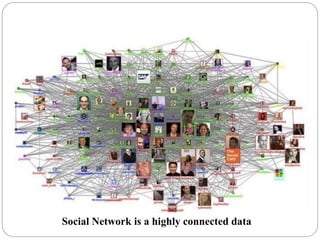
Social Network is a highly connected data
What is Graph?
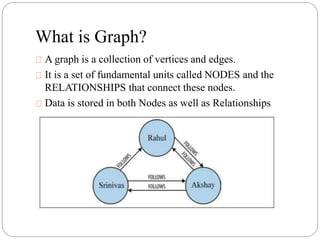
A graph is a collection of vertices and edges.
It is a set of fundamental units called NODES and the
RELATIONSHIPS that connect these nodes.
Data is stored in both Nodes as well as Relationships
Properties of Graph Databases
1. The underlying storage
2. The processing engine
Why Neo4j?
• reliable
• durable and fast
• massively scalable
• highly-available
• expressive
• fast
• simple
Cypher Query Language
• declarative graph query language
• what to retrieve
• Expressions
• Identifiers
• Operators
• Pattern
• Labels
Building blocks of CQL
Structure
• MATCH
• RETURN
• WHERE
• LIMIT
• ORDER BY
• CREATE
• REMOVE
• DELETE
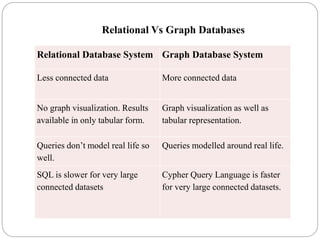
Relational Database System Graph Database System
Less connected data More connected data
No graph visualization. Results
available in only tabular form.
Graph visualization as well as
tabular representation.
Queries don’t model real life so
well.
Queries modelled around real life.
SQL is slower for very large
connected datasets
Cypher Query Language is faster
for very large connected datasets.
Relational Vs Graph Databases
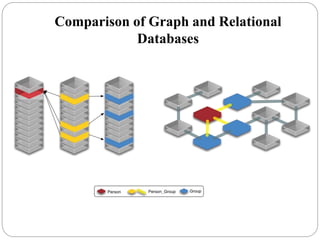
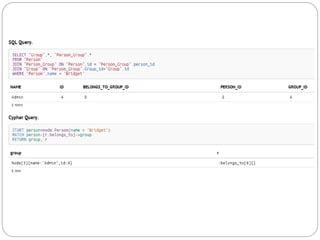
Comparison of Graph and Relational
Databases
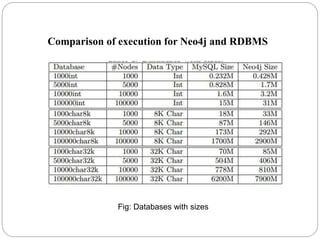
Comparison of execution for Neo4j and RDBMS
Fig: Databases with sizes
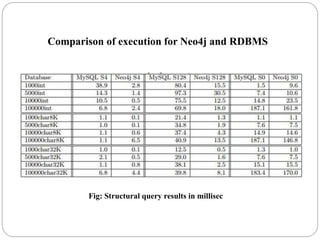
Comparison of execution for Neo4j and RDBMS
Fig: Structural query results in millisec
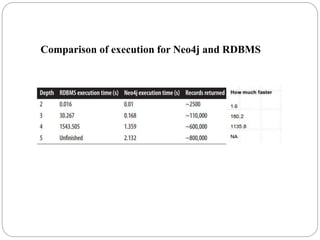
Comparison of execution for Neo4j and RDBMS
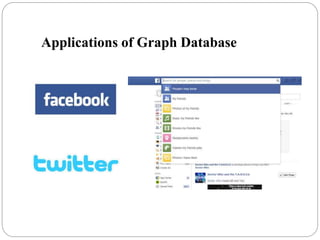
Applications of Graph Database
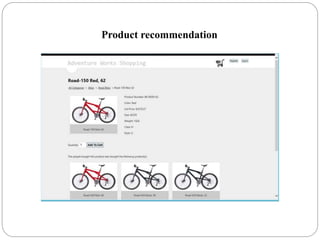
Product recommendation
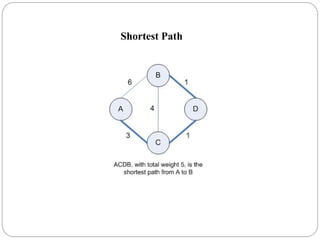
Shortest Path

Graph databases

  • 1.
    Project Mentor: Mrs.Manisha Gahirwal Project Members: Rahul Anwani(03) Akshaykumar Oswal(19) Srinivas Ravi(48) Social Networking Analysis using Graph Database
  • 2.
    Social Network isa highly connected data
  • 3.
    What is Graph? Agraph is a collection of vertices and edges. It is a set of fundamental units called NODES and the RELATIONSHIPS that connect these nodes. Data is stored in both Nodes as well as Relationships
  • 5.
    Properties of GraphDatabases 1. The underlying storage 2. The processing engine
  • 6.
    Why Neo4j? • reliable •durable and fast • massively scalable • highly-available • expressive • fast • simple
  • 7.
    Cypher Query Language •declarative graph query language • what to retrieve • Expressions • Identifiers • Operators • Pattern • Labels Building blocks of CQL
  • 8.
    Structure • MATCH • RETURN •WHERE • LIMIT • ORDER BY • CREATE • REMOVE • DELETE
  • 9.
    Relational Database SystemGraph Database System Less connected data More connected data No graph visualization. Results available in only tabular form. Graph visualization as well as tabular representation. Queries don’t model real life so well. Queries modelled around real life. SQL is slower for very large connected datasets Cypher Query Language is faster for very large connected datasets. Relational Vs Graph Databases
  • 10.
    Comparison of Graphand Relational Databases
  • 12.
    Comparison of executionfor Neo4j and RDBMS Fig: Databases with sizes
  • 13.
    Comparison of executionfor Neo4j and RDBMS Fig: Structural query results in millisec
  • 14.
    Comparison of executionfor Neo4j and RDBMS
  • 15.
  • 16.
  • 17.