Grammar Review
2
Using Who and Whom
Who is used as a subject of a sentence or a
clause.
Example: She is a student who helps her friends.
Whom is an object form.
It is used as:
1. Direct Object
Example: Whom will you ask?
2. Object of preposition
Example: With whom are you talking?
With: preposition / Whom: object of preposition
Choose who or whom to complete the
following sentences.
• 1. ______ wrote the song “This Land Is Your Land” ?
• 2. From _____ did you get the information?
• 3. She is my friend _____ I invited to the party.
• 4. I know the student _____ broke the window glass.
• 1. Who wrote the song “This Land Is Your Land” ?
• 2. From whom did you get the information?
• 3. She is my friend whom I invited to the party.
• 4. I know the student who broke the window glass.
Comparative and Superlative
Adjectives
Adjectives are words that describe or modify
nouns.
*The comparative form of an adjective compares
two things.
*The superlative form of an adjective compares
three or more things.
large larger largest
The first apple is large.
The second apple is larger than the first.
The third apple is the largest of the three.
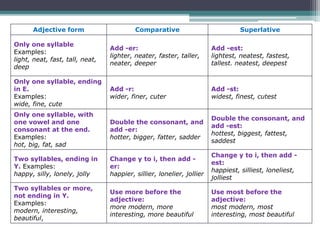
Adjective form Comparative Superlative
Only one syllable
Examples:
light, neat, fast, tall, neat,
deep
Add -er:
lighter, neater, faster, taller,
neater, deeper
Add -est:
lightest, neatest, fastest,
tallest. neatest, deepest
Only one syllable, ending
in E.
Examples:
wide, fine, cute
Add -r:
wider, finer, cuter
Add -st:
widest, finest, cutest
Only one syllable, with
one vowel and one
consonant at the end.
Examples:
hot, big, fat, sad
Double the consonant, and
add -er:
hotter, bigger, fatter, sadder
Double the consonant, and
add -est:
hottest, biggest, fattest,
saddest
Two syllables, ending in
Y. Examples:
happy, silly, lonely, jolly
Change y to i, then add -
er:
happier, sillier, lonelier, jollier
Change y to i, then add -
est:
happiest, silliest, loneliest,
jolliest
Two syllables or more,
not ending in Y.
Examples:
modern, interesting,
beautiful,
Use more before the
adjective:
more modern, more
interesting, more beautiful
Use most before the
adjective:
most modern, most
interesting, most beautiful
Irregular Adjectives
Adjective Comparative Superlative
good better best
bad worse worst
much more most
little less least
Write the correct superlative or comparative form of
the adjectives in brackets to complete the sentences.
1. Molly's stew was (good) ________ than Nathan's.
2. Ezra made the (good) _______stew of all.
3. Which is the ( dangerous) _______ animal of all?
4. This is the (interesting) ______ book I have ever
read.
5. The weather this summer is even (bad) _____ than
last summer.
1. Molly's stew was better than Nathan's.
2. Ezra made the best stew of all.
3. Which is the most dangerous animal of all?
4. This is the most interesting book I have ever
read.
5. The weather this summer is even worse than last
summer.
Adverbs
Adverbs are words that describe or modify verbs.
*The comparative form of an adverb compares
two things.
*The superlative form of an adverb compares
three or more things.
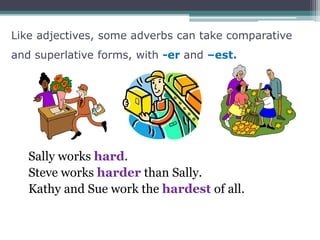
Like adjectives, some adverbs can take comparative
and superlative forms, with -er and –est.
Sally works hard.
Steve works harder than Sally.
Kathy and Sue work the hardest of all.
The bird sings loudly.
The children sing more loudly than the bird.
Of all three, Pete sings most loudly.
For adverbs ending in –ly, add “more” to the original adverb to
form the comparative, and “most” to form the superlative.
Irregular Adverbs
Adverb Comparative Superlative
badly worse worst
much more most
little less least
well better best
Write the correct superlative or comparative
form of the adverbs in brackets to complete
the sentences.
• I speak English (fluently) _____ now than last
year.
• She greeted me (politely) ______of all.
• This girl dances (gracefully) of all.
• Could you write (clearly) ______ ?
• He had an accident last year. Now, he
drives (carefully) _________than before.
• Our team played( bad) _____ of all.
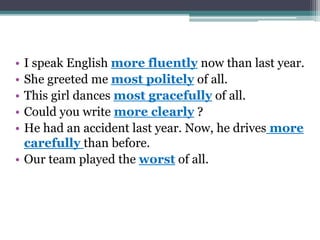
• I speak English more fluently now than last year.
• She greeted me most politely of all.
• This girl dances most gracefully of all.
• Could you write more clearly ?
• He had an accident last year. Now, he drives more
carefully than before.
• Our team played the worst of all.
Commas
,
,
,
,
,
,
, ,
There are many different
ways to
use a comma!
Let’s learn
them all!
In the early morning, the lake looked cold, gray, and
calm.
Words in a Series:
On the boat, we took extra clothes,fishing poles, and some
snacks.
Words, Phrases, and Clauses in a series are usually
separated by commas to show the reader where one item in
the series ends and the next begins.
SERIES
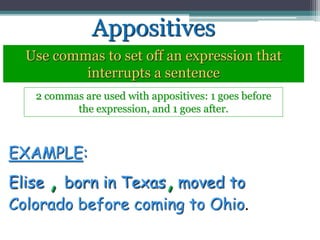
Appositives
Use commas to set off an expression that
interrupts a sentence
2 commas are used with appositives: 1 goes before
the expression, and 1 goes after.
EXAMPLE:
Elise , born in Texas, moved to
Colorado before coming to Ohio.
Use Commas to Set off Words of
Direct Address
Examples
:Mrs. Clarkson, this package
is addressed to you.
Do you know, Odessa, when
the next bus is coming?
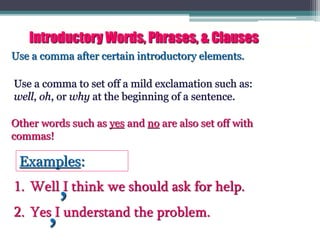
Introductory Words, Phrases, & Clauses
Use a comma after certain introductory elements.
Other words such as yes and no are also set off with
commas!
Examples:
1. Well I think we should ask for help.
2. Yes I understand the problem.
,
,
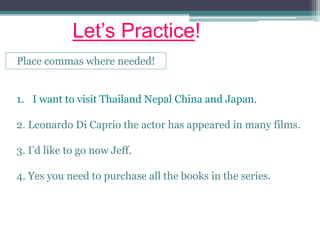
Let’s Practice!
Place commas where needed!
1. I want to visit Thailand Nepal China and Japan.
2. Leonardo Di Caprio the actor has appeared in many films.
3. I’d like to go now Jeff.
4. Yes you need to purchase all the books in the series.
1. I want to visit Thailand ,Nepal , China , and Japan.
2. Leonardo Di Caprio , the actor ,has appeared in many
films.
3. I’d like to go now , Jeff.
4. Yes ,you need to purchase all the books in the series.
Quotation Marks
Direct Quotations
Use quotation marks to enclose a direct quotation—a
person’s exact words.
1. When the quotation comes last, set it off with a
comma.
Example:
Mimi said, “Reptiles are my favorite animals.”
2. When the quotation comes first in the sentence, a
comma, a question mark, or exclamation mark sets
off the quotation.
“Dogs make better pets than cats do,” said Frank
“Have you ever had a cat?” Amy asked.
“No, and I never will!” he replied.
3. When an interrupting expression divides a direct
quotation into two parts, place quotation marks
around both parts of the quoted statement.
“Will you take care of my pets,” Mr. Yates asked, “while
I’m on vacation?”
“Yes, I will,” said Ted. “You can count on me.”
Add quotation marks where they are needed in the following
sentences.
1. We’re going tubing next Saturday, said Carlos.
2. I’d like to go along, said Barbara.
3. Eric asked, Who will bring tubes for everyone?
4. Barbara shouted, I’ll bring them!
5. My dad will drive, said Carlos. He has a van.
6. The water will feel good, Eric said, if Saturday is as hot
as today.
1. “We’re going tubing next Saturday,” said Carlos.
2. “ I’d like to go along, ” said Barbara.
3. Eric asked, “ Who will bring tubes for everyone? ”
4. Barbara shouted, “ I’ll bring them! ”
5. “ My dad will drive”, said Carlos. “He has a van.”
6. “ The water will feel good”, Eric said, “ if Saturday is
as hot as today. ”
Punctuation
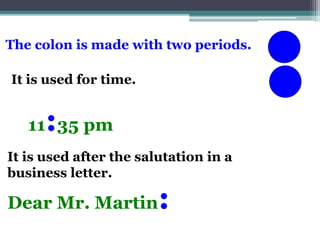
Dear Mr. Martin:
The colon is made with two periods.
It is used for time.
11:35 pm
It is used after the salutation in a
business letter.
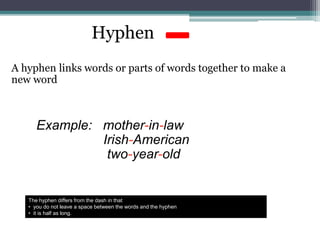
Hyphen
A hyphen links words or parts of words together to make a
new word
Example: mother-in-law
Irish-American
two-year-old
The hyphen differs from the dash in that
• you do not leave a space between the words and the hyphen
• it is half as long.
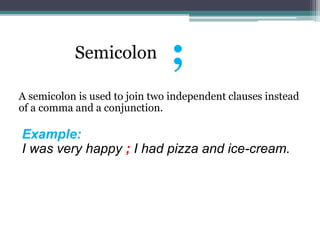
Semicolon
A semicolon is used to join two independent clauses instead
of a comma and a conjunction.
Example:
I was very happy ; I had pizza and ice-cream.
;
Italics
Italics is used for titles of books, newspapers, magazines,
and works of art.
Example:
I read that article in Los Angeles Times.
Underlining
Because you cannot write italics, underline titles in your writing.
Example:
I read that article in Los Angeles Times.
Dash
A dash setts off information or a comment that interrupts
the flow of a sentence.
Example: For our vacation—which was much too short—
we went to Florida and basked in the sun.
The hyphen differs from the dash in that
• you do not leave a space between the words and the hyphen
• it is half as long.

Grammar Review 2

  • 1.
  • 2.
  • 3.
    Who is usedas a subject of a sentence or a clause. Example: She is a student who helps her friends. Whom is an object form. It is used as: 1. Direct Object Example: Whom will you ask? 2. Object of preposition Example: With whom are you talking? With: preposition / Whom: object of preposition
  • 4.
    Choose who orwhom to complete the following sentences. • 1. ______ wrote the song “This Land Is Your Land” ? • 2. From _____ did you get the information? • 3. She is my friend _____ I invited to the party. • 4. I know the student _____ broke the window glass.
  • 5.
    • 1. Whowrote the song “This Land Is Your Land” ? • 2. From whom did you get the information? • 3. She is my friend whom I invited to the party. • 4. I know the student who broke the window glass.
  • 6.
  • 7.
    Adjectives are wordsthat describe or modify nouns. *The comparative form of an adjective compares two things. *The superlative form of an adjective compares three or more things.
  • 8.
    large larger largest Thefirst apple is large. The second apple is larger than the first. The third apple is the largest of the three.
  • 9.
    Adjective form ComparativeSuperlative Only one syllable Examples: light, neat, fast, tall, neat, deep Add -er: lighter, neater, faster, taller, neater, deeper Add -est: lightest, neatest, fastest, tallest. neatest, deepest Only one syllable, ending in E. Examples: wide, fine, cute Add -r: wider, finer, cuter Add -st: widest, finest, cutest Only one syllable, with one vowel and one consonant at the end. Examples: hot, big, fat, sad Double the consonant, and add -er: hotter, bigger, fatter, sadder Double the consonant, and add -est: hottest, biggest, fattest, saddest Two syllables, ending in Y. Examples: happy, silly, lonely, jolly Change y to i, then add - er: happier, sillier, lonelier, jollier Change y to i, then add - est: happiest, silliest, loneliest, jolliest Two syllables or more, not ending in Y. Examples: modern, interesting, beautiful, Use more before the adjective: more modern, more interesting, more beautiful Use most before the adjective: most modern, most interesting, most beautiful
  • 10.
    Irregular Adjectives Adjective ComparativeSuperlative good better best bad worse worst much more most little less least
  • 11.
    Write the correctsuperlative or comparative form of the adjectives in brackets to complete the sentences. 1. Molly's stew was (good) ________ than Nathan's. 2. Ezra made the (good) _______stew of all. 3. Which is the ( dangerous) _______ animal of all? 4. This is the (interesting) ______ book I have ever read. 5. The weather this summer is even (bad) _____ than last summer.
  • 12.
    1. Molly's stewwas better than Nathan's. 2. Ezra made the best stew of all. 3. Which is the most dangerous animal of all? 4. This is the most interesting book I have ever read. 5. The weather this summer is even worse than last summer.
  • 13.
    Adverbs Adverbs are wordsthat describe or modify verbs. *The comparative form of an adverb compares two things. *The superlative form of an adverb compares three or more things.
  • 14.
    Like adjectives, someadverbs can take comparative and superlative forms, with -er and –est. Sally works hard. Steve works harder than Sally. Kathy and Sue work the hardest of all.
  • 15.
    The bird singsloudly. The children sing more loudly than the bird. Of all three, Pete sings most loudly. For adverbs ending in –ly, add “more” to the original adverb to form the comparative, and “most” to form the superlative.
  • 16.
    Irregular Adverbs Adverb ComparativeSuperlative badly worse worst much more most little less least well better best
  • 17.
    Write the correctsuperlative or comparative form of the adverbs in brackets to complete the sentences. • I speak English (fluently) _____ now than last year. • She greeted me (politely) ______of all. • This girl dances (gracefully) of all. • Could you write (clearly) ______ ? • He had an accident last year. Now, he drives (carefully) _________than before. • Our team played( bad) _____ of all.
  • 18.
    • I speakEnglish more fluently now than last year. • She greeted me most politely of all. • This girl dances most gracefully of all. • Could you write more clearly ? • He had an accident last year. Now, he drives more carefully than before. • Our team played the worst of all.
  • 19.
  • 20.
    , , , , , , , , There aremany different ways to use a comma! Let’s learn them all!
  • 21.
    In the earlymorning, the lake looked cold, gray, and calm. Words in a Series: On the boat, we took extra clothes,fishing poles, and some snacks. Words, Phrases, and Clauses in a series are usually separated by commas to show the reader where one item in the series ends and the next begins. SERIES
  • 22.
    Appositives Use commas toset off an expression that interrupts a sentence 2 commas are used with appositives: 1 goes before the expression, and 1 goes after. EXAMPLE: Elise , born in Texas, moved to Colorado before coming to Ohio.
  • 23.
    Use Commas toSet off Words of Direct Address Examples :Mrs. Clarkson, this package is addressed to you. Do you know, Odessa, when the next bus is coming?
  • 24.
    Introductory Words, Phrases,& Clauses Use a comma after certain introductory elements. Other words such as yes and no are also set off with commas! Examples: 1. Well I think we should ask for help. 2. Yes I understand the problem. , ,
  • 25.
    Let’s Practice! Place commaswhere needed! 1. I want to visit Thailand Nepal China and Japan. 2. Leonardo Di Caprio the actor has appeared in many films. 3. I’d like to go now Jeff. 4. Yes you need to purchase all the books in the series.
  • 26.
    1. I wantto visit Thailand ,Nepal , China , and Japan. 2. Leonardo Di Caprio , the actor ,has appeared in many films. 3. I’d like to go now , Jeff. 4. Yes ,you need to purchase all the books in the series.
  • 27.
  • 28.
    Direct Quotations Use quotationmarks to enclose a direct quotation—a person’s exact words. 1. When the quotation comes last, set it off with a comma. Example: Mimi said, “Reptiles are my favorite animals.”
  • 29.
    2. When thequotation comes first in the sentence, a comma, a question mark, or exclamation mark sets off the quotation. “Dogs make better pets than cats do,” said Frank “Have you ever had a cat?” Amy asked. “No, and I never will!” he replied.
  • 30.
    3. When aninterrupting expression divides a direct quotation into two parts, place quotation marks around both parts of the quoted statement. “Will you take care of my pets,” Mr. Yates asked, “while I’m on vacation?” “Yes, I will,” said Ted. “You can count on me.”
  • 31.
    Add quotation markswhere they are needed in the following sentences. 1. We’re going tubing next Saturday, said Carlos. 2. I’d like to go along, said Barbara. 3. Eric asked, Who will bring tubes for everyone? 4. Barbara shouted, I’ll bring them! 5. My dad will drive, said Carlos. He has a van. 6. The water will feel good, Eric said, if Saturday is as hot as today.
  • 32.
    1. “We’re goingtubing next Saturday,” said Carlos. 2. “ I’d like to go along, ” said Barbara. 3. Eric asked, “ Who will bring tubes for everyone? ” 4. Barbara shouted, “ I’ll bring them! ” 5. “ My dad will drive”, said Carlos. “He has a van.” 6. “ The water will feel good”, Eric said, “ if Saturday is as hot as today. ”
  • 33.
  • 34.
    Dear Mr. Martin: Thecolon is made with two periods. It is used for time. 11:35 pm It is used after the salutation in a business letter.
  • 35.
    Hyphen A hyphen linkswords or parts of words together to make a new word Example: mother-in-law Irish-American two-year-old The hyphen differs from the dash in that • you do not leave a space between the words and the hyphen • it is half as long.
  • 36.
    Semicolon A semicolon isused to join two independent clauses instead of a comma and a conjunction. Example: I was very happy ; I had pizza and ice-cream. ;
  • 37.
    Italics Italics is usedfor titles of books, newspapers, magazines, and works of art. Example: I read that article in Los Angeles Times. Underlining Because you cannot write italics, underline titles in your writing. Example: I read that article in Los Angeles Times.
  • 38.
    Dash A dash settsoff information or a comment that interrupts the flow of a sentence. Example: For our vacation—which was much too short— we went to Florida and basked in the sun. The hyphen differs from the dash in that • you do not leave a space between the words and the hyphen • it is half as long.