CHRIST THE KING COLLEGE DE MARANDING
Maranding, Lala, Lanao del Norte Inc.
Detailed Lesson Plan in Science Grade IV
I. LEARNING OBJECTIVES
At the end of the lesson, the learners will be able to:
a. Identify the stages in the life cycles of a butterfly
b. Determine the life cycles of a butterfly
c. Recognize the importance of an animals by taking care of them.
II. SUBJECT MATTER
Topic: Life Cycles of a Butterfly
Textbook: Science GIV, pages 168-173
Materials: Picture Cards, Video Clip
Subject Integration: Values Education and Art
Values Integration: Showing Gratitude and Appreciation
Teaching Approach: Explicit Teaching, Visualization, Interactive
III. PROCEDURE: Inductive Method
Teacher’s Activity Student’s Activity
A. PREPARATION
a. Opening Prayer
Class let us start our day with a prayer.
Who wants to lead the prayer?
Thank you, Prince.
Prince lead the prayer.
Our Father, who art in heaven, hallowed
be thy name; thy kingdom come; thy will
be done; on earth as it is in heaven. Give
us this day our daily bread. And forgive
us our trespasses, as we forgive those
who trespass against us. And lead us not
into temptation; but deliver us from evil.
b. Greetings
Good morning grade 4!
How’s everyone this morning?
That’s great!
c. Energizer
Okay class, do you know the A ram sam
sam song?
Okay! So, everybody stand up and let us
sing and dance it all together!
Good job kids! All of you are doing great!
Before you take your seats, kindly pick up
some pieces of papers under your chairs
and arrange your chairs properly. If you’re
done, you may now take your seats.
d. Checking of attendance
Okay, let me check the attendance. Is
everybody present?
Very good all of you are present .
e. Checking of assignment
Did we have an assignment last meeting?
Pass your assignment.
Pass it forward.
f. Imposing of Rules
Before we begin our lesson for today, I
have four rules to impose. First, avoid
talking with your seatmates. Second listen
to teacher. Third avoid unnecessary
movement like standing, travelling to other
armchair. Lastly, raise your right hand if
you want to say something.
Do you understand?
Very good!
Good morning, teacher Naila!
We are good teacher!
No, teacher!
(The students will sing along with the
teacher)
Yes teacher
Yes, teacher
(Pupils do as told)
Yes teacher
A. Review
What was our topic yesterday?
Yes, Lexi.
Very good! Who can tell me what is liver?
Yes, Marco.
Very good! Marco.
We're can we locate our liver? Yes, Pikot.
Now, what is the function of a liver?
Yes, Princess?
That's right.
Very good! How about the other functions
of the liver?
Yes rob.
Good Job! And since you still remember
our last topic, let’s give ourselves a Very
good clap.
Do you have any questions about our last
topic?
a. Motivation
Before I will discuss our new topic for this
morning, let's play a game. Our game is
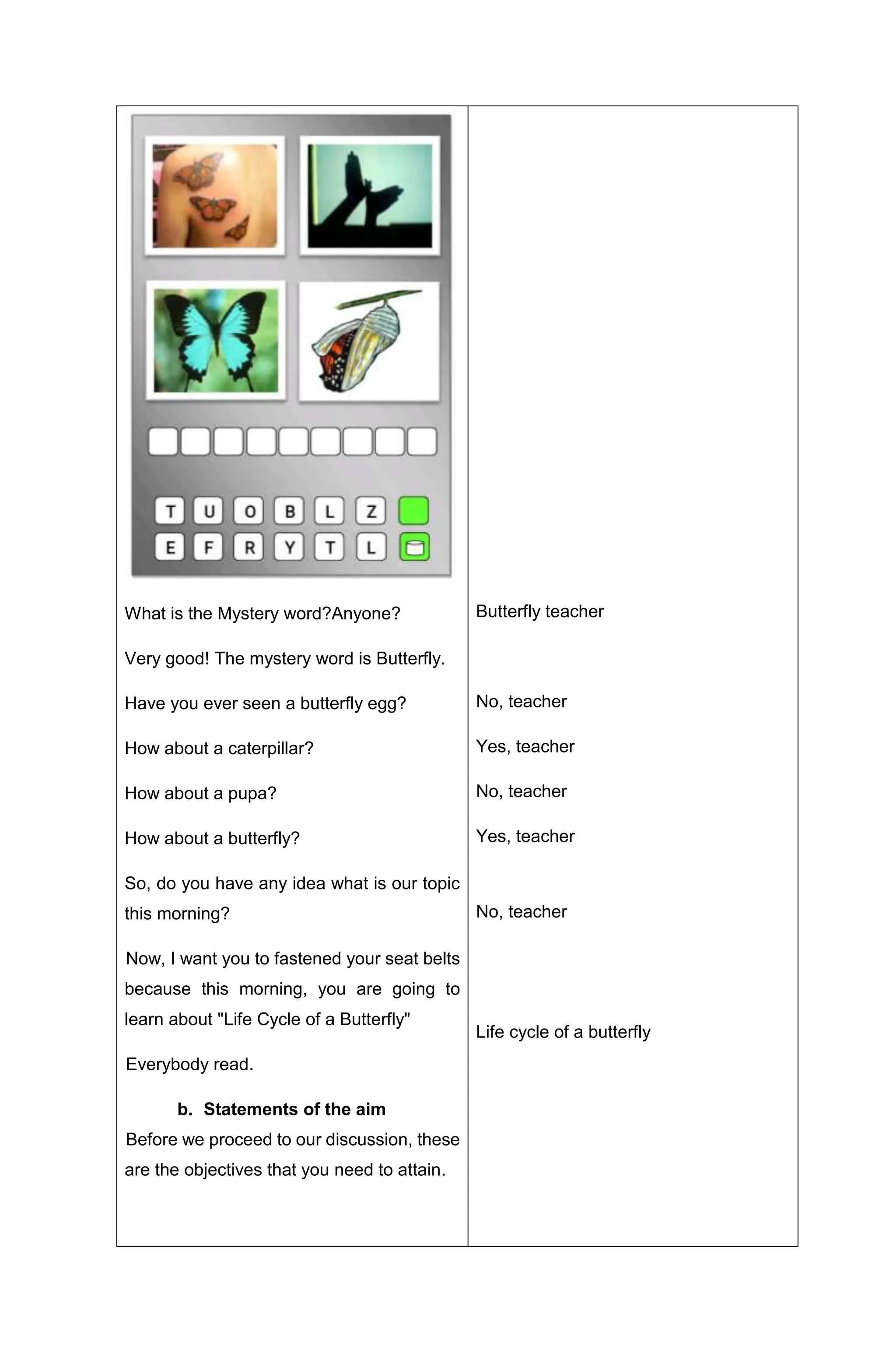
called 4pics, 1 word. All you have to do is to
identify the pictures to guess the mystery
word.
Our topic yesterday was all about liver,
teacher.
Liver teacher is the largest solid organ in
the body, teacher.
The liver is located on the right side of
the abdominal cavity below the
diaphragm.
The primary function of the liver is to
remove toxins from the blood.
The other functions of the liver are to
break down excess proteins (amino
acid), maintain cholesterol and glucose
levels in the blood, and secrete chemical
substances that break down fats and
convert glucose to glycogen.
No, teacher.
What is the Mystery word?Anyone?
Very good! The mystery word is Butterfly.
Have you ever seen a butterfly egg?
How about a caterpillar?
How about a pupa?
How about a butterfly?
So, do you have any idea what is our topic
this morning?
Now, I want you to fastened your seat belts
because this morning, you are going to
learn about "Life Cycle of a Butterfly"
Everybody read.
b. Statements of the aim
Before we proceed to our discussion, these
are the objectives that you need to attain.
Butterfly teacher
No, teacher
Yes, teacher
No, teacher
Yes, teacher
No, teacher
Life cycle of a butterfly
a.Identify the stages in the life cycles of a
butterfly
b. Determine the life cycles of a butterfly
c. Recognize the importance of an animals
by taking care of them.
B. Presentation
Let us identify the stages in the life cycles
of a butterfly.
Okay! Now, I have here a video, all you
have to do is to watch very carefully and
take down all the important information
about the video. In this video, you can see
the changes that happen in butterfly.Is that
clear?
I will now play it. Are you ready?
(The teacher will play the video)
Did you understand what have you
watched?
In order for you to understand very well our
today’s topic, I will show you an illustration
of life cycle, egg, larva, pupa and butterfly.
Yes, teacher
Yes, teacher
Yes, teacher
C. Comparison and Abstraction
If you really understand our today’s topic
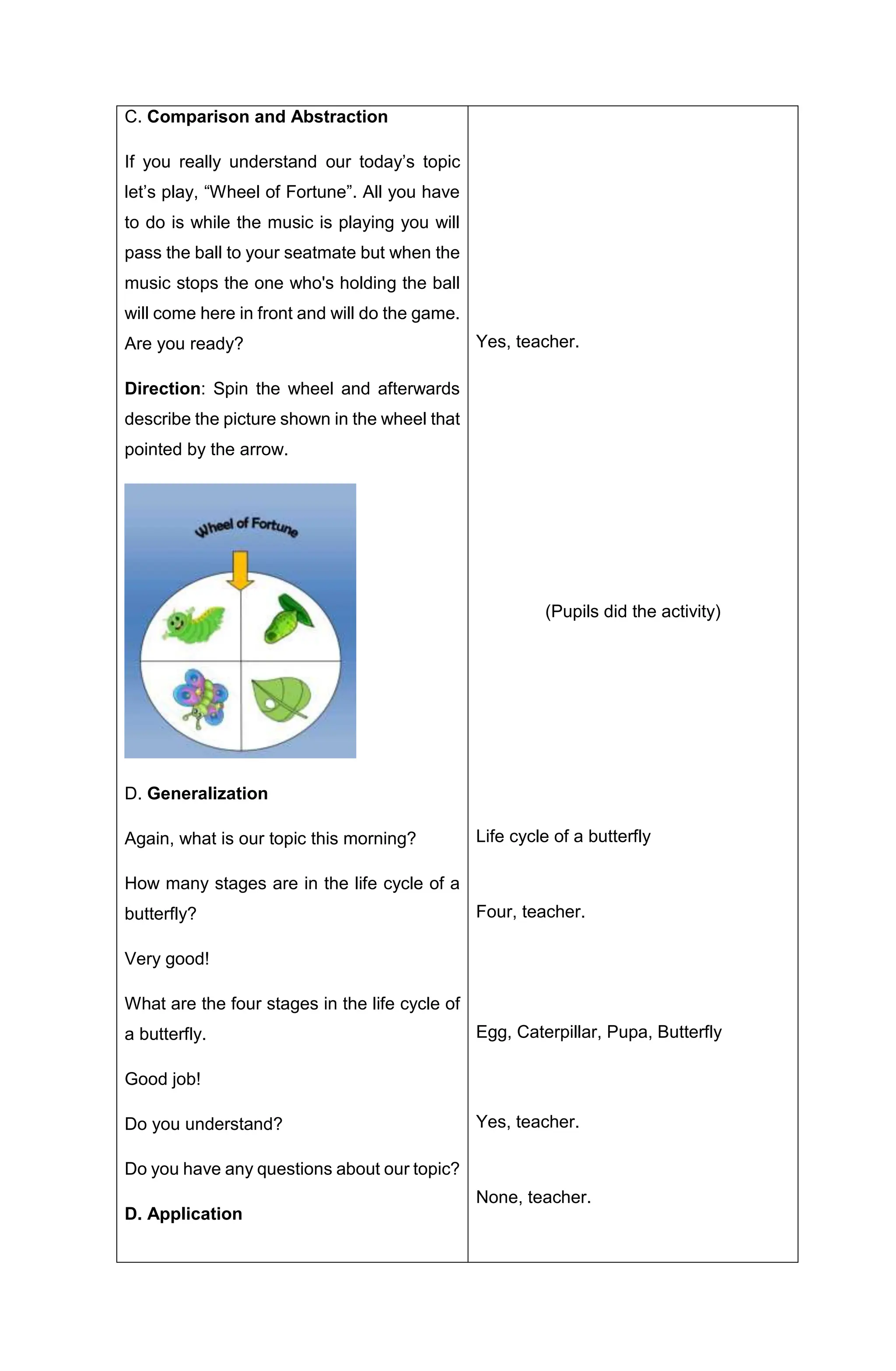
let’s play, “Wheel of Fortune”. All you have
to do is while the music is playing you will
pass the ball to your seatmate but when the
music stops the one who's holding the ball
will come here in front and will do the game.
Are you ready?
Direction: Spin the wheel and afterwards
describe the picture shown in the wheel that
pointed by the arrow.
D. Generalization
Again, what is our topic this morning?
How many stages are in the life cycle of a
butterfly?
Very good!
What are the four stages in the life cycle of
a butterfly.
Good job!
Do you understand?
Do you have any questions about our topic?
D. Application
Yes, teacher.
(Pupils did the activity)
Life cycle of a butterfly
Four, teacher.
Egg, Caterpillar, Pupa, Butterfly
Yes, teacher.
None, teacher.
For your individual activity, let's play a game
called “Candy Crash"
Direction: Loop the stages of the life cycle
of the butterfly in the candy crash.
E. Values Integration
Class, Is it important to take good care of
animals?
Why?
Very good! How can we take care of the
animals?
Very good! Animals are essential to our
environment and our economy. They also
play an important role in maintaining the
balance of nature.
Yes, teacher.
Because they are also have a lives too,
animal's have feelings, they feel hurt,
happy, and sad.
By giving them a foods, water and a
shelter.
Animals are also important to our mental
and emotional well being. Studies have
shown that spending time with animals can
reduce stress, anxiety, and depression.
Animals can also help us to learn to be
more compassionate and understanding of
others.
Do you understand class?
Do you have any questions or clarification
regarding to our topic this morning?
IV. Evaluation
This time, for your evaluation, let’s
play“Find my Partner!”
Direction: Match the stages of the life cycle
of the butterfly in Column A that best
describe each stage in Column B.
IV. Assignment
Yes, teacher.
None, teacher.
Date: Dec. 4, 2023
Print the life cycle of the frog in a one whole
sheet of long bond paper.
Pass it tomorrow morning.
Prepared by:
Naila L. Yahya
Student Teacher
Approved by:
Chriscel D. Zamora
Cooperating Teacher

Grade6-Formal Demo.docx

  • 1.
    CHRIST THE KINGCOLLEGE DE MARANDING Maranding, Lala, Lanao del Norte Inc. Detailed Lesson Plan in Science Grade IV I. LEARNING OBJECTIVES At the end of the lesson, the learners will be able to: a. Identify the stages in the life cycles of a butterfly b. Determine the life cycles of a butterfly c. Recognize the importance of an animals by taking care of them. II. SUBJECT MATTER Topic: Life Cycles of a Butterfly Textbook: Science GIV, pages 168-173 Materials: Picture Cards, Video Clip Subject Integration: Values Education and Art Values Integration: Showing Gratitude and Appreciation Teaching Approach: Explicit Teaching, Visualization, Interactive III. PROCEDURE: Inductive Method Teacher’s Activity Student’s Activity A. PREPARATION a. Opening Prayer Class let us start our day with a prayer. Who wants to lead the prayer? Thank you, Prince. Prince lead the prayer. Our Father, who art in heaven, hallowed be thy name; thy kingdom come; thy will be done; on earth as it is in heaven. Give us this day our daily bread. And forgive us our trespasses, as we forgive those who trespass against us. And lead us not into temptation; but deliver us from evil.
  • 2.
    b. Greetings Good morninggrade 4! How’s everyone this morning? That’s great! c. Energizer Okay class, do you know the A ram sam sam song? Okay! So, everybody stand up and let us sing and dance it all together! Good job kids! All of you are doing great! Before you take your seats, kindly pick up some pieces of papers under your chairs and arrange your chairs properly. If you’re done, you may now take your seats. d. Checking of attendance Okay, let me check the attendance. Is everybody present? Very good all of you are present . e. Checking of assignment Did we have an assignment last meeting? Pass your assignment. Pass it forward. f. Imposing of Rules Before we begin our lesson for today, I have four rules to impose. First, avoid talking with your seatmates. Second listen to teacher. Third avoid unnecessary movement like standing, travelling to other armchair. Lastly, raise your right hand if you want to say something. Do you understand? Very good! Good morning, teacher Naila! We are good teacher! No, teacher! (The students will sing along with the teacher) Yes teacher Yes, teacher (Pupils do as told) Yes teacher
  • 3.
    A. Review What wasour topic yesterday? Yes, Lexi. Very good! Who can tell me what is liver? Yes, Marco. Very good! Marco. We're can we locate our liver? Yes, Pikot. Now, what is the function of a liver? Yes, Princess? That's right. Very good! How about the other functions of the liver? Yes rob. Good Job! And since you still remember our last topic, let’s give ourselves a Very good clap. Do you have any questions about our last topic? a. Motivation Before I will discuss our new topic for this morning, let's play a game. Our game is called 4pics, 1 word. All you have to do is to identify the pictures to guess the mystery word. Our topic yesterday was all about liver, teacher. Liver teacher is the largest solid organ in the body, teacher. The liver is located on the right side of the abdominal cavity below the diaphragm. The primary function of the liver is to remove toxins from the blood. The other functions of the liver are to break down excess proteins (amino acid), maintain cholesterol and glucose levels in the blood, and secrete chemical substances that break down fats and convert glucose to glycogen. No, teacher.
  • 4.
    What is theMystery word?Anyone? Very good! The mystery word is Butterfly. Have you ever seen a butterfly egg? How about a caterpillar? How about a pupa? How about a butterfly? So, do you have any idea what is our topic this morning? Now, I want you to fastened your seat belts because this morning, you are going to learn about "Life Cycle of a Butterfly" Everybody read. b. Statements of the aim Before we proceed to our discussion, these are the objectives that you need to attain. Butterfly teacher No, teacher Yes, teacher No, teacher Yes, teacher No, teacher Life cycle of a butterfly
  • 5.
    a.Identify the stagesin the life cycles of a butterfly b. Determine the life cycles of a butterfly c. Recognize the importance of an animals by taking care of them. B. Presentation Let us identify the stages in the life cycles of a butterfly. Okay! Now, I have here a video, all you have to do is to watch very carefully and take down all the important information about the video. In this video, you can see the changes that happen in butterfly.Is that clear? I will now play it. Are you ready? (The teacher will play the video) Did you understand what have you watched? In order for you to understand very well our today’s topic, I will show you an illustration of life cycle, egg, larva, pupa and butterfly. Yes, teacher Yes, teacher Yes, teacher
  • 6.
    C. Comparison andAbstraction If you really understand our today’s topic let’s play, “Wheel of Fortune”. All you have to do is while the music is playing you will pass the ball to your seatmate but when the music stops the one who's holding the ball will come here in front and will do the game. Are you ready? Direction: Spin the wheel and afterwards describe the picture shown in the wheel that pointed by the arrow. D. Generalization Again, what is our topic this morning? How many stages are in the life cycle of a butterfly? Very good! What are the four stages in the life cycle of a butterfly. Good job! Do you understand? Do you have any questions about our topic? D. Application Yes, teacher. (Pupils did the activity) Life cycle of a butterfly Four, teacher. Egg, Caterpillar, Pupa, Butterfly Yes, teacher. None, teacher.
  • 7.
    For your individualactivity, let's play a game called “Candy Crash" Direction: Loop the stages of the life cycle of the butterfly in the candy crash. E. Values Integration Class, Is it important to take good care of animals? Why? Very good! How can we take care of the animals? Very good! Animals are essential to our environment and our economy. They also play an important role in maintaining the balance of nature. Yes, teacher. Because they are also have a lives too, animal's have feelings, they feel hurt, happy, and sad. By giving them a foods, water and a shelter.
  • 8.
    Animals are alsoimportant to our mental and emotional well being. Studies have shown that spending time with animals can reduce stress, anxiety, and depression. Animals can also help us to learn to be more compassionate and understanding of others. Do you understand class? Do you have any questions or clarification regarding to our topic this morning? IV. Evaluation This time, for your evaluation, let’s play“Find my Partner!” Direction: Match the stages of the life cycle of the butterfly in Column A that best describe each stage in Column B. IV. Assignment Yes, teacher. None, teacher.
  • 9.
    Date: Dec. 4,2023 Print the life cycle of the frog in a one whole sheet of long bond paper. Pass it tomorrow morning. Prepared by: Naila L. Yahya Student Teacher Approved by: Chriscel D. Zamora Cooperating Teacher