EQ: What do logical connectors in a text reveal
about its organizational structure and purpose?
conjunction
and
connectors
• Describe the relationship between
two statements.
• These statements can be written
without linking words, but often
more information can be clearly
explained.
conjunction connectors
grammatically join
two clauses
(independent or
dependent
depending on the
conjunction) so that
it reads as one
sentence.
are used between
two separate
sentences.
Are also helpful in
presenting ideas in a
paragraph in logical
order.
contrast
• however
• yet
• despite
• but
• instead
• on the
contrary
• in contrast to
addition
• moreover
• furthermore
• in addition
• besides
• what’s more
• on the top of
that
• likewise
cause
• because
• since
• due to
• on account of
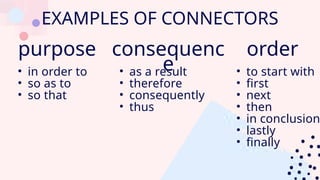
EXAMPLES OF CONNECTORS
purpose
• in order to
• so as to
• so that
consequenc
e
• as a result
• therefore
• consequently
• thus
order
• to start with
• first
• next
• then
• in conclusion
• lastly
• finally
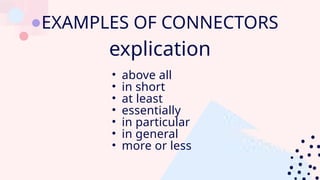
EXAMPLES OF CONNECTORS
explication
• above all
• in short
• at least
• essentially
• in particular
• in general
• more or less
EXAMPLES OF CONNECTORS
4 types of texts
Expository
• Its main purpose is to explain.
• It focuses on telling you about a given
topic or subject without voicing their
personal opinions.
• This type of texts furnishes you with
relevant facts and figure but do not
include their opinion
Descriptive
• Its main purpose is to describe
• It focuses on describing a character,
an event, or a place in great detail.
• It can be poetic when the author takes
time to be very specific in his or her
description
Persuasive
• Its main purpose is to convince
• unlike expository writing, this type of
text contains the opinions and biases
of the author.
• To convince others to agree with the
author’s point of view, persuasive
writing contains justification and
reasons.
Narrative
• Its main purpose is to tell a story
• The author will create different
characters and tell you what happens
to them
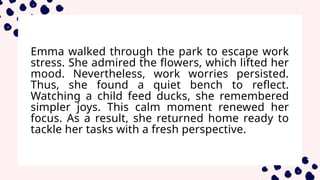
Emma walked through the park to escape work
stress. She admired the flowers, which lifted her
mood. Nevertheless, work worries persisted.
Thus, she found a quiet bench to reflect.
Watching a child feed ducks, she remembered
simpler joys. This calm moment renewed her
focus. As a result, she returned home ready to
tackle her tasks with a fresh perspective.
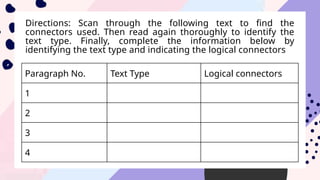
Paragraph No. Text Type Logical connectors
1
2
3
4
Directions: Scan through the following text to find the
connectors used. Then read again thoroughly to identify the
text type. Finally, complete the information below by
identifying the text type and indicating the logical connectors
READING
STYLES
SCANNING
• Is used to find a particular piece of
information
• Running the eyes over the text to look
for the specific piece of information
needed
Examples:
• The “What’s New” section of your
newspaper
• A train/airplane schedule
• A conference guide
• Meeting plans
• Finding the specific details
SKIMMING
• Is used to get the gist of something.
• This technique is used to read a
newspaper or magazine
• Reading quickly to get the main points
and skip over the detail.
• Use skimming to get the main idea of
a text
Examples:
• The Newspaper (to get the general
news of the day)
• Magazines (to discover which articles
you would like to read in more detail
• Business and Travel Brochures (quickly
to get informed)
SPEED READING
• Is the process of rapidly recognizing
and absorbing phrases or sentences
on a page all at once rather than
identifying individual words.
Example:
Gus is reaching information overload. He has to
present a report on three big market studies to
his manager, tomorrow at noon. He's got a stack
of information to read through, and the clock is
ticking. It's not an option to ask for an extension
to the deadline. But he needs to make sure that
he's "covered all the bases" otherwise he'll look
careless. Panic is setting in. Gus wants to sprint
through the material and still retain enough
information to compile a good summary. He
needs to be able to speed read.
INTENSIVE READING
• Is used on shorter texts in order to
get important details
• It includes very close accurate reading
for specific information
• Understanding each work is necessary
Examples:
• Reading an article
• Book critique
• Research work

grade 8 - logical connectors PRESENTATION.pptx

  • 2.
    EQ: What dological connectors in a text reveal about its organizational structure and purpose?
  • 3.
    conjunction and connectors • Describe therelationship between two statements. • These statements can be written without linking words, but often more information can be clearly explained.
  • 4.
    conjunction connectors grammatically join twoclauses (independent or dependent depending on the conjunction) so that it reads as one sentence. are used between two separate sentences. Are also helpful in presenting ideas in a paragraph in logical order.
  • 5.
    contrast • however • yet •despite • but • instead • on the contrary • in contrast to addition • moreover • furthermore • in addition • besides • what’s more • on the top of that • likewise cause • because • since • due to • on account of EXAMPLES OF CONNECTORS
  • 6.
    purpose • in orderto • so as to • so that consequenc e • as a result • therefore • consequently • thus order • to start with • first • next • then • in conclusion • lastly • finally EXAMPLES OF CONNECTORS
  • 7.
    explication • above all •in short • at least • essentially • in particular • in general • more or less EXAMPLES OF CONNECTORS
  • 8.
  • 9.
    Expository • Its mainpurpose is to explain. • It focuses on telling you about a given topic or subject without voicing their personal opinions. • This type of texts furnishes you with relevant facts and figure but do not include their opinion
  • 11.
    Descriptive • Its mainpurpose is to describe • It focuses on describing a character, an event, or a place in great detail. • It can be poetic when the author takes time to be very specific in his or her description
  • 13.
    Persuasive • Its mainpurpose is to convince • unlike expository writing, this type of text contains the opinions and biases of the author. • To convince others to agree with the author’s point of view, persuasive writing contains justification and reasons.
  • 15.
    Narrative • Its mainpurpose is to tell a story • The author will create different characters and tell you what happens to them
  • 16.
    Emma walked throughthe park to escape work stress. She admired the flowers, which lifted her mood. Nevertheless, work worries persisted. Thus, she found a quiet bench to reflect. Watching a child feed ducks, she remembered simpler joys. This calm moment renewed her focus. As a result, she returned home ready to tackle her tasks with a fresh perspective.
  • 17.
    Paragraph No. TextType Logical connectors 1 2 3 4 Directions: Scan through the following text to find the connectors used. Then read again thoroughly to identify the text type. Finally, complete the information below by identifying the text type and indicating the logical connectors
  • 18.
  • 19.
    SCANNING • Is usedto find a particular piece of information • Running the eyes over the text to look for the specific piece of information needed
  • 20.
    Examples: • The “What’sNew” section of your newspaper • A train/airplane schedule • A conference guide • Meeting plans • Finding the specific details
  • 21.
    SKIMMING • Is usedto get the gist of something. • This technique is used to read a newspaper or magazine • Reading quickly to get the main points and skip over the detail. • Use skimming to get the main idea of a text
  • 22.
    Examples: • The Newspaper(to get the general news of the day) • Magazines (to discover which articles you would like to read in more detail • Business and Travel Brochures (quickly to get informed)
  • 23.
    SPEED READING • Isthe process of rapidly recognizing and absorbing phrases or sentences on a page all at once rather than identifying individual words.
  • 24.
    Example: Gus is reachinginformation overload. He has to present a report on three big market studies to his manager, tomorrow at noon. He's got a stack of information to read through, and the clock is ticking. It's not an option to ask for an extension to the deadline. But he needs to make sure that he's "covered all the bases" otherwise he'll look careless. Panic is setting in. Gus wants to sprint through the material and still retain enough information to compile a good summary. He needs to be able to speed read.
  • 25.
    INTENSIVE READING • Isused on shorter texts in order to get important details • It includes very close accurate reading for specific information • Understanding each work is necessary
  • 26.
    Examples: • Reading anarticle • Book critique • Research work