CATALOG
GRADUATE
AUBURN MONTGOMERY
2014-2016
A
	uburn University at Montgomery presents this catalog to its graduate
students, prospective graduate students, employees and others to inform
them about the admission process, degree programs and requirements,
course descriptions, regulations, faculty members and other pertinent
information. The statements made in this catalog are for informational purposes
only and do not constitute a contract between the student and AUM.
While Auburn University at Montgomery reserves the right to make changes to
its policies, regulations, curriculum and other items listed in this catalog without
actual notice to students, the information accurately reflects policy and progress
requirements for graduation effective August 1, 2014. These changes will govern
current and formerly enrolled students. Enrollment of all students is subject to these
conditions.
Auburn Montgomery will make every effort to keep students advised on any such
changes. Information on changes will be available online at www.aum.edu, as well
as in the Office of Admissions and/or the deans’ offices. It is important that each
student be aware of his or her individual responsibility to keep apprised of current
graduation requirements for his or her degree program.
 
2 Auburn University at Montgomery 3
Accreditation
Auburn University at Montgomery is accredited by the Commission on Colleges of
the Southern Association of Colleges and Schools to award baccalaureate, masters,
educational specialist and doctoral degrees. Inquiries related to the university’s
accreditation by the commission may be directed to the Commission on Colleges,
1866 Southern Lane, Decatur, Georgia 30033-4097, 404-679-4500 or www.sacscoc.
org. Questions related to admissions, programs and practices of AUM should be
directed to the university’s offices, publications or websites.
	 Academic Calendars, Class Meeting Times and 	
	 Final Examination Schedule
Current AUM academic calendars, class meeting times and final examination
schedules are available online at www.aum.edu.
	 Graduate Degrees
College of Business
Degree 							Curriculum
M.B.A. 							Business Administration
E.M.B.A						Executive Business Administration
M.S.I.S.M			 Information Systems Management
School of Education
Degree 							Curriculum
M.Ed. 							Art Education (P-12)
								Clinical Mental Health Counseling
									(non-certification)
								School Counseling (P-12)
								Early Childhood Education (P-3)
								Instructional Leadership								
								Elementary Education (K-6)
								Instructional Technology (non-certification)
								Physical Education (P-12)
								Exercise Science (non-certification)
								Reading Specialist (P-12)
								Secondary Education (6-12)
									Biology
									English/Language Arts
Contents
Accreditation............................................................................................................3
Academic Calendar, Class Meeting Times and Final Examination Schedule.........3
Graduate Degrees.....................................................................................................3
Mission of the University.........................................................................................5
AUM Library............................................................................................................6
Counseling Center...................................................................................................7
Learning Center and Instructional Support Lab.....................................................7
Housing and Residence Life ....................................................................................8
Career Development Center....................................................................................8
Fees and Charges......................................................................................................9
Student Financial Aid.............................................................................................13
Educational Benefits for Veterans..........................................................................15
General University Policies..................................................................................... 16
General Information............................................................................................... 21
Student Email Policy...............................................................................................23
University Academic Regulations and Policies.......................................................23
Scope of Graduate Programs..................................................................................26
Admission Requirements.......................................................................................28
Alabama and Non-Alabama Student Policy...........................................................34
Student Classification.............................................................................................36
Graduate Program Requirements...........................................................................37
Grade Requirements...............................................................................................38
College of Business.................................................................................................43
School of Education...............................................................................................62
School of Liberal Arts...........................................................................................107
School of Nursing ................................................................................................132
School of Sciences ............................................................................................... 137
Board of Trustees...................................................................................................176
Faculty Approved for Graduate Teaching..............................................................177
Emeriti Faculty......................................................................................................188	
Index.....................................................................................................................195
School of Sciences
Degree 								Curriculum
M.S.								Cybersystems and Information Security
M.S. 								Homeland Security and Emergency
										Management
M.S.J.P. 							Justice and Public Safety
										Criminal Justice
										Legal Studies
M.I.R.3
								International Relations
M.P.S. 								Political Science
M.S. 								Psychology
M.P.A. 								Public Administration
Ph.D.4
								Public Administration and Public Policy
1
Master’s program in cooperation with Auburn University
2
Joint Master’s program with Auburn University School of Nursing
3
Master’s program offered at Maxwell Air Force Base for permanent party officers,
civilians and noncommissioned officers
4
Joint doctoral program with Auburn University
	 Mission of the University
The mission of Auburn University at Montgomery is to provide quality and diverse
educational opportunities at the undergraduate and graduate levels through use of
traditional and electronic delivery systems, and to foster and support an environ-
ment conducive to teaching, research, scholarship, and collaboration with govern-
ment agencies, our community, and other educational institutions.
	 University Identity and Core Values
Auburn University at Montgomery is a fully accredited comprehensive, public univer-
sity with a diverse student population that includes a blend of traditional and non-
traditional learners awarded degrees in a variety of disciplines from its programs. Our
personalized and caring learning environment offers academically strong undergradu-
ate and graduate programs designed and taught by faculty who are active researchers
in their fields and who play a vital role in each student’s success. We stand apart
from our peers as an institution with an applied emphasis, having a history of pro-
ducing leaders prepared to make a positive impact in their chosen fields.
As a critical partner in our community, we provide expertise that enhances
economic development and the quality of life for individuals in the region and
beyond. These partnerships strengthen not only our community, but our students
and faculty as well.
									General Science
									Social Science
									History
									Mathematics
								Special Education
									Early Childhood Special Education (Birth-age 8)		
									Collaborative Teacher (K–6)
									Collaborative Teacher (6–12)
								Sport Management
Ed.S. 							Instructional Leadership (P-12)
								Clinical Mental Health Counseling
									(non-certification)
								School Counseling (P-12)
								Early Childhood Education (P-3)
								Elementary Education (K-6)
								Physical Education (P-12)
								Special Education
									Collaborative Teacher (K–6)
									Collaborative Teacher (6–12)
Alternative M.Ed. 				 Art Education (P-12)
								Childhood Education (P-6)
								Physical Education
								Secondary Education (6-12)
									Biology
									English/Language Arts								
									General Science
									Social Science
									History
									Mathematics
								Special Education
									Early Childhood Special Education (B-8)			
									Collaborative Teacher (K–6)
									Collaborative Teacher (6–12)
School of Liberal Arts
Degree 								Curriculum
M.L.A. 								Liberal Arts
M.A./M.S.1
						Sociology
School of Nursing
Degree								Curriculum
M.S.N.2
								Primary Care Nurse Practitioner
				 Nurse Educator
4 Auburn University at Montgomery 5
6 Auburn University at Montgomery 7
Librarian” service, available at reference@aum.edu. The library faculty and staff
also provide assistance in finding information, using online databases, and library
equipment. The library provides news and updates through its blog at http://aum-
nicat.aum.edu/weblog.
	
The library has seating for more than 70 students, including study tables and chairs
and comfortable soft seating. For quiet study, there are individual study carrels lo-
cated on floors three, four, and five of the tower. The library provides equipment to
assist those with visual impairments, listening carrels and a combined computer lab/
classroom that can seat 31 patrons. The library is also configured for wireless access
and provides comfortable seating on the first floor, with access to a coffee bar.
	
The library is open 87 hours a week during the semester and is staffed by capable,
friendly professional librarians and paraprofessional staff eager to assist you in
locating information both in person and online.
	 Counseling Center
The Counseling Center supports students in their university experience by offering
free counseling services to those enrolled in a degree-granting program at AUM.
Services provided by the center are designed to promote self-awareness, enhance
positive development in behaviors, feelings and relationships and address
difficulties which impede daily life satisfaction. Students seeking counseling
from the Auburn Montgomery Counseling Center will be met with confidentiality,
acceptance, trust and respect by a trained licensed professional credentialed by
the state of Alabama. The counseling process can be initiated by the student
or through referral via a teacher, family member, friend or professional in the
community. The choice to begin, continue or terminate counseling is left to the
student. Walk-ins are welcomed and appointments are encouraged. The center
is located in room 316 of the Taylor Center. Office hours are Monday through
Friday, 8 a.m.–5 p.m. Extended hours available upon request at 244-3469. After-
hour emergencies should be directed to Campus Police at 244-3424. Center
Services include:
1. Individual and group counseling servicess
2. Outreach programs focusing on prevention, education, and skill
	development
3. Skills and behavioral assessments
4. Crisis intervention
5. Consultation and referral services
	 Learning Center and Instructional Support Lab
AUM offers free tutoring in mathematics, writing in all courses across the
disciplines, English as a Second Language as well in statistics, accounting, biology,
chemistry, organic chemistry, anatomy and physics.
Core Values
Auburn University at Montgomery values and promotes:
• A Student-Centered Experience
• Citizenship & Community Engagement
• Excellence as Our Standard
• Commitment to Constant Improvement
• Diversity of People & Perspective with a Culture of Inclusiveness
• Lifelong Learning
• Environment of Collaboration
	 AUM Library
The AUM Library is housed in a 10-story tower. The library collection contains
over 300,000 books, over 60,000 ebooks, and more than 70,000 full-text journals
available in print and/or electronic format. The library provides Internet access
to more than 120 databases covering all academic disciplines. The library also has
extensive collections of documents and periodicals in electronic format and on
microfilm, as well as a growing collection of manuscripts and archival materials.
In addition, it maintains a collection of browsing materials consisting of bestseller
and popular fiction items. The library is one of two regional federal documents
depository libraries in Alabama, with more than 1.75 million publications dating
from the mid-19th
century to the present.
The library provides access to its holdings through its online catalog, and access
to the catalogs of libraries within the state and throughout the world. For remote
access to library collections, visit the library http:/aumnicat.aum.edu.
	
The library supplements its holdings by providing interlibrary loan services for
students, faculty and staff. The campus community also has direct, online borrow-
ing privileges for books from the libraries at Auburn University, Jacksonville State
University, the University of Alabama and the University of Alabama at Birming-
ham. The AUM Library is a member of OCLC Inc., an international online biblio-
graphic database with more than 100 million records; Lyrasis, the nation’s largest
regional membership organization serving libraries; and the Network of Alabama
Academic Libraries.
	
The AUM Library is also a member of the Montgomery Higher Education Consor-
tium, which allows AUM students, faculty and staff to check materials out from the
libraries at Alabama State University, Faulkner University, Huntingdon College
and Troy University’s Montgomery campus.
The library’s reference service offers instruction for students in the use of library
resources and assistance in beginning a research project. The library’s reference
assistance is offered in person, by phone and online, using the library’s “Ask a
8 Auburn University at Montgomery 9
on the national, state, and regional levels. Student services are available in a variety
of areas, including individual and small group student counseling, consultation, and
career coaching, career assessments, job market information, workshops and seminar
(resume writing, interview skills, job search strategies, and other essential career man-
agement skills). A variety of employer functions are offered, including Career Fairs
(fall and spring), Educator’s Interview Day, part-time job fairs, sponsoring special
employer information events and on-campus recruiting, and experiential education
opportunities (job shadowing, mentoring, cooperative education, internships, etc.).
The office also serves as a resource to AUM faculty and staff to provide consisent and
timely career-related information into their classrooms and curricula.
	
Upon request, job search seminars are given throughout the year on writing
resumes and cover letters, job interviewing skills and job-search techniques. These
seminars are recommended for all AUM students so they can prepare to meet the
recruiters from numerous companies who come to campus to interview seniors for
full-time employment upon graduation. In addition, videotapes covering prepara-
tion for the job search, resume writing, interviewing and negotiating the job offer
are available for viewing.
	
Students nearing graduation may register with the office by establishing a placement
file. These files will be mailed to prospective employers at the request of the student.
Cooperative Education
Cooperative education is designed primarily for the undergraduate student. Co-op
is a blending of classroom learning with actual work experience in a field closely re-
lated to the student’s major field of study. It translates academic theory into the real
world of industry. Some advantages for students participating in the Cooperative
Education Program include becoming better prepared technically through actual on-
the-job experience, learning valuable lessons in human relations, having the chance
to observe professionals working in their chosen field and earning wages which help
cover educational expenses. Students interested in co-op should complete an appli-
cation and establish a co-op file with the Career Development Center.
	 Fees and Charges
Fees at AUM remain somewhat lower than fees charged at similar institutions in
the Southeast and throughout the nation. As operating costs rise, small increases
in fees are authorized by the Board of Trustees to meet these increased costs. Every
effort is made to hold these changes to the minimum.
Payment of Fees and Charges
Students are expected to meet all their financial obligations to the university when
due. AUM has a centralized billing system for student accounts. Students should
receive a statement two to three weeks prior to the first day of classes. If students
register after this time, a billing statement will not be received. However, students
are responsible for paying all charges by the due date. Billing statements for currently
The Learning Center, located in Young Library Tower 225, provides free individual
tutoring in mathematics, accounting, statistics, writing in all courses across the
disciplines, and English as a Second Language. Computers are equipped with
Maple for use in tutoring math. Online asynchronous writing tutoring for
students enrolled in online courses is also provided. In addition, handouts and
links to excellent online writing resources can be found at the Learning Center
webpage at www.aum.edu/learningcenter.
	
Students who live on campus may be tutored in the residence halls. Inquire about
current hours. Students may call 334-244-3470 or stop by the center to make an
appointment. Online tutoring is scheduled by appointment only. TDD users may
call 334-244-3801.	
The Instructional Support Lab offers free, one-on-one, small group and computer-
assisted tutoring in biology, chemistry, physics, statistics, anatomy, organic chemistry
and mathematics. Services are on a first-come, first-served basis. No appointments are
necessary. The ISL also proctors tests for math, business, and science courses as well
as for some online courses. For further information, call 334-244-3265.
	 Housing and Residence Life
Residence life at AUM gives students the full college experience. Residents are
within easy walking distance of classes, the library, Taylor Center, extracurricu-
lar activities and friends. In order to meet residents’ needs, on-campus housing
includes: free basic and expanded cable, free local telephone service and high-speed
Internet, free use of laundry machines and free parking in well-lighted parking lots.
 	
The Commons, AUM’s eight-story apartment tower, features secure, suite-style liv-
ing with single rooms and fully furnished kitchen and living areas. The Courtyards
offers semi-private two-bedroom or private one-bedroom apartments with fully fur-
nished kitchens. Activities planned especially for residence students include cook-
outs, movies, speakers and socials. AUM housing is reserved for full-time students.
Applications for housing are available in the Office of Housing and Residence Life
in Taylor Center or online at my.aum.edu.
	 Career Development Center
The purpose of the Career Development Center is to promote and stimulate the
career development processes of AUM students and interested alumni. It is a
clearinghouse of information for those interested in career planning, placement,
cooperative education and internships.
Career Planning and Placement
The AUM Career Development Center offers comprehensive career program-
ming, planning, and placement services to students and alumni. The office provides
pertinent information on occupational outlooks, salaries, and employment trends
10 Auburn University at Montgomery 11
enrolled students are issued via e-bill only. An email notification will be sent to the
students’ university-issued email address and to all authorized users when a new bill-
ing statement is issued.
	
It is the student’s responsibility to monitor his or her outstanding charges through
WebPay throughout the term and to check his or her AUM email box regularly for
correspondence related to billing statements, due dates and other financial matters.
	
Payment of all billed charges must be made by each statement’s due date to avoid
late payment charges. Payments may be made via WebPay, by mail or by direct
delivery to the Cashier Office. Payments made by mail should allow for delivery
on or before the due date. Students may pay by cash, check or credit card (VISA,
MasterCard, Discover and American Express). International payments can also be
made by wire transfer.
	
Acceptance of Financial Responsibility
AUM reserves the right to deny continuing admission and to hold grades and
transcripts of students who fail to meet their financial obligations. Students are
required to acknowledge an Acceptance of Financial Responsibility statement each
semester. This Acceptance of Financial Responsibility reads as follows:
I understand that registration in classes at Auburn Montgomery will create tuition
and other associated fees being assessed to my student account. By registering for
classes at Auburn Montgomery or otherwise receiving good and valuable services
from Auburn Montgomery, I understand and agree to the following:
• If I fail to pay any unpaid balance on my student account, I will be personally
responsible for the debt, and agree to pay, all costs and fees of collection, including
interest, late payment fees, transcript hold fees, collection fees of third party collec-
tion agencies or attorneys (which may be based on a percentage of up to 40% of
the principal, interest, late payment fees, and transcript hold fees accrued prior to
referral to such agency or attorney), court costs, and/or any other charges necessary
for the collection of this debt.
• I authorize the University and/or their respective agents and contractors to
contact me regarding my student account at the current or any future number that
I provide including my cellular phone or other wireless device using automated
telephone dialing equipment or artificial or pre-recorded voice or text messages.
• This agreement is subject to the laws of the State of Alabama, without regard to
its conflict or choice of law provisions. I irrevocably consent to the jurisdiction
of the state and federal courts located in Montgomery County, Alabama, in any
lawsuit arising out of or concerning this agreement, or the enforcement of any
obligations under this agreement, including any lawsuit to collect amounts that I
may owe as a result of this agreement.
The process of acknowledging the Acceptance of Financial Responsibility is com-
pleted online through the registration process in Webster. In the event it is not
possible to complete it online, a signed form will be required.
Checks
Checks given in payment of fees and charges are accepted subject to final payment. If
the bank on which the check is drawn does not honor the demand for payment and
returns the check unpaid, the student will be assessed the handling charge of $30.
The university has the right, but not the obligation, to redeposit any returned check
without notice. Any returned check not paid within 10 days will be referred to the
District Attorney’s Office for collection at the student’s expense.
	
Stop-payment and account-closed checks will be processed as returned items and
subject to the same fees and collection costs. A stop payment placed on a check does
not constitute withdrawal from courses. Official withdrawal must be made through
the Office of the Registrar.
Veterans
Veterans enrolled under the federal GI Bill receive allowances directly from the
government and are responsible for paying their fees and charges on the same basis as
other students (this does not apply to the Veteran’s Rehabilitation Program).
Yellow Ribbon Program Agreement
AUM participates in the Yellow Ribbon Program under the Post-9/11 GI Bill (autho-
rized under title V of Public Law 110-252) subject to the following terms, conditions
and representations, and applicable VA regulations:
1.	 Provide contributions to all eligible individuals who apply for such program
in the AUM VA Office, regardless of the training rate (i.e., full-time versus
less than full-time), during the academic year.
2.	 Provide contributions on behalf of a participating individual during the cur-
rent academic year and all subsequent academic years in which AUM partici-
pates in the Yellow Ribbon Program, provided that the individual maintains
satisfactory progress, conduct and attendance according to the university’s
prescribed standards.
3.	 Agree to limit contributions made on behalf of a participant to funds with
unrestricted control (e.g., a scholarship sent directly to AUM on behalf of
an individual or specific group of individuals from a third party may not be
included in Yellow Ribbon Program contributions). Funds received directly
or indirectly from Federal sources may not be counted towards contributions.
4.	 Agree to provide the maximum amount of contributions payable toward the
unmet established charges to each participating individual during each term
or semester the individual is enrolled. The maximum amount is 50 percent of
the individual’s unmet established charges.
5.	 AUM agrees to provide contributions for each Yellow Ribbon Program
participant through a university grant.
12 Auburn University at Montgomery 13
Tuition and Charges
Current AUM tuition and charges are available online at www.aum.edu.
Registration Cancellation
Student schedules for each term are subject to cancellation if charges are not paid by
the specified date. The cancellation process will begin prior to the start of the term
and end on the fifth day of classes. The specified dates for cancellation will be posted
online at www.aum.edu. It is the student’s responsibility to be aware of these dates.
	
Students receiving financial aid (federal and state aid, scholarships, third party
tuition payments, military assistance, PACT, etc.) for the semester at issue will not
be subject to cancellation for that portion of the charge covered by financial aid. If
partial financial aid is received, students will be subject to registration cancellation.
If a student’s schedule is not cancelled as a result of financial aid being offered, the
student will be responsible for the outstanding balance if the aid is not accepted.
	
Once a student’s schedule is cancelled, accounts must be current before the
student will be allowed to re-register. All charges must be paid. Once a student’s
schedule is cancelled, there is no guarantee the desired courses will be available.
Resignation and Refunds
Students dropping/resigning before regular classes start are eligible for a refund/
waiver of all tuition and fees. Students dropping/resigning during the refund
period after classes begin will be eligible for a partial refund/waiver. The eligible
percentage of refund/waiver depends on the day of drop/resignation.
	
The only exception to this policy occurs in the case of personal illness or call to active
military duty. Supporting written documentation (i.e., medical reports or military or-
ders) is required in both instances. Refunds for medical withdrawals/resignations will
be prorated based on the number of class days a student is registered. A full waiver/
refund of tuition and fees may be granted if a student is called to active military duty.
Course Waiver/Refund Policy
Full-Term Classes
•	 100 percent waiver/refund of tuition and fees if a student drops or resigns
through the fifth calendar day of the term
•	 50 percent waiver/refund of tuition and technology fee if a student drops or
resigns the sixth through the 21st calendar day of the term
Half-Term Classes
•	 100 percent waiver/refund of tuition and fees if a student drops or resigns
through the first two calendar days of the term
•	 50 percent waiver/refund of tuition and technology fee if a student drops or
resigns the third through the fifth calendar day of the term
Each course or section of a course is considered to be a separate registration with
its own course registration number. Thus, switching from one course to another is
a separate registration, as is switching sections of the same course.
	 Financial Aid
The Financial Aid Office at Auburn Montgomery administers programs which
provide assistance to students who, without such aid, would be unable to attend
the university. The Financial Aid Office also works with university departments
and outside agencies to coordinate disbursement of scholarship funds.
Students may apply for federal financial assistance for the next academic year after
January 1. Financial Aid requests are based on the results of a processed Free Ap-
plication for Federal Student Aid (FAFSA). The FAFSA may be completed at www.
fafsa.ed.gov, and must be renewed annually. Students are encouraged to submit the
FAFSA by the school’s March 1 priority date each year.
Attendance monitoring is required by the U. S. Department of Education to sup-
port any disbursements made to eligible students receiving federal financial aid. Fail-
ure to begin attendance in any course for which a student is registered will require a
pro rata reduction and/or possible cancellation of student loans and other aid.
Students receiving federal financial aid (Title IV funds) who withdraw from the
university are subject to the Return of Title IV regulations. If a student withdraws
(or ceases to attend) prior to completing 60 percent of the term, a prorated portion
of the federal financial aid must be considered unearned and returned to the federal
program(s), and could cause the student to owe the university a balance upon with-
drawal. See the Return to Title IV Funds Policy in the Financial Aid section of the
catalog for more details.
Federal Financial Aid Programs
Federal TEACH Grant
The Federal TEACH Grant is available to students who are completing or plan to
complete coursework needed to begin a career in teaching. Details on the requirements
and service obligation attached to the TEACH Grant are available on the Financial
Aid section of the Auburn Montgomery website at www.aum.edu/admissions. The
grant may be converted to a Federal Direct Unsubsidized Loan if the service obligation
is not met by the recipient.
Loans
Student loan programs provide long-term, low-interest loans for students and/or
parents. Students must be degree-seeking and enrolled at least half-time (4.5 gradu-
ate hours) each term to qualify for federal loans. Not all students are eligible to
borrow from all loan programs. Auburn Montgomery offers several types of loans:
	 • The Federal Direct Unsubsidized Stafford Loan is based on the cost of
14 Auburn University at Montgomery 15
education as well as annual and aggregate loan limits. Students do not have to
demonstrate financial need to be eligible for this loan. Interest on this loan begins
to accrue upon disbursement.
	 • The Federal Perkins Loan is available to students who demonstrate extreme
financial need as determined by the results of the FAFSA. The loan has an interest
rate of 5 percent. Interest on this loan begins to accrue and repayment begins nine
months after graduation or when a student is no longer enrolled at least half-time.
Since funds are limited, students meeting the March 1 priority date are given first
consideration.
	 • The Federal Direct Graduate PLUS Loan is available to the graduate stu-
dents to meet the cost of education not met by other financial aid assistance. Stu-
dents do not have to demonstrate financial need to apply for this credit-based loan.
The repayment period on this loan begins 60 days after the loan is fully disbursed.
Federal Work-Study Program
The Federal Work-Study Program is a federally funded program that provides part-
time employment opportunities in various offices on campus and in the community
to students who demonstrate financial need as determined by the results of the
FAFSA. Students are paid at an hourly rate (typically minimum wage). Since funds
are limited, students meeting the March 1 priority date are given first consideration.
Satisfactory Academic Progress for Federal Financial Aid Recipients
Students must maintain satisfactory academic progress to be eligible for federal
financial aid. This policy contains qualitative (grade-point average), quantitative
(credit hour completion rate), and reasonable length of time measure require-
ments. To review the Satisfactory Academic Progress (SAP) Policy, please visit the
Financial Aid section of the Auburn Montgomery website at www.aum.edu/admis-
sions. Students wishing to appeal their satisfactory academic progress status should
follow the instructions outlined within the policy.
Return of Title IV Funds
The Return of Title IV Funds policy applies to all federal financial aid programs,
including Pell Grants, Supplemental Educational Opportunity Grants, TEACH
Grants, state grants, student loans, and parent loans.
Under this federally mandated policy, students who withdraw from all classes will
be required to return financial aid funds received that are in excess of “earned”
financial aid for the term. The percentage of the semester completed determines
the percentage of aid earned. This percentage is calculated by dividing the number
of days attended prior to the withdrawal date by the number of days in the semes-
ter. For example, if a student withdraws on the 30th day of a semester 100 days in
length, the student will have earned 30 percent of the aid received (30/100 = 0.30).
The “unearned” 70 percent would be subject to the return policy.
Students who remain enrolled at least 60 percent of the term are considered to
have earned 100 percent of aid received and will not owe a repayment of federal
aid received. Students who withdraw during the initial total refund period at the
start of each term are considered to have earned none of the aid received and will
be required to return all federal and state aid received or paid to their account.
Students considering withdrawing are encouraged to check with the Financial Aid
Office prior to withdrawal to discuss options.
Note: Students who have failed to attend any classes in one or more courses prior
to withdrawing may be subject to a reduction of awards. Faculty members report
“no shows” after the third class meeting. Awards paid assuming full-time atten-
dance may be reduced to 3/4 or 1/2 time awards, and then the Return of Title IV
Funds policy calculation will be made.
Additional Information
For more information on the application process, policies, and other general finan-
cial aid information, please visit the Financial Aid section of the Auburn Mont-
gomery website at www.aum.edu/admissions.
	 Educational Benefits for Veterans
AUM is approved by the Veterans Administration to offer educational training
and provide certification for G.I. Bill benefits. Veterans planning to attend school
and receive G.I. Bill benefits should visit the coordinator of veteran affairs in the
Financial Aid Office to complete the paperwork necessary for AUM to submit
enrollment certification for benefit payments.
	
Eligible veterans receive a monthly stipend that can vary according to enrollment
level. Graduate students receive full-time benefits if enrolled for at least nine (9)
credit hours, three-quarter time benefits for 6–8 hours and half benefits for at least
(3) hours for a standard 15-week term.
	
When possible, those enrolling and using G.I. Bill benefits to pay for educational
costs should have sufficient funds to finance themselves for one semester or at least
until payments begin coming from the Veterans Administration (approximately six
weeks) after the start of the first term.
For complete information about these programs, please contact the coordinator of
veterans affairs at 334-244-3571.
The following regulations will apply to all AUM students who receive veterans’
educational benefits:
	 I.	Withdrawal
		 Students receiving VA educational benefits may withdraw from a course.
		 Training time will be adjusted accordingly if the withdrawal occurs before
16 Auburn University at Montgomery 17
		 the deadline for late registration. After that date, a withdrawal with W will
		 be considered the same as an audit and VA benefits for that course will be
		 terminated from the beginning of the term. Possible exceptions concerning
		 the payment of benefits may be made where there are extenuating circum-
		 stances.	Those receiving VA benefits should consult with the coordinator
		 of veterans’ affairs before resigning or dropping courses.
	 II.	 Satisfactory Progress
		 Students receiving VA educational benefits are expected to make satis-
		 factory progress toward a degree. Normal standards of progress as stated
		 in this catalog are in effect for all students. To maintain satisfactory
		 progress, the following should be carefully considered:
		 A. 	 Develop a close advising relationship with your department advisor.
		 B. 	 Take courses essential to your degree program. Veterans or eligible
			 persons cannot receive VA benefits for courses that are not essential to
			 their degree program or for repeating courses in which they already
			 have credit (C grade or better).
		 C. 	 A student receiving VA benefits is required to make satisfactory
			 academic progress by maintaining a minimum overall 2.0 GPA on
			 hours attempted at AUM. hours attempted at AUM. This measure
			 becomes effective when the student has attempted 24 hours at AUM.
			 Students not making satisfactory academic progress as stated above will
			 have their VA benefits terminated.
		 D. Students who fail to meet satisfactory academic progress may appeal
			 the termination by following the appeal process found at
			www.aum/admissions/financial-information/veteran-services.
	 III.	Certification
		 Those receiving VA educational benefits must have their attendance
		 certified to the VARO to receive the appropriate remuneration.
		 All VA benefit recipients will be certified/re-certified each semester after
		 the last day to drop classes for 100 percent refund. It is prudent for all who
		 receive federal VA educational benefits to review their status each semester
		 with the AUM coordinator of veteran affairs to be sure their status is
		 correct. It is the student’s responsibility to renew and report his or her
		 correct enrollment status as necessary. Changes in status (dropping or
		 adding courses, dropping out of school and renewing enrollment) must be
		 reported to the AUM coordinator of veteran affairs.
For more information about veterans’ benefits, visit our financial aid website at
http://www.aum.edu/admissions/financial-information/veteran-services.
	 General University Policies
Equal Opportunity Statement
AUM is an equal opportunity institution. It does not discriminate against students,
employees or applicants for admission or employment in any of its programs or
activities on the basis of age, disability, race, color, national origin, religion or
sex. With respect to students and applicants for admission, AUM has designated
responsible individuals to coordinate its efforts to comply with these non-discrim-
ination provisions. Dr. Marc Hall, Department of Management (334-244-3513),
coordinates compliance with the disability provisions. The Vice Chancellor of Stu-
dent Affairs coordinates compliance with all other non-discrimination provisions.
AUM has adopted grievance procedures providing for prompt, equitable resolution
of complaints. Students and applicants should contact the associate provost to avail
themselves of these procedures.
Accommodation for Individuals with Disabilities
AUM provides reasonable accommodations for environmental and program acces-
sibility for qualified persons with disabilities as defined by Section 504 of the Re-
habilitation Act of 1973 and by the Americans with Disabilities Act (ADA) of 1990
and the ADA Amendments Act of 2008. Specifically, the Center for Disability
Services coordinates support services for such students and is an accommodation
resource for faculty. Specialized services provide students with disabilities complete
access to all academic and campus programs. Eligibility for services requires docu-
mentation of the disability. Students with disabilities or applicants for admission
who need accommodations or modifications in policies, practices or procedures
must register with the Center for Disability Services (334-244-3631) and provide
any requested documentation.
Drug-Free Campus and Workplace Policy
The unlawful manufacture, distribution, dispensation, possession or use of illicit
drugs or alcohol by students or employees is prohibited at any time on any university
property or at any university activity. No employee who is impaired by an illegal drug
or by alcohol will report for work or will work or be present in the workplace. No stu-
dent impaired by illegal drugs or alcohol will attend classes or any university activity.
	
The university will impose sanctions (consistent with local, state and federal law)
upon all employees and students who violate these standards of conduct. Sanc-
tions may include, but are not limited to, the following:
	 •	 Referral for prosecution
	 •	 Probation, suspension or expulsion of students
	 •	 Suspension or termination of employees
The complete Drug-Free Campus and Workplace Policy can be found in the stu-
dent handbook.
Harassment Policy
In accordance with applicable federal and state law, Auburn University at Mont-
gomery complies with all regulations regarding unlawful discrimination against or
harassment of its students. Any form of discrimination or harassment related to a
18 Auburn University at Montgomery 19
student’s race, color, sex, religion, national origin, age, sexual orientation, transexual-
ism, genetic information, military status or disability (protected status) is a violation
of University policy. This policy is intended to cover any prohibited harassment of or
discrimination against a student by other students, employees, or University agents.
This policy also covers harassment of students by non-employees on University
property or while engaged in University-sponsored activities, as well as prohibited
discrimination against students by University contractors. Student-on-student
complaints of sexual harassment or sexual misconduct, up to and including sexual
assault, will be handled according to the University’s Title IX Policy and Procedures
for Student Sex Discrimination.
Harassment in academic settings and in the employment arena where students are in-
volved is defined as: conduct (physical, verbal, graphic, written, or electronic) that is
(1) unwelcome;
(2) discriminatory on the basis of protected status
(3) directed at an individual or group in one of the protected status outlined in
this policy; and
(4) so severe or pervasive and objectively offensive that it unreasonably interferes
with the victim’s ability to participate in or to realize the intended benefits of an in-
stitutional activity, opportunity, or resource, unreasonably interferes with the victim’s
work or living environment, or deprives the victim of some other protected right.
Students who believe they have been victims of discrimination or harassment should
report the incidents to the Vice Chancellor of Student Affairs at 334-244-3620.
Civil Rights Compliance
AUM is an equal opportunity/equal access educational institution and operates
without regard to race, sex, color, age, religion, national origin, disability or veteran
status. The university complies with the regulations of Titles VI and VII of the Civil
Rights Act of 1964, the Age Discrimination Act, the Age Discrimination in Employ-
ment Act, Title IX of the Education Amendments of 1972, Sections 503/504 of
the Rehabilitation Act of 1973, the Vietnam Era Veterans Readjustment Assistance
Act and the Americans with Disabilities Act of 1990. Any employee wishing to file
a complaint covered by the above should contact the EEOC/Affirmative Action of-
ficer in the Human Resources Office, 705 Library Tower, at 334-244-3253 between
8 a.m. and 5 p.m. Monday through Friday. Any student wishing to file a complaint
covered by the above should contact the Vice Chancellor of Student Affairs, 157
Taylor Center, at 334-244-3620 between 8 a.m. and 5 p.m. Monday through Friday.
Equal Employment Opportunities
It is the policy of AUM to provide equal employment opportunities for all individuals
without regard to race, sex, age, religion, color, national origin, disability or veteran
status. Anyone wishing to file a complaint covered by the above should contact the
EEOC/Affirmative Action officer in the Human Resources Office, Library Tower 705,
at 334-244-3253 between 8 a.m. and 5 p.m. Monday through Friday.
Smoking
Smoking of tobacco in AUM facilities is prohibited except where signs are posted
indicating otherwise. The complete smoking policy can be found in the student
handbook.
Weapons
AUM prohibits the possession, use and transportation on university properties
of any dangerous or potentially dangerous weapons, including fixed-blade knives,
shotguns, rifles, handguns, bows and arrows, crossbows, brass knuckles, air guns,
swords and fireworks or explosive devices. The complete weapons policy can be
found in the student handbook.
Student Educational Records Policy
The Family Educational Rights and Privacy Act (FERPA) affords students certain
rights with respect to their education records. These rights include:
	 1.	 The right to inspect and review the student’s education records within 45
		 days of the day the university receives a request for access. Students
		 should submit to the registrar, dean, head of the academic department or
		 other appropriate official, a written request identifying the record(s)
		 they wish to inspect. The university official will make arrangements for
		 access and notify them of the time and place where the record(s) may
		 be inspected. If the record(s) is not maintained by the university official
		 to whom the request was submitted, that official shall advise the student of
		 the correct official to whom the request should be addressed.
	 2.	 The right to request the amendment of the education records
		 that the student believes is inaccurate, misleading or otherwise in viola-
		 tion of the student’s privacy rights under FERPA. A student may ask the
		 university to amend a record by writing to the university official respon-
		 sible for the record, clearly identifying the part of the record the student
		 wants changed and specifying why it should be changed. If the university
		 decides not to amend the record as requested, it will notify the student in
		 writing of the decision and advise the student of his or her right to a
		 hearing regarding the request for amendment. Additional information
		 regarding the hearing procedures will be provided to the student when
		 notified of the right to a hearing.
	 3.	 The right to provide written consent before the university discloses
		 personally identifiable information for the student’s education records,
		 except to the extent that FERPA authorizes disclosure without consent.
		 a.	 The university, without consent, discloses records to school officials
			 with legitimate educational interests. A school official is defined as a
			 person employed by the university in an administrative, supervisory,
20 Auburn University at Montgomery 21
			 academic or research or support staff position (including law enforce-
			 ment and health staff); a person with whom the university has con-
			 tracted as its agent to provide a service instead of using university
			 employees or officials (such as an attorney, auditor or collection agent);
			 a person serving on the Board of Trustees; or a student serving on an
			 official committee, such as a disciplinary or grievance committee or
			 assisting another school official in performing his or her tasks. A
			 school official has a legitimate education interest if the official needs
			 to review an education record in order to fulfill his or her professional
			 responsibilities for the university.
		 b.	 At its discretion, Auburn University at Montgomery may provide
			 “directory information.” Directory information is defined as that
			 information which would not generally be considered harmful or an
			 invasion of privacy if disclosed. Designated directory information at
			 AUM includes the following:
				i.	Student’s name		
				ii.	Address
				iii.	Telephone listing		
				 iv.	 Electronic mail address
				v.	Photograph			
				 vi.	 Date and place of birth
				 vii.	 Major field of study		
				 viii.	Dates of attendance
				ix.	Grade level			
				 x.	 Enrollment status (e.g. undergraduate or graduate, full-time or
					part-time)
				 xi.	 Participation in officially recognized sports
				 xii.	 Weight and height of members of athletic teams
				 xiii.	Degrees, honors and awards received
				 xiv.	Most recent educational agency or institution attended
		 c.	 Students may block the public disclosure of directory information by
			 notifying the Office of the Registrar in writing.
				 i.	 Please consider very carefully the consequences of a decision
					 to withhold directory information. A non-disclosure block
					 will call for AUM not to release any of this “directory
					 information;” thus, any future request for such information
					 from non-institutional persons or organizations will be
					 refused. AUM will honor your request to withhold direc-
					 tory information but cannot assume responsibility to contact
					 you for subsequent permission to release this information.
					 Regardless of the effect upon you, AUM assumes no liability
					 as a result of honoring your instructions that such informa-
					 tion be withheld. Although the initial request may be filed at
					 any time, request for non-disclosure will be honored by the
					 university until removed, in writing, by the student.
		 d.	 Upon request, the university may also disclose education records
			 without consent to officials of another school in which a student
			 seeks or intends to enroll.
	 4.	 The right to file a complaint with the U.S. Department of Education
		 concerning alleged failures by the university to comply with the require-
		 ments of FERPA. The office that administers FERPA is:
		 Family Policy Compliance Office
		 U.S. Department of Education
		 400 Maryland Avenue, SW
		 Washington, DC 20202-5920
	 General Information
Medical Treatment for AUM Students
The AUM Student Health Services is available for students seeking treatment for
minor medical problems. Preventive services are also offered. Student Health Services
is located in Room 102 of Moore Hall, in the School of Nursing building. Students are
asked to present their current student ID when they arrive for treatment. Medical prob-
lems are treated at a base cost of $5 for students and additional services (i.e., physicals,
vaccines) are available at additional costs. In rare instances, students may need to be re-
ferred to an emergency room or the physician of their choice at the student’s expense.
Student Health Services is open from 8 a.m. until 5 p.m., Monday through Friday,
and appointments are available at set times when classes are in session. Students
are encouraged to make appointments by calling 334-244-3281.
	
Health insurance is highly recommended to all students attending AUM to cover
accidents and emergency illnesses. If you are not covered under an insurance
program you are encouraged to participate in the voluntary low-cost student health
insurance program available to enrolled AUM students. Call the Division of Stu-
dent Affairs at 334-244-3620 for more information. TDD users may call 334-244-
3801. Please note: At this time, Student Health Services is only able to accept cash
or checks as forms of payment.
Student Government Association
The Student Government Association (SGA) is composed of AUM students of
all majors and rankings. Each enrolled AUM student is a member of the Student
Government Association, which is the official governing body of the students. The
SGA serves the university by representing the entire spectrum of the student body,
organizing and directing student concerns through proper channels, and working
to provide students with the resources they need to succeed. Through the SGA,
students are involved in the decision-making process of the university. In addi-
tion, the SGA cultivates students to become successful peer leaders by promoting
academic and social engagement of AUM students. The SGA works in partnership
with many university and community committees and organizations and encour-
ages student involvement in student activities and campus initiatives.
22 Auburn University at Montgomery 23
Additional information about the Student Government Association can be found
on the SGA webpage on the AUM website, or by contacting the SGA Office at
334-244-3566.
Athletics
AUM offers a comprehensive program for student athletes who wish to participate
in intercollegiate athletics. Men’s varsity sports include baseball, basketball,
cross-country, soccer and tennis. Women’s varsity sports include basketball, cross-
country, soccer, softball and tennis.
	
AUM men and women participate in the Southern States Athletic Conference (SSAC)
under the direction of the National Association of Intercollegiate Athletics (NAIA).
Intramurals
AUM offers a diverse intramural program. Students may choose to participate in
basketball, coed softball, flag football and various other athletic and non-athletic
competitions for both men and women. For more information, call 334-244-3933.
Auburn Montgomery Alumni Association
The Auburn Montgomery Alumni Association was established in 1979. More than
30,000 alumni have graduated from AUM. When you join the Auburn Montgomery
Alumni Association, you are in good company. You are part of a group of friends and
family who play a vital role in making Auburn Montgomery an even stronger univer-
sity. The alumni association has awarded more than $200,000 in scholarships and also
funds a professorship that recognizes and helps retain dedicated, exceptional professors.
	
All former students, alumni and friends of the university may join the association
as either an annual member for $35 or lifetime member for $500 (this may be paid
at once or given over a five-year period). Student memberships are also available
at a discounted rate. In addition to membership, your annual fund participation
helps the university meet unrestricted needs, provide scholarships and enhance
educational programs.
	
Your membership supports Auburn Montgomery and its programs but members
benefit also. Members may participate with Auburn Montgomery friends in events
that bring the family closer together and also receive these advantages:
	 •	 Access to the Auburn University and Auburn Montgomery Alumni
		 Hospitality Tent, which offers food and entertainment during the Auburn
		 football season. The tent opens three hours prior to every home game
		 and is free to all members.
	 • 	 Job placement and résumé assistance from the Auburn Montgomery 			
		 Career Development Center.
	 • 	 Access to the Auburn Montgomery Library.
	 • 	 Use of on-campus computer labs for internet access and software
		programs.
	 • 	 A $10 discount on Continuing Education courses.
	 • 	 A 10 percent discount at the Auburn Montgomery bookstore, including
		textbooks.
	 • 	 Half-price admission to Auburn Montgomery sporting events.
	 • 	 Free admission for you and a guest to Theatre AUM productions.
	 • 	 Option to join the AUM Wellness Center
For more information regarding the alumni association please visit www.aum.edu/
alumni.
Student Email Policy
At Auburn Montgomery, email is the official medium for communicating with stu-
dents. All students are responsible for checking their AUM issued email accounts
in a timely fashion and on a regular basis. The official email system for students is
identified by username@aum.edu and can be accessed via the AUM website.
	 University Academic Regulations and Policies
Students must comply with regulations and follow procedures prescribed by the
university. Regulations relating to registration, class attendance, grading system,
examinations, degree requirements, honors and other academic matters are pre-
sented in the following pages. It is the student’s responsibility to comply with his
or her specific program requirements. Please see an advisor in the school of your
major for specific program requirements.
	
The university reserves the right to change or modify the curriculum, admission
standards, course content, degree requirements, regulations, tuition or fees at any
time without prior notice. The information in this catalog is not to be regarded as
creating a binding contract between the student and the university.
Catalog of Concern
A student will be bound by the program requirements published in the catalog in
effect at the time of his or her first registration at the university and in consider-
ation of his or her valid admission to a program unless:
	 1. 	 The student has not attended AUM for a period of one continuous
		 calendar year, in which case the catalog in effect at the time of the
		 student’s return and registration will be the catalog of concern
	 2. 	 The university changes program requirements while the student is at-
		 tending, in which case the student will be given the option of choosing
		 which program requirements he or she desires to pursue (either those of
		 the initial catalog of concern or those of the new program)
	 3. 	 The student decides to change program and/or major, in which case the
		 catalog in effect at the time of the change will be the catalog of concern
24 Auburn University at Montgomery 25
Administrative Holds
A student may be denied the opportunity to register or make schedule adjustments, use
university facilities or be issued an official transcript, statement of credits or diploma if
he or she has been identified as having significant academic deficiencies, is in default
or is identified as being in default on any payment, has not submitted required docu-
ments, has not met Discipline Committee sanctions or is otherwise in default by virtue
of fees or property owed to the university or any of its schools or divisions. Administra-
tive holds may be placed on students by units such as the provosts office, admissions,
bookstore, cashier, financial aid, housing, library, registrar or campus police.
Advising
It is the student’s responsibility to meet with his or her academic advisor and/
or graduate coordinator for guidance in selecting courses that comply with his or
her specific program requirements. It is the student’s responsibility to ensure that
degree requirements are met.
Attendance
Students are expected to attend punctually every lecture, laboratory exercise and other
classroom activity. Each instructor can indicate additional attendance requirements in
his or her syllabus. Attendance verification is required for the first three classes to com-
ply with federal financial aid requirements. Instructors must also report the “last date
attended” for students who stop attending class and do not complete the withdrawal
process. The complete class attendance policy can be found in the student handbook.
Auditing Privilege
The privilege of auditing courses is restricted. Auditing of a lecture course or the
lecture part of a combined lecture and laboratory course may be granted with the
approval of the student’s dean and the head of the department in which the course
is offered. The auditing privilege is rarely permitted in laboratory or combined
lecture and laboratory courses.
	
Auditors must complete the regular admission and registration process. They are
listed on class rolls, but they are not required to participate in classroom discussions,
take tests or final examinations or make reports. However, regular attendance at class
meetings is required. The grade of AU (Audit) is awarded to those meeting the above
requirements. The grade of NR (No Grade Reported) is assigned for those not meeting
the attendance requirement. Auditors who have not been admitted to the university
must apply through the Office of Admissions. Auditors who are not regularly enrolled
students will register on the last day of the final registration period. A fee will be
charged for auditing a course. Regularly enrolled students carrying 12 hours or more
and members of the faculty and staff may audit lecture courses without payment of the
auditing fee with approval of the head of the department in which the course is offered
and the dean; however, the regular registration process must be completed.
ID Card
Each student must have an AUM ID (identification) card. ID cards may be
obtained through the bookstore, 334-244-3578.
Registration
Every student is required to be registered at AUM when taking course work, in the
term of graduation, in any term in which the student is clearing an Incomplete
grade, when working on a graduate thesis, when engaged in any other endeavor
relating to normal progress as a student or when use is made of the instructional
staff and/or facilities of the university.
	
A student is considered registered when his or her class schedule is entered into
the Banner system. A student is responsible for all tuition and fees at this point.
If a student wishes to resign or withdraw from all or any of the courses, he or she
must follow the procedures for resignation/withdrawal identified in this catalog.
Late Registration
After the date specified in the AUM calendar as the last day for final registration, a
late registration fee will be charged.
Schedule Adjustment
Add: A student may add a course prior to the second meeting of a traditional class.
(Traditional classes are those that meet twice a week.) Any additions to the stu-
dent’s schedule after the second class meeting must be approved by the head of the
department in which the course is offered. No student will be permitted to register
after the day identified as the last day for refunds in the applicable term.
Resignation: Resignation occurs when a student withdraws from all courses for
which he or she is registered. If a student resigns prior to the day identified as the
fifth day of classes, the courses will be deleted from the record. Resignation after
classes have started on the sixth day will result in a student receiving a grade of W
(Withdrawal).
The deadline for withdrawing from a course is specified in the academic calendar.
In order to withdraw before the deadline, a student must complete the process in
the school of his or her major/advisor. After the last day for refunds, a grade of W
will be recorded on the student’s official academic record.
When a student, as a result of exceptional or emergency circumstances, is forced to
withdraw from a course after the withdrawal date for the term, he or she may peti-
tion, in writing, the dean of the school in which the course is offered for a grade
of W. A student may not withdraw from a course after the deadline if he or she is
failing. The dean will contact the student’s instructor to determine the student’s
scholastic standing at the time of the request to withdraw.
26 Auburn University at Montgomery 27
Examinations and Grades
Examinations are classified as final examinations, which occur at the end of each
term; special examinations; and other course examinations as determined by the
instructor. A student absent from an examination for any reason other than per-
sonal illness must obtain the permission of the instructor prior to the absence in
order to take the examination at a later time. Grades in all subjects are reported to
the student at the end of each term through WEBSTER.
	 Scope of Graduate Programs
AUM currently offers the following graduate degrees: the Master of Public Adminis-
tration (M.P.A.); Master of Business Administration (M.B.A.); Master of Science in
Information Systems Management (M.S.I.S.M.); Master of Political Science (M.P.S.);
Master of Education (M.Ed.); Alternative Master of Education (M.Ed.); Master
of Science in Justice and Public Safety (M.S.J.P.); Master of Science in Psychology
(M.S.); Master of Liberal Arts (M.L.A.); Master of Science in Homeland Security
and Emergency Management (M.S.); Master of Science in Cybersystems and Infor-
mation Security (M.S.) and Education Specialist (Ed.S.).
In cooperation with Auburn University, AUM offers a Masters of Science (M.S.) in
Sociology and a Masters of Arts (M.A.) in Sociology. AUM offers a joint Masters of
Science in Nursing (M.S.N.) with Auburn University. AUM offers one joint doc-
toral program with Auburn University: the Doctor of Philosophy (Ph.D.) in Public
Administration and Public Policy.
The Master of Science in Homeland Security and Emgergency Management is
offered through the School of Sciences. This degree is ideal for those planning a
career in law enforcement, the military, private security, hospital administration or
security, public safety or emergency management. Students with a bachelor’s degree
in any area are welcome.
The Master of Science in Cybersystems and Information Security is offered
through the School of Sciences. This degree prepares students to become leaders
in the field of information and network security, offering instruction and research
opportunities that provide graduates with the necessary knowledge and skills to ef-
fectively assess, develop, and manage secure information networks and to respond
to newly developed threats.
The Master of Public Administration (accredited by the National Association of
Schools of Public Affairs and Administration) is offered through the School of
Sciences. The objective of the Public Administration program is to provide those
currently in public service and those seeking to enter public service with a broad
education that will prepare them for general administrative positions at the munici-
pal, state and national levels
	
The Master of Business Administration program (accredited by the Association to
Advance Collegiate Schools of Business - International) is administered through
the College of Business and is designed to prepare students for administrative
positions in business, government and other organizations. The program of study
consists of graduate courses based on a common core of subjects that examines the
functions of the executive and the environment of the administrator. Beyond this
core, the student may choose to study in some depth any of a number of particular
fields of business administration and economics.	
	
The Master of Science in Information Systems Management is administered through
the College of Business and is designed to prepare students to become leaders and
skilled managers within the realm of information systems and technology. The pro-
gram will provide graduates with a broad knowledge of IS management skills, tools,
and frameworks to effectively manage organizational information systems resources.
	
The Master of Education and the Education Specialist degrees (accredited by the
National Council for the Accreditation of Teacher Education) are offered by the
School of Education. These programs are designed primarily for elementary and
secondary teachers, school counselors and school administrators.
	
The Master of Political Science is available to students who desire a degree with
broader disciplinary scope than public administration. Current courses emphasize
American politics, comparative government and international relations.
	
The Master of Science in Justice and Public Safety is offered in the School of Sci-
ences for students interested in professional careers in justice and the public safety
field. Three options are available: Criminal Justice (MJP); Judicial Administration
(MJL) (approved by the American Bar Association); Homeland Security and Emer-
gency Management; and Executive Master’s in Justice and Public Safety. These
programs prepare personnel for leadership roles with the police, courts, corrections
and other justice and public safety agencies.
 
The Master of Science in Nursing is a joint program offered by Auburn University
and AUM. There are currently two formal program options: Primary Care Nurse
Practitioner and Nurse Educator. Graduates of the formal program options
possess advanced knowledge in nursing science and in advanced nursing roles.
 
The Master of Science in Psychology is offered through the School of Sciences. The
goal of the program is to provide advanced preparation for careers in psychology and
related fields. Individuals interested in pursuing doctoral studies will have the op-
portunity to gain academic and research experiences. Those who want to be involved
in the delivery and administration of psychological services will have the opportunity
to learn practical skills.
 
The Master of Liberal Arts is administered through the School of Liberal Arts.
28 Auburn University at Montgomery 29
Interdisciplinary in nature, this program requires a concentration in at least two
areas of the humanities and an exploration of the diversity of perspectives on the
human experience represented in art, drama, geographic information systems,
Spanish, history, literature, communication, music, philosophy, and sociology.
 
The Master of Arts in Sociology and Master of Science in Sociology degrees are
offered through the interdepartmental program of the Auburn University Depart-
ment of Sociology, Anthropology and Social Work; the Auburn University
Department of Agricultural Economics and Rural Sociology; and the AUM Depart-
ment of Sociology. The shared program of intermediate level studies in sociology
and anthropology is intended for persons interested in pursuing advanced doctoral
degrees elsewhere or preparation for general administrative positions in a variety of
private, state and national career fields in public health, welfare, community and
human resources. The degrees are offered in thesis and non-thesis options.
 
The Master of International Relations is offered through the Department of
Political Science and Public Administration in cooperation with Maxwell Air
Force Base. The degree emphasizes contemporary international politics, American
foreign policy, national security policy, comparative government and area studies.
Classes meet in facilities provided by the United States Air Force.
 
The Doctor of Philosophy in Public Administration and Public Policy is offered
jointly by the Auburn University Department of Political Science and the AUM
Department of Political Science and Public Administration. This degree is intend-
ed for students who want to develop the capacity to perform advanced research
in public administration. This research orientation is consistent with National
Association of Schools of Public Affairs and Administration policies.
 
AUM participates in the Doctor of Audiology program offered by Auburn
University. Interested students should contact the director of the AUM Speech and
Hearing Clinic for application materials and further information.
	 Admission Requirements
Graduation with a bachelor’s degree or its equivalent from an accredited college
or university is a requisite for admission to master’s level study in the graduate
program. The undergraduate preparation of every applicant for admission must
satisfy the requirements of a screening committee in the school where the master’s
work will be completed. The Ph.D. in Public Administration and the Ed.S. require
a master’s degree.
 
Applicants for graduate admission must submit a completed application to the
AUM Office of Graduate Studies. Applicants are responsible for having all univesi-
ties they have previously attended mail transcripts directly to AUM. Official elec-
tronic transcripts are also accepted. Applicants are also responsible for submitting
official scores on the admission test that is specified by their department. It is the
applicant’s responsibility to contact either the AUM Office of Graduate Studies or
the specific school and inquire if additional admission requrements exist.
The following entrance examinations are specified by the schools:
	 A. The School of Education (all departments) requires either the general
	 section of the Graduate Record Examination (GRE) or the Miller
	 Analogies Test (MAT).
	 B. The College of Business requires the following:
		 1. The Graduate Management Admissions Test (GMAT) for the
	 Master of Business Administration and Executive Master of
	 Business Administration
		 2. The GMAT or the GRE for the Master of Science in
		 Information Systems Management,
	 C. The School of Sciences requires the following:
		 1. The general section of the GRE or the MAT for the Master of 		
		 Public Administration and the Master of Political Science. 		
		 The Ph.D. in Public Administration requires the general
		 section of the GRE.
		 2. The general section of the GRE or the MAT for the Master of
		 Science in Justice and Public Safety.
		 3. The Miller Analogies Test is the preferred examination for the
		 Master of Science in Psychology. The GRE can be considered
		 an alternate test for admission into Psychology. Also, a one-
		 page letter of intent and two letters of recommendation are
		 required for admission into Psychology.
	 D. The School of Liberal Arts requires the general section of the GRE or
the MAT for the Master of Liberal Arts. Test requirements are 			
waived for M.L.A. applicants who already have a master’s degree.
There are time limits for entrance examination scores. The MAT, GRE and
GMAT scores can only be considered if not over five (5) years old.
 
When all relevant documents have been collected by the Office of Graduate Studies,
the applicant’s file will be transmitted to the graduate coordinator of the school offer-
ing the program for which the prospective student has applied. The graduate coordi-
nator forwards the applicant’s file to the appropriate departmental screening com-
mittee. For those applying to the Ph.D. in Public Administration, the joint campus
committee is the screening committee. Due to the dual campus nature of the Ph.D.
program, applicants must meet the graduate admission requirements of the Auburn
University Graduate School and apply through Auburn University. Applications for
the M.S.N. program in Nursing should apply through Auburn University as well.
 
The screening committee will consider the applicant’s undergraduate academic record
and scores on the required graduate entrance examination. The screening committee
30 Auburn University at Montgomery 31
may request an interview with the applicant to further aid in the evaluation.
 
The screening committee uses a formula that weighs the undergraduate academic
average and a graduate entrance examination score. On the basis of the formula
and the other considerations enumerated above, the committee may recommend
admission or denial of the applicant or may recommend that validating work be
done before deciding on admission.
 
If the screening committee determines that the applicant is likely to be successful,
the student is notified of his or her classification status and may begin attending
AUM as a provisional or fully admitted graduate student.
Applications for admission to the graduate program should be received by the
AUM Office of Graduate Studies four weeks prior to the beginning of the semester
in which the student expects to begin work. Official transcripts from all institu-
tions previously attended must be forwarded via the U.S. Postal Service from the
appropriate registrar directly to the AUM Office of Graduate Studies.
Admission of International Students
AUM welcomes admission inquiries from international students. If an internation-
al student wishes to apply for admission to a graduate program, he or she should
begin the process immediately. After a full evaluation, the prospective student will
be notified of the admission decision. If the international student is currently in
the United States, he or she must be “in status” according to U.S. immigration
regulations before AUM can process the application. The following documents are
required for an evaluation (those students requiring the issuance of an I-20/F-1
visa have additional requirements identified below):
	 1. 	 A graduate application for admission completed at www.aum.edu/apply 		
		and
	 2.	 Official transcripts from all schools previously attended (college level only);
		 these transcripts, if not in English, must be translated into English by an
		 official translation service (Note: Please submit course content
		 descriptions of any courses for which you wish to receive transfer credit);
		and
	 3.	 A course-by-course evaluation by a recognized, expert service or qualified
		 AUM individual(s) in the field of foreign credential evaluations and inter-
		 national admissions. Please contact the Office of International Affairs for 		
		 a list of approved credentials evaluators.
		Exceptions:
		 a.	 Students enrolling in programs which are included in a contract
			 between AUM and a foreign government/institution and/or U.S.
			military organization.
		 b.	 International students who have a bachelor’s or master’s degree from
			 an accredited U.S. college or university.
	 4.	 Satisfactory completion of any one of the following:
		 a.	 The Test of English as a Foreign Language (TOEFL). The minimum
			 acceptable score for admission is 500 for paper-based testing
			 (including the Auburn or AUM Institutional TOEFL), 173 for
			 computer-based testing and 61 for Internet-based testing. The TOEFL
			 results should be sent directly to the international admissions officer
			 by the testing agency and must not be more than two (2) years old.
		b.	The International English Language Testing System (IELTS) test. The
			 minimum acceptable score for admission is 5.0. IELTS results should
			 be sent directly to the international admissions officer by the testing
			 agency and must not be more than two (2) years old.
		 c.	 Michigan English Language Assessment Battery (MELAB).
			 The minimum acceptable score for admission is 69. MELAB results
			 should be sent directly to the international admissions officer by the
			 testing agency and must not be more than two (2 years old.
		 d.	 Completion of an Auburn University at Montgomery English as a
			 Second Language (ESL) program along with certification by the
			 director of the ESL program that the student has achieved sufficient 	
			 English proficiency for college level academic courses.
		 e. Special International Student Admissions Committee:
			 When an applicant does not meet the established AUM admissions
			 criteria (including, but not limited to test scores reflecting English
			 language proficiency) for a first-year, transfer or graduate student but
			 has demonstrated potential for successful college work, the
			 international admissions officer may refer him or her to the Special
			 International Student Admissions Committee. This group is
			 comprised of educators with extensive experience with international
			 students and will include a faculty representative from the student’s
			 prospective school of study. The committee’s primary charge is to
			 evaluate the applicant’s potential for success at AUM, based on his or
			 her current command of the English language and other factors
			 important to student success. In order to make a recommendation,
			 the group reviews and thoroughly discusses each applicant’s test
			 scores, classroom accomplishments and interview performance. All
			 applicants in this category must interview with the Special
			 International Student Admissions Committee, which may recommend
			 full university admission to the international admissions officer.
Students who fit into any one of the following categories are exempt from
requirement #4.
Admission Requirements
32 Auburn University at Montgomery 33
	 a.	 Students enrolling in programs included in a contract between AUM
		 and a foreign government/institution and/or U.S. military organization.
	 b.	 International students who have satisfactorily completed a bachelor’s
		 or master’s degree at an accredited U.S. college or university.
	 c. 	 International students who have satisfactorily completed the equiva-
		 lent of a bachelor’s or master’s degree in a country or institution
		 where English is the primary language and international students who
		 have satisfactorily completed the equivalent of a U.S. secondary
		 diploma or have satisfactorily completed the equivalent of AUM
		 English composition requirements in a country or at an institution
		 where English is the primary language. Countries included in this
		 exception are Anguilla, Antarctica (British), Antigua, Australia,
		 Bahamas, Barbados, Belize, Bermuda, Bophuthatswana, Botswana,
		 Brunei, Canada, Cayman Islands, Channel Islands, Ciskei, Cyprus,
		 Dominica, Ireland, Falkland Islands, Fiji, Gambia, Ghana, Gibraltar,
		 Grenada, Guyana, India, Indian Ocean Territories (British), Jamaica,
		 Kenya, Kiribati, Lesotho, Liberia, Malawi, Malta, Mauritius, Namibia
		 (South West Africa), Nauru, New Zealand, Nigeria, Pakistan, Papua
		 New Guinea, Philippines, Sierra Leone, Singapore, Solomon Islands
		 (British), South Africa, Sri Lanka, St. Lucia, St. Vincent, Swaziland,
		 Transkei, Tanzania, Tobago, Tonga, Trinidad, Tuvalu, Uganda, United
		 Kingdom, Venda, Virgin Islands (British), Vatican City, Western
		 Samoa, Zambia and Zimbabwe (Southern Rhodesia).
	 d.	 International students who have scored at least 488 on the paper-based
		 TOEFL or 57 on the Internet-based TOEFL can be admitted into 		
		 AUM, but they will take a combined load of undergraduate courses, 		
		 including appropriate English as a Second Language (ESL) courses. 	
		 Students will continue with ESL courses until they meet any one of 	
		 the criteria listed in 4. a. through e.
	 5.	 Satisfactory results on one of the graduate entrance examinations: The
		 College of Business requires a minimum score of 400 on the General
		 Management Aptitude Test (GMAT). The Schools of Education, Liberal
		 Arts and Sciences require either the general section of the Graduate
		 Record Examination (GRE) or the Miller Analogies Test (MAT).
	 6.	 Specific academic programs might have additional requirements for
		 admission. Contact individual schools for school-specific admission
		 requirements for their respective degree programs.
Note: Students who do not meet the TOEFL and/or any other requirement for
full admission to an AUM academic program may apply for admission to the AUM
English as a Second Language (ESL) program. Please visit the AUM ESL website at
http://ce.aum.edu/english-as-a-second-language/ for application information:
International Students Requiring the Issuance of an
I-20/F-1 Visa
International graduate students who will be attending AUM on an I-20/F-1 (stu-
dent) visa, including those transferring from another accredited U.S. college or
university, must meet all of the requirements identified above and also provide the
following documentation:
	 1.	 Evidence in the form of a notarized or certified letter from a bank or other
		 financial institution of sufficient financial resources to meet college
		 expenses for the first year of study. If a sponsor’s account is used, a letter
		 from the sponsor stating the intent to assist with the student’s educational
		 expenses is also required. International students will be required to pay
		non-resident tuition.
	 2.	 Proof of Health and Repatriation Insurance. If the student does not have
		 Health and Repatriation Insurance, he or she must purchase and maintain
		 such coverage while attending AUM. AUM’s Office of the Provost
		 can provide information regarding the coverage. For more information
		 about the Auburn/AUM Student Insurance Plan visit www.UHCSR.com.
Admission Process
	 1.	 All documentation for issuance of I-20s and/or admission must be
		 received in the AUM Office of International Education Services at least 30
		 days prior to the beginning of the term for which the student wishes to
		enroll.
	 2.	 If the evaluation indicates the student can be admitted to AUM, he or
		 she will be sent an acceptance notice and an I-20 (if appropriate). A
		 student who receives the I-20 should complete the student section of the
		 form and present it to an American consulate in his or her country.
		 (NOTE: F-1 international students may not be granted Provisional
		 Admission or Probationary Admission classification. Students must be
		 fully admitted to graduate school to enter the United States.)
	 3.	 If the student is a transfer student from a U.S. college or university or
		 desires to change his or her course of study at AUM (including attaining a
		 second or higher degree), the student must be issued a new I-20.
	 4.	 If the evaluation indicates that the student requires prerequisite under-
		 graduate course work, an I-20 can be issued for that particular purpose.
		 Once the student has satisfactorily completed the prerequisite work,
		 another I-20 can be issued for the graduate program.
34 Auburn University at Montgomery 35
Enrollment Policies
An international student on an I-20/F-1 visa must attend AUM on a full-time basis
in the program identified on the I-20. Full-time enrollment applies to undergraduate,
graduate and English as a Second/Foreign Language programs. In addition, academic
degree students must attend AUM for the fall and spring semesters during the year
in order to remain in current status with U.S. immigration regulations. English as a
Second/Foreign Language students must attend AUM for four consecutive ESL terms
during the year in order to remain in current status with U.S. immigration regulations.
Employment Policies
The student issued an I-20 may accept employment at AUM without prior approval
from the U.S. Immigration Service as soon as he or she is enrolled in a full-time
program at AUM. On-campus employment undertaken pursuant to the terms of
a scholarship, fellowship or assistantship is considered to be part of a student’s
program of study if the student is in good academic standing and is enrolled in
a full-time course of study. On-campus employment is limited and should not be
relied upon to assist the student financially while attending AUM. In addition, on-
campus employment is limited to a maximum of 20 hours per week when school is
in session and also limited to employment performed on the school’s premises.
	
Off-campus employment is specifically prohibited during the first two semesters of
continuous, full-time enrollment in F-1 student status. After the first year, an F-1
student may apply for Optional Practical Training (OPT) or Curricular Practical
Training (CPT). Employment must be directly related to the field of study and for
CPT must be an integral part of the student’s curriculum. A student may also apply
for economic hardship work permission, which requires demonstration of economic
necessity due to unforeseen circumstances arising subsequent to arrival in the United
States. In all cases, the student must be in good academic standing and must demon-
strate that acceptance of employment will not interfere with a full-time course load.
Responsibility
It is the international student’s responsibility to ensure that he or she is in status in
accordance with U.S. immigration regulations and that the I-20 has the necessary
signature each time the student desires to temporarily leave the United States.
	 Alabama and Non-Alabama Student Policy
For the purpose of assessing fees, applicants shall be classified as Alabama or
non-Alabama students. Non-Alabama students are required to pay a non-resident
tuition fee. All students registering at Auburn University at Montgomery (AUM)
who come to the state of Alabama from another state for the purpose of attending
school will be considered a “non-resident student” for tuition purposes. Clas-
sification of students as a non-resident shall be made at the time of their initial
admission to the university and the non-resident status shall continue unchanged
through all registrations at the university until and unless satisfactory evidence is
provided supporting that the student’s reason for coming to and remaining in the
state has changed. Documents which are at least one (1) year old from the date of
issue are often, but not always, more probative than those that are less than one
year old. In determining Alabama student status for purposes of assessing fees, the
burden of proof is on the applicant.
A “resident student” is one who, at the time of admission to the university:
	 • Is not a “minor” and is a resident of the state of Alabama and has been
a resident of the state for at least 12 consecutive months immediately preceding the
date of registration; or
	 • Is a “minor” and whose “supporting person(s)” is a resident of the state
of Alabama and has been a resident of the state for at least 12 consecutive months
immediately preceding the date of registration; or
	 • One who, at the time of registration, is not a “minor” and:
		 • Is a full-time, permanent employee of AUM or is the spouse of
		 such an employee;
		 • Can verify full-time permanent employment within the State
		 of Alabama or is the spouse of such an employee and will c
		 ommence said employment within 90 days of registration with
		 the institution;
		 • Is a spouse by legal marriage of a bona fide Alabama resident;
		 • Is a member or the spouse of a member of the United States
		 military on full-time active duty stationed in Alabama under
		 orders for duties other than attending school; (Members of the
		 National Guard or Reserves are not included in this provision);
		 • Has been a member of the Alabama National Guard for a
		 period of at least two years immediately preceding the student
		 qualifying for resident tuition and continues to be a member
		 of the Alabama National Guard while enrolled at the public
		 institution of higher education;
		 • Is an accredited member or the spouse of an accredited member
		 of a consular staff assigned to duties in Alabama;
		 • Is a non-resident undergraduate student who has been awarded
		 a full-time academic, athletic or other similar performance
		 tuition scholarship by AUM, or a graduate student appointed
		 on assistantships of at least one-fourth time;
		 • Is a non-resident student enrolled in programs included in the
		 Southern Regional Education Board Academic Common
		 Market, provided the student does not change to another
		 program that does not fall under this category. In a case of
		 change, the student will be classified as nonresident for tuition
		 purposes; OR
	 • One who, at the time of registration, is a “minor” and whose
	 “supporting person(s)”:
		 • Is a full-time, permanent employee of AUM;
		 • Can verify full-time permanent employment within the State of
36 Auburn University at Montgomery 37
		 Alabama and will commence said employment within 90 days
		 of student’s registration with AUM;
		 • Is a member of the United States military on full-time active
		 duty stationed in Alabama under orders for duties other than
		 attending school (members of the National Guard or Reserves
		 are not included in this provision);
		 • Is an accredited member of a consular staff assigned to duties in
		 Alabama.
A non-resident student is one who does not meet the criteria for a “resident
student” as specified in the preceding section.
Questions regarding resident and non-resident status for tuition change purposes
should be directed to Auburn University at Montgomery, Office of Graduate
Admissions, PO Box 244023, Montgomery, AL 36124-4023 or by visiting us on the
web at http://www.aum.edu/admissions/residency-requirements.
	 Student Classification
Classification GR: 	 Full admission to graduate program for the purpose of
					 earning a master’s degree. The Auburn University classifica-
					tion is MST.
Classification PB: 	 Academic probationary classification. Student does not sat-
					 isfy all admission requirements and is admitted for 12
					 semester hours of specified provisional work. If an average
					 of 3.0 is achieved in those 12 hours, the student is given full
					 admission. The 12 hours of work will apply to the degree
					 requirements. Failure to meet the 3.0 average in the 12-hour
					 period will result in denial of full admission to the program.
					 A registration hold is placed on students with a probation-
					 ary classification for monitoring purposes. The PB classifi-
					 cation will be used for a returning student who has been
					 released due to grade deficiency. Upon returning to do
					 validating work or to prove his or her capability to do gradu-
					 ate work, the student will be issued a PB. If the student does
					 not obtain a 3.0 GPA in 12 semester hours, the student is
					 released from graduate study.
Classification PV: 	 Administrative provisional classification. Certain documents
					 are missing (e.g., admission test scores, transcripts or teach-
					 ing certificate). Normally, the student must remove the PV
					 classification within the first term of graduate work in order
					 to register for the second term. A registration hold is placed on
					 all students with a provisional classification. (Note: The School
					 of Business has limited use of this classification. All business
					 students must complete the GMAT before they can be admitted
					to graduate study.)
Classification UN 	 Student holds master’s degree from an approved institution.
Non-candidate Status: 	 The UN classification is used only for validating purposes. 		
					 Courses taken as a UN shall not apply for degree credit. Upon
					 completion of successful validation, the department head and
					 departmental screening committee shall review the work to
					 determine the assignment of an appropriate classification.
Classification 		 Provisional classification in the graduate program for
PV-Ed.S.:	 		 the purpose of earning an Ed.S. degree.
Classification 		 Full admission to the graduate program for the purpose
GR-Ed.S.:			 of earning an Ed.S. degree.
Classification TR: 	 Transient status. A student is assigned a TR classification
					 when he or she is enrolled at another campus but is attend-
					 ing AUM for the purpose of acquiring credit that will be
					 transferred back to his or her home campus. The TR is used
					 for both graduate and undergraduate students.
	 Graduate Program Requirements
Graduate programs have varying amounts of minimum credit required for gradu-
ation. (See appropriate section of this catalog for specific departmental require-
ments). All programs are designed to provide students with the depth of knowl-
edge, skills, theoretical insights and leadership necessary for responsible positions
in government, business or education. All graduate work taken to satisfy degree
requirements may be completed on a full-time or part-time basis.
 
A foreign language is not required for completion of the master’s degree and Ed.S.
degree. The M.L.A. has a thesis requirement and the programs of Justice and Public
Safety, Psychology and Education each have a thesis option. All programs require
satisfactory completion of the appropriate comprehensive examination or evaluation
prepared by a committee in the academic department or school offering the degree.
All programs have broadly defined requirements for admission regarding the under-
graduate preparation of the student. These requirements are located in each school.
In addition, program plans that include specific courses are available in the schools.
 
Graduate courses available at AUM are numbered 5000 or above and are open to
those students who have obtained graduate standing. All graduate level courses
have as prerequisites either specific courses or graduate standing. Under special
conditions, an undergraduate student may attempt graduate study. (See provision
under Transfer of Credit.)
38 Auburn University at Montgomery 39
Correspondence Work
Study by correspondence shall not be counted toward a graduate degree.
Course Load
Twelve semester hours of work per semester is the maximum course load to be taken
by full-time graduate students. Graduate students must take nine (9) or more gradu-
ate hours per semester to be classified as full-time students. Under special circum-
stances, a student may request a waiver to take up to 15 graduate hours per semester.
Evaluating Successful Degree Progression of Students
Graduate students deemed not to be making satisfactory progress toward their
degree may be dropped from the graduate program. Issues of professional and
personal development (other than minimal grade point average) may be considered
in determining satisfactory progress toward the degree.
	 Grade Requirements
All graduate students must maintain a grade-point average of 3.0 or higher (on a
4.0 scale) on all graduate work taken. No grade below C will be accepted for gradu-
ate credit, but grades on all AUM courses carrying graduate credit will be used in
determining the overall average unless the advisor designates to the Registrar’s Office
prior to the registration for the course that courses are designated to be taken without
graduate credit. Graduate students must repeat any course carrying graduate credit in
which a grade of less than C is earned unless the course is specifically identified by the
advisor prior to the student’s registration as a course not to be used for degree credit.
 
A student has 9 hours beyond the prescribed course of study to acquire the 3.0
GPA. When a course is retaken, both grades are retained on the transcript and are
used in the calculation of the GPA for graduate programs. The computed GPA is
the graduation GPA in the graduate program.
 
When a student’s AUM GPA drops below 2.51 or has three posted academic warn-
ings, he or she may be required to withdraw from the graduate program.
 
Final grades are assigned as follows: A, B, C, D, F, FA, S, U, CR, NC, P, I, IP, W,
AU and NR. The following explanations and grade points apply:
	 A 	 = 	 passing and 4 quality points per hour attempted.
	 B 	 = 	 passing and 3 quality points per hour attempted.
	 C 	 = 	 passing and 2 quality points per hour attempted.
	 D 	 = 	 passing and 1 quality point per hour attempted.
	 F 	 = 	 failure and 0 quality points per hour attempted.
	 FA 	= 	 failure due to absence and 0 quality points per hour attempted.
	 S 	 = 	 passing and 0 quality points, but the hours attempted are not
			 included in grade point average determination.
	 U 	 = 	 failure and 0 quality points but the hours attempted are not
			 included in grade point average determination.
	 CR	= 	 passing for developmental course work and 0 quality points, but
			 the hours attempted are not included in grade point determinations.
	 NC	= 	 failure for developmental course work and 0 quality points, but
			 the hours attempted are not included in grade point determinations.
	 P 	 = 	 passing for nontraditional course work and 0 quality points, but
			 the hours attempted are not included in grade point determinations.
	 I 	 = 	 incomplete and 0 quality points per hour attempted until resolu-
			 tion and a final grade is assigned. A two-year statute of limita-
			 tions exists for grade changes.
	 IP	 = 	 in progress and 0 quality points, but the hours attempted are not
			 included in grade point determinations. This grade is used only
			 for AUM courses currently in progress, courses for which the
			 student has preregistered and for students who have cross-
			 enrolled at another institution but the final grades have not yet
			been received.
	 W 	= 	 withdrawal and 0 quality points, but the hours attempted are not
			 included in grade point average determination.
	 AU	= 	 audit with 0 quality points and 0 hours attempted.
	 NR	= 	 no grade reported (administrative procedure) and also used for
			 audit students not meeting the attendance requirement.
The grade of Incomplete is not a right exercised by the student. A grade of Incomplete
can be assigned only at the discretion of the instructor and may occur when the quality
of work has been of passing grade, but the student has been prevented by illness or other
justifiable cause from completing the work required prior to the final examination.
 
A student must be registered at the university during the semester in which an
Incomplete grade is being resolved. The student should not register for that course
again on a credit basis (but can register for it on an audit basis). If the student is
not registered for any other courses during the semester of resolution of the
Incomplete, the student should register for REGL 1110, “For Registration Only.”
 
Grades of Incomplete must be rectified within two years following the assignment
of the grade. Grades of Incomplete will be counted as C grades in determining
eligibility for continuation in graduate school. Students will not be permitted to
graduate with Incomplete grades; these will be changed to F (Failure).
 
A grade of Failure Due to Absence (FA) will be assigned if a student has excessive
absences or is absent from a special or final examination.
 
Students have two calendar years from the last day of the term in which a grade was
assigned for any changes in course grades. Grades assigned prior to the awarding of
a degree cannot be changed after the degree has been awarded.
40 Auburn University at Montgomery 41
Time Limit
All graduate work toward a master’s degree and Ed.S. degree (including credit trans-
ferred from another graduate program) must be completed within five calendar years.
However, time spent in active military service because of a national emergency will
not be counted in the application of this regulation whenever the national emer-
gency requires that the student be temporarily relocated. The time limit for the joint
Ph.D. program in public administration is governed by the Auburn University gradu-
ate catalog. A student who expects to exceed the five-year time limit on a graduate
degree may ask for an extension if he or she will complete the degree in six calendar
years. An extension is not automatic and the student must show and document
exigencies that precluded finishing graduate study within five years.
Transfer of Credit
No more than six (6) semester hours or three courses of graduate work not to
exceed six (6) semester hours can be transferred into a graduate program at AUM.
To transfer such work, a student must have been admitted to a graduate degree
program in the institution at which the work was taken. Such credit will not be
accepted until the student has successfully completed nine (9) hours of work in the
graduate program at AUM. Credit accepted after the required nine (9) hours of
work at AUM must be acceptable to the student’s advisor and to the dean in the
appropriate school. The work must be pertinent to the student’s plan of study and
be within the five-year time limit. A student who has completed a master’s degree
or a professional degree may request that 6 hours of credit be transferred to or
within AUM. It is the student’s responsibility to apply for such credit and to apply
for official transcripts of such work.
 
Credit may not be allowed when the cumulative grade point average on graduate
or professional work taken elsewhere is less than 3.0 (B average), nor may transfer
credit be used to improve the grade point average on courses taken at AUM.
 
An AUM undergraduate who is within six (6) semester hours of graduation may, with
proper approval, register for graduate courses during his or her last term of undergrad-
uate work (senior privilege). If the student is accepted into one of the graduate pro-
grams upon graduation, such graduate course work taken as an undergraduate may be
applied to the master’s degrees. Approval of an undergraduate student to take graduate
courses in no way constitutes admission to a graduate program. Graduate work taken
by an undergraduate student may not be applied to the baccalaureate degree. Rules
for transferring credit into the graduate program under the above conditions are the
same rules regarding all transfers of graduate credit, for example, time limit and GPA.
Permission is required from the undergraduate advisor for this procedure.
Under special consideration by the Office of Graduate Studies and with school and de-
partmental approval, a student earning a master’s degree at AUM may take up to half
of his or her course work at Auburn University or at one of the University of Alabama
system campuses (UA, UAB, UAH). Courses taken under provisions must be approved
in advance by the appropriate dean and department head. Issues of school or depart-
mental accreditation must be considered when course transfers are proposed.
Transient Work
A student enrolled in an AUM graduate program who wishes to take course work
at another accredited university may do so with permission. The student must be
in good academic graduate standing. The work taken at another institution must
not exceed 6 semester hours. Transient work taken after admission to a program
and transfer work taken prior to admission to a program should not, when com-
bined, exceed 6 semester hours. Transient course credit taken at another university
will be brought into the AUM system via the Transfer of Graduate Credit form.
 
A graduate student from another campus desiring to take graduate courses in a tran-
sient status at AUM must have a document of good graduate standing and a transcript
from his or her home institution. The transient form is used by AUM’s Graduate
Admissions Office as the admitting document for one semester of transient work.
Academic Honesty Code
Students are expected to maintain academic honesty and integrity in all work
pursued at AUM. Students should not condone violations of academic honesty
and should act to prevent opportunities for violations. Violations of the academic
honesty code are defined as follows:
	 1.	 The possession, receipt or use of any material or assistance not authorized
		 in the preparation of any essay, laboratory report, examination or class
		 assignment, to be submitted for credit as a part of a course or to be
		 submitted in fulfillment of a university requirement
	 2.	 The possession, receipt or use of unauthorized material while an exam or
		 quiz is in progress
	 3.	 Knowingly giving unauthorized assistance to another person during an
		 examination or other graded or credit activities
	 4.	 Selling, giving, lending or otherwise furnishing to any other person any
		 unauthorized material which can be shown to contain the questions or
		 answers to any examination scheduled to be given at some subsequent
		 date in any course of study, excluding questions and answers from tests
		 previously administered and returned to a student by the instructor
	 5.	 The submission of themes, essays, term papers, design projects, theses and
		 dissertations, similar requirements, or parts thereof, that are not the work
		 of the student submitting them. In the case of a graduate thesis or
		 dissertation, submission is defined as the time at which the first complete
		 draft of such is submitted to the major professor for review. Plagiarism is a
		 violation of this code. When the ideas of another are incorporated into a
		 paper, they must be appropriately acknowledged. In starkest terms,
		 plagiarism is stealing - using the words or ideas of another as if they were
42 Auburn University at Montgomery 43
		 one’s own. For example, if another person’s complete sentence, syntax, key
		 words or the specific or unique ideas and information are used, one must
		 give that person credit through proper documentation or recognition, as
		 through the use of footnotes.
	 6.	 Altering or attempting to alter an assigned grade on any official Auburn
		 University at Montgomery record. This violation may also be subject to
		 review and action by the Committee on Discipline
	 7.	 An instructor may delineate in advance and in writing other actions he or
		 she considers a violation of the code. For example, the instructor may
		 consider dishonest or unethical the submission of papers substantially the
		 same in content for credit in more than one course, unless specific
		 permission has been given in advance. Actions so delineated must
		 be reasonable and in the spirit of the Student Academic Honesty Code.
	 8.	 Altering or misusing a document (e.g., university forms, physician’s excuse)
		 for academic purposes. This violation may also be subject to review and
		 action by the Committee on Discipline.
	 9.	 Knowingly submitting a paper, report, examination or any class
		 assignment which has been altered or corrected, in part or in whole, for
		 re-evaluation or re-grading without the consent of the instructor.
	 10.	Serving as or enlisting the assistance of another as a substitute in the
		 taking of examinations.
Presenting false data or intentionally misrepresenting one’s record for admission,
registration, graduation or withdrawal from the university or from a university course
is also considered a violation of the Academic Honesty Code. Any instances in
violation of academic honesty shall be processed in accordance with the procedures
outlined in the AUM student handbook under the title “Academic Honesty Code.”
Discipline
Each student, by act of registration, agrees to conform to all rules and regulations
of the university.
Applying for Graduation
AUM students who are nearing completion of their degree requirements must apply
for graduation no later than the first week of the term in which they intend to gradu-
ate. A student must hold the GR classification to be awarded a master’s degree and
the GREDS classification to be awarded the Ed.S. degree at AUM.
 
Application may be made online at www.aum.edu. The graduation fee will be
billed to the student’s account. University regulations require that all degree candi-
dates be enrolled during the term of their graduation. If a student fails to graduate
in the term for which application is made, the candidate must reapply to graduate
in a subsequent term. (The graduation fee will not be charged again.)
 
Deadlines for application are available online and in the Registrar’s Office.
College of Business
Dr. W. Rhea Ingram, Dean
Faculty:
Accounting:
Professors Deal, Heier, Kamnikar (Head), and Turpen
Associate Professors Lang and Leach
Economics (ECON):
Professors Clark (Associate Provost), Deravi, and Ligeon (Head)
Associate Professors Lan, Moore, and Runco
Finance (FINA):
Professors Johnson, Lange, and Newman
Associate Professor Hah
Information Systems (INFO):
Professor Griffin
Associate Professor Jourdan (Head)	
Assistant Professors Chen and He
Management (MNGT):
Professor Arnold, Duarte, Goodson, and Ritvo
Associate Professors Banning (Head), M. Kiker, S. Kiker, and Johnson
Marketing (MKTG):
Professor Ingram (Dean)
Associate Professors Funches (Associate Dean) and Periatt
Assistant Professor Darrant
Quantitative Methods (QMTD):
Professor Ang
Programs:
Master of Business Administration
Executive MBA
Master of Science in Information Systems Management
	 Graduate Work in the College of Business
The mission of AUM’s College of Business is to provide a comprehensive, rigorous
undergraduate and graduate business education supported by research and service
activities. We:
	 1. 	 Offer student-centered programs accessible to a diverse student body
		 drawn primarily from Central Alabama.
44 Auburn University at Montgomery 45
	 2. 	 Prepare students for lifetime learning and success in their careers by
		 facilitating the acquisition of business knowledge, increasing global
		 awareness and developing critical thinking, decision-making, team
		 communication and analytical skills.
	 3. 	 Engage in the development and transfer of information, knowledge and
		 viewpoints via research, professional development and other activities.
	 4. 	 Serve the greater Montgomery area through activities that enhance the
		 effectiveness of business, government, nonprofit and professional
		organizations.
	 Association to Advance Collegiate Schools of
	 Business (AACSB) - International Accreditation
The degree programs, both undergraduate and graduate, offered by the College
of Business have achieved business accreditation by the Association to Advance
Collegiate Schools of Business (AACSB) International, the nation’s oldest and
most prestigious business school accrediting body. In addition, the undergraduate
accounting program has received separate AACSB accounting accreditation, which
is an honor held by only one percent of schools worldwide.
	 Graduate Study Requirements
Students must meet all AUM graduate program requirements. Additional require-
ments of the College of Business are listed below.
	
A grade average of at least B in all courses attempted in the student’s graduate
program is required for graduation. At least 70 percent of the total program must
be passed with at least a B. Any grade below C is considered a failure in meeting
the course requirements.
 
The normal load will be nine (9) hours per semester. Course loads in excess of
nine (9) hours must be approved by the dean. A maximum of six (6) semester
hours of credit obtained in another institution accredited by the Association to
Advance Collegiate Schools of Business may be transferred to AUM. This credit
will be transferred after nine (9) semester hours of core program work have been
completed at AUM.
 
All candidates not achieving a 3.25 GPA (on a 4.0 scale) in course work beyond the
basic program must pass a comprehensive examination in order to complete the
degree requirements. Appropriate departments in the College of Business will be
represented on the examining committee. All candidates for graduation will be no-
tified in writing of the date and time of the examination. A student may not take
the comprehensive examination until any grade-point deficiencies are overcome
and grades of I (incomplete) are removed. If the student fails the examination, he
or she may take it when scheduled in the following semester. A student may take
the comprehensive examination up to three times. Exceptions to requirements may
be made only with the approval of the dean.
 
All degrees requirements must be completed within five calendar years from the
date the student begins graduate study. Students are expected to make appropri-
ate arrangements with their employers to meet classes on time, avoid absences due
to out-of-town travel and provide sufficient time to do library work, computer lab
work and group assignments as required.
 
It is the responsibility of the student to notify the College of Business of his or her
expected graduation date one semester prior to graduation. At this time, the stu-
dent will pay a graduation fee and fill out the diploma applications. Arrangements
for the master’s comprehensive examination will be made at the beginning of the
semester in which the student expects to graduate. A student should register for
the comprehensive exam even if a comp waiver is expected. A student must apply
for graduation and be registered at AUM for classes during his or her last semester.
 
The specific course requirements and course descriptions of the degrees are listed
below. As a general rule, all basic program course requirements are completed first
by the graduate student. Core classes can be taken in any order, assuming the basic
prerequisites have been met. Regarding the M.B.A., the Synergistic Orgnizational
Strategy course (MNGT 6800) is the capstone course and is taken after all other
core courses have been completed (or concurrently, with dean’s permission).
 
The AUM College of Business has specified policies and procedures for grade
grievance, incomplete grades, late withdrawal, independent studies and intern-
ships. Students needing information should contact the school’s information and
advising office.
	 The Master of Business
	 Administration Program (M.B.A.)
The Master of Business Administration program prepares students for administra-
tive positions in business, government and other organizations. This program is
open to graduates from any field who have demonstrated capability to undertake
graduate study. Evidence considered includes undergraduate degree transcripts and
acceptable scores on the Graduate Management Admissions Test (GMAT).
 
The program of study is divided into three parts: (1) a basic program, consisting
of 11 half-term courses, that provides the student with a review of broad business
concepts (this part of the program may be partially or fully waived — see basic pro-
gram); (2) a core program, consisting of seven courses, that extends the manager’s
knowledge in all areas of business; and (3) elective courses allowing the student to
select work in his or her particular area of interest.
Students who have an adequate background in any of the basic program courses
46 Auburn University at Montgomery 47
listed below may be exempted from courses by the Graduate Screening Committee
or the dean. Students who lack an adequate background may take some or all of
the following mini-courses (all mini-courses are half-term courses). Students should
have a working knowledge of Microsoft Office prior to entering the program.
Students may fulfill this requirement by a skills test or appropriate course utilizing
Microsoft software.
Basic Program
Mini-Courses 													 Semester Hours
ACCT 6010 Financial Accounting Concepts . . . . . . . . . . . . . . . . . . . . . . . . . . .	1.5
ACCT 6020 Managerial Accounting Concepts . . . . . . . . . . . . . . . . . . . . . . . . . 	1.5
MNGT 6000 Survey of Management . . . . . . . . . . . . . . . . . . . . . . . . . . . . . . . . .	1.5
MKTG 6000 Survey of Marketing . . . . . . . . . . . . . . . . . . . . . . . . . . . . . . . . . . . 	1.5
MNGT 6010 Survey of Business Law . . . . . . . . . . . . . . . . . . . . . . . . . . . . . . . . . 	1.5
ECON 6010 Survey of Microeconomic Analysis . . . . . . . . . . . . . . . . . . . . . . . . 	1.5
ECON 6020 Survey of Macroeconomic Analysis . . . . . . . . . . . . . . . . . . . . . . . 	1.5
QMTD 6000 Operations Management . . . . . . . . . . . . . . . . . . . . . . . . . . . . . . . 	1.5
ECST 6100 Business Statistics . . . . . . . . . . . . . . . . . . . . . . . . . . . . . . . . . . . . . . 	1.5
INFO 6070 Introduction to Management Information Systems . . . . . . . . . . . .	1.5
FINA 6000 Survey of Finance . . . . . . . . . . . . . . . . . . . . . . . . . . . . . . . . . . . . . .	 1.5
Total Hours Basic Program 																16.5
Business Core Program
The business core is taken by all students and consists of the following courses:
Courses 															 Semester Hours
ACCT 6220 Managerial Applications of Accounting Information . . . . . . . . . . . 	3
FINA 6630 Financial Valuation: Models and Applications . . . . . . . . . . . . . . . . .	 3
MKTG 6150 Marketing Management . . . . . . . . . . . . . . . . . . . . . . . . . . . . . . . . . .	3
ECON 6080 Economics of Decision Making in a Global Environment. . . . . . . .	3
ECST 6740 Data Analysis for Managers . . . . . . . . . . . . . . . . . . . . . . . . . . . . . . . . 	3
MNGT 6150 Managing People . . . . . . . . . . . . . . . . . . . . . . . . . . . . . . . . . . . . . . . 	3
MNGT 6800 Strategic Analysis for Competitive Advantage . . . . . . . . . . . . . . . . .	3
Total Hours Core Program 																	21
	
In addition to the M.B.A. basic and core programs, students will pursue elective
courses allowing each student to select work in his or her particular area of interest.
Students must take three electives from any approved graduate courses.
Courses 															 Semester Hours
M.B.A. Elective . . . . . . . . . . . . . . . . . . . . . . . . . . . . . . . . . . . . . . . . . . . . . . . . . . . 	3
M.B.A. Elective . . . . . . . . . . . . . . . . . . . . . . . . . . . . . . . . . . . . . . . . . . . . . . . . . . .	3
Total Hours 																				 9
Students who wish to sit for the CPA exam in Alabama should be aware that
Alabama law requires a minimum of 150 semester hours of academic preparation
before an applicant is qualified. Most students must complete additional courses
beyond a baccalaureate degree program in accounting. The M.B.A. for AUM ac-
counting graduates and graduates of other colleges and universities can be used
to complete the additional course requirements at the graduate level. Students
should contact the appropriate state Board of Accountancy to determine the edu-
cational requirements (courses) needed to qualify to sit for the CPA exam before
planning their M.B.A. program.
The following accounting courses are approved electives in the M.B.A. program.
	 ACCT 6130 Advanced Financial Accounting
	 ACCT 6180 Financial Accounting Integrated Business Concepts
	 ACCT 6230 Advanced Managerial Accounting
	 ACCT 6320 Advanced Income Tax Accounting
	 ACCT 6330 Research in Federal Taxation
	 ACCT 6380 Federal Taxes and Management Decisions
	 ACCT 6420 Seminar in Auditing
	 ACCT 6510 Advanced Governmental and Nonprofit Accounting
	 ACCT 6520 Governmental Auditing and Internal Control
	 ACCT 6530 Governmental Environment and Public Accountability
	 ACCT 6924 Internship in Accounting
	 ACCT 6950 Financial Accounting Theory
Executive M.B.A.
The Executive M.B.A. in the College of Business is an accelerated, 10-course pro-
gram across one calendar year, with two courses taken concurrently meeting every
other Saturday for eight weeks. Half of the program will be taught in the Satur-
day class meetings and half online with distance learning assignments, readings,
cases and topic discussions, giving students the flexibility to work and study as a
schedule allows. Eligible candidates must have an undergraduate degree from an
accredited college or university and five or more years of professional work experi-
ence. The screening committee will consider the applicant’s previous academic
record and current resume in determining acceptance.
The EMBA consists of the following courses:
Courses															 Semester Hours
ACCT 6220 Managerial Applications of Accounting Information…………………… 3
ECON 6080 Economics of Decision Making………………………………………………… 3
FINA 6630 Financial Valuation: Models and Applications……………………………… 3
INFO 6205 Information Resource Management……………………………………………… 3
MKGT 6150 Marketing Management…………………………………………………………… 3
MKGT 6970 Managing Communications & Negotiations……………………………… 3
MNGT 6120 Managing Human Resources for a Competitive Advantage…………… 3
48 Auburn University at Montgomery 49
MNGT 6130 Change or Else………………………………………………………………………… 3
MNGT 6150 Managing People……………………………………………………………………… 3
MNGT 6800 Synergystic Organizational Strategy…………………………………………… 3
Total Hours 	 30
Master of Science in Information Systems
Management (M.S.I.S.M.)
The Master of Science in Information Systems Management is administered
through the College of Business and prepares students to become leaders and
skilled managers within the realm of information systems and technology. The
program provides graduates with a broad knowledge of IS management skills,
tools, and frameworks to effectively manage organizational information systems
resources. This program addresses the growing need for technology management
professionals in today’s business world.
Eligible candidates must have an undergraduate degree, in any discipline, or must
be close to completing an undergraduate degree from an accredited institution (a
four-year bachelor’s degree or recognized equivalent from an accredited institution
is required). Additionally, eligible candidates must complete a minimum of six (6)
undergraduate semester hours in a programming language or its equivalency, which
may be pursued in conjunction with the degree program and must be completed
within the first two semesters. The screening committee will consider the applicant’s
previous academic record and GMAT or GRE scores in determining acceptance.
Students should have a working knowledge of Microsoft Office prior to entering
the program.
Core Program
Core courses are taken by all students and consist of the following:
Courses Semester Hours
INFO 6100 Principles of Management Information Systems..............................3
INFO 6200 Disaster Recovery and Contingency Planning.................................3
INFO 6250 Information Resource Management.................................................3
INFO 6410 Network Security and Legal Issues....................................................3
INFO 6450 Information Technology Law & Ethics............................................3
INFO 6700 Data Communications and Distributed Systems……………….……….3
INFO 6780 Systems Analysis and Design............................................................3
INFO 6810 Enterprise Systems Integration.........................................................3
Total Hours Core Program 	 24
Electives
In addition to the M.S.I.S.M core program, students will pursue elective courses
that allow them to select work in their particular area of interest. Students must
take two electives from any approved INFO graduate courses.
Courses 						 Semester Hours
INFO Elective.......................................................................................................3
Total Hours								 6
	 Description of Approved Courses
College of Business
MBA/EMBA
Accounting (ACCT)
6010. Financial Accounting Concepts (1.5). Pr., graduate standing or permission of
department head. A survey of financial accounting concepts designed to acquaint the
student with current practices and problems. May not be used as an elective.
6020. Managerial Accounting Concepts (1.5). Pr., graduate standing. A survey of
managerial accounting concepts designed to acquaint the student with current
practices, problems and techniques. May not be used as an elective.
6130. Advanced Financial Accounting (3). Pr., ACCT 3120, graduate standing.
Advanced accounting theories and methods, consolidation of financial statements
and other special problems. Duplicate credit will not be allowed for ACCT 4130 and
ACCT 6130.
6150. Accounting for Non Financial Managers (3), Pr., graduate standing. A survey
of financial and managerial accounting principles and practices for non financial
managers. May not be used as an elective in the AUM MBA program. Not open to
graduate business students.
6210. Advanced Accounting Information Systems (3). Pr. ACCT 3200 or equiva-
lent, graduate standing. A study of accounting applications, cyber security, and
privacy concerns when evaluating accounting systems, processes, and internal
procedures. This course applies concepts using technology.
6220. Managerial Applications of Accounting Information (3). Pr., ACCT 	6010
and ACCT 6020 or equivalent, graduate standing. Identification, selection and
use of accounting information for management decision making with an emphasis
on management’s control responsibilities and the financial impact of management’s
decisions on the firm.
6230. Advanced Managerial Accounting (3). Pr., ACCT 3210, graduate standing.
The study of advanced cost accumulation and allocation and control techniques for
50 Auburn University at Montgomery 51
manufacturing, service and governmental organizations, with an emphasis on inter-
nal decision making, product pricing and critical firm analysis. Duplicate credit will
not be allowed for ACCT 4230 and ACCT 6230.
6320. Advanced Income Tax Accounting (3). Pr., ACCT 3310, graduate standing.
Specialized tax accounting problems of individuals, corporations and trusts, including
selected current issues in taxation. Duplicate credit will not be allowed for ACCT 4320
and ACCT 6320.
6450. Auditing II (3) Pr., ACCT 4410 or equivalent, graduate standing. Examines
selected external auditing topics in-depth, and other professional services performed
by CPAs, including relevant professional standards. Duplicates will not be allowed for
ACCT 4450 and ACCT 6450.
6470. Seminar in Auditing (3). Pr., ACCT 4450 or 6450 or equivalent, graduate
standing. Case studies covering fraud and other illegal acts, auditor legal liability, audi-
tor independence, professional ethics and other current issues in auditing.
6510. Government and Nonprofit Accounting and Financial Reporting (3) Pr.,
ACCT 3110, graduate standing. Accounting and financial reporting principles and
practices for governmental and nonprofit entities. Duplicates will not be allowed
for ACCT 4510 and ACCT 6510.
6520. Government Auditing and Internal Control (3) Pr., ACCT 6510 or ACCT
4510, graduate standing. A study of internal control, government auditing stan-
dards (GAGAS) and analytical procedures in the government environment. Dupli-
cates will not be allowed for ACCT 4520 and ACCT 6520.
6530. Government Budgeting and Performance Reporting (3) Pr., graduate stand-
ing. The government financial management function including the theories and
methods of budgeting, performance reporting, and public accountability. Dupli-
cates will not be allowed for ACCT 4530 and ACCT 6530.
6610. Nonprofit Accounting and Financial Reporting (3) Pr., ACCT 3110, graduate
standing. Nonprofit accounting, financial reporting, related ethical issues and the
Single Audit Act. Duplicates will not be allowed for ACCT 4610 and ACCT 6610.
6750. Financial Accounting Theory (3) Pr., ACCT 3120, graduate standing. A
study of the current issues of Generally Accepted Accounting Principles (GAAP)
with emphasis on current corporate reporting practices domestically and interna-
tionally.
6800. Financial Accounting Integrated Business Concepts (3) Pr., graduate stand-
ing. A capstone course for graduate students utilizing the applied research process
in the performance of a comprehensive business analysis, including the unique
accounting and auditing issues of specific industry assignments.
6900. Independent Study (1-3). Pr., graduate standing, permission of department
head. Variable content outside of the classroom setting. May be repeated up to 6
hours.
6924. Internship in Accounting (1-3). Pr., departmental approval. Provides stu-
dents with the opportunity to gain valuable insight through practical accounting
experience so they may better correlate their academic experience with a profes-
sional, real-world environment. Business or major elective credit.
6970. Special Problems/Special Topics (3). Pr., graduate standing. Variable content
within the classroom setting. May be repeated up to 6 hours.
Business (BUSN)
6100. Business and Administration Communication (3). Pr., graduate standing.
Topics include the building blocks of effective messages, the communication pro-
cess, basic business messages, the job hunt, proposals, and reports.
Economics (ECON)
6010. Survey of Microeconomic Analysis (1.5). Pr., graduate standing. An acceler-
ated overview of microeconomic concepts. Examines concepts of demand, supply,
consumer choice models, market structure and distribution of income. May not be
used as an elective.
6020. Survey of Macroeconomic Analysis (1.5). Pr., graduate standing. An acceler-
ated overview of fundamental macroeconomic concepts. Examines macroeconomic
growth, differing macroeconomic models and international trade issues. May not
be used as an elective.
6080. Economics of Decision Making in a Global Environment (3). Pr., ECON
6010 or ECON 6020 or equivalent. A study of how economic decisions of manag-
ers can be impacted by changing market, political and global conditions. Decisions
about optimal resource use, production and pricing examined.
6100. Macroeconomic Environment of the Firm (3). Pr., ECON 6080, graduate
standing. The behavior of the firm under different market structures and the study
of competitive strategy and modern industrial organization. Central topics include
industry analysis, market structure and competition, strategic commitment, entry
and exit, and the dynamics of pricing rivalry.
6110. Market Structures (3). Pr., ECON 6080, graduate standing. Analysis of the
aggregate economic performance of the economy, including the determination
of national income, output, employment, price levels and interest rates. Topics
include determinants of growth, business cycle, government policy, inflation,
52 Auburn University at Montgomery 53
exchange rates and the balance of payments.
6170. Managerial Economics (3). Pr., ECON 6080. Decision theory and 	criteria
for decision making concerning output, pricing, capital budgeting, scale of opera-
tion, investment and inventory control. Attention also given to concepts of profits,
production and cost functions.
6310. Economic Foundations of Trade and Finance (3). Pr., ECON 6080. Exam-
ines the global nature of economic activity and its impact on business decision
making and public policy. Key factors include the balance of payments, trade and
capital flows, exchange rate determination and risk management.
6952. Economics Seminar (1-3). Pr., graduate standing. A seminar for graduate
students. Exact subject matter announced each time course is offered. May be
repeated with a change in subject matter.
6900. Independent Study (1-3). Pr., graduate standing and permission of depart-
ment head. Economic topics required for graduation that are fulfilled outside the
classroom setting.
6924. Internship in Economics (1-3). Pr., departmental approval. Provides students
with the opportunity to gain valuable insight through practical accounting experi-
ence so they may better correlate their academic experience with a professional,
real-world environment. Business or major elective credit.
6970. Special Problems (1-3). Pr., graduate standing. Variable content in the eco-
nomics area.
Finance (FINA)
6000. Survey of Finance (1.5). Pr., graduate standing or permission of department
head. A survey of finance theory as well as applications as a basis for FINA 6630.
May not be used as an elective.
6210. Commercial Risk Management and Insurance (3). Pr., FINA 6000 or
equivalent, graduate standing. The identification, measurement and management
of commercial risks. Includes commercial insurance lines of auto, inland marine,
liability and property insurance. Duplicate FINA credit will not be allowed for
FINA 4210 and FINA 6210.
3650. Retirement Planning (3). Pr., Grade of C or better in FINA 6000. A study of
funding, qualified plans, profit sharing plans, stock bonus plans, ESOP’s,
distributions, installation, administration and termination of qualified plans,
IRA’s, SEP’s, 403(b) and 457 plans, simple plans and social security. Employee
benefits includes fringe and group benefits.
6360. Estate Planning (3). Pr., Grade of D or better in FINA 6000. A study of
estate planning documents, property interests, probate, the gift tax, the estate tax,
transfers during life and at death, trusts, charitable giving, the marital deduction,
life insurance, special elections, generation-skipping transfers, and basic plans.
6370. Personal Financial Planning (3). Pr., FINA 6000 or equivalent, graduate
standing. Analysis of the personal financial needs of people and households at
various stages of life, with an emphasis on counseling others in areas of expense
control, credit management, savings accumulation, investment allocation, insur-
ance protection and estate planning.
6630. Financial Valuation: Models and Applications (3). Pr., FINA 6000 or equiva-
lent, graduate standing. Discounted cash flow, capital asset, arbitrage and option
pricing financial valuation models are applied to single, multinational and mul-
tibusiness firms. Valuation factors, including the cost of capital and capital struc-
ture, are identified. Managerial opportunities to create value are further explored
by evaluation of mergers, acquisitions and joint ventures.
6640. Security Analysis and Portfolio Management (3). Pr., FINA 6630, graduate
standing. Analysis of risk and strategies for developing efficient portfolios; qualita-
tive and quantitative analysis of stocks and fixed income securities, theories and
techniques of security valuation; examination of securities markets and interest rate
behavior in the context of national and international economic trends.
6750. International Finance (3). Pr., FINA 6000 or equivalent, graduate 	standing.
Analysis of theories and practices of international finance from internal and external
perspectives. Emphasizes the international monetary system, foreign exchange markets,
foreign risk exposure, international banking, foreign trade financing and the manage-
ment of multinationals. Duplicate credit not allowed for FINA 4750 and FINA 6750.
6900. Independent Study (1-3). Pr., graduate standing, permission of department
head. Variable content outside of the classroom setting. May be repeated up to 6
hours.
6924. Internship in Finance (1-3). Pr., departmental approval. Provides students
with the opportunity to gain valuable insight through practical accounting experi-
ence so they may better correlate their academic experience with a professional,
real-world environment. Business or major elective credit.
6970. Special Problems/Special Topics (3). Pr., graduate standing. Variable content
within the classroom setting. May be repeated up to 6 hours.
54 Auburn University at Montgomery 55
Information Systems (INFO)
6000. Computer Basics (1.5). Pr., graduate standing. Introduces students to basic
computer skills in the Windows operating environment, including word process-
ing, presentation graphics and spreadsheets. May not be used as an elective.
6070. Introduction to Management Information Systems (1.5). Pr., graduate stand-
ing. Introduces business applications in database management, presentation graph-
ics, macro programming, e-mail and the Internet as a business resource. May not be
used as an elective.
6100. Principles of Management Information Systems (3). Pr., graduate standing.
A broad technical treatment of selected topics in information technology topics,
including database management systems, business telecommunications, informa-
tion systems development and management.
6140. Data Storage Technology Concepts (3). Pr., INFO 6700, graduate standing
or permission of department. An overview of technologies used to electronically
store data using Storage Area Networks, Network Attached Storage and other tech-
nologies. The structure of the course combines lecture and hands-on labs. Dupli-
cate credit is not given for this course and INFO 4100.
6150. Advanced Data Storage Technologies (3). Pr., INFO 6140 or INFO 4100
or departmental approval. Advanced concepts, technologies and methodologies
used to electronically store and manage data using Storage Area Network, Network
Attached Storage and other technologies. The structure of the course combines
lecture and labs. Duplicate credit is not given for this course and INFO 4150.
6200. Disaster Recovery and Contingency Planning (3). Pr, INFO 6000 and INFO
6070 or equivalent, graduate standing. Identifies fundamental planning prin-
ciples and practices used to develop and maintain an effective IT contingency and
disaster recovery plan. Provides a foundation for evaluating information systems
and organizational operations to determine contingency requirements and priori-
ties needed to develop a disaster recover plan. Duplicate credit is not given for this
course and INFO 4200.
6250. Information Resource Management (3). Pr., graduate standing. Issues and
management techniques involved in administering the information system/re-
source activities of an organization from a socio-technical perspective. Covers the
management of information resources from a strategic and competitive analysis
viewpoint.
6300. Electronic Commerce Management (3). Pr., INFO 6100 or equivalent, gradu-
ate standing. Covers the tools, technologies and social and business implications of
electronic commerce via the Internet.
6400. Enterprise Systems Security Management. Pr., INFO 6100. Provides
technology managers with frameworks needed to design and develop and effective
information security programs. Explores methods used to raise general security
awareness, reviews current industry practices, and develops expertise needed to
adapts policies to safeguard proprietary information.
6410. Network Security and Legal Issues (3). Pr., INFO 6000 and INFO 6070,
or equivalent, and graduate standing. Security and control aspect of distributed
data networks with particular reference to both global and national information
infrastructures. Underlying security technologies considered for the protection of
enterprise networks. Course also covers current legislation affecting network secu-
rity and management. Duplicate credit will not be given for this course and INFO
4400.
6420. Advanced Network Security (3). Pr., Grade of C or better in INFO 6100. In
this course, we will take an in-depth look at information security concepts and ap-
ply them through variety of hands-on exercises. Through the assigned reading and
lab exercises, students will develop critical thinking and technical skills within the
domain of information security. This course equips the student with a portfolio
of skills that lay a foundation to become a competent, professional information
systems practitioner and manager.
6450. Information Technology Law and Ethics (3). Pr., Grade of C or better in
INFO 6100. Issues related to technology law and ethics.
6480. Current Issues - Information Systems Management (3). Pr., Grade of C or
better in INFO 6100. Current Issues in Information Systems Management. Survey
of current issues affecting the management of strategic information systems and
technology in organizations.
6560. Database Management (3). Pr., INFO 6000 and INFO 6070 or equivalent,
graduate standing. A study of the administrative issues of database systems. Course
covers installation of database systems, creation and enforcement of access con-
trols, backup and recovery techniques and optimization and tuning. Credit is not
given for this course and INFO 4560.
6570. Business Intelligence (3). This course will provide an understanding on how
to leverage both structured and unstructured data. The use of Business Intelligence
will provide an insight in new and emerging types of data, which provides valuable
information and knowledge to decision makers.
6700. Data Communications and Distributed Systems (3). Pr., INFO 6100 or
equivalent, graduate standing. The study of communication systems concepts such
as distributed systems, networking, interfacing mainframes and microcomputers
56 Auburn University at Montgomery 57
and managerial control of data communication systems.
6750. Structured Design (3). Pr., INFO 6100 or equivalent, graduate standing. The
study of the elements of a specific description of program and system design. A spe-
cific, detailed approach with respect to the architecture of programs and systems.
6760. Global ES (3). This course examines the business, strategic, economic, tech-
nological, political and social issues pertaining to global enterprise systems.
6780. Systems Analysis and Design (3). Pr., INFO 6000 and INFO 6070 or equiva-
lent, graduate standing. Analysis, design and implementation of information
flows for management control and decision making. Use of systems development
concepts, principles and practices.
6790. ES Strategy (3). Managing and planning the ES resources from a business
and strategic perspective. The use of frameworks, tools, techniques and methodolo-
gies will be presented. This course will provide a basic understanding of the techni-
cal and management architecture, which comprises the technology environment.
6800. Software Design Management (3). Pr., INFO 6100 or equivalent, graduate
standing. Study of software engineering concepts, including methods, tools and
procedures that enable the manager to control the process of software development
and provide the practitioner with a foundation for building high quality software in a
productive manner.
6810. Enterprise Systems Integration (3).This course focuses on enterprise-level
information systems, technologies, and infrastructures used in organizations. It
addresses theories and skills required for planning, developing, implementing and
managing the integration of Enterprise Information Systems.
6830. ES & Change Management (3). Investigates how an Enterprise Systems strat-
egy and change affects the organization and how the organization can be designed
or realigned to realize its ES strategy more effectively.
6840. EIS Consulting (3). EIS Consultation will investigate trends and proven
applications for information processing, telecommunications, office systems, and
other information systems industry products and services. Consultation skills will
be discussed and developed.
6860. Sustainability (3). This course is designed to expose students to current
thinking regarding sustainability and its implications for organizations and their
managers. It will cover key issues such as green technologies, hazardous technologi-
cal material disposal, recycling strategies and other environmental issues.
6900. Independent Study (1-3). Pr., graduate standing, permission of department head.
Variable content outside of the classroom setting. May be repeated up to 6 hours.
6924. Internship in Information Systems (1-3). Pr., departmental approval. Provides
students with the opportunity to gain valuable insight through practical accounting
experience so they may better correlate their academic experience with a professional,
real-world environment. Business or information systems elective credit.
6970. Special Problems/Special Topics (3). Pr., graduate standing. Variable content
in the information systems area within the classroom setting. May be repeated up
to 6 hours.
Management (MNGT)
6000. Survey of Management (1.5). Pr., graduate standing. A survey of management
principles to expose students to the role of management in today’s changing environ-
ment and the various processes and strategies needed to manage organizations more
effectively. May not be used as an elective.
6010. Survey of Business Law (1.5). Pr., graduate standing. A survey analysis of the
essential aspects of laws affecting the contemporary business manager. May not be
used as an elective.
6120. Managing Human Resources for Competitive Advantage (3). Pr., MNGT
6000, graduate standing. Managing human resources strategically to facilitate busi-
ness strategy formulas, implementation and achievement of organizational objectives.
Analyzes human resource management from the perspective of the general manager.
6130. Change or Else (3). Pr., MNGT 6000, graduate standing. A study of organi-
zational systems in a rapidly changing environment with an emphasis on organiza-
tional design and development. Emphasis on state-of-the-art management practices
and current issues such as quality management, business process re-engineering,
organizational culture and innovation.
6150. Managing People (3). Pr., MNGT 6000, graduate standing. Designed to
enhance awareness of how organizational problems can arise from poor people
skills, how problems can be minimized or solved by improved people skills and how
to develop more effective people skills.
6300. Issues in Sustainability (3) Pr., graduate standing. Environmental issues regard-
ing sustainability have become increasingly salient and important for all organizations
as concerns increase regarding the environment in general. This course is designed to
expose students to current thinking regarding sustainability and its implications for
organizations and their managers. The course also covers the key issues of sustainable
development in both the public sector and the private sector, green standards and
practices, and strategic implications of sustainability.
6400. Managing the Legal Environment (3). Pr., MNGT 6000, graduate standing.
58 Auburn University at Montgomery 59
The essential features of managing the legal environment of a business, including the
legal system and the law of contracts, employment and labor law and so forth, as they
relate to the management function of U.S. and international business transactions.
6410. Ethical and Social Responsibility (3). Pr., MNGT 6000, graduate standing.
Analysis of current ethical and social responsibility issues. Emphasis on the evaluation
of ethical problems and social responsibility challenges facing business leaders.
6420. Employment Law (3). Pr., graduate standing. Examination of laws affecting
the employment relationship. Emphasis is placed on common law “at will” prin-
ciples, employee personal rights, equal employment opportunity, civil rights, workers
compensation and wage and hour legislation.
6520. Government Contract Law (3). Provides useful knowledge of law applicable
to government acquisition contracts and to develop a comprehension of the legal
significance of the contents of the contractual instrument as it affects both the
contractor and the government.
6600. Staffing Organizations (3). Pr., graduate standing. An in-depth study of the
human resource management staffing function. Course work includes job analysis,
performance evaluation, recruitment, statistical bases of selection, selection tech-
niques, costing selection effectiveness and legal issues in staffing.
6610. HR Training and Development (3). Pr., MNGT 6000, graduate standing.
Provides a thorough understanding of designing and implementing training and
development programs. A hands-on methodology is used to cover topics on needs
assessment, training methods, training evaluation, development and safety.
6750. International Business Management (3). Pr., graduate standing. Focuses on
the unique issues of managing in a global environment such as the influence of
trade agreements and financial policies on the strategic formulation and manage-
ment of a firm engaged in international trade.
6760. International Business Law (3). Pr., graduate standing. A survey of domestic
and foreign laws and treaties as they affect international business transactions.
6800. Strategic Analysis for Competitive Advantage (3). Pr., 18 graduate core hours
or permission of dean. Focuses on building the viewpoint and skills required of
the general manager in solving complex business problems. Builds upon previous
M.B.A. course work by integrating the functional and technical areas to provide a
complete business perspective. Oral and written communication emphasized.
6850. Strategic Employment Relations (3). Pr., MNGT 6000, graduate standing.
Managing human resources to facilitate strategy formulation and implementation
in union and nonunion organizations. The relationship between management,
employees and labor organizations. Labor/management cooperation. The labor re-
lations process, including union formation, collective bargaining, contract adminis-
tration and the legal environment.
6924. Internship in Management (1-3). Pr., departmental approval. Provides stu-
dents with the opportunity to gain valuable insight through practical accounting
experience so they may better correlate their academic experience with a profes-
sional, real-world environment. Business or management elective credit.
6970. Special Problems/Special Topics (1-3). Pr., graduate standing. Variable con-
tent within the classroom setting. May be repeated up to 6 hours.
Marketing (MKTG)
6000. Survey of Marketing (1.5). Pr., graduate standing. A broad overview of mar-
keting principles with emphasis on current research, practices and problems. May
not be taken as an elective.
6150. Marketing Management (3). Pr., MKTG 6000, graduate standing. Analysis of
marketing research, product development, promotion, pricing, packaging, competition
and forecasting as related to the decision making process.
6340. Purchasing (3). Pr., MKTG 6150, graduate standing. Objectives, control and
the direction of industrial purchasing. Duplicate credit will not be allowed for
MKTG 4340.
6350. Marketing Strategy (3). Pr., MKTG 6150, graduate standing. Advanced case
course dealing with the wide range of marketing problems involving policy and strat-
egy decisions faced by the marketing manager.
6360. Marketing Research (3). Pr., MKTG 6150, graduate standing. Scientific
examination of marketing phenomena to enhance a manager’s ability to make better
decisions by generating, transmitting and interpreting consumer and environmental
information used to identify and define marketing opportunities. Duplicate credit
not allowed for MKTG 4360.
6390. Sport and Event Marketing (3). Pr. MKTG 6150, graduate standing. Provides
a practical look at the unique characteristics of the sports industry and its impact on
the strategic approach to the marketing of sports and other events, 	 to include pric-
ing, determining the right event/sponsor, branding and maintaining relationships
among parties involved. Duplicate credit will not be allowed for MKTG 	4390.
6400. Professional Selling and Sales Management (3). Pr., C or better in MKTG
6150. Treats sales as entry-level and career opportunity. Focus on managing long-
term customer relationships as a strategy. Managing sales people and their role as
60 Auburn University at Montgomery 61
managers are studied. Students prepare and deliver sales presentations. Duplicate
credit will not be allowed for MKTG 3400.
6410. Buyer Behavior (3). Pr., MKTG 6150, graduate standing. Introduces the
student to concepts and theories as they relate to consumer and business markets.
This will include an analysis of internal and external influences on exchange deci-
sion making process. The frameworks are discussed in context of advertising/pro-
motion, product management and the development of effective marketing strate-
gies. Duplicate credit will not be allowed for MKTG 4410.
		
6420. Supply Chain Management (3). Pr., MKTG 6150, graduate standing. A system-
atic examination of the domestic and international logistics activities and business pro-
cesses associated with the flow of information and goods from the raw material source
to the ultimate consumer. Duplicate credit will not be allowed for MKTG 4730.
6510. Contract Management (3). Focuses on contracting and acquisition processes
used to obtain and support facilities, operations and systems. Cover processes, require-
ments, specifications, planning, bid solicitation, vendor selection, contract awards, con-
tract administration and evaluation. Ethics and government reform also considered.
6600. Services Marketing (3). Pr. MKTG 6150, graduate standing. The course
examines the unique characteristics of service organizations and the increasingly
vital role they play in the U.S. economy. This course stresses the importance of tai-
loring marketing strategies to fit the special needs of service marketers, needs quite
different from those of manufacturing organizations. Duplicate credit will not be
allowed for MKTG 4600.
6650. International Marketing (3). Pr., MKTG 6150, graduate standing. Covers the
role of marketing in the global arena and the impact of culture, law, policies, ethics
and other environmental variables or strategies for marketing goods and services in
a global market. Duplicate credit not allowed for MKTG 4650.
6730. Marketing for Nonprofit Organizations (3). Introduces students to the role of
marketing in non-profit organizations as key to meeting the needs of target clients,
patrons or customers. Deals with basic elements of marketing as well as developing
relevant services and planning marketing communications.
6830. Strategic Promotion Campaign (3). Pr., MKTG 6150, graduate standing. A
team-based applied course designed to develop promotional campaigns, including
advertising, for local organizations. Focus is on linking advertising agencies, ac-
count development and creative execution elements across the marketing promo-
tion mix. Duplicate credit will not be allowed for MKTG 4830.
6900. Independent Study (1-3). Pr., graduate standing, permission of department
head. Marketing topics required for graduation that are fulfilled outside the class-
room setting.
6952. Marketing Seminar (3). Pr., graduate standing. A seminar for graduate
students. Exact subject matter announced each time course is offered. May be
repeated with a change in subject matter.
6970. Special Problems/Special Topics (3). Pr., graduate standing. Variable content
within the classroom setting. May be repeated up to 6 hours.
Quantitative Methods (QMTD)
6000. Operations Management (1.5). Pr., graduate standing. Prepares students to
become better managers in facing the competitive challenge of effectively managing
organizational resources to produce goods or provide services to the customer. May
not be used as an elective.
6750. Operations Research (3). Pr., graduate standing. The application of opera-
tions research methods to business and economic problems. The methods include
linear programming, network analysis, game theory, queing theory, simulation and
Markovian processes.
6760. Forecasting (3). Pr., QMTD 6740, graduate standing. Time series forecasting
and dynamic modeling using the Box-Jenkins approach to include univariate models
and transfer functions.
6900. Independent Study (1-3). Pr., graduate standing, permission of department
head. Variable content outside of the classroom setting. May be repeated up to six
(6) hours.
6924. Internship in Decision Sciences (1-3). Pr., departmental approval. Provides
students with the opportunity to gain valuable insight through practical accounting
experience so they may better correlate their academic experience with a profes-
sional, real-world environment. Business or decision science elective credit.
6970. Special Problems/Special Topics (3). Pr., graduate standing. Variable content
within the classroom setting. May be repeated up to six (6) hours.
Statistics for Business and Economics (ECST)
6100. Business Statistics (1.5). Pr., graduate standing. Basic statistical methods as ap-
plied to business. Includes descriptive measures, probability distributions, sampling
distributions and classical estimation and testing. May not be used as an elective.
6740. Data Analysis for Managers (3). Pr., ECST 6100 or equivalent, graduate
standing. With the continuing development of computer-based information sys-
tems, the quantity of data available to the manager is increasing rapidly. Designed
to provide the manager with the statistical literacy needed to function as an effec-
tive decision maker in today’s data intense environment.
62 Auburn University at Montgomery 63
School of Education
Dr. Sheila M. Austin, Dean
Faculty:
Counselor, Leadership and Special Education:
Professors Austin (Dean), Carpenter (Head), Flynt, Morton (Associate Dean),
Reynolds, and Thomas
Associate Professors Bicard, Brown, Hard, and Simmons
Assistant Professor Bynum
Early Childhood, Elementary and Reading Education:
Professor Bowden
Associate Professors Buskist, Hogan, and Mills (Head)
Assistant Professors Bourke and Duenas
Assistant Clinical Professor Tharpe
Foundations, Technology and Secondary Education:
Associate Professors Shumack (Head) and Young
Assistant Professors Broussard, Burks, and Lewis
Physical Education and Exercise Science:
Professors Olson, Reilly, and Williford (Head)
Associate Professor Schaefer
Assistant Professor Foo
Assistant Clinical Professors Gross and Walker
Programs:
Alternative Master of Education
Master of Education
Education Specialist
	 Graduate Work in the School of Education
Professional study in the School of Education is based on a framework that pre-
pares reflective, competent and committed professional educators. The school is
committed to providing challenging opportunities for a diverse learning commu-
nity in a nurturing environment.
	
Consistent with the mission of AUM, the School of Education strives to fulfill the
following goals:
	 1. 	 Provide individuals seeking careers in education and speciality fields with
		 the knowledge, competencies, ethical attitudes, skills and credentials
		 necessary for successful performance in the profession
	 2. 	 Provide graduate level programs leading to the master’s and education
		 specialist degrees that will enable graduates to improve and extend their
		 professional competencies and leadership abilities
		 a. 	 Utilize recruitment, admission, retention and advising activities
			 that facilitate student progress and guarantee highly qualified graduates
		 b. 	 Provide advanced study in learning theory, research and behavioral
			sciences
		 c. 	 Offer graduate course work in areas of specialization to meet the need
			 for advanced professional study
		 d. 	 Extend opportunities for graduate students to engage in research,
			 utilize research findings and implement research principles in profes-
			sional settings
		 e. 	 Provide educators and associated professionals with an extended
			 understanding of cultural diversity
		 f. 	 Provide educators and associated professionals with expanded
			 knowledge and skills necessary to teach children with disabilities
		 g. 	 Develop student skills and attitudes necessary for decision making,
			 investigation, research, lifelong learning and continued professional
			development
		 h. 	 Develop additional programs leading to the master’s and education
			 specialist degrees as areas of need are identified and justified
	 3. 	 Based on a coordinated plan for external and internal program evaluation,
		 continually study and modify graduate programs to ensure quality learning 		
		 experiences that reflect sound educational thinking
	 4. 	 Provide leadership in educational innovation and emphasize learning
		 experiences that will encourage graduates to evaluate trends and become
		 change agents for improvement
	 5. 	 Improve and extend resources necessary for implementing quality educa-
		 tional and associated instructional support programs
	 6. 	 Engage in research that contributes to instructional and clinical programs 		
		 and the advancement of knowledge
	 7. 	 Continue to serve the community, state and region by educating qualified
		 professional personnel, providing on-campus educational services and
		 extending faculty expertise and university resources to schools and agencies
		 within the region
Accreditation
The School of Education is accredited by the National Council for the Accredita-
tion of Teacher Education (NCATE) and all programs are approved by the Ala-
bama Department of Education. The master’s programs in community counseling
and school counseling are accredited by the Council for Accreditation of Counsel-
ing and Related Educational Programs (CACREP).
Master of Education (M.Ed.)
Class A teacher education programs are designed to help teachers more effectively
serve the purposes defined for the same teaching field at the Class B level (provided
64 Auburn University at Montgomery 65
such programs exist). The intent of the Class A program shall be to help the teacher
develop higher levels of competence than is possible in the Class B program.
Candidates who took a course for undergraduate credit cannot take the same course
for graduate credit. Completion of a Class A program for a teaching field requires
at least 30 semester hours of graduate credit not used for prior certification in any
teaching field or area of instructional support. Coursework used to meet Class
B certification requirements may not be used to meet requirements for Class A
certification in any teaching field or area of instructional support.
The purpose of a Class A program in the area of Instructional Support is to prepare
educators to serve effectively in instructional support positions. Completion of a
Class A program for instructional support personnel requires at least 30 semester
hours of graduate credit not used for prior level certification in the same field.
Every student pursuing the Master of Education degree and/or Class A certification
must complete a planned program of graduate work within an approved area and
maintain a 3.00 GPA in their program area and a 3.00 GPA on all graduate course
work taken. Instructional Leadership students pursuing the Master of Education or
Class A certification require a 3.25 GPA in their program area and a 3.25 GPA on all
graduate course work taken. No grade below C will be accepted for graduate credit.
Students applying for initial certification in a teaching field or area of instructional
support must submit a passing score on the appropriate PRAXIS II test. Specific
courses are determined by the School of Education advisor based upon department
requirements and the student’s needs and goals.
Completion of M.Ed. programs requires acceptable performance on a com-
prehensive examination prepared by a committee in the appropriate department.
Each student must complete the Master’s Comprehensive Examination during or
preceding the semester in which graduation is anticipated. Students are allowed one
retesting; and if not successful on the retesting, they will automatically be dropped
from graduate programs in the School of Education. Students should consult their
advisors for specific information prior to registration. Community Counseling
students will also be required to sit for the Counselor Preparation Comprehensive
Examination (CPCE) during the same semester.
Teaching, counseling, and instructional leadership are specialized professions that
require the ability to relate effectively to others as well as to demonstrate academic
competence. Because of the special nature of these programs, the faculty reserves
the right to recommend to the department head and dean regarding the exclusion
of students from enrolling in the practica and internships based on criteria other
than scholarship.
Alternative Master of Education (M.Ed.)
The purpose of an Alternative Class A program shall be identical to the purposes
for preparing teachers at the Class B level in the same teaching field, except
that persons who complete the Alternative Class A program shall have acquired
knowledge and skills above the level required for completion of a Class B program,
including content knowledge, teaching and learning, literacy, diversity, and
professionalism.
	
Completion of a Class A program for a teaching field requires at least 30
semester hours of graduate credit not used for prior certification in the same
field. Additionally, AUM does not allow a candidate who took a course for
undergraduate credit to take the same course for graduate credit.
	
This program is designed for individuals who desire a master’s degree and a State
of Alabama Class A teaching certificate and who have a bachelor’s degree in a
non-education area. In addition to regular admission requirements, the student
must meet specific course content requirements and have a degree posted grade
point average of 2.5. Students must successfully complete all sections (Reading for
Information, Applied Mathematics and Writing) of the basic skills test of the
Alabama Educator Certification Testing Program (AECTP) before being admitted
into programs leading to initial certification. The individual must complete
a minimum of 42-52 semester hours of graduate work (depending upon the
program plan) with at least six (6) semester hours of the program being a full-time
internship, successfully complete the appropriate PRAXIS II, and maintain a 3.00
GPA in their program area and a 3.00 GPA on all graduate course work taken. No
grade below C will be accepted for graduate credit.
	
Extensive daytime field experiences in public schools are required in this program.
School of Education programs combine classroom and real-world experience.
Students profit from firsthand experience in school settings. The school has
established special partnership arrangements with several elementary and
secondary schools. Students have opportunities for clinical experiences in
surrounding school districts, thus providing diverse field involvement.
	
The program requires acceptable performance on a comprehensive examina-
tion prepared by a committee in the appropriate department. Each student must
complete the Master’s Comprehensive Examination during or preceding the semes-
ter in which graduation is anticipated. Students are allowed one retesting; and if
not successful on the retesting, they will be dropped from graduate programs in the
School of Education.
	
Teaching is a specialized profession that requires the ability to relate effectively
to others as well as to demonstrate academic competence. Because of the special
nature of this program, the faculty reserves the right to recommend to the depart-
ment head and dean regarding the exclusion of students from enrolling in the
66 Auburn University at Montgomery 67
internships based on criteria other than scholarship. Prior to the internship the
student must submit an application for internship approved by his or her advisor
to the director of field and clinical experiences.
The final dates for submission of the internship application are as follows:
Fall semester internship.............................................................. March 30
Spring semester internship......................................................... August 30
The student must be registered for Professional Internship at AUM the term he
or she completes the internship course. The student will receive a letter grade in
the internship. In the event the intern receives a grade of D or F, the student must
reapply for and repeat the internship. The new application must be approved by
the Committee for the Professional Internship prior to enrollment.
Education Specialist (Ed.S.)
The purposes of a Class AA program shall be to prepare educators on the sixth-
year level to serve effectively in either teaching or instructional support positions.
Students pursuing an Ed.S. program must complete a planned program of gradu-
ate work to acquire knowledge and skills above the level required for completion
of a Class A program. The curriculum shall be in work approved by the graduate
school or division of the institution as meeting standards of quality for study at the
sixth-year level. Specific courses are determined by the School of Education advi-
sor, based upon departmental requirements and the student’s needs and goals.
	
To be eligible for an Alabama Class AA teaching certificate, the student must main-
tain a 3.25 GPA on all Ed.S. course work in their program area and a 3.25 GPA on all
graduate course work taken. No grade below C will be accepted for graduate credit.
	
Coursework used to meet Class A certification requirements may not be used to
meet certification requirements for Class AA certification in any teaching field or
area of instructional support. Candidates who took a course for credit in a Class A
program cannot take the same course for credit in a Class AA program. Comple-
tion of a Class AA program for a teaching field requires at least 30 semester hours
of graduate credit not used for prior level certification in the same field.
	
All Ed.S. programs require acceptable performance on a comprehensive ex-
amination prepared by a committee in the appropriate department. Each student
must write the Ed.S. Comprehensive Examination during or preceding the term in
which completion is anticipated. Students are allowed one retesting; and if not suc-
cessful on the retesting, they will be dropped from graduate programs in the School
of Education. Students should consult with their advisor for specific information
prior to registration.
	
Teaching, counseling, and leadership are specialized professions that require the abili-
ty to relate effectively to others as well as demonstrate academic competence. Because
of the special nature of these programs, the faculty reserves the right to recommend
to the department head and dean regarding the exclusion of students from enrolling
in the practica and internships based on criteria other than scholarship.
General Admission Requirements
Applicants for admission to one of the graduate degree programs offered by AUM
must submit to the AUM Graduate Admissions Office a formal application, of-
ficial transcripts of all previous college-level work, and GRE or MAT scores. Any
candidate applying for admission to a state-approved teacher education program
shall be required to be fingerprinted for a criminal background check through the
Alabama Bureau of Investigation (ABI) and the Federal Bureau of Investigation
(FBI). For fingerprinting services, please contact: www.cogentid.com/AL. Some
graduate programs, such as Counseling and Instructional Leadership, have
additional admission criteria such as portfolios and interviews.
	
AUM does not admit individuals to Class A programs based on professional educa-
tor certificates from another state.
Criteria for Admission to Class A Teaching Field Programs:
Requirements for admission shall include a valid bachelor’s level professional
educator certificate in the same teaching field(s) in which the Class A Professional
Educator Certificate is sought, except for special education and as prescribed in
the rules for Alternative Class A programs, English for speakers of other languages,
and reading specialists. Admission to a Class A special education program requires
at least a valid bachelor’s-level certificate in any teaching field.
Criteria for Admission to Class A Programs for Areas of Instructional
Support:
Other than instructional leadership programs, requirements for admission shall
include a valid bachelor’s-level or valid master’s-level professional educator cer-
tificate in a teaching field or a valid master’s–level certificate in another area of
instructional support.
Criteria for Admission to Alternative Class A Programs:
Candidates admitted on or after October 1, 2009, may complete no more than five
approved program courses prior to unconditional admission. Candidates must
attain a passing score in each subtest of the Basic Skills Assessment of the AECTP
for admission to programs leading to initial certification.
Teaching field course requirements must be met prior to unconditional admission
unless a graduate course will be used to meet the requirement of a course in each
of the areas listed ina comprehensive middle level or secondary teachng field (Eng-
lish language arts, general science, general social studies).
68 Auburn University at Montgomery 69
Degree Requirements
A person who is eligible for admission to an Alternative Class A program shall
have earned a bachelor’s or higher degree with a minimum grade point average
(GPA) overall of 2.50. This GPA must be documented on the official transcript
of the degree granting institution and must be the GPA that was used as the basis
for granting the degree. In addition, the person must meet one of the following
options:
	 Option 1: Earned a bachelor’s degree from a regionally accredited college 		
		 or university.
	 Option 2: Earned a bachelor’s degree from a non-regionally accredited 		
		 institution and an earned master’s or higher degree from a
		 regionally accredited institution, and attained a passing score 		
		 on the prescribed Praxis II subject assessment of the Alabama
		 Educator Certification Testing Program (AECTP). This option is 		
		 permitted only when both of the following conditions are met:
•	At the discretion of the administrative head of the unit 		
	 and in accordance with institutional policy.
•	If there is a prescribed Praxis II subject assessment of the 		
	AECTP.
General Studies
Individuals applying for admission to Alternative Class A programs in early child-
hood education, elementary education, early childhood special education, or
collaborative special education teacher (K-6) shall have earned at least 12 semester
hours of acceptable credit, as verified on official transcripts, in each of the fol-
lowing areas: English language arts, mathematics, science, and social studies or,
effective May 4, 2009, earned the current passing score on the prescribed Praxis II
subject assessment of the Alabama Educator Certification Testing Program.
	
Alternative Class A programs in collaborative special education teacher (6-12) shall
have earned at least 12 semester hours of acceptable credit, as verified on official
transcripts, in each of the following areas: English language arts, mathematics, sci-
ence, and social studies.
	
Alternative Class A programs in teaching fields other than early childhood educa-
tion, elementary education, early childhood special education, collaborative special
education (K-6 or 6-12):
•	 Candidates admitted before October 1, 2009, must meet general studies 	
requirements for courses including humanities, social science, science, and	
mathematics.
•	 Candidates admitted on or after October 1, 2009, are not required to
meet general studies requirements for courses including humanities, social
science, science, and mathematics.
Teaching Field
Prior to unconditional admission, a person who wishes to earn certification in a
teaching field listed below shall have completed one of the options below:
	 Option 1: For any teaching field, effective May 4, 2009, in lieu of Rule 		
		 290-2-3-3-.44(3)(d)2. through 5., verification of a current passing
		 score on the prescribed Praxis II subject assessment of the
		 Alabama Educator Certification Testing Program.
	 Option 2: Early Childhood Education, Elementary Education, Early 	
		 Childhood Special Education, Collaborative Special Education 		
		 Teacher K-6, Collaborative Teacher 6-12: At least 32 semester 	
		 hours with at least 19 semester hours at the upper-division level
		 courses appropriate to the curriculum indicated in Alabama
		 Courses of Study and/or related pedagogy or, at a minimum, the
		 institution must require 12 semester hours in each of the four
		 areas of general studies. The institution may have additional
		 requirements as it deems appropriate.
	 Option 3: Single Teaching Field for Secondary: An academic major in the
teaching field, or if an academic major is not on the official tran-
script, 32 semester hours appropriate to the teaching field includ-
ing at least 19 semester hours of upper-division credit.
	 Option 4: Comprehensive Secondary Teaching Fields:
		 English Language Arts
		 An academic major in an area included in English 	
		 language arts—e.g., English, speech, drama/theatre, and
		 journalism—and at least one course in each of the other
		 listed areas of English language arts. If an academic major
		 is not on the official transcript, then the admission
		 requirement shall be 32 semester hours of credit
		 appropriate to English language arts, including at least 19
		 semester hours of upper-division credit. At a minimum,
		 coursework must include courses in literature, grammar,
		 reading skills, writing, speech, theatre, and print or
		 broadcast journalism. If an applicant does not have a
		 course in each of the areas indicated, but meets all other
		 admission requirements, then credit for that course(s)
		 must be earned prior to program completion.
		 General Science
		 An academic major in an area included in the sciences—
		 e.g., biology, chemistry, Earth or space science, and
		 physics—and at least one course in each of the other
		 listed areas of general science. If an academic major is not
		 on the official transcript, then the admission requirement
		 shall be 32 semester hours of credit appropriate to general
		 science including at least 19 semester hours of upper-
		 division credit and at least one course in each of
70 Auburn University at Montgomery 71
		 following areas: biology, chemistry, Earth or space science,
		 and physics. If an applicant does not have a course in
		 each of the areas indicated, but meets all other admission
		 requirements, then credit for that course(s) must be
		 earned prior to program completion.
		 General Social Studies
		 An academic major in an area included in the social
		 studies—e.g., economics, geography, history, and political
		 science—and at least one course in each of the other areas
		 listed in the social studies. If an academic major is not
		 on the official transcript, then the admission requirement
		 shall be 32 semester hours of credit appropriate to the
		 social studies with at least 19 semester hours of upper-
		 division credit and at least one course in each of the
		 following areas: economics, geography, history, and
		 political science. If an applicant does not have a course in
		 each of the areas indicated, but meets all other admission
		 requirements, then credit for that course(s) must be
		 earned prior to program completion.
		 P-12 Programs
		 An academic major in the teaching field or, if an
		 academic major is not on the official transcript, 32 semester
		 hours of credit appropriate to the teaching field including at
		 least 19 semester hours of upper-division credit.
Admission to Class AA (Education Specialist) Programs:
Admission requirements for the Ed.S. programs are substantially higher than those
for the master of education programs. Requirements for admission to Class AA
programs shall include a valid master’s-level professional educator certificate in the
same teaching field(s) in which the Class AA Professional Educator Certificate is
sought, except as prescribed below.
	 Special Circumstances for Admission to Class AA
	 1. A teacher with a valid bachelor’s-level professional educator certificate
in early childhood education and a valid master’s-level professional
educator certificate in reading may be admitted to a Class AA program
in early childhood education. A teacher with a valid bachelor’s-level
professional educator certificate in elementary education and a valid
master’s-level professional educator certificate in reading may be admit-
ted to a Class AA program in elementary education.
	 2. A teacher with a valid bachelor’s-level professional educator certificate
in any teaching field and a valid master’s-level professional educator
certificate in English for speakers of other languages may be admitted
to a Class AA program in the same teaching field for which the teacher
holds a valid bachelor’s-level professional educator certificate.
	 3. A teacher with a valid master’s level professional educator certificate in
a teaching field may be admitted to a Class AA program in special
education.
AUM does not admit individuals to Class AA programs based on professional
educator certificates from another state.
	
Applicants to the Community Counseling and School Counseling Ed.S. programs
must meet additional requirements prior to admission. Community Counsel-
ing Ed.S. applicants must hold a master’s degree in community, school or other
related counseling program area. School Counseling Ed.S. applicants must hold
a Master’s degree in School Counseling or current state certification (Class A) as a
school counselor. Individuals seeking certification in states other than Alabama are
responsible for contacting those state certification offices regarding school counsel-
ing certification requirements.
Application for Alabama Certification
In order to receive the Alabama Class A or Class AA certificate, the applicant must
apply through the School of Education’s Teacher Certification Office after successful
completion of all graduation requirements specific to their program. An official tran-
script from AUM, a regionally accredited institution, documenting an earned Class
A or Class AA degree will accompany the Alabama State Department of Education
Certification Application.
Applicants for initial certification through the completion of an Alternative Class A
program must meet the requirements of the Alabama Educator Certification Testing
Program (AECTP).
	 Requirements for Class AA certification in a teaching field include:
	 1. Satisfactory completion of a state-approved program with a minimum
GPA of 3.25 on all courses in the Alabama State Board of Education ap-
proved teacher education program as verified on an official transcript
	 2. Successful completion of a practicum shall be required for initial
certification in a special education teaching field
	 3. A passing score on a comprehensive written assessment documenting
mastery of the curriculum of the teacher education program, which may
include, but may not be limited to, an oral examination
	 4. A valid Class A Professional Educator Certificate in the same teaching
field(s) which was used as a basis for admission to the Class AA program, 		
except for areas of special education as provided for under Admission to
Class AA Program for Teaching Fields – Special Circumstances
At the present time, there is no testing requirement for Class AA certification for
teachers except for teachers who earn initial Class AA certification as a collabora-
tive special education teacher (K-6) or (6-12). Such teachers must meet the Praxis II
72 Auburn University at Montgomery 73
requirements of the Alabama Educator Certification Testing Program (AECTP) as a
precondition for certification.
Transient Work
A fully admitted graduate student enrolled in the School of Education at AUM
who wishes to take graduate courses at another regionally accredited university may
do so with prior permission. Approval may be given for no more than 6 semester
hours to be taken as transient work. Approval requires that the institution at which
the transient work is completed be accredited by NCATE at the appropriate level
(initial or advanced).
Programs in Education
Art Education (P-12)
The P-12 Art Education Program helps prepare teacher candidates by guiding their
passion for teaching visual art into a rewarding career as an art teacher in both
elementary and secondary settings. The studio component of the program offers
students a chance to concentrate on accumulating technical skills and promot-
ing their own personal growth as artists. Satisfactory completion of the program
enables students to apply for Alabama Class A Certification in Art Education.
Counselor Education
The master’s and education specialist degree programs in counselor education
contain two basic options for study: community counseling or school counseling.
School counseling is a certification program whereas Community Counseling is
a professional practice degree which does not lead to certification. Flexibility for
these two options is allowed so students may (1) choose the degree program that
prepares them to work in either a school or community/mental health setting; (2)
complete the practicum and internships in settings that best prepares students for
their intended area of job placement; and (3) choose research projects and class
assignments that meet the student’s specific learning needs and objectives.
	
The skills and theories learned in the counselor education programs are applicable
to a variety of professional situations. Detailed and current program requirements,
including admissions criteria, minimum program requirements, matriculation
requirements, financial aid and other information can be found in the Counseling
Student Handbook located on the AUM School of Education website.
Master of Education in Counseling
All applicants for the counseling master’s degree programs must: (1) submit a
satisfactory admissions portfolio, (2) possess a minimum 2.50 GPA and a MAT
or GRE test score resulting in a satisfactory formula admission score, (3) submit a
satisfactory Fingerprint Clearance background check; and (4) be interviewed by the
counseling faculty resulting in the recommendation of the Counselor Education
Admission Committee.
School Counseling Admission Options
Two options for entry into the master’s school counseling program are available: (1)
a traditional option for those who hold a valid bachelor’s-level or valid master’s-level
professional educator certificate in a teaching field or a valid master’s-level profes-
sional educator certificate in another area of instructional support from Alabama; or
(2) an expanded option for those who do not hold Alabama Teacher Certification.
Both traditional and expanded option candidates must hold a bachelor’s degree
from an accredited U.S. institution or the equivalent from an international institu-
tion and have a clear background check prior to admission. Traditional option
applicants only must have two (2) years of professional school experience prior
to receiving their counseling degree. Expanded option students only must have a
passing score on the basic skills assessments of the Alabama Educator Certification
Testing Program (AECTP) before graduation. Both traditional and expanded op-
tion students must complete all course work with a minimum 3.0 overall GPA with
no grade below C, obtain a passing score on Praxis II for School Counseling, and
satisfactorily complete the comprehensive examinations. Any additional certifica-
tion requirements beyond those for the degree may be completed within five (5)
years after graduation, but must be completed and documented before the college’s
Certification Officer can verify to Alabama or another state that a state-approved
and CACREP-accredited program has been completed at an NCATE-accredited
institution. Individuals seeking certification in states other than Alabama are
responsible for contacting those state certification offices regarding school counsel-
ing certification requirements. Further details may be obtained from the School of
Education Graduate Studies Office or the Counseling Student Handbook.
The Education Specialist Degree
An Education Specialist degree may be obtained in either School Counseling or
Community Counseling. The School Counseling Ed.S. is a certification program
whereas the Community Counseling Ed.S. is a professional practice degree which
does not lead to school counseling certification.
	
Requirements for admission to a Class AA in School Counseling shall include a
valid master’s-level professional educator certification in School Counseling and at
least two full years of full-time acceptable experience.
	
Counseling is a specialized profession that requires the ability to relate effectively to
others and demonstrate academic competence. Because of the special nature of this
program, the counselor education faculty reserves the right to make binding deci-
sions regarding the suitability of students enrolling in practicums and internships.
Early Childhood/Elementary Education
Traditional Early Childhood Master of Education (P-3)
The Early Childhood Education program is designed to improve the skills of the
traditional Early Childhood Education graduate student in teaching, research, and
74 Auburn University at Montgomery 75
curriculum development at the Master of Education level. Students complete core
courses in education with a concentration in Early Childhood Education. Satisfac-
tory completion of the program enables students to apply for Alabama Class A
certification in early childhood education.
Traditional Elementary Education Master of Education (K-6)
The Elementary Education program is designed to improve traditional elementary
education graduate students’ skills of teaching, research and curriculum develop-
ment at the Master of Education level. Students complete core courses with a
concentration in Elementary Education. Satisfactory completion of the program
enables students to apply for Class A certification in Elementary Education.
Alternative Childhood Education Master of Education (P-6)
The Alternative Master of Education in Childhood Education is designed for indi-
viduals who have a bachelor’s degree in a non-education area and desire a master’s
degree and an Alabama teaching certificate. Students must meet the admission
requirements, which include courses and/or experiences in the humanities, social
sciences, mathematics and science or demonstrate successful completion of the
Elementary Education Praxis II. The program provides the alternative graduate
student with the knowledge in teaching and curriculum to teach in any level from
infancy through sixth grade (P-6). Extensive field experiences and an internship
in a public school setting are required. Satisfactory completion of the program
enables students to apply for Alabama Class A certification in early childhood and
elementary education.
Education Specialist in Early Childhood/Elementary Education
(online programs)
Students enrolled in the education specialist program will have completed a
master’s degree and will have concentration options based on the master’s level
program. An individual program is planned with an advisor.
Instructional Leadership
The master’s and education specialist programs in instructional leadership are
based on the philosophy that the primary function of instructional leaders is the
enhancement of teaching and learning and the ability of the instructional leader to
improve student achievement. The focal point of study is centered upon the eight
Alabama standards concerning instructional leadership.
These standards include:
	
•	 	Planning for Continuous Improvement
•	 Teaching and Learning
•	 Human Resource Development
•	 Diversity
•	 Community and Stakeholder Relationships
•	 Technology
•	 Management of the Learning Organization
•	 Ethics
The purpose of the instructional leadership preparation program is to prepare
instructional leaders for all leadership positions within elementary and secondary
school settings. The program exposes the candidate to theoretical and real world
embedded field experiences. The program also provides a rigorous internship
and residency experience. Admission requirements include: (1) professional
educator certificate; (2) three years of successful teaching experience; and (3) an
admission portfolio, and successful interview. Satisfactory completion of the
master’s program prepares students for the Alabama Class A certification. A GPA
of 3.25 and a satisfactory Praxis II score is required for program completion and
certification.
	
The Ed.S. program in instructional leadership is based on the philosophy that
instructional leadership is a continuous process. The Ed.S. builds on the Master’s
in Instructional Leadership. The eight Alabama state standards concerning
instructional leadership are a primary focus of study for principals and other
instructional leaders. The objectives of the Ed.S. program are to provide candidates
the opportunity to:
1.	 Refine the basic skills and competencies obtained at the master’s level;
2.	 Develop specialized competencies and skills for advanced roles in instruc-		
	 tional leadership.
Admissions Criteria to Class AA Instructional Leadership
Advanced certification for an Instructional Leader shall be at the Class AA level
and shall minimally ensure the following:
1. All candidates must undergo a criminal history background check.
2. All candidates must hold a valid master’s-level professional educator
certification in Instructional Leadership and at least two full years of full-
time acceptable experience.
3. All candidates must hold a valid master’s-level professional educator
	 certificate as a superintendent/principal, superintendent, principal,
supervisor, vocational administrator, educational administrator, or
instructional leader.
Admission Options:
	 a. Candidate must hold a Class A Instructional Leadership certificate
earned after completing a redesigned program at an Alabama university.
	 b. Candidate must be currently serving as a superintendent, assistant or 	
associate superintendent, assistant to the superintendent, principal,
assistant principal, supervisor (any subject and/or grade level),
administrator of career and technical educator, coordinator, or
evaluator.
76 Auburn University at Montgomery 77
c. Candidate must document three years of employment in an
instructional leadership position for which one of the certificates in
Rule 290-3-3.53.01(2)(b) is proper certification according to the current
edition of the Subject and Personnel Codes of the Alabama State
Department of Education.
Ed.S. Graduation Requirements
1. Candidates must complete the Instructional Leadership Education
Specialist program with a minimum 3.25 GPA on all course work
2. Praxis II– Candidates applying for Class AA certification who are
meeting requirements for a certificate that covers a grade span
different from the span covered by the certificate used as the basis for
admission to the Instructional Leadership Education specialist
program must meet the Praxis II requirements of the Alabama Educa-
tor Certification Testing Program (AECTP).
Instructional Technology (online program)
The Master of Education in Instructional Technology is designed for individuals
who a have a bachelor’s degree and who wish to increase their understanding of
the role of technology and its appropriate use in the support of student learning.
This degree option is also appropriate for industry educators (those outside the
P-12 environment) who wish to study instructional design and learn how technol-
ogy can be used in learning and teaching.
	
The program is designed to be completed in five (5) semesters but can be extended
to other time schedules. All courses are available online. Candidates for the pro-
gram must meet the regular admission requirements for the Master of Education
(M.Ed.) degree.
Physical Education
Traditional Physical Education Master of Education (online program)
The master’s degree certification program in physical education is a natural
outgrowth of the policy of the School of Education to provide exemplary programs.
The skills offered in the program can be of tangible benefit in a variety of profes-
sional, school, and non-school settings. Satisfactory completion of the
requirements of the physical education master’s degree certification program
qualifies students for Alabama Class A certification.
Alternative A Physical Education Master of Education (P-12)
The Alternative A Physical Education Master of Education degree is for students
with non-teaching degrees related to physical education who wish to pursue teacher
certification and receive the M.Ed. degree.
Educational Specialist in Physical Education (online program)
Students enrolled in the Education Specialist program will have programs
individually designed based on the master’s level courses taken. An academic
advisor will assist in the design of this program. Requirements may be met online,
on campus, or through a combination of online and campus courses. The Ed.S.
also requires successful completion of a comprehensive examination.
	
Exercise Science (Non-Certification Tract)
The master’s program in exercise science provides advanced study in exercise
physiology and research in related fields including health promotion, cardiac
rehabilitation, physical fitness, wellness and corporate fitness, human performance,
and strength and conditioning. Students take advanced classes in exercise
physiology, kinesiology and biomechanics, exercise prescription, nutrition, the
physiology and science of conditioning, and clinical exercise science. Practicums
are also available in Cardiac Rehab, Pulmonary Rehab, and Athletic Training.
AUM’s exercise science program is also an Educationally Recognized Program
(ERP) by the National Strength and Conditioning Association (NSCA) at the
graduate level.
Sport Management
Certification Tract
The certification tract provides coaches, teachers and athletic directors with theory
and practical experience managing sport or sport curriculums within the school set-
ting. Students will have courses specifically structured to meet their program and in-
dividual needs. Courses will focus on the uniqueness of scholastic sport in areas such
as marketing, facility management, risk management and legal issues, leadership,
ethics, etc. Program completion potentially qualifies appropriate students for Ala-
bama Class A certification. Students wishing to follow this tract must have two years
teaching experience and a current level B certification. An internship is required.
Non-Certification Tract
The non-certification master’s tract prepares students to enter the professional and/
or amateur sport arena or to enhance their content knowledge to further their sport
related careers. Some potential career paths include working for professional sport
teams, college sport teams, recreation departments, retail sports, nonprofit sport
entities, and youth leagues. Varying opportunities exist within each organization.
Instructors will assist students in exploring and determining potential career paths.
Courses will focus on the uniqueness of sport in areas such as marketing, facilities,
risk management and legal issues, leadership, ethics, etc. An internship is required.
Reading Specialist
The Reading Specialist program prepares reading specialists at the M.Ed. level.
Satisfactory completion of the master’s program prepares students for Alabama
Class A Reading Specialist certification.
Admission requirements for the Class A reading specialist program shall include
one of the following:
78 Auburn University at Montgomery 79
1. A valid bachelor’s-level professional educator certificate in early childhood
education, elementary education, or collaborative special education 	
teacher (K-6 or 6-12) and two full years of full-time, successful classroom
teaching experience
2. A valid bachelor’s-level professional educator certificate in any area of
education, two full years of full-time, successful classroom teaching experi-
ence, and completion of two reading courses, including an introduction to
reading course
Requirements for Certification for the Class A Reading Specialist:
1. An official transcript from a regionally accredited institution documenting
an earned master’s degree
2. Satisfactory completion of a State-approved program with a minimum GPA
of 3.0 on all courses in the Alabama State Board of Education approved
reading specialist program
3. Competence to serve as a reading specialist as demonstrated in an
internship of at least 300 clock hours
4. A passing score on a comprehensive assessment documenting mastery of
the curriculum of the reading specialist program, which may include, but
may not be limited to, an oral examination
5. A valid bachelor’s level professional educator certificate in a teaching field
Secondary Education
A specific program of courses leading toward the M.Ed. degree is planned in con-
junction with the student’s major advisor. The student should consult an advisor
in secondary education for further and continuous assistance in this area.
Applicants for the alternative secondary education program who do not hold a
baccalaureate degree in the area to which they are applying will be required to meet
the teaching major requirements for the Class B secondary education program. This
requirement may also be satisfied by holding an academic major in the teaching field
that demonstrates 32 semester hours appropriate to the teaching field that include at
least 19 semester hours of upper-division course credit (i.e., 3000-4000 level). Admis-
sion to the Alternative Master’s in Secondary Education may also be accomplished by
successfully passing the Praxis II in the teaching major being sought. Concentration
areas in Secondary Education include: Biology, English/Language Arts, Social Sci-
ence, General Science, History, and Mathematics.
Special Education
Traditional master’s and alternative master’s programs in special education may be
pursued in Early Childhood Special Education, Collaborative Teacher K-6, or
Collaborative Teacher 6-12. Candidates seeking degrees in these areas will be
prepared to provide special education services to infants, toddlers, children, and
youth with disabilities. Candidates in the area of Early Childhood Special Education
will hold credentials to work both in Early Intervention as well as Preschool Special
Education. Candidates seeking a degree in Collaborative Teacher (K-6) will be eligible
to provide special education services in the elementary school environment. The
program area of Collaborative Teacher 6-12 provides the candidate with the skills
necessary to provide special education services in the secondary school environment.
A specific program of coursework is planned in conjunction with the candidate’s
advisor. The education specialist degree is offered in the area of Collaborative
Teacher K-6 and Collaborative Teacher 6-12.
Graduate Program Options
Masters of Education
Counselor Education
	 Clinical Mental Health Counseling
	 School Counseling
Educational Leadership
	 Instructional Leadership
Elementary Education
	 Early Childhood Education (P-3)
	 Elementary Education (K-6)
	 Reading Specialist
	 Childhood Education (P-6)**
Instructional Technology
	 Instructional Technology
Kinesiology
	 Physical Education (P-12)*
	 Exercise Science (non-certification)
	 Sport Management (certification and non-certification)
Secondary Education
	 Art Education (P-12)*
	 Secondary Education/Biology*
	 Secondary Education/English Language Arts*
	 Secondary Education/General Science*
	 Secondary Education/History*
	 Secondary Education/Mathematics*
	 Secondary Education/Social Science*
Special Education
	 Early Childhood Special Education (Birth – Age 8)*
	 Collaborative Teacher K-6*
	 Collaborative Teacher 6-12*
	 * Also offered in the Alternative Master’s program
	 ** Childhood Education offered in the Alternative Master’s program only
Education Specialist
Counselor Education
	 Clinical Mental Health Counseling (non-certification)
	 School Counseling
80 Auburn University at Montgomery 81
Educational Leadership
	 Instructional Leadership
Elementary Education
	 Early Childhood Education (P-3)
	 Elementary Education (K-6)
	 Physical Education (P-12)
Special Education
	 Collaborative Teacher K-6
	 Collaborative Teacher 6-12
Online Graduate Degrees
Master of Education in Physical Education
Master of Education in Instructional Technology
Education Specialist in Early Childhood Education
Education Specialist in Elementary Education
Education Specialist in Physical Education
Student Affairs Committee
Students who have concerns about student evaluation, advising, recruitment, reten-
tion, student welfare, and other similar issues should contact either the chairperson
of the Student Affairs Committee of the School of Education or a faculty member as
the initial step toward resolution of problems related to the School of Education.
	 Description of Courses
School of Education
Counselor, Leadership and Special Education
Counselor Education (ECED)
6130. Introduction to Play Therapy (3). Includes the history, theoretical approaches,
techniques and methods, applications to special settings or populations and legal
and ethical issues of the use of play therapy in the treatment of children. Includes a
supervised experiential component in a play therapy setting.
6140. Advanced Play Therapy (3). Pr., ECED 6130. Provides comprehensive
training in varied theoretical approaches in the application of play therapy with em-
phasis on the developmental processes of play therapy. Includes supervised practice
in play therapy settings.
6180. Introduction to Rehabilitation Counseling (3). Introduction to the rehabilita-
tion process, emphasizing the philosophical, social, psychological, ethical and legal
responsibilities of the rehabilitation professional, as well as special client needs.
Students also become familiar with rehabilitation and other appropriate available
community services.
6220. Professional Orientation to School Counseling (3). Overview and introduc-
tion to school counseling, including the history, philosophy, organization, prepara-
tion standards, credentials and roles with related professionals. Enables students to
develop a conceptual framework for counseling in the school setting.
6230. Ethical and Legal Issues in Counseling (3). Introduces the ethical standards
of the American Counseling Association and related professions and their applica-
tion to ethical, moral and legal considerations in professional counseling. Helps
students increase awareness of ethical and legal considerations in a diverse and
increasingly technical society.
6240. Professional Orientation to Community Counseling (3). Overview and intro-
duction to the counseling profession in community settings, including the history,
philosophy, organization, preparation standards, credentialing, and roles with related
professions. Promotes knowledge unique to mental health counseling in community
settings.
6250. Diversity in Systemic Marriage and Family Counseling (3). Course includes
factors impacting family relationships, with special emphasis on child/parent
interactions, child abuse, neglect and exploitation; family structure, attitudes and
multicultural issues of selected diverse populations will be examined. This course
meets CAST certification requirements.
6260. Career Development and Vocational Assessment (3). Includes career devel-
opment theories, information systems and resources, vocational assessment, career
planning, decision-making models and computer-based career applications. Stresses
the developmental nature of decision making throughout life and the interrelation-
ship of work, family, culture, gender and age with career development.
6270. Counseling Diverse Populations (3). Provides opportunities for students to
understand the effects of attitudes, experiences, ethnicity and other cultural factors on
the counseling process and relationship. Also includes counseling strategies for client
populations experiencing loss, victimization, discrimination or other specific concerns.
6280. Helping Relationships: Counseling Theory and Practice I (3). Emphasis on
counseling interview techniques and skills helpful in developing and maintaining a
therapeutic relationship. Provides experiential and didactic opportunities to learn
the historical development of counseling theories and the application of traditional
psychodynamic, cognitive, behavioral and humanistic approaches.
6290. Counseling Theory and Practice II (3). Provides experiential and didactic
opportunities to learn the application of modern counseling theories, including fam-
ily systems and brief therapy approaches. Emphasis on goal setting, assessing client
needs, designing intervention strategies and evaluating counseling outcomes.
82 Auburn University at Montgomery 83
6300. Group Dynamics and Procedures in Counseling (3). Provides experiential op-
portunities for students to develop an understanding of group development, dynam-
ics and procedures and learn leadership skills helpful in group work. Includes the use
of counseling theories in groups, ethical considerations, training standards, conflict
resolution models and research.
6310. Community Counseling and Consultation (3). Action and didactic tech-
niques inform students of the organization, administration and evaluation of
community counseling programs, mental health centers, private practice and other
settings for counseling in the community. Consultation models and grant writing
options also included.
6320. School Consultation and Program Planning (3). Organization and adminis-
tration of school counseling programs including consultation skills and practices. Ac-
tion and didactic techniques help students learn to assess, plan, manage and evaluate
school counseling programs. It presents consultation models emphasizing the process
and stages of consultation.
6330. Individual and Group Appraisal (3). Includes the history and basic concepts
of testing and other assessment techniques, statistical interpretation of measurement,
selecting and developing instruments, computer-assisted methods and legal and ethical
concerns. Incorporates specialized methods for evaluating individuals, groups and
special populations.
6340. Counseling Children and Adolescents (3). This course includes child and
adolescent development with emphasis on counseling strategies and consultation
skills for counselors working with various agencies in cases of child abuse and
neglect. This course meets CAST certification requirements.
6350. Human Growth and Development (3). Includes physical, psychological, so-
cial, emotional and intellectual development over the life span. Emphasizes strategies
for healthy development and environmental factors that affect normal and abnormal
behavior. Also includes developmental crises such as family abuse, disabilities, addic-
tion and psychopathology.
6360. Assessment & Diagnosis of Abnormal Behavior (3). Presents a thorough
examination of the scope and understanding of abnormal behavior through the life
span, emphasizing educational clinical implications. The most recent classification
system is used to structure topics in the course.
6370. Addictions Counseling (3). Provides an overview of addictions counseling;
covers topics such as addiction issues, assessment, diagnosis, treatment planning,
ethical and professional issues in addictions counseling practice, individual/group
counseling strategies with diverse populations, pharmacological trends and effects of
substance abuse.
6380. Disaster and Crisis Intervention (3). Course focuses on the development of
skills and knowledge for crisis intervention and management in counseling. Applica-
tion is made to individual crisis intervention as well as to broader disaster contexts.
6410. Couples and Family Counseling (3). Course provides counselors and other
human service workers with an overview of the processes and theories involved with
counseling families. More specifically, the focus is on preparing students to think
systematically and to learn about family concepts, dynamics, theories and techniques.
6420. Counseling Older Adults (3). Course provides counselors and other human
service workers with an overview of the processes and theories involved with counsel-
ing older persons. Attitudes and myths about aging, challenges of aging, trends, re-
search, empowering older persons, and accessing community resources are addressed.
6430. Creative Arts in Counseling (3). Advanced course that includes current
literature on the use of a variety of creative arts in counseling and the opportunity to
implement creative strategies with clients. Includes theoretical and practical applica-
tions with different age groups regarding counseling strategies using the arts.
6510. School Crisis Plans (3). This course will address intervention and prevention
of crisis and trauma in schools. It will include kinds of disasters and trauma, work-
ing with off-campus agencies, community and media. Students will prepare a school
crisis plan.
6560. Research & Evaluation in Counseling Programs (3). Provides knowledge
and practice in research design, experimental research methods, statistical analyses,
and counseling program evaluation. Candidates also learn to write research in the
publication style of the American Psychological Association. Cross-listed with FNDS
6610 Research in Education.
6902. Studies in Counselor Education (3-6). Pr., departmental approval. Indepen-
dent study in an area within the field of counseling. Selected topic for study is chosen
in consultation with the professor supervising the study.
6914. Advanced Practicum in Counseling (1-3). Pr., all core courses & dept
approval. Provides class and supervised on-site practice of individual and group
counseling skills with applications of counseling theories and strategies. Direct
client service, record keeping, information and referral, appraisal, consultation and
evaluations are included.
6923. Supervision in Group Leadership (3). Pr., ECED 6300. Provides opportu-
nities to develop group leadership skills by observing different types of groups,
co-facilitating group sessions and implementing a group under supervision. Em-
phasizes group design, conflict resolution, interaction analysis, varying theoretical
approaches and research.
84 Auburn University at Montgomery 85
6924. Counseling Internship I (3). Pr., ECED 6914 and departmental approval.
Provides supervised individual and group counseling experiences in community or
school counseling settings. Counseling diverse populations and practicing a variety of
counseling approaches are emphasized.
6925. Counseling Internship II (3). Pr., ECED 6924 and departmental approval.
Advanced training and supervised individual and group counseling experiences in
community or school counseling settings. Students have opportunities to become
proficient in using several theoretical approaches and developing a personal style of
counseling.
6952. Seminar in Counseling (3-6). Pr., approval of instructor or departmental
approval. Opportunity for graduate students and professors to cooperatively pursue
special counseling topics of interest. Innovations and emerging issues in counseling
emphasized. May be repeated once.
7560. Research and Evaluation in Counseling Programs (3). Pr., Ed.S. standing.
Provides study and experience in measurement, appraisal and evaluation of a broad
range of objectives in counseling. Emphasizes research designs and procedures ap-
propriate for evaluating counseling programs and outcomes.
7600. Supervision in Counseling (3). Pr., Ed.S. or postgraduate standing. Empha-
sizes models, types and developmental process of counseling supervision. Includes
ethical considerations, program supervision skills, leadership styles, client care
management and program planning and evaluation.
7902. Advanced Studies in Counseling (3-6). Advanced independent study in an
area within the field of counseling. Selected in-depth topic for study is chosen in
consultation with the professor supervising the study. May be taught concurrently
with ECED 6902 or ECED 6952.
7923. Advanced Supervision in Group Leadership (3). Pr., ECED 6300 or equiva-
lent and Ed.S. standing. In depth opportunities to develop group leadership skills
by observing different group types, co-facilitating group sessions, and implementing
a group under supervision with an emphasis on advanced skills. May be taught
concurrently with ECED 6923.
7926. Advanced Internship in Counseling I (3). Pr., Ed.S. standing, ECED 6914,
ECED 6924, ECED 6925 or equivalent. Supervised experiences in group and indi-
vidual counseling, program development, consultation and supervision.
7927. Advanced Internship in Counseling II (3). Pr., Ed.S. standing, ECED 7926
or equivalent. Advanced supervised experience in group and individual counseling,
program development, consultation and supervision.
7952. Advanced Seminar in Counseling (3). An advanced seminar in studying
specific counseling topics. Students learn to research the topics and write reports
in journalistic style according to the American Psychological Association.
7982. Master’s Comprehensive Examination in Counseling (0). Pr., all core cours-
es, departmental approval. Required for all candidates for the M.Ed. in counseling.
Integration of theory and course work with practical application. Must be taken dur-
ing the final two semesters of enrollment in the M.Ed. program.
8982. Ed.S. Comprehensive Examination in Counseling (0). Pr., all Ed.S. core
courses, departmental approval. Required of all candidates for the Ed.S. in coun-
seling. Opportunity to integrate theory and course work with practical application.
Must be taken during the final two semesters of enrollment in the Ed.S. program.
Instructional Leadership (LEAD)
6000. Leadership for Instructional Improvement (3). Pr., departmental approval.
Discusses instructional leaders’ responsibility to establish teaching and learning as
the focal point for schools. Examines the proposition that student learning is the
fundamental purpose of school.
6100. Instructional Planning for Continuous Improvement (3). Pr., departmental
approval. Develops the leadership knowledge and ability in the study of instruc-
tional planning for continuous improvement. Emphasis is on the potenial in-
structional leader’s responsibility for creating and articulating a shared vision of
high expectations for learning within the school or district that fosters a culture of
continuous improvement.
6200. Management of the Learning Organization (3). Pr., departmental approval.
Instructional leaders’ responsibility to enhance student learning through effec-
tive, efficient and equitable utilization of resources. Effective management of the
organization, facilities and appropriate collaboration to create a safe and effective
learning environment are examined.
6300. Instructional Leadership and Human Resources (3). Pr., departmental ap-
proval. Develops a working knowledge of human resources, including recruitment,
selection and induction of employees, effective professional development and person-
nel planning for instructional improvement.
6400. Instructional Leadership: The Law, Ethics and Diversity (3). Pr., departmen-
tal approval. Provides a comprehensive understanding of legal principles, ethics
and diversity. Develops a working knowledge of legal principles, including consti-
tutional requirements, state laws, significant landmark cases, tort law and specific
Alabama laws. Students develop a personal code of ethics using the Alabama Edu-
cator Code of Ethics. Also focuses on equal opportunity and diversity issues.
86 Auburn University at Montgomery 87
6500. The Role of the Instructional Leader in Technology (3). Pr., departmental
approval. Effective leadership for technology in schools. Recognizing the potential
of technology, developing competence in information and technology tools and
utilizing practical technology applications.
6902 Studies in Instructional Leadership (3-6). Pr., graduate standing. Opportunity
for graduate students to examine the current state policy decisions impacting P-12
educational leaders. Innovations and emerging trends that are relevant to the day-
to-day operations of school leaders will be emphasized.
6924. Instructional Leadership Internship (3). Pr., departmental approval. Provides pro-
spective instructional leaders opportunities to demonstrate ability to perform responsi-
bilities and tasks of school leaders. Plans for supervised experiences in a school setting
developed cooperatively by faculty members, experienced administrators and interns.
7000. Instructional Improvement through Shared Leadership (3). Pr., department
approval. This course addresses the instructional leader’s development of leadership
principles and skills that will enable them to effectively lead change through shared
leadership culminating in instructional improvement and student achievement.
7100. Instructional Leadership and Special Programs (3). Pr., department approval.
The course focuses on the instructional leader and special programs including spe-
cial education, career and technical education, English language learners, technol-
ogy, pre-k programs and adolescent literacy.
7200. Instructional Leadership Culture, Change and Learning (3). Pr., department
approval. This course addresses practical methods of understanding leadership
for school culture, change, and learning. Instructional leaders will make decisions
based on the school culture and learning environment.
7300. Mentoring and Adult Learning in Instructional Leadership (3). Pr., department
approval. This course addresses practical methods of understanding mentoring, men-
tor training, and the role of the mentor as it relates to how adults learn. In addition,
this course will focus on the role of EDUCATEAlabama as a means of providing a
high quality learning experience for teachers.
7400. Instructional Leadership and the Teaching and Learning Process (3). Pr., depart-
ment approval. This course addresses strategic approaches to instructional leadership.
The core tasks of instructional leadership include supervision of instruction, evalua-
tion of instruction, and professional development of teachers. Strategic approaches to
instructional leadership to improve teaching and learning will be discussed.
7500. Ethical Instructional Leadership and Decision Making (3). Pr., departmental
approval. This course addresses instructional leaders’ responsibility to conduct
themselves in ethical ways at all times. Instructional leaders make decisions with
the best interest of students as an essential priority. Practicing instructional leaders
apply a principle-centered approach to complex dilemmas with an understanding
of ethics that moves beyond the development of a personal code of ethics.
7902. Studies in Instructional Leadership (1-6). Pr., departmental approval. This
course examines a topic of study in instructional leadership. Approval for the spe-
cific topic must take place at the beginning of the term.
7952 Instructional Leadership Seminar (1-3). Pr., graduate standing. An introduc-
tion to the concept of instructional leadership through a total current curricular
immersion into the eight Alabama State Department of Education Standards for
Instructional Leadership (ASIL). The ASIL are as follows: 1) planning for continu-
ous improvement, 2) teaching and learning, 3) human development, 4) diversity,
5) community and stake holder relationships, 6) technology,7) management of the
learning environment, and 8) ethics.
7982. M.Ed. Comprehensive Examination (0). Pr., departmental approval. Cumu-
latively addresses course content and learning experiences related to the program
of study in instructional leadership.
7984. Problem Analysis Project (1-6). Pr., departmental approval. The Problem
Analysis Project focuses on one central instructional problem which will be
planned with the Auburn University at Montgomery supervising professor, the
Ed.S candidate and an accomplished instructional leader within the schools.
8982. Ed.S Comprehensive Examination (0). Cumulatively addresses course
content and learning experiences related to the program of study in instructional
leadership.
Special Education (ESPE)
6040. Advanced Study of Early Childhood Special Education (3). Pr., graduate stand-
ing. Advanced study of trends, issues and evidence-based strategies related to teaching
young students with exceptionalities. The course will focus on early intervention and
preschool special education for students from birth to age 8. May be taught concur-
rently with ESPE 4040.
6050. Advanced Study of Behavior Management of Students with Exceptionalities (3).
Pr., graduate standing. This course presents the theoretical foundations and evidence-
based strategies for managing behavior of all students, including those students with
exceptionalities who consistently exhibit inappropriate behaviors in the classroom.
May be taught concurrently with ESPE 4050.
6060. Advanced Study of Problems and Issues in Early Childhood Special Education
(3). Pr., graduate standing. An advanced research course emphasizing problems and
issues associated with administering and implementing educational programs for
88 Auburn University at Montgomery 89
young children with exceptionalities, birth through age 8.
	
6100. Students with Special Needs (3). Pr., graduate standing. An overview of the vari-
ous exceptionalities, including the etiology, incidence, laws and strategies related to
teaching students with exceptionalities. Field experience is included.
6200. Advanced Study of Special Education: Critical Professional Components (3).
Pr., ESPE 6100 (or comparable course taken at the undergraduate level). Advanced
study of critical professional components in special education. Topics include ethics,
roles and responsibilities of the special educator, special education law, policies and
procedures, and transition. May be taught concurrently with ESPE 4200.
6300. Advanced Study of Assessment of Students with Exceptionalities (3). Pr., ESPE
6200, graduate standing. Advanced course that addresses the multi-assessment ap-
proach related to studying formal and informal assessment. Participants will learn
to administer standardized assessment instruments as well as interpret assessment
results for the purpose of writing individualized educational programs for students
with exceptionalities. May be taught concurrently with ESPE 4300.
6350. Advanced Study of Collaboration and Consultation (3). Pr., graduate standing.
Examination of and training in collaborative teaching in educational settings. Par-
ticipants will study interpersonal relationships with other professionals in the school
setting and with families of students with exceptionalities. Included are evidence-
based best practices in collaboration, the fundamentals of group processes, and skills
needed for collaboration. May be taught concurrently with ESPE 4350.
6400. Advanced Methods, Materials and Curriculum for Students with Significant
Support Needs (3). Pr., ESPE 6200, graduate standing. Study of curriculum, methods,
and materials for learners with autism, other health impairments, and moderate and
severe disabilities. Emphasis on specialized procedures and educational and vocational
skills to facilitate normalization and independent living. May be taught concurrently
with ESPE 4400.
6500. Advanced Study of Teaching and Learning Strategies for Students with Excep-
tionalities (3). Pr., ESPE 6200, graduate standing. Emphasizes evidence-based teaching
and learning strategies to meet the individual learning needs of students with excep-
tionalities. Included are methods for providing accommodations and making modifica-
tions for students to be successful learners in the general education curriculum.
6510. Research Studies in Special Education (3). Pr., FNDS 6610, education specialist
standing. Candidates conduct an in-depth research-related project in consultation
with the instructor.
6600. Advanced Techniques for Working with Families of Students with Exceptionali-
ties (3). Pr., graduate standing. Principles of working with families of students with 	
exceptionalities from diverse backgrounds. Emphasis given to evidence-based and
best practices of working with families to help students be successful learners. May be
taught concurrently with ESPE 4600.
6700. Assistive Technology (3). Pr., graduate standing. This web-assisted course is
comprised of readings, lecture, discussion, evaluation and application of assistive
technology for students with exceptionalities who require access to the general educa-
tion curriculum.
6800. Advanced Study of Teaching Basic Mathematics and Reading Skills to Students
with Exceptionalities (3). ESPE 6200, graduate standing. This course covers the
advantages and limitations of curriculum and instructional strategies for teaching
basic mathematics and reading skills to students with exceptionalities. Students will
learn about modifications and accommodations of basic mathematic and reading
instruction to integrate learners into the general curriculum. This course will focus
on evidence-based reading instruction for students with exceptionalities. Basic math-
ematics strategies for 	teaching students with exceptionalities will be covered. The
course provides the tools to individualize instruction in a variety of school environ-
ments based on assessment, effective planning and instructional design.
6902. Studies in Special Education for Collaborative Teacher (K-6), Collaborative
Teacher (6-12), Early Childhood Special Education (3-9). Pr., ESPE 6200, graduate
standing. Independent study of a topic in an area related to working with students with
exceptionalities. Topics will be selected in consultation with supervising professor.
6914. Advanced Practicum in Special Education for Collaborative Teacher (K-6),
Collaborative Teacher (6-12), Early Childhood Special Education (3). Pr., gradu-
ate standing, departmental and advisor approval. Supervised field experiences in
specific program area of study.
6924. Professional Internship in Special Education for Collaborative Teacher (K-6),
Collaborative Teacher (6-12), Early Childhood Special Education (6). Pr., gradu-
ate standing in alternative master’s program. Professional internship for alterna-
tive master’s program areas of Collaborative Teacher (K-6), Collaborative Teacher
(6-12), Early Childhood Special Education. With advisor approval, candidates must
submit an application for internship to the School of Education director of field and
clinical experiences. After the application is approved, candidates are placed in ac-
credited public schools for one semester of supervised teaching experiences.
6952. Seminar in FNDS (3-9). PR., graduate standing. An analysis of selected topics
in the secondary education area of specialization in foundations of education. Maxi-
mum credit 9 hours.
6970. Critical Issues and Current Trends in Special Education (3). Pr., education
specialist standing, departmental and advisor approval. Issues and trends impact-
ing special education. Advance graduate candidates conduct an in-depth analysis of
issues relevant to their specific program areas of study.
90 Auburn University at Montgomery 91
7000 Issues and Trends in Special Education (3). Pr., graduate standing. Issues and
trends impacting special education. Advanced graduate candidates conduct and in-
depth analysis of issues relevant to their specific program areas of study.
7200 Policies and Practices in Special Education (3). Pr., graduate standing. The
candidate will research and present best practices in K-12 public schools, public rela-
tions programs, the development of school and community relationships, planning
school programs and services, cooperative activities, and their relationships in regards
to special education.
7450 Studies in Autism Pr., graduate standing (3). Study of curriculum, methods,
and materials for students with autism spectrum disorder. Emphasis on the char-
acteristics of autism spectrum disorder and specialized procedures to address those
characteristics.
7600 Special Education Law and Leadership (3). Pr., graduate standing. This
course addresses foundational knowledge of the field of special education, pertinent
legal policies, and related professional leadership standards.
7700 Technology for Inclusion (3). Pr., graduate standing. This class will prepare
candidates to be contributing professional educators in the area of special education
technology. Candidates will gain skills in designing technology-based instructional
materials for students with a wide range of exceptionalities.
7800 Technology for Inclusion (3). Pr., graduate standing. Candidates will under-
stand the advantages and limitations of curriculum and instructional strategies for se-
lecting programs in a P-12 setting. The course will provide tools to evaluate programs
within a variety of school environments based on assessment, effective planning, and
instructional design.
7902 Advanced Studies in Special Education (3). Pr., ESPE 7000, with minimum
grade of C, graduate standing. Independent study of topics at the Education Special-
ist level in an area related to working with students with exceptionalities. Topics will
be selected in consultation with the university supervisor. May be taught concur-
rently with ESPE 6902.
7914. Education Specialist Practicum in Special Education for Collaborative Teacher
(K-6), Collaborative Teacher (6-12) (3). Pr., educational specialist standing, depart-
mental and advisor approval. Supervised field experience in program area of study.
7915 Education Specialist Practicum (3). Pr., ESPE 7000, with minimum grade of
B, graduate standing. Supervised field experience in program area of study.
7952 Seminar in Special Education (3). Pr., graduate standing. Seminar participants
engage in professional development activities and document professional growth.
7982. Master’s Comprehensive Examination for Collaborative Teacher (K-6), Col-
laborative Teacher (6-12), Early Childhood Special Education (0). Pr.,
graduate standing, departmental and advisor approval. Comprehensive examina-
tion of knowledge and skills from professional courses for candidates completing
traditional master’s degree and alternative master’s degree.
7995 Research Studies in Special Education I (3). Pr., ESPE 7000, graduate standing.
This course provides a study of the essential theory, logic, concepts, principles, meth-
ods, and ethics of research methodologies prevalent in the field of special education.
The focus will be designing research to improve the practices with individuals with
exceptionalities and their families. Cannot be taken concurrently with ESPE 7996.
7996 Research Studies in Special Education II (3). Pr., ESPE 7995, graduate
standing. This course prepares students to conduct research, analyze and interpret
data, and synthesize findings that investigate effective practices for individuals with
exceptionalities and/or their families. In addition, students will demonstrate how to
utilize research findings in their teaching.
8982. Education Specialist Comprehensive Examination for Collaborative Teacher
(K-6), Collaborative Teacher (6-12) (0). Pr., education specialist standing, depart-
mental and advisor approval. Comprehensive examination of knowledge and skills
from professional courses.
Early Childhood, Elementary and Reading Education
Childhood Education (ECEL)
6453. Professional Development Seminar (3). Pr., admission to professional intern-
ship. Study of special topics relevant to childhood education. Course must be taken
concurrently with professional internship (ECEL 6924).
6914. Practicum in Early Childhood/Elementary (3). Pr., departmental approval.
Supervised experiences in applying skills, concepts, values and principles acquired
in previous courses.
6924. Graduate Professional Internship (6). Pr., admission to professional intern-
ship. Alternative students are placed in public school settings for supervised teaching
experiences.
7553. Teachers as Researchers in Education (3). Pr., departmental approval. A
study of theoretical frameworks, concepts and designs in qualitative research.
Includes an overview of historical and current issues. Field experiences and
research initiated.
7914. Advanced Practicum in Early Childhood/Elementary Education (6). Pr.,
graduate standing. Clinical experiences for advanced childhood education students
in applying knowledge acquired in previous courses. Enrollment limited to Ed.S.
students.
92 Auburn University at Montgomery 93
7982. M.Ed. Comprehensive Exam for Childhood Education (0). Pr., departmen-
tal approval (alternative master’s candidates only). Comprehensive examination
covering material from professional courses.
8992. Thesis in Childhood Education (6). Pr., graduate standing. Candidates will
prepare a theoretical thesis formulated from research conducted in their classroom
or other educational setting. The method(s) of inquiry will be selected based on a
review of current literature.
Early Childhood Education (ECHE)
6403. Curriculum and Teaching Preschool (3). Pr., graduate standing. Advanced
study of early childhood education with emphasis on the role of the teacher and the
preschool curriculum. Extensive field experiences provided for alternative students.
6423. Developmental Processes (3). Pr., graduate standing. Review and interpreta-
tion of substantive areas of child development especially for infants and toddlers.
Emphasis on establishing a developmentally appropriate curriculum and environment.
Extensive field experiences provided for alternative students.
6433. Current Trends in Early Childhood Education (3). Pr., graduate standing.
Developments, issues and trends in early childhood education programs.
6914. Preschool Practicum (3). Coreq., ECHE 6403. Supervised experiences in ap-
plying skills, concepts, values, and principles acquired in ECHE 6403: Curriculum
and Teaching Preschool.
7513. Research Studies in Early Childhood Language Arts I (3). Pr., departmental
approval. Review, analysis, and interpretation of available research with emphasis
on research into trends within the field of early childhood language arts education.
7514. Research Studies in Early Childhood Language Arts II (3). Pr., ECHE 7513.
Review, analysis, and interpretation of available research with emphasis on reading,
interpreting, and designing quantitative research dealing with teaching methods
and strategies of early childhood language arts education.
7515. Research Studies in Early Childhood Language Arts III (3). Pr., ECHE 7514.
Review, analysis, and interpretation of available research with emphasis on reading,
interpreting, and designing qualitative research dealing with curriculum trends,
issues and problems in early childhood language arts education.
7516. Research Studies in Early Childhood Language Arts IV (3)., Pr., ECHE 7515.
Review, analysis and interpretation of research leading to development and implemen-
tation of a quantitative or qualitative research study in early childhood language arts.
7523. Research Studies in Early Childhood Mathematics I (3). Pr., departmental
approval. Review, analysis, and interpretation of available research with emphasis
on research into trends within the field of early childhood mathematics education.
7524. Research Studies in Early Childhood Mathematics II (3). Pr., ECHE 7523.
Review, analysis, and interpretation of available research with emphasis on reading,
interpreting, and designing qualitative research dealing with teaching methods and
strategies for early childhood mathematics education.
7525. Research Studies in Early Childhood Mathematics III (3). Pr., ECHE 7524.
Review, analysis, and interpretation of available research with emphasis on reading,
interpreting, and designing qualitative research dealing with curriculum trends,
issues and problems in early childhood mathematics education
7526. Research Studies in Early Childhood Mathematics IV (3). Pr., ECHE 7525.
Review, analysis and interpretation of available research in mathematics education
leading to the development and implementation of a quantitative or qualitative
research study in early childhood mathematics education.
7533. Research Studies in Early Childhood Social Studies I (3). Pr., departmental
approval. Review, analysis, and interpretation of available research with emphasis
on research into trends within the field of early childhood social studies education.
7534. Research Studies in Early Childhood Social Studies II (3). Pr., ECHE 7533.
Review, analysis, and interpretation of available research with emphasis on reading,
interpreting, and designing quantitative research dealing with teaching methods of
strategies for early childhood social studies education.
7535. Research Studies in Early Childhood Social Studies III (3). Pr., ECHE 7534.
Review, analysis and interpretation of availabe research with emphasis on reading,
interpreting and designing qualitative research dealing with curriculum trends, is-
sues and problems in early childhood social studies education.
7536. Research Studies in Early Childhood Social Studies IV (3). Pr., ECHE 7535.
Review, analysis and interpretation of available research in social studies education
leading to the development and implementation of a quantitative or qualitative
research study in early childhood social studies education.
7543. Research Studies in Early Childhood Science I (3). Pr., departmental ap-
proval. Review, analysis, and interpretation of available research with emphasis on
research into trends within the field of early childhood science education.
7544. Research Studies in Early Childhood Science II (3). Pr., ECHE 7543. Re-
view, analysis, and interpretation of available research with emphasis on reading,
interpreting, and designing quantitative research dealing with teaching methods
and strategies for early childhood science education.
94 Auburn University at Montgomery 95
7545. Research Studies in Early Childhood Science III (3). Pr., ECHE 7544.
Review, analysis, and interpretation of available research with emphasis on reading,
interpreting, and designing qualitative research dealing with curriculum trends,
issues and problems in early childhood science education.
7546. Research Studies in Early Childhood Science IV (3). Pr., ECHE 7545. Re-
view, analysis and interpretation of available research in science education leading
to the development and implementation of a quantitative or qualitative research
study in early childhood science education. Prerequisite ECHE 7545.
7982. Master’s Comprehensive Examination for Early Childhood (0). Pr., departmen-
tal approval. Comprehensive examination covering material from professional courses.
8982. Education Specialist Comprehensive Exam for Early Childhood (0). Pr., de-
partmental approval. Comprehensive examination covering material from profes-
sional courses.
Elementary Education (ELEM)
6513. Curriculum and Teaching Elementary Language Arts (3). Pr., graduate stand-
ing. A critical study of teaching practices and reappraisal of selected experiences and
content for curriculum improvement in language arts. Extensive field experiences
provided for alternative students.
6523. Curriculum and Teaching Elementary Mathematics (3). Pr., graduate stand-
ing. A critical study of teaching practices and reappraisal of selected experiences and
content for curriculum improvement in mathematics. Extensive field experiences
provided for alternative students.
6533. Curriculum and Teaching Elementary Social Studies (3). Pr., graduate stand-
ing. A critical study of teaching practices and reappraisal of selected experiences and
content for curriculum improvement in social studies. Extensive field experiences
provided for alternative students.
6543. Curriculum and Teaching Elementary Science (3). Pr., departmental approv-
al. A critical study of teaching practices and reappraisal of selected experiences and
content for curriculum improvement in science. Extensive field experiences provided
for alternative students.
7513. Research Studies in Elementary Language Arts I (3). Pr., departmental ap-
proval. Review, analysis, and interpretation of available research with emphasis on
research into trends within the field of elementary language arts education.
7514. Research Studies in Elementary Language Arts II (3). Pr., ELEM 7513.
Review, analysis, and interpretation of available research with emphasis on reading,
interpreting, and designing quantitative research dealing with teaching methods
and strategies for elementary language arts education.
7515. Research Studies in Elementary Language Arts III (3). Pr., ELEM 7514.
Review, analysis, and interpretation of available research with emphasis on reading,
interpreting, and designing qualitative research dealing with curriculum trends,
issues, and problems in elementary language arts education.
7516. Research Studies in Elementary Language Arts IV (3)., Pr., ELEM 7515.
Review, analysis and interpretation of available research in language arts education
leading to the development and implementation of a quantitative or qualitative
research study in elementary language arts education.
7523. Research Studies in Elementary Mathematics I (3). Pr., departmental ap-
proval. Review, analysis, and interpretation of available research with emphasis on
research into trends within the field of elementary mathematics education.
7524. Research Studies in Elementary Mathematics II (3). Pr., ELEM 7523. Re-
view, analysis, and interpretation of available research with emphasis on reading,
interpreting, and designing quantitative research dealing with teaching methods
and strategies for elementary mathematics education.
7525. Research Studies in Elementary Mathematics III (3). Pr., ELEM 7524.
Review, analysis and interpretation of available research with emphasis on reading,
interpreting, and designing qualitative research dealing with curriulum trends, is-
sues, and problems in elementary mathematics education.
7526. Research Studies in Elementary Mathematics IV (3). Pr., ELEM 7525.
Review, analysis and interpretation of available research in mathematics educa-
tion leading to the development and implementation of quantitative or qualitative
research study in elementary mathematics education.
7533. Research Studies in Elementary Social Studies I (3). Pr., departmental ap-
proval. Review, analysis, and interpretation of available research with emphasis on
research into trends within the field of elementary social studies education.
7534. Research Studies in Elementary Social Studies II (3). Pr., ELEM 7533.
Review, analysis, and interpretation of available research with emphasis on reading,
interpreting, and designing quantitative research dealing with teaching methods
and strategies for elementary social studies education.
7535. Research Studies in Elementary Social Studies III (3). Pr., ELEM 7534.
Review, analysis and interpretation of available research with emphasis on reading,
interpreting, and designing qualitative research dealing with curriculum trends,
issues, and problems in elementary social studies education.
7536. Research Studies in Elementary Social Studies IV (3). Pr., ELEM 7535.
Review, analysis and interpretation of available research with emphasis on reading,
96 Auburn University at Montgomery 97
interpreting, and designing qualitative research dealing with curriculum trends,
issues, and problems in elementary social studies education.
7543. Research Studies in Elementary Science I (3). Pr., departmental approval.
Review, analysis, and interpretation of available research with emphasis on research
into trends within the field of elementary science education.
7544. Research Studies in Elementary Science II (3). Pr., ELEM 7543. Review,
analysis, and interpretation of available research with emphasis on reading, inter-
preting, and designing quantitative research dealing with teaching methods and
strategies for elementary science education.
7545. Research Studies in Elementary Science III (3). Pr., ELEM 7544. Review,
analysis and interpretation of available research with emphasis on reading, inter-
preting, and designing qualitative research dealing with curriculum trends, issues,
and problems in elementary science education.
7546. Research Studies in Elementary Science IV (3). Pr., ELEM 7545. Review,
analysis and interpretation of research leading to development and implementa-
tion of quantitative or qualitative research study in elementary science.
7982. Master’s Comprehensive Examination for Elementary Education (0). Pr.,
departmental approval. Comprehensive examination covering material from profes-
sional courses.
8982. Education Specialist Comprehensive Exam for Elementary Education (0).
Pr., departmental approval. Comprehensive examination covering material from
professional courses.
Reading Education (READ)
6253. Curriculum and Teaching Reading I (3). Pr., graduate standing, Alternative
A students only, taken concurrently with READ 6254. An introduction to the
teaching of reading. Focuses on beginning reading acquisition and instruction and
is designed for students who have not had reading education courses at the under-
graduate level.
6254. Curriculum and Teaching Reading II (3). Pr., graduate standing, alternative
students only, taken concurrently with READ 6253. A critical study in the teaching
of reading. Focuses on expanding reading acquisition and instruction. Designed
for students who have not had undergraduate reading education courses. Extensive
field experiences provided.
6255. Advanced Curriculum and Teaching Reading (3). Pr., graduate standing.
Designed for teachers who have had undergraduate reading education courses
and who wish to deepen their understanding of reading processes and reading
instruction. Provides a critical study of theory, reading acquistition, assessment and
instruction.
6353. Teaching Reading with Children’s Books (3). Pr., graduate standing. Empha-
sizes a literature approach to the teaching of reading. Examines a wide variety of
reading materials and media. Extensive field experiences provided for alternative
students.
6400. Historical and Current Trends in Reading (3). Pr., graduate standing. The his-
tory of reading instruction as well as current trends are discussed. This course pro-
vides students with an understanding of the role of research in developing methods
and strategies for teaching reading.
6553. Assessment and Intervention in Reading Instruction (3). Pr., graduate stand-
ing. Assessment and instruction designed for students of all ages who are experienc-
ing reading difficulty is discussed. Data from multiple assessments are used to plan
and implement instruction for case study.
6563. Content Area Literacy (3). Pr., graduate standing. Effective reading instruction
in the content areas discussed. Emphasis on materials and techniques of critical read-
ing skills relating to content areas.
6914. Practicum in Reading I (3). Pr., departmental approval. Opportunity to apply
the knowledge gained from reading education course work. Emphasis on providing
literacy service to students in reading intervention programs at a variety of levels.
6915. Practicum in Reading II (3). Pr., departmental approval. Opportunity to apply
the knowledge gained from reading education course work. Emphasis on providing
literacy service to students in reading intervention programs at a variety of levels.
6924. Organization and Supervision of Reading Programs (3). Pr., departmental
approval. Provides supervised experiences for advanced reading students in apply-
ing knowledge acquired in previous courses. Students are involved in a mentoring
relationship with other teachers in a reading program.
7982. Master’s Comprehensive Examination for Reading Teachers (0). Pr., depart-
mental approval. Comprehensive examination covering material from professional
courses.
Foundations, Technology and Secondary Education
General Education (EDUC)
6914. Practicum in Education (1-3). Pr., graduate standing. Independent (directed)
field experience during internship. May be taught concurrently with EDUC 4914.
98 Auburn University at Montgomery 99
May also be taught as an independent (study) practicum course (1-3 hours) in the
traditional master’s program.
6972. Workshop in Education (1-6). Pr., graduate standing. Workshop experiences
in education. May be taught concurrently with EDUC 4972.
Foundations of Education (FNDS)
6000. Historical and Philosophical Foundations of Education (3). Pr., graduate
standing. Analysis and interpretation of the interaction of historical, philosophical
and sociological considerations affecting education in a modern society.
6010. Innovations in E-Learning (3). Pr., graduate standing. An investigation
of the latest developments in e-learning and reflection on how they are changing
relationships between teachers, students, and technology. Students will investigate
what constitutes e-learning and why some technological innovations are adopted
more readily than others. Hands-on experiences of new communication technologies
and an understanding of their effects on teaching and learning practices will be
integrated throughout the course.
6170. Advanced Educational Psychology (3). Pr., graduate standing. An in-depth anal-
ysis of the psychological bases of learning. Particular emphasis on the development
and modification of cognitive and affective behavior. A field experience is required.
6213. Computer-Based Instructional Technologies (3). Pr., graduate standing. Designed
to demonstrate: (1) competency in the educational context of computers; (2) com-
petency in the knowledge of computer systems; (3) competency in the knowledge of
software; and (4) skill in computer use. May be taught concurrently with FNDS 4703.
6223. Current and Emerging Instructional Technologies (3). Pr., FNDS 6213,
graduate standing. Designed to demonstrate: (1) competency in software and applica-
tions; (2) skill in desktop publishing; (3) skill in graphics; (4) skill in hypermedia; and
(5) skill in telecommunications.
6233. Curriculum Integration of Technology (3). Pr., FNDS 6223, graduate stand-
ing. Designed to demonstrate: (1) knowledge of curriculum integration; (2) skill in
instructional design; (3) production skills; (4) evaluation skills; and (5) complete
projects based upon these competencies.
6243. Instructional Design (3). Pr., graduate standing. This course is designed to in-
troduce and apply the fundamentals of instructional design using a systems approach
model; that is, the ideas and procedures for analyzing, designing, developing, imple-
menting and formatively evaluating instruction. In this course, the emphasis will be
on the development of authentic instructional materials.
6253. Coordinating Technology (3). Pr., graduate standing. This course examines
the role of leadership as it relates to the implementation of educational technology
and is designed to apply the skills and knowledge needed to direct the use of learn-
ing technologies in a variety of educational settings. Students taking this course will
be exposed to a range of concepts and components related to the coordination and
direction of technology facilities and resources in industry and/or a K-12 setting.
6300. Education in Culturally Diverse Environments (3). Pr., graduate standing.
Effective teaching in multicultural and diverse environments. Includes content and
strategies in classroom management, curriculum and instructional techniques for
elementary, middle school and secondary teachers.
6610. Research in Education (3). Pr., graduate standing. A basic research course
designed to evaluate research design, methods and experimentation in education
and related areas.
6650. Applied Educational Statistics (3). Pr., graduate standing. An introductory
statistics course for graduate students in education. Emphasis on fundamental
statistical concepts.
6800. Measurement and Evaluation in Teaching (3). Pr., graduate standing, one
methods course. Methods, procedures and evaluative instruments for determining
teaching effectiveness, pupil learning, and attainment of educational goals in cogni-
tive, psychomotor and affective areas. May be taught concurrently with FNDS 4800.
6902. Studies in Educational Foundations (1-3). Pr., graduate standing. Supervised
independent study of issues, problems and trends affecting educational theorizing
and practice. Emphasis on application of knowledge from social sciences to predict
and resolve educational problems. Maximum credit 3 hours.
6952. Seminar in FNDS (3-9). Pr., graduate standing. An analysis of selected top-
ics in the secondary education area of specialization in foundations of education.
Maximum credit 9 hours.
7000 Action Research in Instructional Technology (3). Pr., FNDS 7650, graduate
standing. This course is designed to prepare candidates for action research in their
school environment. In this course, candidates will design individual research that
applies to their area of specialty and can be applied to their classroom, school, or
school system.
7100 Technology and Adult Learning Theory (3). Pr., graduate standing. This
course will examine adult learning theory and characteristics of the adult learner. In
addition, it will explore the theoretical and practical issues of adult learning theory
and research while exploring current trends and advancements in adult learning.
100 Auburn University at Montgomery 101
7200 Designing 21st Century Learning Environments (3). Pr., graduate standing.
This course requires candidates to analyze and report findings associated with
school policies, building infrastructure, and stakeholders’ perceptions of technol-
ogy innovation and integration in schools.
7300 Digital and Interactive Media Design for Education (3). Pr., graduate standing.
This course is designed to equip candidates with the knowledge and skills
necessary to design, develop, and evaluate multimedia projects that facilitate student
learning in the P-12 classroom. Candidates will utilize multimedia authoring tools to
produce products that can be incorporated into their traditional classroom and into
traditional and online curriculum. Candidates should be prepared to properly evalu-
ate existing multimedia and produce their own multimedia for professional develop-
ment purposes or use in the classroom.
7400 Principles of Teaching at a Distance (3). Pr., graduate standing. This course is
designed to prepare teachers, corporate trainers, staff development program man-
agers, or other leaders of programs to address teaching learners with a conceptual
and theoretical foundation in distance education and develop skills necessary for
quality distance education.
7500 Trends, Issues and Ethics in Technology (3). Pr., graduate standing. This
course is designed to provide an understanding and awareness of issues related to trends
and ethics in technology such as cyberbullying, information security, sexting, virtual
desktops, virtual worlds, MOOCS, including digital textbooks, and mobile learning.
7650 Advanced Applied Educational Statistics (3). Pr., graduate standing. This
course provides a fundamental understanding of educational statistics and enhanc-
es the ability to perform essential statistical analysis and interpretation in a variety
of experimental situations for program and services evaluation.
7914 Advanced Practicum in Instructional Technology (3). Pr., graduate standing.
Practical experiences for advanced instructional technology students in applying
knowledge acquired in previous courses. Enrollment limited to ED.S. students in
the instructional technology program.
7983 Master’s Comprehensive Exam (0). Pr., graduate standing. A comprehensive
exam to evaluate graduate study.
8982 Comprehensive Examination in Instructional Technology (0). Pr., gradu-
ate standing. Required of all candidates for the Ed.S. in instructional technology.
Comprehensive examination covering material from professional courses. Should
be taken the final semester of enrollment in the Ed.S. program.
Secondary Education (SCED)
6000. Principles of Teaching in Diverse Environments (3). Pr., graduate standing,
departmental approval. An introduction to basic principles of teaching, including
planning, classroom environments and relationship skills; teaching strategies for
diverse student abilities; multicultural education; professionalism; and classroom
management and discipline. Field experiences required. May be taught concurrently
with SCED 4000.
6050. Classroom Management and Teaching Middle and Secondary Schools (3).
Pr., graduate standing, SCED 6000. Instructional methods, the learning process
and evaluation of learning in middle and secondary school settings; theory and
application of curriculum development for various academic disciplines. Field
experiences required. May be taught concurrently with SCED 4050.
6100. Teaching Methods for Secondary Language Arts (3). Pr., graduate standing,
SCED 6000 and SCED 6050. Required for all students teaching secondary language
arts. Provides specific instructional strategies and techniques. Includes a review of
curriculum standards and assessment strategies for the discipline. Field experiences
required. May be taught concurrently with SCED 4100.
6110. Teaching Methods for Secondary Mathematics (3). Pr., graduate standing,
SCED 6000 and SCED 6050. Required for all students teaching secondary math-
ematics. Provides specific instructional strategies and techniques. Includes a review
of curriculum standards and assessment strategies for the discipline. Field experi-
ences required. May be taught concurrently with SCED 4110.
6120. Teaching Methods for Middle School (3). Pr., graduate standing, SCED 6000
and SCED 6050. Required for all students seeking middle school certification. Ad-
dresses specific techniques for teaching middle school: teaming, interdisciplinary
themes and units, exploratory courses and advisor/advisee programs. Includes middle
school philosophy and field experiences. May be taught concurrently with SCED 4120.
6130. Teaching Methods for Secondary Science (3). Pr., graduate standing, SCED
6000 and SCED 6050. Required for all students teaching secondary science. Pro-
vides specific instructional strategies and techniques. Includes review of curriculum
standards and assessment strategies for the discipline. Field experiences required.
May be taught concurrently with SCED 4130.
6140. Teaching Methods for Secondary Social Science Education (3). Pr., graduate
standing, SCED 6000 and SCED 6050. Required for all students teaching second-
ary social science education. Provides specific instructional strategies and tech-
niques. Includes a review of curriculum standards and assessment strategies. Field
experiences required. May be taught concurrently with SCED 4140.
6152. Teaching Methods for Art (3). Pr., graduate standing, SCED 6000 and
SCED 6050. Required for all students teaching art. Provides specific instructional
102 Auburn University at Montgomery 103
strategies and techniques. Includes a review of curriculum standards and assessment
strategies. Field experiences required. May be taught concurrently with SCED 4152.
6520. Curriculum and Teaching in Area of Specialization (3). Pr., graduate stand-
ing. A critical study of teaching practices and reappraisal of selecting experiences and
content for curriculum improvement.
6540. Evaluation of Program in Area of Specialty (3). Pr., graduate standing.
Evaluation and investigation of teaching effectiveness, with attention also given to
the utilization of human and material resources and the coordination of areas of
specialization with the total school program and with other education programs of
the community.
6570. Advanced Instructional Strategies (3). Pr., graduate standing. A theory-prac-
tice course designed for in-service teachers committed to a serious examination of
their teaching practices. Co-equal emphasis on theory and practice.
6610. Research in Education (3). Pr., graduate standing. A basic research course
designed to evaluate research design, methods and experimentation in education
and related areas.
6902. Studies in Education (1-3). Pr., graduate standing. Independent study in
major area to be selected in consultation with the professor who will supervise the
study. Maximum credit 3 hours.
6924. Professional Internship in the Secondary School (1-6). Pr., graduate stand-
ing, departmental approval. Students placed in accredited public schools in the
area for supervised teaching experiences. Students must submit an application for
internship to the director of laboratory experiences prior to placement.
6952. Seminar (1-3). Pr., graduate standing. An analysis of selected topics in area of
specialization. Maximum credit 3 hours.
7982. Master’s Comprehensive Exam (0). Pr., graduate standing. A comprehensive
exam to evaluate graduate study.
7992. Master’s Thesis (3). Pr., graduate standing, departmental approval, FNDS
6610. The thesis is a formal research project in the area of exercise science or physical
education.
Physical Education and Exercise Science
Physical Education and Exercise Science (PHED)
6003. Advanced Exercise Physiology (3). Pr., graduate standing, undergraduate
Exercise Physiology. An advanced study of exercise physiology as it relates to human
movement. May be taught concurrently with PHED 4003.
6013. Advanced Cardiac Rehabilitation (3). Pr., graduate standing, undergraduate
Exercise Physiology. Emphasizes the theories, programming and procedures in reha-
bilitating those with cardiovascular disease. Students acquire academic and practical
experience in exercise and therapeutic exercise prescriptions. May be taught concur-
rently with PHED 4013.
6020. Elementary Methods in Physical Education (3). Pr., graduate standing.
Provides an in-depth study of current research, issues and trends in elementary
physical education. Research is conducted in these areas to ascertain the best cur-
rent practices available.
6030. Advanced Methods of Teaching Physical Education (3). Pr., graduate stand-
ing. Provides an in-depth study of instructional methods, the learning process,
evaluation, curriculum trends and factors impacting the physical education pro-
gram. May be taught concurrently with PHED 4030.
6043. Advanced Kinesiology (3). Pr., graduate standing. An advanced course in the
study of human motion. Biomechanics related to sport and exercise emphasized.
May be taught concurrently with PHED 4043.
6044. Advanced Biomechanics of Human Movement (3). Pr., PHED 6043.
A course designed to study of the mechanical laws and principles that govern
human movement and its application to activities of daily living, fitness, sport and
rehabilitation.
6050. Advanced Motor Development (3). Pr., graduate standing. Measurement,
evaluation and neurological structure of the human organism. Researching the motor
learning aspect of the development of motor skills is an integral component of the
course. May be taught concurrently with PHED 4050.
6160. Advanced Adapted Physical Education (3). Pr., graduate standing. Guides the
student in the development of adapted programs to meet the needs of children with
exceptionalities. Identification and diagnosis of various discrepancies also included.
May be taught concurrently with PHED 4160.
6183. Advanced Measurement and Evaluation (3). Pr., graduate standing. Ele-
ments of measurement and evaluation as they relate to research design, statistics and
104 Auburn University at Montgomery 105
fundamentals of exercise testing. May be taught concurrently with PHED 4183.
6200. Organization and Administration of Sports and Physical Education (3). Pr.,
graduate standing. A course designed to study the organizational and administra-
tive duties associated with sports and physical education.
6230. Scientific Basis of Exercise (3). Pr., graduate standing. Scientific basis for
exercise training, conditioning and coaching-related	variables.
6243. Advanced Exercise Prescription (3). Pr., graduate standing. Principles of
exercise prescription as they relate to normal and special populations. May be
taught concurrently with PHED 4153.
6250. Nutritional Basis of Exercise (3). Pr., graduate standing. An overview of the
relationships between nutrition and motor performance. Consideration of materi-
als applicable to nutrition and survey of current literature in the field of nutrition
education. May be taught concurrently with PHED 4250.
6260. Consumer Health (3). Pr., graduate standing. Principles related to selection
and use of health products and services. Consideration of materials applicable
to consumer health education, evaluation techniques, preparation of consumer
health teaching units and survey of current literature.
6270. Advanced Sociology of Sport and Physical Activity (3). Pr., graduate stand-
ing. Introduces the sociological aspects of sport and physical activity. Attention
given to the role of sport in connection with other spheres of social life such as fam-
ily, education, politics and the media.
6280. Psychology of Coaching (3). Pr., graduate standing. Introduces and evaluates
the psychological aspects of teaching and coaching. Emphasis on the psychological
preparation of the individual athlete and team cohesiveness. May be taught concur-
rently with PHED 4280.
6310. Ethics in Sport (3). Pr., graduate standing. A course designed to promote
critical examination of ethical issues and moral dilemmas inherent in sport and
physical education.
6320. Adapted Physical Education (3). Pr., graduate standing. Prepares students
to recognize the physiological discrepancies that affect motor learning. Students
required to analyze selected diagnostic instruments. May be taught concurrently
with PHED 4320.
6330. Sport Marketing (3). Pr., graduate standing. A course designed for students
to acquire an understanding of the unique concepts and theories associated with
sport marketing.
6340. Risk Management and Legal Issues in Sport and Physical Education (3). Pr.,
graduate standing. Provides graduate students with an in-depth study of risk man-
agement and legal issues facing sport managers and physical education teachers.
6350. Sport Facility Planning & Construction (3). Pr., graduate standing.
Provides graduate students an overview of the fundamentals of planning, design
and construction of physical education, recreation and sport facilities.
6360. Advanced Sport Finance (3). Pr., graduate standing. This course will apply
economic principles to professional, collegiate, and high school sports programs. It
will also provide the student with practical background knowledge of the general
principles in financial management.
6363. Advanced Emergency Medical Care (3). Pr., graduate standing. Provides
professional rescuer skills (BLS, first aid, advanced care). Injury and disease preven-
tion emphasized in conjunction with practical skills and teaching experiences. May
be taught concurrently with PHED 4363.
6370. Advanced Sport Sales and Promotion (3). Pr., graduate standing. A critical
examination of theory and practice related to sales and promotion in sport and
physical education.
6380. Leadership in Sport Organizations (3). Pr., graduate standing. The purpose
of this course is to study leadership theory as it applies to sport organizations.
6383. Advanced Athletic Training (3). Pr., graduate standing. Current practices in
sports medicine, including practical experience in training athletes and preventing
and treating sport injuries. May be taught concurrently with PHED 4383.
6924. Advanced Internship in Physical Education (3-9). Pr., graduate standing,
departmental approval. An internship to gain or improve knowledge and abilities
related to teaching physical education.
6944. Professional Leadership (3). Pr., graduate standing, departmental approval.
Provides the graduate student the opportunity to gain knowledge and professional
experience in program development, supervision, and leadership. May be taught
concurrently with PHED 4944.
6954. Internship in Sport Management (Non-cert) (1-6). Pr., admission to intern-
ship. The student will be placed in a professional setting designed to meet his/her
career goals and desires.
6964. Internship in Sport Management (Cert.) (1-6). Pr., admission to internship.
The student will be placed in a professional setting designed to meet his/her career
goals and desires.
106 Auburn University at Montgomery 107
6972. Problems and Issues (3). Pr., graduate standing, departmental approval.
Designed to enable the graduate student to research current problems and issues in
physical education or exercise science.
7914. Advanced Practicum in Physical Education, Exercise Science and Sport
Management (3-6). Pr., graduate standing and department approval. Advanced
practical experiences in professional settings related to physical education, exercise
science and sport management.
7915. Advanced Practicum in Physical Education or Exercise Science (3-6). Pr.,
graduate standing and departmental approval. Advanced practical experiences in
professional settings related to physical education or exercise science.
7982. Master’s Comprehensive Exam (0). Pr., graduate standing. A comprehensive
exam to evaluate graduate study.
7985. Non-Thesis Project (3). Pr., graduate standing, departmental approval, FNDS
6610. A course for the non-thesis major to develop a comprehensive research project.
7992. Master’s Thesis (3). Pr., graduate standing, departmental approval, FNDS
6610. Formal research project in the area of exercise science or physical education.
8982. Education Specialist Comprehensive Exam (0). Pr., departmental approval.
Comprehensive exam to evaluate advanced graduate study.
School of Liberal Arts
Dr. Michael Burger, Dean
Faculty:
Communication (COMM)
Associate Professors Giagnoni and Ogburn
Assistant Professors Jones and Wood
Theatre (THEA)
Professors M. Winkelman and V. Winkelman
Associate Professor Seibel
English (ENGL)
Professors Evans, Gerard, Gribben, Harris-Fain (Chair), Kaufman, Sterling,
Wiedemann, and Willis
Associate Professors Aaij, Anderson, Kelley, and Woodworth
Assistant Professors Havard, Klevay, and Reno
Philosophy (PHIL)
Assistant Professors Cobb and Jordan
Fine Arts
Associate Professors Baine and Hairstans
Assistant Professors Fenn, Lemay, and Lingamfelter
History (HIST)
Professors Farrow (Associate Dean), Fitzsimmons, Gish, Henderson (Chair),
Krawczynski, Severance, Wells, and Zhai
Associate Professors Bulman and Simmons
World Languages and Cultures
Associate Professor Long (Coordinator)
Visiting Assistant Professor Bonkougou
Sociology (SOCI)
Professors Djamba and Tang
Associate Professors Brackett (Associate Dean), Davis-Maye, and Yarber
Assistant Professor Feltmate
Anthropology (ANTH)
Associate Professor Winemiller (Chair)
Assistant Professor Pyszka
Geography (GEOG)
Associate Professor Winemiller (Chair)
108 Auburn University at Montgomery 109
Programs:
Master of Liberal Arts
Master of Arts in Sociology
Master of Science in Sociology
	 Graduate Work in the School of Liberal Arts
The M.L.A. Degree
The Master of Liberal Arts degree is designed for students seeking intellectual chal-
lenge and interested in exploring a variety of current and classical ideas, themes and
problems through the disciplines of the liberal arts. An interdisciplinary program, the
M.L.A. involves students in the areas of anthropology, art, communication, English,
foreign language, geography, geographic information systems (GIS), history, interna-
tional studies, music, philosophy, sociology and theatre. Following a wide-ranging sur-
vey of developments in culture and society of the Western world, the student builds a
focused array of course work leading to a specific project and a thesis. Throughout the
M.L.A. curriculum, students are challenged to write on diverse topics, thus sharpening
the skills of critical thinking, effective analysis and scholarly research.
 
The Master of Liberal Arts is not a traditional professional degree but should
enhance any student’s effectiveness in a career, regardless of profession, in addition
to providing opportunities for intellectual growth.
Graduate Study Requirements
The program is open to graduates from any field who have demonstrated the capabil-
ity to undertake graduate study. Graduate students must meet all admission require-
ments of the AUM Graduate School pertaining to the master’s degree. Evidence
considered includes undergraduate degree transcripts and scores on the Graduate
Record Examination or the Miller Analogies Test as well as a letter from the candi-
date explaining his or her particular interest in the M.L.A. program and plans for
specialization(s) within it. The GRE or MAT is waived for students who already have
earned a master’s degree. Students with a 2.75 minimum GPA in their undergradu-
ate career or their last 60 credit hours are admitted provisionally before taking the
test; they must take the test within their first semester of graduate study to be fully
admitted and to remain in the program. Probationary students, who earn between a
900-959 score on the admission formula, must maintain a 3.0 GPA in their first 12
hours of graduate study in order to remain in the program.
 
The 30-hour M.L.A. program includes three required core courses that establish a basis
for interdisciplinary study. Six additional courses are chosen from the graduate courses
offered in particular disciplines in liberal arts to explore the student’s individual area of
concern. The degree culminates with a required thesis and thesis defense.
A grade average of at least B in all courses attempted in the student’s graduate
program is required for graduation. The normal course load is nine (9) hours per
semester. Course loads in excess of 12 hours must be approved by the dean of the
School of Liberal Arts. All requirements for the M.L.A. degree must be completed
within five calendar years from the date the student begins graduate study. Students
are eligible for a time extension for a sixth and seventh year to complete and defend
their thesis. These students must submit the Time Extension Form in which they
explain the reason why they have not yet completed their thesis. The form must be
approved by the M.L.A. Coordinator, the Dean of the School of Liberal Arts, and
the Associate Provost. Decisions are made on an individual basis. Extensions beyond
seven years are not permitted.
	 The Master of Liberal Arts Program
The Master of Liberal Arts degree requires 32 semester hours in all. The following
nine (9) hours of course work are required.
Core Courses (MLAS.)
6000. Research and Writing (2). Pr., admission to M.L.A. program. Required of all
students in the Master of Liberal Arts program. Emphasizes interdisciplinary writing
and introduces the student to library research at the graduate level. Available online
or in the classroom.
6010. Themes in Culture and Society I (3). Pr., admission to M.L.A. program.
Required of all students in the Master of Liberal Arts program. An interdisciplinary
exploration of culture and society through aesthetics, art, communication, drama,
history, literature, music, politics, philosophy and social movements from ancient
times through the 17th
century. Available online or in the classroom.
6020. Themes in Culture and Society II (3). Pr., admission to M.L.A. program.
Required of all students in the Master of Liberal Arts program. An interdisciplinary
exploration of culture and society through aesthetics, art, communication, drama,
history, literature, music, politics, philosophy and social movements from the 17th
century to the present.
M.L.A. Seminar Electives (MLA)
When the core courses are completed, the student’s individual area of study is
planned with the M.L.A. graduate coordinator. This area of study is comprised of
six 3-hour semester courses (18 hours) chosen from the M.L.A. seminars. With
permission of the M.L.A. coordinator, students may supplement these seminars with
selected graduate course work from the individual disciplines. Course work must be
done in at least two fields. The M.L.A. seminars are:
6000. Research and Writing (3). Pr., graduate standing. Emphasizes interdisciplin-
ary writing and introduces the student to library research at the graduate level.
110 Auburn University at Montgomery 111
6010. Themes in Culture and Society I (3). Pr., graduate standing. An interdisci-
plinary exploration of culture and society through aesthetics, art, communication,
drama, history, literature, music, politics, philosophy, and social movements from
ancient times through the 17th century.
6020. Themes in Culture & Society II (3). Pr., graduate standing. An interdisci-
plinary exploration of culture and society through aesthetics, art, communication,
drama, history, literature, music, politics, philosophy, and social movements from
the 17th century to the present.
6100. Studies in Fine Arts (3). Pr., completion or concurrent enrollment in MLAS
6010 or MLAS 6020 when offered. Period and topic courses in fine arts; the exact
emphasis specified at each course offering.
6150. Studies in Music (3). Pr., completion or concurrent enrollment in MLAS
6010 or MLAS 6020 when offered. Period and topic courses in music; the exact
emphasis specified at each course offering.
6200. Studies in English (3). Pr., completion or concurrent enrollment in MLAS
6010 or MLAS 6020 when offered. Period or topic courses in English; the exact
emphasis specified at each course offering.
6250. Studies in Philosophy (3). Pr., completion or concurrent enrollment in
MLAS 6010 or MLAS 6020 when offered. Period or topic courses in philosophy;
the exact emphasis specified at each course offering.
6300. Studies in History (3). Pr., completion or concurrent enrollment in MLAS 6010
or MLAS 6020 when offered. Period or topic courses in history; the exact emphasis
specified at each course offering.
6400. Studies in International Studies (3). Pr., completion or concurrent enroll-
ment in MLAS 6010 or MLAS 6020 when offered. Period or topic courses in
international studies; the exact emphasis specified at each course offering.
6500. Studies in Sociology (3). Pr., completion or concurrent enrollment in MLAS
6010 or MLAS 6020 when offered. Period or topic courses in sociology; the exact
emphasis specified at each course offering.
6600. Studies in Theatre (3). Pr., completion or concurrent enrollment in MLAS
6010 or MLAS 6020 when offered. Period or topic courses in theatre; the exact
emphasis specified at each course offering.
6650. Studies in Communication (3). Pr., completion or concurrent enrollment in
MLAS 6010 or MLAS 6020 when offered. Period or topics courses in communication;
the exact emphasis specified at each course offering.
6930. Directed Study in Liberal Arts (1-6). Pr., completion or concurrent enroll-
ment in MLAS 6010 or MLAS 6020 when offered. Permission of M.L.A. coordina-
tor and instructor.
Thesis-Related Courses
6952. Thesis Seminar (2). Pr., completion of 21 hours in the M.L.A. program. A
seminar for the development of a thesis topic, preliminary research on that topic
and the writing of a thesis prospectus with bibliography.
6992. Thesis (3). Pr., completion of all other course work in the M.L.A. program
and a 3.0 graduate GPA on a 4.0 scale. The student will submit to the Liberal Arts
Graduate Committee and defend an approved thesis in partial fulfillment of the
requirements for the Master of Liberal Arts degree.
Additional Graduate Offerings in Liberal Arts
In addition to courses for the Master of Liberal Arts degree, the School of Liberal
Arts offers graduate courses in anthropology, art, English, geography, gerontology,
history, philosophy, sociology, spanish, speech-language pathology and audiology,
theatre and world languages and cultures designed to support the master’s degree
program in education and which can supplement the seminar offerings for the
M.L.A. degree. The Liberal Arts courses approved for graduate credit are:
Communication (COMM)
6030. Communication Theory (3). Pr., graduate standing. Major theoretical ap-
proaches to and issues involved in the study of human communication. Various
psychological and sociological conceptualizations of the communication process.
May be offered concurrently with COMM 4030.
6110. Theories of Persuasion (3). Pr., graduate standing. Major social and psycho-
logical approaches to the study of attitudes and attitude change. Includes the study
and analysis of theory and focuses on the persuasive campaign in various contexts.
6130. Research Methods (3). Pr., graduate standing. Examines methods of research
in communication. Intended to increase understanding of research literature,
including design, subject selection, instrumentation, procedures, rules of inference,
and theory testing.
6310. Advanced Interpersonal Communication (3). Pr., graduate standing. A study
of the communication process in various interpersonal contexts. Considers prob-
lems of conflict management as well as the so called “dark side” of interpersonal
communication.
6330. Special Topics in Communication (3). Pr., graduate standing. An explora-
tion of a theme from any area of communication having contemporary relevance.
112 Auburn University at Montgomery 113
Course may be repeated for a maximum of 6SH, provided a different theme is
selected each time.
6504. Advanced Methods and Procedures in Speech Pathology (3). Pr., graduate
standing. Advanced studies in service delivery models in speech pathology, program
design, implementation procedures and outcome criterion.
6510. Articulation and Phonological Disorders (3). Pr., graduate standing.
Advanced studies in disorders of articulation, with emphasis on diagnosis and
methods of remediation. Participation in clinical activities required. May be taught
concurrently with COMM 4510.
6520. Voice Fluency (3). Pr., graduate standing. Advanced studies in disorders of
voice and rhythm, with emphasis on diagnosis and remediation. Participation in
clinical activities required. May be taught concurrently with COMM 4520.
6530. Language Development and Disorders (3). Pr., graduate standing. Advanced
studies in language development and disorders, with emphasis on diagnosis and
remediation of language delay and disorders. Participation in clinical activities
required. May be taught concurrently with COMM 4530.
6543. Diagnosis and Clinical Management in Speech-Language Pathology (3). Pr.,
permission of instructor. Evaluation and clinical management of speech-language
disorders, with emphasis on assessment techniques, therapeutic principles and
processes. May be taught concurrently with COMM 4543.
6600. Advanced Audiology and Hearing Disorders (3). Pr., graduate standing.
Advanced study of the principles of auditory reception, hearing mechanism and
problems involved in measuring, evaluating and conserving hearing. Etiology and
management addressed.
6610. Hearing Pathology (3). Pr., COMM 6600. Types and causes of auditory
disorders; basic principles of special auditory tests for site of lesion. May be taught
concurrently with COMM 4610.
6620. Advanced Aural Rehabilitation, Habilitation and Hearing Conservation (3).
Pr., graduate standing. Advanced study of the rehabilitation of aurally handicapped
children and adults, with emphasis on auditory training, speech reading and hear-
ing aids. Independent study and research required. May be taught concurrently
with COMM 4620.
6720. Critical Issues in Mass Media (3). Pr., graduate standing. Critical analysis of
the purpose, functions and effects of mass media.
6900. Independent Study in Communication (1-3). Pr., graduate standing, permis-
sion of instructor. Special research problems or projects in communication studies
as determined by the instructor and student. May be repeated for credit when the
topics vary. A maximum of nine (9) semester hours may be earned.
Communication Disorders (CMDS)
5400. Pediatric Audiology (3). Etiologic factors, screening, audiologic assessment,
differential diagnosis and clinical management of infants and children with
hearing disorders.
Theatre (THEA)
6310. The Dramatic Literature and Theatre History of the Western World I (3).
Pr., graduate standing. Dramatic literature and theatre history from the rituals of
ancient civilizations to the middle of the 19th century. May be taught concurrently
with THEA 4310.
6320. The Dramatic Literature and Theatre History of the Western World II (3).
Pr., graduate standing. Theatre history and dramatic literature from Ibsen to today.
Deals extensively with the theatre of our day. May be taught concurrently with
THEA 4320.
6740. Studies in American Drama and Theatre (3). Pr., graduate standing. Topics
in the history and major developments of American dramatic literature and the
stage. May be repeated twice when the topics vary. May be offered concurrently
with THEA 4740.
6852. Studies in Drama (3). Pr., graduate standing. Examination of a sub-genre or
period of drama, such as tragedy, Restoration comedy, 18th century British drama
or modern drama, to be specified for each course scheduling. May be repeated twice
when the topics vary. May be offered concurrently with THEA 4852.
6902. Independent Study (1-3). Pr., permission of instructor. Advanced indepen-
dent reading and/or research in selected areas of theatre.
6972. Selected Topics in Theatre (3). Pr., permission of instructor. An exploration of
a theme from any area of the theatre having contemporary relevance. Course may
be repeated for credit up to three times, provided a different theme is selected each
time.
English (ENGL)
6010. Poetry Writing Workshop (3). Pr., graduate standing. Workshop designed
to help students become more accomplished writers of poetry and more insightful
readers of poetry. May be offered concurrently with ENGL 4010.
114 Auburn University at Montgomery 115
6012. Special Topics in Creative Writing (3). Pr., graduate standing. Introduction
to a specific genre of creative writing, such as children’s literature, songwriting, sci-
ence fiction, etc. Students write in the genre and become more insightful readers
of the genre. May be repeated twice when topics vary. May be offered concurrently
with ENGL 4012.
6020. Fiction Writing Workshop (3). Pr., graduate standing. Introduction to
writing and critiquing fiction. This course will be conducted primarily as a work-
shop, centered on discussion of original student writing in order to explore topics
involved in creating good fiction. May be offered concurrently with ENGL 4020.
6040. Creative Nonfiction Workshop (3). Pr., graduate standing. Workshop de-
signed to help students become more accomplished writers of creative nonfiction
and more insightful readers of the genre. May be offered concurrently with ENGL
4040.
6050. Advanced English Grammar (3). Pr., graduate standing. Intensive study of
English grammar from the transformational, structural and traditional perspec-
tives; examination of Black English. May be offered concurrently with ENGL 4050.
6060. Theories of Composition (3). Pr., graduate standing. Study of composition
theory and the composing process for teachers and writers. May be offered concur-
rently with ENGL 4060.
6070. History of the English Language (3). Pr., graduate standing. The chrono-
logical development of the English language, with specific attention to changes in
sounds, spellings, inflectional endings, syntax and vocabulary, and to their relation-
ships to political and social history. May be offered concurrently with ENGL 4070.
6080. Literary Criticism (3). Pr., graduate standing. Advanced study of the history of
critical theory from Aristotle to the present, emphasizing the evolution of aesthetic
concepts predominant in the study of Western literature. May be offered concur-
rently with ENGL 4080.
6090. Writing Across the Curriculum (3). Pr., graduate standing. Strategies and
practice for incorporating writing into the learning process in all curricula. May be
offered concurrently with ENGL 4090.
6100. Pedagogy of Basic Writing (3). Pr., graduate standing. Study of theories of
composition and application to basic writing instruction.
6130. Studies in Mythology (3). Pr., graduate standing. An examination of the
origin, nature and transmission of myth, as well as the importance of myth to
cultural traditions and cohesiveness. A specific focus announced when the course
is offered, investigating such topics as the hero, gender images or myth in film. May
be offered concurrently with ENGL 4130.
6160. Chaucer (3). Pr., graduate standing. A detailed study of Chaucer’s minor
works and The Canterbury Tales, together with the linguistic, literary and historical
backgrounds of his age. May be offered concurrently with ENGL 4160.
6210. Poetry and Prose of the English Renaissance (3). Pr., graduate standing. The
non-dramatic literature of the Tudor period, stressing the humanist poets and
prose writers. The history of the period emphasized along with the stylistic and
generic relationship between the Renaissance and modern literature. May be offered
concurrently with ENGL 4210.
6270. Studies in Shakespeare (3). Pr., graduate standing. A study of the plays of Wil-
liam Shakespeare. The topic will vary from semester to semester at the discretion of
the instructor. May be offered concurrently with ENGL 4270.
6310. Poetry and Prose of the Seventeenth Century (3). Pr., graduate standing.
The non-dramatic literature of the 17th century, with an emphasis on the stylistic and
generic contributions of John Milton, the Metaphysical poets and important prose writ-
ers. May be offered concurrently with ENGL 4310.
6360. The Bible as Literature (3). Pr., graduate standing. Historical-critical analysis
of selected books from the Old Testament: their historical and social context, their
composition and their meaning to their original audience. This course provides an
in-depth literary study of the Bible. May be offered concurrently with ENGL 6360.
ENGL 6370. Literature of the Old Testament (3). Pr., graduate standing. Histori-
cal-critical analyses of selected books from the Old Testament: What was their his-
torical context, how were they composed, and what did they mean to their original
audience? May be offered concurrently with ENGL 4370.
6410. Eighteenth-Century Prose and Poetry (3). Pr., graduate standing. A study of
the poetry and prose writing of the Neoclassical Age, with an emphasis on Dryden,
Swift and Pope; and the philosophical, religious and political backgrounds of their
writings. May be offered concurrently with ENGL 4410.
6430. British Novel I (3). Pr., graduate standing. A study of the evolution of the
British novel from its experimental stages in the early 18th century to its emergence
as an established literary genre by 1800. May be offered concurrently with ENGL
4430.
6510. The English Romantic Movement (3). Pr., graduate standing. An intensive
study of the social, political and aesthetic aspects of the English Romantic movement
116 Auburn University at Montgomery 117
and of the writers from Blake through Keats who constitute the major poets of this
period. May be offered concurrently with ENGL 4510.
6530. British Novel II (3). Pr., graduate standing. Advanced study of the develop-
ment of the British novel in the 19th century, with emphasis on the relationship
of the novel to the predominant social concerns of the Victorian period. May be
offered concurrently with ENGL 4530.
6550. Victorian Poetry and Prose (3). Pr., graduate standing. An in-depth examina-
tion of the writings of Tennyson, Browning, Arnold, Carlyle and other selected
Victorian poets and essayists, with special emphasis on the impact of the industrial
and scientific revolutions on 19th-century thought as reflected in their works. May
be offered concurrently with ENGL 4550.
6620. Jewish Literature of the Holocaust (3). Pr., graduate standing. Introduction
to Jewish literature of the Holocaust, with in-class writings on the perception of the
Holocaust. May be offered concurrently with ENGL 4620.
6630. British Novel III (3). Pr., graduate standing. The technique and form of the
modern novel; its themes, narrative developments and styles as seen in close study
of the works of major 20th-century British novelists. May be offered concurrently
with ENGL 4630.
6710. American Poetry (3). Pr., graduate standing. A study of American poets,
emphasizing major figures of 19th
- and 20th
-century poetry. Selected works of such
masters as Whitman, Dickinson, Frost, Eliot, Stevens and Williams. May be of-
fered concurrently with ENGL 4710.
6720. American Short Story (3). Pr., graduate standing. A study of major Ameri-
can short-story writers; the focus to be announced at each scheduling of the course.
May be offered concurrently with ENGL 4720.
6730. American Novel (3). Pr., graduate standing. A study of major contributions to
the genre; the focus announced at each scheduling of the course. May be offered
concurrently with ENGL 4730.
6740. Studies in American Drama and Theatre (3). Pr., graduate standing. Topics
in the history and major developments of American dramatic literature and the
stage. May be repeated twice when the topics vary. May be offered concurrently
with ENGL 4740.
6760. American Theatre and Drama II (3). A study of major development in the
history of American theatre from 1929 to the present, emphasizing the works of
playwrights such as O’Neill, Williams, Wilder, Inge, and Albee. May be offered
concurrently with ENGL 4760.
6770. Studies in Southern Literature (3). Pr., graduate standing. Authors, works
and literary movements associated with the American South, including Colonial
writers, slavery and slave narratives, the Civil War, Southern Gothic, the Southern
Renaissance or Southern women writers. May be offered concurrently with ENGL
4770. May be repeated once for credit when topics vary.
6780. Studies in Children’s Literature (3). Pr., graduate standing. Theme, genre, nar-
rative, character, popular reception, publishing history and other subjects relating
to literature for young audiences. Seminar titles announced each time the course
is scheduled. May be offered concurrently with ENGL 4780. May be repeated once
for credit when topics vary.
6810. Modern Poetry (3). Pr., graduate standing. Analyses of 20th-century poets and
poetic movements of Britain, America and Europe, treating their background,
development, influence and particular achievement, both thematic and technical.
May be offered concurrently with ENGL 4810.
6820. Studies in American Literature (3). Pr., graduate standing. Topics illustrating
selected experiences, voices and themes of U.S. authors, including those describing
ethnic identities and literary movements. Focus announced at each scheduling of
course. May be repeated twice for credit when topics vary. May be offered concur-
rently with ENGL 4820.
6830. Studies in British and American Literature (3). Pr., graduate standing. Topics
combining British and American literary works and examining themes, figures,
movements or other phenomena that illustrate trans-Atlantic connections. Focus
announced at each scheduling of course. May be repeated twice when topics vary.
May be offered concurrently with ENGL 4830.
6840. Studies in Literary Form (3). Pr., graduate standing. Topics in the develop-
ment and artistry of a particular genre or sub-genre, such as the essay, autobiogra-
phy, letter, travel narrative, literary biography or diary and journal, as announced.
May be offered concurrently with ENGL 4840. May be repeated twice for credit
when topics vary.
6850. Studies in Drama (3). Pr., graduate standing. The development, forms and
techniques of a particular period or sub-genre of drama, such as Restoration drama
or comedy, to be specified at each course offering. May be offered concurrently with
ENGL 4850. May be repeated twice when topics vary.
6860. Medieval Literature (3). A study of English and selected Continental literature
from the Old English elegy through Morte D’Arthur. May be offered concurrently
with ENGL 4860. May be repeated twice for credit when topics vary.
118 Auburn University at Montgomery 119
6870. Studies in British Literature (3). Topics illustrating selected experiences, voices
and themes of British authors, including literary movements. Focus varies with each
course offering. May be repeated twice when the topics vary substantially. May be of-
fered concurrently with ENGL 4825.
6924. Internship in Editing and Writing (1-6). Pr., departmental approval and 6
hours in designated upper-level or graduate rhetoric, writing, linguistic or editing
courses; graduate standing. On-the-job training in editing, word processing, drafting
or other duties of an assistant editor. The student’s progress monitored by a super-
vising professor. May be offered concurrently with ENGL 4924.
6935. Directed Creative Writing (3). Pr., ENGL 6010, ENGL 6012, ENGL 6020, or
ENGL 6040 and permission of instructor. An advanced specialized creative writ-
ing course for students who have successfully completed ENGL 6010, ENGL 6012,
ENGL 6020, or ENGL 6040. Students work individually or in small groups with
the instructor on projects in poetry, fiction, or creative nonfiction. May be repeated
twice when genres vary.
6962. Readings in English (1-6). Pr., departmental approval, graduate standing.
Individual study programs in literature or language as determined by the instructor
and student. A minimum of two written assignments required.
6972. Special Topics in Research and Writing (1-3). Pr., permission of instructor,
graduate standing. Instruction and practice in specialized fields within the larger
areas of research and writing, such as advanced scholarly projects, archival studies,
computer research, grant proposals or community publications. Focus announced at
each scheduling of course. May be repeated for credit once when topics vary.
6973. Professional Writing, Editing and Consulting (3). Pr., graduate standing.
Instruction and practice in professional writing, editing, and consulting with varied
audiences, for varied purposes. At the discretion of the instructor, may involve
observation hours, internship activities, guest lectures, and visits to and from
professional writers/editors/consultants.
6974. Composition Teaching Practicum (3). Pr., graduate standing. Topics on the
practice and theory of teaching college composition: rubrics/outcomes for grading,
research on teaching writing, informational literacy standards, curriculum develop-
ment, L2 writing, basic writing, and policies and procedures.
6975. Master’s in Teaching Writing Thesis/Portfolio (3). Pr., Completion of core
and elective requirements for M.T.W. Two-part capstone course is a partial fulfill-
ment for the M.T.W. Part one: development of prospectus. Part two: writing of the-
sis and portfolio, submission to committee for approval, scheduling of oral defense
of both thesis and portfolio.
6976. Certificate of Teaching Writing Portfolio (3). Pr., Completion of core courses
for C.T.W. A capstone course in partial fulfillment of the C.T.W. Includes devel-
opment of portfolio, submission to committee for approval, and scheduling of oral
defense of portfolio.
Philosophy (PHIL)
6100. Moral Theory (3). Pr., graduate status. This course examines philosophical
questions about the nature of morality. Possible topics include: accounts of the ori-
gins of morality, the nature and justification of moral judgments, the implications
of moral disagreement, and the relationship between religion and morality. May be
offered concurrently with PHIL 4100.
6110. God & Morality (3). Pr., graduate status. This course involves a philosophi-
cal examination of the relationship between religion and morality. Issues to be
discussed include the tenability of non-theistic explanations of morality, various
theistic accounts of morality, and the relationship between theism and the mean-
ingfulness of human life. May be offered concurrently with PHIL 4110.
6150. Issues in Bioethics (3). An investigation of theoretical and practical ethical
issues related to contemporary medical practices, including abortion, euthanasia,
and the challenges posed by emerging biotechnologies.
6200. Philosophy of Religion (3). Pr., graduate status. A broad survey of important
concerns in the philosophy of religion, including the acquisition of adequate under-
standing of the classical theistic conception of God and a study of the challenge that
evil raises for traditional theistic faith. May be offered concurrently with PHIL 4200.
6210. Philosophical Theology (3). Pr., graduate status. There is considerable over-
lap between the methods and questions of philosophy, as historically practiced,
and the discipline of theology. This course involves a philosophical investigation
of various theological topics, with particular emphasis on the Christian tradition.
Examples include: the relationship between faith and reason; religious exclusivism
and inclusivism; divine attributes; trinity, incarnation, and atonement; inspiration;
heaven and hell; and creation. May be offered concurrently with PHIL 4210.
6220. The Philosophical Writings of C. S. Lewis (3). Pr., graduate status. Although
best known for being the author of the Chronicles of Narnia, C. S. Lewis was a pro-
lific writer whose work dealt with a number of perennial philosophical topics. This
course will examine Lewis’s views of religion and morality as expressed in non-fiction
books like The Abolition of Man, Mere Christianity, and Miracles, as well as in fictional
writings such as the Narnia books, the space trilogy, and Till We Have Faces. (Read-
ings may vary by semester). May be offered concurrently with PHIL 4220.
6230. Inklings: Literary Friendship, Fantasy and Philosophy (3). Pr., graduate
standing. Advanced study of the writings of the “Inklings”, a group of authors who
120 Auburn University at Montgomery 121
worked in and around Oxford, England in the mid-twentieth century, including C.
S. Lewis, J. R. R. Tolkien, Owen Barfield and Charles Williams.
6330. History of Modern Philosophy (3). Pr., graduate standing. A study of major
figures in modern philosophy from Rene Descartes to Immanuel Kant. May be of-
fered concurrently with PHIL 4330.
6670. Topics in Philosophy (3). Pr., graduate status. Instruction in specialized fields
within philosophy, such as advanced scholarly projects. Focus varies with each
course. May be repeated for credit twice when topics vary.
Fine Arts
The Department of Fine Arts has two constituents: the visual arts and music.
Candidates for the M.L.A. degree may take course work in these areas and, with
the approval of the department head, may focus on either one for thesis purposes.
Teachers or prospective public school teachers who wish to earn the M.Ed. degree
with certification in art N-12 may pursue that program at AUM. See the graduate
advisor in the School of Education and the Department of Fine Arts for additional
information. Also available in the School of Education is a program of certification
in art for nontraditionally prepared undergraduates.
Visual Arts (VISU)
6010. Survey of Non-Western Art (3). Pr., graduate standing. Survey of tribal, pre-
Columbian, Islamic, Indian and Far Eastern art. May be taught concurrently with
the corresponding senior-level course.
6020. The Renaissance in Italy (3). Pr., graduate standing. An analysis of the visual
arts in Italy from the 14th through 16th centuries. May be taught concurrently with
VISU 3020.
6030. History of Seventeenth and Eighteenth Century Art (3). Pr., graduate stand-
ing. An investigation beyond the survey level of Western painting, sculpture and archi-
tecture produced during the Baroque and Rococo periods. May be taught concurrently
with the corresponding senior-level course.
6040. History of Nineteenth Century Art (3). Pr., graduate standing. An investiga-
tion beyond the survey level of Western painting, sculpture and architecture from the
late 18th through the 19th century. May be taught concurrently with the correspond-
ing senior level course.
6050. American Art (3). Pr., graduate standing. A study beyond the survey level
of the visual arts in America from the Colonial Era to the present. May be taught
concurrently with corresponding senior level course.
6060. Art Since 1945 (3). Pr., graduate standing. A study of international art since
1945 as well as themes and issues in contemporary art. May be taught concurrently
with the corresponding senior-level course.
6070. Women in the History of Art (3). Pr., graduate standing. A study of women
artists from 1550 to the present, including cultural and social issues and historiogra-
phy. May be taught concurrently with corresponding senior-level course.
6090. Medieval Art (3). A study of the art and architecture of Western Europe and
Byzantium from the Early Christian period through the Gothic era. May be taught
concurrently with VISU 3090.
6100. The Artist in Film and Fiction (3). Pr., VISU 2030, VISU 2040, graduate stand-
ing. The proposed course examines the way in which visual artists have been (and cur-
rently are) depicted in film and fiction. The course will examine a wide range of material
beginning with early films and 18th and 19th century stories and books.
6110. History of Photography (3). A survey of the history of photography from its
invention in 1839 to the present day.
6212. Painting (3). Pr., Permission of Instructor. Graduate painting; optional prob-
lems and media. May be repeated for credit.
6512. Printmaking. Pr., Permission of Instructor. Graduate printmaking; optional
problems and media. May be repeated for credit.
6902. Individual Studio Project (3). Pr., department head’s approval. Graduate
work in the various disciplines designed by the student with approval of faculty
involved. May be repeated for credit. May be taught concurrently with the corre-
sponding senior-level course.
History (HIST)
6010. The American South to 1865 (3). Pr., graduate standing. The growth and
development of the distinctive political, economic, social, cultural and ideological
patterns of the South from 1607 to 1865. Concurrent with HIST 4010.
6020. The American South Since 1865 (3). Pr., graduate standing. The continued
growth and development of the distinctive political, economic, social, cultural and
ideological patterns of the South since the end of the Civil War. Concurrent with
HIST 4020.
6030. History of American Slavery (3). Pr., graduate standing. A survey of slavery
in America from its introduction to the Civil War, with particular attention to the
social structure and lives of black Americans and slavery’s impact upon community
life, politics and culture. Concurrent with HIST 4030.
122 Auburn University at Montgomery 123
6040. The African-American Experience since Emancipation (3). Pr., graduate
standing. The experience of American blacks since the end of the Civil War, includ-
ing Reconstruction and the Civil Rights movement. Concurrent with HIST 4040.
6050. The History of Alabama (3). Pr., graduate standing. A survey of the social,
political and economic development of Alabama from the colonial era to the pres-
ent. Concurrent with HIST 4050.
6080. American Intellectual History to 1865 (3). Pr., graduate standing. Perceptions,
ideas and values in American culture from colonial times to the Civil War. Primary
sources emphasized. Concurrent with HIST 4080.
6090. American Intellectual History Since 1865 (3). Pr., graduate standing. Percep-
tions, ideas and values in American culture since 1865 with a special emphasis on
change and disruption. Primary sources emphasized. Concurrent with HIST 4090.
6120. History of Religion in America (3). Pr., graduate standing. A survey of the
religious experience in America, including consideration of the variety of religious
traditions and how developments in religion have affected society, politics and
culture since Colonial times. Concurrent with HIST 4120.
6140. The History of American Business (3). Pr., graduate standing. A survey of the
development of capitalist enterprise in the United States from the first European
settlements to the present, including an examination of the impact of capitalist
change upon society. Concurrent with HIST 4140.
6150. American Diplomatic History (3). Pr., graduate standing. A survey of the
principal forces and factors bearing on the relationships between the United States
and other countries, 1776–present. Concurrent with HIST 4150.
6160. American Military History (3). Pr., graduate standing. A survey of U.S.
military policy, strategy and tactics from 1775 to the present. Concurrent with HIST
4160.
6190. American Historiography (3). Pr., graduate standing. The development of
historical writing in the United States, with emphasis on how particular scholars
and schools of thought have had an impact on the intellectual life of the nation.
Concurrent with HIST 4190.
6230. Women in Medieval Society (3). Pr., junior standing. Religious, political
and social roles of women in the Middle Ages from about 500 to 1500. Course
instruction will be lecture and discussion format; in-class essay exams and analytical
papers will evaluate students’ performances. Concurrent with HIST 4230.
6240. Witchcraft and Magic Before 1700 (3). Pr., graduate standing. Medieval 16th
and 17th
century European witchcraft and magic in its social, political, religious
and legal contexts. Concurrent with HIST 4240.
6250. Biographical Studies (3). Pr., graduate standing. Biography as a historical
genre from antiquity to the present. Concurrent with HIST 4250.
6290. Non-American Historiography (3). Pr., graduate standing. The development
of historical writing outside the United States, with emphasis on how particular
scholars and schools of thought have had an impact on the intellectual life of western
civilization. Concurrent with HIST 4290.
6310. The Renaissance (3). Pr., graduate standing. Medieval background, the nature
of the Renaissance, Renaissance society, the Latin Church, the Renaissance state
and political theory, Italian and northern humanism, the expansion of Europe,
and Renaissance of art. Concurrent with HIST 4310.
6320. The Reformation (3). Pr., graduate standing. Religious and political back-
ground of the Reformation, the Roman and German Churches, Martin Luther
and the German Reformation, the French, Swiss and English Reformations, the
Radical Reformation and the Catholic Reformation. Concurrent with HIST 4320.
6340. Medieval England (3). Pr., graduate standing. The Middle Ages in England,
especially the post-Conquest period, examining political, social, economic and
religious institutions and changes up to the beginning of the Tudor period in 1485.
Concurrent with HIST 4340.
6350. Pilgrimage in the Middle Ages (3). Pr., graduate standing. Examines the people,
places, and ideologies that played central roles in medieval Christian pilgrimage.
6360. Tudor–Stuart England (3). Pr., graduate standing. A study of the England
of Henry VIII, Elizabeth I and James I or more broadly the 16th and 17th centuries,
with emphasis on social, political, economic, constitutional, religious and intellec-
tual changes of lasting effect. Concurrent with HIST 4360.
6380. Modern Britain (3). Pr., graduate standing. The economic, social, politi-
cal and cultural forces contributing to the development of contemporary Britain.
Concurrent with HIST 4380.
6400. France, 1787–1870 (3). Pr., graduate standing. Covering the beginning of the
Revolution until the fall of Napoleon III, treats the era in terms of many of the forces
arising from the Revolution. Concurrent with HIST 4400.
6410. Modern France, 1870–Present (3). Pr., graduate standing. Examines the
124 Auburn University at Montgomery 125
uncertain course of republican government in France and some of the causes and
consequences of this instability. Concurrent with HIST 4410.
6420. The French Revolution and Napoleon (3). Pr., graduate standing. Revolution-
ary ideas and events in France and Europe from 1789 to 1815, with emphasis on
forces and factors causing revolution and reaction. Concurrent with HIST 4420.
6450. Early Germany (3). Pr., graduate standing. The development of the Ger-
manic peoples from Roman times to the end of the Napoleonic era, emphasizing
the political structure of the Holy Roman Empire. Culture and religious issues also
discussed. Concurrent with HIST 4450.
6460. Modern Germany (3). Pr., graduate standing. German history from 1806 to
the present, including German unification, political society in the Second Empire,
failure of democracy during the Weimar Republic, the rise of National Socialism
and postwar developments. Concurrent with HIST 4460.
6490. The Enlightenment (3). Pr., graduate standing. Examination of intellectual and
cultural developments in Europe from 1680 to 1789, including the social, religious,
moral and political ideas of Enlightenment thinkers and the diffusion of Enlight-
enment values. Concurrent with HIST 4490.
6500. The Industrial Revolution (3). Pr., graduate standing. The development of
industrialism and its consequences in Europe and other parts of the world. Con-
current with HIST 4500.
6510. History of Early Christianity (3). Pr., graduate standing. A survey of the
history of Early Christianity beginning with the Jewish background to Jesus and
ending with the Age of Justinian in the 6th century CE, focusing on institutional
and doctrinal developments within the context of ancient Mediterranean culture.
6520. The Western Way of War, 1775-1920 (3). Pr., graduate standing. Compares the
major wars and military trends in Europe and the United States. Special focus on
how the revolutionary forces of nationalism, democracy and industrialism contribute
to the emergence of modern and total warfare. Concurrent with HIST 4520.
6540. The Habsburg Empire (3). Pr., graduate standing. The history of East Cen-
tral Europe during the last phase of Habsburg history. The difficulties inherent in
running a multinational state provide the main focus of analysis. Concurrent with
HIST 4540.
6560. Imperial Russia (3). Pr., graduate standing. Survey of Russian history from
the rise of Kiev to the Emancipation of 1861. Traces Russian expansion under the
leadership of Muscovy, focusing on Peter the Great,	Catherine the Great and
Russian involvement with Europe in the 19th century. Concurrent with HIST
4560.
6570. Russia and the Soviet Union (3). Pr., graduate standing. Survey of Russian
history since 1861, examining the rise of a revolutionary movement and development
of the Communist state, including Soviet culture, foreign policy, governmental and
economic structures. Concurrent with HIST 4570.
6580. Technology in the Soviet Union (3). Pr., graduate standing. The role of
science and technology in Soviet ideology and policy and the precarious place of
scientists and technical/industrial specialists during the Soviet period, as well as
effects of these programs/policies on humans and the environment. Concurrent
with HIST 4580.
6590. East Europe in the Twentieth Century (3). Pr., graduate standing. The history
of East Central Europe from World War I to the collapse of the communist regimes.
Emphasis on comparative political and socioeconomic development. Concurrent
with HIST 4590.
6630. Israel and the Arab World (3). Pr., graduate standing. The development of Arab
and Israeli nationalism and their transformation in the age of super-power rivalry in
the region. Concurrent with HIST 4630.
6640. South African History (3). Pr., graduate standing. A study of the political,
social and economic development of South Africa from the birth of a multiracial
society in the 17th century to the end of apartheid. Concurrent with HIST 4640.
6650. Racial Segregation in South Africa (3). Pr., graduate standing. An examina-
tion of South Africa’s legalized system of racial discrimination, from its origins in
the 1940s to its demise in the 1990s. Concurrent with HIST 4650.
6660. Life and Times of Nelson Mandela (3). Pr., graduate standing. A study of
Nelson Mandela and the struggle for racial equality in South Africa, covering Man-
dela’s early activism, imprisonment, efforts to achieve democracy upon his release
and his status as an international icon. Concurrent with HIST 4660.
6670. Africa to 1800 (3). Pr., graduate standing. A survey of the political, social and
economic development of Africa and its interaction with other regions of the world
from the origins of humankind to the Atlantic slave trade.
6680. Africa Since 1800 (3). Pr., graduate standing. A study of Africa in the last
two centuries, focusing on the abolition of the slave trade, the colonial era, African
nationalism, decolonization and independent Africa’s progress and problems.
126 Auburn University at Montgomery 127
6690. Contemporary Africa (3). Pr., graduate standing. A study of key political,
economic and social trends in Africa in the last 10-15 years. Concurrent with HIST
4690.
6730. A History of Chinese Communism (3). Pr., graduate standing. An analysis of
the reasons the Chinese communists came to power and of the political and social
changes that have occurred since the establishment of the People’s Republic in
1949. Concurrent with HIST 4730.
6770. Vietnam (3). Pr., graduate standing. An analysis of both traditional Vietnam-
ese culture and the character of French and American involvement in the country.
Concurrent with HIST 4770.
6790. East Asian–American Relations Since 1850 (3). Pr., graduate standing. Politi-
cal, economic and cultural interactions between the United States and East Asia
(China and Japan) since 1850, with emphasis on mutual perceptions and images.
Concurrent with HIST 4790.
6800. Mexico Since 1810 (3). Pr., graduate standing. An introduction to the
national history of Mexico, examining early development, economic and political
instability, foreign intervention and civil war, including the Mexican Revolution
and the consolidation of the single party state. Concurrent with HIST 4800.
6810. Colonial Latin America (3). Pr., graduate standing. A survey of European
and native political, economic, religious, and social developments and institutions
from the era of conquest to the Wars of Independence in the 19th century.
6820. Modern Latin America (3). Pr., graduate standing. Pr., graduate standing. A
survey of the nations of Latin America from independence in the early 19th cen-
tury to the present, with emphasis on internal problems, reform movements and
external relations with the United States and other countries.
6840. US and Latin America (3). Pr., graduate standing. A study of U.S. relations
with its hemispheric neighbors, examining the goals of Latin Americans as well as
those of their policy makers and analyzing the tension arising from inequalities of
wealth and power, American interventions, the Cold War and drug trafficking.
6850. The Holocaust (3). Pr., graduate standing. Drawing on both historical and
literary sources, the course examines some of the forces and ideas that culminated
in the “final solution.” Concurrent with HIST 4850.
6930. Historical Methods (3). Pr., graduate standing. An analysis of the techniques
used in the research and writing of history.
6962. Readings in History (3). Pr., graduate standing. Special reading tutorials or
independent research projects may be proposed by students with a 3.0 average or
better in history courses. Concurrent with HIST 4962.
6972. Advanced Special Topics in History (3). Pr., graduate standing. Special ad-
vanced reading tutorials or independent research projects may be proposed by students
with a 3.0 average or better in history courses. Concurrent with HIST 4972.
International Studies (INTL)
6400. Studies in International Studies (3). Pr., completion or concurrent enroll-
ment in MLAS 6010 or MLAS 6020 when offered. Period or topic courses in
international studies, the exact emphasis specified at each course offering. (Same as
MLAS 6400.)
Spanish (SPAN)
6000. Introduction to Graduate Studies in Spanish (3). Pr., graduate standing. An
overview of literary theory, research methodology and issues in Hispanic studies.
Taught in Fall semester.
6020. Topics in Spoken Spanish (3). Pr., graduate standing. Topics vary each time
the course is offered, but may include conversation, lexicon, phonetics, or inter-
preting.
6040. Topics in Written Spanish (3). Pr., graduate standing. Advanced study in
grammar, stylistics and translation of written Spanish. Topic to be announced.
6100. Topics in Spanish Culture and Civilization (3). Pr., graduate standing. The
cultures, languages and civilizations of Spain from earliest times to the present.
Emphasis on the geographic, historical, social, artistic, spiritual, and political forces
in Spanish civilization. Topic to be announced.
6200. Topics in Spanish American Culture and Civilization (3). Pr., graduate
standing. Advanced study of Spanish American Pre-Columbian, colonial and post-
colonial cultures. Topics to be announced.
6500. Topics in Spanish Literature (3). Pr., graduate standing. Readings in Spanish
Literature from the Middle Ages to the 21st
century.
6600. Topics in Spanish American Literature (3). Pr., graduate standing. Readings
in Spanish American literature, from the age of conquest to the 21st
century.
The Master of Arts and Master of Science in Sociology Programs
The interdepartmental graduate program in sociology offers study and research
leading to the degrees of Master of Arts and Master of Science. Anthropologists,
rural sociologists and sociologists from the Auburn and Montgomery campuses
128 Auburn University at Montgomery 129
make up the faculty. The program is administered by a three-member coordinating
committee from the Department of Agricultural Economics and Rural Sociology-
AU, Department of Sociology-AU and Department of Sociology-AUM.
Students admitted to the program are required to complete three core courses: 	
	 (1)	 Advanced Sociological Theory;
	 (2) 	Statistical Analysis of Survey, Aggregate and Large Data Sources; and
	 (3) 	Methods of Social Research.
  The remainder of the course work is elective but must be determined in consul-
tation with the student’s advisor. The program has a thesis option and a non-thesis
option (the non-thesis option requires additional course work).
Anthropology (ANTH)
6100. Biological Anthropology (3). Pr. Graduate standing. Human evolution, evolu-
tionary theory, natural selection, genetics, hominid origins and ancestry, and archaeo-
logical methods for recovery and interpretation of the fossil record. Emphasis is placed
on the concept of adaptive fitness and variation in diverse physical environments.
6902. Independent Study (1-3). Pr., permission of instructor. Advanced indepen-
dent reading and/or research in selected areas of anthropology.
6972. Advanced Special Topics in Anthropology (3). Pr., graduate standing. Inten-
sive examination of selected topics of an anthropological perspective in a seminar
setting. Topics announced prior to the beginning of each semester. May be repeat-
ed for a maximum of 6 hours.
Geography (GEOG)
6200. Urban Geography (3). An intensive study of the location, character and
growth of urban centers, with special attention to their interior patterns of land
use and cultural development. May be taught concurrently with GEOG 4200.
6300. Population Geography (3). Study of population growth, change, and
redistribution at regional, national and global scales. Topics include theoreti-
cal perspectives, data sources, fertility, mortality, migration, aging, urbanization,
household dynamics, and sustainability.
6340. Cartography with Lab (3). This course is an introduction to mapping sci-
ences and arts. Topics covered include the basics of mapping (scale, spatial refer-
ence systems and projections), data acquisition and organization, key techniques
for thematic mapping and the principles of cartographic abstraction and design.
6350. Introduction to Geographic Information Systems with Lab (3). GIS history
and theory, spatial concepts, research design, computer cartography, data collection
and entry, information, storage, relational database design, digitizing, raster/vector
operations, overlay operations, map making, attribute queries, spatial queries and
GIS output.
6400. Economic Geography (3). Pr., graduate standing. Investigation of factors
influencing the geography of contemporary economic activity; including human
capital, the built environment, transportation, communications, international
trade, and natural resources.
6430. Python Scripting for Geographic Information Systems with Lab (3). Pr.,
GEOG 6340, GEOG 6350, and GEOG 6450. This course provides students using
geographic information systems (GIS) the skills necessary to write script in Python
program language to accomplish repetitive or iterative tasks and statistical calcula-
tions.
6450. Advanced Geographic Information Systems with Lab (3). Pr., GEOG 6350.
Geographic information systems and science history and theory, advanced spatial
concepts, research and relational database design, raster operations and analyses,
GPS and GIS, remote sensing concepts, overlay operations, spatial statistics and
predictive modeling, advanced topological analysis and GIS output.
6455. GIS and Urban Studies with Lab (3). Pr., GEOG 6340, GEOG 6350, and
GEOG 6450. A course in GIS applications in urban and community manage-
ment, economic development, education, elections, districting, housing and
property evaluation, transit and transportation, land use and sustainability, crime
analysis, emergency management, public works, utilities, and growth modeling.
6460. Remote Sensing and GPS Applications in Geographic Information Systems
with Lab (3). Pr., GEOG 6340, GEOG 6350 and GEOG 6450. This couse is an
introduction to remote sensing technology. Lectures and lab exercises cover the ba-
sic theoretical and technical aspects of various remote sensing platforms and their
integration with GPS and GIS to facilitate accurate characterization of the Earth’s
physical and human environment.
6465. Spatial Statistics for GIS Professionals with Lab (3). Pr., GEOG 6340,
GEOG 6350, and GEOG 6450. This course informs the student on methods and
theory for quantitative analysis within the geographic information systems (GIS)
environment. The statistical methods taught in this course will enable the student
to characterize geo-spatial distributions of geographic features and entities and
verify casual relationships.
6470. 3D and Raster Surfaces in Geographic Information Systems with Lab (3). Pr.
GEOG 6340, GEOG 6350, and GEOG 6450. The methods, theory, and applica-
tions employed to develop 3D objects in the GIS environment. This course covers
raster conversion of vector data, grid surface, terrain and hydrological modeling,
statistical surfaces, view-shed analyses, distance and density surfaces, and 3D or 4D
visualization. Prerequisite GEOG 6340, GEOG 6350, GEOG 6450.
6475. Geographic Information Systems for Health Professionals with Lab (3). Pr.,
130 Auburn University at Montgomery 131
GEOG 6340, GEOG 6350, and GEOG 6450. This course exposes students to meth-
ods and theory in geographic information systems (GIS) as applied to the geo-spatial
distribution of wellness and healthcare. The course also investigates relationships
between humans, diseases, healthcare providers, and physical environments.
6480. Advanced GIS Database Framework Design and Map Object Management.
with Lab (3). Pr. GEOG 6340, GEOG 6350, and GEOG 6450. Course covers ad-
vanced operations in database framework design, data creation, and management,
topological editing, automated scripts, workflow optimization, and symbolization.
6485. GIS and Environmental Management with Lab (3). Pr., GEOG 6340,
GEOG 6350, and GEOG 6450. This course provides students exposure to meth-
ods and theory in geographic information systems (GIS) as they apply to the analy-
sis of relationships between humans and their environments whether physical or
social. Study focuses on the role GIS plays in environmental management.
6972. Special Topics in Geography (1-3). Pr., permission of instructor. An intensive ex-
amination of selected topics from a geographical perspective. Topics announced prior
to the beginning of each semester. May be repeated for a maximum of 6 hours credit.
6990. Applied Research in Geographic Information Science and Systems with
Lab (3). Pr., GEOG 6340, GEOG 6350, GEOG 6450 and GEOG 6460. This is
the capstone course for students seeking certification in GIS. The course provides
an opportunity for students to demonstrate knowledge derived from four basic
courses in GIS. Under faculty supervision, students design and carry out a major
research project that incorporates topics relating to the history, philosophy and
science of spatial analysis.
Gerontology (GERO)
6400. Social Gerontology (3). Analysis of aging in American society from the
perspective of the fields of biology, political science, economics, psychology and
sociology. (Same as SOCI 6400.)
6500. Research in Aging (3). Methods and techniques currently employed in study-
ing the aging process and aging populations. (Same as SOCI 6500.)
6700. Aging and Health Care (3). The biology of aging. The normal senescence and
pathological conditions common to the aged. Preventive health measures, manage-
ment of chronic conditions and rehabilitative services. (Same as SOCI 6700.)
6800. Legal Aspects of Aging (3). Political and legal realities confronting older
adults. An examination of historic and current legislative programming relevant
to the aging and strategies of political involvement and influence-building. (Same as
SOCI 6800.)
6850. Implementation and Evaluation of Programs for Older Adults (3). Analy-
sis of organizational structure and function of current programs for older adults.
Administrative and management principles of program evaluation. Models of plan-
ning, programming and budgeting systems examined. (Same as SOCI 6850.)
Sociology (SOCI)
6000. Social Theory (3). Pr., graduate standing. An advanced study of the develop-
ment of sociological theory from the 19th century to the present. Consideration
given to major theoretical perspectives such as functionalism, evolutionism, con-
flict and interactionism.
6050. Sociology of Deviance (3). Pr., graduate standing. An advanced examination
of behavioral and non-behavioral forms of norm violations from theoretical, method-
ological and evidentiary sources. Substance abuse, mental and physical illness, sexual
deviations, suicide, violence and societal reactions to forms of deviance examined.
6100. Minority Groups (3). Pr., graduate standing. An intensive analysis of inter-
group relations in the United States, with special emphasis on the processes of
assimilation, amalgamation and pluralism. Problems related to prejudice, discrimi-
nation, identity formation and prevailing power arrangements also analyzed.
6150. Population (3). Pr., graduate standing. An in-depth study that focuses on the
effects of population structure and change in relation to social and environmental
contexts. Includes a study of the techniques of demographic analysis, theories, sourc-
es of data, the components of population change and population characteristics.
6200. Urban Sociology (3). Pr., graduate standing. The city in historical and contem-
porary contexts. Also the internal structure and functioning of the city, including
ecological patterns, power arrangements, community institutions, minority group
relations, class systems and demographic characteristics.
6250. Sociology of Religion (3). Pr., graduate standing. An in-depth study of the so-
ciological perspective of religion, including the effects of religion on behavior and
attitudes and the reciprocal relationship of religion to other societal institutions.
Major aspects of religion in the United States are examined.
6300. Sociology of the Family (3). Pr., graduate standing. An advanced analysis of
family systems in the United States, including their structural features, internal
dynamics and current trends.
6350. Social Psychology (3). Pr., graduate standing. An advanced study of the na-
ture and causes of individual behavior in social situations. Includes an orientation
to theory and research methods, with emphasis on research studies and practical
application of principles.
6902. Independent Study in Sociology.
132 Auburn University at Montgomery 133
School of Nursing
Dr. Gregg Newschwander, Dean
Faculty:
Professors All, Faulk, Lazenby, Morris, and Newschwander
Associate Professors Rhodes and Terry
Assistant Professors Freeman, Hamilton, Langham, and Pierce
Assistant Clinical Professors Clifton, Johnson, Rials, and Rodriguez
Programs:
Master of Science in Nursing
	 Graduate Work in the School of Nursing
The School of Nursing offers a MSN program jointly with Auburn University
(Auburn). Graduates are ready to lead in educator and advanced practice nurse
roles in health-related services to diverse populations. The MSN Program currently
has two program options: Nurse Educator (33 credit/semester hours) and Primary
Care Nurse Practitioner (43 credit/semester hours).
	
Both formal program options share a 24-credit/semester hour core and then cours-
es specific to each program option. The program is offered via a hybrid format
where a few course meetings may be held over the semester. Course meetings may
be held either at AU or AUM depending on the pre-published schedule for that
particular semester. The program does not require a thesis. Students are required
to complete a capstone paper, generally a plan for an evidence-based intervention
either in the educational setting or in the primary care practice setting.
Admission to both formal program options is competitive and all qualified appli-
cants may not be admitted. Minimum requirements for admission include:
	 •	 A Bachelor’s of Science in nursing from an accredited college or university
	 •	 Good academic standing from the last university attended
	 •	 Overall GPA of 3.0
	 •	 Unencumbered RN License. Students completing a BSN Program during 	
		 the 	semester of application must request a waiver from the admission
		 committee in order for the application to be considered.
	 •	 500-word Professional Goal Statement. This statement will include:
		 reasons for pursuing this degree and program option, past experiences, 		
		 career goals and past achievements.
	 •	 Successful completion of undergraduate statistics course.
	
Applicants may be asked by the School of Nursing for additional information and
may be required to interview with the Director of the MSN Program, the MSN
admission committee, and/or graduate faculty.
	
Full-time admission is available in the summer semester only and part-time admission
is available, summer, fall, and spring if space it available. It is unlikely due to schedul-
ing of courses and pre-requisites that students admitted part-time can move to full-
time status. Courses are offered only one time per each academic year, so changing
programs of study from full to part-time may impact planned graduation dates.
	 Application deadlines are:
•	 Summer Semester: March 1
•	 Fall Semester: July 1
•	 Spring Semester: Oct. 1
	
The application is completed online and may be found on the Auburn University
Graduate School webpage.
Core Courses
Course															 Semester Hours
NURS 7346 Advanced Theoretical Foundations of Nursing..................................3
NURS 7356 Quality, Safety, and Prevention Using Technology............................. 3
NURS 7366 Evidence-Based Practice I....................................................................2
NSG 6671 Pathophysiology (Troy University)
NURS 7256 Healthcare Policy and Ethics for the Nurse Leader............................3
NURS 7376 Evidence-Based Practice II................................................................... 2
NSG 6649 Advanced Pharmacology (Troy University)
NURS 7110	Advanced Physical Assessment/Applied Clinical Concepts I.............3
NURS 7940 Evidence-Based Practice III.................................................................2
Nurse Educator Specific Courses
Course															 Semester Hours
NURS 7326 Development and Evaluation of Educational Programs in Nursing 3
HIED 8500 The Professoriate................................................................................. 3
NURS 7816 Practicum in Teaching........................................................................ 3
Primary Care Nurse Practitioner Specific Courses
Course															 Semester Hours
NURS 7220 Roles and Issues of the Primary Care Practitioner.............................3
NURS 7336 Diagnostic Reasoning and Clinical Management...............................3
NURS 7446 Primary Care I: Women and Children	..............................................3
NURS 7556 Primary Care II: Adults and Elderly..................................................3
NURS 7926 Primary Care Practicum ....................................................................7
134 Auburn University at Montgomery 135
7356. Quality, Safety, and Prevention Using Healthcare Technology (3). Pr., admis-
sion to MSN Program or permission of faculty. This course examines the concepts
of clinical illness prevention, population health, quality and safety in health care,
and the use of information technologies.
7366. Evidence-Based Nursing Practice I (2). Pr., admission to MSN Program or
permission of instructor. This course is designed to introduce the Master’s student to
evidence based practice. The foundations of EBP are explored including search strate-
gies, research critique, and applications of EBP in advanced generalist nursing prac-
tice. Synthesis and evaluation of evidence using various models will be discussed.
7376. Evidence-Based Nursing Practice II (2). Pr., NURS 7366. This course focuses
on the concepts necessary for implementation and evaluation of an EBP project.
Data collection tools, data analysis, and the presentation of data will be explored.
Students will discuss change strategies, protection of human subjects, and the
development of measureable outcomes.
7446. Primary Care I: Women and Children (3). Pr., NURS 7336, NURS 7556.
Co-req., NURS 7556. Focus is on the primary care nurse practitioner’s role in
managing common acute and chronic health care problems in women and pediat-
ric patients in a variety of primary care settings.
7556. Primary Care II: Adults and Elderly (3). Pr., NURS 7336. Focus is on the
primary care nurse practitioner’s role in managing common acute and chronic
health care problems in the adult and geriatric population in a variety of primary
care settings.
7816. Education Practicum (3). Pr., NURS 7346, admission to the MSN program
or permission of the instructor. Co-requ., NURS 7326, EDLD 8500. Synthesis
of educational theories, research and strategies in applying the role of educator in
teaching clients, students, or care providers. Selected educational settings provide
opportunities to practice the roles of the educator under guidance of qualified
preceptor. This course will be a combination of professional seminars and teaching
practice (180 hours).
7926. Primary Care Practicum (7). Pr., NURS 7446, NURS 7556. Focus is on the
application of knowledge and skills in the transition to the role of the primary care
nurse practitioner.
7930. Directed Studies in Nursing (1-6). Directed individual study plan. Topics and
activities may relate to enrichment needs and/or opportunities on an individual
basis, culturally diverse populations of interest to students or clinical specialization.
Description of Courses
Nursing (NURS)
6649. Advanced Pharmacology I (3). Pr., admission to the MSN program or permis-
sion of the faculty. Presents knowledge and theory concepts critical to the management
of the pharmacological needs of a variety of populations. Discusses major classifica-
tions of drugs and protocols for administration. Content is organized around catego-
ries of drugs for physiological systems, with information on therapeutic and adverse
effects, indications for use, drug interactions, and guidelines for nurse practitioners.
7236. Advanced Pathophysiology (3). Pr., BIOL 2100, NURS 3100, graduate stand-
ing. Focus on alterations of various physiological systems frequently encountered
in primary care conditions across the life span. In-depth analysis of risk factors,
pathophysiological changes, and associated clusters of signs and symptoms.
7246. Advanced Pharmacology (3). Pr., graduate standing. This course is designed
to prepare advanced practice nurses to prescribe, administer, and counsel patients
regarding safe medication regimes within their scope of practice.
7256. Healthcare Policy and Ethics for Nurse Leaders (3). pr., admission to the
MSN program or permission of the faculty. This course addresses the U.S. health
care delivery system in micro and macro levels, problems, principles and the alter-
natives for managing problems in a systematic manner. Health policy, economic,
and ethical principles and the relationship of these concepts to advocacy and
leadership roles are explored.
7326. Development and Evaluation of Educational Programs in Nursing (3).
Analysis and evaluation of curriculum construction, selection of teaching strategies
for diverse groups and individuals and evaluation of learning outcomes in educa-
tion of patients, health providers and nursing students.
7336. Diagnostic Reasoning and Clinical Management (3). Pr., NSG 6671, NSG
6649, NURS 7110. This course provides the primary care nurse practitioner stu-
dent with the advanced skills and knowledge to collect data, critically analyze data
and arrive at diagnoses and treatment regimes for patients in the primary care
setting. Additionally, this course meets key elements of the criteria for accredi-
tation by the Commission on Collegiate Nursing Education, the accreditation
agency used by the AU/AUM Joint MSN Program.
7346. Advanced Theoretical Foundations of Nursing Practice (3). Pr., admission to
MSN Program or permission of faculty. Students explore the theoretical founda-
tions of advanced nursing practice. The roles of the Master’s prepared nurse are
explored, along with central concepts inherent to nursing practice. Theories from
nursing and related disciplines are examined with emphasis on application of
theory to nursing practice.
137136 Auburn University at Montgomery
7946. Evidence-Based Nursing Practice III (2). Pr., NURS 7376. The focus of this
course is the application of evidence-based practice (EBP) concepts in advanced
nursing practice. EBP III is a practicum course in which the student may implement
the project proposed in EBP I & II or prepare a manuscript from that project that
synthesizes the evidence and submit to a national refereed professional journal.
School of Sciences
Dr. Karen E. Stine, Dean
Faculty:
Biology (BIOL)
Professors Hall, Okeke, and Stine (Dean)
Associate Professors Haddix, Thomson, and Ward
Assistant Professors Estes and Kroft
Chemistry (CHEM)
Professor Thomas
Associate Professor Kim
Mathematics (MATH)
Professor Underwood
Associate Professors Aga, Brown, Cueva-Parra, Lee (Head), and Wang
Assistant Professor Goddard
Instructor Duncan
Justice and Public Safety
Associate Professors Ioimo (Head), Pelfrey, and Yonker
Assistant Professors Chon and Kaur
Lecturer Zanglin
Political Science and Public Administration
Professors Cortell (Head), Dennard, Kalu, and Nathan (Eminent Scholar, Khaled
in Sultan Chair)
Assistant Professors Ellis, Knigge, and Xu
Psychology
Professors LoBello, Ray (Chair), and Zachar
Associate Professors Harper, Mehta, and Tidwell
Assistant Professors Arms-Chavez, Carol, and Parenteau
Lecturer Center
Programs:
Master of Science in Cybersystems and Information Security
Master of Science in Homeland Security and Emergency Management
Master of Science in Justice and Public Safety
Master of Science in Psychology
Master of Science in Political Science
Master of Science in Public Administration
Master of Science in International Relations
Ph.D. in Public Administration and Public Policy
138 Auburn University at Montgomery 139
Graduate courses may also be taken in the following areas:
	Biology
	 Computer Sciences
	Chemistry
	Mathematics
	 The Mission
As an academic unit of Auburn University at Montgomery, the School of Sciences
supports the institutional mission to foster and exemplify excellence in educa-
tion through instruction, research, and service. We are committed to creating a
dynamic and stimulating environment, focused on use of the scientific methods,
that serves to foster open inquiry, encourage critical thinking, and promote ethical
decision-making. Specifically, the School of Sciences strives to:
	 • Provide academically strong undergraduate and graduate programs that
	 prepare our majors with the current knowledge, critical thinking, ability, and
	 practical skills necessary to succeed in their chosen careers.
	 • Provide focused academic preparation and guidance to students preparing
	 for 	acceptance into graduate school and professional programs in medical and
	 veterinary sciences, pharmacy, physical therapy, engineering, and law.
	 • Continue the traditions of the liberal arts and sciences education,
	 encouraging students in lifelong learning and preparing them to become
	 knowledgeable citizens in a complex and changing global society.
	 • Advance knowledge in the natural and social sciences and mathematics
	 through research and scholarship, with particular emphasis on research
	 opportunities for undergraduate students.
	 • Enhance the understanding and appreciation of the sciences and
	 mathematics in the community at large.
	 • Apply relevant disciplinary and interdisciplinary knowledge towards finding
	 practical solutions to current regional, state, national, and global issues.
	 • Demonstrate honesty, integrity, and commitment to academic freedom in
	 all pursuits.
	 Graduate Work in the School of Sciences
In addition to the master degree programs listed above, the School of Sciences of-
fers a doctoral program in Public Administration and Public Policy jointly with the
Auburn campus as well as a limited number of graduate courses in biology, math-
ematics and chemistry that are offered primarily in support of the master degree
programs in Education.
Biology (BIOL)
6013. Medical Microbiology (4). Pr., BIOL 2010, BIOL 2011. Etiology, epidemiol-
ogy, vector controls, identification and pathogenesis of micro-organisms of medi-
cal importance to man. May be taught concurrently with BIOL 4013. This course
includes a required laboratory component.
6033. Virology (4). Pr., BIOL 2010, BIOL 2011, BIOL 3303. The molecular biology
of bacterial and animal viruses, pathogenesis, diagnosis, and procedures for isola-
tion, cultivation and purification. May be taught concurrently with BIOL 4033. This
course includes a required laboratory component.
6053. Industrial Microbiology (4). Pr., BIOL 2010, BIOL 2011. Lectures and
laboratory exercises on the principles and practices of industrial processes involv-
ing micro-organisms with emphasis on microbial biotechnology. Topics include
screening and improvement of industrial micro-organisms, fermentation media/
equipment/systems, health care products (antibiotics, anti-tumor agents, alkaloids,
steroids, vaccines etc), alcoholic beverages, biofuel, single cell protein, probiotics,
bioinsecticides, microbial fertilizer, fermented foods, microbial mining, production
of amino acids, biocatalysis, waste biotechnology and recombinant DNA technol-
ogy. May be taught concurrently with BIOL 4053. This course includes a required
laboratory component.
6063. Environmental Microbiology (4). Pr., BIOL 2010, BIOL 2011. A combined
lecture and lab course that covers the roles of micro-organisms in the environment.
Specific study areas include microbial diversity in earth environments, microbial
ecology, biofilms and microbial communication, water- and food-borne pathogens
and diseases, mycotoxins, water and sewage treatment, biogeochemical cycles, mo-
lecular methods, micro-organisms and bioterrorism, indoor health microbiology,
environmental sample collection and processing. May be taught concurrently with
BIOL 4063. This course includes a required laboratory component.
6073. Immunobiology (4). Pr., or Coreq., BIOL 3303. Covers cells and molecules
operative in the immune response. Emphasis on immunogenetics and modern
experimental techniques used in analysis and research. May be taught concurrently
with BIOL 4073. This course includes a required laboratory component.
6103. Developmental Biology (4). Pr., BIOL 1020, BIOL 1021. A consideration of
the impact of descriptive and experimentally derived information on developmental
events in various organisms, with emphasis on the mechanics of orderly progression
during life cycles. May be taught concurrently with BIOL 4103. This course includes
a required laboratory component.
6153. Vertebrate Physiology (4). Pr., BIOL 1020, BIOL 1021. The physiological
processes and specializations of vertebrates. May be taught concurrently with BIOL
140 Auburn University at Montgomery 141
4153. This course includes a required laboratory component.
6203. Ecology (4). Pr., BIOL 1010, BIOL 1011, BIOL 1020, BIOL 1021 or per-
mission of instructor. The dynamics of the environment, accenting the physical,
chemical and biological properties of local ecosytems, giving special attention to
integrative and homeostatic processes, energy flow, nutrient cycles and disruptive
phenomena. May be taught concurrently with BIOL 4203. This course includes a
required laboratory component.
6210. Population Ecology (3). Pr., BIOL 4203/BIOL 6203. Elementary mathemati-
cal ecology. Introduces many of the models and techniques needed to understand
population dynamics. Problem solving and the use of computer models will be
emphasized. May be taught concurrently with BIOL 4210.
6233. Environmental Pollution and Control (4). Pr., BIOL 1020. Introduction to
environmental science, focusing on detection, sources and treatment methods of
water pollution; air pollution; noise pollution; solid waste; and hazardous waste.
Legal and regulatory background also presented. Fieldtrips made and laboratory
exercises focus on characterizing water quality. May be taught concurrently with
BIOL 4233. This course includes a required laboratory component.
6240. Ecosystems (3). Pr., BIOL 4203/BIOL 6203. A continuation of the study of
ecology, focusing on key concepts at higher levels of organization. Topics include
fluxes of energy and matter, temporal and spatial patterns, problems of ecological
scale, disturbance and succession. May be taught concurrently with BIOL 4240.
6343. Histology (4). Pr., BIOL 1020, BIOL 1021. Morphology and classification of
animal tissues and the arrangement of tissues in organs and systems in vertebrate
animals. May be taught concurrently with BIOL 4343. This course includes a
required laboratory component.
6353. Cell Biology (4). Pr., BIOL 1020, BIOL 1021, CHEM 1200, CHEM 1201. Cell
structure and function. The generalized cell, specialized cell and the cell as an organ-
ism are considered from the viewpoint of classical cytology and in terms of current
biochemical, optical and ultrastructural studies. May be taught concurrently with
BIOL 4353. This course includes a required laboratory component.
6400. Human Genetics (3). Pr., BIOL 1020, BIOL 1021, BIOL 1030, BIOL 1031. Fac-
ets of modern genetics relative to humans. Topics include quantitative trait locus and
association studies as methods of identifying genes that contribute to human diseases,
whole genome sequencing, gene expression, forensics, how genetics have been used
to better understand the history of humanity, and a discussion of how recent develop-
ments in genetics and genomics have created complex legal and ethical considerations.
May be taught concurrently with BIOL 4403. This course includes a required labora-
tory component.
6503. Freshwater Biology (4). Pr., BIOL 1020, BIOL 1021, BIOL 1030, BIOL 1031. Tax-
onomy and environmental relationships of the biota of freshwater inhabitants. May
be taught concurrently with BIOL 4503. This course includes a required laboratory
component.
6513. Invertebrate Zoology (4). Pr., BIOL 1020, BIOL 1021. A taxonomic survey
of all major invertebrate phyla, with emphasis on major anatomical and physiologi-
cal features and life histories. May be taught concurrently with BIOL 4513. This
course includes a required laboratory component.
6523. Wetlands (4). Pr., BIOL 4203/BIOL 6203. An introduction to the role,
value, distribution, variability and structure of wetlands and to the legal and regula-
tory framework through which they are managed in the U.S. Emphasis on biogeo-
chemical processes unique to wetlands. Fieldtrips made. May be taught concurrently
with BIOL 4523. This course includes a required laboratory component.
6533. Conservation Biology (4). Pr., BIOL 4203/BIOL 6203. The application of
ecological and genetic principles to conservation. Case studies include fisheries,
habitat fragmentation, use of corridors, rarity, extinctions, viability analysis, endan-
gered species and the role of models in conservation biology. May be taught concur-
rently with BIOL 4533. This course includes a required laboratory component.
6543. Field Botany (4). Pr., BIOL 1030, BIOL 1031. Morphology, taxonomy, ecol-
ogy and systematics of higher plants. Emphasis on fieldtrips and plant collections
to learn local plant flora. May be taught concurrently with BIOL 4543. This course
includes a required laboratory component.
6603. Molecular Genetics (4). Pr., BIOL 3303, BIOL 3503. Fundamentals of DNA
structure, replication, mutation and repair, gene expression; recombinant DNA
techniques; and applications of biotechnology in medicine, agriculture and indus-
try. May be taught concurrently with BIOL 4603. This course includes a required
laboratory component.
6663. Field Zoology (4). Pr., BIOL 1010 and BIOL 1020 or departmental approval. The
natural history of vertebrates, concentrating on phylogeny, adaptations, ecology
and behavior. Laboratory exercises oriented toward learning field techniques and
familiarizing students with the local fauna. May be taught concurrently with BIOL
4663. This course includes a required laboratory component.
6753. Endocrinology (4). Pr., BIOL 1020, BIOL 1021. Endocrine glands and their
hormones as integrators of body functions in organisms, especially vertebrates. May
be taught concurrently with BIOL 4753. This course includes a required laboratory
component.
142 Auburn University at Montgomery 143
6760. Evolutionary Biology (3). Pr., BIOL 3303. Evolutionary concepts, including
population genetics, variability, dispersal, gene frequencies, natural selection and spe-
cialization. May be taught concurrently with BIOL 4760.
6800. Perspectives in Biology I (3). Pr., prerequisites will differ according to the
course description. Allows the student to study a current topic not offered in the
basic biology curriculum. Topics will vary and times offered will be irregular. No lab
is required. May be taught concurrently with BIOL 4800.
6803. Perspectives in Biology II (4). Pr., prerequisites will differ according to the
course description. Allows the student to study a current topic not offered in the
basic biology curriculum. Topics will vary and times offered will be irregular. May
be taught concurrently with BIOL 4803. This course includes a required labora-
tory component.
6932. Directed Research (1-4). Pr., 20 hours of biology, 3.0 GPA, departmental
approval. Affords the opportunity for graduate students to conduct research under
the supervision of biology faculty. Faculty must agree to sponsor the research for 1-4
hours elective credit. May be taught concurrently with BIOL 4932.
6970. Special Topics (1-4). Pr., departmental approval. Instruction and discussion in
a selected topic in biological sciences. The course may be offered for 1-4 hours of
elective credit. May be taught concurrently with BIOL 6970.
Chemistry (CHEM)
6100. Physical Chemistry I–Thermodynamics (3). Pr., 16 hours of chemistry, 3
hours of calculus; coreq., CHEM 6101. Theoretical foundations of chemistry; a
study of thermodynamics. Topics include thermodynamic laws, equilibrium and
electrochemistry. May be taught concurrently with CHEM 4100.
6101. Physical Chemistry Laboratory (1). Coreq., CHEM 6100. Experiments to
accompany lecture topics in CHEM 6100. May be taught concurrently with CHEM
4101.
6200. Physical Chemistry II–Quantum Chemistry and Spectroscopy (3). Pr., 16
hours of chemistry, 3 hours of calculus; coreq., CHEM 6201. Theoretical founda-
tions of chemistry; a study of quantum mechanics, kinetics and spectroscopy. May
be taught concurrently with CHEM 4200.
6201. Physical Chemistry Laboratory II (1). Coreq., CHEM 6200. Experiments to
accompany lecture topics in CHEM 6200. May be taught concurrently with CHEM
4201.
6303. Instrumental Biochemistry (4). Pr., CHEM 3100, CHEM 3101. Emphasis on
the principles and applications of instrumental methods to structure determina-
tion, chemical behavior and analysis. Methods include chromatography and spectral
analysis. (Laboratory and lecture cannot be separated). May be taught concurrently
with CHEM 4303.
Computer Science (CSCI)
6100. Software Components (3). Pr., CSCI 3000. The abstraction and implementa-
tion of reusable computer software components with applications to data structures
and algorithms and to the engineering of large software-intensive programs. Uses
Ada; assumes a background in fundamentals of Ada.
6200. Theory of Formal Languages (3). Pr., CSCI 3000, MATH 4200 or MATH
6200. Mathematical models of regular sets, context-free languages and Turing ma-
chines; deterministic and non-deterministic models, closure properties, normal forms
and applications.
6970. Special Topics in Computer Science (1-3). Pr., permission of instructor. The
student will work under the direction of a staff member on some topic of mutual
interest. With the approval of the mathematics department head, CSCI 4970 may
be taken pass/fail.
Mathematics (MATH)
6110. History of Mathematics (3). Pr., MATH 1620 (minimum grade - C), MATH
2000. A first course beginning with Babylonian and Egyptian mathematics, includ-
ing the contributions of the Greeks and the development of elementary mathemat-
ics through calculus.
6200. Discrete Mathematics (3). Pr., MATH 2660 (minimum grade - C), MATH
2000. Combinatorial reasoning and problem solving, including graph theory,
counting principles, permutations and combinations and combinatorial modeling.
6210. Analysis I (3). Pr., MATH 2660 (minimum grade - C), MATH 2000. The
Least Upper Bound axiom and order properties of the real line; sequences, series;
continuous functions; fixed point theory. Emphasis on the development of proofs
by students.
6220. Analysis II (3). Pr., MATH 6210 (minimum grade - C). A continuation of
MATH 6210 Analysis I. Limits; theory of the Riemann integral; sequences of func-
tions; uniform convergence; power series. Emphasis on the development of proofs
by students.
6230. Complex Variables (3). Pr., MATH 2630 (minimum grade - C). Complex
numbers, limits, differentiation, analytic functions, integration, conformal map-
pings and applications.
144 Auburn University at Montgomery 145
6300. Number Theory (3). Pr., MATH 2660 (minimum grade – C), MATH 2000.
Mathematics of the integers; divisibility, primes, unique factorization; congruences
and residues; Diophantine problems; and number theoretic functions.
6310. Modern Algebra I (3). Pr., MATH 2660 (minimum grade - C), MATH 2000.
An introduction to algebraic structures. Binary operations, groups, subgroups,
groups of permutations, cyclic groups, normal subgroups, quotient groups, homo-
morphisms and isomorphisms, rings, integral domains and fields.
6320. Modern Algebra II (3). Pr., MATH 6310 (minimum grade - C). A continua-
tion of MATH 6310 Modern Algebra I. Ideals and quotient rings, ring homomor-
phisms, rings of polynomials, factorization, Euclidean rings, extension fields and
selected additional topics.
6400. Mathematical Models and Simulation (3). Pr., MATH 2660 (minimum grade
- C), knowledge of a computer programming language. Use of models and simula-
tion for solving problems in applied mathematics. Techniques of setting up, solving
and interpreting models as well as an introduction to selected standard models.
6470. Foundations of Plane Geometry (3). Pr., MATH 1620 (minimum grade - C),
MATH 2000. Axiomatic development of plane geometry. Emphasis on the devel-
opment of proofs by students.
6500. Topology (3). Pr., MATH 2630 (minimum grade - C), MATH 2000, permis-
sion of instructor. Metric spaces, continuity, sequences, equivalent metrics; topo-
logical spaces and homeomorphisms; products; and connectedness and compact-
ness. Offered when there is sufficient demand.
6600. Numerical Analysis I (3). Pr., MATH 2660 (minimum grade - C), significant
fluency in a programming language, familiarity with FORTRAN. Number systems
and error propagation, solution of systems of nonlinear equations, acceleration of
convergence, polynomial and spline interpolation, Chebyshev economization, nu-
merical integration and differentiation, efficient direct solution of systems of linear
equations, PLU factorization of matrices, matrix norms and condition numbers.
Additional projects of more theoretical nature required.
6610. Numerical Analysis II (3). Pr., MATH 6600 (minimum grade - C). Iterative
solutions of large systems of linear equations, numerical solutions of eigenvalue prob-
lems for linear systems, numerical solutions of boundary value problems for ordinary
differential equations, numerical solutions of systems of ordinary differential equa-
tions and least squares approximation. Offered when there is sufficient demand.
6670. Mathematical Statistics I (3). Pr., MATH 2630 (minimum grade - C). Basic
probability theory; combinatorics; random variables; special distributions; and ap-
plications to scientific and engineering data.
6680. Mathematical Statistics II (3). Pr., MATH 6670. A continuation of MATH
6670 Mathematical Statistics I. Moment generating functions and the use of mo-
ments; Central Limit Theorem; derivation of probability density function of sample
statistics; sampling, estimation and hypothesis testing; and correlation and regression.
Offered when there is sufficient demand.
6690. Mathematical Methods in Engineering and Physics (3). Pr., MATH 2630
(minimum grade - C) and MATH 2690 (minimum grade - C). Sturm-Liouville
problems with special functions; Fourier series and integrals; partial differential
equations, including hyperbolic, parabolic and elliptic equations with applications;
and Fourier and Laplace transform methods.
6970. Special Topics in Mathematics (3). Pr., permission of instructor. An indi-
vidual topics or problems course. Each student will work under the direction of a
staff member on a topic or problem of mutual interest. With permission from the
department head, may be taken on a pass-fail basis.
	 Informatics Institute
Master of Science in Cybersystems and Information Security
The Master of Science degree program in Cybersystems and Information Security
(CSIS) prepares students to become leaders in the field of information and net-
work security, offering instruction and research opportunities that provide gradu-
ates with the necessary knowledge and skills to effectively assess, develop, and
manage secure information networks and to respond to newly developed threats. 		
	 This program offers a unique opportunity for students to learn to:
•Identify and respond to information security challenges in distributed and
embedded systems.
•Evaluate and recommend technological tools and protocols to protect against
risks.
•Integrate the use of encryption technology in non-secure and non-private
computers and systems.
•Design and conduct research in the area of cybersystems and information
security.
•Critically evaluate and apply research to computer and cybersystems threats.
There is an ever-increasing need in society for greater cybersystems and information
security. This calls for the development of leaders who can implement, monitor,
and respond to security issues, as well as researchers who can develop original and
innovative technologies to improve cybersystems security. The Cybersystems and
Information Security master’s program will provide specialized training in comput-
er network and information security, secure software engineering, operating system
security, secure network engineering, and applied cryptology.
146 Auburn University at Montgomery 147
Preparation for program admission: Undergraduate degree in Computer Science or
a related field. Other majors may require prerequisite coursework.
Students in this program will develop skills to:
• Demonstrate an understanding of the technical, management, and policy
aspects of cybersystems and information security.
• Recognize the impact of security issues related to software engineering on
distributed information systems.
• Assess information risks faced by an organization and develop a
response plan.
• Demonstrate an understanding of technological and human engineering
problems linked to security risks.
• Access the impact of information security policies, and market developments
on complex systems and organizational objectives.
• Mitigate system vulnerabilities and restore compromised services.
• Manage the development, acquisition, and evolution of a secure information
network.
• Construct secure networked and distributed computer systems.
• Troubleshoot large–scale information networks and distributed systems.
• Develop a strategy for lifelong learning and professional development in
information security disciplines.
Students in this program can find jobs in:
• Information Technology
• Homeland Security
• Government and State Agencies
• Private Business
• Armed Forces
Students in this program will be instructed by qualified faculty from Auburn Uni-
versity at Montgomery, Auburn University, and also experienced instructors and
practitioners from the IT industry professionally affiliated with cybersystems and
information security issues.
Program Requirements:
The curriculum consists of 36 semester hours with thesis and non-thesis options.
Courses are taught by faculty from the School of Sciences and College of Business
at AUM, and in partial collaboration with the Auburn University Department of
Computer Science and Software Engineering.
Course	 						 Semester Hours
CSIS 6003: Introduction to Computer Security....................................................3
CSIS 6010: Data Communications and Computer Networks...............................3
CSIS 6013: Network Security and Reliability-Quantitative Metrics......................3
CSIS 6020: Distributed Systems.............................................................................3
CSIS 6033: Secure Software Systems.....................................................................3
CSIS 6040: Applied Cryptology.............................................................................3
CSIS 6053: Information Security Management.....................................................3
CSIS 6403: Computer Systems Modeling & Simulation......................................3
ACCT 6180: Financial Accounting/Integrated Business Concepts......................3
Without thesis option:
QMTD 6750: Operations Research.......................................................................3
CSIS 6912: Supervised Practicum with Cyber-Industry Experience......................3
CSIS: 6952: Security Policy Seminar: Health Care, Finance, Business,
or Government.......................................................................................................3
With thesis option:
CSIS 6992: M.S. Research Thesis..........................................................................9
Electives:
CSIS 6970: Operating Systems...............................................................................3
CSIS 6973: Special Topics – Cybersecurity............................................................3
Cybersystems and Information Security (CSIS) Course Descriptions
6003. Introduction to Computer Security (3)
This course provides an introduction to techniques for defending against hostile
adversaries in modern computer systems and computer networks, operating system
security; network security, cryptography and firewalls, and network denial-of-service
attacks and defenses; user authentication technologies with fundamental issues
and first principles of security and information assurance. A laboratory component
is incorporated into this course.
6010. Data Communications and Computer Networks (3)
Topics in this course include: computer networks overview, OSI layers, transport,
network and link layers of the protocol stack, including network management, traf-
fic engineering, router internals, queuing theory, data link protocol, flow control,
congestion control, routing, local area networks, transport layer, fundamental
principles underlying computer and telecommunication networks.
6013. Network Security and Reliability - Quantitative Metrics (3)
This course involves the exploitation of network infrastructure, either as the target
of attack or as a vehicle to advance attacks on end systems. This course provides
an in-depth study of network attack techniques and methods to defend against
them by way of assessing and managing to mitigate. Network reliability with chance
failures will be analyzed with metrics to assess security and reliability. A laboratory
component is incorporated into this course.
148 Auburn University at Montgomery 149
6020. Distributed Systems (3)
Topics in this course include: models of distributed systems, distributed transac-
tions, distributed file systems, infrastructures, distributed algorithms, cryptography
and distributed security, overview of distributed multimedia applications, systems
and networking support for distributed multimedia systems, distributed real-time
systems, load shedding, storage systems, security, and fault tolerance.
6033. Secure Software Systems (3)
This course takes a close look at software as a mechanism for attack, as a tool for
protecting resources, and as a resource to be defended; the software design process;
choices of programming languages, operating systems, and distributed object plat-
forms for building secure systems; common software vulnerabilities, such as buffer
overflows and race conditions; auditing software; proving properties of software;
software and data watermarking; code obfuscation; tamper resistant software; and
the benefits of open and closed source development. A laboratory component is
incorporated into this course.
6040. Applied Cryptology (3)
This course explores modern cryptographic (code making) and cryptanalytic (code
breaking) techniques in detail. Topics covered include cryptographic primitives
such as symmetric encryption, public key encryption, digital signatures, and mes-
sage authentication codes; cryptographic protocols, such as key exchange, remote
user authentication, and interactive proofs; cryptanalysis of cryptographic primi-
tives and protocols, such as by side-channel attacks, differential cryptanalysis, or
replay attacks; and cryptanalytic techniques on deployed systems, such as memory
remanence, timing attacks.
6053. Information Security Management (3)
This course covers administration and management of security of enterprise
information systems and networks. Topics include intrusion detection systems,
vulnerability analysis, anomaly detection, computer forensics, application logging,
risk management, contingency planning and incident handling, digital immune
systems, alarms and responses, security standards, evaluation and certification pro-
cess, security planning, ethical and legal issues in information, privacy, traceability
and cyber-evidence. A laboratory component is incorporated into this course.
6403. Computer Systems Modeling and Simulation (3)
This course provides a simulation overview and studies types of simulation, com-
plex system modeling, statistical simulation, selecting input probability distribu-
tions, generating random deviates, Monte Carlo simulation, discrete event simula-
tion, modeling of computer hardware/software domain, modeling of integrated
computer systems, simulation of software quality, simulation of queuing (banking
etc.) systems, applications to cyber industry/security/reliability (project drafts),
software application. A term project is required. A laboratory component is incor-
porated into this course.
6912: Supervised Practicum with Cyber-Industry Experience (3)
This supervised practicum provides internship experience with an IT organization.
During this practicum, the student is to apply knowledge in a real-world setting,
gain experience in a specific field on security and privacy risk concerns, and create
professional contacts. The cyber-industry is not limited to information technology
but also can be extended to telecommunications enterprises and wireless commu-
nications.
6952: Security Policy Seminars: Health Care, Finance or Government (3) This
course provides the opportunity to participate in seminars by health care, finance
and government authorities associated with risk related trends and problems. Most
important, this is an opportunity for the student to learn and apply advanced engi-
neering and management skills, including the specialized knowledge, to solve real-
world problems. This course will provide opportunity for the student to respond to
data intensive risk trends.
6970. Operating Systems (3). Summary of operating systems, their associated
functions and components will be covered. Topics will include process definition,
scheduling, security maintenance, and memory management. Modern operating
systems are analyzed and compared, studying pros and cons. Programmable
projects will be assigned.
6973. Special Topics – Cybersecurity (3). This special topics course, as an applied
elective on the emerging issues of cyber security and information assurance, will serve
to elaborate on a number of modern trends not covered in the regular core program.
6992. M.S. Research Thesis (9)
This course provides individualized support and direction for students completing
research and writing their thesis.
Department of Justice and Public Safety
The Department of Justice and Public Safety offers two master degrees. The Master
of Science in Justice and Public Safety is designed to provide advanced preparation
for persons interested in professional careers in the justice and public safety field or
those who wish to pursue doctoral study. There are two options within this degree,
a concentration in Criminal Justice or Legal Studies. The other master’s degree
offered is in Homeland Security and Emergency Management.
The Criminal Justice concentration allows students to focus on law enforcement
administration, corrections management, and juvenile justice administration. The
objective of this degree program is to produce highly competent, well-rounded
individuals who obtain careers in police departments, correctional institutes, com-
munity corrections, or security administration.
150 Auburn University at Montgomery 151
The Legal Studies concentration is an American Bar Association-approved pro-
gram. Its objective is to produce extremely competent, well-rounded individuals
who have advanced preparation for careers as paralegals/legal assistants and court
or other judicial administrators. Students interested in later attending law school
may want to consider the Legal Studies concentration. Students in the Legal Stud-
ies program also earn an ABA-approved paralegal certificate upon completion of
the necessary courses. Paralegals/legal assistants are not lawyers, but, rather, assist
lawyers. Please note that Alabama law prohibits the practice of law by non-lawyers,
including paralegals/legal assistants. Paralegals/legal assistants may not provide
legal services directly to the public, except as permitted by law. AUM is an institu-
tional member of the American Association for Paralegal Education.
Please note: The Outreach Program paralegal certificate courses offered at Auburn
University, Auburn, Alabama, are not ABA-approved.
	
Justice and Public Safety also offers a master’s degree in Homeland Security and
Emergency Management. This degree is an online program. Students that receive
this degree are prepared for careers with first responders, e.g. police, fire EMS, Fu-
sion Centers, State Homeland Security offices, federal law enforcement agencies,
Department of Homeland Security, military positions, as well as private sector jobs
servicing homeland security.
	
Students with less than a 2.75 overall grade-point average in their undergradu-
ate work will be required to submit scores on the Miller Analogies Test (MAT) or
Graduate Record Examination (GRE) before being considered for admission into
the program. Those with a 2.75 or better grade-point average must take the MAT
or GRE during their first semester of provisional admission.
Master of Science in Justice and Public Safety	
 
All candidates for the Master of Science in Justice and Public Safety degree, regardless
of concentration, must demonstrate competence through one of the following options:
	 A. 	Comprehensive Examination option
		 1. 	 The student will be required to complete a comprehensive exami-
			 nation that will include questions from the core area and the
			 required course area.
		 2. 	 Students choosing this option will be required to complete a mini-
			 mum of 30 semester hours of course work.
		 3. 	 The comprehensive examination will be taken in the last semester
			 of enrollment and may be taken a maximum of two times.
	
	 B. 	Specialization option Master of Science in Justice and Public Safety
		 1. 	 This option offers the student specialization in the MJPS degree. To
			 qualify for this option, the student must meet the following
			 conditions:
			 a. 	 The student must have completed a minimum of 21 semester
				 hours towards the Master of Science Justice and Public Safety degree
				 with a minimum grade-point average of 3.5.
			 b. 	 The student must submit a written petition, for approval by his
				 or her advisor, explaining the option selected and how that
				 option is consistent with the student’s career objectives.
			 c. 	 The six (6) semester hours of specialized work will be in addition 		
				 to the required 30 semester hours and must be approved by the
				 student’s academic advisor and the department head. The student
				 must receive a grade of B or better in both of the specialization
				 courses. The additional six (6) semester hours may be taken from 		
				 JPS courses offered or from outside the Department of Justice and 	
				Public Safety.
		 2. 	 Students choosing this option will be required to complete a mini-
			 mum of 36 semester hours of course work.
	 C. 	Thesis option
		 1. 	 The student choosing this option must prepare a thesis on an appro-			
			 priate topic approved by his or her supervisory committee.
		 2. 	 The student must complete a minimum of 24 semester hours of course
			 work. In addition, the student must register for a minimum of six (6)
			 semester hours of thesis credit.
Master of Science in Homeland Security and Emergency Management	
All candidates for the Master of Science in Homeland Security and Emergency
Management degree must demonstrate competence through completion of the
capstone course, which will encompass one of the following options:
	 D. Comprehensive Examination option
	 1. The student will be required to complete a comprehensive examination
that will include questions from the core area and the required course
area.
	 2. Students choosing this option will be required to complete a minimum
of 33 semester hours of course work
	 3. The comprehensive examination will be taken in the last semester
of enrollment and may be taken a maximum of two (2) times.
	 E. M.H.S.E.M. Thesis option
	 1. The student choosing this option must prepare a thesis on an
appropriate topic approved by his or her supervisory committee.
	 2. The student must complete a minimum of 33 semester hours of course
work. In addition, the student must register for a minimum of three
(3) semester hours of thesis credit.
	 F. M.H.S.E.M. Practicum option
	 1. The student choosing this option must work with a Homeland
Security agency and develop a practicum that provides the agency with
152 Auburn University at Montgomery 153
a completed and implemented program.
	 2. The practicum must be approved by the student’s advisor.
	 3. The student must complete a minimum of 33 semester hours of course
work. In addition, the student must register for a minimum of three
(3) semester hours of practicum credit.
Graduate Programs in Justice and Public Safety Concentrations
Legal Studies Concentration
Required Courses												 Semester Hours
JUST 6602 Legal Research..............................................................................3	
JUST 6622 Legal Writing................................................................................3
JUST 6650 Civil Litigation..............................................................................3
JUST 6660 Court and Judicial Administration..............................................3
JUST 6700 Research Methods ........................................................................3
JUST 6710 Alternative Dispute Resolution.....................................................3
JUST 6800 Advanced Paralegal Studies/Legal Ethics.....................................3
JUST 6813 Computer Applications in Law....................................................3
JUST 6850 JPS Personnel Administration......................................................3	
MJL Electives (choose two courses)
JUST 6600 Business Organizations.................................................................3
JUST 6670 Family Law....................................................................................3	
JUST 6680 Torts/Civil Actions.......................................................................3	
JUST 6780 Administrative Law.......................................................................3
JUST 6932 Directed Research.........................................................................1-3
JUST 6924 Internship.....................................................................................1-3
Criminal Justice Concentration
JUST 6403 JPS Information Systems................................................................3	
JUST 6510 JPS Planning and Budgeting...........................................................3
JUST 6642 Criminal Justice Writing................................................................3
JUST 6700 Research Methods...........................................................................3		
JUST 6850 Human Resource Management......................................................3
JUST 6410 Law Enforcement Administration..................................................3	
JUST 6420 Correctional Administration..........................................................3	
JUST 6370 Security Administration..................................................................3	
JUST 6610 Juvenile Justice Administration......................................................3
MJP Electives (choose one course)
JUST 6220 Ethics in Criminal Justice............................................................. 3
JUST 6430 Community Corrections.............................................................. 3
JUST 6580 Loss Prevention............................................................................. 3
JUST 6630 Victimology................................................................................... 3	
JUST 6670 Family Law.................................................................................... 3
JUST 6932 Directed Research......................................................................... 1-3
JUST 6924 Internship..................................................................................... 1-3	
JUST 6972 Special Topics................................................................................ 3
Homeland Security Degree
Required Courses												 Semester Hours
JUST 6110 Introduction to Homeland Security and Emergency
Management................................................................................................3
JUST 6130 Crime Intelligence and Analysis.....................................................3
JUST 6510 JPS Planning and Budgeting...........................................................3
JUST 6700 Research Methods...........................................................................3
JUST 6985 Capstone Project in Homeland Security........................................3
Electives: (choose seven courses)
HSEM 6120 Issues of Patriot Act, U.S. Constitution and Homeland
Security...............................................................................................................3
HSEM 6320 Emergency Management.....................................................................3
HSEM 6330 Psychology of Terrorism and Fear.......................................................3
HSEM 6340 Weapons of Mass Destruction............................................................3
HSEM 6350 Technology of Homeland Security......................................................3
HSEM 6390 Intelligence and Information Dissemination.....................................3
POLS 6130 Seminar in American Government......................................................3
POLS 6250 National Security and Domestic Policy................................................3
HSEM 6965 Independent Study..............................................................................3
HSEM 6899 Elective Transfer Credit.......................................................................3
HSEM 6970 Special Topics......................................................................................3
JUST 6360 Agricultural Security..............................................................................3
JUST 6380 World Religions and Terrorism............................................................3
Justice and Public Safety (JUST) Course Descriptions
6000. JPS Quantitative Methods (3). This course covers principles of quantitative
methods to address real world problems in criminal justice. Emphasis is on concepts
and techniques of descriptive and inferential statistics with applications in JPS; fulfills
a JPS requirement.
6100. Women in Criminal Justice System (3). Examines the nature and extent of
female offenders, victims and professionals in the criminal justice system. The
course will provide students with an understanding of the processing of women of-
fenders and victims through the criminal justice system. Students will also become
familiar with the theoretical concepts focusing on female criminality, victimization,
and women professionals in the criminal justice system.
6110. Introduction to Homeland Security (3). The course outlines and describes
this emerging discipline. It introduces theories of terrorism; focuses on the domes-
tic and international threats of terrorism, basic security issues, and techniques to
combat terrorism. Discusses existence, the present and future state of terrorism.
154 Auburn University at Montgomery 155
6200. Comparative Criminal Justice (3). Examines representative criminal justice sys-
tems from a variety of nations with emphasis on the role of history, culture, social and
political values and economic institutions in shaping institutions of justice including,
law, police, courts, corrections, and juvenile justice systems and practice. Attention is
paid to conflict and cooperation between criminal justice systems and ideologies that
occur when peoples of different cultures and systems are in close proximity.
6220. Ethics in Criminal Justice (3). Ethical dilemmas and decisions in the crimi-
nal justice system with a focus on law enforcement problems.
6310. JPS Administrative Issues (3). Examines critical public policy issues relating
to the administration of justice in terms of society’s interest. Implications of inter-
agency relationships at all levels of government.
6320. Public Safety in Cont. America (3). Focuses on the impact of social change
on justice and public safety community involvement in the control and prevention
of crime in an urbanized society.
6370. Security Administration (3). Administrative and managerial aspects of the
security field in the private and public sectors; administrative and regulatory agency
requirements; financial management and planning; organization and vulnerability
assessment.
6390. Intel and Info Dis (3). Course examines key questions and issues pertain-
ing to intelligence role in homeland security. Emphasis on issues affecting policy,
oversight, and intelligence support to homeland defense/security and national
decision-making.
6400. Crime Analysis (3). This course focuses on the application of advanced
tactical, strategic and administrative crime analysis tools, techniques and methods;
identify crime patterns, series and trends; develop weekly and daily crime bulletins;
prepare target sheets and known offender mapping applications.
6403. JPS Information Systems (3). Major information technology systems used in
criminal justice. Practical experience is offered on systems used in actual agencies.
Technologies of the future will be explored.
6410. Law Enforcement Administration (3). Administrative structure, management
practices and operational aspects of enforcement agencies. Emphasis on
community-oriented policing.
6415. Crime Analysis (3). Pr., graduate standing. The course focuses on the applica-
tion of tactical, strategic, and administrative crime analysis tools, techniques and
methods to provide direction in reducing crime and disorder as well as deployment
of police resources.
6420. Correctional Administration (3). Administration, organization and manage-
ment theory and practice in correctional institutions and agencies. The impact
of legal and social change on correctional policy development. Discusses current
problems, issues and trends.
6430. Community Corrections (3). The development of and rationale for commu-
nity-based corrections as an alternative to incarceration. Discusses probation and
parole, half-way houses, diversion, restitution and other community-based pro-
grams, including intermediate sanctions.
6510. JPS Planning and Budgeting (3). Planning concepts, methods, implementa-
tion, budgeting and evaluation. Focuses on the relationship of planning to effective
management and decision making.
6520. Gangs (3). Explores gang phenomena in the United States; concentrates
on recent research about gang formation and gang-related violence including the
various criminological theories that explain the social, economic, political, and
environmental reasons for the rise of gangs in various urban centers.
6580. Loss Prevention (3). Examination of losses suffered by retailers as a result of
man-made and natural security hazards. Reviews methods of handling such losses
as shrinkage and external theft, insurance fraud and employee theft as they relate
to the duties and responsibilities of the loss prevention administrator.
6600. Business Organizations for Paralegals (3). Detailed study of legal issues in
business. Topics include contracts, UCC, e-commerce, negotiable instruments,
securities, secured transactions and business entities.
6602. Legal Research (3). Detailed study of legal bibliography, law library research,
case and text analysis, resulting in the supervised production of legal research as-
signments. Upon completion, the student will be able to identify and use a variety
of legal sources, plan a research strategy and complete a significant research project.
6610. Juvenile Justice Administration (3). Application of basic principles of orga-
nizations and management in the juvenile justice system. Examines the social and
legal context of delinquency and juvenile justice practice. Discusses policy, proce-
dure, budgeting, program development and evaluation.
6622. Justice Writing/Legal Writing (3). Prerequisite: Legal Research, JUST 6602.
Detailed study of effective communication in justice and public safety. Includes
analysis and synthesis of interoffice communications, analysis of research and
development of projects and presentation of social science research.
6630. Victimology (3). Characteristics of victim/offender interaction, the effects of
criminal acts on victims and their families, and society’s reaction to the plight of
the victim.
156 Auburn University at Montgomery 157
6642. Justice Writing (3). Pr., Grade of C or better in JUST 6602. Detailed study
of effective communication in justice & public safety. Includes analysis and
synthesis of interoffice communications, analysis of research, and development of
projects and presentation of social science research.
6650. Civil Litigation (3). Legal steps involved in preparation of a civil case, efforts
towards a non-judicial settlement and trial and post-trial considerations in general
civil matters.
6660. Court and Judicial Administration (3). Analysis of administrative and
management issues concerning trial courts, state court systems and the federal
courts regarding to case management, jury management, personnel administration,
budgeting and other topics.
6670. Family Law (3). Examination of laws impacting family relationships such as
marriage, annulment, divorce, adoption, child support and custody, child abuse,
parentage, termination of parental rights and other related issues.
6700. Research Methods (3). Pr., JUST 6642. Research theory and methodology in
social sciences, including research design, conceptual models, sampling techniques
and development of individual research papers. Grant writing fundamentals.
6710. Alternative Dispute Resolution (3). Examination of various aspects of alter-
native dispute resolution, including arbitration, negotiation and mediation.
6730. Criminal Justice Politics (3). Examination of the political environment of
criminal justice agencies and personnel. In addition, this course will explore indi-
vidual political decision-making within criminal justice agencies.
6750. Survey of Crime Theories (3). Provides an examination of the major crimi-
nological schools of thought as well as the prominent theorists within each school;
theories are presented that examine criminal motivation and the application of
criminal law; additionally, the implicit theoretical assumptions regarding the pun-
ishment of offenders is examined.
6752. Homeland Security and Terrorism (3). Introduces theories of the world’s
best terrorist analysts. Focuses on domestic and international terrorism threats,
basic security issues and use of technology to combat terrorism. Discusses why
terrorism exists, the present state of terrorism and the future of this erratic phe-
nomenon.
6780. Administrative Law (3). Focuses on substantive and procedural matters,
including code and standards, benefit claims, regulated groups, court decisions and
civil rights.
6800. Paralegal Studies/Legal Ethics (3). Survey of the occupational field of the
paralegal (legal assistant), including ethics, law office management, legal research,
law libraries, administrative law, criminal and civil law, employment discrimination
and career opportunities.
6810. Cold Case Investigations (3). Pr., graduate standing. The course is an over-
view of the best advanced practices for working cold cases. Topics will include
techniques for solving cold cases, interviewing, court orders, DNA, information
sources, prosecution, and case studies involving homicide and sexual assaults.
6813. Computer Applications in Law (3). Pr., JUST 6602. Introduction to software
commonly used in law offices, including spreadsheets, databases and case manage-
ment software and review of word processing applications. Includes instruction in
the use of Internet and computer-assisted legal research.
6850. JPS Personnel Administration (3). Focuses on the implications of substantive
and procedural law relating to personnel issues, legal and regulatory issues within
an organization and sexual harassment in the workplace.
6924. Internship (1-3). Pr., permission of advisor. Supervised study in an adminis-
trative setting, with opportunity to integrate theory and practice in criminal justice
agencies. Credit may not exceed 3 semester hours for any single internship.
6932. Directed Research (1-3). Pr., JUST 6642, permission of advisor. Independent
research into criminal justice problems, issues and theories or a practical problem
in a student’s work setting. Credit may not exceed 3 semester hours for any single
project.
6972. Special Problems/Special Topics (3). In-depth examination of specific topics
of current interest in criminal justice, public safety and paralegal education. Course
may be repeated as topics change.
6982. Master’s Comprehensive Examination (0). Pr., completion of coursework or
in last semester of coursework.
Homeland Security and Emergency Management (HSEM)
6100. Introduction to Homeland Security (3). Asymmetric threats have taken the
public safety and private security fields to new levels. The events of 9-11 brought this
threat to national security to the forefront of public attention. Understanding these
threats and the developing public safety policies, tactics, techniques, and procedures,
and the interface with the private security sector are the focus of this course.
6120. Issues of Patriot Act, U.S. Constitution and Homeland Security (3). The
course will discuss various issues of the Patriot Act as it relates to the U.S.
158 Auburn University at Montgomery 159
Constitution and homeland security.
6130. Crime and Intelligence Analysis (3). This course focuses on the application
of tactical, strategic and administrative crime analysis and intelligence analysis
tools, techniques and methods to provide direction in reducing crime and disorder
as well as deployment of HS and EM resources.
6320. Emergency Management (3). HSEM 6320 provides a critical understand-
ing of the nature of emergency management for first responders. The class uses a
mixed set of class procedures designed for varied learning and virtual discussions
of theoretical and contemporary emergency management procedures dealing with
disasters.
6330. Psychology of Terrorism and Fear (3). Course provides a broad overview of
psychological effects of terrorism, including the generalized fear and anxiety experi-
enced by the public.
6340. Weapons of Mass Destruction (3). Topics to be covered include the defini-
tions and effects of nuclear, chemical, biological and radiological weapons; motiva-
tion and capabilities of terrorist groups to acquire and use WMDs.
6350. Technology for Homeland Security (3). Broad overview of homeland security
technology, includes (but not limited to) information systems, information security,
inspection, surveillance technology and an emphasis on security of technology
infrastructure.
6360. Agricultural Security (3). This course will introduce the student to the vul-
nerabilities of agriculture to intentional and unintentional harmful agents. Legisla-
tion related to ag security will be covered. Current and past incidents of agro-terror-
ism will be taught. Roles of local, state and federal response will also be explored.
6370. Crisis Intervention (3). This course introduces the basic theories and prin-
ciples of crisis intervention. The emphasis is on identifying and demonstrating
appropriate and differential techniques for intervening in various disasters and
emergencies.
6380. World Relitions and Terrorism (3).This course explores the three major reli-
gions of the world: Christianity, Judaism and Islam, and their association with war
and terrorism. Emphasis will be on the radical sects of all three religions. Emphasis
on current conflicts and its relationship to homeland security.
6390. Intelligence and Information Dissemination (3). This course will cover the
principles of intelligence gathering and appropriate means of disseminating critical
intelligence information. (Course will be modeled after the Naval Postgraduate
Course.)
6440. Introduction to the Fusion Center (3). Pr., graduate standing. Provide
students with an introduction to Fusion Center operations, specifically intelligence
sharing organizations that have been created in 50 states following the 9/11 ter-
rorist attacks. This course also includes a review of the 9/11 Commission findings
and the intelligence reorganization.
6965. Independent Study (3). Pr., Permission of advisor.
6972. Special Topics in Homeland Security and Emergency Management (3). Pr.,
graduate standing in HSEM. In-depth examination of specific topics of current in-
terest in Homeland Security and Emergency Management. Course may be repeated
as topics change.
6985. Capstone Project in Homeland Security (3). Provide students with the moti-
vation and skills to perform their professional roles in new ways by putting knowl-
edge into practice. Students will have writing assignments, such as development of
a concept paper for practical and applied implementation and research topics.
Department of Psychology
The Department of Psychology promotes the generation, development and transfer
of scientific and professional knowledge through its programs of teaching, research
and service. The graduate program is an academically rigorous program with a
basis in scientific psychology. The goal for graduate students is the ability to gain
entrance into a doctoral program or have skills to obtain employment in the field.
All students will be able to recognize and differentiate concepts used in the basic
domains of psychology and distinguish research methods and statistical procedures
commonly used in psychology. The program has a clinical focus, and students will
learn to administer and interpret psychological tests and demonstrate basic clinical
skills. Thesis students will be able to present and successfully defend an original
research study.
The Clinical Comprehensive Exam Track
First Year
Fall
PSYC 6150 Theories of Psychotherapy
PSYC 6273 Individual Intelligence Testing
PSYC 6190 Research Methods
PSYC 6263 Psychometrics for Psychological Assessment (Online)
Spring
PSYC 6530 Advanced Abnormal Psychology
PSYC 6283 Objective Psychological Assessment
PSYC 6290 Research Statistics
160 Auburn University at Montgomery 161
Summer
PSYC 6100 Professional Issues, Ethics and Diversity
PSYC 6243 Principles of Psychotherapy
Second Year
Fall
PSYC 6250 Group Psychotherapy
PSYC 6450 Advanced Social Psychology
PSYC 6780 Advanced Developmental Psychology
PSYC 6924 Practicum
Spring
PSYC 6160 History and Systems of Psychology
PSYC 6670 Cognitive Neuroscience
PSYC 6924 Practicum
PSYC 6982 Master of Psychology Comprehensive Exam
The Clinical Thesis Track
First Year
Fall
PSYC 6150 Theories of Psychotherapy
PSYC 6273 Individual Intelligence Testing
PSYC 6190 Research Methods
PSYC 6263 Psychometrics for Psychological Assessment (Online)
Spring
PSYC 6530 Advanced Abnormal Psychology
PSYC 6283 Advanced Objective Testing
PSYC 6290 Research Statistics
Summer
PSYC 6100 Professional Issues, Ethics and Diversity
PSYC 6243 Principles of Psychotherapy
We recommend having a thesis topic and advisor by early summer.
Second Year
Fall
PSYC 6250 Group Psychotherapy
PSYC 6450 Advanced Social Psychology or
PSYC 6780 Advanced Developmental Psychology
PSYC 6902 Independent Study For Thesis
Spring
PSYC 6160 History and Systems of Psychology
PSYC 6670 Cognitive Neuroscience
PSYC 6902 Independent Study For Thesis
PSYC 6992 Thesis
Psychology Course Descriptions (PSYC)
6100. Professional Issues, Ethics and Diversity (3). Pr., graduate standing. Ethical
issues and their relevance for the student’s professional identity. Practice research
applications of the American Psychological Association’s code of ethics examined,
along with cultural and diversity issues. Usually offered summer term.
6150. Theories of Psychotherapy (3). Pr. graduate standing. Basic theoretical systems
of psychotherapy. Usually offered summer term.
6160. History and Systems of Psychology (3). Pr., graduate standing. Historical de-
velopments leading to various systematic foundations in contemporary psychology.
Usually offered spring term.
6170. Advanced Educational Psychology (3). Pr., graduate standing. In-depth analy-
sis of the psychological bases of learning. Particular emphasis is on development
and modification of cognitive and affective behavior. Same as FNDS 6170.
6190. Research Methods (3). Pr., graduate standing. Investigative techniques of
research, with special emphasis on principles and practices of research design and
methodology. Usually offered fall term.
6223. Advanced Experimental Analysis of Behavior (3). Pr., PSYC 6613. Advanced
study of the experimental analysis of behavior. An in-depth review of current theo-
retical models of the quantitative law of effects. Students are required to partici-
pate in laboratory sessions which use an experimental animal to explore the basic
phenomena covered in class.
6243. Principles of Psychotherapy (4). Pr., graduate standing. An introduction to
counseling and psychotherapy, with an emphasis on basic skills and common thera-
peutic principles. Usually offered summer term.
6250. Group Psychotherapy (3). Pr., graduate standing. Group psychotherapy and
technique. Covers the history of group therapy, aspects of group development,
leadership styles, ethical considerations and leading groups from different theoreti-
cal perspectives.
6263. Psychometrics for Psychological Assessment (1). Pr., graduate standing.
Concepts of test reliability, validity and their applications to psychological testing
(online). Usually offered every term.
6273. Individual Intelligence Testing (3). Pr., PSYC 4153 or equivalent. Supervised
162 Auburn University at Montgomery 163
practice in administration and interpretation of individual intelligence tests for
children and adults. Usually offered fall term.
6280. Principles and Theories of Learning (3). Pr., graduate standing. Analysis of
traditional and contemporary learning theories.
6283. Advanced Objective Testing (4) Pr., PSYC 6273. Use of psychological tests
for the assessment of personality in clinical, career and personnel settings. Usually
offered spring term.
6290. Research Statistics (3) Pr., graduate standing. An advanced lecture and labo-
ratory course using statistical analysis for complex research designs.
6293. Projective Personality Appraisal (4)., Pr. PSYC 6273. Supervised practice
in administration and interpretation of projective personality techniques. Rorschach,
T.A.T. and other techniques emphasized.
6320. Physiological Psychology (3). Pr., graduate standing. Physiological bases of be-
havior, motivation and cognitive processes, focusing on the central nervous system.
6330. Sensation and Perception (3). Pr., graduate standing. A survey of how organ-
isms sense and perceive the environment. Topics include stimuli that activate the
sense organs, anatomy of sense organs and theories and research about how the
brain and past experiences convert sensations into perceptions.
6340. Health Psychology (3). Pr., graduate standing. Relationships between behavior
and physical health. Emphasis on factors associated with physical illness, well-being
and adaptation to illness.
6350. Psychopharmacology (3).Pr., graduate standing. Study of chemicals with the
potential to alter mood, perception or behavior. Includes the composition and ef-
fects of such drugs, theoretical perspectives and empirical research.
6450. Advanced Social Psychology (3). Pr., graduate standing. Selected theory and
research in socialization process, interpersonal dynamics, conformity and attitude
formation and change.
6470. Culture and Psychology (3). Pr., graduate standing. The importance of
culture in explaining human behavior. Encourages students to raise questions
about traditional viewpoints in psychology and to evaluate different ways of under-
standing the diversity of human behavior in general.
6530. Advanced Abnormal Psychology (3). Pr., graduate standing. Provides a
working understanding of various disorders treated and managed by professional
psychologists. Includes familiarity with operationalized diagnostic criteria and theo-
retical perspectives on various disorders. Usually offered spring term.
6613. Principles of Behavior Modification (4). Pr., graduate standing. Learning
reviewed with emphasis on the modification of human behavior. Group and single-
subject research, data gathering instruments and designs are compared, constructed
and used in a supervised practicum.
6623. Advanced Behavior Modifcation (3). Pr., PSYC 6613. Analysis of the litera-
ture of behavior modification and participation in a supervised practicum. May be
repeated for a maximum of 9 hours credit.
6640. Personnel Selection and Utilization (3). Pr., graduate standing. Application of
behavior principles to recruiting, selecting, evaluating and training of factory, office,
labor and professional personnel. Usually offered spring term.
6660. Cognitive Psychology (3). Pr., graduate standing. A survey course that exam-
ines cognitive processes involved in memory, attention, decision making, problem
solving, mental imagery and language. Basic and applied research in these areas
emphasized.
6670. Cogntive Neuroscience (3). Pr., graduate standing. Attention, memory,
emotions and higher order cognitive processes, with an emphasis on their biological
bases.
6710. Theories of Personality (3). Pr., graduate standing. A systematic examination
of the theoretical and methodological characteristics of approaches to the study of
personality which have influenced the area.
6760. Advanced Industrial-Organizational Psychology (3). Pr., graduate standing.
Provides an in-depth focus on issues in industrial-organizational psychology. Basic
theoretical positions and empirical findings emphasized.
6780. Advanced Developmental Psychology (3). Pr., graduate standing. An ad-
vanced investigation of the influences on socio-emotional, cognitive and behavioral
age-related changes across the lifespan, including current theoretical perspectives and
empirical research.
6860. Political Psychology (3). Examines the psychological foundations of individual
political behavior. Applies various social-psychological paradigms to the study of pub-
lic attitudes, mass and elite behavior, social conflicts, and foreign policy making. May
be taught concurrently with 4860.
6902. Independent Study and Project (1-6). Pr., graduate standing. Topics relevant
164 Auburn University at Montgomery 165
to the individual’s program which are not available in the remainder of the curricu-
lum may be investigated with one objective being the production of a thesis. May
be repeated for a total not to exceed 9 hours. Offered every term.
6924. Practicum in Psychology (2-6). Pr., graduate standing. Supervised practice in an
applied setting. Content and placement to be arranged by the student and depart-
ment. May be repeated for a total of 6 hours. Usually offered every term.
6952. Seminar in Psychology (3) Pr., graduate standing. A topical course reflect-
ing student and faculty interests. May be repeated by the student in various topics.
Usually offered as needed.
6982. Master in Psychology Comprehensive Examination (0). Pr., advisor’s approval.
A series of exams covering core areas that parallel many of the topics assessed in
the EPPP licensing exam for psychologists. Students are eligible to register for the
comprehensive if they meet the following criteria:
		 1. 	 Formal admission to the graduate program (GR entry).
		 2. 	 A 3.0 graduate GPA (based on a 4.0 scale).
Should a student fail the examination, it may be retaken two times.
6992. Thesis (0). Pr., graduate standing, committee chair’s approval. Completion of a
formal research project under faculty supervision.
Department of Political Science and
Public Administration
Master of Science in International Relations
In cooperation with the United States Air Force and Maxwell Air Force Base, the
Department of Political Science and Public Administration offers a master’s degree
in international relations. The Master of Science in International Relations (M.I.R.)
offers students advanced training in the study of international relations – the interac-
tions among states and the relations between states and non-state actors. Courses cov-
er many facets of international relations, including U.S. foreign policy, globalization,
democratization, international organizations, conflict and cooperation, and national
security. The program positions students for careers with international organizations,
state and national governments, and the private sector, and provides students with
the additional academic training needed when applying to doctoral programs.
	
The M.I.R. comprises 30 semester hours (10 courses) and a comprehensive exam.
Classes meet at Maxwell Air Force Base in facilities provided by the U.S. Air Force.
Time Limit
All graduate work toward the MIR degree must be completed within five calendar
years (15 terms), including summer terms. Time spent in active military service
because of a national emergency will not be counted when the national emergency
requires that the student be temporarily relocated.
Residency Requirement
With the exception of transfer credits, a student must take all course work toward the
M.I.R. degree in residence. No correspondence or distance learning credit may be
granted.
Degree Requirements
The Master of International Relations degree consists of 30 semester hours, of
which no more than six (6) hours may be transfer credit. Students must maintain
a 3.0 GPA or higher and must pass a written comprehensive examination in their
last semester of course work. There is no thesis requirement.
Tuition and Fees
Tuition and fees in the M.I.R. program are the same as those for campus graduate
programs.
Courses in the MIR Degree Program (POLS)
6060. Applied Research and Program Evaluation (3). Pr., graduate standing. The
application of scientific research methods to administrative problems, including prac-
tical methods of gathering, analyzing and interpreting data. Includes theory and basic
techniques underlying quantitative and qualitative analysis of public programs.
6110. Seminar in American Government (3). Pr., graduate standing. A systematic
examination of functions, problems and issues within the political and constitutional
framework of selected areas of American government.
6200. U.S. Foreign Policy (3). Pr., graduate standing. An examination of American
diplomatic experience and foreign relations from the Revolution to the present.
6250. National Security and Domestic Policy (3). Pr., graduate standing. An analy-
sis of concepts of national security, national interest, self-defense and self-determi-
nation and how these concepts are affected by domestic policy decisions.
6350. Area Studies (3). Pr., graduate standing. An in-depth analysis of the politi-
cal environment, institutions and processes of government in a geographical area
166 Auburn University at Montgomery 167
selected by the instructor. May be repeated with focus in another area.
6450. Comparative Government and Politics (3). Pr., graduate standing. An
examination of the institutions, political processes, functions and problems of major
contemporary political systems from a comparative perspective.
6550. Problems in Contemporary International Politics (3). Pr., graduate standing.
An in-depth analysis of current problems and conflicts in international relations,
such as terrorism, globalization and the use of force.
6660. Democracy and Democratization (3). Pr., graduate standing. The roots,
development and major components of the democratic idea, the variety of modern
democratic practice, as well as the spread of democracy in the modern world and
its effects on international politics.
6670. Seminar in International Politics (3). Pr., graduate standing. In-depth re-
search on concepts and topics of international relations under the supervision of
the instructor, with results presented in a seminar setting.
6850. Seminar in International Law and Organization (3). Pr., graduate standing. A
systematic analysis of international law and organizations and their relevance and
effectiveness in resolving conflict among states.
Master of Science in Political Science
The Master’s Degree in Political Science (M.P.S.) provides students with advanced
training in the study of political processes and institutions at the national and
international levels. Courses focus on the role of governments, interest groups,
non-state actors such as international organizations, and the sources and signifi-
cance of such contemporary dynamics as globalization, terrorism, democratization,
and changing power differentials. The program is designed for students who seek
both academic or professional careers and positions students for careers in higher
and secondary education, journalism, local, state, or federal government, and non-
profit organizations at the local, national, or international levels. The program also
provides students with the additional training doctoral programs often expect.
	
The M.P.S. comprises a five-course core and 18 additional hours of study selected
from any political science or public administration courses offered for graduate
credit. With the consent of the Department Head, a student may take up to nine
hours of coursework from any other AUM department offering graduate courses.
These nine hours would be applied toward the 18 elective hours required.
Awarding of the degree is conditional on completion of 33 graduate semester
hours at a 3.0 GPA or higher, meeting graduate school requirements, and passing
comprehensive exams on the completion of all required coursework.
Courses in the M.P.S. Program (POLS)
There are five required courses in the M.P.S. program:
6010. Introduction to Public Administration (3). Pr., graduate standing. Examines
the constitutional, institutional, political and social environment in which public
administration occurs and introduces students to the important theories, concepts,
functions and issues in public administration.
6060. Introduction to Applied Research Design and Quantitative Analysis.
Students are introduced to the purpose and design of applied research as well as
the foundations of quantitative analysis including basic statistics and hypothesis
testing, linear regression techniques, and the use of data management/analysis
software.
6110. Seminar in American Government (3). Pr., graduate standing. A systematic
examination of functions, problems and issues within the political and constitu-
tional framework of selected areas of American government.
6130. Seminar in State and Local Government (3). Pr., graduate standing. A
systematic examination of function, problems and issues within the political and
constitutional framework of selected areas of state and local government.
6810. Political Behavior (3). Pr., graduate standing. Surveys the personal and social
basis of political participation, political choice and political leadership. May be
taught concurrently with POLS 4810.
POLS Electives
6100. Politics of Education (3). Pr., graduate standing. Relationships among citi-
zens, interest groups, political institutions and public policy for education, includ-
ing the impact of local, state and national institutions on educational policy and
practice. May be taught concurrently with POLS 4100.
6160. Seminar in Intergovernmental Relations (3). Pr., graduate standing. Selected
areas of intergovernmental systems with emphasis on the practical operation of
government in American Federalism.
6200. U.S. Foreign Policy (3). Pr., graduate standing. American diplomatic experi-
ence and foreign relations from the Revolution to the present.
6250. National Security and Domestic Policy (3). Pr., graduate standing. Concepts
168 Auburn University at Montgomery 169169168 Auburn University at Montgomery
of national security, national interest, self-defense and self determination and how
they are affected by domestic policy decisions.
6300. Problems in Metropolitan Politics (3). Pr., graduate standing. Selected prob-
lems of metropolitan areas and their possible resolution through public policy.
May be taught concurrently with POLS 4300.
6350. Area Studies (3). Pr., POLS 2020, junior standing. An in-depth analysis of
the political environment, institutions and processes of government in a geographi-
cal area selected by the instructor. May be repeated with focus in another area. May
be taught concurrently with POLS 4350.
6450. Comparative Government and Politics (3). Pr., graduate standing. The insti-
tutions, political processes, functions and problems of major contemporary political
systems from a comparative perspective. May be taught concurrently with POLS
4450.
6500. Southern Politics (3). Pr., graduate standing. The nature of political process
in the South, with emphasis on the extent to which the process is both similar to
and distinct from the American political process as a whole. May be taught concur-
rently with POLS 4500.
6540. American Chief Executive (3). Pr., graduate standing. Surveys the develop-
ment and operation of the American presidency and state gubernatorial offices. May
be taught concurrently with POLS 4540.
6550. Problems in Contemporary International Politics (3). Pr., graduate standing.
Analyzes current problems and conflicts in international relations, such as terror-
ism, globalization and use of force.
6650. Seminar in Political Theory (3). Pr., graduate standing. The problems of
scope and methods of inquiry in the field of political theory, with intensive re-
search in selected topics.
6660. Democracy and Democratization (3). Pr., graduate standing. The roots,
development and major components of the democratic idea, the variety of modern
democratic practice; and the spread of democracy in the modern world and its ef-
fects on international politics.
6670. Seminar in International Politics (3). Pr., graduate standing. In-depth re-
search on concepts and topics of international relations under the supervision of
the instructor, with results presented in a seminar setting.
6680. International Conflict: War and Peace (3). Pr., Grade of C or better in
either POLS 6550 or POLS 6670 This course reviews the classic and contemporary
literature on international conflict, the nature of war, and strategic assessments in
military doctrine. International conflicts and wars progress through cycles of devel-
opment, escalation, and peaceful or violent termination.
6690. Globalization & Governance (3). Pr., Grade of C or beter in POLS 6450.
This course explores emerging patterns of cooperation, conflict, in todays’ interna-
tional politics. The topics include general theories and interpretations of contem-
porary global politics, changes in relevant forms of power, information technology,
and alternative ways of promoting global order and governance.
6750. Seminar in Constitutional Law (3). Pr., graduate standing. Selected areas of
constitutional law, with in-depth readings in relevant cases and constitutional theory.
6800. Voting Behavior (3). Pr., graduate standing. The personal, social and con-
stitutional basis of the behavior of electorates. May be taught concurrently with
POLS 4800.
6840. Politics and the Mass Media (3). Pr., graduate standing. How modern mass
media have altered the dynamics of democratic politics in the United States. Specific
topics include the role of the media in electoral campaigns and how the news influ-
ences public opinion and policymakers. May be taught concurrently with POLS 4840.
6850. Seminar in International Law and Organization (3). Pr., graduate standing. 	
A systematic analysis of international law and organizations and their relevance and
effectiveness in resolving conflict among states.
6860. Political Psychology (3). Pr., graduate standing. Psychological foundations of
individual political behavior. Applies various social-psychological paradigms to the
study of public attitudes, mass and elite behavior, social conflicts and foreign policy
making. May be taught with POLS 4860.
6962. Directed Readings in Political Science and Public Administration (1-6). Pr.,
graduate standing. Credit to be arranged and consent of instructor required for
enrollment.
6972. Special Problems in Political Science and Public Administration (1-6). Pr.,
graduate standing. Advanced research in specific areas of political science as ar-
ranged with the instructor.
6982. Comprehensive Examination (0). Pr., graduate standing. Students are eli-
gible to register for the comprehensive if they meet the following criteria:
		 1. 	 Formal admission to the graduate program (GR entry).
		 2. 	 Completion (with recorded grades, not I’s ) of 30 hours of
170 Auburn University at Montgomery 171
			 degree courses, including all core courses.
		 3. 	 A 3.0 graduate GPA (based on a 4.0 scale).
The exam may be retaken one time, no earlier than the next term’s scheduled exam
date. The student retakes only the section(s) failed.
Master of Science in Public Administration
The Master’s Degree Program in Public Administration (M.P.A.) provides students
with the knowledge and skills needed for a variety of positions in the public, non-
profit, and private sectors, and is designed for students seeking to enhance their
administrative careers as well as those seeking greater professional preparation and
development. The Auburn University at Montgomery program is accredited by the
Network of Schools of Public Policy, Affairs and Administration (NASPAA), the
accrediting body of master’s degree programs in public administration.
	
The mission of the Auburn University at Montgomery M.P.A. program is to pre-
pare students with diverse backgrounds and experiences for successful policymak-
ing and administrative careers at the local, regional, and national levels. Through
excellent teaching, research, academic collaboration, community engagement, and
service, the program provides students with the critical knowledge, professional
skills, and public service values required to assume leadership positions in the
public and nonprofit sectors. Key hallmarks of the program are its emphasis on the
importance of an understanding of the normative, constitutional, and participa-
tory aspects of active citizenship, and the broader challenges facing public policy
and administration in the contemporary world.
	
The M.P.A. program comprises 36 semester hours – an eight-course core and four
electives chosen from any political science or public administration courses offered
for graduate credit. Students may choose to concentrate in one of the program’s
elective concentrations (Nonprofit Management and Leadership and State and
Local Administration) or they may select a broader set of electives. In addition, with
the consent of the Department Head, a student may take up to six hours of course-
work from any other AUM department offering graduate courses. These six hours
would be applied toward the required elective hours. Awarding of the degree is con-
ditional on completion of 36 graduate semester hours at a 3.0 GPA or higher and,
on the completion of all required coursework, passing the comprehensive exams.
	 Courses in the M.P.A. Program of Study (PUAD)
Core Courses
6010. Introduction to Public Administration (3). Pr., graduate standing. Examines
the constitutional, institutional, political and social environment in which public
administration occurs and introduces students to the important theories, concepts,
functions and issues in the discipline of public administration.
6020. Public Service Ethics (3). Pr., graduate standing. Prepares students to
engage in ethical discourse in diverse circumstances, to recognize ethical questions
when they exist, to act with legitimacy, accountability, and transparency as public
servants and to possess a working knowledge of the literature, philosophy, and
issues of public service ethics.
6030. Government Organization and Administration (3). Pr., graduate standing.
Surveys major theoretical, conceptual and ethical issues in understanding the behavior
of public organizations. Compares the behavior of public and private organizations and
introduces strategies for responding to problems in leadership, motivation, structure,
decision making, communication and organizational change.
6040. Public and Nonprofit Budgeting (3). Pr., graduate standing. An examination
of the processes and techniques of public and nonprofit sector budgeting. Includes
formulation, authorization, appropriation and execution stages.
6050. Human Resource Administration in the Public Sector (3). Pr., graduate stand-
ing. Examines the nature of employment/merit systems in the context of public sec-
tor. Focuses on the value/ethical dimensions of the personnel field and on selected
personnel processes such as job analysis, job evaluation, recruitment and selection.
6060. Introduction to Applied Research Design and Quantitative Analysis (3).
Pr., graduate standing. Students are introduced to the purpose and design of
applied research as well as the foundations of quantitative analysis including basic
statistics and hypothesis testing, linear regression techniques, and the use of data
management/analysis software.
6070. Public Policymaking (3). Pr., graduate standing This course broadly explores
the rich and complex world of public policymaking. Students will examine the nu-
merous actors involved in the process and their interactions with and impact on each
other, including but not limited to the roles of public managers and administrators.
6080. Seminar in Quantitative Decision Making (3). Pr., graduate standing. A re-
view of quantitative decision-making techniques and procedures currently in use in
public agencies. Includes such approaches as benefit-cost analysis, decision analysis
and linear programming.
PUAD Electives
6130. Seminar in State and Local Government (3). Pr., graduate standing. A
systematic examination of function, problems and issues within the political and
constitutional framework of selected areas of state and local government.
6140. Issues in Public Administration (3). Pr., graduate standing. Examination
and analysis of various public programs of concern to the public administrator:
172 Auburn University at Montgomery 173
housing, health, poverty, welfare, employment, urban renewal and related political and
social factors influencing policy formulation and implementation.
6170. Seminar in Environmental Policy (3). Pr., graduate standing. The course
reviews national, international and state environmental policies and history; the
policy issues process and landscape, change in the philosophy of science that influ-
ences effective policy-making and citizen engagement at the local level.
6180. Science, Technology and Public Policy (3). Pr., graduate standing. A study of
the impact of science and technology on social, political and economic systems and
of governmental decision making for science and 	technology.
6210. Intermediate Decision Making (3). Pr., graduate standing, PUAD 6060,
PUAD 6080. Extends student’s quantitative decision-making skills developed in
PUAD 6080.
6220. Problems in Policy Formulation and Decision Making (3). Pr., graduate
standing. Application of small group policy formulation and decision-making
techniques and individual decision-making techniques to selected policy areas such
as military-civilian policy, foreign policy and energy policy.
6230. Policy Implementation (3). Pr., graduate standing. Includes the use of regula-
tions, statutes, economic incentives, education, coercion and other devices to
implement policies within one level of government and among two or more levels.
6310. Public Administration in State and Metropolitan Government (3). Pr., gradu-
ate standing. Focuses on the problems of identification, analysis, decision-making
implementation and evaluation of government programs and services as they apply
to state and local governments.
6710. Administration of Nonprofit Organizations (3). Pr., graduate standing. An
introduction to management issues in the nonprofit sector. Topics include the his-
tory and structure of nonprofits, total quality management applications, strategic
planning and the role of a board of directors.
6720. Fundraising and Grantsmanship for Nonprofit Organizations (3). Pr., gradu-
ate standing. Explores funding sources and writing grant proposals. As part of this
course, students will be expected to write at least one actual grant proposal.
6730. Marketing for Nonprofit Organizations (3). Pr., graduate standing. Intro-
duces students to the role of marketing in nonprofit organizations as the key to
meeting the needs of target clients, patrons or customers.
6740. Financial Management for Health and Non Profits (3). Pr., graduate stand-
ing. This course introduces students to the essential financial management con-
cepts, techniques, policies, and practices required for health service and nonprofit
organizations.
6810. Introduction to Health Care Administration (3). Pr., graduate standing. Sur-
vey of the administrative issues involved in the delivery of health care services.
6820. Leadership in Health Care Administration (3). Pr., graduate standing. Ex-
amination of management practices in institutional health care organizations.
6830. Seminar in Health Care Policy & Administration (3). Pr., graduate stand-
ing. In-depth examination of contemporary problems and issues in the delivery of
health care.
6840. Health Care and Legal Principles (3). Pr., graduate standing. An examina-
tion of the legal principles covering sources of law, business, enterprises, government
regulations, general health law and managed care.
6924. Internship in Public Administration (3). Pr., graduate standing. Provides pre-
service students practical knowledge of some of the concepts	and theories taught in
class. Students allowed to take a maximum of six (6) hours internship credit.
6962. Directed Readings in Public Administration (3). Pr., graduate standing.
Credit to be arranged and consent of instructor required for enrollment.
6972. Special Problems in Public Administration (1-6). Pr., graduate standing.
Advanced research in specific areas of public administration (as arranged).
6982. Comprehensive Examination (0). Pr., graduate standing. Students are eligible
to register for the comprehensive if they meet the following criteria:
		 1.	 Formal admission to the graduate program (GR entry).
		 2. 	 Completion (with recorded grades, not Is) of 36 hours of
			 degree courses, including all core courses.
		 3. 	 A 3.0 graduate GPA (based on a 4.0 scale).
Should a student fail the examination, the exam may be retaken one time. That
retake can be taken no earlier than the next term’s scheduled exam date. Students
retake only the section(s) failed.
Ph.D. in Public Administration and Public Policy
The Ph.D. in Public Administration and Public Policy is a collaborative enterprise
between the AUM Department of Political Science and Public Administration and
the Auburn University Department of Political Science. Students take courses at both
campuses and faculty members from each campus serve on a student’s committee. The
174 Auburn University at Montgomery 175
degree is designed for students interested in public administration, public policy, or
political science and pursuing careers in academics, advocacy, consulting, government,
policy analysis, or research.
	
The curriculum includes five required core courses (Seminar in Public Administration,
Seminar in Public Policy, Research Design, Quantitative Methods, and Qualitative
Methods). Students also take three public administration track courses or three public
policy track courses. In addition to the core and track courses, students take five elec-
tives to develop a concentration or area of specialization in either the policy or public
administration fields. The specialization is developed in coordination with the stu-
dent’s primary advisor and committee, which must comprise at least one member from
the AUM Political Science and Public Administration Department and one from the
Auburn Political Science Department. Upon completion of all course work students
are eligible to take the comprehensives. An oral defense of a dissertation prospectus
follows the comprehensives. Successful completion of those steps enables the student to
be admitted to doctoral candidacy.
Courses for the doctoral degree are offered on both campuses and students should
consult the websites of both universities for the most up-to-date course listings. A note
on course numbers: 8000 numbers refer to Auburn University doctoral courses, 7000
numbers refer to Auburn University at Montgomery doctoral courses. Master’s level
courses may be taken as electives with the approval of the student’s advisor so long as
there are not Ph.D.-level corollaries.
Courses in the Ph.D. Program of Study (PUAD)
The following Ph.D. core courses are offered at AUM.
7000. Seminar in Public Administration (3). Pr., PUAD 6010, doctoral standing. A
critical survey of U.S. scholarship in public administration.
7020. Seminar in Public Policy (3). Pr., PUAD 6070, doctoral standing. Advanced
study of the nature of policy development and implementation.
7060. Public Policy Analysis and Research (3). Pr., PUAD 6060, PUAD 6080, doc-
toral standing. An examination of advanced policy analysis and research methodol-
ogy and of the relationship between evaluation and quantitative analysis and policy
formulation and implementation.
Ph.D. Electives
7040. Public Budgeting (3). Pr., doctoral standing. Comprehensive theoretical
underpinning for research in the field of public budgeting. Focuses on models
associated with descriptive and prescriptive budgeting research.
7070. Human Resource Management (3). Pr., doctoral standing. Introduces the
advanced concepts in the field of human resource management. Emphasis is on the
wide range of human resource concerns revolving around the use of a merit system
in the public sector.
7080. Public Organization Theory (3). Pr., PUAD 6030, doctoral standing. Analy-
sis of the research literature on administrative and organization theory and behav-
ior, especially as it applies to the problems and opportunities of public manage-
ment.
7110. American Government and Public Policy (3). Pr., doctoral standing. Survey
of the literature on the main institutions and policy processes of American nation-
al government; strong emphasis on research design, methodology, and validity.
7550. International Relations and Public Policy (3). Pr., doctoral standing. This
course provides students with an understanding of the central methods, concepts,
and analytical developments in the field of international relations and the applica-
bility of international relations theories to public policy.
7580. International Political Economy (3). Pr., doctoral standing. This course
surveys leading theoretical approaches from the subfield of international politi-
cal economy that seek to offer explanations for the evolution of the international
economic system.
7992. Dissertation (1-12). Pr., doctoral standing.
176 Auburn University at Montgomery 177
	 Board of Trustees
Auburn University is governed by a board of trustees consisting of one member
from each congressional district, as these districts were constituted on Jan. 1,
1961, one member from Lee County; three at-large members, all of whom shall be
residents of the continental United States; and the governor, who is ex-officio. The
governor is the president. Currently, new trustees are appointed by a committee, by
and with the consent of the state Senate, for a term of seven years and may serve
no more than two full seven-year terms. A member may continue to serve until a
successor is confirmed, but in no case for more than one year after a completion of
a term. Members of the board receive no compensation. Consistent with an execu-
tive order of the governor in 1971, a non-voting student representative selected by
the student body serves as a member ex-officio.
Members of the Board
Dr. Robert Bentley, Governor of Alabama, President (ex officio)		 Montgomery
Name	 District		Home
	
Term Ends 2014
Gaines Lanier	 Fifth	 West Point, Ga.
Term Ends 2019
Bob Dumas	 Third (Lee County)	 Auburn		
Elizabeth Huntley 	 Sixth	 Clanton
Sarah B. Newton 	 Seventh	 Fayette
James Pratt	 Ninth	 Birmingham
James W. Rane 	 Third 	 Abbeville
B.T. Roberts	 First 	 Mobile
Jimmy Sanford	 Fourth 	 Prattville
Clark Sahlie	 Second	 Montgomery
Term Ends 2020
Michael A. DeMaioribus	 Eighth	 Huntsville
Members at Large
Term Ends 2016
Raymond J. Harbert	 At-Large	 Birmingham
Charles D. McCrary	 At-Large	 Birmingham
Term Ends 2020
Wayne T. Smith	 At-Large	 Franklin, Tenn.
Advisory Members
President, Student Government Association, Auburn University (ex officio)
President, Student Government Association, Auburn Montgomery (ex officio)
	 Faculty Approved for Graduate Teaching
Name, Title and Degrees held								 Year Began Work at AUM
Aaij, Michel, Associate Professor of English.....................................................2006
		 M.A., Ph.D., University of Alabama
Aga, Mosisa, Associate Professor of Mathematics.............................................2006
		 B.S., M.S., Addis Ababa University
		 M.A., Ph.D., Wayne State University
All, Anita, Professor...........................................................................................2006
		 B.S.N., University of Wyoming;
		 M.S.N., University of Northern Colorado;
		 Ph.D., University of Colorado
Anderson, Nancy, Associate Professor of English............................................. 1973
		 B.A., Millsaps College; M.A., University of Virginia
Ang, David S., Professor of Information Systems and Decision Science......... 1992
		 B.S., Ohio University
		 M.S., Ph.D., University of Alabama at Huntsville
Arms-Chavez, Clarissa, Assistant Professor of Psychology................................2009
		 B.S., Western Illinois University
		 M.A., Ph.D., University of Texas El-Paso
Arnold, Edwin W., Professor of Management.................................................. 1989
		 B.B.A., University of Wisconsin-Whitewater
		 M.B.A., University of Arkansas; Ph.D., University of Alabama
Austin, Shelia, Professor of Education..............................................................2008
		 B.S., M.S., Ed.D., University of Toledo
Baine, Breuna K., Associate Professor of Fine Arts..........................................2005
		 B.F.A., Savannah College of Art and Design
		 M.F.A., Auburn University
Banning, Kevin C., Head, Department of Management and
		 Associate Professor of Management..................................................... 1997
		 B.S., Indiana University; Ph.D., University of Florida
Bicard, Sara E., Associate Professor of Education..............................................2011
	 B.S., University of Southern Mississippi
	 M.Ed., University of Southern Mississippi; Ph.D., Ohio State University
Bourke, Nicholas F., Assistant Professor of Education.......................................2011
	 B.S., M.S., Auburn University; Ed.D. University of Alabama
Bowden, Shelly J., Professor of Education and
		 Distinguished Teaching Professor........................................................ 1996
		 B.S., Morehead State University; M.S., Troy State University
		 Ph.D., Florida State University
Brackett, Kimberly P., Associate Dean, School of Liberal Arts, and
		 Associate Professor of Sociology; Distinguished Teaching Professor....1996
		 B.S., Jacksonville University; M.A., Ph.D., University of Florida
178 Auburn University at Montgomery 179
Broussard, Jessica, Assistant Professor of Education..........................................2011
	 B.S., Temple University; M.Ed., University of Idaho
	 Ph.D., Louisiana State University
Brown, Scott, Associate Professor of Mathematics............................................2003
		 B.A., West Virginia University; M.A., Pepperdine University
		 M.Ed., Ph.D., Auburn University
Brown, Sidney L., Associate Professor of Leadership………………………………….2011
	 B.S., Tuskegee University; Ph.D., Iowa State University of Science
	 and Technology
Bulman, Jan K., Associate Professor of History................................................2003
		 B.A., Oakland University; M.A., Ph.D., Michigan State University
Burger, Michael, Dean, Liberal Arts, and Professor of History.........................2009
		 B.A., Michigan State University;
		 M.A., Ph.D., University of California, Santa Barbara
Burks, Brooke A., Assistant Professor of Education..........................................2011
	 B.A., Tuskegee University; M.Ed., Ph.D., Auburn University
Buskist, Connie, Associate Professor of Education..........................................2005
		 B.S., Brigham Young University; M.Ed., Ph.D., Auburn University
Bynum, Yvette, Assistant Professor, Leadership…………………………………………2013
	 B.S., Auburn University; M.S., Alabama State University;
	 Ph.D., Auburn University
Carol, Rolando, Assistant Professor of Psychology............................................2013
		 B.S., M.S., and Ph.D., Florida International University
Carpenter, Laura B., Head, Professor of Education;
		 Distinguished Teaching Professor........................................................ 1999
		 B.A., Huntingdon College; M.S., Troy University;
		 Ed.D., University of Alabama
Center, Hayden D., Lecturer in Psychology.......................................................2007
B.S., Middle Tennessee State University; M.S., Auburn University at
Montgomery; Ph.D., Auburn University
Chon, Don Soo, Assistant Professor of Justice and Public Safety.....................2011
	 M.S., Chicago State University
	 Ph.D., Florida State University
Cobb, Aaron, D., Assistant Professor of Philosophy.........................................2010
		 B.A., Greenville College; M.A., Western Michigan University;
		 Ph.D., Saint Louis University
Cortell, Andrew P., Head and Professor, Department of Political Science and
Public Administration...........................................................................2013
	 B.A., Wesleyan University;
	 M.I.A., M.Phil., Ph.D., Columbia University
Cueva-Parra, Luis Albert, Associate Professor of Mathematics.........................2004
	 B.S., Catholic University of Peru
	 M.S., University of Kaiserslauteru
	 Ph.D., University of Southern Mississippi
Darrat, Mahmoud, Assistant Professor of Marketing........................................2010
	 B.S., M.B.A., D.B.A., Louisiana Tech University
Davis-Maye, Denise, Associate Professor of Sociology......................................2009
		 B.A., Clark Atlanta University;
		 M.S.W., Ph.D., University of Alabama
Deal, Keren H., Associate Dean, Business, and Professor of Accounting........2000
		 B.S., M.B.A., Auburn University at Montgomery;
		 Ph.D., Auburn University; C.P.A.
Dennard, Linda F., Professor of Political Science and
		 Public Administration .........................................................................2006
		 B.A., University of Idaho; M.P.A., New Mexico State University;
		 Ph.D., Virginia Polytechnic Institute and State University
Djamba, Yanyi, Director, Center for Demographics,,
		 and Associate Professor of Sociology.................................................... 2007
		 B.S., Universite’ de Kinshasa (D.R. Congo);
		 M.A., Ph.D., Louisiana State University
Duarte, Neville, Professor of Management....................................................... 1989
		 B.A., M.A., LL.B., University of Bombay; Ph.D., University of Florida
Duenas, Gilbert, Assistant Professor of Education............................................2011
	 B.S., University of Maryland; M.Ed., Auburn University at Montgomery;
	 Ph.D., Auburn University
Duncan, Byce, Instructor of Mathematics............................................…………..2013
	 B.S. Auburn University at Montgomery; M.S., Ph.D., Auburn University
Ellis, William Curtis, Assistant Professor of Political Science and
	 Public Administration, and Graduate Coordinator,
School of Sciences.................................................................................2010
	 B.A., Randolph-Macon College;
	 M.A., Ph.D., University of Oklahoma
Esco, Michael R., Associate Professor of Education......................................... 2007
		 B.S., M.Ed., Auburn University at Montgomery;
		 Ph.D., Auburn University
Estes, II, N. Robert, Assistant Professor of Biology.......................................... 2007
		 B.S., Auburn University at Montgomery;
		 Ph.D., University of 	Alabama at Birmingham
Evans, Robert C., Professor of English............................................................. 1982
		 B.A., University of Pittsburgh; Ph.D., Princeton University
Farrow, Lee A., Dean, Liberal Arts, Associate Professor of History
		 and Distinguished Teaching Professor................................................. 1999
		 B.A., University of New Orleans; M.A., Ph.D., Tulane University
Faulk, Debbie R., Professor of Nursing and
		 Distinguished Teaching Professor........................................................ 1996
		 B.S.N., Auburn University at Montgomery
		 M.S.N., Troy University
		 C.R.N.P., University of Alabama at Birmingham
		 Ph.D., Auburn University
180 Auburn University at Montgomery 181
Feltmate, David S., Assistant Professor of Sociology.........................................2011
	 B.A., St. Thomas University; M.A., Wilfrid Laurier University
	 Ph.D., University of Waterloo
Fenn, William, Assistant Professor of Fine Arts................................................2011
		 B.A., California State University, Fresno
		 M.F.A., University of California, Santa Barbara
Fitzsimmons, Michael P., Professor of History.................................................. 1985
		 B.A., Belmont Abbey College
		 M.A., Ph.D., University of North Carolina at Chapel Hill
Flynt, Samuel W., Professor of Education......................................................... 1987
		 B.S., M.S., University of South Alabama
		 Ed.D., Auburn University
Foo, Cornell, Assistant Professor of Education………………………………………….2013
	 B.S., Brewton-Parker College; M.Ed., University of Georgia;
	 Ph.D., University of Florida
Funches, Venessa, Assistant Professor of Marketing.........................................2006
		 B.S.M., Tulane University;
		 M.B.A., University of Alabama at Birmingham
		 Ph.D., University of Alabama
Gehling, Robert, Associate Professor of Information Systems
		 and	Decision Science ........................................................................... 2001
		 B.S., Austin Peay State University
		 M.B.A., University of North Florida
		 M.M.I.S., Ph.D., Auburn University
Gerard, William Blake, Professor of English....................................................2002
		 B.A., M.A., Florida Atlantic University
		 Ph.D., University of Florida
Giagnoni, Silvia, Associate Professor of Communication and
		 Dramatic Arts		 ...................................................................................2008
		 B.A., M.A., La Sapienza University
		 Ph.D., Florida Atlantic University
Gish, Steven D., Professor of History................................................................ 1997
		 B.A., Northwestern University
		 A.M., Ph.D., Stanford University
Goddard, Jerome, Assistant Professor of Mathematics.....................................2011
	 B.S., M.S., Mississippi College
	 Ph. D., Mississippi State University
Goodson, Jane R., Professor of Management...................................................1986
	 B.S., M.S., Ph.D., University of Alabama
Gribben, Alan, Professor of English...................................................................1991
		 B.A., University of Kansas; M.A., University of Oregon;
		 Ph.D., University of California at Berkeley
Griffin, Thomas F., III, Professor of Information Systems
		 and Decision Science............................................................................ 1992
		 B.S., M.B.A., Ph.D., University of Alabama
Gross, Michael K., Assistant Clinical Professor of Education.......................... 2007
		 B.S., M.Ed., Auburn Unviersity at Montgomery
		 Ph.D., Auburn University
Haddix, Pryce L, “Pete”, Associate Professor of Biology...................................2005
		 B.A., Transylvania University
		 Ph.D., University of Kentucky
Hahn, TeWhan, Associate Professor of Finance...............................................2006
		 B.S., M.S., Chonnam National University
		 M.B.A., University of Missouri; Ph.D., University of Alabama
Hairstans, Andrew, Associate Professor of Fine Arts........................................2006
		 B.A., Duncan of Jordanstone College of Art and Design, University of
		 Dundee, Scotland; M.F.A., Southern Illinois University at Carbondale
Hall, Rosine, Associate Dean, School of Science and
		 Associate Professor of Biology.............................................................. 1996
		 B.A., Rice University; M.S., Yale University
		 Ph.D., Rice University
Hard, Paul, Associate Professor of Education................................................... 2007
		 B.S., University of Mobile
		 M.S., Ph.D., University of Alabama
Harper, Bridgette D., Associate Professor of Psychology..................................2006
		 B.A., M.A., Western Kentucky University;
		 Ph.D., University of Texas at Dallas
Harris-Fain, Darren, Chair, Department of English and Philosophy, and
		 Professor of English...............................................................................2011
		 B.A., Ohio University
		 M.A., Ph.D., Kent State University
Havard, John, Assistant Professor of English.....................................................2012
	 B.A., University of South Alabama;
	 M.A., University of South Carolina;
	 Ph.D., University of Rochester
Heier, Jan Richard, Professor of Accounting and Finance............................... 1986
		 B.S., M.B.A., University of Wisconsin
		 D.B.A., Mississippi State University; CPA
Henderson, Timothy J., Chair, Department of History, and
		 Professor of History	 .............................................................................1996
		 B.A., M.A., University of Texas
		 Ph.D., University of North Carolina at Chapel Hill
Hogan, Jan, Associate Professor of Education..................................................2004
		 B.S., Sanford University; M.Ed., Troy University Montgomery
		 Ph.D., Auburn University
Ingram, Rhea, Dean, School of Business, and
		 Professor of Marketing..........................................................................2008
		 B.S.B.A., M.B.A., Troy University
		 Ph.D., University of Kentucky
182 Auburn University at Montgomery 183183182 Auburn University at Montgomery
Ioimo, Ralph E., Head, Department of Justice and Public Safety, and
		 Associate Professor 	 .............................................................................2000
		 B.A., California State Polytechnic University
		 M.S., California Lutheran University; D.P.A., Nova Southeastern University
Johnson, Kimberly, Associate Professor of Management..................................2005
		 B.S., Tennessee State University; M.S., M.S., Auburn University
Johnson, Raymond M., Professor of Finance.................................................... 1970
		 B.S., M.B.A., University of Southern Mississippi;
		 M.S., Ph.D., Oklahoma State University
Jordan, Matthew C., Assistant Professor of Philosophy.....................................2010
		 B.A., Ohio University, M.A., Biola University,
		 Ph.D., Ohio State University
Jourdan, Stephen Zack, Associate Professor of Information Systems and
		 Decision Sciences	..................................................................................2010
		 B.B.A., M.S.I.S., Mississippi State University;
		 Ph.D., Auburn University
Kalu, Kalu N., Professor of Political Science and Public Administration........2006
		 B.S., Rutgers University; M.B.A., Atlanta University
		 Ph.D., Texas Tech University
Kamnikar, Judith, Professor of Accounting...................................................... 1985
		 B.S., M.S.B.A., Northern Illinois University
		 Ph.D., University of Denver; CPA
Kaufman, Alexander, Professor of English........................................................2006
		 B.S.E., Millersville University of Pennsylvania
		 M.A., Ph.D., Purdue University
Kaur, Prit, Assistant Professor of Justice and Public Safety..............................2011
	 Ph.D., Panjab University, India
Kelley, Joyce, Associate Professor of English.....................................................2009
		 B.A., Haverford College; M.A., Ph.D., University of Iowa
Kiker, D. Scott, Associate Professor of Management........................................2002
		 B.S., University of South Carolina; Ph.D., University of Florida
Kiker, Mary D., Associate Professor of Management........................................ 1999		
	 B.S.B.A., M.B.A., Creighton University
	 Ph.D., University of Florida
Kim, Duk K. “Daniel,” Associate Professor of Chemistry......................………..2006
	 B.S., M.S., Yonsei University
	 Ph.D., Florida International University
Klevay, Robert, Assistant Professor of English.......................................................2009
		 B.A., Hillsdale College; M.A., Ph.D., University of Delaware
Knigge, Pia A., Assistant Professor of Political Science and
	 Public Administration..........................................................................1997
	 B.S., M.P.S., Bamberg University (Germany)
	 Ph.D., University of Kentucky
Krawczynski, Keith, Professor of History...........................................................2000
		 B.A., University of Texas-San Antonio; M.A., Baylor University;
		 Ph.D., University of South Carolina
Kroft, Tim L., Assistant Professor of Biology.....................................................2012
	 B.A., Miami University; Ph.D. Northwestern University
Lamay, Kate C., Assistant Professor of Art History...........................................2011
		 B.A., Syracuse University; M.A., Ph.D., Indiana University
Lan, Yuexing “Simon”, Associate Professor of Economics............................... 2007
		 B.A., South Central University for Nationalitites, China;
		 Ph.D., Southern Illinois University Carbondale
Lang, Teresa, Associate Professor of Accounting...............................................2011
		 B.S., University of Florida; M.A., Ph.D., Auburn University
Lange, David R., Professor of Finance.............................................................. 1990
		 B.S., Northern Kentucky University;
		 M.A., D.B.A., University of Kentucky
Lazenby, Ramona B., Associate Dean and Professor of Nursing...................... 1989
		 B.S.N., C.R.N.P., University of Alabama at Birmingham;
		 M.S.N., Troy University; Ed.D., Auburn University
Leach, Maria Antonieta Lopez, Associate Professor of Accounting.................2004
		 B.A., Mississippi State University for Women
		 M.P.A., D.B.A., Mississippi State University
Lee, Kin Shun Enoch, Head, Department of Mathematics and
		 Associate Professor of Mathematics.....................................................2005
		 B.S., Hong Kong Baptist University
		 M.S., Ph.D., University of Louisiana
Lewis, Timothy, Assistant Professor of Education.............................................2011
		 B.S., Auburn University; M.A., Ph.D., University of Alabama
Ligeon, Carel, Head, Department of Economics and Finance, and
		 Professor of Economics........................................................................ 2001
		 B.A., University of Suriname; Ph.D., Auburn University
Lingamfelter, Heidi, Assistant Professor of Fine Arts........................................2011
	 B.F.A., Texas Christian University
	 M.A., M.F.A., University of Dallas
Linna, Kenneth W., Associate Professor of Economics.................................... 1999
		 B.S.B.A., M.B.A., Auburn University at Montgomery
		 Ph.D., University of Alabama
LoBello, Steven G., Professor of Psychology..................................................... 1989
		 B.A., Christian Brothers College
		 M.S., Mississippi State University
		 Ph.D., University of Southern Mississippi
Long, Pamela H., Associate Professor of French, Spanish and
		 International Studies............................................................................2002
		 B.A., M.A., Auburn University
		 Ph.D., Tulane University
184 Auburn University at Montgomery 185185184 Auburn University at Montgomery
Mehta, Sheila, Associate Professor of Psychology............................................. 1993
		 A.B., Brown University
		 M.A., Ph.D., University of Connecticut
Mills, Lynne, Head, Department of Early Childhood, Elementary and
		 Reading Education and Associate Professor of Education.................. 1990
		 B.S., M.Ed., Ph.D., Auburn University
Moore, Evan C., Associate Dean, Business, and
		 Associate Professor of Economics........................................................2002
		 B.S., Virginia Commonwealth University
		 M.A., Ph.D., Virginia Polytechnic Institute and State University
Morris, Arlene H., Professor of Nursing........................................................... 1997
		 B.S.N., Harding University; M.S.N., Troy University
		 Ed.D., Auburn University
Morton, Rhonda C., Associate Dean and Graduate Coordinator, School of
		 Education, and Professor of Education;
		 Distinguished Teaching Professor.........................................................1991
		 B.S., M.Ed., College of Charleston
		 Ph.D., Florida State University
Nathan, James A., Khaled bin Sultan Eminent Scholar in Political Science
		 and International Policy........................................................................1991
		 A.B., Indiana University
		 M.A., Ph.D., Johns Hopkins University
Newman, Joseph A., Professor of Finance .......................................................2003
		 B.S., Indiana University
		 M.B.A., Ph.D., University of Tennessee
Newschwander, Gregg E., Dean, School of Nursing, and
		 Professor of Nursing .............................................................................2010
		 B.S., Rutgers University; M.S., University of Colorado
		 Ph.D., Marquette University
Ogburn, Amy, Associate Professor of Speech/Language
		Pathology…………………………………………………………………………………..2004
		 B.S., Auburn University
		 Ph.D., University of South Alabama
Okeke, Benedict C., Professor of Biology.........................................................2005
		 B.S., University of Nigeria
		 M.S., Ph.D., University of Strathclyde
Olson, Michele Scharff, Professor of Education and
		 Distinguished Research and Teaching Professor.................................. 1995
		 B.A., Huntingdon College
		 M.Ed., Ph.D., Auburn University
Parenteau, Stacy C., Assistant Professor of Psychology.....................................2012
	 B.A., University of Massachusetts
	 M.A., Ph.D., University of Kansas
Pelfrey, Theresa, Associate Professor of Justice and Public Safety.....................2009
		 B.S., M.S.W., J.D., University of Alabama
Pyszka, Kimberly, Assistant Professor of Sociology............................................2013
		 B.S., College of Charleston; M.A., Ph.D., University of Tennessee
Ragland, Matthew, Associate Provost of Research and
		 Graduate Studies, Professor of Mathematics........................................2005
		 B.S., Morehead State University
		 M.S., Ph.D., University of Kentucky
Ray, Glen E., Chair, Department of Psychology, Professor of Psychology and
		 Distinguished Teaching Professor ....................................................... 1994
		 B.S., Arkansas State University
		 M.S., Memphis State University
		 Ph.D., University of Memphis
Reilly, Erin R., Professor of Education and
		 Distinguished Teaching Professor........................................................ 2001
		 B.S., Southeast Missouri State University
		 M.S., University of Alabama;
		 Ph.D., University of Kansas
Reno, Seth, Assistant Professor of English.........................................................2013
		 B.A., M.A., Ph.D., The Ohio State University
Reynolds, Glenda P., Professor of Education.................................................... 1998
		 B.S., M.S., Jacksonville State University
		 Ed.D., University of Alabama
Rhodes, Marilyn K., Associate Professor of Nursing........................................ 2006
	 B.S.N., Spalding University
	 M.S.N., University of Kentucky
Ritvo, Roger A., Professor of Management....................................................... 1997
		 B.A., Ph.D., Case Western Reserve University
		 M.B.A., George Washington University
Runco, Mariano G., Associate Professor of Economics....................................2009
	 B.A., University of Argentina de la Empresa;
	 M.S., Ph.D., Arizona State University
Schaefer, George R., Assistant Professor of Education..................................... 2007
	 B. S., Lyndon State College; M.S.S., United States Sports Academy;
		 Ph.D., University of New Mexico
Seibel, Neil David, Associate Professor of Theatre...........................................2008
		 B.A., Northern Kentucky University
		 M.F.A., University of California Irvine
Severance, Ben H., Professor of History............................................................2005
		 B.A., University of Washington; M.A., Clemson University;
		 Ph.D., University of Tennessee in Knoxville
Shows, G. David, Assistant Professor of Marketing...........................................2012
	 B.S., M.B.A., University of Southern Mississippi
	 D.B.A., Louisiana Tech University
Shumack, Kellie, Head, Department of Foundations, Technology and
	 Secondary Education, and Associate Professor of Education..............2008
	 B.S., M.Ed., Auburn University
186 Auburn University at Montgomery 187187186 Auburn University at Montgomery
	 Ph.D. Mississippi State University
Simmons, Kate, Associate Professor of Education............................................ 2007
		 B.S., M.S., Ph.D., Auburn University
Simmons, Michael B., Associate Professor of History...................................... 1999
		 B.A., University of South Alabama; M.Div., Duke University;
		 S.T.M., Yale University; Ph.D., Edinburgh University
Sterling, Eric J., Professor of English and Distinguished Teaching Professor..........1994
		 B.A., Queens College (City University of New York);
		 M.A., Ph.D., Indiana University
Stine, Karen E., Dean, Sciences, and Professor of Biology..................................2009
		 B.S., College of William and Mary
		 M.S., University of Virginia
		 Ph.D., University of North Carolina at Chapel Hill
Tang, Zongli, Professor of Sociology.................................................................. 2001
		 B.A., Anhui University, M.A., Wuhan University,
		 M.A., University of Regina, Ph.D., University of Alberta
Terry, Allison, Associate Professor of Nursing................................................... 2009
	 B.S.N., Auburn University at Montgomery
	 M.S.N., Troy University; Ph.D., Auburn University
Thomas, M. Carolyn, Professor of Education................................................... 1985
		 B.S., M.Ed., Tulane University
		 M.S., Auburn University at Montgomery;
		 Ph.D., University of Iowa
Thomas, Nicholas C., Professor of Chemistry and
	 Distinguished Teaching Professor........................................................ 1985
	 B.S., Ph.D., Monash University
Thomson, Mary Sue, Associate Professor of Biology.........................................1988
	 B.S., D.V.M., Mississippi State University;
	 M.S., Ph.D., Auburn University
Tidwell, Pamela s., Associate Dean of Sciences and Associate Professor
	 of Psychology.........................................………………………………………….1993
	 B.A., Birmingham-Southern College;
	 M.S., Ph.D., Univesity of Georgia
Turpen, Richard, Professor of Accounting........................................……………..2012
		 B.S., Birmingham Southern College
		 M.A., Ph.D., University of Alabama
Underwood, Robert G., Professor of Mathematics.......................................... 1994
		 B.S., M.A., M.S., Ph.D., State University of New York at Albany
Wang, Yi, Associate Professor of Mathematics.................................................2006
		 B.S., Ph.D., Southwest Jiaolong University
		 Ph.D., West Virginia University
Ward, Chelsea K., Associate Professor of Biology.............................................2005
		 B.S., Florida Institute of Technology
		 Ph.D., Auburn University
Wells, Wyatt C., Professor of History................................................................ 1997
		 B.A., Vanderbilt University
		 M.A., Ph.D., University of North Carolina at Chapel Hill
Wiedemann, Barbara, Professor of English...................................................... 1988
		 B.A., State University of New York at Buffalo
		 M.A., Ph.D., University of South Florida
Williford, Henry “Hank” N., Jr., Head, Department of Physical Education and
		 Exercise Science, Professor of Education, Distinguished Research
		 Professor and Ida Belle Young Professorship....................................... 1983
		 B.S., M.Ed., Auburn University
		 Ed.S., University of Alabama at Birmingham
		 Ed.D., University of Alabama
Willis, Susan, Professor of English ................................................................... 1978
		 B.A., Emory University
		 M.A., Ph.D., University of Virginia
Winemiller, Terance L., Chair, Department of Sociology and
	 Associate Professor of Anthropologyand Geography...........................2003
	 B.A., Rollins College
	 M.A., Ph.D., Louisiana State University
Winkelman, Michael E., Professor of Theatre and
		 Distinguished Teaching Professor........................................................ 1990
		 B.A., North Texas State University
		 M.F.A., University of Texas at Austin
Winkelman, Valeria J., Professor of Theatre..................................................... 1994
		 B.A., North Texas State University
		 M.F.A., University of Texas at Austin
Wood, Janice, Assistant Professor of
		 Comunication and Dramatic Arts.......................................................2008
		 B.A., Carson-Newman College, M.A., University of South Carolina
		 Ph.D., Southern Illinois University
Woodworth, Elizabeth, Director of Composition and
	 Associate Professor of English..............................................................2009
	 B.A., Boise State University
	 M.A., California State University, San Bernardino
	 Ph.D., Texas Christian University
Xu, Hua, Assistant Professor of Political Science
		 and Public Administration...................................................................2009
		 B.A., Wuhan University; M.P.A., University of Texas
		 Ph.D., Rutgers University
Yarber, Annice D., Associate Professor of Sociology.........................................2004
		 B.S., Ph.D., University of Alabama at Birmingham;
		 M.S., University of Alabama;
Young, Clara Y., Associate Professor of Education........................................... 1999
		 B.S., Ed.D., Illinois State University
		 M.A., Webster University
188 Auburn University at Montgomery 189189188 Auburn University at Montgomery
Younker, Barr, Associate Professor of Justice and Public Safety.......................2008
		 B.S., U.S. Air Force Academy; M.S., Troy University
		 J.D., Oklahoma City University
Zachar, Peter, Professor of Psychology
		 and Distinguished Research Professor................................................. 1995
		 B.A., Loras College
		 M.A., Ph.D., Southern Illinois University
Zanglin, Lisa Ann, Lecturer in Organizational Leadership and Justice and
		 Public Safety………………………………………………………………………………2011
		 M.S., Troy University, Ed.D., Walden University
Zhai, Qiang, Professor of History.......................................................................1991
		 B.A., M.A., Nanjing University; Ph.D., Ohio University
Affiliated Auburn University Faculty,
Cooperative Graduate Program in Sociology
Bailey, Jr., L. Connor, Alumni Professor; Auburn Faculty,
		 Cooperative Program . . . . . . . . . . . . . . . . . . . . . . . . . . . . . . . . . . .	 1985
		 B.S., Southern Oregon University; M.A., Ohio University;
		 Ph.D., Cornell University
Clifford, Janice E., Associate Professor of Sociology, Auburn Faculty,
	 Cooperative Program . . . . . . . . . . . . . . . . . . . . . . . . . . . . . . . . . . .	 1999
	 B.A., M.A., Ph.D., State University of New York-Buffalo
	 Emeriti Faculty
Adams, Caroline S., Professor Emerita of Biology……………………………………..1974
		 B.A., Drew University; M.A., Ph.D., Southern Illinois University
Alexander, Jeri Jo, Professor of Education and
		 Distinguished Teaching Professor........................................................ 1988
		 B.A., Fort Lewis College; M.A., Northern Arizona University;
		 Ph.D., University of New Mexico
Barnett, Kathryn, Dean Emerita of Nursing.................................................... 1979
		 R.N., Parkland Memorial Hospital; B.S., George Peabody College;
		 M.S., University of Colorado; Ph.D., North Texas State University
Barksdale, Jeffrey M., Associate Professor Emeritus of Biology......................... 1982
		 B.S., M.T. (A.S.C.P.), University of Alabama at Birmingham
		 M.S., Ph.D., Auburn University
Billingslea, Oliver, Associate Professor Emeritus of English..............................1970
B.A., University of Mississippi; M.A., Johns Hopkins University;
Ph.D., University of Wisconsin
Bogie, Donald W., Professor Emeritus of Sociology..........................................1971
		 B.A., Georgetown College; M.A., Ph.D., University of Kentucky
Braswell, Ray, Professor Emeritus of Education................................................ 1988
		 B.M., M.A., Appalachian State University;
		 Ed.D., Virginia Polytechnic Institute and State University
Brown, Jennifer, Professor of Education............................................................1976
		 B.S., Jacksonville State University; M.A., Ed.D., University of Alabama
Cairns, Eldon J., Professor Emeritus of Biology............................................... 1970
		 B.A., M.A., University of California at Los Angeles;
		 Ph.D., University of Maryland
Campbell, Ken C., Professor Emeritus of Education....................................... 1970
		 B.S., Florida State University; M.A., Florida Atlantic University;
		 Ed.D., University of Georgia
Chambless, Donald A., Professor Emeritus of Mathematics............................ 1973
		 B.M.E., Auburn University; M.S., University of Tennessee;
		 Ph.D., Tulane University
Coley, Phillip, Professor Emeritus of Fine Arts................................................ 1972
		 B.A., M.F.A., University of Georgia
Cornell, Richard A., Associate Professor Emeritus of Communication...........1976
		 B.F.A., Ohio University; M.S., Vanderbilt University;
		 Ph.D., Northwestern University
Crowley, Joseph P., Associate Professor Emeritus of English............................ 1979
		 B.A., University of Toronto; Ph.D., University of North Carolina
Deaton, William L., Dean Emeritus of Education........................................... 1992
		 B.S., Albany State College; M.S.Ed., Ph.D., University of Kansas
Dekle, Barbara, Librarian Emerita.....................................................................1971
		 B.A., Huntingdon College; M.L.S., University of Alabama
Denton, Thomas E., Professor Emeritus of Biology......................................... 1987
		 B.A., Huntingdon College; M.S., Ph.D., University of Alabama
Dodd, Donald B., Professor Emeritus of History............................................. 1969
		 B.S., Florence State University; M.A., Auburn University;
		 Ph.D., University of Georgia
Elliott, Robert H., Dean Emeritus, School of Sciences and
		 Professor of Political Science and Public Administration.....................1976
		 B.A., M.A., Mississippi State University; Ph.D., University of Houston
Fair, John D., Professor Emeritus of History.....................................................1971
		 B.A., Juniata College; M.A., Wake Forest University;
		 Ph.D., Duke University
Gaines, Robert A., Professor Emeritus of Theatre.............................................1977
		 B.A., College of William and Mary; M.A., University of Maryland;
		 Ph.D., Indiana University; J.D., Thomas Goode Jones School of Law
Gehling, Robert, Associate Professor Emeritus of Information Systems
		 and	Decision Science ........................................................................... 2001
		 B.S., Austin Peay State University; M.B.A., University of North Florida;
		 M.M.I.S., Ph.D., Auburn University
190 Auburn University at Montgomery 191190 Auburn University at Montgomery 191
Golden, Charles W., Professor Emeritus of Information Systems 		
and	Decision Science............................................................................ 1973		
B.S., D.B.A., Mississippi State University; 		
M.B.A., Memphis State University
Gilchrist, Michael R., Professor of Education....................................................1991		
B.S., Texas Christian University		
M.Ed., Auburn University at Montgomery		
Ed.D., Auburn University
Golden, Mary E., Professor Emerita of Accounting......................................... 1973		
B.B.A., M.B.A., Memphis State University; 		
D.B.A., Mississippi State University; CPA
Gordon, Bruce, Professor Emeritus of Education.............................................1971		
B.S., M.S., State College of New York at Buffalo;
		 Ed.D., University of Georgia
Grafton, Carl, Professor Emerita of Political Science and 		
Public Administration.......................................................................... 1975
Griswold, Diane L., Professor Emerita of Education........................................ 1979		
B.S., M.Ed., Auburn University; Ph.D., Arizona State University
Hamilton, John B., Jr., Professor Emeritus of Chemistry................................. 1972		
B.A., Bellarmine College; Ph.D., Case Western Reserve University
Harrison, Danny E., Professor Emeritus of Sociology...................................... 1972
		 B.A., M.S., Ph.D., Mississippi State University; M.C.E., Emory University
Hebert, Richard J., Associate Professor Emeritus of Biology and		
Director Emeritus of Medical Technology............................................1976		
B.S., University of Southwestern Louisiana; M.S., Northwestern		
State University; Ph.D., Louisiana State University; MT(ASCP), Baton 		
Rouge General School of Medical Technology
Hegji, Charles E., Professor Emeritus of Economics........................................ 1985		
B.S., M.S., University of Wisconsin; Ph.D. Wisconsin University
Hess, Allen K., Emeritus Professor of Psychology............................................. 1988		
B.A., City College of New York; M.A., Ph.D., University of Kentucky
Hill, Joseph B., Dean Emeritus, School of Sciences......................................... 1969		
B.A., M.A., Washington State University; Ph.D., Auburn University
Hill, Patricia N., Associate Professor Emerita of English...................................1971
		 A.B., Spring Hill College; M.A., Ph.D., Auburn University
Ho, Yaw-Chin, Professor Emeritus of Information Systems 		
and Decision Science............................................................................ 1980		
B.A., Soochow University; M.A., Vanderbilt University;		
Ph.D., George Peabody College
Honey, William C., Associate Professor Emeritus of Management................. 1985		
B.A., University of the South; J.D., Washington University
Ingram, Jerry J., Professor Emeritus of Marketing............................................ 1970		
B.S., M.A., University of Alabama; Ph.D., University of Arkansas .
Judd, Vaughan C., Professor Emeritus of Marketing.......................................1986		
B.S., Rochester Institute of Technology; M.S., University of Rochester;		
Ph.D., University of North Texas
Katz, Judd A., Professor Emerita of Psychology................................................ 1973		
B.A., M.A., Arizona State University; Ed.D., University of Georgia
Lacy, Allen Wayne, Professor Emeritus of Economics.......................................1976		
B.S., M.S., Auburn University; Ph.D., Iowa State University
Lake, Robert C., Professor Emeritus of Accounting..........................................1971		
B.S., M.B.A., University of New Orleans; 		
D.B.A., Louisiana Tech University; CPA; CDP; CIA; CMA
Lett, Samuel L., Associate Professor Emeritus of Accounting...........................1976		
B.S., Huntingdon College; M.A., University of Alabama;		
Ph.D., University of South Carolina, CPA
Liddell, Will L., Jr., Associate Professor Emeritus of Mathematics...................1976		
B.M.E., M.S., Auburn University; Ph.D., North Carolina State University
Little, Anne C., Professor Emerita of English................................................... 1989 		
B.A., University of South Carolina; M.A., Auburn University;		
Ph.D., University of South Carolina
Marks, Daniel G., Professor Emeritus of Mathematics..................................... 1980		
B.S., M.S., California Institute of Technology; Ed.D., Auburn University
Martin, Larry L., Professor Emeritus of Education............................................1976
		 B.P.E., M.S., Ph.D., Purdue University
McClurg, Verne H., Associate Professor Emeritus of 		
Justice and Public Safety....................................................................... 1982		
B.S., Northern Arizona University; M.A., Washington State University; 		
Ph.D., University of Nebraska
McDonald, Nancy, Assistant Dean, Professor Emerita of Nursing.................. 1987		
B.S.N., University of North Alabama; M.S.N., University of Alabama at . 				
Birmingham; Ed.S., Troy University; Ed.D., Auburn University
McElroy, Derwyn, Associate Professor Emeritus of Education.........................1976
		 B.S., Florida State University; M.Ed., Ed.D., Auburn University
McPherson, Gloria J., Assistant Professor Emerita of 		
Justice and Public Safety....................................................................... 1998		
B.S., Auburn University at Montgomery; J.D., Jones School of Law
Meadows, Robert B., Associate Professor Emeritus of Education.................... 1993 		
B.S., Jacksonville State University; M.Ed., Auburn University;
		 Ed.D., University of Georgia
Medley, Jerry Morgan, Associate Professor Emeritus of 		
Communication and Dramatic Arts.....................................................1981		
B.A., University of Alabama; M.A., Pennsylvania State University
Michael, Marion C., Professor Emeritus of English......................................... 1982		
B.A., University of Georgia; M.A., University of Virginia; 		
Ph.D., University of Georgia
Mills, Richard, Professor Emeritus of Fine Arts............................................... 1979		
B.F.A., M.F.A., University of Tennessee
192 Auburn University at Montgomery 193192 Auburn University at Montgomery 193
Moberly, H. Dean, Professor Emeritus of Economics...................................... 1970
		 B.S., Abilene Christian University; M.S., Texas Tech University;
		 Ph.D., Texas A&M University
Moody, Bradley, Associate Professor Emeritus of Political Science and Public
		Administration…………………………………………………………………………..1972
		 B.A., Southwest Texas State College; Ph.D., University of Texas
Morton, Gerald, Professor Emeritus of English................................................ 1982
		 B.A., Emory and Henry College; M.A., Georgia Southern College;
		 Ph.D., University of Tennessee in Knoxville
Mullins, Larry L., Professor Emeritus of Sociology........................................... 1994
		 B.A., M.A., University of Alabama; Ph.D., Yale University
Nance, Guinevera A., Chancellor Emerita........................................................1971
		 B.A., Texas Christian University; M.A., Ph.D., University of Virginia
Nanney, Jimmy R., Professor Emeritus of Mathematics................................... 1970
		 A.A., Itawamba Junior College; .B.S., M.S., Ph.D., University of Mississippi
Nivens, Maryruth K., Professor Emerita of Education..................................... 1975
		 B.S., Denver University; M.S., Ph.D., Purdue University
Nowell, William O., Jr., Associate Professor Emeritus of Mathematics............1981
		 B.S., Georgia Institute of Technology; M.A., University of Maryland;
		 Ph.D., University of Kentucky
Osterhoff, William E., Professor Emerita of Justice and Public Safety............. 1975
		 B.A., Syracuse University; M.A., Ph.D., University of Alabama
Palmer, Chester I., Professor Emeritus of Mathematics.....................................1974
		 A.B., Dartmouth College; M.A., Cornell University;
		 M.Phil., Yale University; Ed.D., Auburn University
Paul, Susie, Associate Professor Emeritua of English........................................ 1985
		 B.A., University of Southern Mississippi;
		 M.A., University of Mississippi; Ph.D., University of South Carolina
Permaloff, Anne, Professor Emerita of Political Science
		 and Public Administration................................................................... 1975
		 Ph.B., M.A., Wayne State University; Ph.D., University of Minnesota
Portis, Sarah C., Associate Professor Emerita of Education............................. 1973
		 B.S., M.Ed., Mississippi State University; Ed.D., Auburn
Rawlings, Jill, Professor Emerita of Physical Science........................................ 1979
		 B.A., Northwestern University; Ph.D., California Institute of Technology
Richardson, William S., Professor Emeritus of Physical Science.......................1977
		 B.A., Huntingdon College; Ph.D., University of Alabama
Riley, Karen, Professor Emerita of Education................................................... 1996
		 B.A., M.A., University of Central Florida;
		 Ph.D., University of Texas at Austin
Rogow, Robert B., Professor Emeritus of Accounting...................................... 1986
		 B.S., M.B.A., Florida Atlantic University;
		 Ph.D., University of Arkansas; CPA
Ryali, Rajagopal, Professor Emeritus of Anthropology, Geography and
		 International Studies.............................................................................1981
		 B.A., Honours, Presidency College, Madras;
		 M.A., University of Madras, India; M.A., Ph.D., Duke University
Sadowski, Cyril J., Professor Emeritus of Psychology ....................................... 1983
		 B.A., University of Illinois; M.S., Ph.D., University of Georgia
Schlotterback, Darrell L., Associate Professor Emeritus of
		 Justice and Public Safety....................................................................... 1975
		 B.S.C., University of Iowa; M.S., Florida State University;
		 J.D., University of Alabama Law School
Schrader, George D., Professor Emeritus of Justice and Public Safety............. 1979
		 B.S., J.D., University of Kentucky; M.B.A., University of Drayton;
		 M.P.S., Auburn University; M.P.A., Auburn University at Montgomery
Schwarz, Joseph E., Professor Emeritus of Fine Arts.........................................1977
		 B.F.A., Ohio Wesleyan University; M.F.A., University of Illinois;
		 Ph.D., Ohio State University
Self, Donald R., Professor Emeritus of Marketing.............................................1985
B.A., Pan American University; M.B.A., Texas A&M University;
D.B.A., Louisiana Tech University
Sheldon, Craig T., Jr., Professor Emeritus of Anthropology and International
		 Studies and Distinguished Research Professor......................................1977
		 B.A., University of Alabama; M.A., Ph.D., University of Oregon
Shook, Lyle L., Associate Professor Emeritus of
		 Justice and Public Safety....................................................................... 1984
		 B.A., Coe College; M.A., University of Iowa;
		 Ed.D., University of Northern Colorado
Simpson, F. Morgan, Professor Emeritus of Education.....................................1974
		 B.S., M.Ed., Auburn University; Ed.D., University of Memphis
Teggins, John E., Professor and Department Head Emeritus
		 of Physical Science………………………………………………………………………1971
		 B.Sc., Sheffield University; M.A., Ph.D., Boston University
Tims, Betty J., Librarian IV and Head of Public Services................................. 1983
		 B.A., Livingston University; M.A.T., University of Montevallo;
		 M.L.S., University of Alabama
Vocino, Thomas, Professor Emeritus of Political Science and Public
		Administration…………………………………………………………………………..1974
		 B.S., M.S., University of Wisconsin-Milwaukee;
		 Ph.D., Southern Illinois University
Walden, John C., Professor Emeritus of Education......................................... 1988
		 B.A., University of California at Los Angeles;
		 M.A., California State University; Ph.D., Claremont Graduate School
Walker, Robbie Jean, Professor Emerita of English.......................................... 1979
		 B.S., Alabama A & M University; M.Ed., Alabama State University;
		 Ed.D., Auburn University
194 Auburn University at Montgomery 195194 Auburn University at Montgomery 195
Warren, Janet S., Professor Emerita of Education.............................................1974
		 B.S., M.S., Ed.D., Auburn University
Williams, James O., Chancellor Emeritus........................................................ 1969
		 B.S., M.Ed., Ed.D., Auburn University
Wilson, Thomas M., Associate Professor Emerita of Political
	 Science and Public Administration ........................................................... 1983
	 B.A., Mississippi State University; M.A., Ph.D., University of Tennessee
Witt, Barbara S., Professor Emerita of Nursing................................................ 1998
		 B.S.N., M.S.N., University of Connecticut; Ed.D., Columbia University
Wolfe, Virginia I., Professor Emerita of Communication................................ 1983
		 B.S., M.A., Ph.D., Ohio State University
Wolfinger, Donna M., Professor Emerita of Education................................... 1980
		 B.S., Clarion State College; M.Ed., Ed.D., Pennysylvania State University
Woods, Paul C., Associate Professor Emeritus of Mathematics....................... 1972
		 B.A., M.A., Ph.D., Florida State University
	Index
Academic Calendar..................................................................................................3
Academic Honesty Code........................................................................................ 41
Academic Regulations and Policies........................................................................23
Accommodation for Individuals with Disabilities................................................. 17
Accounting..............................................................................................................49
Administrative Holds..............................................................................................24
Admission Requirements ......................................................................................28
Advising..................................................................................................................24
Affiliated Auburn University Faculty–Sociology .................................................188
Alabama and Non-Alabama Student Policy...........................................................34
Alabama Certification, Application for................................................................. 71
Alternative Master of Education............................................................................ 74
Alumni Association................................................................................................22
Anthropology .......................................................................................................128
Applying for Admission..........................................................................................28
Applying for Graduation........................................................................................42
Athletics and Intramurals.......................................................................................22
Audiology...............................................................................................................111
Auditing..................................................................................................................24
Biology..................................................................................................................139
Board of Trustees...................................................................................................176
Business, College of................................................................................................43
Calendars, Academic................................................................................................3
Career Development Center....................................................................................8
Catalog of Concern................................................................................................23
Certification, Alabama........................................................................................... 71
Check Policy............................................................................................................ 11
Chemistry.............................................................................................................142
Childhood Education.............................................................................................73
Civil Rights Compliance........................................................................................18
Class A Certification..............................................................................................67
Classification, Student............................................................................................36
Communication....................................................................................................111
Computer Science................................................................................................143
Cooperative Education.............................................................................................9
Correspondence Work...........................................................................................38
Counselor Education .............................................................................................72
Counselor, Leadership and Special Education......................................................80
Course Load............................................................................................................38
Course Waiver/Refund Policy................................................................................12
Credit Transfer........................................................................................................40
Cyber Systems and Information Security..............................................................147
196 Auburn University at Montgomery 197197
Degrees, Graduate....................................................................................................3
Degree Progression of Students, Evaluating Successful.........................................38
Directory Infomation, Release of...........................................................................20
Discipline................................................................................................................42
Disabilities, Policy on Accommodation................................................................. 17
Doctor of Audiology...............................................................................................28
Doctorate in Public Administration and Public Policy........................................ 173
Drop/Resignation Policy........................................................................................12
Early Childhood/Elementary Education...............................................................73
	 Traditional Master’s Programs.........................................................................73
	 Alternative Master’s Program .......................................................................... 74
Early Childhood, Elementary and Reading Education......................................... 91
Economics............................................................................................................... 51
Education, School of..............................................................................................62
Education Specialist Degree...................................................................................66
Educational Benefits for Veterans..........................................................................15
Educational Records Policy....................................................................................19
Elementary Education............................................................................................73
Emeriti Faculty......................................................................................................188
English.................................................................................................................. 113
English as a Second Language................................................................................ 31
Equal Employment Opportunity............................................................................ 18
Examinations..........................................................................................................26
Exercise Science......................................................................................................77
Faculty Approved for Graduate Teaching..............................................................177
Fees and Charges......................................................................................................9
Final Exam Schedule................................................................................................3
Finance....................................................................................................................52
Financial Aid .........................................................................................................13
	 Repayment Policy............................................................................................. 14
Fine Arts...............................................................................................................120
Foundations, Technology, and Secondary Education............................................97
General University Policies..................................................................................... 16
Geography.............................................................................................................128
Gerontology..........................................................................................................130
Graduate Management Admissions Test (GMAT) ...............................................29
Grade Requirements...............................................................................................38
Graduate Degrees.....................................................................................................3
Graduate Faculty....................................................................................................177
Graduate Programs.................................................................................................26
	 Admission Requirements.................................................................................28
	 Program Requirements....................................................................................37
Graduate Record Examination (GRE)...................................................................29
Graduation, Applying for.......................................................................................42
Harassment Policy................................................................................................... 17
History.................................................................................................................. 121
Housing and Residence Life.....................................................................................8
ID Card...................................................................................................................25
Informatics Institute.............................................................................................145
Information Systems...............................................................................................54
Instructional Leadership......................................................................................... 74
International Relations.........................................................................................164
International Student Admission...........................................................................30
International Studies............................................................................................ 127
Intramurals.............................................................................................................22
Justice and Public Safety.......................................................................................149
Late Registration.....................................................................................................25
Liberal Arts, Additional Graduate Offerings........................................................111
Liberal Arts, School of..........................................................................................107
Library ......................................................................................................................6
Loans.......................................................................................................................13
Management...........................................................................................................57
Marketing................................................................................................................59
Master of Arts in Sociology.................................................................................. 127
Master of Business Administration........................................................................45
	 AACSB-International Accreditation................................................................44	
Master of Education...............................................................................................63
	 Alternative Master of Education......................................................................65
	 CACREP Accreditation...................................................................................63
	 NCATE Accreditation.....................................................................................63
Master of International Relations........................................................................164
Master of Liberal Arts ..........................................................................................108
	 Graduate Study Requirements......................................................................108
	 M.L.A. Program.............................................................................................109
Master of Political Science.................................................................................... 167
Master of Public Administration.......................................................................... 170
Master of Science in Cyber Systems and Information Security........................... 145
Master of Science in Homeland Security and Emergency Management............. 151
Master of Science in Justice and Public Safety.....................................................150
Master of Science in Nursing ..............................................................................132
Master of Science in Sociology............................................................................. 127
Mathematics..........................................................................................................143
Medical Treatment for AUM Students.................................................................. 21
Miller Analogies Test (MAT)..................................................................................29
198 Auburn University at Montgomery 199198 Auburn University at Montgomery
Mission of the University.........................................................................................5
NCATE Accreditation, School of Education ........................................................63
Nonprofit Management and Leadership.............................................................. 173
Nursing, School of ...............................................................................................132
Ph.D. in Public Administration and Public Policy.............................................. 173
Philosophy............................................................................................................. 119
Physical Education..................................................................................................76
Plagiarism................................................................................................................ 41
Policies, University..................................................................................................16
Political Science....................................................................................................164
Professional Internship, Education........................................................................66
Psychology ............................................................................................................159
Public Administration..........................................................................................164
	 Doctoral Program........................................................................................... 173
	 Master’s Program............................................................................................ 170
Reading Education.................................................................................................77
Registration.............................................................................................................25
	 Late Registration .............................................................................................25
Refunds...................................................................................................................12
Release of Educational Records..............................................................................19
Repayment Policy, Financial Aid............................................................................13
Requirements, Grade..............................................................................................38
Resignation.............................................................................................................12
Schedule Adjustment..............................................................................................25
Sciences, School of .............................................................................................. 137
Secondary Education..............................................................................................78
Smoking..................................................................................................................19
Sociology............................................................................................................... 131
Spanish..................................................................................................................127
Special Education...................................................................................................78
	 Early Childhood Special Education................................................................78
	 Collaborative Teacher (K-6, 6-12).....................................................................78
Student Affairs Committee, School of Education.................................................80
Student Classification.............................................................................................36
Student Educational Records Policy.......................................................................19
Student Financial Aid.............................................................................................13
Student Government Association.......................................................................... 21
Student Housing.......................................................................................................8
Student Visa (I-20/F-1)...........................................................................................33
Theatre.................................................................................................................. 113
Time Limit .............................................................................................................40
Transfer of Credit...................................................................................................40
Transient Work....................................................................................................... 41
Trustees, Board of..................................................................................................176
Tuition ...................................................................................................................12
University Academic Regulations and Policies.......................................................23
University Mission....................................................................................................5
University Policies, General.................................................................................... 16
Veterans Educational Benefits ...............................................................................15
Visual Arts............................................................................................................120
Weapons.................................................................................................................19
Auburn University at Montgomery Grad catalog-2014-2016

Auburn University at Montgomery Grad catalog-2014-2016

  • 1.
  • 2.
    A uburn University atMontgomery presents this catalog to its graduate students, prospective graduate students, employees and others to inform them about the admission process, degree programs and requirements, course descriptions, regulations, faculty members and other pertinent information. The statements made in this catalog are for informational purposes only and do not constitute a contract between the student and AUM. While Auburn University at Montgomery reserves the right to make changes to its policies, regulations, curriculum and other items listed in this catalog without actual notice to students, the information accurately reflects policy and progress requirements for graduation effective August 1, 2014. These changes will govern current and formerly enrolled students. Enrollment of all students is subject to these conditions. Auburn Montgomery will make every effort to keep students advised on any such changes. Information on changes will be available online at www.aum.edu, as well as in the Office of Admissions and/or the deans’ offices. It is important that each student be aware of his or her individual responsibility to keep apprised of current graduation requirements for his or her degree program.  
  • 3.
    2 Auburn Universityat Montgomery 3 Accreditation Auburn University at Montgomery is accredited by the Commission on Colleges of the Southern Association of Colleges and Schools to award baccalaureate, masters, educational specialist and doctoral degrees. Inquiries related to the university’s accreditation by the commission may be directed to the Commission on Colleges, 1866 Southern Lane, Decatur, Georgia 30033-4097, 404-679-4500 or www.sacscoc. org. Questions related to admissions, programs and practices of AUM should be directed to the university’s offices, publications or websites. Academic Calendars, Class Meeting Times and Final Examination Schedule Current AUM academic calendars, class meeting times and final examination schedules are available online at www.aum.edu. Graduate Degrees College of Business Degree Curriculum M.B.A. Business Administration E.M.B.A Executive Business Administration M.S.I.S.M Information Systems Management School of Education Degree Curriculum M.Ed. Art Education (P-12) Clinical Mental Health Counseling (non-certification) School Counseling (P-12) Early Childhood Education (P-3) Instructional Leadership Elementary Education (K-6) Instructional Technology (non-certification) Physical Education (P-12) Exercise Science (non-certification) Reading Specialist (P-12) Secondary Education (6-12) Biology English/Language Arts Contents Accreditation............................................................................................................3 Academic Calendar, Class Meeting Times and Final Examination Schedule.........3 Graduate Degrees.....................................................................................................3 Mission of the University.........................................................................................5 AUM Library............................................................................................................6 Counseling Center...................................................................................................7 Learning Center and Instructional Support Lab.....................................................7 Housing and Residence Life ....................................................................................8 Career Development Center....................................................................................8 Fees and Charges......................................................................................................9 Student Financial Aid.............................................................................................13 Educational Benefits for Veterans..........................................................................15 General University Policies..................................................................................... 16 General Information............................................................................................... 21 Student Email Policy...............................................................................................23 University Academic Regulations and Policies.......................................................23 Scope of Graduate Programs..................................................................................26 Admission Requirements.......................................................................................28 Alabama and Non-Alabama Student Policy...........................................................34 Student Classification.............................................................................................36 Graduate Program Requirements...........................................................................37 Grade Requirements...............................................................................................38 College of Business.................................................................................................43 School of Education...............................................................................................62 School of Liberal Arts...........................................................................................107 School of Nursing ................................................................................................132 School of Sciences ............................................................................................... 137 Board of Trustees...................................................................................................176 Faculty Approved for Graduate Teaching..............................................................177 Emeriti Faculty......................................................................................................188 Index.....................................................................................................................195
  • 4.
    School of Sciences Degree Curriculum M.S. Cybersystems and Information Security M.S. Homeland Security and Emergency Management M.S.J.P. Justice and Public Safety Criminal Justice Legal Studies M.I.R.3 International Relations M.P.S. Political Science M.S. Psychology M.P.A. Public Administration Ph.D.4 Public Administration and Public Policy 1 Master’s program in cooperation with Auburn University 2 Joint Master’s program with Auburn University School of Nursing 3 Master’s program offered at Maxwell Air Force Base for permanent party officers, civilians and noncommissioned officers 4 Joint doctoral program with Auburn University Mission of the University The mission of Auburn University at Montgomery is to provide quality and diverse educational opportunities at the undergraduate and graduate levels through use of traditional and electronic delivery systems, and to foster and support an environ- ment conducive to teaching, research, scholarship, and collaboration with govern- ment agencies, our community, and other educational institutions. University Identity and Core Values Auburn University at Montgomery is a fully accredited comprehensive, public univer- sity with a diverse student population that includes a blend of traditional and non- traditional learners awarded degrees in a variety of disciplines from its programs. Our personalized and caring learning environment offers academically strong undergradu- ate and graduate programs designed and taught by faculty who are active researchers in their fields and who play a vital role in each student’s success. We stand apart from our peers as an institution with an applied emphasis, having a history of pro- ducing leaders prepared to make a positive impact in their chosen fields. As a critical partner in our community, we provide expertise that enhances economic development and the quality of life for individuals in the region and beyond. These partnerships strengthen not only our community, but our students and faculty as well. General Science Social Science History Mathematics Special Education Early Childhood Special Education (Birth-age 8) Collaborative Teacher (K–6) Collaborative Teacher (6–12) Sport Management Ed.S. Instructional Leadership (P-12) Clinical Mental Health Counseling (non-certification) School Counseling (P-12) Early Childhood Education (P-3) Elementary Education (K-6) Physical Education (P-12) Special Education Collaborative Teacher (K–6) Collaborative Teacher (6–12) Alternative M.Ed. Art Education (P-12) Childhood Education (P-6) Physical Education Secondary Education (6-12) Biology English/Language Arts General Science Social Science History Mathematics Special Education Early Childhood Special Education (B-8) Collaborative Teacher (K–6) Collaborative Teacher (6–12) School of Liberal Arts Degree Curriculum M.L.A. Liberal Arts M.A./M.S.1 Sociology School of Nursing Degree Curriculum M.S.N.2 Primary Care Nurse Practitioner Nurse Educator 4 Auburn University at Montgomery 5
  • 5.
    6 Auburn Universityat Montgomery 7 Librarian” service, available at reference@aum.edu. The library faculty and staff also provide assistance in finding information, using online databases, and library equipment. The library provides news and updates through its blog at http://aum- nicat.aum.edu/weblog. The library has seating for more than 70 students, including study tables and chairs and comfortable soft seating. For quiet study, there are individual study carrels lo- cated on floors three, four, and five of the tower. The library provides equipment to assist those with visual impairments, listening carrels and a combined computer lab/ classroom that can seat 31 patrons. The library is also configured for wireless access and provides comfortable seating on the first floor, with access to a coffee bar. The library is open 87 hours a week during the semester and is staffed by capable, friendly professional librarians and paraprofessional staff eager to assist you in locating information both in person and online. Counseling Center The Counseling Center supports students in their university experience by offering free counseling services to those enrolled in a degree-granting program at AUM. Services provided by the center are designed to promote self-awareness, enhance positive development in behaviors, feelings and relationships and address difficulties which impede daily life satisfaction. Students seeking counseling from the Auburn Montgomery Counseling Center will be met with confidentiality, acceptance, trust and respect by a trained licensed professional credentialed by the state of Alabama. The counseling process can be initiated by the student or through referral via a teacher, family member, friend or professional in the community. The choice to begin, continue or terminate counseling is left to the student. Walk-ins are welcomed and appointments are encouraged. The center is located in room 316 of the Taylor Center. Office hours are Monday through Friday, 8 a.m.–5 p.m. Extended hours available upon request at 244-3469. After- hour emergencies should be directed to Campus Police at 244-3424. Center Services include: 1. Individual and group counseling servicess 2. Outreach programs focusing on prevention, education, and skill development 3. Skills and behavioral assessments 4. Crisis intervention 5. Consultation and referral services Learning Center and Instructional Support Lab AUM offers free tutoring in mathematics, writing in all courses across the disciplines, English as a Second Language as well in statistics, accounting, biology, chemistry, organic chemistry, anatomy and physics. Core Values Auburn University at Montgomery values and promotes: • A Student-Centered Experience • Citizenship & Community Engagement • Excellence as Our Standard • Commitment to Constant Improvement • Diversity of People & Perspective with a Culture of Inclusiveness • Lifelong Learning • Environment of Collaboration AUM Library The AUM Library is housed in a 10-story tower. The library collection contains over 300,000 books, over 60,000 ebooks, and more than 70,000 full-text journals available in print and/or electronic format. The library provides Internet access to more than 120 databases covering all academic disciplines. The library also has extensive collections of documents and periodicals in electronic format and on microfilm, as well as a growing collection of manuscripts and archival materials. In addition, it maintains a collection of browsing materials consisting of bestseller and popular fiction items. The library is one of two regional federal documents depository libraries in Alabama, with more than 1.75 million publications dating from the mid-19th century to the present. The library provides access to its holdings through its online catalog, and access to the catalogs of libraries within the state and throughout the world. For remote access to library collections, visit the library http:/aumnicat.aum.edu. The library supplements its holdings by providing interlibrary loan services for students, faculty and staff. The campus community also has direct, online borrow- ing privileges for books from the libraries at Auburn University, Jacksonville State University, the University of Alabama and the University of Alabama at Birming- ham. The AUM Library is a member of OCLC Inc., an international online biblio- graphic database with more than 100 million records; Lyrasis, the nation’s largest regional membership organization serving libraries; and the Network of Alabama Academic Libraries. The AUM Library is also a member of the Montgomery Higher Education Consor- tium, which allows AUM students, faculty and staff to check materials out from the libraries at Alabama State University, Faulkner University, Huntingdon College and Troy University’s Montgomery campus. The library’s reference service offers instruction for students in the use of library resources and assistance in beginning a research project. The library’s reference assistance is offered in person, by phone and online, using the library’s “Ask a
  • 6.
    8 Auburn Universityat Montgomery 9 on the national, state, and regional levels. Student services are available in a variety of areas, including individual and small group student counseling, consultation, and career coaching, career assessments, job market information, workshops and seminar (resume writing, interview skills, job search strategies, and other essential career man- agement skills). A variety of employer functions are offered, including Career Fairs (fall and spring), Educator’s Interview Day, part-time job fairs, sponsoring special employer information events and on-campus recruiting, and experiential education opportunities (job shadowing, mentoring, cooperative education, internships, etc.). The office also serves as a resource to AUM faculty and staff to provide consisent and timely career-related information into their classrooms and curricula. Upon request, job search seminars are given throughout the year on writing resumes and cover letters, job interviewing skills and job-search techniques. These seminars are recommended for all AUM students so they can prepare to meet the recruiters from numerous companies who come to campus to interview seniors for full-time employment upon graduation. In addition, videotapes covering prepara- tion for the job search, resume writing, interviewing and negotiating the job offer are available for viewing. Students nearing graduation may register with the office by establishing a placement file. These files will be mailed to prospective employers at the request of the student. Cooperative Education Cooperative education is designed primarily for the undergraduate student. Co-op is a blending of classroom learning with actual work experience in a field closely re- lated to the student’s major field of study. It translates academic theory into the real world of industry. Some advantages for students participating in the Cooperative Education Program include becoming better prepared technically through actual on- the-job experience, learning valuable lessons in human relations, having the chance to observe professionals working in their chosen field and earning wages which help cover educational expenses. Students interested in co-op should complete an appli- cation and establish a co-op file with the Career Development Center. Fees and Charges Fees at AUM remain somewhat lower than fees charged at similar institutions in the Southeast and throughout the nation. As operating costs rise, small increases in fees are authorized by the Board of Trustees to meet these increased costs. Every effort is made to hold these changes to the minimum. Payment of Fees and Charges Students are expected to meet all their financial obligations to the university when due. AUM has a centralized billing system for student accounts. Students should receive a statement two to three weeks prior to the first day of classes. If students register after this time, a billing statement will not be received. However, students are responsible for paying all charges by the due date. Billing statements for currently The Learning Center, located in Young Library Tower 225, provides free individual tutoring in mathematics, accounting, statistics, writing in all courses across the disciplines, and English as a Second Language. Computers are equipped with Maple for use in tutoring math. Online asynchronous writing tutoring for students enrolled in online courses is also provided. In addition, handouts and links to excellent online writing resources can be found at the Learning Center webpage at www.aum.edu/learningcenter. Students who live on campus may be tutored in the residence halls. Inquire about current hours. Students may call 334-244-3470 or stop by the center to make an appointment. Online tutoring is scheduled by appointment only. TDD users may call 334-244-3801. The Instructional Support Lab offers free, one-on-one, small group and computer- assisted tutoring in biology, chemistry, physics, statistics, anatomy, organic chemistry and mathematics. Services are on a first-come, first-served basis. No appointments are necessary. The ISL also proctors tests for math, business, and science courses as well as for some online courses. For further information, call 334-244-3265. Housing and Residence Life Residence life at AUM gives students the full college experience. Residents are within easy walking distance of classes, the library, Taylor Center, extracurricu- lar activities and friends. In order to meet residents’ needs, on-campus housing includes: free basic and expanded cable, free local telephone service and high-speed Internet, free use of laundry machines and free parking in well-lighted parking lots.   The Commons, AUM’s eight-story apartment tower, features secure, suite-style liv- ing with single rooms and fully furnished kitchen and living areas. The Courtyards offers semi-private two-bedroom or private one-bedroom apartments with fully fur- nished kitchens. Activities planned especially for residence students include cook- outs, movies, speakers and socials. AUM housing is reserved for full-time students. Applications for housing are available in the Office of Housing and Residence Life in Taylor Center or online at my.aum.edu. Career Development Center The purpose of the Career Development Center is to promote and stimulate the career development processes of AUM students and interested alumni. It is a clearinghouse of information for those interested in career planning, placement, cooperative education and internships. Career Planning and Placement The AUM Career Development Center offers comprehensive career program- ming, planning, and placement services to students and alumni. The office provides pertinent information on occupational outlooks, salaries, and employment trends
  • 7.
    10 Auburn Universityat Montgomery 11 enrolled students are issued via e-bill only. An email notification will be sent to the students’ university-issued email address and to all authorized users when a new bill- ing statement is issued. It is the student’s responsibility to monitor his or her outstanding charges through WebPay throughout the term and to check his or her AUM email box regularly for correspondence related to billing statements, due dates and other financial matters. Payment of all billed charges must be made by each statement’s due date to avoid late payment charges. Payments may be made via WebPay, by mail or by direct delivery to the Cashier Office. Payments made by mail should allow for delivery on or before the due date. Students may pay by cash, check or credit card (VISA, MasterCard, Discover and American Express). International payments can also be made by wire transfer. Acceptance of Financial Responsibility AUM reserves the right to deny continuing admission and to hold grades and transcripts of students who fail to meet their financial obligations. Students are required to acknowledge an Acceptance of Financial Responsibility statement each semester. This Acceptance of Financial Responsibility reads as follows: I understand that registration in classes at Auburn Montgomery will create tuition and other associated fees being assessed to my student account. By registering for classes at Auburn Montgomery or otherwise receiving good and valuable services from Auburn Montgomery, I understand and agree to the following: • If I fail to pay any unpaid balance on my student account, I will be personally responsible for the debt, and agree to pay, all costs and fees of collection, including interest, late payment fees, transcript hold fees, collection fees of third party collec- tion agencies or attorneys (which may be based on a percentage of up to 40% of the principal, interest, late payment fees, and transcript hold fees accrued prior to referral to such agency or attorney), court costs, and/or any other charges necessary for the collection of this debt. • I authorize the University and/or their respective agents and contractors to contact me regarding my student account at the current or any future number that I provide including my cellular phone or other wireless device using automated telephone dialing equipment or artificial or pre-recorded voice or text messages. • This agreement is subject to the laws of the State of Alabama, without regard to its conflict or choice of law provisions. I irrevocably consent to the jurisdiction of the state and federal courts located in Montgomery County, Alabama, in any lawsuit arising out of or concerning this agreement, or the enforcement of any obligations under this agreement, including any lawsuit to collect amounts that I may owe as a result of this agreement. The process of acknowledging the Acceptance of Financial Responsibility is com- pleted online through the registration process in Webster. In the event it is not possible to complete it online, a signed form will be required. Checks Checks given in payment of fees and charges are accepted subject to final payment. If the bank on which the check is drawn does not honor the demand for payment and returns the check unpaid, the student will be assessed the handling charge of $30. The university has the right, but not the obligation, to redeposit any returned check without notice. Any returned check not paid within 10 days will be referred to the District Attorney’s Office for collection at the student’s expense. Stop-payment and account-closed checks will be processed as returned items and subject to the same fees and collection costs. A stop payment placed on a check does not constitute withdrawal from courses. Official withdrawal must be made through the Office of the Registrar. Veterans Veterans enrolled under the federal GI Bill receive allowances directly from the government and are responsible for paying their fees and charges on the same basis as other students (this does not apply to the Veteran’s Rehabilitation Program). Yellow Ribbon Program Agreement AUM participates in the Yellow Ribbon Program under the Post-9/11 GI Bill (autho- rized under title V of Public Law 110-252) subject to the following terms, conditions and representations, and applicable VA regulations: 1. Provide contributions to all eligible individuals who apply for such program in the AUM VA Office, regardless of the training rate (i.e., full-time versus less than full-time), during the academic year. 2. Provide contributions on behalf of a participating individual during the cur- rent academic year and all subsequent academic years in which AUM partici- pates in the Yellow Ribbon Program, provided that the individual maintains satisfactory progress, conduct and attendance according to the university’s prescribed standards. 3. Agree to limit contributions made on behalf of a participant to funds with unrestricted control (e.g., a scholarship sent directly to AUM on behalf of an individual or specific group of individuals from a third party may not be included in Yellow Ribbon Program contributions). Funds received directly or indirectly from Federal sources may not be counted towards contributions. 4. Agree to provide the maximum amount of contributions payable toward the unmet established charges to each participating individual during each term or semester the individual is enrolled. The maximum amount is 50 percent of the individual’s unmet established charges. 5. AUM agrees to provide contributions for each Yellow Ribbon Program participant through a university grant.
  • 8.
    12 Auburn Universityat Montgomery 13 Tuition and Charges Current AUM tuition and charges are available online at www.aum.edu. Registration Cancellation Student schedules for each term are subject to cancellation if charges are not paid by the specified date. The cancellation process will begin prior to the start of the term and end on the fifth day of classes. The specified dates for cancellation will be posted online at www.aum.edu. It is the student’s responsibility to be aware of these dates. Students receiving financial aid (federal and state aid, scholarships, third party tuition payments, military assistance, PACT, etc.) for the semester at issue will not be subject to cancellation for that portion of the charge covered by financial aid. If partial financial aid is received, students will be subject to registration cancellation. If a student’s schedule is not cancelled as a result of financial aid being offered, the student will be responsible for the outstanding balance if the aid is not accepted. Once a student’s schedule is cancelled, accounts must be current before the student will be allowed to re-register. All charges must be paid. Once a student’s schedule is cancelled, there is no guarantee the desired courses will be available. Resignation and Refunds Students dropping/resigning before regular classes start are eligible for a refund/ waiver of all tuition and fees. Students dropping/resigning during the refund period after classes begin will be eligible for a partial refund/waiver. The eligible percentage of refund/waiver depends on the day of drop/resignation. The only exception to this policy occurs in the case of personal illness or call to active military duty. Supporting written documentation (i.e., medical reports or military or- ders) is required in both instances. Refunds for medical withdrawals/resignations will be prorated based on the number of class days a student is registered. A full waiver/ refund of tuition and fees may be granted if a student is called to active military duty. Course Waiver/Refund Policy Full-Term Classes • 100 percent waiver/refund of tuition and fees if a student drops or resigns through the fifth calendar day of the term • 50 percent waiver/refund of tuition and technology fee if a student drops or resigns the sixth through the 21st calendar day of the term Half-Term Classes • 100 percent waiver/refund of tuition and fees if a student drops or resigns through the first two calendar days of the term • 50 percent waiver/refund of tuition and technology fee if a student drops or resigns the third through the fifth calendar day of the term Each course or section of a course is considered to be a separate registration with its own course registration number. Thus, switching from one course to another is a separate registration, as is switching sections of the same course. Financial Aid The Financial Aid Office at Auburn Montgomery administers programs which provide assistance to students who, without such aid, would be unable to attend the university. The Financial Aid Office also works with university departments and outside agencies to coordinate disbursement of scholarship funds. Students may apply for federal financial assistance for the next academic year after January 1. Financial Aid requests are based on the results of a processed Free Ap- plication for Federal Student Aid (FAFSA). The FAFSA may be completed at www. fafsa.ed.gov, and must be renewed annually. Students are encouraged to submit the FAFSA by the school’s March 1 priority date each year. Attendance monitoring is required by the U. S. Department of Education to sup- port any disbursements made to eligible students receiving federal financial aid. Fail- ure to begin attendance in any course for which a student is registered will require a pro rata reduction and/or possible cancellation of student loans and other aid. Students receiving federal financial aid (Title IV funds) who withdraw from the university are subject to the Return of Title IV regulations. If a student withdraws (or ceases to attend) prior to completing 60 percent of the term, a prorated portion of the federal financial aid must be considered unearned and returned to the federal program(s), and could cause the student to owe the university a balance upon with- drawal. See the Return to Title IV Funds Policy in the Financial Aid section of the catalog for more details. Federal Financial Aid Programs Federal TEACH Grant The Federal TEACH Grant is available to students who are completing or plan to complete coursework needed to begin a career in teaching. Details on the requirements and service obligation attached to the TEACH Grant are available on the Financial Aid section of the Auburn Montgomery website at www.aum.edu/admissions. The grant may be converted to a Federal Direct Unsubsidized Loan if the service obligation is not met by the recipient. Loans Student loan programs provide long-term, low-interest loans for students and/or parents. Students must be degree-seeking and enrolled at least half-time (4.5 gradu- ate hours) each term to qualify for federal loans. Not all students are eligible to borrow from all loan programs. Auburn Montgomery offers several types of loans: • The Federal Direct Unsubsidized Stafford Loan is based on the cost of
  • 9.
    14 Auburn Universityat Montgomery 15 education as well as annual and aggregate loan limits. Students do not have to demonstrate financial need to be eligible for this loan. Interest on this loan begins to accrue upon disbursement. • The Federal Perkins Loan is available to students who demonstrate extreme financial need as determined by the results of the FAFSA. The loan has an interest rate of 5 percent. Interest on this loan begins to accrue and repayment begins nine months after graduation or when a student is no longer enrolled at least half-time. Since funds are limited, students meeting the March 1 priority date are given first consideration. • The Federal Direct Graduate PLUS Loan is available to the graduate stu- dents to meet the cost of education not met by other financial aid assistance. Stu- dents do not have to demonstrate financial need to apply for this credit-based loan. The repayment period on this loan begins 60 days after the loan is fully disbursed. Federal Work-Study Program The Federal Work-Study Program is a federally funded program that provides part- time employment opportunities in various offices on campus and in the community to students who demonstrate financial need as determined by the results of the FAFSA. Students are paid at an hourly rate (typically minimum wage). Since funds are limited, students meeting the March 1 priority date are given first consideration. Satisfactory Academic Progress for Federal Financial Aid Recipients Students must maintain satisfactory academic progress to be eligible for federal financial aid. This policy contains qualitative (grade-point average), quantitative (credit hour completion rate), and reasonable length of time measure require- ments. To review the Satisfactory Academic Progress (SAP) Policy, please visit the Financial Aid section of the Auburn Montgomery website at www.aum.edu/admis- sions. Students wishing to appeal their satisfactory academic progress status should follow the instructions outlined within the policy. Return of Title IV Funds The Return of Title IV Funds policy applies to all federal financial aid programs, including Pell Grants, Supplemental Educational Opportunity Grants, TEACH Grants, state grants, student loans, and parent loans. Under this federally mandated policy, students who withdraw from all classes will be required to return financial aid funds received that are in excess of “earned” financial aid for the term. The percentage of the semester completed determines the percentage of aid earned. This percentage is calculated by dividing the number of days attended prior to the withdrawal date by the number of days in the semes- ter. For example, if a student withdraws on the 30th day of a semester 100 days in length, the student will have earned 30 percent of the aid received (30/100 = 0.30). The “unearned” 70 percent would be subject to the return policy. Students who remain enrolled at least 60 percent of the term are considered to have earned 100 percent of aid received and will not owe a repayment of federal aid received. Students who withdraw during the initial total refund period at the start of each term are considered to have earned none of the aid received and will be required to return all federal and state aid received or paid to their account. Students considering withdrawing are encouraged to check with the Financial Aid Office prior to withdrawal to discuss options. Note: Students who have failed to attend any classes in one or more courses prior to withdrawing may be subject to a reduction of awards. Faculty members report “no shows” after the third class meeting. Awards paid assuming full-time atten- dance may be reduced to 3/4 or 1/2 time awards, and then the Return of Title IV Funds policy calculation will be made. Additional Information For more information on the application process, policies, and other general finan- cial aid information, please visit the Financial Aid section of the Auburn Mont- gomery website at www.aum.edu/admissions. Educational Benefits for Veterans AUM is approved by the Veterans Administration to offer educational training and provide certification for G.I. Bill benefits. Veterans planning to attend school and receive G.I. Bill benefits should visit the coordinator of veteran affairs in the Financial Aid Office to complete the paperwork necessary for AUM to submit enrollment certification for benefit payments. Eligible veterans receive a monthly stipend that can vary according to enrollment level. Graduate students receive full-time benefits if enrolled for at least nine (9) credit hours, three-quarter time benefits for 6–8 hours and half benefits for at least (3) hours for a standard 15-week term. When possible, those enrolling and using G.I. Bill benefits to pay for educational costs should have sufficient funds to finance themselves for one semester or at least until payments begin coming from the Veterans Administration (approximately six weeks) after the start of the first term. For complete information about these programs, please contact the coordinator of veterans affairs at 334-244-3571. The following regulations will apply to all AUM students who receive veterans’ educational benefits: I. Withdrawal Students receiving VA educational benefits may withdraw from a course. Training time will be adjusted accordingly if the withdrawal occurs before
  • 10.
    16 Auburn Universityat Montgomery 17 the deadline for late registration. After that date, a withdrawal with W will be considered the same as an audit and VA benefits for that course will be terminated from the beginning of the term. Possible exceptions concerning the payment of benefits may be made where there are extenuating circum- stances. Those receiving VA benefits should consult with the coordinator of veterans’ affairs before resigning or dropping courses. II. Satisfactory Progress Students receiving VA educational benefits are expected to make satis- factory progress toward a degree. Normal standards of progress as stated in this catalog are in effect for all students. To maintain satisfactory progress, the following should be carefully considered: A. Develop a close advising relationship with your department advisor. B. Take courses essential to your degree program. Veterans or eligible persons cannot receive VA benefits for courses that are not essential to their degree program or for repeating courses in which they already have credit (C grade or better). C. A student receiving VA benefits is required to make satisfactory academic progress by maintaining a minimum overall 2.0 GPA on hours attempted at AUM. hours attempted at AUM. This measure becomes effective when the student has attempted 24 hours at AUM. Students not making satisfactory academic progress as stated above will have their VA benefits terminated. D. Students who fail to meet satisfactory academic progress may appeal the termination by following the appeal process found at www.aum/admissions/financial-information/veteran-services. III. Certification Those receiving VA educational benefits must have their attendance certified to the VARO to receive the appropriate remuneration. All VA benefit recipients will be certified/re-certified each semester after the last day to drop classes for 100 percent refund. It is prudent for all who receive federal VA educational benefits to review their status each semester with the AUM coordinator of veteran affairs to be sure their status is correct. It is the student’s responsibility to renew and report his or her correct enrollment status as necessary. Changes in status (dropping or adding courses, dropping out of school and renewing enrollment) must be reported to the AUM coordinator of veteran affairs. For more information about veterans’ benefits, visit our financial aid website at http://www.aum.edu/admissions/financial-information/veteran-services. General University Policies Equal Opportunity Statement AUM is an equal opportunity institution. It does not discriminate against students, employees or applicants for admission or employment in any of its programs or activities on the basis of age, disability, race, color, national origin, religion or sex. With respect to students and applicants for admission, AUM has designated responsible individuals to coordinate its efforts to comply with these non-discrim- ination provisions. Dr. Marc Hall, Department of Management (334-244-3513), coordinates compliance with the disability provisions. The Vice Chancellor of Stu- dent Affairs coordinates compliance with all other non-discrimination provisions. AUM has adopted grievance procedures providing for prompt, equitable resolution of complaints. Students and applicants should contact the associate provost to avail themselves of these procedures. Accommodation for Individuals with Disabilities AUM provides reasonable accommodations for environmental and program acces- sibility for qualified persons with disabilities as defined by Section 504 of the Re- habilitation Act of 1973 and by the Americans with Disabilities Act (ADA) of 1990 and the ADA Amendments Act of 2008. Specifically, the Center for Disability Services coordinates support services for such students and is an accommodation resource for faculty. Specialized services provide students with disabilities complete access to all academic and campus programs. Eligibility for services requires docu- mentation of the disability. Students with disabilities or applicants for admission who need accommodations or modifications in policies, practices or procedures must register with the Center for Disability Services (334-244-3631) and provide any requested documentation. Drug-Free Campus and Workplace Policy The unlawful manufacture, distribution, dispensation, possession or use of illicit drugs or alcohol by students or employees is prohibited at any time on any university property or at any university activity. No employee who is impaired by an illegal drug or by alcohol will report for work or will work or be present in the workplace. No stu- dent impaired by illegal drugs or alcohol will attend classes or any university activity. The university will impose sanctions (consistent with local, state and federal law) upon all employees and students who violate these standards of conduct. Sanc- tions may include, but are not limited to, the following: • Referral for prosecution • Probation, suspension or expulsion of students • Suspension or termination of employees The complete Drug-Free Campus and Workplace Policy can be found in the stu- dent handbook. Harassment Policy In accordance with applicable federal and state law, Auburn University at Mont- gomery complies with all regulations regarding unlawful discrimination against or harassment of its students. Any form of discrimination or harassment related to a
  • 11.
    18 Auburn Universityat Montgomery 19 student’s race, color, sex, religion, national origin, age, sexual orientation, transexual- ism, genetic information, military status or disability (protected status) is a violation of University policy. This policy is intended to cover any prohibited harassment of or discrimination against a student by other students, employees, or University agents. This policy also covers harassment of students by non-employees on University property or while engaged in University-sponsored activities, as well as prohibited discrimination against students by University contractors. Student-on-student complaints of sexual harassment or sexual misconduct, up to and including sexual assault, will be handled according to the University’s Title IX Policy and Procedures for Student Sex Discrimination. Harassment in academic settings and in the employment arena where students are in- volved is defined as: conduct (physical, verbal, graphic, written, or electronic) that is (1) unwelcome; (2) discriminatory on the basis of protected status (3) directed at an individual or group in one of the protected status outlined in this policy; and (4) so severe or pervasive and objectively offensive that it unreasonably interferes with the victim’s ability to participate in or to realize the intended benefits of an in- stitutional activity, opportunity, or resource, unreasonably interferes with the victim’s work or living environment, or deprives the victim of some other protected right. Students who believe they have been victims of discrimination or harassment should report the incidents to the Vice Chancellor of Student Affairs at 334-244-3620. Civil Rights Compliance AUM is an equal opportunity/equal access educational institution and operates without regard to race, sex, color, age, religion, national origin, disability or veteran status. The university complies with the regulations of Titles VI and VII of the Civil Rights Act of 1964, the Age Discrimination Act, the Age Discrimination in Employ- ment Act, Title IX of the Education Amendments of 1972, Sections 503/504 of the Rehabilitation Act of 1973, the Vietnam Era Veterans Readjustment Assistance Act and the Americans with Disabilities Act of 1990. Any employee wishing to file a complaint covered by the above should contact the EEOC/Affirmative Action of- ficer in the Human Resources Office, 705 Library Tower, at 334-244-3253 between 8 a.m. and 5 p.m. Monday through Friday. Any student wishing to file a complaint covered by the above should contact the Vice Chancellor of Student Affairs, 157 Taylor Center, at 334-244-3620 between 8 a.m. and 5 p.m. Monday through Friday. Equal Employment Opportunities It is the policy of AUM to provide equal employment opportunities for all individuals without regard to race, sex, age, religion, color, national origin, disability or veteran status. Anyone wishing to file a complaint covered by the above should contact the EEOC/Affirmative Action officer in the Human Resources Office, Library Tower 705, at 334-244-3253 between 8 a.m. and 5 p.m. Monday through Friday. Smoking Smoking of tobacco in AUM facilities is prohibited except where signs are posted indicating otherwise. The complete smoking policy can be found in the student handbook. Weapons AUM prohibits the possession, use and transportation on university properties of any dangerous or potentially dangerous weapons, including fixed-blade knives, shotguns, rifles, handguns, bows and arrows, crossbows, brass knuckles, air guns, swords and fireworks or explosive devices. The complete weapons policy can be found in the student handbook. Student Educational Records Policy The Family Educational Rights and Privacy Act (FERPA) affords students certain rights with respect to their education records. These rights include: 1. The right to inspect and review the student’s education records within 45 days of the day the university receives a request for access. Students should submit to the registrar, dean, head of the academic department or other appropriate official, a written request identifying the record(s) they wish to inspect. The university official will make arrangements for access and notify them of the time and place where the record(s) may be inspected. If the record(s) is not maintained by the university official to whom the request was submitted, that official shall advise the student of the correct official to whom the request should be addressed. 2. The right to request the amendment of the education records that the student believes is inaccurate, misleading or otherwise in viola- tion of the student’s privacy rights under FERPA. A student may ask the university to amend a record by writing to the university official respon- sible for the record, clearly identifying the part of the record the student wants changed and specifying why it should be changed. If the university decides not to amend the record as requested, it will notify the student in writing of the decision and advise the student of his or her right to a hearing regarding the request for amendment. Additional information regarding the hearing procedures will be provided to the student when notified of the right to a hearing. 3. The right to provide written consent before the university discloses personally identifiable information for the student’s education records, except to the extent that FERPA authorizes disclosure without consent. a. The university, without consent, discloses records to school officials with legitimate educational interests. A school official is defined as a person employed by the university in an administrative, supervisory,
  • 12.
    20 Auburn Universityat Montgomery 21 academic or research or support staff position (including law enforce- ment and health staff); a person with whom the university has con- tracted as its agent to provide a service instead of using university employees or officials (such as an attorney, auditor or collection agent); a person serving on the Board of Trustees; or a student serving on an official committee, such as a disciplinary or grievance committee or assisting another school official in performing his or her tasks. A school official has a legitimate education interest if the official needs to review an education record in order to fulfill his or her professional responsibilities for the university. b. At its discretion, Auburn University at Montgomery may provide “directory information.” Directory information is defined as that information which would not generally be considered harmful or an invasion of privacy if disclosed. Designated directory information at AUM includes the following: i. Student’s name ii. Address iii. Telephone listing iv. Electronic mail address v. Photograph vi. Date and place of birth vii. Major field of study viii. Dates of attendance ix. Grade level x. Enrollment status (e.g. undergraduate or graduate, full-time or part-time) xi. Participation in officially recognized sports xii. Weight and height of members of athletic teams xiii. Degrees, honors and awards received xiv. Most recent educational agency or institution attended c. Students may block the public disclosure of directory information by notifying the Office of the Registrar in writing. i. Please consider very carefully the consequences of a decision to withhold directory information. A non-disclosure block will call for AUM not to release any of this “directory information;” thus, any future request for such information from non-institutional persons or organizations will be refused. AUM will honor your request to withhold direc- tory information but cannot assume responsibility to contact you for subsequent permission to release this information. Regardless of the effect upon you, AUM assumes no liability as a result of honoring your instructions that such informa- tion be withheld. Although the initial request may be filed at any time, request for non-disclosure will be honored by the university until removed, in writing, by the student. d. Upon request, the university may also disclose education records without consent to officials of another school in which a student seeks or intends to enroll. 4. The right to file a complaint with the U.S. Department of Education concerning alleged failures by the university to comply with the require- ments of FERPA. The office that administers FERPA is: Family Policy Compliance Office U.S. Department of Education 400 Maryland Avenue, SW Washington, DC 20202-5920 General Information Medical Treatment for AUM Students The AUM Student Health Services is available for students seeking treatment for minor medical problems. Preventive services are also offered. Student Health Services is located in Room 102 of Moore Hall, in the School of Nursing building. Students are asked to present their current student ID when they arrive for treatment. Medical prob- lems are treated at a base cost of $5 for students and additional services (i.e., physicals, vaccines) are available at additional costs. In rare instances, students may need to be re- ferred to an emergency room or the physician of their choice at the student’s expense. Student Health Services is open from 8 a.m. until 5 p.m., Monday through Friday, and appointments are available at set times when classes are in session. Students are encouraged to make appointments by calling 334-244-3281. Health insurance is highly recommended to all students attending AUM to cover accidents and emergency illnesses. If you are not covered under an insurance program you are encouraged to participate in the voluntary low-cost student health insurance program available to enrolled AUM students. Call the Division of Stu- dent Affairs at 334-244-3620 for more information. TDD users may call 334-244- 3801. Please note: At this time, Student Health Services is only able to accept cash or checks as forms of payment. Student Government Association The Student Government Association (SGA) is composed of AUM students of all majors and rankings. Each enrolled AUM student is a member of the Student Government Association, which is the official governing body of the students. The SGA serves the university by representing the entire spectrum of the student body, organizing and directing student concerns through proper channels, and working to provide students with the resources they need to succeed. Through the SGA, students are involved in the decision-making process of the university. In addi- tion, the SGA cultivates students to become successful peer leaders by promoting academic and social engagement of AUM students. The SGA works in partnership with many university and community committees and organizations and encour- ages student involvement in student activities and campus initiatives.
  • 13.
    22 Auburn Universityat Montgomery 23 Additional information about the Student Government Association can be found on the SGA webpage on the AUM website, or by contacting the SGA Office at 334-244-3566. Athletics AUM offers a comprehensive program for student athletes who wish to participate in intercollegiate athletics. Men’s varsity sports include baseball, basketball, cross-country, soccer and tennis. Women’s varsity sports include basketball, cross- country, soccer, softball and tennis. AUM men and women participate in the Southern States Athletic Conference (SSAC) under the direction of the National Association of Intercollegiate Athletics (NAIA). Intramurals AUM offers a diverse intramural program. Students may choose to participate in basketball, coed softball, flag football and various other athletic and non-athletic competitions for both men and women. For more information, call 334-244-3933. Auburn Montgomery Alumni Association The Auburn Montgomery Alumni Association was established in 1979. More than 30,000 alumni have graduated from AUM. When you join the Auburn Montgomery Alumni Association, you are in good company. You are part of a group of friends and family who play a vital role in making Auburn Montgomery an even stronger univer- sity. The alumni association has awarded more than $200,000 in scholarships and also funds a professorship that recognizes and helps retain dedicated, exceptional professors. All former students, alumni and friends of the university may join the association as either an annual member for $35 or lifetime member for $500 (this may be paid at once or given over a five-year period). Student memberships are also available at a discounted rate. In addition to membership, your annual fund participation helps the university meet unrestricted needs, provide scholarships and enhance educational programs. Your membership supports Auburn Montgomery and its programs but members benefit also. Members may participate with Auburn Montgomery friends in events that bring the family closer together and also receive these advantages: • Access to the Auburn University and Auburn Montgomery Alumni Hospitality Tent, which offers food and entertainment during the Auburn football season. The tent opens three hours prior to every home game and is free to all members. • Job placement and résumé assistance from the Auburn Montgomery Career Development Center. • Access to the Auburn Montgomery Library. • Use of on-campus computer labs for internet access and software programs. • A $10 discount on Continuing Education courses. • A 10 percent discount at the Auburn Montgomery bookstore, including textbooks. • Half-price admission to Auburn Montgomery sporting events. • Free admission for you and a guest to Theatre AUM productions. • Option to join the AUM Wellness Center For more information regarding the alumni association please visit www.aum.edu/ alumni. Student Email Policy At Auburn Montgomery, email is the official medium for communicating with stu- dents. All students are responsible for checking their AUM issued email accounts in a timely fashion and on a regular basis. The official email system for students is identified by username@aum.edu and can be accessed via the AUM website. University Academic Regulations and Policies Students must comply with regulations and follow procedures prescribed by the university. Regulations relating to registration, class attendance, grading system, examinations, degree requirements, honors and other academic matters are pre- sented in the following pages. It is the student’s responsibility to comply with his or her specific program requirements. Please see an advisor in the school of your major for specific program requirements. The university reserves the right to change or modify the curriculum, admission standards, course content, degree requirements, regulations, tuition or fees at any time without prior notice. The information in this catalog is not to be regarded as creating a binding contract between the student and the university. Catalog of Concern A student will be bound by the program requirements published in the catalog in effect at the time of his or her first registration at the university and in consider- ation of his or her valid admission to a program unless: 1. The student has not attended AUM for a period of one continuous calendar year, in which case the catalog in effect at the time of the student’s return and registration will be the catalog of concern 2. The university changes program requirements while the student is at- tending, in which case the student will be given the option of choosing which program requirements he or she desires to pursue (either those of the initial catalog of concern or those of the new program) 3. The student decides to change program and/or major, in which case the catalog in effect at the time of the change will be the catalog of concern
  • 14.
    24 Auburn Universityat Montgomery 25 Administrative Holds A student may be denied the opportunity to register or make schedule adjustments, use university facilities or be issued an official transcript, statement of credits or diploma if he or she has been identified as having significant academic deficiencies, is in default or is identified as being in default on any payment, has not submitted required docu- ments, has not met Discipline Committee sanctions or is otherwise in default by virtue of fees or property owed to the university or any of its schools or divisions. Administra- tive holds may be placed on students by units such as the provosts office, admissions, bookstore, cashier, financial aid, housing, library, registrar or campus police. Advising It is the student’s responsibility to meet with his or her academic advisor and/ or graduate coordinator for guidance in selecting courses that comply with his or her specific program requirements. It is the student’s responsibility to ensure that degree requirements are met. Attendance Students are expected to attend punctually every lecture, laboratory exercise and other classroom activity. Each instructor can indicate additional attendance requirements in his or her syllabus. Attendance verification is required for the first three classes to com- ply with federal financial aid requirements. Instructors must also report the “last date attended” for students who stop attending class and do not complete the withdrawal process. The complete class attendance policy can be found in the student handbook. Auditing Privilege The privilege of auditing courses is restricted. Auditing of a lecture course or the lecture part of a combined lecture and laboratory course may be granted with the approval of the student’s dean and the head of the department in which the course is offered. The auditing privilege is rarely permitted in laboratory or combined lecture and laboratory courses. Auditors must complete the regular admission and registration process. They are listed on class rolls, but they are not required to participate in classroom discussions, take tests or final examinations or make reports. However, regular attendance at class meetings is required. The grade of AU (Audit) is awarded to those meeting the above requirements. The grade of NR (No Grade Reported) is assigned for those not meeting the attendance requirement. Auditors who have not been admitted to the university must apply through the Office of Admissions. Auditors who are not regularly enrolled students will register on the last day of the final registration period. A fee will be charged for auditing a course. Regularly enrolled students carrying 12 hours or more and members of the faculty and staff may audit lecture courses without payment of the auditing fee with approval of the head of the department in which the course is offered and the dean; however, the regular registration process must be completed. ID Card Each student must have an AUM ID (identification) card. ID cards may be obtained through the bookstore, 334-244-3578. Registration Every student is required to be registered at AUM when taking course work, in the term of graduation, in any term in which the student is clearing an Incomplete grade, when working on a graduate thesis, when engaged in any other endeavor relating to normal progress as a student or when use is made of the instructional staff and/or facilities of the university. A student is considered registered when his or her class schedule is entered into the Banner system. A student is responsible for all tuition and fees at this point. If a student wishes to resign or withdraw from all or any of the courses, he or she must follow the procedures for resignation/withdrawal identified in this catalog. Late Registration After the date specified in the AUM calendar as the last day for final registration, a late registration fee will be charged. Schedule Adjustment Add: A student may add a course prior to the second meeting of a traditional class. (Traditional classes are those that meet twice a week.) Any additions to the stu- dent’s schedule after the second class meeting must be approved by the head of the department in which the course is offered. No student will be permitted to register after the day identified as the last day for refunds in the applicable term. Resignation: Resignation occurs when a student withdraws from all courses for which he or she is registered. If a student resigns prior to the day identified as the fifth day of classes, the courses will be deleted from the record. Resignation after classes have started on the sixth day will result in a student receiving a grade of W (Withdrawal). The deadline for withdrawing from a course is specified in the academic calendar. In order to withdraw before the deadline, a student must complete the process in the school of his or her major/advisor. After the last day for refunds, a grade of W will be recorded on the student’s official academic record. When a student, as a result of exceptional or emergency circumstances, is forced to withdraw from a course after the withdrawal date for the term, he or she may peti- tion, in writing, the dean of the school in which the course is offered for a grade of W. A student may not withdraw from a course after the deadline if he or she is failing. The dean will contact the student’s instructor to determine the student’s scholastic standing at the time of the request to withdraw.
  • 15.
    26 Auburn Universityat Montgomery 27 Examinations and Grades Examinations are classified as final examinations, which occur at the end of each term; special examinations; and other course examinations as determined by the instructor. A student absent from an examination for any reason other than per- sonal illness must obtain the permission of the instructor prior to the absence in order to take the examination at a later time. Grades in all subjects are reported to the student at the end of each term through WEBSTER. Scope of Graduate Programs AUM currently offers the following graduate degrees: the Master of Public Adminis- tration (M.P.A.); Master of Business Administration (M.B.A.); Master of Science in Information Systems Management (M.S.I.S.M.); Master of Political Science (M.P.S.); Master of Education (M.Ed.); Alternative Master of Education (M.Ed.); Master of Science in Justice and Public Safety (M.S.J.P.); Master of Science in Psychology (M.S.); Master of Liberal Arts (M.L.A.); Master of Science in Homeland Security and Emergency Management (M.S.); Master of Science in Cybersystems and Infor- mation Security (M.S.) and Education Specialist (Ed.S.). In cooperation with Auburn University, AUM offers a Masters of Science (M.S.) in Sociology and a Masters of Arts (M.A.) in Sociology. AUM offers a joint Masters of Science in Nursing (M.S.N.) with Auburn University. AUM offers one joint doc- toral program with Auburn University: the Doctor of Philosophy (Ph.D.) in Public Administration and Public Policy. The Master of Science in Homeland Security and Emgergency Management is offered through the School of Sciences. This degree is ideal for those planning a career in law enforcement, the military, private security, hospital administration or security, public safety or emergency management. Students with a bachelor’s degree in any area are welcome. The Master of Science in Cybersystems and Information Security is offered through the School of Sciences. This degree prepares students to become leaders in the field of information and network security, offering instruction and research opportunities that provide graduates with the necessary knowledge and skills to ef- fectively assess, develop, and manage secure information networks and to respond to newly developed threats. The Master of Public Administration (accredited by the National Association of Schools of Public Affairs and Administration) is offered through the School of Sciences. The objective of the Public Administration program is to provide those currently in public service and those seeking to enter public service with a broad education that will prepare them for general administrative positions at the munici- pal, state and national levels The Master of Business Administration program (accredited by the Association to Advance Collegiate Schools of Business - International) is administered through the College of Business and is designed to prepare students for administrative positions in business, government and other organizations. The program of study consists of graduate courses based on a common core of subjects that examines the functions of the executive and the environment of the administrator. Beyond this core, the student may choose to study in some depth any of a number of particular fields of business administration and economics. The Master of Science in Information Systems Management is administered through the College of Business and is designed to prepare students to become leaders and skilled managers within the realm of information systems and technology. The pro- gram will provide graduates with a broad knowledge of IS management skills, tools, and frameworks to effectively manage organizational information systems resources. The Master of Education and the Education Specialist degrees (accredited by the National Council for the Accreditation of Teacher Education) are offered by the School of Education. These programs are designed primarily for elementary and secondary teachers, school counselors and school administrators. The Master of Political Science is available to students who desire a degree with broader disciplinary scope than public administration. Current courses emphasize American politics, comparative government and international relations. The Master of Science in Justice and Public Safety is offered in the School of Sci- ences for students interested in professional careers in justice and the public safety field. Three options are available: Criminal Justice (MJP); Judicial Administration (MJL) (approved by the American Bar Association); Homeland Security and Emer- gency Management; and Executive Master’s in Justice and Public Safety. These programs prepare personnel for leadership roles with the police, courts, corrections and other justice and public safety agencies.   The Master of Science in Nursing is a joint program offered by Auburn University and AUM. There are currently two formal program options: Primary Care Nurse Practitioner and Nurse Educator. Graduates of the formal program options possess advanced knowledge in nursing science and in advanced nursing roles.   The Master of Science in Psychology is offered through the School of Sciences. The goal of the program is to provide advanced preparation for careers in psychology and related fields. Individuals interested in pursuing doctoral studies will have the op- portunity to gain academic and research experiences. Those who want to be involved in the delivery and administration of psychological services will have the opportunity to learn practical skills.   The Master of Liberal Arts is administered through the School of Liberal Arts.
  • 16.
    28 Auburn Universityat Montgomery 29 Interdisciplinary in nature, this program requires a concentration in at least two areas of the humanities and an exploration of the diversity of perspectives on the human experience represented in art, drama, geographic information systems, Spanish, history, literature, communication, music, philosophy, and sociology.   The Master of Arts in Sociology and Master of Science in Sociology degrees are offered through the interdepartmental program of the Auburn University Depart- ment of Sociology, Anthropology and Social Work; the Auburn University Department of Agricultural Economics and Rural Sociology; and the AUM Depart- ment of Sociology. The shared program of intermediate level studies in sociology and anthropology is intended for persons interested in pursuing advanced doctoral degrees elsewhere or preparation for general administrative positions in a variety of private, state and national career fields in public health, welfare, community and human resources. The degrees are offered in thesis and non-thesis options.   The Master of International Relations is offered through the Department of Political Science and Public Administration in cooperation with Maxwell Air Force Base. The degree emphasizes contemporary international politics, American foreign policy, national security policy, comparative government and area studies. Classes meet in facilities provided by the United States Air Force.   The Doctor of Philosophy in Public Administration and Public Policy is offered jointly by the Auburn University Department of Political Science and the AUM Department of Political Science and Public Administration. This degree is intend- ed for students who want to develop the capacity to perform advanced research in public administration. This research orientation is consistent with National Association of Schools of Public Affairs and Administration policies.   AUM participates in the Doctor of Audiology program offered by Auburn University. Interested students should contact the director of the AUM Speech and Hearing Clinic for application materials and further information. Admission Requirements Graduation with a bachelor’s degree or its equivalent from an accredited college or university is a requisite for admission to master’s level study in the graduate program. The undergraduate preparation of every applicant for admission must satisfy the requirements of a screening committee in the school where the master’s work will be completed. The Ph.D. in Public Administration and the Ed.S. require a master’s degree.   Applicants for graduate admission must submit a completed application to the AUM Office of Graduate Studies. Applicants are responsible for having all univesi- ties they have previously attended mail transcripts directly to AUM. Official elec- tronic transcripts are also accepted. Applicants are also responsible for submitting official scores on the admission test that is specified by their department. It is the applicant’s responsibility to contact either the AUM Office of Graduate Studies or the specific school and inquire if additional admission requrements exist. The following entrance examinations are specified by the schools: A. The School of Education (all departments) requires either the general section of the Graduate Record Examination (GRE) or the Miller Analogies Test (MAT). B. The College of Business requires the following: 1. The Graduate Management Admissions Test (GMAT) for the Master of Business Administration and Executive Master of Business Administration 2. The GMAT or the GRE for the Master of Science in Information Systems Management, C. The School of Sciences requires the following: 1. The general section of the GRE or the MAT for the Master of Public Administration and the Master of Political Science. The Ph.D. in Public Administration requires the general section of the GRE. 2. The general section of the GRE or the MAT for the Master of Science in Justice and Public Safety. 3. The Miller Analogies Test is the preferred examination for the Master of Science in Psychology. The GRE can be considered an alternate test for admission into Psychology. Also, a one- page letter of intent and two letters of recommendation are required for admission into Psychology. D. The School of Liberal Arts requires the general section of the GRE or the MAT for the Master of Liberal Arts. Test requirements are waived for M.L.A. applicants who already have a master’s degree. There are time limits for entrance examination scores. The MAT, GRE and GMAT scores can only be considered if not over five (5) years old.   When all relevant documents have been collected by the Office of Graduate Studies, the applicant’s file will be transmitted to the graduate coordinator of the school offer- ing the program for which the prospective student has applied. The graduate coordi- nator forwards the applicant’s file to the appropriate departmental screening com- mittee. For those applying to the Ph.D. in Public Administration, the joint campus committee is the screening committee. Due to the dual campus nature of the Ph.D. program, applicants must meet the graduate admission requirements of the Auburn University Graduate School and apply through Auburn University. Applications for the M.S.N. program in Nursing should apply through Auburn University as well.   The screening committee will consider the applicant’s undergraduate academic record and scores on the required graduate entrance examination. The screening committee
  • 17.
    30 Auburn Universityat Montgomery 31 may request an interview with the applicant to further aid in the evaluation.   The screening committee uses a formula that weighs the undergraduate academic average and a graduate entrance examination score. On the basis of the formula and the other considerations enumerated above, the committee may recommend admission or denial of the applicant or may recommend that validating work be done before deciding on admission.   If the screening committee determines that the applicant is likely to be successful, the student is notified of his or her classification status and may begin attending AUM as a provisional or fully admitted graduate student. Applications for admission to the graduate program should be received by the AUM Office of Graduate Studies four weeks prior to the beginning of the semester in which the student expects to begin work. Official transcripts from all institu- tions previously attended must be forwarded via the U.S. Postal Service from the appropriate registrar directly to the AUM Office of Graduate Studies. Admission of International Students AUM welcomes admission inquiries from international students. If an internation- al student wishes to apply for admission to a graduate program, he or she should begin the process immediately. After a full evaluation, the prospective student will be notified of the admission decision. If the international student is currently in the United States, he or she must be “in status” according to U.S. immigration regulations before AUM can process the application. The following documents are required for an evaluation (those students requiring the issuance of an I-20/F-1 visa have additional requirements identified below): 1. A graduate application for admission completed at www.aum.edu/apply and 2. Official transcripts from all schools previously attended (college level only); these transcripts, if not in English, must be translated into English by an official translation service (Note: Please submit course content descriptions of any courses for which you wish to receive transfer credit); and 3. A course-by-course evaluation by a recognized, expert service or qualified AUM individual(s) in the field of foreign credential evaluations and inter- national admissions. Please contact the Office of International Affairs for a list of approved credentials evaluators. Exceptions: a. Students enrolling in programs which are included in a contract between AUM and a foreign government/institution and/or U.S. military organization. b. International students who have a bachelor’s or master’s degree from an accredited U.S. college or university. 4. Satisfactory completion of any one of the following: a. The Test of English as a Foreign Language (TOEFL). The minimum acceptable score for admission is 500 for paper-based testing (including the Auburn or AUM Institutional TOEFL), 173 for computer-based testing and 61 for Internet-based testing. The TOEFL results should be sent directly to the international admissions officer by the testing agency and must not be more than two (2) years old. b. The International English Language Testing System (IELTS) test. The minimum acceptable score for admission is 5.0. IELTS results should be sent directly to the international admissions officer by the testing agency and must not be more than two (2) years old. c. Michigan English Language Assessment Battery (MELAB). The minimum acceptable score for admission is 69. MELAB results should be sent directly to the international admissions officer by the testing agency and must not be more than two (2 years old. d. Completion of an Auburn University at Montgomery English as a Second Language (ESL) program along with certification by the director of the ESL program that the student has achieved sufficient English proficiency for college level academic courses. e. Special International Student Admissions Committee: When an applicant does not meet the established AUM admissions criteria (including, but not limited to test scores reflecting English language proficiency) for a first-year, transfer or graduate student but has demonstrated potential for successful college work, the international admissions officer may refer him or her to the Special International Student Admissions Committee. This group is comprised of educators with extensive experience with international students and will include a faculty representative from the student’s prospective school of study. The committee’s primary charge is to evaluate the applicant’s potential for success at AUM, based on his or her current command of the English language and other factors important to student success. In order to make a recommendation, the group reviews and thoroughly discusses each applicant’s test scores, classroom accomplishments and interview performance. All applicants in this category must interview with the Special International Student Admissions Committee, which may recommend full university admission to the international admissions officer. Students who fit into any one of the following categories are exempt from requirement #4. Admission Requirements
  • 18.
    32 Auburn Universityat Montgomery 33 a. Students enrolling in programs included in a contract between AUM and a foreign government/institution and/or U.S. military organization. b. International students who have satisfactorily completed a bachelor’s or master’s degree at an accredited U.S. college or university. c. International students who have satisfactorily completed the equiva- lent of a bachelor’s or master’s degree in a country or institution where English is the primary language and international students who have satisfactorily completed the equivalent of a U.S. secondary diploma or have satisfactorily completed the equivalent of AUM English composition requirements in a country or at an institution where English is the primary language. Countries included in this exception are Anguilla, Antarctica (British), Antigua, Australia, Bahamas, Barbados, Belize, Bermuda, Bophuthatswana, Botswana, Brunei, Canada, Cayman Islands, Channel Islands, Ciskei, Cyprus, Dominica, Ireland, Falkland Islands, Fiji, Gambia, Ghana, Gibraltar, Grenada, Guyana, India, Indian Ocean Territories (British), Jamaica, Kenya, Kiribati, Lesotho, Liberia, Malawi, Malta, Mauritius, Namibia (South West Africa), Nauru, New Zealand, Nigeria, Pakistan, Papua New Guinea, Philippines, Sierra Leone, Singapore, Solomon Islands (British), South Africa, Sri Lanka, St. Lucia, St. Vincent, Swaziland, Transkei, Tanzania, Tobago, Tonga, Trinidad, Tuvalu, Uganda, United Kingdom, Venda, Virgin Islands (British), Vatican City, Western Samoa, Zambia and Zimbabwe (Southern Rhodesia). d. International students who have scored at least 488 on the paper-based TOEFL or 57 on the Internet-based TOEFL can be admitted into AUM, but they will take a combined load of undergraduate courses, including appropriate English as a Second Language (ESL) courses. Students will continue with ESL courses until they meet any one of the criteria listed in 4. a. through e. 5. Satisfactory results on one of the graduate entrance examinations: The College of Business requires a minimum score of 400 on the General Management Aptitude Test (GMAT). The Schools of Education, Liberal Arts and Sciences require either the general section of the Graduate Record Examination (GRE) or the Miller Analogies Test (MAT). 6. Specific academic programs might have additional requirements for admission. Contact individual schools for school-specific admission requirements for their respective degree programs. Note: Students who do not meet the TOEFL and/or any other requirement for full admission to an AUM academic program may apply for admission to the AUM English as a Second Language (ESL) program. Please visit the AUM ESL website at http://ce.aum.edu/english-as-a-second-language/ for application information: International Students Requiring the Issuance of an I-20/F-1 Visa International graduate students who will be attending AUM on an I-20/F-1 (stu- dent) visa, including those transferring from another accredited U.S. college or university, must meet all of the requirements identified above and also provide the following documentation: 1. Evidence in the form of a notarized or certified letter from a bank or other financial institution of sufficient financial resources to meet college expenses for the first year of study. If a sponsor’s account is used, a letter from the sponsor stating the intent to assist with the student’s educational expenses is also required. International students will be required to pay non-resident tuition. 2. Proof of Health and Repatriation Insurance. If the student does not have Health and Repatriation Insurance, he or she must purchase and maintain such coverage while attending AUM. AUM’s Office of the Provost can provide information regarding the coverage. For more information about the Auburn/AUM Student Insurance Plan visit www.UHCSR.com. Admission Process 1. All documentation for issuance of I-20s and/or admission must be received in the AUM Office of International Education Services at least 30 days prior to the beginning of the term for which the student wishes to enroll. 2. If the evaluation indicates the student can be admitted to AUM, he or she will be sent an acceptance notice and an I-20 (if appropriate). A student who receives the I-20 should complete the student section of the form and present it to an American consulate in his or her country. (NOTE: F-1 international students may not be granted Provisional Admission or Probationary Admission classification. Students must be fully admitted to graduate school to enter the United States.) 3. If the student is a transfer student from a U.S. college or university or desires to change his or her course of study at AUM (including attaining a second or higher degree), the student must be issued a new I-20. 4. If the evaluation indicates that the student requires prerequisite under- graduate course work, an I-20 can be issued for that particular purpose. Once the student has satisfactorily completed the prerequisite work, another I-20 can be issued for the graduate program.
  • 19.
    34 Auburn Universityat Montgomery 35 Enrollment Policies An international student on an I-20/F-1 visa must attend AUM on a full-time basis in the program identified on the I-20. Full-time enrollment applies to undergraduate, graduate and English as a Second/Foreign Language programs. In addition, academic degree students must attend AUM for the fall and spring semesters during the year in order to remain in current status with U.S. immigration regulations. English as a Second/Foreign Language students must attend AUM for four consecutive ESL terms during the year in order to remain in current status with U.S. immigration regulations. Employment Policies The student issued an I-20 may accept employment at AUM without prior approval from the U.S. Immigration Service as soon as he or she is enrolled in a full-time program at AUM. On-campus employment undertaken pursuant to the terms of a scholarship, fellowship or assistantship is considered to be part of a student’s program of study if the student is in good academic standing and is enrolled in a full-time course of study. On-campus employment is limited and should not be relied upon to assist the student financially while attending AUM. In addition, on- campus employment is limited to a maximum of 20 hours per week when school is in session and also limited to employment performed on the school’s premises. Off-campus employment is specifically prohibited during the first two semesters of continuous, full-time enrollment in F-1 student status. After the first year, an F-1 student may apply for Optional Practical Training (OPT) or Curricular Practical Training (CPT). Employment must be directly related to the field of study and for CPT must be an integral part of the student’s curriculum. A student may also apply for economic hardship work permission, which requires demonstration of economic necessity due to unforeseen circumstances arising subsequent to arrival in the United States. In all cases, the student must be in good academic standing and must demon- strate that acceptance of employment will not interfere with a full-time course load. Responsibility It is the international student’s responsibility to ensure that he or she is in status in accordance with U.S. immigration regulations and that the I-20 has the necessary signature each time the student desires to temporarily leave the United States. Alabama and Non-Alabama Student Policy For the purpose of assessing fees, applicants shall be classified as Alabama or non-Alabama students. Non-Alabama students are required to pay a non-resident tuition fee. All students registering at Auburn University at Montgomery (AUM) who come to the state of Alabama from another state for the purpose of attending school will be considered a “non-resident student” for tuition purposes. Clas- sification of students as a non-resident shall be made at the time of their initial admission to the university and the non-resident status shall continue unchanged through all registrations at the university until and unless satisfactory evidence is provided supporting that the student’s reason for coming to and remaining in the state has changed. Documents which are at least one (1) year old from the date of issue are often, but not always, more probative than those that are less than one year old. In determining Alabama student status for purposes of assessing fees, the burden of proof is on the applicant. A “resident student” is one who, at the time of admission to the university: • Is not a “minor” and is a resident of the state of Alabama and has been a resident of the state for at least 12 consecutive months immediately preceding the date of registration; or • Is a “minor” and whose “supporting person(s)” is a resident of the state of Alabama and has been a resident of the state for at least 12 consecutive months immediately preceding the date of registration; or • One who, at the time of registration, is not a “minor” and: • Is a full-time, permanent employee of AUM or is the spouse of such an employee; • Can verify full-time permanent employment within the State of Alabama or is the spouse of such an employee and will c ommence said employment within 90 days of registration with the institution; • Is a spouse by legal marriage of a bona fide Alabama resident; • Is a member or the spouse of a member of the United States military on full-time active duty stationed in Alabama under orders for duties other than attending school; (Members of the National Guard or Reserves are not included in this provision); • Has been a member of the Alabama National Guard for a period of at least two years immediately preceding the student qualifying for resident tuition and continues to be a member of the Alabama National Guard while enrolled at the public institution of higher education; • Is an accredited member or the spouse of an accredited member of a consular staff assigned to duties in Alabama; • Is a non-resident undergraduate student who has been awarded a full-time academic, athletic or other similar performance tuition scholarship by AUM, or a graduate student appointed on assistantships of at least one-fourth time; • Is a non-resident student enrolled in programs included in the Southern Regional Education Board Academic Common Market, provided the student does not change to another program that does not fall under this category. In a case of change, the student will be classified as nonresident for tuition purposes; OR • One who, at the time of registration, is a “minor” and whose “supporting person(s)”: • Is a full-time, permanent employee of AUM; • Can verify full-time permanent employment within the State of
  • 20.
    36 Auburn Universityat Montgomery 37 Alabama and will commence said employment within 90 days of student’s registration with AUM; • Is a member of the United States military on full-time active duty stationed in Alabama under orders for duties other than attending school (members of the National Guard or Reserves are not included in this provision); • Is an accredited member of a consular staff assigned to duties in Alabama. A non-resident student is one who does not meet the criteria for a “resident student” as specified in the preceding section. Questions regarding resident and non-resident status for tuition change purposes should be directed to Auburn University at Montgomery, Office of Graduate Admissions, PO Box 244023, Montgomery, AL 36124-4023 or by visiting us on the web at http://www.aum.edu/admissions/residency-requirements. Student Classification Classification GR: Full admission to graduate program for the purpose of earning a master’s degree. The Auburn University classifica- tion is MST. Classification PB: Academic probationary classification. Student does not sat- isfy all admission requirements and is admitted for 12 semester hours of specified provisional work. If an average of 3.0 is achieved in those 12 hours, the student is given full admission. The 12 hours of work will apply to the degree requirements. Failure to meet the 3.0 average in the 12-hour period will result in denial of full admission to the program. A registration hold is placed on students with a probation- ary classification for monitoring purposes. The PB classifi- cation will be used for a returning student who has been released due to grade deficiency. Upon returning to do validating work or to prove his or her capability to do gradu- ate work, the student will be issued a PB. If the student does not obtain a 3.0 GPA in 12 semester hours, the student is released from graduate study. Classification PV: Administrative provisional classification. Certain documents are missing (e.g., admission test scores, transcripts or teach- ing certificate). Normally, the student must remove the PV classification within the first term of graduate work in order to register for the second term. A registration hold is placed on all students with a provisional classification. (Note: The School of Business has limited use of this classification. All business students must complete the GMAT before they can be admitted to graduate study.) Classification UN Student holds master’s degree from an approved institution. Non-candidate Status: The UN classification is used only for validating purposes. Courses taken as a UN shall not apply for degree credit. Upon completion of successful validation, the department head and departmental screening committee shall review the work to determine the assignment of an appropriate classification. Classification Provisional classification in the graduate program for PV-Ed.S.: the purpose of earning an Ed.S. degree. Classification Full admission to the graduate program for the purpose GR-Ed.S.: of earning an Ed.S. degree. Classification TR: Transient status. A student is assigned a TR classification when he or she is enrolled at another campus but is attend- ing AUM for the purpose of acquiring credit that will be transferred back to his or her home campus. The TR is used for both graduate and undergraduate students. Graduate Program Requirements Graduate programs have varying amounts of minimum credit required for gradu- ation. (See appropriate section of this catalog for specific departmental require- ments). All programs are designed to provide students with the depth of knowl- edge, skills, theoretical insights and leadership necessary for responsible positions in government, business or education. All graduate work taken to satisfy degree requirements may be completed on a full-time or part-time basis.   A foreign language is not required for completion of the master’s degree and Ed.S. degree. The M.L.A. has a thesis requirement and the programs of Justice and Public Safety, Psychology and Education each have a thesis option. All programs require satisfactory completion of the appropriate comprehensive examination or evaluation prepared by a committee in the academic department or school offering the degree. All programs have broadly defined requirements for admission regarding the under- graduate preparation of the student. These requirements are located in each school. In addition, program plans that include specific courses are available in the schools.   Graduate courses available at AUM are numbered 5000 or above and are open to those students who have obtained graduate standing. All graduate level courses have as prerequisites either specific courses or graduate standing. Under special conditions, an undergraduate student may attempt graduate study. (See provision under Transfer of Credit.)
  • 21.
    38 Auburn Universityat Montgomery 39 Correspondence Work Study by correspondence shall not be counted toward a graduate degree. Course Load Twelve semester hours of work per semester is the maximum course load to be taken by full-time graduate students. Graduate students must take nine (9) or more gradu- ate hours per semester to be classified as full-time students. Under special circum- stances, a student may request a waiver to take up to 15 graduate hours per semester. Evaluating Successful Degree Progression of Students Graduate students deemed not to be making satisfactory progress toward their degree may be dropped from the graduate program. Issues of professional and personal development (other than minimal grade point average) may be considered in determining satisfactory progress toward the degree. Grade Requirements All graduate students must maintain a grade-point average of 3.0 or higher (on a 4.0 scale) on all graduate work taken. No grade below C will be accepted for gradu- ate credit, but grades on all AUM courses carrying graduate credit will be used in determining the overall average unless the advisor designates to the Registrar’s Office prior to the registration for the course that courses are designated to be taken without graduate credit. Graduate students must repeat any course carrying graduate credit in which a grade of less than C is earned unless the course is specifically identified by the advisor prior to the student’s registration as a course not to be used for degree credit.   A student has 9 hours beyond the prescribed course of study to acquire the 3.0 GPA. When a course is retaken, both grades are retained on the transcript and are used in the calculation of the GPA for graduate programs. The computed GPA is the graduation GPA in the graduate program.   When a student’s AUM GPA drops below 2.51 or has three posted academic warn- ings, he or she may be required to withdraw from the graduate program.   Final grades are assigned as follows: A, B, C, D, F, FA, S, U, CR, NC, P, I, IP, W, AU and NR. The following explanations and grade points apply: A = passing and 4 quality points per hour attempted. B = passing and 3 quality points per hour attempted. C = passing and 2 quality points per hour attempted. D = passing and 1 quality point per hour attempted. F = failure and 0 quality points per hour attempted. FA = failure due to absence and 0 quality points per hour attempted. S = passing and 0 quality points, but the hours attempted are not included in grade point average determination. U = failure and 0 quality points but the hours attempted are not included in grade point average determination. CR = passing for developmental course work and 0 quality points, but the hours attempted are not included in grade point determinations. NC = failure for developmental course work and 0 quality points, but the hours attempted are not included in grade point determinations. P = passing for nontraditional course work and 0 quality points, but the hours attempted are not included in grade point determinations. I = incomplete and 0 quality points per hour attempted until resolu- tion and a final grade is assigned. A two-year statute of limita- tions exists for grade changes. IP = in progress and 0 quality points, but the hours attempted are not included in grade point determinations. This grade is used only for AUM courses currently in progress, courses for which the student has preregistered and for students who have cross- enrolled at another institution but the final grades have not yet been received. W = withdrawal and 0 quality points, but the hours attempted are not included in grade point average determination. AU = audit with 0 quality points and 0 hours attempted. NR = no grade reported (administrative procedure) and also used for audit students not meeting the attendance requirement. The grade of Incomplete is not a right exercised by the student. A grade of Incomplete can be assigned only at the discretion of the instructor and may occur when the quality of work has been of passing grade, but the student has been prevented by illness or other justifiable cause from completing the work required prior to the final examination.   A student must be registered at the university during the semester in which an Incomplete grade is being resolved. The student should not register for that course again on a credit basis (but can register for it on an audit basis). If the student is not registered for any other courses during the semester of resolution of the Incomplete, the student should register for REGL 1110, “For Registration Only.”   Grades of Incomplete must be rectified within two years following the assignment of the grade. Grades of Incomplete will be counted as C grades in determining eligibility for continuation in graduate school. Students will not be permitted to graduate with Incomplete grades; these will be changed to F (Failure).   A grade of Failure Due to Absence (FA) will be assigned if a student has excessive absences or is absent from a special or final examination.   Students have two calendar years from the last day of the term in which a grade was assigned for any changes in course grades. Grades assigned prior to the awarding of a degree cannot be changed after the degree has been awarded.
  • 22.
    40 Auburn Universityat Montgomery 41 Time Limit All graduate work toward a master’s degree and Ed.S. degree (including credit trans- ferred from another graduate program) must be completed within five calendar years. However, time spent in active military service because of a national emergency will not be counted in the application of this regulation whenever the national emer- gency requires that the student be temporarily relocated. The time limit for the joint Ph.D. program in public administration is governed by the Auburn University gradu- ate catalog. A student who expects to exceed the five-year time limit on a graduate degree may ask for an extension if he or she will complete the degree in six calendar years. An extension is not automatic and the student must show and document exigencies that precluded finishing graduate study within five years. Transfer of Credit No more than six (6) semester hours or three courses of graduate work not to exceed six (6) semester hours can be transferred into a graduate program at AUM. To transfer such work, a student must have been admitted to a graduate degree program in the institution at which the work was taken. Such credit will not be accepted until the student has successfully completed nine (9) hours of work in the graduate program at AUM. Credit accepted after the required nine (9) hours of work at AUM must be acceptable to the student’s advisor and to the dean in the appropriate school. The work must be pertinent to the student’s plan of study and be within the five-year time limit. A student who has completed a master’s degree or a professional degree may request that 6 hours of credit be transferred to or within AUM. It is the student’s responsibility to apply for such credit and to apply for official transcripts of such work.   Credit may not be allowed when the cumulative grade point average on graduate or professional work taken elsewhere is less than 3.0 (B average), nor may transfer credit be used to improve the grade point average on courses taken at AUM.   An AUM undergraduate who is within six (6) semester hours of graduation may, with proper approval, register for graduate courses during his or her last term of undergrad- uate work (senior privilege). If the student is accepted into one of the graduate pro- grams upon graduation, such graduate course work taken as an undergraduate may be applied to the master’s degrees. Approval of an undergraduate student to take graduate courses in no way constitutes admission to a graduate program. Graduate work taken by an undergraduate student may not be applied to the baccalaureate degree. Rules for transferring credit into the graduate program under the above conditions are the same rules regarding all transfers of graduate credit, for example, time limit and GPA. Permission is required from the undergraduate advisor for this procedure. Under special consideration by the Office of Graduate Studies and with school and de- partmental approval, a student earning a master’s degree at AUM may take up to half of his or her course work at Auburn University or at one of the University of Alabama system campuses (UA, UAB, UAH). Courses taken under provisions must be approved in advance by the appropriate dean and department head. Issues of school or depart- mental accreditation must be considered when course transfers are proposed. Transient Work A student enrolled in an AUM graduate program who wishes to take course work at another accredited university may do so with permission. The student must be in good academic graduate standing. The work taken at another institution must not exceed 6 semester hours. Transient work taken after admission to a program and transfer work taken prior to admission to a program should not, when com- bined, exceed 6 semester hours. Transient course credit taken at another university will be brought into the AUM system via the Transfer of Graduate Credit form.   A graduate student from another campus desiring to take graduate courses in a tran- sient status at AUM must have a document of good graduate standing and a transcript from his or her home institution. The transient form is used by AUM’s Graduate Admissions Office as the admitting document for one semester of transient work. Academic Honesty Code Students are expected to maintain academic honesty and integrity in all work pursued at AUM. Students should not condone violations of academic honesty and should act to prevent opportunities for violations. Violations of the academic honesty code are defined as follows: 1. The possession, receipt or use of any material or assistance not authorized in the preparation of any essay, laboratory report, examination or class assignment, to be submitted for credit as a part of a course or to be submitted in fulfillment of a university requirement 2. The possession, receipt or use of unauthorized material while an exam or quiz is in progress 3. Knowingly giving unauthorized assistance to another person during an examination or other graded or credit activities 4. Selling, giving, lending or otherwise furnishing to any other person any unauthorized material which can be shown to contain the questions or answers to any examination scheduled to be given at some subsequent date in any course of study, excluding questions and answers from tests previously administered and returned to a student by the instructor 5. The submission of themes, essays, term papers, design projects, theses and dissertations, similar requirements, or parts thereof, that are not the work of the student submitting them. In the case of a graduate thesis or dissertation, submission is defined as the time at which the first complete draft of such is submitted to the major professor for review. Plagiarism is a violation of this code. When the ideas of another are incorporated into a paper, they must be appropriately acknowledged. In starkest terms, plagiarism is stealing - using the words or ideas of another as if they were
  • 23.
    42 Auburn Universityat Montgomery 43 one’s own. For example, if another person’s complete sentence, syntax, key words or the specific or unique ideas and information are used, one must give that person credit through proper documentation or recognition, as through the use of footnotes. 6. Altering or attempting to alter an assigned grade on any official Auburn University at Montgomery record. This violation may also be subject to review and action by the Committee on Discipline 7. An instructor may delineate in advance and in writing other actions he or she considers a violation of the code. For example, the instructor may consider dishonest or unethical the submission of papers substantially the same in content for credit in more than one course, unless specific permission has been given in advance. Actions so delineated must be reasonable and in the spirit of the Student Academic Honesty Code. 8. Altering or misusing a document (e.g., university forms, physician’s excuse) for academic purposes. This violation may also be subject to review and action by the Committee on Discipline. 9. Knowingly submitting a paper, report, examination or any class assignment which has been altered or corrected, in part or in whole, for re-evaluation or re-grading without the consent of the instructor. 10. Serving as or enlisting the assistance of another as a substitute in the taking of examinations. Presenting false data or intentionally misrepresenting one’s record for admission, registration, graduation or withdrawal from the university or from a university course is also considered a violation of the Academic Honesty Code. Any instances in violation of academic honesty shall be processed in accordance with the procedures outlined in the AUM student handbook under the title “Academic Honesty Code.” Discipline Each student, by act of registration, agrees to conform to all rules and regulations of the university. Applying for Graduation AUM students who are nearing completion of their degree requirements must apply for graduation no later than the first week of the term in which they intend to gradu- ate. A student must hold the GR classification to be awarded a master’s degree and the GREDS classification to be awarded the Ed.S. degree at AUM.   Application may be made online at www.aum.edu. The graduation fee will be billed to the student’s account. University regulations require that all degree candi- dates be enrolled during the term of their graduation. If a student fails to graduate in the term for which application is made, the candidate must reapply to graduate in a subsequent term. (The graduation fee will not be charged again.)   Deadlines for application are available online and in the Registrar’s Office. College of Business Dr. W. Rhea Ingram, Dean Faculty: Accounting: Professors Deal, Heier, Kamnikar (Head), and Turpen Associate Professors Lang and Leach Economics (ECON): Professors Clark (Associate Provost), Deravi, and Ligeon (Head) Associate Professors Lan, Moore, and Runco Finance (FINA): Professors Johnson, Lange, and Newman Associate Professor Hah Information Systems (INFO): Professor Griffin Associate Professor Jourdan (Head) Assistant Professors Chen and He Management (MNGT): Professor Arnold, Duarte, Goodson, and Ritvo Associate Professors Banning (Head), M. Kiker, S. Kiker, and Johnson Marketing (MKTG): Professor Ingram (Dean) Associate Professors Funches (Associate Dean) and Periatt Assistant Professor Darrant Quantitative Methods (QMTD): Professor Ang Programs: Master of Business Administration Executive MBA Master of Science in Information Systems Management Graduate Work in the College of Business The mission of AUM’s College of Business is to provide a comprehensive, rigorous undergraduate and graduate business education supported by research and service activities. We: 1. Offer student-centered programs accessible to a diverse student body drawn primarily from Central Alabama.
  • 24.
    44 Auburn Universityat Montgomery 45 2. Prepare students for lifetime learning and success in their careers by facilitating the acquisition of business knowledge, increasing global awareness and developing critical thinking, decision-making, team communication and analytical skills. 3. Engage in the development and transfer of information, knowledge and viewpoints via research, professional development and other activities. 4. Serve the greater Montgomery area through activities that enhance the effectiveness of business, government, nonprofit and professional organizations. Association to Advance Collegiate Schools of Business (AACSB) - International Accreditation The degree programs, both undergraduate and graduate, offered by the College of Business have achieved business accreditation by the Association to Advance Collegiate Schools of Business (AACSB) International, the nation’s oldest and most prestigious business school accrediting body. In addition, the undergraduate accounting program has received separate AACSB accounting accreditation, which is an honor held by only one percent of schools worldwide. Graduate Study Requirements Students must meet all AUM graduate program requirements. Additional require- ments of the College of Business are listed below. A grade average of at least B in all courses attempted in the student’s graduate program is required for graduation. At least 70 percent of the total program must be passed with at least a B. Any grade below C is considered a failure in meeting the course requirements.   The normal load will be nine (9) hours per semester. Course loads in excess of nine (9) hours must be approved by the dean. A maximum of six (6) semester hours of credit obtained in another institution accredited by the Association to Advance Collegiate Schools of Business may be transferred to AUM. This credit will be transferred after nine (9) semester hours of core program work have been completed at AUM.   All candidates not achieving a 3.25 GPA (on a 4.0 scale) in course work beyond the basic program must pass a comprehensive examination in order to complete the degree requirements. Appropriate departments in the College of Business will be represented on the examining committee. All candidates for graduation will be no- tified in writing of the date and time of the examination. A student may not take the comprehensive examination until any grade-point deficiencies are overcome and grades of I (incomplete) are removed. If the student fails the examination, he or she may take it when scheduled in the following semester. A student may take the comprehensive examination up to three times. Exceptions to requirements may be made only with the approval of the dean.   All degrees requirements must be completed within five calendar years from the date the student begins graduate study. Students are expected to make appropri- ate arrangements with their employers to meet classes on time, avoid absences due to out-of-town travel and provide sufficient time to do library work, computer lab work and group assignments as required.   It is the responsibility of the student to notify the College of Business of his or her expected graduation date one semester prior to graduation. At this time, the stu- dent will pay a graduation fee and fill out the diploma applications. Arrangements for the master’s comprehensive examination will be made at the beginning of the semester in which the student expects to graduate. A student should register for the comprehensive exam even if a comp waiver is expected. A student must apply for graduation and be registered at AUM for classes during his or her last semester.   The specific course requirements and course descriptions of the degrees are listed below. As a general rule, all basic program course requirements are completed first by the graduate student. Core classes can be taken in any order, assuming the basic prerequisites have been met. Regarding the M.B.A., the Synergistic Orgnizational Strategy course (MNGT 6800) is the capstone course and is taken after all other core courses have been completed (or concurrently, with dean’s permission).   The AUM College of Business has specified policies and procedures for grade grievance, incomplete grades, late withdrawal, independent studies and intern- ships. Students needing information should contact the school’s information and advising office. The Master of Business Administration Program (M.B.A.) The Master of Business Administration program prepares students for administra- tive positions in business, government and other organizations. This program is open to graduates from any field who have demonstrated capability to undertake graduate study. Evidence considered includes undergraduate degree transcripts and acceptable scores on the Graduate Management Admissions Test (GMAT).   The program of study is divided into three parts: (1) a basic program, consisting of 11 half-term courses, that provides the student with a review of broad business concepts (this part of the program may be partially or fully waived — see basic pro- gram); (2) a core program, consisting of seven courses, that extends the manager’s knowledge in all areas of business; and (3) elective courses allowing the student to select work in his or her particular area of interest. Students who have an adequate background in any of the basic program courses
  • 25.
    46 Auburn Universityat Montgomery 47 listed below may be exempted from courses by the Graduate Screening Committee or the dean. Students who lack an adequate background may take some or all of the following mini-courses (all mini-courses are half-term courses). Students should have a working knowledge of Microsoft Office prior to entering the program. Students may fulfill this requirement by a skills test or appropriate course utilizing Microsoft software. Basic Program Mini-Courses Semester Hours ACCT 6010 Financial Accounting Concepts . . . . . . . . . . . . . . . . . . . . . . . . . . . 1.5 ACCT 6020 Managerial Accounting Concepts . . . . . . . . . . . . . . . . . . . . . . . . . 1.5 MNGT 6000 Survey of Management . . . . . . . . . . . . . . . . . . . . . . . . . . . . . . . . . 1.5 MKTG 6000 Survey of Marketing . . . . . . . . . . . . . . . . . . . . . . . . . . . . . . . . . . . 1.5 MNGT 6010 Survey of Business Law . . . . . . . . . . . . . . . . . . . . . . . . . . . . . . . . . 1.5 ECON 6010 Survey of Microeconomic Analysis . . . . . . . . . . . . . . . . . . . . . . . . 1.5 ECON 6020 Survey of Macroeconomic Analysis . . . . . . . . . . . . . . . . . . . . . . . 1.5 QMTD 6000 Operations Management . . . . . . . . . . . . . . . . . . . . . . . . . . . . . . . 1.5 ECST 6100 Business Statistics . . . . . . . . . . . . . . . . . . . . . . . . . . . . . . . . . . . . . . 1.5 INFO 6070 Introduction to Management Information Systems . . . . . . . . . . . . 1.5 FINA 6000 Survey of Finance . . . . . . . . . . . . . . . . . . . . . . . . . . . . . . . . . . . . . . 1.5 Total Hours Basic Program 16.5 Business Core Program The business core is taken by all students and consists of the following courses: Courses Semester Hours ACCT 6220 Managerial Applications of Accounting Information . . . . . . . . . . . 3 FINA 6630 Financial Valuation: Models and Applications . . . . . . . . . . . . . . . . . 3 MKTG 6150 Marketing Management . . . . . . . . . . . . . . . . . . . . . . . . . . . . . . . . . . 3 ECON 6080 Economics of Decision Making in a Global Environment. . . . . . . . 3 ECST 6740 Data Analysis for Managers . . . . . . . . . . . . . . . . . . . . . . . . . . . . . . . . 3 MNGT 6150 Managing People . . . . . . . . . . . . . . . . . . . . . . . . . . . . . . . . . . . . . . . 3 MNGT 6800 Strategic Analysis for Competitive Advantage . . . . . . . . . . . . . . . . . 3 Total Hours Core Program 21 In addition to the M.B.A. basic and core programs, students will pursue elective courses allowing each student to select work in his or her particular area of interest. Students must take three electives from any approved graduate courses. Courses Semester Hours M.B.A. Elective . . . . . . . . . . . . . . . . . . . . . . . . . . . . . . . . . . . . . . . . . . . . . . . . . . . 3 M.B.A. Elective . . . . . . . . . . . . . . . . . . . . . . . . . . . . . . . . . . . . . . . . . . . . . . . . . . . 3 M.B.A. Elective . . . . . . . . . . . . . . . . . . . . . . . . . . . . . . . . . . . . . . . . . . . . . . . . . . . 3 Total Hours 9 Students who wish to sit for the CPA exam in Alabama should be aware that Alabama law requires a minimum of 150 semester hours of academic preparation before an applicant is qualified. Most students must complete additional courses beyond a baccalaureate degree program in accounting. The M.B.A. for AUM ac- counting graduates and graduates of other colleges and universities can be used to complete the additional course requirements at the graduate level. Students should contact the appropriate state Board of Accountancy to determine the edu- cational requirements (courses) needed to qualify to sit for the CPA exam before planning their M.B.A. program. The following accounting courses are approved electives in the M.B.A. program. ACCT 6130 Advanced Financial Accounting ACCT 6180 Financial Accounting Integrated Business Concepts ACCT 6230 Advanced Managerial Accounting ACCT 6320 Advanced Income Tax Accounting ACCT 6330 Research in Federal Taxation ACCT 6380 Federal Taxes and Management Decisions ACCT 6420 Seminar in Auditing ACCT 6510 Advanced Governmental and Nonprofit Accounting ACCT 6520 Governmental Auditing and Internal Control ACCT 6530 Governmental Environment and Public Accountability ACCT 6924 Internship in Accounting ACCT 6950 Financial Accounting Theory Executive M.B.A. The Executive M.B.A. in the College of Business is an accelerated, 10-course pro- gram across one calendar year, with two courses taken concurrently meeting every other Saturday for eight weeks. Half of the program will be taught in the Satur- day class meetings and half online with distance learning assignments, readings, cases and topic discussions, giving students the flexibility to work and study as a schedule allows. Eligible candidates must have an undergraduate degree from an accredited college or university and five or more years of professional work experi- ence. The screening committee will consider the applicant’s previous academic record and current resume in determining acceptance. The EMBA consists of the following courses: Courses Semester Hours ACCT 6220 Managerial Applications of Accounting Information…………………… 3 ECON 6080 Economics of Decision Making………………………………………………… 3 FINA 6630 Financial Valuation: Models and Applications……………………………… 3 INFO 6205 Information Resource Management……………………………………………… 3 MKGT 6150 Marketing Management…………………………………………………………… 3 MKGT 6970 Managing Communications & Negotiations……………………………… 3 MNGT 6120 Managing Human Resources for a Competitive Advantage…………… 3
  • 26.
    48 Auburn Universityat Montgomery 49 MNGT 6130 Change or Else………………………………………………………………………… 3 MNGT 6150 Managing People……………………………………………………………………… 3 MNGT 6800 Synergystic Organizational Strategy…………………………………………… 3 Total Hours 30 Master of Science in Information Systems Management (M.S.I.S.M.) The Master of Science in Information Systems Management is administered through the College of Business and prepares students to become leaders and skilled managers within the realm of information systems and technology. The program provides graduates with a broad knowledge of IS management skills, tools, and frameworks to effectively manage organizational information systems resources. This program addresses the growing need for technology management professionals in today’s business world. Eligible candidates must have an undergraduate degree, in any discipline, or must be close to completing an undergraduate degree from an accredited institution (a four-year bachelor’s degree or recognized equivalent from an accredited institution is required). Additionally, eligible candidates must complete a minimum of six (6) undergraduate semester hours in a programming language or its equivalency, which may be pursued in conjunction with the degree program and must be completed within the first two semesters. The screening committee will consider the applicant’s previous academic record and GMAT or GRE scores in determining acceptance. Students should have a working knowledge of Microsoft Office prior to entering the program. Core Program Core courses are taken by all students and consist of the following: Courses Semester Hours INFO 6100 Principles of Management Information Systems..............................3 INFO 6200 Disaster Recovery and Contingency Planning.................................3 INFO 6250 Information Resource Management.................................................3 INFO 6410 Network Security and Legal Issues....................................................3 INFO 6450 Information Technology Law & Ethics............................................3 INFO 6700 Data Communications and Distributed Systems……………….……….3 INFO 6780 Systems Analysis and Design............................................................3 INFO 6810 Enterprise Systems Integration.........................................................3 Total Hours Core Program 24 Electives In addition to the M.S.I.S.M core program, students will pursue elective courses that allow them to select work in their particular area of interest. Students must take two electives from any approved INFO graduate courses. Courses Semester Hours INFO Elective.......................................................................................................3 INFO Elective.......................................................................................................3 Total Hours 6 Description of Approved Courses College of Business MBA/EMBA Accounting (ACCT) 6010. Financial Accounting Concepts (1.5). Pr., graduate standing or permission of department head. A survey of financial accounting concepts designed to acquaint the student with current practices and problems. May not be used as an elective. 6020. Managerial Accounting Concepts (1.5). Pr., graduate standing. A survey of managerial accounting concepts designed to acquaint the student with current practices, problems and techniques. May not be used as an elective. 6130. Advanced Financial Accounting (3). Pr., ACCT 3120, graduate standing. Advanced accounting theories and methods, consolidation of financial statements and other special problems. Duplicate credit will not be allowed for ACCT 4130 and ACCT 6130. 6150. Accounting for Non Financial Managers (3), Pr., graduate standing. A survey of financial and managerial accounting principles and practices for non financial managers. May not be used as an elective in the AUM MBA program. Not open to graduate business students. 6210. Advanced Accounting Information Systems (3). Pr. ACCT 3200 or equiva- lent, graduate standing. A study of accounting applications, cyber security, and privacy concerns when evaluating accounting systems, processes, and internal procedures. This course applies concepts using technology. 6220. Managerial Applications of Accounting Information (3). Pr., ACCT 6010 and ACCT 6020 or equivalent, graduate standing. Identification, selection and use of accounting information for management decision making with an emphasis on management’s control responsibilities and the financial impact of management’s decisions on the firm. 6230. Advanced Managerial Accounting (3). Pr., ACCT 3210, graduate standing. The study of advanced cost accumulation and allocation and control techniques for
  • 27.
    50 Auburn Universityat Montgomery 51 manufacturing, service and governmental organizations, with an emphasis on inter- nal decision making, product pricing and critical firm analysis. Duplicate credit will not be allowed for ACCT 4230 and ACCT 6230. 6320. Advanced Income Tax Accounting (3). Pr., ACCT 3310, graduate standing. Specialized tax accounting problems of individuals, corporations and trusts, including selected current issues in taxation. Duplicate credit will not be allowed for ACCT 4320 and ACCT 6320. 6450. Auditing II (3) Pr., ACCT 4410 or equivalent, graduate standing. Examines selected external auditing topics in-depth, and other professional services performed by CPAs, including relevant professional standards. Duplicates will not be allowed for ACCT 4450 and ACCT 6450. 6470. Seminar in Auditing (3). Pr., ACCT 4450 or 6450 or equivalent, graduate standing. Case studies covering fraud and other illegal acts, auditor legal liability, audi- tor independence, professional ethics and other current issues in auditing. 6510. Government and Nonprofit Accounting and Financial Reporting (3) Pr., ACCT 3110, graduate standing. Accounting and financial reporting principles and practices for governmental and nonprofit entities. Duplicates will not be allowed for ACCT 4510 and ACCT 6510. 6520. Government Auditing and Internal Control (3) Pr., ACCT 6510 or ACCT 4510, graduate standing. A study of internal control, government auditing stan- dards (GAGAS) and analytical procedures in the government environment. Dupli- cates will not be allowed for ACCT 4520 and ACCT 6520. 6530. Government Budgeting and Performance Reporting (3) Pr., graduate stand- ing. The government financial management function including the theories and methods of budgeting, performance reporting, and public accountability. Dupli- cates will not be allowed for ACCT 4530 and ACCT 6530. 6610. Nonprofit Accounting and Financial Reporting (3) Pr., ACCT 3110, graduate standing. Nonprofit accounting, financial reporting, related ethical issues and the Single Audit Act. Duplicates will not be allowed for ACCT 4610 and ACCT 6610. 6750. Financial Accounting Theory (3) Pr., ACCT 3120, graduate standing. A study of the current issues of Generally Accepted Accounting Principles (GAAP) with emphasis on current corporate reporting practices domestically and interna- tionally. 6800. Financial Accounting Integrated Business Concepts (3) Pr., graduate stand- ing. A capstone course for graduate students utilizing the applied research process in the performance of a comprehensive business analysis, including the unique accounting and auditing issues of specific industry assignments. 6900. Independent Study (1-3). Pr., graduate standing, permission of department head. Variable content outside of the classroom setting. May be repeated up to 6 hours. 6924. Internship in Accounting (1-3). Pr., departmental approval. Provides stu- dents with the opportunity to gain valuable insight through practical accounting experience so they may better correlate their academic experience with a profes- sional, real-world environment. Business or major elective credit. 6970. Special Problems/Special Topics (3). Pr., graduate standing. Variable content within the classroom setting. May be repeated up to 6 hours. Business (BUSN) 6100. Business and Administration Communication (3). Pr., graduate standing. Topics include the building blocks of effective messages, the communication pro- cess, basic business messages, the job hunt, proposals, and reports. Economics (ECON) 6010. Survey of Microeconomic Analysis (1.5). Pr., graduate standing. An acceler- ated overview of microeconomic concepts. Examines concepts of demand, supply, consumer choice models, market structure and distribution of income. May not be used as an elective. 6020. Survey of Macroeconomic Analysis (1.5). Pr., graduate standing. An acceler- ated overview of fundamental macroeconomic concepts. Examines macroeconomic growth, differing macroeconomic models and international trade issues. May not be used as an elective. 6080. Economics of Decision Making in a Global Environment (3). Pr., ECON 6010 or ECON 6020 or equivalent. A study of how economic decisions of manag- ers can be impacted by changing market, political and global conditions. Decisions about optimal resource use, production and pricing examined. 6100. Macroeconomic Environment of the Firm (3). Pr., ECON 6080, graduate standing. The behavior of the firm under different market structures and the study of competitive strategy and modern industrial organization. Central topics include industry analysis, market structure and competition, strategic commitment, entry and exit, and the dynamics of pricing rivalry. 6110. Market Structures (3). Pr., ECON 6080, graduate standing. Analysis of the aggregate economic performance of the economy, including the determination of national income, output, employment, price levels and interest rates. Topics include determinants of growth, business cycle, government policy, inflation,
  • 28.
    52 Auburn Universityat Montgomery 53 exchange rates and the balance of payments. 6170. Managerial Economics (3). Pr., ECON 6080. Decision theory and criteria for decision making concerning output, pricing, capital budgeting, scale of opera- tion, investment and inventory control. Attention also given to concepts of profits, production and cost functions. 6310. Economic Foundations of Trade and Finance (3). Pr., ECON 6080. Exam- ines the global nature of economic activity and its impact on business decision making and public policy. Key factors include the balance of payments, trade and capital flows, exchange rate determination and risk management. 6952. Economics Seminar (1-3). Pr., graduate standing. A seminar for graduate students. Exact subject matter announced each time course is offered. May be repeated with a change in subject matter. 6900. Independent Study (1-3). Pr., graduate standing and permission of depart- ment head. Economic topics required for graduation that are fulfilled outside the classroom setting. 6924. Internship in Economics (1-3). Pr., departmental approval. Provides students with the opportunity to gain valuable insight through practical accounting experi- ence so they may better correlate their academic experience with a professional, real-world environment. Business or major elective credit. 6970. Special Problems (1-3). Pr., graduate standing. Variable content in the eco- nomics area. Finance (FINA) 6000. Survey of Finance (1.5). Pr., graduate standing or permission of department head. A survey of finance theory as well as applications as a basis for FINA 6630. May not be used as an elective. 6210. Commercial Risk Management and Insurance (3). Pr., FINA 6000 or equivalent, graduate standing. The identification, measurement and management of commercial risks. Includes commercial insurance lines of auto, inland marine, liability and property insurance. Duplicate FINA credit will not be allowed for FINA 4210 and FINA 6210. 3650. Retirement Planning (3). Pr., Grade of C or better in FINA 6000. A study of funding, qualified plans, profit sharing plans, stock bonus plans, ESOP’s, distributions, installation, administration and termination of qualified plans, IRA’s, SEP’s, 403(b) and 457 plans, simple plans and social security. Employee benefits includes fringe and group benefits. 6360. Estate Planning (3). Pr., Grade of D or better in FINA 6000. A study of estate planning documents, property interests, probate, the gift tax, the estate tax, transfers during life and at death, trusts, charitable giving, the marital deduction, life insurance, special elections, generation-skipping transfers, and basic plans. 6370. Personal Financial Planning (3). Pr., FINA 6000 or equivalent, graduate standing. Analysis of the personal financial needs of people and households at various stages of life, with an emphasis on counseling others in areas of expense control, credit management, savings accumulation, investment allocation, insur- ance protection and estate planning. 6630. Financial Valuation: Models and Applications (3). Pr., FINA 6000 or equiva- lent, graduate standing. Discounted cash flow, capital asset, arbitrage and option pricing financial valuation models are applied to single, multinational and mul- tibusiness firms. Valuation factors, including the cost of capital and capital struc- ture, are identified. Managerial opportunities to create value are further explored by evaluation of mergers, acquisitions and joint ventures. 6640. Security Analysis and Portfolio Management (3). Pr., FINA 6630, graduate standing. Analysis of risk and strategies for developing efficient portfolios; qualita- tive and quantitative analysis of stocks and fixed income securities, theories and techniques of security valuation; examination of securities markets and interest rate behavior in the context of national and international economic trends. 6750. International Finance (3). Pr., FINA 6000 or equivalent, graduate standing. Analysis of theories and practices of international finance from internal and external perspectives. Emphasizes the international monetary system, foreign exchange markets, foreign risk exposure, international banking, foreign trade financing and the manage- ment of multinationals. Duplicate credit not allowed for FINA 4750 and FINA 6750. 6900. Independent Study (1-3). Pr., graduate standing, permission of department head. Variable content outside of the classroom setting. May be repeated up to 6 hours. 6924. Internship in Finance (1-3). Pr., departmental approval. Provides students with the opportunity to gain valuable insight through practical accounting experi- ence so they may better correlate their academic experience with a professional, real-world environment. Business or major elective credit. 6970. Special Problems/Special Topics (3). Pr., graduate standing. Variable content within the classroom setting. May be repeated up to 6 hours.
  • 29.
    54 Auburn Universityat Montgomery 55 Information Systems (INFO) 6000. Computer Basics (1.5). Pr., graduate standing. Introduces students to basic computer skills in the Windows operating environment, including word process- ing, presentation graphics and spreadsheets. May not be used as an elective. 6070. Introduction to Management Information Systems (1.5). Pr., graduate stand- ing. Introduces business applications in database management, presentation graph- ics, macro programming, e-mail and the Internet as a business resource. May not be used as an elective. 6100. Principles of Management Information Systems (3). Pr., graduate standing. A broad technical treatment of selected topics in information technology topics, including database management systems, business telecommunications, informa- tion systems development and management. 6140. Data Storage Technology Concepts (3). Pr., INFO 6700, graduate standing or permission of department. An overview of technologies used to electronically store data using Storage Area Networks, Network Attached Storage and other tech- nologies. The structure of the course combines lecture and hands-on labs. Dupli- cate credit is not given for this course and INFO 4100. 6150. Advanced Data Storage Technologies (3). Pr., INFO 6140 or INFO 4100 or departmental approval. Advanced concepts, technologies and methodologies used to electronically store and manage data using Storage Area Network, Network Attached Storage and other technologies. The structure of the course combines lecture and labs. Duplicate credit is not given for this course and INFO 4150. 6200. Disaster Recovery and Contingency Planning (3). Pr, INFO 6000 and INFO 6070 or equivalent, graduate standing. Identifies fundamental planning prin- ciples and practices used to develop and maintain an effective IT contingency and disaster recovery plan. Provides a foundation for evaluating information systems and organizational operations to determine contingency requirements and priori- ties needed to develop a disaster recover plan. Duplicate credit is not given for this course and INFO 4200. 6250. Information Resource Management (3). Pr., graduate standing. Issues and management techniques involved in administering the information system/re- source activities of an organization from a socio-technical perspective. Covers the management of information resources from a strategic and competitive analysis viewpoint. 6300. Electronic Commerce Management (3). Pr., INFO 6100 or equivalent, gradu- ate standing. Covers the tools, technologies and social and business implications of electronic commerce via the Internet. 6400. Enterprise Systems Security Management. Pr., INFO 6100. Provides technology managers with frameworks needed to design and develop and effective information security programs. Explores methods used to raise general security awareness, reviews current industry practices, and develops expertise needed to adapts policies to safeguard proprietary information. 6410. Network Security and Legal Issues (3). Pr., INFO 6000 and INFO 6070, or equivalent, and graduate standing. Security and control aspect of distributed data networks with particular reference to both global and national information infrastructures. Underlying security technologies considered for the protection of enterprise networks. Course also covers current legislation affecting network secu- rity and management. Duplicate credit will not be given for this course and INFO 4400. 6420. Advanced Network Security (3). Pr., Grade of C or better in INFO 6100. In this course, we will take an in-depth look at information security concepts and ap- ply them through variety of hands-on exercises. Through the assigned reading and lab exercises, students will develop critical thinking and technical skills within the domain of information security. This course equips the student with a portfolio of skills that lay a foundation to become a competent, professional information systems practitioner and manager. 6450. Information Technology Law and Ethics (3). Pr., Grade of C or better in INFO 6100. Issues related to technology law and ethics. 6480. Current Issues - Information Systems Management (3). Pr., Grade of C or better in INFO 6100. Current Issues in Information Systems Management. Survey of current issues affecting the management of strategic information systems and technology in organizations. 6560. Database Management (3). Pr., INFO 6000 and INFO 6070 or equivalent, graduate standing. A study of the administrative issues of database systems. Course covers installation of database systems, creation and enforcement of access con- trols, backup and recovery techniques and optimization and tuning. Credit is not given for this course and INFO 4560. 6570. Business Intelligence (3). This course will provide an understanding on how to leverage both structured and unstructured data. The use of Business Intelligence will provide an insight in new and emerging types of data, which provides valuable information and knowledge to decision makers. 6700. Data Communications and Distributed Systems (3). Pr., INFO 6100 or equivalent, graduate standing. The study of communication systems concepts such as distributed systems, networking, interfacing mainframes and microcomputers
  • 30.
    56 Auburn Universityat Montgomery 57 and managerial control of data communication systems. 6750. Structured Design (3). Pr., INFO 6100 or equivalent, graduate standing. The study of the elements of a specific description of program and system design. A spe- cific, detailed approach with respect to the architecture of programs and systems. 6760. Global ES (3). This course examines the business, strategic, economic, tech- nological, political and social issues pertaining to global enterprise systems. 6780. Systems Analysis and Design (3). Pr., INFO 6000 and INFO 6070 or equiva- lent, graduate standing. Analysis, design and implementation of information flows for management control and decision making. Use of systems development concepts, principles and practices. 6790. ES Strategy (3). Managing and planning the ES resources from a business and strategic perspective. The use of frameworks, tools, techniques and methodolo- gies will be presented. This course will provide a basic understanding of the techni- cal and management architecture, which comprises the technology environment. 6800. Software Design Management (3). Pr., INFO 6100 or equivalent, graduate standing. Study of software engineering concepts, including methods, tools and procedures that enable the manager to control the process of software development and provide the practitioner with a foundation for building high quality software in a productive manner. 6810. Enterprise Systems Integration (3).This course focuses on enterprise-level information systems, technologies, and infrastructures used in organizations. It addresses theories and skills required for planning, developing, implementing and managing the integration of Enterprise Information Systems. 6830. ES & Change Management (3). Investigates how an Enterprise Systems strat- egy and change affects the organization and how the organization can be designed or realigned to realize its ES strategy more effectively. 6840. EIS Consulting (3). EIS Consultation will investigate trends and proven applications for information processing, telecommunications, office systems, and other information systems industry products and services. Consultation skills will be discussed and developed. 6860. Sustainability (3). This course is designed to expose students to current thinking regarding sustainability and its implications for organizations and their managers. It will cover key issues such as green technologies, hazardous technologi- cal material disposal, recycling strategies and other environmental issues. 6900. Independent Study (1-3). Pr., graduate standing, permission of department head. Variable content outside of the classroom setting. May be repeated up to 6 hours. 6924. Internship in Information Systems (1-3). Pr., departmental approval. Provides students with the opportunity to gain valuable insight through practical accounting experience so they may better correlate their academic experience with a professional, real-world environment. Business or information systems elective credit. 6970. Special Problems/Special Topics (3). Pr., graduate standing. Variable content in the information systems area within the classroom setting. May be repeated up to 6 hours. Management (MNGT) 6000. Survey of Management (1.5). Pr., graduate standing. A survey of management principles to expose students to the role of management in today’s changing environ- ment and the various processes and strategies needed to manage organizations more effectively. May not be used as an elective. 6010. Survey of Business Law (1.5). Pr., graduate standing. A survey analysis of the essential aspects of laws affecting the contemporary business manager. May not be used as an elective. 6120. Managing Human Resources for Competitive Advantage (3). Pr., MNGT 6000, graduate standing. Managing human resources strategically to facilitate busi- ness strategy formulas, implementation and achievement of organizational objectives. Analyzes human resource management from the perspective of the general manager. 6130. Change or Else (3). Pr., MNGT 6000, graduate standing. A study of organi- zational systems in a rapidly changing environment with an emphasis on organiza- tional design and development. Emphasis on state-of-the-art management practices and current issues such as quality management, business process re-engineering, organizational culture and innovation. 6150. Managing People (3). Pr., MNGT 6000, graduate standing. Designed to enhance awareness of how organizational problems can arise from poor people skills, how problems can be minimized or solved by improved people skills and how to develop more effective people skills. 6300. Issues in Sustainability (3) Pr., graduate standing. Environmental issues regard- ing sustainability have become increasingly salient and important for all organizations as concerns increase regarding the environment in general. This course is designed to expose students to current thinking regarding sustainability and its implications for organizations and their managers. The course also covers the key issues of sustainable development in both the public sector and the private sector, green standards and practices, and strategic implications of sustainability. 6400. Managing the Legal Environment (3). Pr., MNGT 6000, graduate standing.
  • 31.
    58 Auburn Universityat Montgomery 59 The essential features of managing the legal environment of a business, including the legal system and the law of contracts, employment and labor law and so forth, as they relate to the management function of U.S. and international business transactions. 6410. Ethical and Social Responsibility (3). Pr., MNGT 6000, graduate standing. Analysis of current ethical and social responsibility issues. Emphasis on the evaluation of ethical problems and social responsibility challenges facing business leaders. 6420. Employment Law (3). Pr., graduate standing. Examination of laws affecting the employment relationship. Emphasis is placed on common law “at will” prin- ciples, employee personal rights, equal employment opportunity, civil rights, workers compensation and wage and hour legislation. 6520. Government Contract Law (3). Provides useful knowledge of law applicable to government acquisition contracts and to develop a comprehension of the legal significance of the contents of the contractual instrument as it affects both the contractor and the government. 6600. Staffing Organizations (3). Pr., graduate standing. An in-depth study of the human resource management staffing function. Course work includes job analysis, performance evaluation, recruitment, statistical bases of selection, selection tech- niques, costing selection effectiveness and legal issues in staffing. 6610. HR Training and Development (3). Pr., MNGT 6000, graduate standing. Provides a thorough understanding of designing and implementing training and development programs. A hands-on methodology is used to cover topics on needs assessment, training methods, training evaluation, development and safety. 6750. International Business Management (3). Pr., graduate standing. Focuses on the unique issues of managing in a global environment such as the influence of trade agreements and financial policies on the strategic formulation and manage- ment of a firm engaged in international trade. 6760. International Business Law (3). Pr., graduate standing. A survey of domestic and foreign laws and treaties as they affect international business transactions. 6800. Strategic Analysis for Competitive Advantage (3). Pr., 18 graduate core hours or permission of dean. Focuses on building the viewpoint and skills required of the general manager in solving complex business problems. Builds upon previous M.B.A. course work by integrating the functional and technical areas to provide a complete business perspective. Oral and written communication emphasized. 6850. Strategic Employment Relations (3). Pr., MNGT 6000, graduate standing. Managing human resources to facilitate strategy formulation and implementation in union and nonunion organizations. The relationship between management, employees and labor organizations. Labor/management cooperation. The labor re- lations process, including union formation, collective bargaining, contract adminis- tration and the legal environment. 6924. Internship in Management (1-3). Pr., departmental approval. Provides stu- dents with the opportunity to gain valuable insight through practical accounting experience so they may better correlate their academic experience with a profes- sional, real-world environment. Business or management elective credit. 6970. Special Problems/Special Topics (1-3). Pr., graduate standing. Variable con- tent within the classroom setting. May be repeated up to 6 hours. Marketing (MKTG) 6000. Survey of Marketing (1.5). Pr., graduate standing. A broad overview of mar- keting principles with emphasis on current research, practices and problems. May not be taken as an elective. 6150. Marketing Management (3). Pr., MKTG 6000, graduate standing. Analysis of marketing research, product development, promotion, pricing, packaging, competition and forecasting as related to the decision making process. 6340. Purchasing (3). Pr., MKTG 6150, graduate standing. Objectives, control and the direction of industrial purchasing. Duplicate credit will not be allowed for MKTG 4340. 6350. Marketing Strategy (3). Pr., MKTG 6150, graduate standing. Advanced case course dealing with the wide range of marketing problems involving policy and strat- egy decisions faced by the marketing manager. 6360. Marketing Research (3). Pr., MKTG 6150, graduate standing. Scientific examination of marketing phenomena to enhance a manager’s ability to make better decisions by generating, transmitting and interpreting consumer and environmental information used to identify and define marketing opportunities. Duplicate credit not allowed for MKTG 4360. 6390. Sport and Event Marketing (3). Pr. MKTG 6150, graduate standing. Provides a practical look at the unique characteristics of the sports industry and its impact on the strategic approach to the marketing of sports and other events, to include pric- ing, determining the right event/sponsor, branding and maintaining relationships among parties involved. Duplicate credit will not be allowed for MKTG 4390. 6400. Professional Selling and Sales Management (3). Pr., C or better in MKTG 6150. Treats sales as entry-level and career opportunity. Focus on managing long- term customer relationships as a strategy. Managing sales people and their role as
  • 32.
    60 Auburn Universityat Montgomery 61 managers are studied. Students prepare and deliver sales presentations. Duplicate credit will not be allowed for MKTG 3400. 6410. Buyer Behavior (3). Pr., MKTG 6150, graduate standing. Introduces the student to concepts and theories as they relate to consumer and business markets. This will include an analysis of internal and external influences on exchange deci- sion making process. The frameworks are discussed in context of advertising/pro- motion, product management and the development of effective marketing strate- gies. Duplicate credit will not be allowed for MKTG 4410. 6420. Supply Chain Management (3). Pr., MKTG 6150, graduate standing. A system- atic examination of the domestic and international logistics activities and business pro- cesses associated with the flow of information and goods from the raw material source to the ultimate consumer. Duplicate credit will not be allowed for MKTG 4730. 6510. Contract Management (3). Focuses on contracting and acquisition processes used to obtain and support facilities, operations and systems. Cover processes, require- ments, specifications, planning, bid solicitation, vendor selection, contract awards, con- tract administration and evaluation. Ethics and government reform also considered. 6600. Services Marketing (3). Pr. MKTG 6150, graduate standing. The course examines the unique characteristics of service organizations and the increasingly vital role they play in the U.S. economy. This course stresses the importance of tai- loring marketing strategies to fit the special needs of service marketers, needs quite different from those of manufacturing organizations. Duplicate credit will not be allowed for MKTG 4600. 6650. International Marketing (3). Pr., MKTG 6150, graduate standing. Covers the role of marketing in the global arena and the impact of culture, law, policies, ethics and other environmental variables or strategies for marketing goods and services in a global market. Duplicate credit not allowed for MKTG 4650. 6730. Marketing for Nonprofit Organizations (3). Introduces students to the role of marketing in non-profit organizations as key to meeting the needs of target clients, patrons or customers. Deals with basic elements of marketing as well as developing relevant services and planning marketing communications. 6830. Strategic Promotion Campaign (3). Pr., MKTG 6150, graduate standing. A team-based applied course designed to develop promotional campaigns, including advertising, for local organizations. Focus is on linking advertising agencies, ac- count development and creative execution elements across the marketing promo- tion mix. Duplicate credit will not be allowed for MKTG 4830. 6900. Independent Study (1-3). Pr., graduate standing, permission of department head. Marketing topics required for graduation that are fulfilled outside the class- room setting. 6952. Marketing Seminar (3). Pr., graduate standing. A seminar for graduate students. Exact subject matter announced each time course is offered. May be repeated with a change in subject matter. 6970. Special Problems/Special Topics (3). Pr., graduate standing. Variable content within the classroom setting. May be repeated up to 6 hours. Quantitative Methods (QMTD) 6000. Operations Management (1.5). Pr., graduate standing. Prepares students to become better managers in facing the competitive challenge of effectively managing organizational resources to produce goods or provide services to the customer. May not be used as an elective. 6750. Operations Research (3). Pr., graduate standing. The application of opera- tions research methods to business and economic problems. The methods include linear programming, network analysis, game theory, queing theory, simulation and Markovian processes. 6760. Forecasting (3). Pr., QMTD 6740, graduate standing. Time series forecasting and dynamic modeling using the Box-Jenkins approach to include univariate models and transfer functions. 6900. Independent Study (1-3). Pr., graduate standing, permission of department head. Variable content outside of the classroom setting. May be repeated up to six (6) hours. 6924. Internship in Decision Sciences (1-3). Pr., departmental approval. Provides students with the opportunity to gain valuable insight through practical accounting experience so they may better correlate their academic experience with a profes- sional, real-world environment. Business or decision science elective credit. 6970. Special Problems/Special Topics (3). Pr., graduate standing. Variable content within the classroom setting. May be repeated up to six (6) hours. Statistics for Business and Economics (ECST) 6100. Business Statistics (1.5). Pr., graduate standing. Basic statistical methods as ap- plied to business. Includes descriptive measures, probability distributions, sampling distributions and classical estimation and testing. May not be used as an elective. 6740. Data Analysis for Managers (3). Pr., ECST 6100 or equivalent, graduate standing. With the continuing development of computer-based information sys- tems, the quantity of data available to the manager is increasing rapidly. Designed to provide the manager with the statistical literacy needed to function as an effec- tive decision maker in today’s data intense environment.
  • 33.
    62 Auburn Universityat Montgomery 63 School of Education Dr. Sheila M. Austin, Dean Faculty: Counselor, Leadership and Special Education: Professors Austin (Dean), Carpenter (Head), Flynt, Morton (Associate Dean), Reynolds, and Thomas Associate Professors Bicard, Brown, Hard, and Simmons Assistant Professor Bynum Early Childhood, Elementary and Reading Education: Professor Bowden Associate Professors Buskist, Hogan, and Mills (Head) Assistant Professors Bourke and Duenas Assistant Clinical Professor Tharpe Foundations, Technology and Secondary Education: Associate Professors Shumack (Head) and Young Assistant Professors Broussard, Burks, and Lewis Physical Education and Exercise Science: Professors Olson, Reilly, and Williford (Head) Associate Professor Schaefer Assistant Professor Foo Assistant Clinical Professors Gross and Walker Programs: Alternative Master of Education Master of Education Education Specialist Graduate Work in the School of Education Professional study in the School of Education is based on a framework that pre- pares reflective, competent and committed professional educators. The school is committed to providing challenging opportunities for a diverse learning commu- nity in a nurturing environment. Consistent with the mission of AUM, the School of Education strives to fulfill the following goals: 1. Provide individuals seeking careers in education and speciality fields with the knowledge, competencies, ethical attitudes, skills and credentials necessary for successful performance in the profession 2. Provide graduate level programs leading to the master’s and education specialist degrees that will enable graduates to improve and extend their professional competencies and leadership abilities a. Utilize recruitment, admission, retention and advising activities that facilitate student progress and guarantee highly qualified graduates b. Provide advanced study in learning theory, research and behavioral sciences c. Offer graduate course work in areas of specialization to meet the need for advanced professional study d. Extend opportunities for graduate students to engage in research, utilize research findings and implement research principles in profes- sional settings e. Provide educators and associated professionals with an extended understanding of cultural diversity f. Provide educators and associated professionals with expanded knowledge and skills necessary to teach children with disabilities g. Develop student skills and attitudes necessary for decision making, investigation, research, lifelong learning and continued professional development h. Develop additional programs leading to the master’s and education specialist degrees as areas of need are identified and justified 3. Based on a coordinated plan for external and internal program evaluation, continually study and modify graduate programs to ensure quality learning experiences that reflect sound educational thinking 4. Provide leadership in educational innovation and emphasize learning experiences that will encourage graduates to evaluate trends and become change agents for improvement 5. Improve and extend resources necessary for implementing quality educa- tional and associated instructional support programs 6. Engage in research that contributes to instructional and clinical programs and the advancement of knowledge 7. Continue to serve the community, state and region by educating qualified professional personnel, providing on-campus educational services and extending faculty expertise and university resources to schools and agencies within the region Accreditation The School of Education is accredited by the National Council for the Accredita- tion of Teacher Education (NCATE) and all programs are approved by the Ala- bama Department of Education. The master’s programs in community counseling and school counseling are accredited by the Council for Accreditation of Counsel- ing and Related Educational Programs (CACREP). Master of Education (M.Ed.) Class A teacher education programs are designed to help teachers more effectively serve the purposes defined for the same teaching field at the Class B level (provided
  • 34.
    64 Auburn Universityat Montgomery 65 such programs exist). The intent of the Class A program shall be to help the teacher develop higher levels of competence than is possible in the Class B program. Candidates who took a course for undergraduate credit cannot take the same course for graduate credit. Completion of a Class A program for a teaching field requires at least 30 semester hours of graduate credit not used for prior certification in any teaching field or area of instructional support. Coursework used to meet Class B certification requirements may not be used to meet requirements for Class A certification in any teaching field or area of instructional support. The purpose of a Class A program in the area of Instructional Support is to prepare educators to serve effectively in instructional support positions. Completion of a Class A program for instructional support personnel requires at least 30 semester hours of graduate credit not used for prior level certification in the same field. Every student pursuing the Master of Education degree and/or Class A certification must complete a planned program of graduate work within an approved area and maintain a 3.00 GPA in their program area and a 3.00 GPA on all graduate course work taken. Instructional Leadership students pursuing the Master of Education or Class A certification require a 3.25 GPA in their program area and a 3.25 GPA on all graduate course work taken. No grade below C will be accepted for graduate credit. Students applying for initial certification in a teaching field or area of instructional support must submit a passing score on the appropriate PRAXIS II test. Specific courses are determined by the School of Education advisor based upon department requirements and the student’s needs and goals. Completion of M.Ed. programs requires acceptable performance on a com- prehensive examination prepared by a committee in the appropriate department. Each student must complete the Master’s Comprehensive Examination during or preceding the semester in which graduation is anticipated. Students are allowed one retesting; and if not successful on the retesting, they will automatically be dropped from graduate programs in the School of Education. Students should consult their advisors for specific information prior to registration. Community Counseling students will also be required to sit for the Counselor Preparation Comprehensive Examination (CPCE) during the same semester. Teaching, counseling, and instructional leadership are specialized professions that require the ability to relate effectively to others as well as to demonstrate academic competence. Because of the special nature of these programs, the faculty reserves the right to recommend to the department head and dean regarding the exclusion of students from enrolling in the practica and internships based on criteria other than scholarship. Alternative Master of Education (M.Ed.) The purpose of an Alternative Class A program shall be identical to the purposes for preparing teachers at the Class B level in the same teaching field, except that persons who complete the Alternative Class A program shall have acquired knowledge and skills above the level required for completion of a Class B program, including content knowledge, teaching and learning, literacy, diversity, and professionalism. Completion of a Class A program for a teaching field requires at least 30 semester hours of graduate credit not used for prior certification in the same field. Additionally, AUM does not allow a candidate who took a course for undergraduate credit to take the same course for graduate credit. This program is designed for individuals who desire a master’s degree and a State of Alabama Class A teaching certificate and who have a bachelor’s degree in a non-education area. In addition to regular admission requirements, the student must meet specific course content requirements and have a degree posted grade point average of 2.5. Students must successfully complete all sections (Reading for Information, Applied Mathematics and Writing) of the basic skills test of the Alabama Educator Certification Testing Program (AECTP) before being admitted into programs leading to initial certification. The individual must complete a minimum of 42-52 semester hours of graduate work (depending upon the program plan) with at least six (6) semester hours of the program being a full-time internship, successfully complete the appropriate PRAXIS II, and maintain a 3.00 GPA in their program area and a 3.00 GPA on all graduate course work taken. No grade below C will be accepted for graduate credit. Extensive daytime field experiences in public schools are required in this program. School of Education programs combine classroom and real-world experience. Students profit from firsthand experience in school settings. The school has established special partnership arrangements with several elementary and secondary schools. Students have opportunities for clinical experiences in surrounding school districts, thus providing diverse field involvement. The program requires acceptable performance on a comprehensive examina- tion prepared by a committee in the appropriate department. Each student must complete the Master’s Comprehensive Examination during or preceding the semes- ter in which graduation is anticipated. Students are allowed one retesting; and if not successful on the retesting, they will be dropped from graduate programs in the School of Education. Teaching is a specialized profession that requires the ability to relate effectively to others as well as to demonstrate academic competence. Because of the special nature of this program, the faculty reserves the right to recommend to the depart- ment head and dean regarding the exclusion of students from enrolling in the
  • 35.
    66 Auburn Universityat Montgomery 67 internships based on criteria other than scholarship. Prior to the internship the student must submit an application for internship approved by his or her advisor to the director of field and clinical experiences. The final dates for submission of the internship application are as follows: Fall semester internship.............................................................. March 30 Spring semester internship......................................................... August 30 The student must be registered for Professional Internship at AUM the term he or she completes the internship course. The student will receive a letter grade in the internship. In the event the intern receives a grade of D or F, the student must reapply for and repeat the internship. The new application must be approved by the Committee for the Professional Internship prior to enrollment. Education Specialist (Ed.S.) The purposes of a Class AA program shall be to prepare educators on the sixth- year level to serve effectively in either teaching or instructional support positions. Students pursuing an Ed.S. program must complete a planned program of gradu- ate work to acquire knowledge and skills above the level required for completion of a Class A program. The curriculum shall be in work approved by the graduate school or division of the institution as meeting standards of quality for study at the sixth-year level. Specific courses are determined by the School of Education advi- sor, based upon departmental requirements and the student’s needs and goals. To be eligible for an Alabama Class AA teaching certificate, the student must main- tain a 3.25 GPA on all Ed.S. course work in their program area and a 3.25 GPA on all graduate course work taken. No grade below C will be accepted for graduate credit. Coursework used to meet Class A certification requirements may not be used to meet certification requirements for Class AA certification in any teaching field or area of instructional support. Candidates who took a course for credit in a Class A program cannot take the same course for credit in a Class AA program. Comple- tion of a Class AA program for a teaching field requires at least 30 semester hours of graduate credit not used for prior level certification in the same field. All Ed.S. programs require acceptable performance on a comprehensive ex- amination prepared by a committee in the appropriate department. Each student must write the Ed.S. Comprehensive Examination during or preceding the term in which completion is anticipated. Students are allowed one retesting; and if not suc- cessful on the retesting, they will be dropped from graduate programs in the School of Education. Students should consult with their advisor for specific information prior to registration. Teaching, counseling, and leadership are specialized professions that require the abili- ty to relate effectively to others as well as demonstrate academic competence. Because of the special nature of these programs, the faculty reserves the right to recommend to the department head and dean regarding the exclusion of students from enrolling in the practica and internships based on criteria other than scholarship. General Admission Requirements Applicants for admission to one of the graduate degree programs offered by AUM must submit to the AUM Graduate Admissions Office a formal application, of- ficial transcripts of all previous college-level work, and GRE or MAT scores. Any candidate applying for admission to a state-approved teacher education program shall be required to be fingerprinted for a criminal background check through the Alabama Bureau of Investigation (ABI) and the Federal Bureau of Investigation (FBI). For fingerprinting services, please contact: www.cogentid.com/AL. Some graduate programs, such as Counseling and Instructional Leadership, have additional admission criteria such as portfolios and interviews. AUM does not admit individuals to Class A programs based on professional educa- tor certificates from another state. Criteria for Admission to Class A Teaching Field Programs: Requirements for admission shall include a valid bachelor’s level professional educator certificate in the same teaching field(s) in which the Class A Professional Educator Certificate is sought, except for special education and as prescribed in the rules for Alternative Class A programs, English for speakers of other languages, and reading specialists. Admission to a Class A special education program requires at least a valid bachelor’s-level certificate in any teaching field. Criteria for Admission to Class A Programs for Areas of Instructional Support: Other than instructional leadership programs, requirements for admission shall include a valid bachelor’s-level or valid master’s-level professional educator cer- tificate in a teaching field or a valid master’s–level certificate in another area of instructional support. Criteria for Admission to Alternative Class A Programs: Candidates admitted on or after October 1, 2009, may complete no more than five approved program courses prior to unconditional admission. Candidates must attain a passing score in each subtest of the Basic Skills Assessment of the AECTP for admission to programs leading to initial certification. Teaching field course requirements must be met prior to unconditional admission unless a graduate course will be used to meet the requirement of a course in each of the areas listed ina comprehensive middle level or secondary teachng field (Eng- lish language arts, general science, general social studies).
  • 36.
    68 Auburn Universityat Montgomery 69 Degree Requirements A person who is eligible for admission to an Alternative Class A program shall have earned a bachelor’s or higher degree with a minimum grade point average (GPA) overall of 2.50. This GPA must be documented on the official transcript of the degree granting institution and must be the GPA that was used as the basis for granting the degree. In addition, the person must meet one of the following options: Option 1: Earned a bachelor’s degree from a regionally accredited college or university. Option 2: Earned a bachelor’s degree from a non-regionally accredited institution and an earned master’s or higher degree from a regionally accredited institution, and attained a passing score on the prescribed Praxis II subject assessment of the Alabama Educator Certification Testing Program (AECTP). This option is permitted only when both of the following conditions are met: • At the discretion of the administrative head of the unit and in accordance with institutional policy. • If there is a prescribed Praxis II subject assessment of the AECTP. General Studies Individuals applying for admission to Alternative Class A programs in early child- hood education, elementary education, early childhood special education, or collaborative special education teacher (K-6) shall have earned at least 12 semester hours of acceptable credit, as verified on official transcripts, in each of the fol- lowing areas: English language arts, mathematics, science, and social studies or, effective May 4, 2009, earned the current passing score on the prescribed Praxis II subject assessment of the Alabama Educator Certification Testing Program. Alternative Class A programs in collaborative special education teacher (6-12) shall have earned at least 12 semester hours of acceptable credit, as verified on official transcripts, in each of the following areas: English language arts, mathematics, sci- ence, and social studies. Alternative Class A programs in teaching fields other than early childhood educa- tion, elementary education, early childhood special education, collaborative special education (K-6 or 6-12): • Candidates admitted before October 1, 2009, must meet general studies requirements for courses including humanities, social science, science, and mathematics. • Candidates admitted on or after October 1, 2009, are not required to meet general studies requirements for courses including humanities, social science, science, and mathematics. Teaching Field Prior to unconditional admission, a person who wishes to earn certification in a teaching field listed below shall have completed one of the options below: Option 1: For any teaching field, effective May 4, 2009, in lieu of Rule 290-2-3-3-.44(3)(d)2. through 5., verification of a current passing score on the prescribed Praxis II subject assessment of the Alabama Educator Certification Testing Program. Option 2: Early Childhood Education, Elementary Education, Early Childhood Special Education, Collaborative Special Education Teacher K-6, Collaborative Teacher 6-12: At least 32 semester hours with at least 19 semester hours at the upper-division level courses appropriate to the curriculum indicated in Alabama Courses of Study and/or related pedagogy or, at a minimum, the institution must require 12 semester hours in each of the four areas of general studies. The institution may have additional requirements as it deems appropriate. Option 3: Single Teaching Field for Secondary: An academic major in the teaching field, or if an academic major is not on the official tran- script, 32 semester hours appropriate to the teaching field includ- ing at least 19 semester hours of upper-division credit. Option 4: Comprehensive Secondary Teaching Fields: English Language Arts An academic major in an area included in English language arts—e.g., English, speech, drama/theatre, and journalism—and at least one course in each of the other listed areas of English language arts. If an academic major is not on the official transcript, then the admission requirement shall be 32 semester hours of credit appropriate to English language arts, including at least 19 semester hours of upper-division credit. At a minimum, coursework must include courses in literature, grammar, reading skills, writing, speech, theatre, and print or broadcast journalism. If an applicant does not have a course in each of the areas indicated, but meets all other admission requirements, then credit for that course(s) must be earned prior to program completion. General Science An academic major in an area included in the sciences— e.g., biology, chemistry, Earth or space science, and physics—and at least one course in each of the other listed areas of general science. If an academic major is not on the official transcript, then the admission requirement shall be 32 semester hours of credit appropriate to general science including at least 19 semester hours of upper- division credit and at least one course in each of
  • 37.
    70 Auburn Universityat Montgomery 71 following areas: biology, chemistry, Earth or space science, and physics. If an applicant does not have a course in each of the areas indicated, but meets all other admission requirements, then credit for that course(s) must be earned prior to program completion. General Social Studies An academic major in an area included in the social studies—e.g., economics, geography, history, and political science—and at least one course in each of the other areas listed in the social studies. If an academic major is not on the official transcript, then the admission requirement shall be 32 semester hours of credit appropriate to the social studies with at least 19 semester hours of upper- division credit and at least one course in each of the following areas: economics, geography, history, and political science. If an applicant does not have a course in each of the areas indicated, but meets all other admission requirements, then credit for that course(s) must be earned prior to program completion. P-12 Programs An academic major in the teaching field or, if an academic major is not on the official transcript, 32 semester hours of credit appropriate to the teaching field including at least 19 semester hours of upper-division credit. Admission to Class AA (Education Specialist) Programs: Admission requirements for the Ed.S. programs are substantially higher than those for the master of education programs. Requirements for admission to Class AA programs shall include a valid master’s-level professional educator certificate in the same teaching field(s) in which the Class AA Professional Educator Certificate is sought, except as prescribed below. Special Circumstances for Admission to Class AA 1. A teacher with a valid bachelor’s-level professional educator certificate in early childhood education and a valid master’s-level professional educator certificate in reading may be admitted to a Class AA program in early childhood education. A teacher with a valid bachelor’s-level professional educator certificate in elementary education and a valid master’s-level professional educator certificate in reading may be admit- ted to a Class AA program in elementary education. 2. A teacher with a valid bachelor’s-level professional educator certificate in any teaching field and a valid master’s-level professional educator certificate in English for speakers of other languages may be admitted to a Class AA program in the same teaching field for which the teacher holds a valid bachelor’s-level professional educator certificate. 3. A teacher with a valid master’s level professional educator certificate in a teaching field may be admitted to a Class AA program in special education. AUM does not admit individuals to Class AA programs based on professional educator certificates from another state. Applicants to the Community Counseling and School Counseling Ed.S. programs must meet additional requirements prior to admission. Community Counsel- ing Ed.S. applicants must hold a master’s degree in community, school or other related counseling program area. School Counseling Ed.S. applicants must hold a Master’s degree in School Counseling or current state certification (Class A) as a school counselor. Individuals seeking certification in states other than Alabama are responsible for contacting those state certification offices regarding school counsel- ing certification requirements. Application for Alabama Certification In order to receive the Alabama Class A or Class AA certificate, the applicant must apply through the School of Education’s Teacher Certification Office after successful completion of all graduation requirements specific to their program. An official tran- script from AUM, a regionally accredited institution, documenting an earned Class A or Class AA degree will accompany the Alabama State Department of Education Certification Application. Applicants for initial certification through the completion of an Alternative Class A program must meet the requirements of the Alabama Educator Certification Testing Program (AECTP). Requirements for Class AA certification in a teaching field include: 1. Satisfactory completion of a state-approved program with a minimum GPA of 3.25 on all courses in the Alabama State Board of Education ap- proved teacher education program as verified on an official transcript 2. Successful completion of a practicum shall be required for initial certification in a special education teaching field 3. A passing score on a comprehensive written assessment documenting mastery of the curriculum of the teacher education program, which may include, but may not be limited to, an oral examination 4. A valid Class A Professional Educator Certificate in the same teaching field(s) which was used as a basis for admission to the Class AA program, except for areas of special education as provided for under Admission to Class AA Program for Teaching Fields – Special Circumstances At the present time, there is no testing requirement for Class AA certification for teachers except for teachers who earn initial Class AA certification as a collabora- tive special education teacher (K-6) or (6-12). Such teachers must meet the Praxis II
  • 38.
    72 Auburn Universityat Montgomery 73 requirements of the Alabama Educator Certification Testing Program (AECTP) as a precondition for certification. Transient Work A fully admitted graduate student enrolled in the School of Education at AUM who wishes to take graduate courses at another regionally accredited university may do so with prior permission. Approval may be given for no more than 6 semester hours to be taken as transient work. Approval requires that the institution at which the transient work is completed be accredited by NCATE at the appropriate level (initial or advanced). Programs in Education Art Education (P-12) The P-12 Art Education Program helps prepare teacher candidates by guiding their passion for teaching visual art into a rewarding career as an art teacher in both elementary and secondary settings. The studio component of the program offers students a chance to concentrate on accumulating technical skills and promot- ing their own personal growth as artists. Satisfactory completion of the program enables students to apply for Alabama Class A Certification in Art Education. Counselor Education The master’s and education specialist degree programs in counselor education contain two basic options for study: community counseling or school counseling. School counseling is a certification program whereas Community Counseling is a professional practice degree which does not lead to certification. Flexibility for these two options is allowed so students may (1) choose the degree program that prepares them to work in either a school or community/mental health setting; (2) complete the practicum and internships in settings that best prepares students for their intended area of job placement; and (3) choose research projects and class assignments that meet the student’s specific learning needs and objectives. The skills and theories learned in the counselor education programs are applicable to a variety of professional situations. Detailed and current program requirements, including admissions criteria, minimum program requirements, matriculation requirements, financial aid and other information can be found in the Counseling Student Handbook located on the AUM School of Education website. Master of Education in Counseling All applicants for the counseling master’s degree programs must: (1) submit a satisfactory admissions portfolio, (2) possess a minimum 2.50 GPA and a MAT or GRE test score resulting in a satisfactory formula admission score, (3) submit a satisfactory Fingerprint Clearance background check; and (4) be interviewed by the counseling faculty resulting in the recommendation of the Counselor Education Admission Committee. School Counseling Admission Options Two options for entry into the master’s school counseling program are available: (1) a traditional option for those who hold a valid bachelor’s-level or valid master’s-level professional educator certificate in a teaching field or a valid master’s-level profes- sional educator certificate in another area of instructional support from Alabama; or (2) an expanded option for those who do not hold Alabama Teacher Certification. Both traditional and expanded option candidates must hold a bachelor’s degree from an accredited U.S. institution or the equivalent from an international institu- tion and have a clear background check prior to admission. Traditional option applicants only must have two (2) years of professional school experience prior to receiving their counseling degree. Expanded option students only must have a passing score on the basic skills assessments of the Alabama Educator Certification Testing Program (AECTP) before graduation. Both traditional and expanded op- tion students must complete all course work with a minimum 3.0 overall GPA with no grade below C, obtain a passing score on Praxis II for School Counseling, and satisfactorily complete the comprehensive examinations. Any additional certifica- tion requirements beyond those for the degree may be completed within five (5) years after graduation, but must be completed and documented before the college’s Certification Officer can verify to Alabama or another state that a state-approved and CACREP-accredited program has been completed at an NCATE-accredited institution. Individuals seeking certification in states other than Alabama are responsible for contacting those state certification offices regarding school counsel- ing certification requirements. Further details may be obtained from the School of Education Graduate Studies Office or the Counseling Student Handbook. The Education Specialist Degree An Education Specialist degree may be obtained in either School Counseling or Community Counseling. The School Counseling Ed.S. is a certification program whereas the Community Counseling Ed.S. is a professional practice degree which does not lead to school counseling certification. Requirements for admission to a Class AA in School Counseling shall include a valid master’s-level professional educator certification in School Counseling and at least two full years of full-time acceptable experience. Counseling is a specialized profession that requires the ability to relate effectively to others and demonstrate academic competence. Because of the special nature of this program, the counselor education faculty reserves the right to make binding deci- sions regarding the suitability of students enrolling in practicums and internships. Early Childhood/Elementary Education Traditional Early Childhood Master of Education (P-3) The Early Childhood Education program is designed to improve the skills of the traditional Early Childhood Education graduate student in teaching, research, and
  • 39.
    74 Auburn Universityat Montgomery 75 curriculum development at the Master of Education level. Students complete core courses in education with a concentration in Early Childhood Education. Satisfac- tory completion of the program enables students to apply for Alabama Class A certification in early childhood education. Traditional Elementary Education Master of Education (K-6) The Elementary Education program is designed to improve traditional elementary education graduate students’ skills of teaching, research and curriculum develop- ment at the Master of Education level. Students complete core courses with a concentration in Elementary Education. Satisfactory completion of the program enables students to apply for Class A certification in Elementary Education. Alternative Childhood Education Master of Education (P-6) The Alternative Master of Education in Childhood Education is designed for indi- viduals who have a bachelor’s degree in a non-education area and desire a master’s degree and an Alabama teaching certificate. Students must meet the admission requirements, which include courses and/or experiences in the humanities, social sciences, mathematics and science or demonstrate successful completion of the Elementary Education Praxis II. The program provides the alternative graduate student with the knowledge in teaching and curriculum to teach in any level from infancy through sixth grade (P-6). Extensive field experiences and an internship in a public school setting are required. Satisfactory completion of the program enables students to apply for Alabama Class A certification in early childhood and elementary education. Education Specialist in Early Childhood/Elementary Education (online programs) Students enrolled in the education specialist program will have completed a master’s degree and will have concentration options based on the master’s level program. An individual program is planned with an advisor. Instructional Leadership The master’s and education specialist programs in instructional leadership are based on the philosophy that the primary function of instructional leaders is the enhancement of teaching and learning and the ability of the instructional leader to improve student achievement. The focal point of study is centered upon the eight Alabama standards concerning instructional leadership. These standards include: • Planning for Continuous Improvement • Teaching and Learning • Human Resource Development • Diversity • Community and Stakeholder Relationships • Technology • Management of the Learning Organization • Ethics The purpose of the instructional leadership preparation program is to prepare instructional leaders for all leadership positions within elementary and secondary school settings. The program exposes the candidate to theoretical and real world embedded field experiences. The program also provides a rigorous internship and residency experience. Admission requirements include: (1) professional educator certificate; (2) three years of successful teaching experience; and (3) an admission portfolio, and successful interview. Satisfactory completion of the master’s program prepares students for the Alabama Class A certification. A GPA of 3.25 and a satisfactory Praxis II score is required for program completion and certification. The Ed.S. program in instructional leadership is based on the philosophy that instructional leadership is a continuous process. The Ed.S. builds on the Master’s in Instructional Leadership. The eight Alabama state standards concerning instructional leadership are a primary focus of study for principals and other instructional leaders. The objectives of the Ed.S. program are to provide candidates the opportunity to: 1. Refine the basic skills and competencies obtained at the master’s level; 2. Develop specialized competencies and skills for advanced roles in instruc- tional leadership. Admissions Criteria to Class AA Instructional Leadership Advanced certification for an Instructional Leader shall be at the Class AA level and shall minimally ensure the following: 1. All candidates must undergo a criminal history background check. 2. All candidates must hold a valid master’s-level professional educator certification in Instructional Leadership and at least two full years of full- time acceptable experience. 3. All candidates must hold a valid master’s-level professional educator certificate as a superintendent/principal, superintendent, principal, supervisor, vocational administrator, educational administrator, or instructional leader. Admission Options: a. Candidate must hold a Class A Instructional Leadership certificate earned after completing a redesigned program at an Alabama university. b. Candidate must be currently serving as a superintendent, assistant or associate superintendent, assistant to the superintendent, principal, assistant principal, supervisor (any subject and/or grade level), administrator of career and technical educator, coordinator, or evaluator.
  • 40.
    76 Auburn Universityat Montgomery 77 c. Candidate must document three years of employment in an instructional leadership position for which one of the certificates in Rule 290-3-3.53.01(2)(b) is proper certification according to the current edition of the Subject and Personnel Codes of the Alabama State Department of Education. Ed.S. Graduation Requirements 1. Candidates must complete the Instructional Leadership Education Specialist program with a minimum 3.25 GPA on all course work 2. Praxis II– Candidates applying for Class AA certification who are meeting requirements for a certificate that covers a grade span different from the span covered by the certificate used as the basis for admission to the Instructional Leadership Education specialist program must meet the Praxis II requirements of the Alabama Educa- tor Certification Testing Program (AECTP). Instructional Technology (online program) The Master of Education in Instructional Technology is designed for individuals who a have a bachelor’s degree and who wish to increase their understanding of the role of technology and its appropriate use in the support of student learning. This degree option is also appropriate for industry educators (those outside the P-12 environment) who wish to study instructional design and learn how technol- ogy can be used in learning and teaching. The program is designed to be completed in five (5) semesters but can be extended to other time schedules. All courses are available online. Candidates for the pro- gram must meet the regular admission requirements for the Master of Education (M.Ed.) degree. Physical Education Traditional Physical Education Master of Education (online program) The master’s degree certification program in physical education is a natural outgrowth of the policy of the School of Education to provide exemplary programs. The skills offered in the program can be of tangible benefit in a variety of profes- sional, school, and non-school settings. Satisfactory completion of the requirements of the physical education master’s degree certification program qualifies students for Alabama Class A certification. Alternative A Physical Education Master of Education (P-12) The Alternative A Physical Education Master of Education degree is for students with non-teaching degrees related to physical education who wish to pursue teacher certification and receive the M.Ed. degree. Educational Specialist in Physical Education (online program) Students enrolled in the Education Specialist program will have programs individually designed based on the master’s level courses taken. An academic advisor will assist in the design of this program. Requirements may be met online, on campus, or through a combination of online and campus courses. The Ed.S. also requires successful completion of a comprehensive examination. Exercise Science (Non-Certification Tract) The master’s program in exercise science provides advanced study in exercise physiology and research in related fields including health promotion, cardiac rehabilitation, physical fitness, wellness and corporate fitness, human performance, and strength and conditioning. Students take advanced classes in exercise physiology, kinesiology and biomechanics, exercise prescription, nutrition, the physiology and science of conditioning, and clinical exercise science. Practicums are also available in Cardiac Rehab, Pulmonary Rehab, and Athletic Training. AUM’s exercise science program is also an Educationally Recognized Program (ERP) by the National Strength and Conditioning Association (NSCA) at the graduate level. Sport Management Certification Tract The certification tract provides coaches, teachers and athletic directors with theory and practical experience managing sport or sport curriculums within the school set- ting. Students will have courses specifically structured to meet their program and in- dividual needs. Courses will focus on the uniqueness of scholastic sport in areas such as marketing, facility management, risk management and legal issues, leadership, ethics, etc. Program completion potentially qualifies appropriate students for Ala- bama Class A certification. Students wishing to follow this tract must have two years teaching experience and a current level B certification. An internship is required. Non-Certification Tract The non-certification master’s tract prepares students to enter the professional and/ or amateur sport arena or to enhance their content knowledge to further their sport related careers. Some potential career paths include working for professional sport teams, college sport teams, recreation departments, retail sports, nonprofit sport entities, and youth leagues. Varying opportunities exist within each organization. Instructors will assist students in exploring and determining potential career paths. Courses will focus on the uniqueness of sport in areas such as marketing, facilities, risk management and legal issues, leadership, ethics, etc. An internship is required. Reading Specialist The Reading Specialist program prepares reading specialists at the M.Ed. level. Satisfactory completion of the master’s program prepares students for Alabama Class A Reading Specialist certification. Admission requirements for the Class A reading specialist program shall include one of the following:
  • 41.
    78 Auburn Universityat Montgomery 79 1. A valid bachelor’s-level professional educator certificate in early childhood education, elementary education, or collaborative special education teacher (K-6 or 6-12) and two full years of full-time, successful classroom teaching experience 2. A valid bachelor’s-level professional educator certificate in any area of education, two full years of full-time, successful classroom teaching experi- ence, and completion of two reading courses, including an introduction to reading course Requirements for Certification for the Class A Reading Specialist: 1. An official transcript from a regionally accredited institution documenting an earned master’s degree 2. Satisfactory completion of a State-approved program with a minimum GPA of 3.0 on all courses in the Alabama State Board of Education approved reading specialist program 3. Competence to serve as a reading specialist as demonstrated in an internship of at least 300 clock hours 4. A passing score on a comprehensive assessment documenting mastery of the curriculum of the reading specialist program, which may include, but may not be limited to, an oral examination 5. A valid bachelor’s level professional educator certificate in a teaching field Secondary Education A specific program of courses leading toward the M.Ed. degree is planned in con- junction with the student’s major advisor. The student should consult an advisor in secondary education for further and continuous assistance in this area. Applicants for the alternative secondary education program who do not hold a baccalaureate degree in the area to which they are applying will be required to meet the teaching major requirements for the Class B secondary education program. This requirement may also be satisfied by holding an academic major in the teaching field that demonstrates 32 semester hours appropriate to the teaching field that include at least 19 semester hours of upper-division course credit (i.e., 3000-4000 level). Admis- sion to the Alternative Master’s in Secondary Education may also be accomplished by successfully passing the Praxis II in the teaching major being sought. Concentration areas in Secondary Education include: Biology, English/Language Arts, Social Sci- ence, General Science, History, and Mathematics. Special Education Traditional master’s and alternative master’s programs in special education may be pursued in Early Childhood Special Education, Collaborative Teacher K-6, or Collaborative Teacher 6-12. Candidates seeking degrees in these areas will be prepared to provide special education services to infants, toddlers, children, and youth with disabilities. Candidates in the area of Early Childhood Special Education will hold credentials to work both in Early Intervention as well as Preschool Special Education. Candidates seeking a degree in Collaborative Teacher (K-6) will be eligible to provide special education services in the elementary school environment. The program area of Collaborative Teacher 6-12 provides the candidate with the skills necessary to provide special education services in the secondary school environment. A specific program of coursework is planned in conjunction with the candidate’s advisor. The education specialist degree is offered in the area of Collaborative Teacher K-6 and Collaborative Teacher 6-12. Graduate Program Options Masters of Education Counselor Education Clinical Mental Health Counseling School Counseling Educational Leadership Instructional Leadership Elementary Education Early Childhood Education (P-3) Elementary Education (K-6) Reading Specialist Childhood Education (P-6)** Instructional Technology Instructional Technology Kinesiology Physical Education (P-12)* Exercise Science (non-certification) Sport Management (certification and non-certification) Secondary Education Art Education (P-12)* Secondary Education/Biology* Secondary Education/English Language Arts* Secondary Education/General Science* Secondary Education/History* Secondary Education/Mathematics* Secondary Education/Social Science* Special Education Early Childhood Special Education (Birth – Age 8)* Collaborative Teacher K-6* Collaborative Teacher 6-12* * Also offered in the Alternative Master’s program ** Childhood Education offered in the Alternative Master’s program only Education Specialist Counselor Education Clinical Mental Health Counseling (non-certification) School Counseling
  • 42.
    80 Auburn Universityat Montgomery 81 Educational Leadership Instructional Leadership Elementary Education Early Childhood Education (P-3) Elementary Education (K-6) Physical Education (P-12) Special Education Collaborative Teacher K-6 Collaborative Teacher 6-12 Online Graduate Degrees Master of Education in Physical Education Master of Education in Instructional Technology Education Specialist in Early Childhood Education Education Specialist in Elementary Education Education Specialist in Physical Education Student Affairs Committee Students who have concerns about student evaluation, advising, recruitment, reten- tion, student welfare, and other similar issues should contact either the chairperson of the Student Affairs Committee of the School of Education or a faculty member as the initial step toward resolution of problems related to the School of Education. Description of Courses School of Education Counselor, Leadership and Special Education Counselor Education (ECED) 6130. Introduction to Play Therapy (3). Includes the history, theoretical approaches, techniques and methods, applications to special settings or populations and legal and ethical issues of the use of play therapy in the treatment of children. Includes a supervised experiential component in a play therapy setting. 6140. Advanced Play Therapy (3). Pr., ECED 6130. Provides comprehensive training in varied theoretical approaches in the application of play therapy with em- phasis on the developmental processes of play therapy. Includes supervised practice in play therapy settings. 6180. Introduction to Rehabilitation Counseling (3). Introduction to the rehabilita- tion process, emphasizing the philosophical, social, psychological, ethical and legal responsibilities of the rehabilitation professional, as well as special client needs. Students also become familiar with rehabilitation and other appropriate available community services. 6220. Professional Orientation to School Counseling (3). Overview and introduc- tion to school counseling, including the history, philosophy, organization, prepara- tion standards, credentials and roles with related professionals. Enables students to develop a conceptual framework for counseling in the school setting. 6230. Ethical and Legal Issues in Counseling (3). Introduces the ethical standards of the American Counseling Association and related professions and their applica- tion to ethical, moral and legal considerations in professional counseling. Helps students increase awareness of ethical and legal considerations in a diverse and increasingly technical society. 6240. Professional Orientation to Community Counseling (3). Overview and intro- duction to the counseling profession in community settings, including the history, philosophy, organization, preparation standards, credentialing, and roles with related professions. Promotes knowledge unique to mental health counseling in community settings. 6250. Diversity in Systemic Marriage and Family Counseling (3). Course includes factors impacting family relationships, with special emphasis on child/parent interactions, child abuse, neglect and exploitation; family structure, attitudes and multicultural issues of selected diverse populations will be examined. This course meets CAST certification requirements. 6260. Career Development and Vocational Assessment (3). Includes career devel- opment theories, information systems and resources, vocational assessment, career planning, decision-making models and computer-based career applications. Stresses the developmental nature of decision making throughout life and the interrelation- ship of work, family, culture, gender and age with career development. 6270. Counseling Diverse Populations (3). Provides opportunities for students to understand the effects of attitudes, experiences, ethnicity and other cultural factors on the counseling process and relationship. Also includes counseling strategies for client populations experiencing loss, victimization, discrimination or other specific concerns. 6280. Helping Relationships: Counseling Theory and Practice I (3). Emphasis on counseling interview techniques and skills helpful in developing and maintaining a therapeutic relationship. Provides experiential and didactic opportunities to learn the historical development of counseling theories and the application of traditional psychodynamic, cognitive, behavioral and humanistic approaches. 6290. Counseling Theory and Practice II (3). Provides experiential and didactic opportunities to learn the application of modern counseling theories, including fam- ily systems and brief therapy approaches. Emphasis on goal setting, assessing client needs, designing intervention strategies and evaluating counseling outcomes.
  • 43.
    82 Auburn Universityat Montgomery 83 6300. Group Dynamics and Procedures in Counseling (3). Provides experiential op- portunities for students to develop an understanding of group development, dynam- ics and procedures and learn leadership skills helpful in group work. Includes the use of counseling theories in groups, ethical considerations, training standards, conflict resolution models and research. 6310. Community Counseling and Consultation (3). Action and didactic tech- niques inform students of the organization, administration and evaluation of community counseling programs, mental health centers, private practice and other settings for counseling in the community. Consultation models and grant writing options also included. 6320. School Consultation and Program Planning (3). Organization and adminis- tration of school counseling programs including consultation skills and practices. Ac- tion and didactic techniques help students learn to assess, plan, manage and evaluate school counseling programs. It presents consultation models emphasizing the process and stages of consultation. 6330. Individual and Group Appraisal (3). Includes the history and basic concepts of testing and other assessment techniques, statistical interpretation of measurement, selecting and developing instruments, computer-assisted methods and legal and ethical concerns. Incorporates specialized methods for evaluating individuals, groups and special populations. 6340. Counseling Children and Adolescents (3). This course includes child and adolescent development with emphasis on counseling strategies and consultation skills for counselors working with various agencies in cases of child abuse and neglect. This course meets CAST certification requirements. 6350. Human Growth and Development (3). Includes physical, psychological, so- cial, emotional and intellectual development over the life span. Emphasizes strategies for healthy development and environmental factors that affect normal and abnormal behavior. Also includes developmental crises such as family abuse, disabilities, addic- tion and psychopathology. 6360. Assessment & Diagnosis of Abnormal Behavior (3). Presents a thorough examination of the scope and understanding of abnormal behavior through the life span, emphasizing educational clinical implications. The most recent classification system is used to structure topics in the course. 6370. Addictions Counseling (3). Provides an overview of addictions counseling; covers topics such as addiction issues, assessment, diagnosis, treatment planning, ethical and professional issues in addictions counseling practice, individual/group counseling strategies with diverse populations, pharmacological trends and effects of substance abuse. 6380. Disaster and Crisis Intervention (3). Course focuses on the development of skills and knowledge for crisis intervention and management in counseling. Applica- tion is made to individual crisis intervention as well as to broader disaster contexts. 6410. Couples and Family Counseling (3). Course provides counselors and other human service workers with an overview of the processes and theories involved with counseling families. More specifically, the focus is on preparing students to think systematically and to learn about family concepts, dynamics, theories and techniques. 6420. Counseling Older Adults (3). Course provides counselors and other human service workers with an overview of the processes and theories involved with counsel- ing older persons. Attitudes and myths about aging, challenges of aging, trends, re- search, empowering older persons, and accessing community resources are addressed. 6430. Creative Arts in Counseling (3). Advanced course that includes current literature on the use of a variety of creative arts in counseling and the opportunity to implement creative strategies with clients. Includes theoretical and practical applica- tions with different age groups regarding counseling strategies using the arts. 6510. School Crisis Plans (3). This course will address intervention and prevention of crisis and trauma in schools. It will include kinds of disasters and trauma, work- ing with off-campus agencies, community and media. Students will prepare a school crisis plan. 6560. Research & Evaluation in Counseling Programs (3). Provides knowledge and practice in research design, experimental research methods, statistical analyses, and counseling program evaluation. Candidates also learn to write research in the publication style of the American Psychological Association. Cross-listed with FNDS 6610 Research in Education. 6902. Studies in Counselor Education (3-6). Pr., departmental approval. Indepen- dent study in an area within the field of counseling. Selected topic for study is chosen in consultation with the professor supervising the study. 6914. Advanced Practicum in Counseling (1-3). Pr., all core courses & dept approval. Provides class and supervised on-site practice of individual and group counseling skills with applications of counseling theories and strategies. Direct client service, record keeping, information and referral, appraisal, consultation and evaluations are included. 6923. Supervision in Group Leadership (3). Pr., ECED 6300. Provides opportu- nities to develop group leadership skills by observing different types of groups, co-facilitating group sessions and implementing a group under supervision. Em- phasizes group design, conflict resolution, interaction analysis, varying theoretical approaches and research.
  • 44.
    84 Auburn Universityat Montgomery 85 6924. Counseling Internship I (3). Pr., ECED 6914 and departmental approval. Provides supervised individual and group counseling experiences in community or school counseling settings. Counseling diverse populations and practicing a variety of counseling approaches are emphasized. 6925. Counseling Internship II (3). Pr., ECED 6924 and departmental approval. Advanced training and supervised individual and group counseling experiences in community or school counseling settings. Students have opportunities to become proficient in using several theoretical approaches and developing a personal style of counseling. 6952. Seminar in Counseling (3-6). Pr., approval of instructor or departmental approval. Opportunity for graduate students and professors to cooperatively pursue special counseling topics of interest. Innovations and emerging issues in counseling emphasized. May be repeated once. 7560. Research and Evaluation in Counseling Programs (3). Pr., Ed.S. standing. Provides study and experience in measurement, appraisal and evaluation of a broad range of objectives in counseling. Emphasizes research designs and procedures ap- propriate for evaluating counseling programs and outcomes. 7600. Supervision in Counseling (3). Pr., Ed.S. or postgraduate standing. Empha- sizes models, types and developmental process of counseling supervision. Includes ethical considerations, program supervision skills, leadership styles, client care management and program planning and evaluation. 7902. Advanced Studies in Counseling (3-6). Advanced independent study in an area within the field of counseling. Selected in-depth topic for study is chosen in consultation with the professor supervising the study. May be taught concurrently with ECED 6902 or ECED 6952. 7923. Advanced Supervision in Group Leadership (3). Pr., ECED 6300 or equiva- lent and Ed.S. standing. In depth opportunities to develop group leadership skills by observing different group types, co-facilitating group sessions, and implementing a group under supervision with an emphasis on advanced skills. May be taught concurrently with ECED 6923. 7926. Advanced Internship in Counseling I (3). Pr., Ed.S. standing, ECED 6914, ECED 6924, ECED 6925 or equivalent. Supervised experiences in group and indi- vidual counseling, program development, consultation and supervision. 7927. Advanced Internship in Counseling II (3). Pr., Ed.S. standing, ECED 7926 or equivalent. Advanced supervised experience in group and individual counseling, program development, consultation and supervision. 7952. Advanced Seminar in Counseling (3). An advanced seminar in studying specific counseling topics. Students learn to research the topics and write reports in journalistic style according to the American Psychological Association. 7982. Master’s Comprehensive Examination in Counseling (0). Pr., all core cours- es, departmental approval. Required for all candidates for the M.Ed. in counseling. Integration of theory and course work with practical application. Must be taken dur- ing the final two semesters of enrollment in the M.Ed. program. 8982. Ed.S. Comprehensive Examination in Counseling (0). Pr., all Ed.S. core courses, departmental approval. Required of all candidates for the Ed.S. in coun- seling. Opportunity to integrate theory and course work with practical application. Must be taken during the final two semesters of enrollment in the Ed.S. program. Instructional Leadership (LEAD) 6000. Leadership for Instructional Improvement (3). Pr., departmental approval. Discusses instructional leaders’ responsibility to establish teaching and learning as the focal point for schools. Examines the proposition that student learning is the fundamental purpose of school. 6100. Instructional Planning for Continuous Improvement (3). Pr., departmental approval. Develops the leadership knowledge and ability in the study of instruc- tional planning for continuous improvement. Emphasis is on the potenial in- structional leader’s responsibility for creating and articulating a shared vision of high expectations for learning within the school or district that fosters a culture of continuous improvement. 6200. Management of the Learning Organization (3). Pr., departmental approval. Instructional leaders’ responsibility to enhance student learning through effec- tive, efficient and equitable utilization of resources. Effective management of the organization, facilities and appropriate collaboration to create a safe and effective learning environment are examined. 6300. Instructional Leadership and Human Resources (3). Pr., departmental ap- proval. Develops a working knowledge of human resources, including recruitment, selection and induction of employees, effective professional development and person- nel planning for instructional improvement. 6400. Instructional Leadership: The Law, Ethics and Diversity (3). Pr., departmen- tal approval. Provides a comprehensive understanding of legal principles, ethics and diversity. Develops a working knowledge of legal principles, including consti- tutional requirements, state laws, significant landmark cases, tort law and specific Alabama laws. Students develop a personal code of ethics using the Alabama Edu- cator Code of Ethics. Also focuses on equal opportunity and diversity issues.
  • 45.
    86 Auburn Universityat Montgomery 87 6500. The Role of the Instructional Leader in Technology (3). Pr., departmental approval. Effective leadership for technology in schools. Recognizing the potential of technology, developing competence in information and technology tools and utilizing practical technology applications. 6902 Studies in Instructional Leadership (3-6). Pr., graduate standing. Opportunity for graduate students to examine the current state policy decisions impacting P-12 educational leaders. Innovations and emerging trends that are relevant to the day- to-day operations of school leaders will be emphasized. 6924. Instructional Leadership Internship (3). Pr., departmental approval. Provides pro- spective instructional leaders opportunities to demonstrate ability to perform responsi- bilities and tasks of school leaders. Plans for supervised experiences in a school setting developed cooperatively by faculty members, experienced administrators and interns. 7000. Instructional Improvement through Shared Leadership (3). Pr., department approval. This course addresses the instructional leader’s development of leadership principles and skills that will enable them to effectively lead change through shared leadership culminating in instructional improvement and student achievement. 7100. Instructional Leadership and Special Programs (3). Pr., department approval. The course focuses on the instructional leader and special programs including spe- cial education, career and technical education, English language learners, technol- ogy, pre-k programs and adolescent literacy. 7200. Instructional Leadership Culture, Change and Learning (3). Pr., department approval. This course addresses practical methods of understanding leadership for school culture, change, and learning. Instructional leaders will make decisions based on the school culture and learning environment. 7300. Mentoring and Adult Learning in Instructional Leadership (3). Pr., department approval. This course addresses practical methods of understanding mentoring, men- tor training, and the role of the mentor as it relates to how adults learn. In addition, this course will focus on the role of EDUCATEAlabama as a means of providing a high quality learning experience for teachers. 7400. Instructional Leadership and the Teaching and Learning Process (3). Pr., depart- ment approval. This course addresses strategic approaches to instructional leadership. The core tasks of instructional leadership include supervision of instruction, evalua- tion of instruction, and professional development of teachers. Strategic approaches to instructional leadership to improve teaching and learning will be discussed. 7500. Ethical Instructional Leadership and Decision Making (3). Pr., departmental approval. This course addresses instructional leaders’ responsibility to conduct themselves in ethical ways at all times. Instructional leaders make decisions with the best interest of students as an essential priority. Practicing instructional leaders apply a principle-centered approach to complex dilemmas with an understanding of ethics that moves beyond the development of a personal code of ethics. 7902. Studies in Instructional Leadership (1-6). Pr., departmental approval. This course examines a topic of study in instructional leadership. Approval for the spe- cific topic must take place at the beginning of the term. 7952 Instructional Leadership Seminar (1-3). Pr., graduate standing. An introduc- tion to the concept of instructional leadership through a total current curricular immersion into the eight Alabama State Department of Education Standards for Instructional Leadership (ASIL). The ASIL are as follows: 1) planning for continu- ous improvement, 2) teaching and learning, 3) human development, 4) diversity, 5) community and stake holder relationships, 6) technology,7) management of the learning environment, and 8) ethics. 7982. M.Ed. Comprehensive Examination (0). Pr., departmental approval. Cumu- latively addresses course content and learning experiences related to the program of study in instructional leadership. 7984. Problem Analysis Project (1-6). Pr., departmental approval. The Problem Analysis Project focuses on one central instructional problem which will be planned with the Auburn University at Montgomery supervising professor, the Ed.S candidate and an accomplished instructional leader within the schools. 8982. Ed.S Comprehensive Examination (0). Cumulatively addresses course content and learning experiences related to the program of study in instructional leadership. Special Education (ESPE) 6040. Advanced Study of Early Childhood Special Education (3). Pr., graduate stand- ing. Advanced study of trends, issues and evidence-based strategies related to teaching young students with exceptionalities. The course will focus on early intervention and preschool special education for students from birth to age 8. May be taught concur- rently with ESPE 4040. 6050. Advanced Study of Behavior Management of Students with Exceptionalities (3). Pr., graduate standing. This course presents the theoretical foundations and evidence- based strategies for managing behavior of all students, including those students with exceptionalities who consistently exhibit inappropriate behaviors in the classroom. May be taught concurrently with ESPE 4050. 6060. Advanced Study of Problems and Issues in Early Childhood Special Education (3). Pr., graduate standing. An advanced research course emphasizing problems and issues associated with administering and implementing educational programs for
  • 46.
    88 Auburn Universityat Montgomery 89 young children with exceptionalities, birth through age 8. 6100. Students with Special Needs (3). Pr., graduate standing. An overview of the vari- ous exceptionalities, including the etiology, incidence, laws and strategies related to teaching students with exceptionalities. Field experience is included. 6200. Advanced Study of Special Education: Critical Professional Components (3). Pr., ESPE 6100 (or comparable course taken at the undergraduate level). Advanced study of critical professional components in special education. Topics include ethics, roles and responsibilities of the special educator, special education law, policies and procedures, and transition. May be taught concurrently with ESPE 4200. 6300. Advanced Study of Assessment of Students with Exceptionalities (3). Pr., ESPE 6200, graduate standing. Advanced course that addresses the multi-assessment ap- proach related to studying formal and informal assessment. Participants will learn to administer standardized assessment instruments as well as interpret assessment results for the purpose of writing individualized educational programs for students with exceptionalities. May be taught concurrently with ESPE 4300. 6350. Advanced Study of Collaboration and Consultation (3). Pr., graduate standing. Examination of and training in collaborative teaching in educational settings. Par- ticipants will study interpersonal relationships with other professionals in the school setting and with families of students with exceptionalities. Included are evidence- based best practices in collaboration, the fundamentals of group processes, and skills needed for collaboration. May be taught concurrently with ESPE 4350. 6400. Advanced Methods, Materials and Curriculum for Students with Significant Support Needs (3). Pr., ESPE 6200, graduate standing. Study of curriculum, methods, and materials for learners with autism, other health impairments, and moderate and severe disabilities. Emphasis on specialized procedures and educational and vocational skills to facilitate normalization and independent living. May be taught concurrently with ESPE 4400. 6500. Advanced Study of Teaching and Learning Strategies for Students with Excep- tionalities (3). Pr., ESPE 6200, graduate standing. Emphasizes evidence-based teaching and learning strategies to meet the individual learning needs of students with excep- tionalities. Included are methods for providing accommodations and making modifica- tions for students to be successful learners in the general education curriculum. 6510. Research Studies in Special Education (3). Pr., FNDS 6610, education specialist standing. Candidates conduct an in-depth research-related project in consultation with the instructor. 6600. Advanced Techniques for Working with Families of Students with Exceptionali- ties (3). Pr., graduate standing. Principles of working with families of students with exceptionalities from diverse backgrounds. Emphasis given to evidence-based and best practices of working with families to help students be successful learners. May be taught concurrently with ESPE 4600. 6700. Assistive Technology (3). Pr., graduate standing. This web-assisted course is comprised of readings, lecture, discussion, evaluation and application of assistive technology for students with exceptionalities who require access to the general educa- tion curriculum. 6800. Advanced Study of Teaching Basic Mathematics and Reading Skills to Students with Exceptionalities (3). ESPE 6200, graduate standing. This course covers the advantages and limitations of curriculum and instructional strategies for teaching basic mathematics and reading skills to students with exceptionalities. Students will learn about modifications and accommodations of basic mathematic and reading instruction to integrate learners into the general curriculum. This course will focus on evidence-based reading instruction for students with exceptionalities. Basic math- ematics strategies for teaching students with exceptionalities will be covered. The course provides the tools to individualize instruction in a variety of school environ- ments based on assessment, effective planning and instructional design. 6902. Studies in Special Education for Collaborative Teacher (K-6), Collaborative Teacher (6-12), Early Childhood Special Education (3-9). Pr., ESPE 6200, graduate standing. Independent study of a topic in an area related to working with students with exceptionalities. Topics will be selected in consultation with supervising professor. 6914. Advanced Practicum in Special Education for Collaborative Teacher (K-6), Collaborative Teacher (6-12), Early Childhood Special Education (3). Pr., gradu- ate standing, departmental and advisor approval. Supervised field experiences in specific program area of study. 6924. Professional Internship in Special Education for Collaborative Teacher (K-6), Collaborative Teacher (6-12), Early Childhood Special Education (6). Pr., gradu- ate standing in alternative master’s program. Professional internship for alterna- tive master’s program areas of Collaborative Teacher (K-6), Collaborative Teacher (6-12), Early Childhood Special Education. With advisor approval, candidates must submit an application for internship to the School of Education director of field and clinical experiences. After the application is approved, candidates are placed in ac- credited public schools for one semester of supervised teaching experiences. 6952. Seminar in FNDS (3-9). PR., graduate standing. An analysis of selected topics in the secondary education area of specialization in foundations of education. Maxi- mum credit 9 hours. 6970. Critical Issues and Current Trends in Special Education (3). Pr., education specialist standing, departmental and advisor approval. Issues and trends impact- ing special education. Advance graduate candidates conduct an in-depth analysis of issues relevant to their specific program areas of study.
  • 47.
    90 Auburn Universityat Montgomery 91 7000 Issues and Trends in Special Education (3). Pr., graduate standing. Issues and trends impacting special education. Advanced graduate candidates conduct and in- depth analysis of issues relevant to their specific program areas of study. 7200 Policies and Practices in Special Education (3). Pr., graduate standing. The candidate will research and present best practices in K-12 public schools, public rela- tions programs, the development of school and community relationships, planning school programs and services, cooperative activities, and their relationships in regards to special education. 7450 Studies in Autism Pr., graduate standing (3). Study of curriculum, methods, and materials for students with autism spectrum disorder. Emphasis on the char- acteristics of autism spectrum disorder and specialized procedures to address those characteristics. 7600 Special Education Law and Leadership (3). Pr., graduate standing. This course addresses foundational knowledge of the field of special education, pertinent legal policies, and related professional leadership standards. 7700 Technology for Inclusion (3). Pr., graduate standing. This class will prepare candidates to be contributing professional educators in the area of special education technology. Candidates will gain skills in designing technology-based instructional materials for students with a wide range of exceptionalities. 7800 Technology for Inclusion (3). Pr., graduate standing. Candidates will under- stand the advantages and limitations of curriculum and instructional strategies for se- lecting programs in a P-12 setting. The course will provide tools to evaluate programs within a variety of school environments based on assessment, effective planning, and instructional design. 7902 Advanced Studies in Special Education (3). Pr., ESPE 7000, with minimum grade of C, graduate standing. Independent study of topics at the Education Special- ist level in an area related to working with students with exceptionalities. Topics will be selected in consultation with the university supervisor. May be taught concur- rently with ESPE 6902. 7914. Education Specialist Practicum in Special Education for Collaborative Teacher (K-6), Collaborative Teacher (6-12) (3). Pr., educational specialist standing, depart- mental and advisor approval. Supervised field experience in program area of study. 7915 Education Specialist Practicum (3). Pr., ESPE 7000, with minimum grade of B, graduate standing. Supervised field experience in program area of study. 7952 Seminar in Special Education (3). Pr., graduate standing. Seminar participants engage in professional development activities and document professional growth. 7982. Master’s Comprehensive Examination for Collaborative Teacher (K-6), Col- laborative Teacher (6-12), Early Childhood Special Education (0). Pr., graduate standing, departmental and advisor approval. Comprehensive examina- tion of knowledge and skills from professional courses for candidates completing traditional master’s degree and alternative master’s degree. 7995 Research Studies in Special Education I (3). Pr., ESPE 7000, graduate standing. This course provides a study of the essential theory, logic, concepts, principles, meth- ods, and ethics of research methodologies prevalent in the field of special education. The focus will be designing research to improve the practices with individuals with exceptionalities and their families. Cannot be taken concurrently with ESPE 7996. 7996 Research Studies in Special Education II (3). Pr., ESPE 7995, graduate standing. This course prepares students to conduct research, analyze and interpret data, and synthesize findings that investigate effective practices for individuals with exceptionalities and/or their families. In addition, students will demonstrate how to utilize research findings in their teaching. 8982. Education Specialist Comprehensive Examination for Collaborative Teacher (K-6), Collaborative Teacher (6-12) (0). Pr., education specialist standing, depart- mental and advisor approval. Comprehensive examination of knowledge and skills from professional courses. Early Childhood, Elementary and Reading Education Childhood Education (ECEL) 6453. Professional Development Seminar (3). Pr., admission to professional intern- ship. Study of special topics relevant to childhood education. Course must be taken concurrently with professional internship (ECEL 6924). 6914. Practicum in Early Childhood/Elementary (3). Pr., departmental approval. Supervised experiences in applying skills, concepts, values and principles acquired in previous courses. 6924. Graduate Professional Internship (6). Pr., admission to professional intern- ship. Alternative students are placed in public school settings for supervised teaching experiences. 7553. Teachers as Researchers in Education (3). Pr., departmental approval. A study of theoretical frameworks, concepts and designs in qualitative research. Includes an overview of historical and current issues. Field experiences and research initiated. 7914. Advanced Practicum in Early Childhood/Elementary Education (6). Pr., graduate standing. Clinical experiences for advanced childhood education students in applying knowledge acquired in previous courses. Enrollment limited to Ed.S. students.
  • 48.
    92 Auburn Universityat Montgomery 93 7982. M.Ed. Comprehensive Exam for Childhood Education (0). Pr., departmen- tal approval (alternative master’s candidates only). Comprehensive examination covering material from professional courses. 8992. Thesis in Childhood Education (6). Pr., graduate standing. Candidates will prepare a theoretical thesis formulated from research conducted in their classroom or other educational setting. The method(s) of inquiry will be selected based on a review of current literature. Early Childhood Education (ECHE) 6403. Curriculum and Teaching Preschool (3). Pr., graduate standing. Advanced study of early childhood education with emphasis on the role of the teacher and the preschool curriculum. Extensive field experiences provided for alternative students. 6423. Developmental Processes (3). Pr., graduate standing. Review and interpreta- tion of substantive areas of child development especially for infants and toddlers. Emphasis on establishing a developmentally appropriate curriculum and environment. Extensive field experiences provided for alternative students. 6433. Current Trends in Early Childhood Education (3). Pr., graduate standing. Developments, issues and trends in early childhood education programs. 6914. Preschool Practicum (3). Coreq., ECHE 6403. Supervised experiences in ap- plying skills, concepts, values, and principles acquired in ECHE 6403: Curriculum and Teaching Preschool. 7513. Research Studies in Early Childhood Language Arts I (3). Pr., departmental approval. Review, analysis, and interpretation of available research with emphasis on research into trends within the field of early childhood language arts education. 7514. Research Studies in Early Childhood Language Arts II (3). Pr., ECHE 7513. Review, analysis, and interpretation of available research with emphasis on reading, interpreting, and designing quantitative research dealing with teaching methods and strategies of early childhood language arts education. 7515. Research Studies in Early Childhood Language Arts III (3). Pr., ECHE 7514. Review, analysis, and interpretation of available research with emphasis on reading, interpreting, and designing qualitative research dealing with curriculum trends, issues and problems in early childhood language arts education. 7516. Research Studies in Early Childhood Language Arts IV (3)., Pr., ECHE 7515. Review, analysis and interpretation of research leading to development and implemen- tation of a quantitative or qualitative research study in early childhood language arts. 7523. Research Studies in Early Childhood Mathematics I (3). Pr., departmental approval. Review, analysis, and interpretation of available research with emphasis on research into trends within the field of early childhood mathematics education. 7524. Research Studies in Early Childhood Mathematics II (3). Pr., ECHE 7523. Review, analysis, and interpretation of available research with emphasis on reading, interpreting, and designing qualitative research dealing with teaching methods and strategies for early childhood mathematics education. 7525. Research Studies in Early Childhood Mathematics III (3). Pr., ECHE 7524. Review, analysis, and interpretation of available research with emphasis on reading, interpreting, and designing qualitative research dealing with curriculum trends, issues and problems in early childhood mathematics education 7526. Research Studies in Early Childhood Mathematics IV (3). Pr., ECHE 7525. Review, analysis and interpretation of available research in mathematics education leading to the development and implementation of a quantitative or qualitative research study in early childhood mathematics education. 7533. Research Studies in Early Childhood Social Studies I (3). Pr., departmental approval. Review, analysis, and interpretation of available research with emphasis on research into trends within the field of early childhood social studies education. 7534. Research Studies in Early Childhood Social Studies II (3). Pr., ECHE 7533. Review, analysis, and interpretation of available research with emphasis on reading, interpreting, and designing quantitative research dealing with teaching methods of strategies for early childhood social studies education. 7535. Research Studies in Early Childhood Social Studies III (3). Pr., ECHE 7534. Review, analysis and interpretation of availabe research with emphasis on reading, interpreting and designing qualitative research dealing with curriculum trends, is- sues and problems in early childhood social studies education. 7536. Research Studies in Early Childhood Social Studies IV (3). Pr., ECHE 7535. Review, analysis and interpretation of available research in social studies education leading to the development and implementation of a quantitative or qualitative research study in early childhood social studies education. 7543. Research Studies in Early Childhood Science I (3). Pr., departmental ap- proval. Review, analysis, and interpretation of available research with emphasis on research into trends within the field of early childhood science education. 7544. Research Studies in Early Childhood Science II (3). Pr., ECHE 7543. Re- view, analysis, and interpretation of available research with emphasis on reading, interpreting, and designing quantitative research dealing with teaching methods and strategies for early childhood science education.
  • 49.
    94 Auburn Universityat Montgomery 95 7545. Research Studies in Early Childhood Science III (3). Pr., ECHE 7544. Review, analysis, and interpretation of available research with emphasis on reading, interpreting, and designing qualitative research dealing with curriculum trends, issues and problems in early childhood science education. 7546. Research Studies in Early Childhood Science IV (3). Pr., ECHE 7545. Re- view, analysis and interpretation of available research in science education leading to the development and implementation of a quantitative or qualitative research study in early childhood science education. Prerequisite ECHE 7545. 7982. Master’s Comprehensive Examination for Early Childhood (0). Pr., departmen- tal approval. Comprehensive examination covering material from professional courses. 8982. Education Specialist Comprehensive Exam for Early Childhood (0). Pr., de- partmental approval. Comprehensive examination covering material from profes- sional courses. Elementary Education (ELEM) 6513. Curriculum and Teaching Elementary Language Arts (3). Pr., graduate stand- ing. A critical study of teaching practices and reappraisal of selected experiences and content for curriculum improvement in language arts. Extensive field experiences provided for alternative students. 6523. Curriculum and Teaching Elementary Mathematics (3). Pr., graduate stand- ing. A critical study of teaching practices and reappraisal of selected experiences and content for curriculum improvement in mathematics. Extensive field experiences provided for alternative students. 6533. Curriculum and Teaching Elementary Social Studies (3). Pr., graduate stand- ing. A critical study of teaching practices and reappraisal of selected experiences and content for curriculum improvement in social studies. Extensive field experiences provided for alternative students. 6543. Curriculum and Teaching Elementary Science (3). Pr., departmental approv- al. A critical study of teaching practices and reappraisal of selected experiences and content for curriculum improvement in science. Extensive field experiences provided for alternative students. 7513. Research Studies in Elementary Language Arts I (3). Pr., departmental ap- proval. Review, analysis, and interpretation of available research with emphasis on research into trends within the field of elementary language arts education. 7514. Research Studies in Elementary Language Arts II (3). Pr., ELEM 7513. Review, analysis, and interpretation of available research with emphasis on reading, interpreting, and designing quantitative research dealing with teaching methods and strategies for elementary language arts education. 7515. Research Studies in Elementary Language Arts III (3). Pr., ELEM 7514. Review, analysis, and interpretation of available research with emphasis on reading, interpreting, and designing qualitative research dealing with curriculum trends, issues, and problems in elementary language arts education. 7516. Research Studies in Elementary Language Arts IV (3)., Pr., ELEM 7515. Review, analysis and interpretation of available research in language arts education leading to the development and implementation of a quantitative or qualitative research study in elementary language arts education. 7523. Research Studies in Elementary Mathematics I (3). Pr., departmental ap- proval. Review, analysis, and interpretation of available research with emphasis on research into trends within the field of elementary mathematics education. 7524. Research Studies in Elementary Mathematics II (3). Pr., ELEM 7523. Re- view, analysis, and interpretation of available research with emphasis on reading, interpreting, and designing quantitative research dealing with teaching methods and strategies for elementary mathematics education. 7525. Research Studies in Elementary Mathematics III (3). Pr., ELEM 7524. Review, analysis and interpretation of available research with emphasis on reading, interpreting, and designing qualitative research dealing with curriulum trends, is- sues, and problems in elementary mathematics education. 7526. Research Studies in Elementary Mathematics IV (3). Pr., ELEM 7525. Review, analysis and interpretation of available research in mathematics educa- tion leading to the development and implementation of quantitative or qualitative research study in elementary mathematics education. 7533. Research Studies in Elementary Social Studies I (3). Pr., departmental ap- proval. Review, analysis, and interpretation of available research with emphasis on research into trends within the field of elementary social studies education. 7534. Research Studies in Elementary Social Studies II (3). Pr., ELEM 7533. Review, analysis, and interpretation of available research with emphasis on reading, interpreting, and designing quantitative research dealing with teaching methods and strategies for elementary social studies education. 7535. Research Studies in Elementary Social Studies III (3). Pr., ELEM 7534. Review, analysis and interpretation of available research with emphasis on reading, interpreting, and designing qualitative research dealing with curriculum trends, issues, and problems in elementary social studies education. 7536. Research Studies in Elementary Social Studies IV (3). Pr., ELEM 7535. Review, analysis and interpretation of available research with emphasis on reading,
  • 50.
    96 Auburn Universityat Montgomery 97 interpreting, and designing qualitative research dealing with curriculum trends, issues, and problems in elementary social studies education. 7543. Research Studies in Elementary Science I (3). Pr., departmental approval. Review, analysis, and interpretation of available research with emphasis on research into trends within the field of elementary science education. 7544. Research Studies in Elementary Science II (3). Pr., ELEM 7543. Review, analysis, and interpretation of available research with emphasis on reading, inter- preting, and designing quantitative research dealing with teaching methods and strategies for elementary science education. 7545. Research Studies in Elementary Science III (3). Pr., ELEM 7544. Review, analysis and interpretation of available research with emphasis on reading, inter- preting, and designing qualitative research dealing with curriculum trends, issues, and problems in elementary science education. 7546. Research Studies in Elementary Science IV (3). Pr., ELEM 7545. Review, analysis and interpretation of research leading to development and implementa- tion of quantitative or qualitative research study in elementary science. 7982. Master’s Comprehensive Examination for Elementary Education (0). Pr., departmental approval. Comprehensive examination covering material from profes- sional courses. 8982. Education Specialist Comprehensive Exam for Elementary Education (0). Pr., departmental approval. Comprehensive examination covering material from professional courses. Reading Education (READ) 6253. Curriculum and Teaching Reading I (3). Pr., graduate standing, Alternative A students only, taken concurrently with READ 6254. An introduction to the teaching of reading. Focuses on beginning reading acquisition and instruction and is designed for students who have not had reading education courses at the under- graduate level. 6254. Curriculum and Teaching Reading II (3). Pr., graduate standing, alternative students only, taken concurrently with READ 6253. A critical study in the teaching of reading. Focuses on expanding reading acquisition and instruction. Designed for students who have not had undergraduate reading education courses. Extensive field experiences provided. 6255. Advanced Curriculum and Teaching Reading (3). Pr., graduate standing. Designed for teachers who have had undergraduate reading education courses and who wish to deepen their understanding of reading processes and reading instruction. Provides a critical study of theory, reading acquistition, assessment and instruction. 6353. Teaching Reading with Children’s Books (3). Pr., graduate standing. Empha- sizes a literature approach to the teaching of reading. Examines a wide variety of reading materials and media. Extensive field experiences provided for alternative students. 6400. Historical and Current Trends in Reading (3). Pr., graduate standing. The his- tory of reading instruction as well as current trends are discussed. This course pro- vides students with an understanding of the role of research in developing methods and strategies for teaching reading. 6553. Assessment and Intervention in Reading Instruction (3). Pr., graduate stand- ing. Assessment and instruction designed for students of all ages who are experienc- ing reading difficulty is discussed. Data from multiple assessments are used to plan and implement instruction for case study. 6563. Content Area Literacy (3). Pr., graduate standing. Effective reading instruction in the content areas discussed. Emphasis on materials and techniques of critical read- ing skills relating to content areas. 6914. Practicum in Reading I (3). Pr., departmental approval. Opportunity to apply the knowledge gained from reading education course work. Emphasis on providing literacy service to students in reading intervention programs at a variety of levels. 6915. Practicum in Reading II (3). Pr., departmental approval. Opportunity to apply the knowledge gained from reading education course work. Emphasis on providing literacy service to students in reading intervention programs at a variety of levels. 6924. Organization and Supervision of Reading Programs (3). Pr., departmental approval. Provides supervised experiences for advanced reading students in apply- ing knowledge acquired in previous courses. Students are involved in a mentoring relationship with other teachers in a reading program. 7982. Master’s Comprehensive Examination for Reading Teachers (0). Pr., depart- mental approval. Comprehensive examination covering material from professional courses. Foundations, Technology and Secondary Education General Education (EDUC) 6914. Practicum in Education (1-3). Pr., graduate standing. Independent (directed) field experience during internship. May be taught concurrently with EDUC 4914.
  • 51.
    98 Auburn Universityat Montgomery 99 May also be taught as an independent (study) practicum course (1-3 hours) in the traditional master’s program. 6972. Workshop in Education (1-6). Pr., graduate standing. Workshop experiences in education. May be taught concurrently with EDUC 4972. Foundations of Education (FNDS) 6000. Historical and Philosophical Foundations of Education (3). Pr., graduate standing. Analysis and interpretation of the interaction of historical, philosophical and sociological considerations affecting education in a modern society. 6010. Innovations in E-Learning (3). Pr., graduate standing. An investigation of the latest developments in e-learning and reflection on how they are changing relationships between teachers, students, and technology. Students will investigate what constitutes e-learning and why some technological innovations are adopted more readily than others. Hands-on experiences of new communication technologies and an understanding of their effects on teaching and learning practices will be integrated throughout the course. 6170. Advanced Educational Psychology (3). Pr., graduate standing. An in-depth anal- ysis of the psychological bases of learning. Particular emphasis on the development and modification of cognitive and affective behavior. A field experience is required. 6213. Computer-Based Instructional Technologies (3). Pr., graduate standing. Designed to demonstrate: (1) competency in the educational context of computers; (2) com- petency in the knowledge of computer systems; (3) competency in the knowledge of software; and (4) skill in computer use. May be taught concurrently with FNDS 4703. 6223. Current and Emerging Instructional Technologies (3). Pr., FNDS 6213, graduate standing. Designed to demonstrate: (1) competency in software and applica- tions; (2) skill in desktop publishing; (3) skill in graphics; (4) skill in hypermedia; and (5) skill in telecommunications. 6233. Curriculum Integration of Technology (3). Pr., FNDS 6223, graduate stand- ing. Designed to demonstrate: (1) knowledge of curriculum integration; (2) skill in instructional design; (3) production skills; (4) evaluation skills; and (5) complete projects based upon these competencies. 6243. Instructional Design (3). Pr., graduate standing. This course is designed to in- troduce and apply the fundamentals of instructional design using a systems approach model; that is, the ideas and procedures for analyzing, designing, developing, imple- menting and formatively evaluating instruction. In this course, the emphasis will be on the development of authentic instructional materials. 6253. Coordinating Technology (3). Pr., graduate standing. This course examines the role of leadership as it relates to the implementation of educational technology and is designed to apply the skills and knowledge needed to direct the use of learn- ing technologies in a variety of educational settings. Students taking this course will be exposed to a range of concepts and components related to the coordination and direction of technology facilities and resources in industry and/or a K-12 setting. 6300. Education in Culturally Diverse Environments (3). Pr., graduate standing. Effective teaching in multicultural and diverse environments. Includes content and strategies in classroom management, curriculum and instructional techniques for elementary, middle school and secondary teachers. 6610. Research in Education (3). Pr., graduate standing. A basic research course designed to evaluate research design, methods and experimentation in education and related areas. 6650. Applied Educational Statistics (3). Pr., graduate standing. An introductory statistics course for graduate students in education. Emphasis on fundamental statistical concepts. 6800. Measurement and Evaluation in Teaching (3). Pr., graduate standing, one methods course. Methods, procedures and evaluative instruments for determining teaching effectiveness, pupil learning, and attainment of educational goals in cogni- tive, psychomotor and affective areas. May be taught concurrently with FNDS 4800. 6902. Studies in Educational Foundations (1-3). Pr., graduate standing. Supervised independent study of issues, problems and trends affecting educational theorizing and practice. Emphasis on application of knowledge from social sciences to predict and resolve educational problems. Maximum credit 3 hours. 6952. Seminar in FNDS (3-9). Pr., graduate standing. An analysis of selected top- ics in the secondary education area of specialization in foundations of education. Maximum credit 9 hours. 7000 Action Research in Instructional Technology (3). Pr., FNDS 7650, graduate standing. This course is designed to prepare candidates for action research in their school environment. In this course, candidates will design individual research that applies to their area of specialty and can be applied to their classroom, school, or school system. 7100 Technology and Adult Learning Theory (3). Pr., graduate standing. This course will examine adult learning theory and characteristics of the adult learner. In addition, it will explore the theoretical and practical issues of adult learning theory and research while exploring current trends and advancements in adult learning.
  • 52.
    100 Auburn Universityat Montgomery 101 7200 Designing 21st Century Learning Environments (3). Pr., graduate standing. This course requires candidates to analyze and report findings associated with school policies, building infrastructure, and stakeholders’ perceptions of technol- ogy innovation and integration in schools. 7300 Digital and Interactive Media Design for Education (3). Pr., graduate standing. This course is designed to equip candidates with the knowledge and skills necessary to design, develop, and evaluate multimedia projects that facilitate student learning in the P-12 classroom. Candidates will utilize multimedia authoring tools to produce products that can be incorporated into their traditional classroom and into traditional and online curriculum. Candidates should be prepared to properly evalu- ate existing multimedia and produce their own multimedia for professional develop- ment purposes or use in the classroom. 7400 Principles of Teaching at a Distance (3). Pr., graduate standing. This course is designed to prepare teachers, corporate trainers, staff development program man- agers, or other leaders of programs to address teaching learners with a conceptual and theoretical foundation in distance education and develop skills necessary for quality distance education. 7500 Trends, Issues and Ethics in Technology (3). Pr., graduate standing. This course is designed to provide an understanding and awareness of issues related to trends and ethics in technology such as cyberbullying, information security, sexting, virtual desktops, virtual worlds, MOOCS, including digital textbooks, and mobile learning. 7650 Advanced Applied Educational Statistics (3). Pr., graduate standing. This course provides a fundamental understanding of educational statistics and enhanc- es the ability to perform essential statistical analysis and interpretation in a variety of experimental situations for program and services evaluation. 7914 Advanced Practicum in Instructional Technology (3). Pr., graduate standing. Practical experiences for advanced instructional technology students in applying knowledge acquired in previous courses. Enrollment limited to ED.S. students in the instructional technology program. 7983 Master’s Comprehensive Exam (0). Pr., graduate standing. A comprehensive exam to evaluate graduate study. 8982 Comprehensive Examination in Instructional Technology (0). Pr., gradu- ate standing. Required of all candidates for the Ed.S. in instructional technology. Comprehensive examination covering material from professional courses. Should be taken the final semester of enrollment in the Ed.S. program. Secondary Education (SCED) 6000. Principles of Teaching in Diverse Environments (3). Pr., graduate standing, departmental approval. An introduction to basic principles of teaching, including planning, classroom environments and relationship skills; teaching strategies for diverse student abilities; multicultural education; professionalism; and classroom management and discipline. Field experiences required. May be taught concurrently with SCED 4000. 6050. Classroom Management and Teaching Middle and Secondary Schools (3). Pr., graduate standing, SCED 6000. Instructional methods, the learning process and evaluation of learning in middle and secondary school settings; theory and application of curriculum development for various academic disciplines. Field experiences required. May be taught concurrently with SCED 4050. 6100. Teaching Methods for Secondary Language Arts (3). Pr., graduate standing, SCED 6000 and SCED 6050. Required for all students teaching secondary language arts. Provides specific instructional strategies and techniques. Includes a review of curriculum standards and assessment strategies for the discipline. Field experiences required. May be taught concurrently with SCED 4100. 6110. Teaching Methods for Secondary Mathematics (3). Pr., graduate standing, SCED 6000 and SCED 6050. Required for all students teaching secondary math- ematics. Provides specific instructional strategies and techniques. Includes a review of curriculum standards and assessment strategies for the discipline. Field experi- ences required. May be taught concurrently with SCED 4110. 6120. Teaching Methods for Middle School (3). Pr., graduate standing, SCED 6000 and SCED 6050. Required for all students seeking middle school certification. Ad- dresses specific techniques for teaching middle school: teaming, interdisciplinary themes and units, exploratory courses and advisor/advisee programs. Includes middle school philosophy and field experiences. May be taught concurrently with SCED 4120. 6130. Teaching Methods for Secondary Science (3). Pr., graduate standing, SCED 6000 and SCED 6050. Required for all students teaching secondary science. Pro- vides specific instructional strategies and techniques. Includes review of curriculum standards and assessment strategies for the discipline. Field experiences required. May be taught concurrently with SCED 4130. 6140. Teaching Methods for Secondary Social Science Education (3). Pr., graduate standing, SCED 6000 and SCED 6050. Required for all students teaching second- ary social science education. Provides specific instructional strategies and tech- niques. Includes a review of curriculum standards and assessment strategies. Field experiences required. May be taught concurrently with SCED 4140. 6152. Teaching Methods for Art (3). Pr., graduate standing, SCED 6000 and SCED 6050. Required for all students teaching art. Provides specific instructional
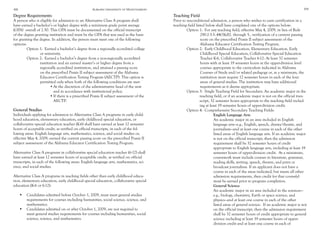
  • 53.
    102 Auburn Universityat Montgomery 103 strategies and techniques. Includes a review of curriculum standards and assessment strategies. Field experiences required. May be taught concurrently with SCED 4152. 6520. Curriculum and Teaching in Area of Specialization (3). Pr., graduate stand- ing. A critical study of teaching practices and reappraisal of selecting experiences and content for curriculum improvement. 6540. Evaluation of Program in Area of Specialty (3). Pr., graduate standing. Evaluation and investigation of teaching effectiveness, with attention also given to the utilization of human and material resources and the coordination of areas of specialization with the total school program and with other education programs of the community. 6570. Advanced Instructional Strategies (3). Pr., graduate standing. A theory-prac- tice course designed for in-service teachers committed to a serious examination of their teaching practices. Co-equal emphasis on theory and practice. 6610. Research in Education (3). Pr., graduate standing. A basic research course designed to evaluate research design, methods and experimentation in education and related areas. 6902. Studies in Education (1-3). Pr., graduate standing. Independent study in major area to be selected in consultation with the professor who will supervise the study. Maximum credit 3 hours. 6924. Professional Internship in the Secondary School (1-6). Pr., graduate stand- ing, departmental approval. Students placed in accredited public schools in the area for supervised teaching experiences. Students must submit an application for internship to the director of laboratory experiences prior to placement. 6952. Seminar (1-3). Pr., graduate standing. An analysis of selected topics in area of specialization. Maximum credit 3 hours. 7982. Master’s Comprehensive Exam (0). Pr., graduate standing. A comprehensive exam to evaluate graduate study. 7992. Master’s Thesis (3). Pr., graduate standing, departmental approval, FNDS 6610. The thesis is a formal research project in the area of exercise science or physical education. Physical Education and Exercise Science Physical Education and Exercise Science (PHED) 6003. Advanced Exercise Physiology (3). Pr., graduate standing, undergraduate Exercise Physiology. An advanced study of exercise physiology as it relates to human movement. May be taught concurrently with PHED 4003. 6013. Advanced Cardiac Rehabilitation (3). Pr., graduate standing, undergraduate Exercise Physiology. Emphasizes the theories, programming and procedures in reha- bilitating those with cardiovascular disease. Students acquire academic and practical experience in exercise and therapeutic exercise prescriptions. May be taught concur- rently with PHED 4013. 6020. Elementary Methods in Physical Education (3). Pr., graduate standing. Provides an in-depth study of current research, issues and trends in elementary physical education. Research is conducted in these areas to ascertain the best cur- rent practices available. 6030. Advanced Methods of Teaching Physical Education (3). Pr., graduate stand- ing. Provides an in-depth study of instructional methods, the learning process, evaluation, curriculum trends and factors impacting the physical education pro- gram. May be taught concurrently with PHED 4030. 6043. Advanced Kinesiology (3). Pr., graduate standing. An advanced course in the study of human motion. Biomechanics related to sport and exercise emphasized. May be taught concurrently with PHED 4043. 6044. Advanced Biomechanics of Human Movement (3). Pr., PHED 6043. A course designed to study of the mechanical laws and principles that govern human movement and its application to activities of daily living, fitness, sport and rehabilitation. 6050. Advanced Motor Development (3). Pr., graduate standing. Measurement, evaluation and neurological structure of the human organism. Researching the motor learning aspect of the development of motor skills is an integral component of the course. May be taught concurrently with PHED 4050. 6160. Advanced Adapted Physical Education (3). Pr., graduate standing. Guides the student in the development of adapted programs to meet the needs of children with exceptionalities. Identification and diagnosis of various discrepancies also included. May be taught concurrently with PHED 4160. 6183. Advanced Measurement and Evaluation (3). Pr., graduate standing. Ele- ments of measurement and evaluation as they relate to research design, statistics and
  • 54.
    104 Auburn Universityat Montgomery 105 fundamentals of exercise testing. May be taught concurrently with PHED 4183. 6200. Organization and Administration of Sports and Physical Education (3). Pr., graduate standing. A course designed to study the organizational and administra- tive duties associated with sports and physical education. 6230. Scientific Basis of Exercise (3). Pr., graduate standing. Scientific basis for exercise training, conditioning and coaching-related variables. 6243. Advanced Exercise Prescription (3). Pr., graduate standing. Principles of exercise prescription as they relate to normal and special populations. May be taught concurrently with PHED 4153. 6250. Nutritional Basis of Exercise (3). Pr., graduate standing. An overview of the relationships between nutrition and motor performance. Consideration of materi- als applicable to nutrition and survey of current literature in the field of nutrition education. May be taught concurrently with PHED 4250. 6260. Consumer Health (3). Pr., graduate standing. Principles related to selection and use of health products and services. Consideration of materials applicable to consumer health education, evaluation techniques, preparation of consumer health teaching units and survey of current literature. 6270. Advanced Sociology of Sport and Physical Activity (3). Pr., graduate stand- ing. Introduces the sociological aspects of sport and physical activity. Attention given to the role of sport in connection with other spheres of social life such as fam- ily, education, politics and the media. 6280. Psychology of Coaching (3). Pr., graduate standing. Introduces and evaluates the psychological aspects of teaching and coaching. Emphasis on the psychological preparation of the individual athlete and team cohesiveness. May be taught concur- rently with PHED 4280. 6310. Ethics in Sport (3). Pr., graduate standing. A course designed to promote critical examination of ethical issues and moral dilemmas inherent in sport and physical education. 6320. Adapted Physical Education (3). Pr., graduate standing. Prepares students to recognize the physiological discrepancies that affect motor learning. Students required to analyze selected diagnostic instruments. May be taught concurrently with PHED 4320. 6330. Sport Marketing (3). Pr., graduate standing. A course designed for students to acquire an understanding of the unique concepts and theories associated with sport marketing. 6340. Risk Management and Legal Issues in Sport and Physical Education (3). Pr., graduate standing. Provides graduate students with an in-depth study of risk man- agement and legal issues facing sport managers and physical education teachers. 6350. Sport Facility Planning & Construction (3). Pr., graduate standing. Provides graduate students an overview of the fundamentals of planning, design and construction of physical education, recreation and sport facilities. 6360. Advanced Sport Finance (3). Pr., graduate standing. This course will apply economic principles to professional, collegiate, and high school sports programs. It will also provide the student with practical background knowledge of the general principles in financial management. 6363. Advanced Emergency Medical Care (3). Pr., graduate standing. Provides professional rescuer skills (BLS, first aid, advanced care). Injury and disease preven- tion emphasized in conjunction with practical skills and teaching experiences. May be taught concurrently with PHED 4363. 6370. Advanced Sport Sales and Promotion (3). Pr., graduate standing. A critical examination of theory and practice related to sales and promotion in sport and physical education. 6380. Leadership in Sport Organizations (3). Pr., graduate standing. The purpose of this course is to study leadership theory as it applies to sport organizations. 6383. Advanced Athletic Training (3). Pr., graduate standing. Current practices in sports medicine, including practical experience in training athletes and preventing and treating sport injuries. May be taught concurrently with PHED 4383. 6924. Advanced Internship in Physical Education (3-9). Pr., graduate standing, departmental approval. An internship to gain or improve knowledge and abilities related to teaching physical education. 6944. Professional Leadership (3). Pr., graduate standing, departmental approval. Provides the graduate student the opportunity to gain knowledge and professional experience in program development, supervision, and leadership. May be taught concurrently with PHED 4944. 6954. Internship in Sport Management (Non-cert) (1-6). Pr., admission to intern- ship. The student will be placed in a professional setting designed to meet his/her career goals and desires. 6964. Internship in Sport Management (Cert.) (1-6). Pr., admission to internship. The student will be placed in a professional setting designed to meet his/her career goals and desires.
  • 55.
    106 Auburn Universityat Montgomery 107 6972. Problems and Issues (3). Pr., graduate standing, departmental approval. Designed to enable the graduate student to research current problems and issues in physical education or exercise science. 7914. Advanced Practicum in Physical Education, Exercise Science and Sport Management (3-6). Pr., graduate standing and department approval. Advanced practical experiences in professional settings related to physical education, exercise science and sport management. 7915. Advanced Practicum in Physical Education or Exercise Science (3-6). Pr., graduate standing and departmental approval. Advanced practical experiences in professional settings related to physical education or exercise science. 7982. Master’s Comprehensive Exam (0). Pr., graduate standing. A comprehensive exam to evaluate graduate study. 7985. Non-Thesis Project (3). Pr., graduate standing, departmental approval, FNDS 6610. A course for the non-thesis major to develop a comprehensive research project. 7992. Master’s Thesis (3). Pr., graduate standing, departmental approval, FNDS 6610. Formal research project in the area of exercise science or physical education. 8982. Education Specialist Comprehensive Exam (0). Pr., departmental approval. Comprehensive exam to evaluate advanced graduate study. School of Liberal Arts Dr. Michael Burger, Dean Faculty: Communication (COMM) Associate Professors Giagnoni and Ogburn Assistant Professors Jones and Wood Theatre (THEA) Professors M. Winkelman and V. Winkelman Associate Professor Seibel English (ENGL) Professors Evans, Gerard, Gribben, Harris-Fain (Chair), Kaufman, Sterling, Wiedemann, and Willis Associate Professors Aaij, Anderson, Kelley, and Woodworth Assistant Professors Havard, Klevay, and Reno Philosophy (PHIL) Assistant Professors Cobb and Jordan Fine Arts Associate Professors Baine and Hairstans Assistant Professors Fenn, Lemay, and Lingamfelter History (HIST) Professors Farrow (Associate Dean), Fitzsimmons, Gish, Henderson (Chair), Krawczynski, Severance, Wells, and Zhai Associate Professors Bulman and Simmons World Languages and Cultures Associate Professor Long (Coordinator) Visiting Assistant Professor Bonkougou Sociology (SOCI) Professors Djamba and Tang Associate Professors Brackett (Associate Dean), Davis-Maye, and Yarber Assistant Professor Feltmate Anthropology (ANTH) Associate Professor Winemiller (Chair) Assistant Professor Pyszka Geography (GEOG) Associate Professor Winemiller (Chair)
  • 56.
    108 Auburn Universityat Montgomery 109 Programs: Master of Liberal Arts Master of Arts in Sociology Master of Science in Sociology Graduate Work in the School of Liberal Arts The M.L.A. Degree The Master of Liberal Arts degree is designed for students seeking intellectual chal- lenge and interested in exploring a variety of current and classical ideas, themes and problems through the disciplines of the liberal arts. An interdisciplinary program, the M.L.A. involves students in the areas of anthropology, art, communication, English, foreign language, geography, geographic information systems (GIS), history, interna- tional studies, music, philosophy, sociology and theatre. Following a wide-ranging sur- vey of developments in culture and society of the Western world, the student builds a focused array of course work leading to a specific project and a thesis. Throughout the M.L.A. curriculum, students are challenged to write on diverse topics, thus sharpening the skills of critical thinking, effective analysis and scholarly research.   The Master of Liberal Arts is not a traditional professional degree but should enhance any student’s effectiveness in a career, regardless of profession, in addition to providing opportunities for intellectual growth. Graduate Study Requirements The program is open to graduates from any field who have demonstrated the capabil- ity to undertake graduate study. Graduate students must meet all admission require- ments of the AUM Graduate School pertaining to the master’s degree. Evidence considered includes undergraduate degree transcripts and scores on the Graduate Record Examination or the Miller Analogies Test as well as a letter from the candi- date explaining his or her particular interest in the M.L.A. program and plans for specialization(s) within it. The GRE or MAT is waived for students who already have earned a master’s degree. Students with a 2.75 minimum GPA in their undergradu- ate career or their last 60 credit hours are admitted provisionally before taking the test; they must take the test within their first semester of graduate study to be fully admitted and to remain in the program. Probationary students, who earn between a 900-959 score on the admission formula, must maintain a 3.0 GPA in their first 12 hours of graduate study in order to remain in the program.   The 30-hour M.L.A. program includes three required core courses that establish a basis for interdisciplinary study. Six additional courses are chosen from the graduate courses offered in particular disciplines in liberal arts to explore the student’s individual area of concern. The degree culminates with a required thesis and thesis defense. A grade average of at least B in all courses attempted in the student’s graduate program is required for graduation. The normal course load is nine (9) hours per semester. Course loads in excess of 12 hours must be approved by the dean of the School of Liberal Arts. All requirements for the M.L.A. degree must be completed within five calendar years from the date the student begins graduate study. Students are eligible for a time extension for a sixth and seventh year to complete and defend their thesis. These students must submit the Time Extension Form in which they explain the reason why they have not yet completed their thesis. The form must be approved by the M.L.A. Coordinator, the Dean of the School of Liberal Arts, and the Associate Provost. Decisions are made on an individual basis. Extensions beyond seven years are not permitted. The Master of Liberal Arts Program The Master of Liberal Arts degree requires 32 semester hours in all. The following nine (9) hours of course work are required. Core Courses (MLAS.) 6000. Research and Writing (2). Pr., admission to M.L.A. program. Required of all students in the Master of Liberal Arts program. Emphasizes interdisciplinary writing and introduces the student to library research at the graduate level. Available online or in the classroom. 6010. Themes in Culture and Society I (3). Pr., admission to M.L.A. program. Required of all students in the Master of Liberal Arts program. An interdisciplinary exploration of culture and society through aesthetics, art, communication, drama, history, literature, music, politics, philosophy and social movements from ancient times through the 17th century. Available online or in the classroom. 6020. Themes in Culture and Society II (3). Pr., admission to M.L.A. program. Required of all students in the Master of Liberal Arts program. An interdisciplinary exploration of culture and society through aesthetics, art, communication, drama, history, literature, music, politics, philosophy and social movements from the 17th century to the present. M.L.A. Seminar Electives (MLA) When the core courses are completed, the student’s individual area of study is planned with the M.L.A. graduate coordinator. This area of study is comprised of six 3-hour semester courses (18 hours) chosen from the M.L.A. seminars. With permission of the M.L.A. coordinator, students may supplement these seminars with selected graduate course work from the individual disciplines. Course work must be done in at least two fields. The M.L.A. seminars are: 6000. Research and Writing (3). Pr., graduate standing. Emphasizes interdisciplin- ary writing and introduces the student to library research at the graduate level.
  • 57.
    110 Auburn Universityat Montgomery 111 6010. Themes in Culture and Society I (3). Pr., graduate standing. An interdisci- plinary exploration of culture and society through aesthetics, art, communication, drama, history, literature, music, politics, philosophy, and social movements from ancient times through the 17th century. 6020. Themes in Culture & Society II (3). Pr., graduate standing. An interdisci- plinary exploration of culture and society through aesthetics, art, communication, drama, history, literature, music, politics, philosophy, and social movements from the 17th century to the present. 6100. Studies in Fine Arts (3). Pr., completion or concurrent enrollment in MLAS 6010 or MLAS 6020 when offered. Period and topic courses in fine arts; the exact emphasis specified at each course offering. 6150. Studies in Music (3). Pr., completion or concurrent enrollment in MLAS 6010 or MLAS 6020 when offered. Period and topic courses in music; the exact emphasis specified at each course offering. 6200. Studies in English (3). Pr., completion or concurrent enrollment in MLAS 6010 or MLAS 6020 when offered. Period or topic courses in English; the exact emphasis specified at each course offering. 6250. Studies in Philosophy (3). Pr., completion or concurrent enrollment in MLAS 6010 or MLAS 6020 when offered. Period or topic courses in philosophy; the exact emphasis specified at each course offering. 6300. Studies in History (3). Pr., completion or concurrent enrollment in MLAS 6010 or MLAS 6020 when offered. Period or topic courses in history; the exact emphasis specified at each course offering. 6400. Studies in International Studies (3). Pr., completion or concurrent enroll- ment in MLAS 6010 or MLAS 6020 when offered. Period or topic courses in international studies; the exact emphasis specified at each course offering. 6500. Studies in Sociology (3). Pr., completion or concurrent enrollment in MLAS 6010 or MLAS 6020 when offered. Period or topic courses in sociology; the exact emphasis specified at each course offering. 6600. Studies in Theatre (3). Pr., completion or concurrent enrollment in MLAS 6010 or MLAS 6020 when offered. Period or topic courses in theatre; the exact emphasis specified at each course offering. 6650. Studies in Communication (3). Pr., completion or concurrent enrollment in MLAS 6010 or MLAS 6020 when offered. Period or topics courses in communication; the exact emphasis specified at each course offering. 6930. Directed Study in Liberal Arts (1-6). Pr., completion or concurrent enroll- ment in MLAS 6010 or MLAS 6020 when offered. Permission of M.L.A. coordina- tor and instructor. Thesis-Related Courses 6952. Thesis Seminar (2). Pr., completion of 21 hours in the M.L.A. program. A seminar for the development of a thesis topic, preliminary research on that topic and the writing of a thesis prospectus with bibliography. 6992. Thesis (3). Pr., completion of all other course work in the M.L.A. program and a 3.0 graduate GPA on a 4.0 scale. The student will submit to the Liberal Arts Graduate Committee and defend an approved thesis in partial fulfillment of the requirements for the Master of Liberal Arts degree. Additional Graduate Offerings in Liberal Arts In addition to courses for the Master of Liberal Arts degree, the School of Liberal Arts offers graduate courses in anthropology, art, English, geography, gerontology, history, philosophy, sociology, spanish, speech-language pathology and audiology, theatre and world languages and cultures designed to support the master’s degree program in education and which can supplement the seminar offerings for the M.L.A. degree. The Liberal Arts courses approved for graduate credit are: Communication (COMM) 6030. Communication Theory (3). Pr., graduate standing. Major theoretical ap- proaches to and issues involved in the study of human communication. Various psychological and sociological conceptualizations of the communication process. May be offered concurrently with COMM 4030. 6110. Theories of Persuasion (3). Pr., graduate standing. Major social and psycho- logical approaches to the study of attitudes and attitude change. Includes the study and analysis of theory and focuses on the persuasive campaign in various contexts. 6130. Research Methods (3). Pr., graduate standing. Examines methods of research in communication. Intended to increase understanding of research literature, including design, subject selection, instrumentation, procedures, rules of inference, and theory testing. 6310. Advanced Interpersonal Communication (3). Pr., graduate standing. A study of the communication process in various interpersonal contexts. Considers prob- lems of conflict management as well as the so called “dark side” of interpersonal communication. 6330. Special Topics in Communication (3). Pr., graduate standing. An explora- tion of a theme from any area of communication having contemporary relevance.
  • 58.
    112 Auburn Universityat Montgomery 113 Course may be repeated for a maximum of 6SH, provided a different theme is selected each time. 6504. Advanced Methods and Procedures in Speech Pathology (3). Pr., graduate standing. Advanced studies in service delivery models in speech pathology, program design, implementation procedures and outcome criterion. 6510. Articulation and Phonological Disorders (3). Pr., graduate standing. Advanced studies in disorders of articulation, with emphasis on diagnosis and methods of remediation. Participation in clinical activities required. May be taught concurrently with COMM 4510. 6520. Voice Fluency (3). Pr., graduate standing. Advanced studies in disorders of voice and rhythm, with emphasis on diagnosis and remediation. Participation in clinical activities required. May be taught concurrently with COMM 4520. 6530. Language Development and Disorders (3). Pr., graduate standing. Advanced studies in language development and disorders, with emphasis on diagnosis and remediation of language delay and disorders. Participation in clinical activities required. May be taught concurrently with COMM 4530. 6543. Diagnosis and Clinical Management in Speech-Language Pathology (3). Pr., permission of instructor. Evaluation and clinical management of speech-language disorders, with emphasis on assessment techniques, therapeutic principles and processes. May be taught concurrently with COMM 4543. 6600. Advanced Audiology and Hearing Disorders (3). Pr., graduate standing. Advanced study of the principles of auditory reception, hearing mechanism and problems involved in measuring, evaluating and conserving hearing. Etiology and management addressed. 6610. Hearing Pathology (3). Pr., COMM 6600. Types and causes of auditory disorders; basic principles of special auditory tests for site of lesion. May be taught concurrently with COMM 4610. 6620. Advanced Aural Rehabilitation, Habilitation and Hearing Conservation (3). Pr., graduate standing. Advanced study of the rehabilitation of aurally handicapped children and adults, with emphasis on auditory training, speech reading and hear- ing aids. Independent study and research required. May be taught concurrently with COMM 4620. 6720. Critical Issues in Mass Media (3). Pr., graduate standing. Critical analysis of the purpose, functions and effects of mass media. 6900. Independent Study in Communication (1-3). Pr., graduate standing, permis- sion of instructor. Special research problems or projects in communication studies as determined by the instructor and student. May be repeated for credit when the topics vary. A maximum of nine (9) semester hours may be earned. Communication Disorders (CMDS) 5400. Pediatric Audiology (3). Etiologic factors, screening, audiologic assessment, differential diagnosis and clinical management of infants and children with hearing disorders. Theatre (THEA) 6310. The Dramatic Literature and Theatre History of the Western World I (3). Pr., graduate standing. Dramatic literature and theatre history from the rituals of ancient civilizations to the middle of the 19th century. May be taught concurrently with THEA 4310. 6320. The Dramatic Literature and Theatre History of the Western World II (3). Pr., graduate standing. Theatre history and dramatic literature from Ibsen to today. Deals extensively with the theatre of our day. May be taught concurrently with THEA 4320. 6740. Studies in American Drama and Theatre (3). Pr., graduate standing. Topics in the history and major developments of American dramatic literature and the stage. May be repeated twice when the topics vary. May be offered concurrently with THEA 4740. 6852. Studies in Drama (3). Pr., graduate standing. Examination of a sub-genre or period of drama, such as tragedy, Restoration comedy, 18th century British drama or modern drama, to be specified for each course scheduling. May be repeated twice when the topics vary. May be offered concurrently with THEA 4852. 6902. Independent Study (1-3). Pr., permission of instructor. Advanced indepen- dent reading and/or research in selected areas of theatre. 6972. Selected Topics in Theatre (3). Pr., permission of instructor. An exploration of a theme from any area of the theatre having contemporary relevance. Course may be repeated for credit up to three times, provided a different theme is selected each time. English (ENGL) 6010. Poetry Writing Workshop (3). Pr., graduate standing. Workshop designed to help students become more accomplished writers of poetry and more insightful readers of poetry. May be offered concurrently with ENGL 4010.
  • 59.
    114 Auburn Universityat Montgomery 115 6012. Special Topics in Creative Writing (3). Pr., graduate standing. Introduction to a specific genre of creative writing, such as children’s literature, songwriting, sci- ence fiction, etc. Students write in the genre and become more insightful readers of the genre. May be repeated twice when topics vary. May be offered concurrently with ENGL 4012. 6020. Fiction Writing Workshop (3). Pr., graduate standing. Introduction to writing and critiquing fiction. This course will be conducted primarily as a work- shop, centered on discussion of original student writing in order to explore topics involved in creating good fiction. May be offered concurrently with ENGL 4020. 6040. Creative Nonfiction Workshop (3). Pr., graduate standing. Workshop de- signed to help students become more accomplished writers of creative nonfiction and more insightful readers of the genre. May be offered concurrently with ENGL 4040. 6050. Advanced English Grammar (3). Pr., graduate standing. Intensive study of English grammar from the transformational, structural and traditional perspec- tives; examination of Black English. May be offered concurrently with ENGL 4050. 6060. Theories of Composition (3). Pr., graduate standing. Study of composition theory and the composing process for teachers and writers. May be offered concur- rently with ENGL 4060. 6070. History of the English Language (3). Pr., graduate standing. The chrono- logical development of the English language, with specific attention to changes in sounds, spellings, inflectional endings, syntax and vocabulary, and to their relation- ships to political and social history. May be offered concurrently with ENGL 4070. 6080. Literary Criticism (3). Pr., graduate standing. Advanced study of the history of critical theory from Aristotle to the present, emphasizing the evolution of aesthetic concepts predominant in the study of Western literature. May be offered concur- rently with ENGL 4080. 6090. Writing Across the Curriculum (3). Pr., graduate standing. Strategies and practice for incorporating writing into the learning process in all curricula. May be offered concurrently with ENGL 4090. 6100. Pedagogy of Basic Writing (3). Pr., graduate standing. Study of theories of composition and application to basic writing instruction. 6130. Studies in Mythology (3). Pr., graduate standing. An examination of the origin, nature and transmission of myth, as well as the importance of myth to cultural traditions and cohesiveness. A specific focus announced when the course is offered, investigating such topics as the hero, gender images or myth in film. May be offered concurrently with ENGL 4130. 6160. Chaucer (3). Pr., graduate standing. A detailed study of Chaucer’s minor works and The Canterbury Tales, together with the linguistic, literary and historical backgrounds of his age. May be offered concurrently with ENGL 4160. 6210. Poetry and Prose of the English Renaissance (3). Pr., graduate standing. The non-dramatic literature of the Tudor period, stressing the humanist poets and prose writers. The history of the period emphasized along with the stylistic and generic relationship between the Renaissance and modern literature. May be offered concurrently with ENGL 4210. 6270. Studies in Shakespeare (3). Pr., graduate standing. A study of the plays of Wil- liam Shakespeare. The topic will vary from semester to semester at the discretion of the instructor. May be offered concurrently with ENGL 4270. 6310. Poetry and Prose of the Seventeenth Century (3). Pr., graduate standing. The non-dramatic literature of the 17th century, with an emphasis on the stylistic and generic contributions of John Milton, the Metaphysical poets and important prose writ- ers. May be offered concurrently with ENGL 4310. 6360. The Bible as Literature (3). Pr., graduate standing. Historical-critical analysis of selected books from the Old Testament: their historical and social context, their composition and their meaning to their original audience. This course provides an in-depth literary study of the Bible. May be offered concurrently with ENGL 6360. ENGL 6370. Literature of the Old Testament (3). Pr., graduate standing. Histori- cal-critical analyses of selected books from the Old Testament: What was their his- torical context, how were they composed, and what did they mean to their original audience? May be offered concurrently with ENGL 4370. 6410. Eighteenth-Century Prose and Poetry (3). Pr., graduate standing. A study of the poetry and prose writing of the Neoclassical Age, with an emphasis on Dryden, Swift and Pope; and the philosophical, religious and political backgrounds of their writings. May be offered concurrently with ENGL 4410. 6430. British Novel I (3). Pr., graduate standing. A study of the evolution of the British novel from its experimental stages in the early 18th century to its emergence as an established literary genre by 1800. May be offered concurrently with ENGL 4430. 6510. The English Romantic Movement (3). Pr., graduate standing. An intensive study of the social, political and aesthetic aspects of the English Romantic movement
  • 60.
    116 Auburn Universityat Montgomery 117 and of the writers from Blake through Keats who constitute the major poets of this period. May be offered concurrently with ENGL 4510. 6530. British Novel II (3). Pr., graduate standing. Advanced study of the develop- ment of the British novel in the 19th century, with emphasis on the relationship of the novel to the predominant social concerns of the Victorian period. May be offered concurrently with ENGL 4530. 6550. Victorian Poetry and Prose (3). Pr., graduate standing. An in-depth examina- tion of the writings of Tennyson, Browning, Arnold, Carlyle and other selected Victorian poets and essayists, with special emphasis on the impact of the industrial and scientific revolutions on 19th-century thought as reflected in their works. May be offered concurrently with ENGL 4550. 6620. Jewish Literature of the Holocaust (3). Pr., graduate standing. Introduction to Jewish literature of the Holocaust, with in-class writings on the perception of the Holocaust. May be offered concurrently with ENGL 4620. 6630. British Novel III (3). Pr., graduate standing. The technique and form of the modern novel; its themes, narrative developments and styles as seen in close study of the works of major 20th-century British novelists. May be offered concurrently with ENGL 4630. 6710. American Poetry (3). Pr., graduate standing. A study of American poets, emphasizing major figures of 19th - and 20th -century poetry. Selected works of such masters as Whitman, Dickinson, Frost, Eliot, Stevens and Williams. May be of- fered concurrently with ENGL 4710. 6720. American Short Story (3). Pr., graduate standing. A study of major Ameri- can short-story writers; the focus to be announced at each scheduling of the course. May be offered concurrently with ENGL 4720. 6730. American Novel (3). Pr., graduate standing. A study of major contributions to the genre; the focus announced at each scheduling of the course. May be offered concurrently with ENGL 4730. 6740. Studies in American Drama and Theatre (3). Pr., graduate standing. Topics in the history and major developments of American dramatic literature and the stage. May be repeated twice when the topics vary. May be offered concurrently with ENGL 4740. 6760. American Theatre and Drama II (3). A study of major development in the history of American theatre from 1929 to the present, emphasizing the works of playwrights such as O’Neill, Williams, Wilder, Inge, and Albee. May be offered concurrently with ENGL 4760. 6770. Studies in Southern Literature (3). Pr., graduate standing. Authors, works and literary movements associated with the American South, including Colonial writers, slavery and slave narratives, the Civil War, Southern Gothic, the Southern Renaissance or Southern women writers. May be offered concurrently with ENGL 4770. May be repeated once for credit when topics vary. 6780. Studies in Children’s Literature (3). Pr., graduate standing. Theme, genre, nar- rative, character, popular reception, publishing history and other subjects relating to literature for young audiences. Seminar titles announced each time the course is scheduled. May be offered concurrently with ENGL 4780. May be repeated once for credit when topics vary. 6810. Modern Poetry (3). Pr., graduate standing. Analyses of 20th-century poets and poetic movements of Britain, America and Europe, treating their background, development, influence and particular achievement, both thematic and technical. May be offered concurrently with ENGL 4810. 6820. Studies in American Literature (3). Pr., graduate standing. Topics illustrating selected experiences, voices and themes of U.S. authors, including those describing ethnic identities and literary movements. Focus announced at each scheduling of course. May be repeated twice for credit when topics vary. May be offered concur- rently with ENGL 4820. 6830. Studies in British and American Literature (3). Pr., graduate standing. Topics combining British and American literary works and examining themes, figures, movements or other phenomena that illustrate trans-Atlantic connections. Focus announced at each scheduling of course. May be repeated twice when topics vary. May be offered concurrently with ENGL 4830. 6840. Studies in Literary Form (3). Pr., graduate standing. Topics in the develop- ment and artistry of a particular genre or sub-genre, such as the essay, autobiogra- phy, letter, travel narrative, literary biography or diary and journal, as announced. May be offered concurrently with ENGL 4840. May be repeated twice for credit when topics vary. 6850. Studies in Drama (3). Pr., graduate standing. The development, forms and techniques of a particular period or sub-genre of drama, such as Restoration drama or comedy, to be specified at each course offering. May be offered concurrently with ENGL 4850. May be repeated twice when topics vary. 6860. Medieval Literature (3). A study of English and selected Continental literature from the Old English elegy through Morte D’Arthur. May be offered concurrently with ENGL 4860. May be repeated twice for credit when topics vary.
  • 61.
    118 Auburn Universityat Montgomery 119 6870. Studies in British Literature (3). Topics illustrating selected experiences, voices and themes of British authors, including literary movements. Focus varies with each course offering. May be repeated twice when the topics vary substantially. May be of- fered concurrently with ENGL 4825. 6924. Internship in Editing and Writing (1-6). Pr., departmental approval and 6 hours in designated upper-level or graduate rhetoric, writing, linguistic or editing courses; graduate standing. On-the-job training in editing, word processing, drafting or other duties of an assistant editor. The student’s progress monitored by a super- vising professor. May be offered concurrently with ENGL 4924. 6935. Directed Creative Writing (3). Pr., ENGL 6010, ENGL 6012, ENGL 6020, or ENGL 6040 and permission of instructor. An advanced specialized creative writ- ing course for students who have successfully completed ENGL 6010, ENGL 6012, ENGL 6020, or ENGL 6040. Students work individually or in small groups with the instructor on projects in poetry, fiction, or creative nonfiction. May be repeated twice when genres vary. 6962. Readings in English (1-6). Pr., departmental approval, graduate standing. Individual study programs in literature or language as determined by the instructor and student. A minimum of two written assignments required. 6972. Special Topics in Research and Writing (1-3). Pr., permission of instructor, graduate standing. Instruction and practice in specialized fields within the larger areas of research and writing, such as advanced scholarly projects, archival studies, computer research, grant proposals or community publications. Focus announced at each scheduling of course. May be repeated for credit once when topics vary. 6973. Professional Writing, Editing and Consulting (3). Pr., graduate standing. Instruction and practice in professional writing, editing, and consulting with varied audiences, for varied purposes. At the discretion of the instructor, may involve observation hours, internship activities, guest lectures, and visits to and from professional writers/editors/consultants. 6974. Composition Teaching Practicum (3). Pr., graduate standing. Topics on the practice and theory of teaching college composition: rubrics/outcomes for grading, research on teaching writing, informational literacy standards, curriculum develop- ment, L2 writing, basic writing, and policies and procedures. 6975. Master’s in Teaching Writing Thesis/Portfolio (3). Pr., Completion of core and elective requirements for M.T.W. Two-part capstone course is a partial fulfill- ment for the M.T.W. Part one: development of prospectus. Part two: writing of the- sis and portfolio, submission to committee for approval, scheduling of oral defense of both thesis and portfolio. 6976. Certificate of Teaching Writing Portfolio (3). Pr., Completion of core courses for C.T.W. A capstone course in partial fulfillment of the C.T.W. Includes devel- opment of portfolio, submission to committee for approval, and scheduling of oral defense of portfolio. Philosophy (PHIL) 6100. Moral Theory (3). Pr., graduate status. This course examines philosophical questions about the nature of morality. Possible topics include: accounts of the ori- gins of morality, the nature and justification of moral judgments, the implications of moral disagreement, and the relationship between religion and morality. May be offered concurrently with PHIL 4100. 6110. God & Morality (3). Pr., graduate status. This course involves a philosophi- cal examination of the relationship between religion and morality. Issues to be discussed include the tenability of non-theistic explanations of morality, various theistic accounts of morality, and the relationship between theism and the mean- ingfulness of human life. May be offered concurrently with PHIL 4110. 6150. Issues in Bioethics (3). An investigation of theoretical and practical ethical issues related to contemporary medical practices, including abortion, euthanasia, and the challenges posed by emerging biotechnologies. 6200. Philosophy of Religion (3). Pr., graduate status. A broad survey of important concerns in the philosophy of religion, including the acquisition of adequate under- standing of the classical theistic conception of God and a study of the challenge that evil raises for traditional theistic faith. May be offered concurrently with PHIL 4200. 6210. Philosophical Theology (3). Pr., graduate status. There is considerable over- lap between the methods and questions of philosophy, as historically practiced, and the discipline of theology. This course involves a philosophical investigation of various theological topics, with particular emphasis on the Christian tradition. Examples include: the relationship between faith and reason; religious exclusivism and inclusivism; divine attributes; trinity, incarnation, and atonement; inspiration; heaven and hell; and creation. May be offered concurrently with PHIL 4210. 6220. The Philosophical Writings of C. S. Lewis (3). Pr., graduate status. Although best known for being the author of the Chronicles of Narnia, C. S. Lewis was a pro- lific writer whose work dealt with a number of perennial philosophical topics. This course will examine Lewis’s views of religion and morality as expressed in non-fiction books like The Abolition of Man, Mere Christianity, and Miracles, as well as in fictional writings such as the Narnia books, the space trilogy, and Till We Have Faces. (Read- ings may vary by semester). May be offered concurrently with PHIL 4220. 6230. Inklings: Literary Friendship, Fantasy and Philosophy (3). Pr., graduate standing. Advanced study of the writings of the “Inklings”, a group of authors who
  • 62.
    120 Auburn Universityat Montgomery 121 worked in and around Oxford, England in the mid-twentieth century, including C. S. Lewis, J. R. R. Tolkien, Owen Barfield and Charles Williams. 6330. History of Modern Philosophy (3). Pr., graduate standing. A study of major figures in modern philosophy from Rene Descartes to Immanuel Kant. May be of- fered concurrently with PHIL 4330. 6670. Topics in Philosophy (3). Pr., graduate status. Instruction in specialized fields within philosophy, such as advanced scholarly projects. Focus varies with each course. May be repeated for credit twice when topics vary. Fine Arts The Department of Fine Arts has two constituents: the visual arts and music. Candidates for the M.L.A. degree may take course work in these areas and, with the approval of the department head, may focus on either one for thesis purposes. Teachers or prospective public school teachers who wish to earn the M.Ed. degree with certification in art N-12 may pursue that program at AUM. See the graduate advisor in the School of Education and the Department of Fine Arts for additional information. Also available in the School of Education is a program of certification in art for nontraditionally prepared undergraduates. Visual Arts (VISU) 6010. Survey of Non-Western Art (3). Pr., graduate standing. Survey of tribal, pre- Columbian, Islamic, Indian and Far Eastern art. May be taught concurrently with the corresponding senior-level course. 6020. The Renaissance in Italy (3). Pr., graduate standing. An analysis of the visual arts in Italy from the 14th through 16th centuries. May be taught concurrently with VISU 3020. 6030. History of Seventeenth and Eighteenth Century Art (3). Pr., graduate stand- ing. An investigation beyond the survey level of Western painting, sculpture and archi- tecture produced during the Baroque and Rococo periods. May be taught concurrently with the corresponding senior-level course. 6040. History of Nineteenth Century Art (3). Pr., graduate standing. An investiga- tion beyond the survey level of Western painting, sculpture and architecture from the late 18th through the 19th century. May be taught concurrently with the correspond- ing senior level course. 6050. American Art (3). Pr., graduate standing. A study beyond the survey level of the visual arts in America from the Colonial Era to the present. May be taught concurrently with corresponding senior level course. 6060. Art Since 1945 (3). Pr., graduate standing. A study of international art since 1945 as well as themes and issues in contemporary art. May be taught concurrently with the corresponding senior-level course. 6070. Women in the History of Art (3). Pr., graduate standing. A study of women artists from 1550 to the present, including cultural and social issues and historiogra- phy. May be taught concurrently with corresponding senior-level course. 6090. Medieval Art (3). A study of the art and architecture of Western Europe and Byzantium from the Early Christian period through the Gothic era. May be taught concurrently with VISU 3090. 6100. The Artist in Film and Fiction (3). Pr., VISU 2030, VISU 2040, graduate stand- ing. The proposed course examines the way in which visual artists have been (and cur- rently are) depicted in film and fiction. The course will examine a wide range of material beginning with early films and 18th and 19th century stories and books. 6110. History of Photography (3). A survey of the history of photography from its invention in 1839 to the present day. 6212. Painting (3). Pr., Permission of Instructor. Graduate painting; optional prob- lems and media. May be repeated for credit. 6512. Printmaking. Pr., Permission of Instructor. Graduate printmaking; optional problems and media. May be repeated for credit. 6902. Individual Studio Project (3). Pr., department head’s approval. Graduate work in the various disciplines designed by the student with approval of faculty involved. May be repeated for credit. May be taught concurrently with the corre- sponding senior-level course. History (HIST) 6010. The American South to 1865 (3). Pr., graduate standing. The growth and development of the distinctive political, economic, social, cultural and ideological patterns of the South from 1607 to 1865. Concurrent with HIST 4010. 6020. The American South Since 1865 (3). Pr., graduate standing. The continued growth and development of the distinctive political, economic, social, cultural and ideological patterns of the South since the end of the Civil War. Concurrent with HIST 4020. 6030. History of American Slavery (3). Pr., graduate standing. A survey of slavery in America from its introduction to the Civil War, with particular attention to the social structure and lives of black Americans and slavery’s impact upon community life, politics and culture. Concurrent with HIST 4030.
  • 63.
    122 Auburn Universityat Montgomery 123 6040. The African-American Experience since Emancipation (3). Pr., graduate standing. The experience of American blacks since the end of the Civil War, includ- ing Reconstruction and the Civil Rights movement. Concurrent with HIST 4040. 6050. The History of Alabama (3). Pr., graduate standing. A survey of the social, political and economic development of Alabama from the colonial era to the pres- ent. Concurrent with HIST 4050. 6080. American Intellectual History to 1865 (3). Pr., graduate standing. Perceptions, ideas and values in American culture from colonial times to the Civil War. Primary sources emphasized. Concurrent with HIST 4080. 6090. American Intellectual History Since 1865 (3). Pr., graduate standing. Percep- tions, ideas and values in American culture since 1865 with a special emphasis on change and disruption. Primary sources emphasized. Concurrent with HIST 4090. 6120. History of Religion in America (3). Pr., graduate standing. A survey of the religious experience in America, including consideration of the variety of religious traditions and how developments in religion have affected society, politics and culture since Colonial times. Concurrent with HIST 4120. 6140. The History of American Business (3). Pr., graduate standing. A survey of the development of capitalist enterprise in the United States from the first European settlements to the present, including an examination of the impact of capitalist change upon society. Concurrent with HIST 4140. 6150. American Diplomatic History (3). Pr., graduate standing. A survey of the principal forces and factors bearing on the relationships between the United States and other countries, 1776–present. Concurrent with HIST 4150. 6160. American Military History (3). Pr., graduate standing. A survey of U.S. military policy, strategy and tactics from 1775 to the present. Concurrent with HIST 4160. 6190. American Historiography (3). Pr., graduate standing. The development of historical writing in the United States, with emphasis on how particular scholars and schools of thought have had an impact on the intellectual life of the nation. Concurrent with HIST 4190. 6230. Women in Medieval Society (3). Pr., junior standing. Religious, political and social roles of women in the Middle Ages from about 500 to 1500. Course instruction will be lecture and discussion format; in-class essay exams and analytical papers will evaluate students’ performances. Concurrent with HIST 4230. 6240. Witchcraft and Magic Before 1700 (3). Pr., graduate standing. Medieval 16th and 17th century European witchcraft and magic in its social, political, religious and legal contexts. Concurrent with HIST 4240. 6250. Biographical Studies (3). Pr., graduate standing. Biography as a historical genre from antiquity to the present. Concurrent with HIST 4250. 6290. Non-American Historiography (3). Pr., graduate standing. The development of historical writing outside the United States, with emphasis on how particular scholars and schools of thought have had an impact on the intellectual life of western civilization. Concurrent with HIST 4290. 6310. The Renaissance (3). Pr., graduate standing. Medieval background, the nature of the Renaissance, Renaissance society, the Latin Church, the Renaissance state and political theory, Italian and northern humanism, the expansion of Europe, and Renaissance of art. Concurrent with HIST 4310. 6320. The Reformation (3). Pr., graduate standing. Religious and political back- ground of the Reformation, the Roman and German Churches, Martin Luther and the German Reformation, the French, Swiss and English Reformations, the Radical Reformation and the Catholic Reformation. Concurrent with HIST 4320. 6340. Medieval England (3). Pr., graduate standing. The Middle Ages in England, especially the post-Conquest period, examining political, social, economic and religious institutions and changes up to the beginning of the Tudor period in 1485. Concurrent with HIST 4340. 6350. Pilgrimage in the Middle Ages (3). Pr., graduate standing. Examines the people, places, and ideologies that played central roles in medieval Christian pilgrimage. 6360. Tudor–Stuart England (3). Pr., graduate standing. A study of the England of Henry VIII, Elizabeth I and James I or more broadly the 16th and 17th centuries, with emphasis on social, political, economic, constitutional, religious and intellec- tual changes of lasting effect. Concurrent with HIST 4360. 6380. Modern Britain (3). Pr., graduate standing. The economic, social, politi- cal and cultural forces contributing to the development of contemporary Britain. Concurrent with HIST 4380. 6400. France, 1787–1870 (3). Pr., graduate standing. Covering the beginning of the Revolution until the fall of Napoleon III, treats the era in terms of many of the forces arising from the Revolution. Concurrent with HIST 4400. 6410. Modern France, 1870–Present (3). Pr., graduate standing. Examines the
  • 64.
    124 Auburn Universityat Montgomery 125 uncertain course of republican government in France and some of the causes and consequences of this instability. Concurrent with HIST 4410. 6420. The French Revolution and Napoleon (3). Pr., graduate standing. Revolution- ary ideas and events in France and Europe from 1789 to 1815, with emphasis on forces and factors causing revolution and reaction. Concurrent with HIST 4420. 6450. Early Germany (3). Pr., graduate standing. The development of the Ger- manic peoples from Roman times to the end of the Napoleonic era, emphasizing the political structure of the Holy Roman Empire. Culture and religious issues also discussed. Concurrent with HIST 4450. 6460. Modern Germany (3). Pr., graduate standing. German history from 1806 to the present, including German unification, political society in the Second Empire, failure of democracy during the Weimar Republic, the rise of National Socialism and postwar developments. Concurrent with HIST 4460. 6490. The Enlightenment (3). Pr., graduate standing. Examination of intellectual and cultural developments in Europe from 1680 to 1789, including the social, religious, moral and political ideas of Enlightenment thinkers and the diffusion of Enlight- enment values. Concurrent with HIST 4490. 6500. The Industrial Revolution (3). Pr., graduate standing. The development of industrialism and its consequences in Europe and other parts of the world. Con- current with HIST 4500. 6510. History of Early Christianity (3). Pr., graduate standing. A survey of the history of Early Christianity beginning with the Jewish background to Jesus and ending with the Age of Justinian in the 6th century CE, focusing on institutional and doctrinal developments within the context of ancient Mediterranean culture. 6520. The Western Way of War, 1775-1920 (3). Pr., graduate standing. Compares the major wars and military trends in Europe and the United States. Special focus on how the revolutionary forces of nationalism, democracy and industrialism contribute to the emergence of modern and total warfare. Concurrent with HIST 4520. 6540. The Habsburg Empire (3). Pr., graduate standing. The history of East Cen- tral Europe during the last phase of Habsburg history. The difficulties inherent in running a multinational state provide the main focus of analysis. Concurrent with HIST 4540. 6560. Imperial Russia (3). Pr., graduate standing. Survey of Russian history from the rise of Kiev to the Emancipation of 1861. Traces Russian expansion under the leadership of Muscovy, focusing on Peter the Great, Catherine the Great and Russian involvement with Europe in the 19th century. Concurrent with HIST 4560. 6570. Russia and the Soviet Union (3). Pr., graduate standing. Survey of Russian history since 1861, examining the rise of a revolutionary movement and development of the Communist state, including Soviet culture, foreign policy, governmental and economic structures. Concurrent with HIST 4570. 6580. Technology in the Soviet Union (3). Pr., graduate standing. The role of science and technology in Soviet ideology and policy and the precarious place of scientists and technical/industrial specialists during the Soviet period, as well as effects of these programs/policies on humans and the environment. Concurrent with HIST 4580. 6590. East Europe in the Twentieth Century (3). Pr., graduate standing. The history of East Central Europe from World War I to the collapse of the communist regimes. Emphasis on comparative political and socioeconomic development. Concurrent with HIST 4590. 6630. Israel and the Arab World (3). Pr., graduate standing. The development of Arab and Israeli nationalism and their transformation in the age of super-power rivalry in the region. Concurrent with HIST 4630. 6640. South African History (3). Pr., graduate standing. A study of the political, social and economic development of South Africa from the birth of a multiracial society in the 17th century to the end of apartheid. Concurrent with HIST 4640. 6650. Racial Segregation in South Africa (3). Pr., graduate standing. An examina- tion of South Africa’s legalized system of racial discrimination, from its origins in the 1940s to its demise in the 1990s. Concurrent with HIST 4650. 6660. Life and Times of Nelson Mandela (3). Pr., graduate standing. A study of Nelson Mandela and the struggle for racial equality in South Africa, covering Man- dela’s early activism, imprisonment, efforts to achieve democracy upon his release and his status as an international icon. Concurrent with HIST 4660. 6670. Africa to 1800 (3). Pr., graduate standing. A survey of the political, social and economic development of Africa and its interaction with other regions of the world from the origins of humankind to the Atlantic slave trade. 6680. Africa Since 1800 (3). Pr., graduate standing. A study of Africa in the last two centuries, focusing on the abolition of the slave trade, the colonial era, African nationalism, decolonization and independent Africa’s progress and problems.
  • 65.
    126 Auburn Universityat Montgomery 127 6690. Contemporary Africa (3). Pr., graduate standing. A study of key political, economic and social trends in Africa in the last 10-15 years. Concurrent with HIST 4690. 6730. A History of Chinese Communism (3). Pr., graduate standing. An analysis of the reasons the Chinese communists came to power and of the political and social changes that have occurred since the establishment of the People’s Republic in 1949. Concurrent with HIST 4730. 6770. Vietnam (3). Pr., graduate standing. An analysis of both traditional Vietnam- ese culture and the character of French and American involvement in the country. Concurrent with HIST 4770. 6790. East Asian–American Relations Since 1850 (3). Pr., graduate standing. Politi- cal, economic and cultural interactions between the United States and East Asia (China and Japan) since 1850, with emphasis on mutual perceptions and images. Concurrent with HIST 4790. 6800. Mexico Since 1810 (3). Pr., graduate standing. An introduction to the national history of Mexico, examining early development, economic and political instability, foreign intervention and civil war, including the Mexican Revolution and the consolidation of the single party state. Concurrent with HIST 4800. 6810. Colonial Latin America (3). Pr., graduate standing. A survey of European and native political, economic, religious, and social developments and institutions from the era of conquest to the Wars of Independence in the 19th century. 6820. Modern Latin America (3). Pr., graduate standing. Pr., graduate standing. A survey of the nations of Latin America from independence in the early 19th cen- tury to the present, with emphasis on internal problems, reform movements and external relations with the United States and other countries. 6840. US and Latin America (3). Pr., graduate standing. A study of U.S. relations with its hemispheric neighbors, examining the goals of Latin Americans as well as those of their policy makers and analyzing the tension arising from inequalities of wealth and power, American interventions, the Cold War and drug trafficking. 6850. The Holocaust (3). Pr., graduate standing. Drawing on both historical and literary sources, the course examines some of the forces and ideas that culminated in the “final solution.” Concurrent with HIST 4850. 6930. Historical Methods (3). Pr., graduate standing. An analysis of the techniques used in the research and writing of history. 6962. Readings in History (3). Pr., graduate standing. Special reading tutorials or independent research projects may be proposed by students with a 3.0 average or better in history courses. Concurrent with HIST 4962. 6972. Advanced Special Topics in History (3). Pr., graduate standing. Special ad- vanced reading tutorials or independent research projects may be proposed by students with a 3.0 average or better in history courses. Concurrent with HIST 4972. International Studies (INTL) 6400. Studies in International Studies (3). Pr., completion or concurrent enroll- ment in MLAS 6010 or MLAS 6020 when offered. Period or topic courses in international studies, the exact emphasis specified at each course offering. (Same as MLAS 6400.) Spanish (SPAN) 6000. Introduction to Graduate Studies in Spanish (3). Pr., graduate standing. An overview of literary theory, research methodology and issues in Hispanic studies. Taught in Fall semester. 6020. Topics in Spoken Spanish (3). Pr., graduate standing. Topics vary each time the course is offered, but may include conversation, lexicon, phonetics, or inter- preting. 6040. Topics in Written Spanish (3). Pr., graduate standing. Advanced study in grammar, stylistics and translation of written Spanish. Topic to be announced. 6100. Topics in Spanish Culture and Civilization (3). Pr., graduate standing. The cultures, languages and civilizations of Spain from earliest times to the present. Emphasis on the geographic, historical, social, artistic, spiritual, and political forces in Spanish civilization. Topic to be announced. 6200. Topics in Spanish American Culture and Civilization (3). Pr., graduate standing. Advanced study of Spanish American Pre-Columbian, colonial and post- colonial cultures. Topics to be announced. 6500. Topics in Spanish Literature (3). Pr., graduate standing. Readings in Spanish Literature from the Middle Ages to the 21st century. 6600. Topics in Spanish American Literature (3). Pr., graduate standing. Readings in Spanish American literature, from the age of conquest to the 21st century. The Master of Arts and Master of Science in Sociology Programs The interdepartmental graduate program in sociology offers study and research leading to the degrees of Master of Arts and Master of Science. Anthropologists, rural sociologists and sociologists from the Auburn and Montgomery campuses
  • 66.
    128 Auburn Universityat Montgomery 129 make up the faculty. The program is administered by a three-member coordinating committee from the Department of Agricultural Economics and Rural Sociology- AU, Department of Sociology-AU and Department of Sociology-AUM. Students admitted to the program are required to complete three core courses: (1) Advanced Sociological Theory; (2) Statistical Analysis of Survey, Aggregate and Large Data Sources; and (3) Methods of Social Research.   The remainder of the course work is elective but must be determined in consul- tation with the student’s advisor. The program has a thesis option and a non-thesis option (the non-thesis option requires additional course work). Anthropology (ANTH) 6100. Biological Anthropology (3). Pr. Graduate standing. Human evolution, evolu- tionary theory, natural selection, genetics, hominid origins and ancestry, and archaeo- logical methods for recovery and interpretation of the fossil record. Emphasis is placed on the concept of adaptive fitness and variation in diverse physical environments. 6902. Independent Study (1-3). Pr., permission of instructor. Advanced indepen- dent reading and/or research in selected areas of anthropology. 6972. Advanced Special Topics in Anthropology (3). Pr., graduate standing. Inten- sive examination of selected topics of an anthropological perspective in a seminar setting. Topics announced prior to the beginning of each semester. May be repeat- ed for a maximum of 6 hours. Geography (GEOG) 6200. Urban Geography (3). An intensive study of the location, character and growth of urban centers, with special attention to their interior patterns of land use and cultural development. May be taught concurrently with GEOG 4200. 6300. Population Geography (3). Study of population growth, change, and redistribution at regional, national and global scales. Topics include theoreti- cal perspectives, data sources, fertility, mortality, migration, aging, urbanization, household dynamics, and sustainability. 6340. Cartography with Lab (3). This course is an introduction to mapping sci- ences and arts. Topics covered include the basics of mapping (scale, spatial refer- ence systems and projections), data acquisition and organization, key techniques for thematic mapping and the principles of cartographic abstraction and design. 6350. Introduction to Geographic Information Systems with Lab (3). GIS history and theory, spatial concepts, research design, computer cartography, data collection and entry, information, storage, relational database design, digitizing, raster/vector operations, overlay operations, map making, attribute queries, spatial queries and GIS output. 6400. Economic Geography (3). Pr., graduate standing. Investigation of factors influencing the geography of contemporary economic activity; including human capital, the built environment, transportation, communications, international trade, and natural resources. 6430. Python Scripting for Geographic Information Systems with Lab (3). Pr., GEOG 6340, GEOG 6350, and GEOG 6450. This course provides students using geographic information systems (GIS) the skills necessary to write script in Python program language to accomplish repetitive or iterative tasks and statistical calcula- tions. 6450. Advanced Geographic Information Systems with Lab (3). Pr., GEOG 6350. Geographic information systems and science history and theory, advanced spatial concepts, research and relational database design, raster operations and analyses, GPS and GIS, remote sensing concepts, overlay operations, spatial statistics and predictive modeling, advanced topological analysis and GIS output. 6455. GIS and Urban Studies with Lab (3). Pr., GEOG 6340, GEOG 6350, and GEOG 6450. A course in GIS applications in urban and community manage- ment, economic development, education, elections, districting, housing and property evaluation, transit and transportation, land use and sustainability, crime analysis, emergency management, public works, utilities, and growth modeling. 6460. Remote Sensing and GPS Applications in Geographic Information Systems with Lab (3). Pr., GEOG 6340, GEOG 6350 and GEOG 6450. This couse is an introduction to remote sensing technology. Lectures and lab exercises cover the ba- sic theoretical and technical aspects of various remote sensing platforms and their integration with GPS and GIS to facilitate accurate characterization of the Earth’s physical and human environment. 6465. Spatial Statistics for GIS Professionals with Lab (3). Pr., GEOG 6340, GEOG 6350, and GEOG 6450. This course informs the student on methods and theory for quantitative analysis within the geographic information systems (GIS) environment. The statistical methods taught in this course will enable the student to characterize geo-spatial distributions of geographic features and entities and verify casual relationships. 6470. 3D and Raster Surfaces in Geographic Information Systems with Lab (3). Pr. GEOG 6340, GEOG 6350, and GEOG 6450. The methods, theory, and applica- tions employed to develop 3D objects in the GIS environment. This course covers raster conversion of vector data, grid surface, terrain and hydrological modeling, statistical surfaces, view-shed analyses, distance and density surfaces, and 3D or 4D visualization. Prerequisite GEOG 6340, GEOG 6350, GEOG 6450. 6475. Geographic Information Systems for Health Professionals with Lab (3). Pr.,
  • 67.
    130 Auburn Universityat Montgomery 131 GEOG 6340, GEOG 6350, and GEOG 6450. This course exposes students to meth- ods and theory in geographic information systems (GIS) as applied to the geo-spatial distribution of wellness and healthcare. The course also investigates relationships between humans, diseases, healthcare providers, and physical environments. 6480. Advanced GIS Database Framework Design and Map Object Management. with Lab (3). Pr. GEOG 6340, GEOG 6350, and GEOG 6450. Course covers ad- vanced operations in database framework design, data creation, and management, topological editing, automated scripts, workflow optimization, and symbolization. 6485. GIS and Environmental Management with Lab (3). Pr., GEOG 6340, GEOG 6350, and GEOG 6450. This course provides students exposure to meth- ods and theory in geographic information systems (GIS) as they apply to the analy- sis of relationships between humans and their environments whether physical or social. Study focuses on the role GIS plays in environmental management. 6972. Special Topics in Geography (1-3). Pr., permission of instructor. An intensive ex- amination of selected topics from a geographical perspective. Topics announced prior to the beginning of each semester. May be repeated for a maximum of 6 hours credit. 6990. Applied Research in Geographic Information Science and Systems with Lab (3). Pr., GEOG 6340, GEOG 6350, GEOG 6450 and GEOG 6460. This is the capstone course for students seeking certification in GIS. The course provides an opportunity for students to demonstrate knowledge derived from four basic courses in GIS. Under faculty supervision, students design and carry out a major research project that incorporates topics relating to the history, philosophy and science of spatial analysis. Gerontology (GERO) 6400. Social Gerontology (3). Analysis of aging in American society from the perspective of the fields of biology, political science, economics, psychology and sociology. (Same as SOCI 6400.) 6500. Research in Aging (3). Methods and techniques currently employed in study- ing the aging process and aging populations. (Same as SOCI 6500.) 6700. Aging and Health Care (3). The biology of aging. The normal senescence and pathological conditions common to the aged. Preventive health measures, manage- ment of chronic conditions and rehabilitative services. (Same as SOCI 6700.) 6800. Legal Aspects of Aging (3). Political and legal realities confronting older adults. An examination of historic and current legislative programming relevant to the aging and strategies of political involvement and influence-building. (Same as SOCI 6800.) 6850. Implementation and Evaluation of Programs for Older Adults (3). Analy- sis of organizational structure and function of current programs for older adults. Administrative and management principles of program evaluation. Models of plan- ning, programming and budgeting systems examined. (Same as SOCI 6850.) Sociology (SOCI) 6000. Social Theory (3). Pr., graduate standing. An advanced study of the develop- ment of sociological theory from the 19th century to the present. Consideration given to major theoretical perspectives such as functionalism, evolutionism, con- flict and interactionism. 6050. Sociology of Deviance (3). Pr., graduate standing. An advanced examination of behavioral and non-behavioral forms of norm violations from theoretical, method- ological and evidentiary sources. Substance abuse, mental and physical illness, sexual deviations, suicide, violence and societal reactions to forms of deviance examined. 6100. Minority Groups (3). Pr., graduate standing. An intensive analysis of inter- group relations in the United States, with special emphasis on the processes of assimilation, amalgamation and pluralism. Problems related to prejudice, discrimi- nation, identity formation and prevailing power arrangements also analyzed. 6150. Population (3). Pr., graduate standing. An in-depth study that focuses on the effects of population structure and change in relation to social and environmental contexts. Includes a study of the techniques of demographic analysis, theories, sourc- es of data, the components of population change and population characteristics. 6200. Urban Sociology (3). Pr., graduate standing. The city in historical and contem- porary contexts. Also the internal structure and functioning of the city, including ecological patterns, power arrangements, community institutions, minority group relations, class systems and demographic characteristics. 6250. Sociology of Religion (3). Pr., graduate standing. An in-depth study of the so- ciological perspective of religion, including the effects of religion on behavior and attitudes and the reciprocal relationship of religion to other societal institutions. Major aspects of religion in the United States are examined. 6300. Sociology of the Family (3). Pr., graduate standing. An advanced analysis of family systems in the United States, including their structural features, internal dynamics and current trends. 6350. Social Psychology (3). Pr., graduate standing. An advanced study of the na- ture and causes of individual behavior in social situations. Includes an orientation to theory and research methods, with emphasis on research studies and practical application of principles. 6902. Independent Study in Sociology.
  • 68.
    132 Auburn Universityat Montgomery 133 School of Nursing Dr. Gregg Newschwander, Dean Faculty: Professors All, Faulk, Lazenby, Morris, and Newschwander Associate Professors Rhodes and Terry Assistant Professors Freeman, Hamilton, Langham, and Pierce Assistant Clinical Professors Clifton, Johnson, Rials, and Rodriguez Programs: Master of Science in Nursing Graduate Work in the School of Nursing The School of Nursing offers a MSN program jointly with Auburn University (Auburn). Graduates are ready to lead in educator and advanced practice nurse roles in health-related services to diverse populations. The MSN Program currently has two program options: Nurse Educator (33 credit/semester hours) and Primary Care Nurse Practitioner (43 credit/semester hours). Both formal program options share a 24-credit/semester hour core and then cours- es specific to each program option. The program is offered via a hybrid format where a few course meetings may be held over the semester. Course meetings may be held either at AU or AUM depending on the pre-published schedule for that particular semester. The program does not require a thesis. Students are required to complete a capstone paper, generally a plan for an evidence-based intervention either in the educational setting or in the primary care practice setting. Admission to both formal program options is competitive and all qualified appli- cants may not be admitted. Minimum requirements for admission include: • A Bachelor’s of Science in nursing from an accredited college or university • Good academic standing from the last university attended • Overall GPA of 3.0 • Unencumbered RN License. Students completing a BSN Program during the semester of application must request a waiver from the admission committee in order for the application to be considered. • 500-word Professional Goal Statement. This statement will include: reasons for pursuing this degree and program option, past experiences, career goals and past achievements. • Successful completion of undergraduate statistics course. Applicants may be asked by the School of Nursing for additional information and may be required to interview with the Director of the MSN Program, the MSN admission committee, and/or graduate faculty. Full-time admission is available in the summer semester only and part-time admission is available, summer, fall, and spring if space it available. It is unlikely due to schedul- ing of courses and pre-requisites that students admitted part-time can move to full- time status. Courses are offered only one time per each academic year, so changing programs of study from full to part-time may impact planned graduation dates. Application deadlines are: • Summer Semester: March 1 • Fall Semester: July 1 • Spring Semester: Oct. 1 The application is completed online and may be found on the Auburn University Graduate School webpage. Core Courses Course Semester Hours NURS 7346 Advanced Theoretical Foundations of Nursing..................................3 NURS 7356 Quality, Safety, and Prevention Using Technology............................. 3 NURS 7366 Evidence-Based Practice I....................................................................2 NSG 6671 Pathophysiology (Troy University) NURS 7256 Healthcare Policy and Ethics for the Nurse Leader............................3 NURS 7376 Evidence-Based Practice II................................................................... 2 NSG 6649 Advanced Pharmacology (Troy University) NURS 7110 Advanced Physical Assessment/Applied Clinical Concepts I.............3 NURS 7940 Evidence-Based Practice III.................................................................2 Nurse Educator Specific Courses Course Semester Hours NURS 7326 Development and Evaluation of Educational Programs in Nursing 3 HIED 8500 The Professoriate................................................................................. 3 NURS 7816 Practicum in Teaching........................................................................ 3 Primary Care Nurse Practitioner Specific Courses Course Semester Hours NURS 7220 Roles and Issues of the Primary Care Practitioner.............................3 NURS 7336 Diagnostic Reasoning and Clinical Management...............................3 NURS 7446 Primary Care I: Women and Children ..............................................3 NURS 7556 Primary Care II: Adults and Elderly..................................................3 NURS 7926 Primary Care Practicum ....................................................................7
  • 69.
    134 Auburn Universityat Montgomery 135 7356. Quality, Safety, and Prevention Using Healthcare Technology (3). Pr., admis- sion to MSN Program or permission of faculty. This course examines the concepts of clinical illness prevention, population health, quality and safety in health care, and the use of information technologies. 7366. Evidence-Based Nursing Practice I (2). Pr., admission to MSN Program or permission of instructor. This course is designed to introduce the Master’s student to evidence based practice. The foundations of EBP are explored including search strate- gies, research critique, and applications of EBP in advanced generalist nursing prac- tice. Synthesis and evaluation of evidence using various models will be discussed. 7376. Evidence-Based Nursing Practice II (2). Pr., NURS 7366. This course focuses on the concepts necessary for implementation and evaluation of an EBP project. Data collection tools, data analysis, and the presentation of data will be explored. Students will discuss change strategies, protection of human subjects, and the development of measureable outcomes. 7446. Primary Care I: Women and Children (3). Pr., NURS 7336, NURS 7556. Co-req., NURS 7556. Focus is on the primary care nurse practitioner’s role in managing common acute and chronic health care problems in women and pediat- ric patients in a variety of primary care settings. 7556. Primary Care II: Adults and Elderly (3). Pr., NURS 7336. Focus is on the primary care nurse practitioner’s role in managing common acute and chronic health care problems in the adult and geriatric population in a variety of primary care settings. 7816. Education Practicum (3). Pr., NURS 7346, admission to the MSN program or permission of the instructor. Co-requ., NURS 7326, EDLD 8500. Synthesis of educational theories, research and strategies in applying the role of educator in teaching clients, students, or care providers. Selected educational settings provide opportunities to practice the roles of the educator under guidance of qualified preceptor. This course will be a combination of professional seminars and teaching practice (180 hours). 7926. Primary Care Practicum (7). Pr., NURS 7446, NURS 7556. Focus is on the application of knowledge and skills in the transition to the role of the primary care nurse practitioner. 7930. Directed Studies in Nursing (1-6). Directed individual study plan. Topics and activities may relate to enrichment needs and/or opportunities on an individual basis, culturally diverse populations of interest to students or clinical specialization. Description of Courses Nursing (NURS) 6649. Advanced Pharmacology I (3). Pr., admission to the MSN program or permis- sion of the faculty. Presents knowledge and theory concepts critical to the management of the pharmacological needs of a variety of populations. Discusses major classifica- tions of drugs and protocols for administration. Content is organized around catego- ries of drugs for physiological systems, with information on therapeutic and adverse effects, indications for use, drug interactions, and guidelines for nurse practitioners. 7236. Advanced Pathophysiology (3). Pr., BIOL 2100, NURS 3100, graduate stand- ing. Focus on alterations of various physiological systems frequently encountered in primary care conditions across the life span. In-depth analysis of risk factors, pathophysiological changes, and associated clusters of signs and symptoms. 7246. Advanced Pharmacology (3). Pr., graduate standing. This course is designed to prepare advanced practice nurses to prescribe, administer, and counsel patients regarding safe medication regimes within their scope of practice. 7256. Healthcare Policy and Ethics for Nurse Leaders (3). pr., admission to the MSN program or permission of the faculty. This course addresses the U.S. health care delivery system in micro and macro levels, problems, principles and the alter- natives for managing problems in a systematic manner. Health policy, economic, and ethical principles and the relationship of these concepts to advocacy and leadership roles are explored. 7326. Development and Evaluation of Educational Programs in Nursing (3). Analysis and evaluation of curriculum construction, selection of teaching strategies for diverse groups and individuals and evaluation of learning outcomes in educa- tion of patients, health providers and nursing students. 7336. Diagnostic Reasoning and Clinical Management (3). Pr., NSG 6671, NSG 6649, NURS 7110. This course provides the primary care nurse practitioner stu- dent with the advanced skills and knowledge to collect data, critically analyze data and arrive at diagnoses and treatment regimes for patients in the primary care setting. Additionally, this course meets key elements of the criteria for accredi- tation by the Commission on Collegiate Nursing Education, the accreditation agency used by the AU/AUM Joint MSN Program. 7346. Advanced Theoretical Foundations of Nursing Practice (3). Pr., admission to MSN Program or permission of faculty. Students explore the theoretical founda- tions of advanced nursing practice. The roles of the Master’s prepared nurse are explored, along with central concepts inherent to nursing practice. Theories from nursing and related disciplines are examined with emphasis on application of theory to nursing practice.
  • 70.
    137136 Auburn Universityat Montgomery 7946. Evidence-Based Nursing Practice III (2). Pr., NURS 7376. The focus of this course is the application of evidence-based practice (EBP) concepts in advanced nursing practice. EBP III is a practicum course in which the student may implement the project proposed in EBP I & II or prepare a manuscript from that project that synthesizes the evidence and submit to a national refereed professional journal. School of Sciences Dr. Karen E. Stine, Dean Faculty: Biology (BIOL) Professors Hall, Okeke, and Stine (Dean) Associate Professors Haddix, Thomson, and Ward Assistant Professors Estes and Kroft Chemistry (CHEM) Professor Thomas Associate Professor Kim Mathematics (MATH) Professor Underwood Associate Professors Aga, Brown, Cueva-Parra, Lee (Head), and Wang Assistant Professor Goddard Instructor Duncan Justice and Public Safety Associate Professors Ioimo (Head), Pelfrey, and Yonker Assistant Professors Chon and Kaur Lecturer Zanglin Political Science and Public Administration Professors Cortell (Head), Dennard, Kalu, and Nathan (Eminent Scholar, Khaled in Sultan Chair) Assistant Professors Ellis, Knigge, and Xu Psychology Professors LoBello, Ray (Chair), and Zachar Associate Professors Harper, Mehta, and Tidwell Assistant Professors Arms-Chavez, Carol, and Parenteau Lecturer Center Programs: Master of Science in Cybersystems and Information Security Master of Science in Homeland Security and Emergency Management Master of Science in Justice and Public Safety Master of Science in Psychology Master of Science in Political Science Master of Science in Public Administration Master of Science in International Relations Ph.D. in Public Administration and Public Policy
  • 71.
    138 Auburn Universityat Montgomery 139 Graduate courses may also be taken in the following areas: Biology Computer Sciences Chemistry Mathematics The Mission As an academic unit of Auburn University at Montgomery, the School of Sciences supports the institutional mission to foster and exemplify excellence in educa- tion through instruction, research, and service. We are committed to creating a dynamic and stimulating environment, focused on use of the scientific methods, that serves to foster open inquiry, encourage critical thinking, and promote ethical decision-making. Specifically, the School of Sciences strives to: • Provide academically strong undergraduate and graduate programs that prepare our majors with the current knowledge, critical thinking, ability, and practical skills necessary to succeed in their chosen careers. • Provide focused academic preparation and guidance to students preparing for acceptance into graduate school and professional programs in medical and veterinary sciences, pharmacy, physical therapy, engineering, and law. • Continue the traditions of the liberal arts and sciences education, encouraging students in lifelong learning and preparing them to become knowledgeable citizens in a complex and changing global society. • Advance knowledge in the natural and social sciences and mathematics through research and scholarship, with particular emphasis on research opportunities for undergraduate students. • Enhance the understanding and appreciation of the sciences and mathematics in the community at large. • Apply relevant disciplinary and interdisciplinary knowledge towards finding practical solutions to current regional, state, national, and global issues. • Demonstrate honesty, integrity, and commitment to academic freedom in all pursuits. Graduate Work in the School of Sciences In addition to the master degree programs listed above, the School of Sciences of- fers a doctoral program in Public Administration and Public Policy jointly with the Auburn campus as well as a limited number of graduate courses in biology, math- ematics and chemistry that are offered primarily in support of the master degree programs in Education. Biology (BIOL) 6013. Medical Microbiology (4). Pr., BIOL 2010, BIOL 2011. Etiology, epidemiol- ogy, vector controls, identification and pathogenesis of micro-organisms of medi- cal importance to man. May be taught concurrently with BIOL 4013. This course includes a required laboratory component. 6033. Virology (4). Pr., BIOL 2010, BIOL 2011, BIOL 3303. The molecular biology of bacterial and animal viruses, pathogenesis, diagnosis, and procedures for isola- tion, cultivation and purification. May be taught concurrently with BIOL 4033. This course includes a required laboratory component. 6053. Industrial Microbiology (4). Pr., BIOL 2010, BIOL 2011. Lectures and laboratory exercises on the principles and practices of industrial processes involv- ing micro-organisms with emphasis on microbial biotechnology. Topics include screening and improvement of industrial micro-organisms, fermentation media/ equipment/systems, health care products (antibiotics, anti-tumor agents, alkaloids, steroids, vaccines etc), alcoholic beverages, biofuel, single cell protein, probiotics, bioinsecticides, microbial fertilizer, fermented foods, microbial mining, production of amino acids, biocatalysis, waste biotechnology and recombinant DNA technol- ogy. May be taught concurrently with BIOL 4053. This course includes a required laboratory component. 6063. Environmental Microbiology (4). Pr., BIOL 2010, BIOL 2011. A combined lecture and lab course that covers the roles of micro-organisms in the environment. Specific study areas include microbial diversity in earth environments, microbial ecology, biofilms and microbial communication, water- and food-borne pathogens and diseases, mycotoxins, water and sewage treatment, biogeochemical cycles, mo- lecular methods, micro-organisms and bioterrorism, indoor health microbiology, environmental sample collection and processing. May be taught concurrently with BIOL 4063. This course includes a required laboratory component. 6073. Immunobiology (4). Pr., or Coreq., BIOL 3303. Covers cells and molecules operative in the immune response. Emphasis on immunogenetics and modern experimental techniques used in analysis and research. May be taught concurrently with BIOL 4073. This course includes a required laboratory component. 6103. Developmental Biology (4). Pr., BIOL 1020, BIOL 1021. A consideration of the impact of descriptive and experimentally derived information on developmental events in various organisms, with emphasis on the mechanics of orderly progression during life cycles. May be taught concurrently with BIOL 4103. This course includes a required laboratory component. 6153. Vertebrate Physiology (4). Pr., BIOL 1020, BIOL 1021. The physiological processes and specializations of vertebrates. May be taught concurrently with BIOL
  • 72.
    140 Auburn Universityat Montgomery 141 4153. This course includes a required laboratory component. 6203. Ecology (4). Pr., BIOL 1010, BIOL 1011, BIOL 1020, BIOL 1021 or per- mission of instructor. The dynamics of the environment, accenting the physical, chemical and biological properties of local ecosytems, giving special attention to integrative and homeostatic processes, energy flow, nutrient cycles and disruptive phenomena. May be taught concurrently with BIOL 4203. This course includes a required laboratory component. 6210. Population Ecology (3). Pr., BIOL 4203/BIOL 6203. Elementary mathemati- cal ecology. Introduces many of the models and techniques needed to understand population dynamics. Problem solving and the use of computer models will be emphasized. May be taught concurrently with BIOL 4210. 6233. Environmental Pollution and Control (4). Pr., BIOL 1020. Introduction to environmental science, focusing on detection, sources and treatment methods of water pollution; air pollution; noise pollution; solid waste; and hazardous waste. Legal and regulatory background also presented. Fieldtrips made and laboratory exercises focus on characterizing water quality. May be taught concurrently with BIOL 4233. This course includes a required laboratory component. 6240. Ecosystems (3). Pr., BIOL 4203/BIOL 6203. A continuation of the study of ecology, focusing on key concepts at higher levels of organization. Topics include fluxes of energy and matter, temporal and spatial patterns, problems of ecological scale, disturbance and succession. May be taught concurrently with BIOL 4240. 6343. Histology (4). Pr., BIOL 1020, BIOL 1021. Morphology and classification of animal tissues and the arrangement of tissues in organs and systems in vertebrate animals. May be taught concurrently with BIOL 4343. This course includes a required laboratory component. 6353. Cell Biology (4). Pr., BIOL 1020, BIOL 1021, CHEM 1200, CHEM 1201. Cell structure and function. The generalized cell, specialized cell and the cell as an organ- ism are considered from the viewpoint of classical cytology and in terms of current biochemical, optical and ultrastructural studies. May be taught concurrently with BIOL 4353. This course includes a required laboratory component. 6400. Human Genetics (3). Pr., BIOL 1020, BIOL 1021, BIOL 1030, BIOL 1031. Fac- ets of modern genetics relative to humans. Topics include quantitative trait locus and association studies as methods of identifying genes that contribute to human diseases, whole genome sequencing, gene expression, forensics, how genetics have been used to better understand the history of humanity, and a discussion of how recent develop- ments in genetics and genomics have created complex legal and ethical considerations. May be taught concurrently with BIOL 4403. This course includes a required labora- tory component. 6503. Freshwater Biology (4). Pr., BIOL 1020, BIOL 1021, BIOL 1030, BIOL 1031. Tax- onomy and environmental relationships of the biota of freshwater inhabitants. May be taught concurrently with BIOL 4503. This course includes a required laboratory component. 6513. Invertebrate Zoology (4). Pr., BIOL 1020, BIOL 1021. A taxonomic survey of all major invertebrate phyla, with emphasis on major anatomical and physiologi- cal features and life histories. May be taught concurrently with BIOL 4513. This course includes a required laboratory component. 6523. Wetlands (4). Pr., BIOL 4203/BIOL 6203. An introduction to the role, value, distribution, variability and structure of wetlands and to the legal and regula- tory framework through which they are managed in the U.S. Emphasis on biogeo- chemical processes unique to wetlands. Fieldtrips made. May be taught concurrently with BIOL 4523. This course includes a required laboratory component. 6533. Conservation Biology (4). Pr., BIOL 4203/BIOL 6203. The application of ecological and genetic principles to conservation. Case studies include fisheries, habitat fragmentation, use of corridors, rarity, extinctions, viability analysis, endan- gered species and the role of models in conservation biology. May be taught concur- rently with BIOL 4533. This course includes a required laboratory component. 6543. Field Botany (4). Pr., BIOL 1030, BIOL 1031. Morphology, taxonomy, ecol- ogy and systematics of higher plants. Emphasis on fieldtrips and plant collections to learn local plant flora. May be taught concurrently with BIOL 4543. This course includes a required laboratory component. 6603. Molecular Genetics (4). Pr., BIOL 3303, BIOL 3503. Fundamentals of DNA structure, replication, mutation and repair, gene expression; recombinant DNA techniques; and applications of biotechnology in medicine, agriculture and indus- try. May be taught concurrently with BIOL 4603. This course includes a required laboratory component. 6663. Field Zoology (4). Pr., BIOL 1010 and BIOL 1020 or departmental approval. The natural history of vertebrates, concentrating on phylogeny, adaptations, ecology and behavior. Laboratory exercises oriented toward learning field techniques and familiarizing students with the local fauna. May be taught concurrently with BIOL 4663. This course includes a required laboratory component. 6753. Endocrinology (4). Pr., BIOL 1020, BIOL 1021. Endocrine glands and their hormones as integrators of body functions in organisms, especially vertebrates. May be taught concurrently with BIOL 4753. This course includes a required laboratory component.
  • 73.
    142 Auburn Universityat Montgomery 143 6760. Evolutionary Biology (3). Pr., BIOL 3303. Evolutionary concepts, including population genetics, variability, dispersal, gene frequencies, natural selection and spe- cialization. May be taught concurrently with BIOL 4760. 6800. Perspectives in Biology I (3). Pr., prerequisites will differ according to the course description. Allows the student to study a current topic not offered in the basic biology curriculum. Topics will vary and times offered will be irregular. No lab is required. May be taught concurrently with BIOL 4800. 6803. Perspectives in Biology II (4). Pr., prerequisites will differ according to the course description. Allows the student to study a current topic not offered in the basic biology curriculum. Topics will vary and times offered will be irregular. May be taught concurrently with BIOL 4803. This course includes a required labora- tory component. 6932. Directed Research (1-4). Pr., 20 hours of biology, 3.0 GPA, departmental approval. Affords the opportunity for graduate students to conduct research under the supervision of biology faculty. Faculty must agree to sponsor the research for 1-4 hours elective credit. May be taught concurrently with BIOL 4932. 6970. Special Topics (1-4). Pr., departmental approval. Instruction and discussion in a selected topic in biological sciences. The course may be offered for 1-4 hours of elective credit. May be taught concurrently with BIOL 6970. Chemistry (CHEM) 6100. Physical Chemistry I–Thermodynamics (3). Pr., 16 hours of chemistry, 3 hours of calculus; coreq., CHEM 6101. Theoretical foundations of chemistry; a study of thermodynamics. Topics include thermodynamic laws, equilibrium and electrochemistry. May be taught concurrently with CHEM 4100. 6101. Physical Chemistry Laboratory (1). Coreq., CHEM 6100. Experiments to accompany lecture topics in CHEM 6100. May be taught concurrently with CHEM 4101. 6200. Physical Chemistry II–Quantum Chemistry and Spectroscopy (3). Pr., 16 hours of chemistry, 3 hours of calculus; coreq., CHEM 6201. Theoretical founda- tions of chemistry; a study of quantum mechanics, kinetics and spectroscopy. May be taught concurrently with CHEM 4200. 6201. Physical Chemistry Laboratory II (1). Coreq., CHEM 6200. Experiments to accompany lecture topics in CHEM 6200. May be taught concurrently with CHEM 4201. 6303. Instrumental Biochemistry (4). Pr., CHEM 3100, CHEM 3101. Emphasis on the principles and applications of instrumental methods to structure determina- tion, chemical behavior and analysis. Methods include chromatography and spectral analysis. (Laboratory and lecture cannot be separated). May be taught concurrently with CHEM 4303. Computer Science (CSCI) 6100. Software Components (3). Pr., CSCI 3000. The abstraction and implementa- tion of reusable computer software components with applications to data structures and algorithms and to the engineering of large software-intensive programs. Uses Ada; assumes a background in fundamentals of Ada. 6200. Theory of Formal Languages (3). Pr., CSCI 3000, MATH 4200 or MATH 6200. Mathematical models of regular sets, context-free languages and Turing ma- chines; deterministic and non-deterministic models, closure properties, normal forms and applications. 6970. Special Topics in Computer Science (1-3). Pr., permission of instructor. The student will work under the direction of a staff member on some topic of mutual interest. With the approval of the mathematics department head, CSCI 4970 may be taken pass/fail. Mathematics (MATH) 6110. History of Mathematics (3). Pr., MATH 1620 (minimum grade - C), MATH 2000. A first course beginning with Babylonian and Egyptian mathematics, includ- ing the contributions of the Greeks and the development of elementary mathemat- ics through calculus. 6200. Discrete Mathematics (3). Pr., MATH 2660 (minimum grade - C), MATH 2000. Combinatorial reasoning and problem solving, including graph theory, counting principles, permutations and combinations and combinatorial modeling. 6210. Analysis I (3). Pr., MATH 2660 (minimum grade - C), MATH 2000. The Least Upper Bound axiom and order properties of the real line; sequences, series; continuous functions; fixed point theory. Emphasis on the development of proofs by students. 6220. Analysis II (3). Pr., MATH 6210 (minimum grade - C). A continuation of MATH 6210 Analysis I. Limits; theory of the Riemann integral; sequences of func- tions; uniform convergence; power series. Emphasis on the development of proofs by students. 6230. Complex Variables (3). Pr., MATH 2630 (minimum grade - C). Complex numbers, limits, differentiation, analytic functions, integration, conformal map- pings and applications.
  • 74.
    144 Auburn Universityat Montgomery 145 6300. Number Theory (3). Pr., MATH 2660 (minimum grade – C), MATH 2000. Mathematics of the integers; divisibility, primes, unique factorization; congruences and residues; Diophantine problems; and number theoretic functions. 6310. Modern Algebra I (3). Pr., MATH 2660 (minimum grade - C), MATH 2000. An introduction to algebraic structures. Binary operations, groups, subgroups, groups of permutations, cyclic groups, normal subgroups, quotient groups, homo- morphisms and isomorphisms, rings, integral domains and fields. 6320. Modern Algebra II (3). Pr., MATH 6310 (minimum grade - C). A continua- tion of MATH 6310 Modern Algebra I. Ideals and quotient rings, ring homomor- phisms, rings of polynomials, factorization, Euclidean rings, extension fields and selected additional topics. 6400. Mathematical Models and Simulation (3). Pr., MATH 2660 (minimum grade - C), knowledge of a computer programming language. Use of models and simula- tion for solving problems in applied mathematics. Techniques of setting up, solving and interpreting models as well as an introduction to selected standard models. 6470. Foundations of Plane Geometry (3). Pr., MATH 1620 (minimum grade - C), MATH 2000. Axiomatic development of plane geometry. Emphasis on the devel- opment of proofs by students. 6500. Topology (3). Pr., MATH 2630 (minimum grade - C), MATH 2000, permis- sion of instructor. Metric spaces, continuity, sequences, equivalent metrics; topo- logical spaces and homeomorphisms; products; and connectedness and compact- ness. Offered when there is sufficient demand. 6600. Numerical Analysis I (3). Pr., MATH 2660 (minimum grade - C), significant fluency in a programming language, familiarity with FORTRAN. Number systems and error propagation, solution of systems of nonlinear equations, acceleration of convergence, polynomial and spline interpolation, Chebyshev economization, nu- merical integration and differentiation, efficient direct solution of systems of linear equations, PLU factorization of matrices, matrix norms and condition numbers. Additional projects of more theoretical nature required. 6610. Numerical Analysis II (3). Pr., MATH 6600 (minimum grade - C). Iterative solutions of large systems of linear equations, numerical solutions of eigenvalue prob- lems for linear systems, numerical solutions of boundary value problems for ordinary differential equations, numerical solutions of systems of ordinary differential equa- tions and least squares approximation. Offered when there is sufficient demand. 6670. Mathematical Statistics I (3). Pr., MATH 2630 (minimum grade - C). Basic probability theory; combinatorics; random variables; special distributions; and ap- plications to scientific and engineering data. 6680. Mathematical Statistics II (3). Pr., MATH 6670. A continuation of MATH 6670 Mathematical Statistics I. Moment generating functions and the use of mo- ments; Central Limit Theorem; derivation of probability density function of sample statistics; sampling, estimation and hypothesis testing; and correlation and regression. Offered when there is sufficient demand. 6690. Mathematical Methods in Engineering and Physics (3). Pr., MATH 2630 (minimum grade - C) and MATH 2690 (minimum grade - C). Sturm-Liouville problems with special functions; Fourier series and integrals; partial differential equations, including hyperbolic, parabolic and elliptic equations with applications; and Fourier and Laplace transform methods. 6970. Special Topics in Mathematics (3). Pr., permission of instructor. An indi- vidual topics or problems course. Each student will work under the direction of a staff member on a topic or problem of mutual interest. With permission from the department head, may be taken on a pass-fail basis. Informatics Institute Master of Science in Cybersystems and Information Security The Master of Science degree program in Cybersystems and Information Security (CSIS) prepares students to become leaders in the field of information and net- work security, offering instruction and research opportunities that provide gradu- ates with the necessary knowledge and skills to effectively assess, develop, and manage secure information networks and to respond to newly developed threats. This program offers a unique opportunity for students to learn to: •Identify and respond to information security challenges in distributed and embedded systems. •Evaluate and recommend technological tools and protocols to protect against risks. •Integrate the use of encryption technology in non-secure and non-private computers and systems. •Design and conduct research in the area of cybersystems and information security. •Critically evaluate and apply research to computer and cybersystems threats. There is an ever-increasing need in society for greater cybersystems and information security. This calls for the development of leaders who can implement, monitor, and respond to security issues, as well as researchers who can develop original and innovative technologies to improve cybersystems security. The Cybersystems and Information Security master’s program will provide specialized training in comput- er network and information security, secure software engineering, operating system security, secure network engineering, and applied cryptology.
  • 75.
    146 Auburn Universityat Montgomery 147 Preparation for program admission: Undergraduate degree in Computer Science or a related field. Other majors may require prerequisite coursework. Students in this program will develop skills to: • Demonstrate an understanding of the technical, management, and policy aspects of cybersystems and information security. • Recognize the impact of security issues related to software engineering on distributed information systems. • Assess information risks faced by an organization and develop a response plan. • Demonstrate an understanding of technological and human engineering problems linked to security risks. • Access the impact of information security policies, and market developments on complex systems and organizational objectives. • Mitigate system vulnerabilities and restore compromised services. • Manage the development, acquisition, and evolution of a secure information network. • Construct secure networked and distributed computer systems. • Troubleshoot large–scale information networks and distributed systems. • Develop a strategy for lifelong learning and professional development in information security disciplines. Students in this program can find jobs in: • Information Technology • Homeland Security • Government and State Agencies • Private Business • Armed Forces Students in this program will be instructed by qualified faculty from Auburn Uni- versity at Montgomery, Auburn University, and also experienced instructors and practitioners from the IT industry professionally affiliated with cybersystems and information security issues. Program Requirements: The curriculum consists of 36 semester hours with thesis and non-thesis options. Courses are taught by faculty from the School of Sciences and College of Business at AUM, and in partial collaboration with the Auburn University Department of Computer Science and Software Engineering. Course Semester Hours CSIS 6003: Introduction to Computer Security....................................................3 CSIS 6010: Data Communications and Computer Networks...............................3 CSIS 6013: Network Security and Reliability-Quantitative Metrics......................3 CSIS 6020: Distributed Systems.............................................................................3 CSIS 6033: Secure Software Systems.....................................................................3 CSIS 6040: Applied Cryptology.............................................................................3 CSIS 6053: Information Security Management.....................................................3 CSIS 6403: Computer Systems Modeling & Simulation......................................3 ACCT 6180: Financial Accounting/Integrated Business Concepts......................3 Without thesis option: QMTD 6750: Operations Research.......................................................................3 CSIS 6912: Supervised Practicum with Cyber-Industry Experience......................3 CSIS: 6952: Security Policy Seminar: Health Care, Finance, Business, or Government.......................................................................................................3 With thesis option: CSIS 6992: M.S. Research Thesis..........................................................................9 Electives: CSIS 6970: Operating Systems...............................................................................3 CSIS 6973: Special Topics – Cybersecurity............................................................3 Cybersystems and Information Security (CSIS) Course Descriptions 6003. Introduction to Computer Security (3) This course provides an introduction to techniques for defending against hostile adversaries in modern computer systems and computer networks, operating system security; network security, cryptography and firewalls, and network denial-of-service attacks and defenses; user authentication technologies with fundamental issues and first principles of security and information assurance. A laboratory component is incorporated into this course. 6010. Data Communications and Computer Networks (3) Topics in this course include: computer networks overview, OSI layers, transport, network and link layers of the protocol stack, including network management, traf- fic engineering, router internals, queuing theory, data link protocol, flow control, congestion control, routing, local area networks, transport layer, fundamental principles underlying computer and telecommunication networks. 6013. Network Security and Reliability - Quantitative Metrics (3) This course involves the exploitation of network infrastructure, either as the target of attack or as a vehicle to advance attacks on end systems. This course provides an in-depth study of network attack techniques and methods to defend against them by way of assessing and managing to mitigate. Network reliability with chance failures will be analyzed with metrics to assess security and reliability. A laboratory component is incorporated into this course.
  • 76.
    148 Auburn Universityat Montgomery 149 6020. Distributed Systems (3) Topics in this course include: models of distributed systems, distributed transac- tions, distributed file systems, infrastructures, distributed algorithms, cryptography and distributed security, overview of distributed multimedia applications, systems and networking support for distributed multimedia systems, distributed real-time systems, load shedding, storage systems, security, and fault tolerance. 6033. Secure Software Systems (3) This course takes a close look at software as a mechanism for attack, as a tool for protecting resources, and as a resource to be defended; the software design process; choices of programming languages, operating systems, and distributed object plat- forms for building secure systems; common software vulnerabilities, such as buffer overflows and race conditions; auditing software; proving properties of software; software and data watermarking; code obfuscation; tamper resistant software; and the benefits of open and closed source development. A laboratory component is incorporated into this course. 6040. Applied Cryptology (3) This course explores modern cryptographic (code making) and cryptanalytic (code breaking) techniques in detail. Topics covered include cryptographic primitives such as symmetric encryption, public key encryption, digital signatures, and mes- sage authentication codes; cryptographic protocols, such as key exchange, remote user authentication, and interactive proofs; cryptanalysis of cryptographic primi- tives and protocols, such as by side-channel attacks, differential cryptanalysis, or replay attacks; and cryptanalytic techniques on deployed systems, such as memory remanence, timing attacks. 6053. Information Security Management (3) This course covers administration and management of security of enterprise information systems and networks. Topics include intrusion detection systems, vulnerability analysis, anomaly detection, computer forensics, application logging, risk management, contingency planning and incident handling, digital immune systems, alarms and responses, security standards, evaluation and certification pro- cess, security planning, ethical and legal issues in information, privacy, traceability and cyber-evidence. A laboratory component is incorporated into this course. 6403. Computer Systems Modeling and Simulation (3) This course provides a simulation overview and studies types of simulation, com- plex system modeling, statistical simulation, selecting input probability distribu- tions, generating random deviates, Monte Carlo simulation, discrete event simula- tion, modeling of computer hardware/software domain, modeling of integrated computer systems, simulation of software quality, simulation of queuing (banking etc.) systems, applications to cyber industry/security/reliability (project drafts), software application. A term project is required. A laboratory component is incor- porated into this course. 6912: Supervised Practicum with Cyber-Industry Experience (3) This supervised practicum provides internship experience with an IT organization. During this practicum, the student is to apply knowledge in a real-world setting, gain experience in a specific field on security and privacy risk concerns, and create professional contacts. The cyber-industry is not limited to information technology but also can be extended to telecommunications enterprises and wireless commu- nications. 6952: Security Policy Seminars: Health Care, Finance or Government (3) This course provides the opportunity to participate in seminars by health care, finance and government authorities associated with risk related trends and problems. Most important, this is an opportunity for the student to learn and apply advanced engi- neering and management skills, including the specialized knowledge, to solve real- world problems. This course will provide opportunity for the student to respond to data intensive risk trends. 6970. Operating Systems (3). Summary of operating systems, their associated functions and components will be covered. Topics will include process definition, scheduling, security maintenance, and memory management. Modern operating systems are analyzed and compared, studying pros and cons. Programmable projects will be assigned. 6973. Special Topics – Cybersecurity (3). This special topics course, as an applied elective on the emerging issues of cyber security and information assurance, will serve to elaborate on a number of modern trends not covered in the regular core program. 6992. M.S. Research Thesis (9) This course provides individualized support and direction for students completing research and writing their thesis. Department of Justice and Public Safety The Department of Justice and Public Safety offers two master degrees. The Master of Science in Justice and Public Safety is designed to provide advanced preparation for persons interested in professional careers in the justice and public safety field or those who wish to pursue doctoral study. There are two options within this degree, a concentration in Criminal Justice or Legal Studies. The other master’s degree offered is in Homeland Security and Emergency Management. The Criminal Justice concentration allows students to focus on law enforcement administration, corrections management, and juvenile justice administration. The objective of this degree program is to produce highly competent, well-rounded individuals who obtain careers in police departments, correctional institutes, com- munity corrections, or security administration.
  • 77.
    150 Auburn Universityat Montgomery 151 The Legal Studies concentration is an American Bar Association-approved pro- gram. Its objective is to produce extremely competent, well-rounded individuals who have advanced preparation for careers as paralegals/legal assistants and court or other judicial administrators. Students interested in later attending law school may want to consider the Legal Studies concentration. Students in the Legal Stud- ies program also earn an ABA-approved paralegal certificate upon completion of the necessary courses. Paralegals/legal assistants are not lawyers, but, rather, assist lawyers. Please note that Alabama law prohibits the practice of law by non-lawyers, including paralegals/legal assistants. Paralegals/legal assistants may not provide legal services directly to the public, except as permitted by law. AUM is an institu- tional member of the American Association for Paralegal Education. Please note: The Outreach Program paralegal certificate courses offered at Auburn University, Auburn, Alabama, are not ABA-approved. Justice and Public Safety also offers a master’s degree in Homeland Security and Emergency Management. This degree is an online program. Students that receive this degree are prepared for careers with first responders, e.g. police, fire EMS, Fu- sion Centers, State Homeland Security offices, federal law enforcement agencies, Department of Homeland Security, military positions, as well as private sector jobs servicing homeland security. Students with less than a 2.75 overall grade-point average in their undergradu- ate work will be required to submit scores on the Miller Analogies Test (MAT) or Graduate Record Examination (GRE) before being considered for admission into the program. Those with a 2.75 or better grade-point average must take the MAT or GRE during their first semester of provisional admission. Master of Science in Justice and Public Safety   All candidates for the Master of Science in Justice and Public Safety degree, regardless of concentration, must demonstrate competence through one of the following options: A. Comprehensive Examination option 1. The student will be required to complete a comprehensive exami- nation that will include questions from the core area and the required course area. 2. Students choosing this option will be required to complete a mini- mum of 30 semester hours of course work. 3. The comprehensive examination will be taken in the last semester of enrollment and may be taken a maximum of two times. B. Specialization option Master of Science in Justice and Public Safety 1. This option offers the student specialization in the MJPS degree. To qualify for this option, the student must meet the following conditions: a. The student must have completed a minimum of 21 semester hours towards the Master of Science Justice and Public Safety degree with a minimum grade-point average of 3.5. b. The student must submit a written petition, for approval by his or her advisor, explaining the option selected and how that option is consistent with the student’s career objectives. c. The six (6) semester hours of specialized work will be in addition to the required 30 semester hours and must be approved by the student’s academic advisor and the department head. The student must receive a grade of B or better in both of the specialization courses. The additional six (6) semester hours may be taken from JPS courses offered or from outside the Department of Justice and Public Safety. 2. Students choosing this option will be required to complete a mini- mum of 36 semester hours of course work. C. Thesis option 1. The student choosing this option must prepare a thesis on an appro- priate topic approved by his or her supervisory committee. 2. The student must complete a minimum of 24 semester hours of course work. In addition, the student must register for a minimum of six (6) semester hours of thesis credit. Master of Science in Homeland Security and Emergency Management All candidates for the Master of Science in Homeland Security and Emergency Management degree must demonstrate competence through completion of the capstone course, which will encompass one of the following options: D. Comprehensive Examination option 1. The student will be required to complete a comprehensive examination that will include questions from the core area and the required course area. 2. Students choosing this option will be required to complete a minimum of 33 semester hours of course work 3. The comprehensive examination will be taken in the last semester of enrollment and may be taken a maximum of two (2) times. E. M.H.S.E.M. Thesis option 1. The student choosing this option must prepare a thesis on an appropriate topic approved by his or her supervisory committee. 2. The student must complete a minimum of 33 semester hours of course work. In addition, the student must register for a minimum of three (3) semester hours of thesis credit. F. M.H.S.E.M. Practicum option 1. The student choosing this option must work with a Homeland Security agency and develop a practicum that provides the agency with
  • 78.
    152 Auburn Universityat Montgomery 153 a completed and implemented program. 2. The practicum must be approved by the student’s advisor. 3. The student must complete a minimum of 33 semester hours of course work. In addition, the student must register for a minimum of three (3) semester hours of practicum credit. Graduate Programs in Justice and Public Safety Concentrations Legal Studies Concentration Required Courses Semester Hours JUST 6602 Legal Research..............................................................................3 JUST 6622 Legal Writing................................................................................3 JUST 6650 Civil Litigation..............................................................................3 JUST 6660 Court and Judicial Administration..............................................3 JUST 6700 Research Methods ........................................................................3 JUST 6710 Alternative Dispute Resolution.....................................................3 JUST 6800 Advanced Paralegal Studies/Legal Ethics.....................................3 JUST 6813 Computer Applications in Law....................................................3 JUST 6850 JPS Personnel Administration......................................................3 MJL Electives (choose two courses) JUST 6600 Business Organizations.................................................................3 JUST 6670 Family Law....................................................................................3 JUST 6680 Torts/Civil Actions.......................................................................3 JUST 6780 Administrative Law.......................................................................3 JUST 6932 Directed Research.........................................................................1-3 JUST 6924 Internship.....................................................................................1-3 Criminal Justice Concentration JUST 6403 JPS Information Systems................................................................3 JUST 6510 JPS Planning and Budgeting...........................................................3 JUST 6642 Criminal Justice Writing................................................................3 JUST 6700 Research Methods...........................................................................3 JUST 6850 Human Resource Management......................................................3 JUST 6410 Law Enforcement Administration..................................................3 JUST 6420 Correctional Administration..........................................................3 JUST 6370 Security Administration..................................................................3 JUST 6610 Juvenile Justice Administration......................................................3 MJP Electives (choose one course) JUST 6220 Ethics in Criminal Justice............................................................. 3 JUST 6430 Community Corrections.............................................................. 3 JUST 6580 Loss Prevention............................................................................. 3 JUST 6630 Victimology................................................................................... 3 JUST 6670 Family Law.................................................................................... 3 JUST 6932 Directed Research......................................................................... 1-3 JUST 6924 Internship..................................................................................... 1-3 JUST 6972 Special Topics................................................................................ 3 Homeland Security Degree Required Courses Semester Hours JUST 6110 Introduction to Homeland Security and Emergency Management................................................................................................3 JUST 6130 Crime Intelligence and Analysis.....................................................3 JUST 6510 JPS Planning and Budgeting...........................................................3 JUST 6700 Research Methods...........................................................................3 JUST 6985 Capstone Project in Homeland Security........................................3 Electives: (choose seven courses) HSEM 6120 Issues of Patriot Act, U.S. Constitution and Homeland Security...............................................................................................................3 HSEM 6320 Emergency Management.....................................................................3 HSEM 6330 Psychology of Terrorism and Fear.......................................................3 HSEM 6340 Weapons of Mass Destruction............................................................3 HSEM 6350 Technology of Homeland Security......................................................3 HSEM 6390 Intelligence and Information Dissemination.....................................3 POLS 6130 Seminar in American Government......................................................3 POLS 6250 National Security and Domestic Policy................................................3 HSEM 6965 Independent Study..............................................................................3 HSEM 6899 Elective Transfer Credit.......................................................................3 HSEM 6970 Special Topics......................................................................................3 JUST 6360 Agricultural Security..............................................................................3 JUST 6380 World Religions and Terrorism............................................................3 Justice and Public Safety (JUST) Course Descriptions 6000. JPS Quantitative Methods (3). This course covers principles of quantitative methods to address real world problems in criminal justice. Emphasis is on concepts and techniques of descriptive and inferential statistics with applications in JPS; fulfills a JPS requirement. 6100. Women in Criminal Justice System (3). Examines the nature and extent of female offenders, victims and professionals in the criminal justice system. The course will provide students with an understanding of the processing of women of- fenders and victims through the criminal justice system. Students will also become familiar with the theoretical concepts focusing on female criminality, victimization, and women professionals in the criminal justice system. 6110. Introduction to Homeland Security (3). The course outlines and describes this emerging discipline. It introduces theories of terrorism; focuses on the domes- tic and international threats of terrorism, basic security issues, and techniques to combat terrorism. Discusses existence, the present and future state of terrorism.
  • 79.
    154 Auburn Universityat Montgomery 155 6200. Comparative Criminal Justice (3). Examines representative criminal justice sys- tems from a variety of nations with emphasis on the role of history, culture, social and political values and economic institutions in shaping institutions of justice including, law, police, courts, corrections, and juvenile justice systems and practice. Attention is paid to conflict and cooperation between criminal justice systems and ideologies that occur when peoples of different cultures and systems are in close proximity. 6220. Ethics in Criminal Justice (3). Ethical dilemmas and decisions in the crimi- nal justice system with a focus on law enforcement problems. 6310. JPS Administrative Issues (3). Examines critical public policy issues relating to the administration of justice in terms of society’s interest. Implications of inter- agency relationships at all levels of government. 6320. Public Safety in Cont. America (3). Focuses on the impact of social change on justice and public safety community involvement in the control and prevention of crime in an urbanized society. 6370. Security Administration (3). Administrative and managerial aspects of the security field in the private and public sectors; administrative and regulatory agency requirements; financial management and planning; organization and vulnerability assessment. 6390. Intel and Info Dis (3). Course examines key questions and issues pertain- ing to intelligence role in homeland security. Emphasis on issues affecting policy, oversight, and intelligence support to homeland defense/security and national decision-making. 6400. Crime Analysis (3). This course focuses on the application of advanced tactical, strategic and administrative crime analysis tools, techniques and methods; identify crime patterns, series and trends; develop weekly and daily crime bulletins; prepare target sheets and known offender mapping applications. 6403. JPS Information Systems (3). Major information technology systems used in criminal justice. Practical experience is offered on systems used in actual agencies. Technologies of the future will be explored. 6410. Law Enforcement Administration (3). Administrative structure, management practices and operational aspects of enforcement agencies. Emphasis on community-oriented policing. 6415. Crime Analysis (3). Pr., graduate standing. The course focuses on the applica- tion of tactical, strategic, and administrative crime analysis tools, techniques and methods to provide direction in reducing crime and disorder as well as deployment of police resources. 6420. Correctional Administration (3). Administration, organization and manage- ment theory and practice in correctional institutions and agencies. The impact of legal and social change on correctional policy development. Discusses current problems, issues and trends. 6430. Community Corrections (3). The development of and rationale for commu- nity-based corrections as an alternative to incarceration. Discusses probation and parole, half-way houses, diversion, restitution and other community-based pro- grams, including intermediate sanctions. 6510. JPS Planning and Budgeting (3). Planning concepts, methods, implementa- tion, budgeting and evaluation. Focuses on the relationship of planning to effective management and decision making. 6520. Gangs (3). Explores gang phenomena in the United States; concentrates on recent research about gang formation and gang-related violence including the various criminological theories that explain the social, economic, political, and environmental reasons for the rise of gangs in various urban centers. 6580. Loss Prevention (3). Examination of losses suffered by retailers as a result of man-made and natural security hazards. Reviews methods of handling such losses as shrinkage and external theft, insurance fraud and employee theft as they relate to the duties and responsibilities of the loss prevention administrator. 6600. Business Organizations for Paralegals (3). Detailed study of legal issues in business. Topics include contracts, UCC, e-commerce, negotiable instruments, securities, secured transactions and business entities. 6602. Legal Research (3). Detailed study of legal bibliography, law library research, case and text analysis, resulting in the supervised production of legal research as- signments. Upon completion, the student will be able to identify and use a variety of legal sources, plan a research strategy and complete a significant research project. 6610. Juvenile Justice Administration (3). Application of basic principles of orga- nizations and management in the juvenile justice system. Examines the social and legal context of delinquency and juvenile justice practice. Discusses policy, proce- dure, budgeting, program development and evaluation. 6622. Justice Writing/Legal Writing (3). Prerequisite: Legal Research, JUST 6602. Detailed study of effective communication in justice and public safety. Includes analysis and synthesis of interoffice communications, analysis of research and development of projects and presentation of social science research. 6630. Victimology (3). Characteristics of victim/offender interaction, the effects of criminal acts on victims and their families, and society’s reaction to the plight of the victim.
  • 80.
    156 Auburn Universityat Montgomery 157 6642. Justice Writing (3). Pr., Grade of C or better in JUST 6602. Detailed study of effective communication in justice & public safety. Includes analysis and synthesis of interoffice communications, analysis of research, and development of projects and presentation of social science research. 6650. Civil Litigation (3). Legal steps involved in preparation of a civil case, efforts towards a non-judicial settlement and trial and post-trial considerations in general civil matters. 6660. Court and Judicial Administration (3). Analysis of administrative and management issues concerning trial courts, state court systems and the federal courts regarding to case management, jury management, personnel administration, budgeting and other topics. 6670. Family Law (3). Examination of laws impacting family relationships such as marriage, annulment, divorce, adoption, child support and custody, child abuse, parentage, termination of parental rights and other related issues. 6700. Research Methods (3). Pr., JUST 6642. Research theory and methodology in social sciences, including research design, conceptual models, sampling techniques and development of individual research papers. Grant writing fundamentals. 6710. Alternative Dispute Resolution (3). Examination of various aspects of alter- native dispute resolution, including arbitration, negotiation and mediation. 6730. Criminal Justice Politics (3). Examination of the political environment of criminal justice agencies and personnel. In addition, this course will explore indi- vidual political decision-making within criminal justice agencies. 6750. Survey of Crime Theories (3). Provides an examination of the major crimi- nological schools of thought as well as the prominent theorists within each school; theories are presented that examine criminal motivation and the application of criminal law; additionally, the implicit theoretical assumptions regarding the pun- ishment of offenders is examined. 6752. Homeland Security and Terrorism (3). Introduces theories of the world’s best terrorist analysts. Focuses on domestic and international terrorism threats, basic security issues and use of technology to combat terrorism. Discusses why terrorism exists, the present state of terrorism and the future of this erratic phe- nomenon. 6780. Administrative Law (3). Focuses on substantive and procedural matters, including code and standards, benefit claims, regulated groups, court decisions and civil rights. 6800. Paralegal Studies/Legal Ethics (3). Survey of the occupational field of the paralegal (legal assistant), including ethics, law office management, legal research, law libraries, administrative law, criminal and civil law, employment discrimination and career opportunities. 6810. Cold Case Investigations (3). Pr., graduate standing. The course is an over- view of the best advanced practices for working cold cases. Topics will include techniques for solving cold cases, interviewing, court orders, DNA, information sources, prosecution, and case studies involving homicide and sexual assaults. 6813. Computer Applications in Law (3). Pr., JUST 6602. Introduction to software commonly used in law offices, including spreadsheets, databases and case manage- ment software and review of word processing applications. Includes instruction in the use of Internet and computer-assisted legal research. 6850. JPS Personnel Administration (3). Focuses on the implications of substantive and procedural law relating to personnel issues, legal and regulatory issues within an organization and sexual harassment in the workplace. 6924. Internship (1-3). Pr., permission of advisor. Supervised study in an adminis- trative setting, with opportunity to integrate theory and practice in criminal justice agencies. Credit may not exceed 3 semester hours for any single internship. 6932. Directed Research (1-3). Pr., JUST 6642, permission of advisor. Independent research into criminal justice problems, issues and theories or a practical problem in a student’s work setting. Credit may not exceed 3 semester hours for any single project. 6972. Special Problems/Special Topics (3). In-depth examination of specific topics of current interest in criminal justice, public safety and paralegal education. Course may be repeated as topics change. 6982. Master’s Comprehensive Examination (0). Pr., completion of coursework or in last semester of coursework. Homeland Security and Emergency Management (HSEM) 6100. Introduction to Homeland Security (3). Asymmetric threats have taken the public safety and private security fields to new levels. The events of 9-11 brought this threat to national security to the forefront of public attention. Understanding these threats and the developing public safety policies, tactics, techniques, and procedures, and the interface with the private security sector are the focus of this course. 6120. Issues of Patriot Act, U.S. Constitution and Homeland Security (3). The course will discuss various issues of the Patriot Act as it relates to the U.S.
  • 81.
    158 Auburn Universityat Montgomery 159 Constitution and homeland security. 6130. Crime and Intelligence Analysis (3). This course focuses on the application of tactical, strategic and administrative crime analysis and intelligence analysis tools, techniques and methods to provide direction in reducing crime and disorder as well as deployment of HS and EM resources. 6320. Emergency Management (3). HSEM 6320 provides a critical understand- ing of the nature of emergency management for first responders. The class uses a mixed set of class procedures designed for varied learning and virtual discussions of theoretical and contemporary emergency management procedures dealing with disasters. 6330. Psychology of Terrorism and Fear (3). Course provides a broad overview of psychological effects of terrorism, including the generalized fear and anxiety experi- enced by the public. 6340. Weapons of Mass Destruction (3). Topics to be covered include the defini- tions and effects of nuclear, chemical, biological and radiological weapons; motiva- tion and capabilities of terrorist groups to acquire and use WMDs. 6350. Technology for Homeland Security (3). Broad overview of homeland security technology, includes (but not limited to) information systems, information security, inspection, surveillance technology and an emphasis on security of technology infrastructure. 6360. Agricultural Security (3). This course will introduce the student to the vul- nerabilities of agriculture to intentional and unintentional harmful agents. Legisla- tion related to ag security will be covered. Current and past incidents of agro-terror- ism will be taught. Roles of local, state and federal response will also be explored. 6370. Crisis Intervention (3). This course introduces the basic theories and prin- ciples of crisis intervention. The emphasis is on identifying and demonstrating appropriate and differential techniques for intervening in various disasters and emergencies. 6380. World Relitions and Terrorism (3).This course explores the three major reli- gions of the world: Christianity, Judaism and Islam, and their association with war and terrorism. Emphasis will be on the radical sects of all three religions. Emphasis on current conflicts and its relationship to homeland security. 6390. Intelligence and Information Dissemination (3). This course will cover the principles of intelligence gathering and appropriate means of disseminating critical intelligence information. (Course will be modeled after the Naval Postgraduate Course.) 6440. Introduction to the Fusion Center (3). Pr., graduate standing. Provide students with an introduction to Fusion Center operations, specifically intelligence sharing organizations that have been created in 50 states following the 9/11 ter- rorist attacks. This course also includes a review of the 9/11 Commission findings and the intelligence reorganization. 6965. Independent Study (3). Pr., Permission of advisor. 6972. Special Topics in Homeland Security and Emergency Management (3). Pr., graduate standing in HSEM. In-depth examination of specific topics of current in- terest in Homeland Security and Emergency Management. Course may be repeated as topics change. 6985. Capstone Project in Homeland Security (3). Provide students with the moti- vation and skills to perform their professional roles in new ways by putting knowl- edge into practice. Students will have writing assignments, such as development of a concept paper for practical and applied implementation and research topics. Department of Psychology The Department of Psychology promotes the generation, development and transfer of scientific and professional knowledge through its programs of teaching, research and service. The graduate program is an academically rigorous program with a basis in scientific psychology. The goal for graduate students is the ability to gain entrance into a doctoral program or have skills to obtain employment in the field. All students will be able to recognize and differentiate concepts used in the basic domains of psychology and distinguish research methods and statistical procedures commonly used in psychology. The program has a clinical focus, and students will learn to administer and interpret psychological tests and demonstrate basic clinical skills. Thesis students will be able to present and successfully defend an original research study. The Clinical Comprehensive Exam Track First Year Fall PSYC 6150 Theories of Psychotherapy PSYC 6273 Individual Intelligence Testing PSYC 6190 Research Methods PSYC 6263 Psychometrics for Psychological Assessment (Online) Spring PSYC 6530 Advanced Abnormal Psychology PSYC 6283 Objective Psychological Assessment PSYC 6290 Research Statistics
  • 82.
    160 Auburn Universityat Montgomery 161 Summer PSYC 6100 Professional Issues, Ethics and Diversity PSYC 6243 Principles of Psychotherapy Second Year Fall PSYC 6250 Group Psychotherapy PSYC 6450 Advanced Social Psychology PSYC 6780 Advanced Developmental Psychology PSYC 6924 Practicum Spring PSYC 6160 History and Systems of Psychology PSYC 6670 Cognitive Neuroscience PSYC 6924 Practicum PSYC 6982 Master of Psychology Comprehensive Exam The Clinical Thesis Track First Year Fall PSYC 6150 Theories of Psychotherapy PSYC 6273 Individual Intelligence Testing PSYC 6190 Research Methods PSYC 6263 Psychometrics for Psychological Assessment (Online) Spring PSYC 6530 Advanced Abnormal Psychology PSYC 6283 Advanced Objective Testing PSYC 6290 Research Statistics Summer PSYC 6100 Professional Issues, Ethics and Diversity PSYC 6243 Principles of Psychotherapy We recommend having a thesis topic and advisor by early summer. Second Year Fall PSYC 6250 Group Psychotherapy PSYC 6450 Advanced Social Psychology or PSYC 6780 Advanced Developmental Psychology PSYC 6902 Independent Study For Thesis Spring PSYC 6160 History and Systems of Psychology PSYC 6670 Cognitive Neuroscience PSYC 6902 Independent Study For Thesis PSYC 6992 Thesis Psychology Course Descriptions (PSYC) 6100. Professional Issues, Ethics and Diversity (3). Pr., graduate standing. Ethical issues and their relevance for the student’s professional identity. Practice research applications of the American Psychological Association’s code of ethics examined, along with cultural and diversity issues. Usually offered summer term. 6150. Theories of Psychotherapy (3). Pr. graduate standing. Basic theoretical systems of psychotherapy. Usually offered summer term. 6160. History and Systems of Psychology (3). Pr., graduate standing. Historical de- velopments leading to various systematic foundations in contemporary psychology. Usually offered spring term. 6170. Advanced Educational Psychology (3). Pr., graduate standing. In-depth analy- sis of the psychological bases of learning. Particular emphasis is on development and modification of cognitive and affective behavior. Same as FNDS 6170. 6190. Research Methods (3). Pr., graduate standing. Investigative techniques of research, with special emphasis on principles and practices of research design and methodology. Usually offered fall term. 6223. Advanced Experimental Analysis of Behavior (3). Pr., PSYC 6613. Advanced study of the experimental analysis of behavior. An in-depth review of current theo- retical models of the quantitative law of effects. Students are required to partici- pate in laboratory sessions which use an experimental animal to explore the basic phenomena covered in class. 6243. Principles of Psychotherapy (4). Pr., graduate standing. An introduction to counseling and psychotherapy, with an emphasis on basic skills and common thera- peutic principles. Usually offered summer term. 6250. Group Psychotherapy (3). Pr., graduate standing. Group psychotherapy and technique. Covers the history of group therapy, aspects of group development, leadership styles, ethical considerations and leading groups from different theoreti- cal perspectives. 6263. Psychometrics for Psychological Assessment (1). Pr., graduate standing. Concepts of test reliability, validity and their applications to psychological testing (online). Usually offered every term. 6273. Individual Intelligence Testing (3). Pr., PSYC 4153 or equivalent. Supervised
  • 83.
    162 Auburn Universityat Montgomery 163 practice in administration and interpretation of individual intelligence tests for children and adults. Usually offered fall term. 6280. Principles and Theories of Learning (3). Pr., graduate standing. Analysis of traditional and contemporary learning theories. 6283. Advanced Objective Testing (4) Pr., PSYC 6273. Use of psychological tests for the assessment of personality in clinical, career and personnel settings. Usually offered spring term. 6290. Research Statistics (3) Pr., graduate standing. An advanced lecture and labo- ratory course using statistical analysis for complex research designs. 6293. Projective Personality Appraisal (4)., Pr. PSYC 6273. Supervised practice in administration and interpretation of projective personality techniques. Rorschach, T.A.T. and other techniques emphasized. 6320. Physiological Psychology (3). Pr., graduate standing. Physiological bases of be- havior, motivation and cognitive processes, focusing on the central nervous system. 6330. Sensation and Perception (3). Pr., graduate standing. A survey of how organ- isms sense and perceive the environment. Topics include stimuli that activate the sense organs, anatomy of sense organs and theories and research about how the brain and past experiences convert sensations into perceptions. 6340. Health Psychology (3). Pr., graduate standing. Relationships between behavior and physical health. Emphasis on factors associated with physical illness, well-being and adaptation to illness. 6350. Psychopharmacology (3).Pr., graduate standing. Study of chemicals with the potential to alter mood, perception or behavior. Includes the composition and ef- fects of such drugs, theoretical perspectives and empirical research. 6450. Advanced Social Psychology (3). Pr., graduate standing. Selected theory and research in socialization process, interpersonal dynamics, conformity and attitude formation and change. 6470. Culture and Psychology (3). Pr., graduate standing. The importance of culture in explaining human behavior. Encourages students to raise questions about traditional viewpoints in psychology and to evaluate different ways of under- standing the diversity of human behavior in general. 6530. Advanced Abnormal Psychology (3). Pr., graduate standing. Provides a working understanding of various disorders treated and managed by professional psychologists. Includes familiarity with operationalized diagnostic criteria and theo- retical perspectives on various disorders. Usually offered spring term. 6613. Principles of Behavior Modification (4). Pr., graduate standing. Learning reviewed with emphasis on the modification of human behavior. Group and single- subject research, data gathering instruments and designs are compared, constructed and used in a supervised practicum. 6623. Advanced Behavior Modifcation (3). Pr., PSYC 6613. Analysis of the litera- ture of behavior modification and participation in a supervised practicum. May be repeated for a maximum of 9 hours credit. 6640. Personnel Selection and Utilization (3). Pr., graduate standing. Application of behavior principles to recruiting, selecting, evaluating and training of factory, office, labor and professional personnel. Usually offered spring term. 6660. Cognitive Psychology (3). Pr., graduate standing. A survey course that exam- ines cognitive processes involved in memory, attention, decision making, problem solving, mental imagery and language. Basic and applied research in these areas emphasized. 6670. Cogntive Neuroscience (3). Pr., graduate standing. Attention, memory, emotions and higher order cognitive processes, with an emphasis on their biological bases. 6710. Theories of Personality (3). Pr., graduate standing. A systematic examination of the theoretical and methodological characteristics of approaches to the study of personality which have influenced the area. 6760. Advanced Industrial-Organizational Psychology (3). Pr., graduate standing. Provides an in-depth focus on issues in industrial-organizational psychology. Basic theoretical positions and empirical findings emphasized. 6780. Advanced Developmental Psychology (3). Pr., graduate standing. An ad- vanced investigation of the influences on socio-emotional, cognitive and behavioral age-related changes across the lifespan, including current theoretical perspectives and empirical research. 6860. Political Psychology (3). Examines the psychological foundations of individual political behavior. Applies various social-psychological paradigms to the study of pub- lic attitudes, mass and elite behavior, social conflicts, and foreign policy making. May be taught concurrently with 4860. 6902. Independent Study and Project (1-6). Pr., graduate standing. Topics relevant
  • 84.
    164 Auburn Universityat Montgomery 165 to the individual’s program which are not available in the remainder of the curricu- lum may be investigated with one objective being the production of a thesis. May be repeated for a total not to exceed 9 hours. Offered every term. 6924. Practicum in Psychology (2-6). Pr., graduate standing. Supervised practice in an applied setting. Content and placement to be arranged by the student and depart- ment. May be repeated for a total of 6 hours. Usually offered every term. 6952. Seminar in Psychology (3) Pr., graduate standing. A topical course reflect- ing student and faculty interests. May be repeated by the student in various topics. Usually offered as needed. 6982. Master in Psychology Comprehensive Examination (0). Pr., advisor’s approval. A series of exams covering core areas that parallel many of the topics assessed in the EPPP licensing exam for psychologists. Students are eligible to register for the comprehensive if they meet the following criteria: 1. Formal admission to the graduate program (GR entry). 2. A 3.0 graduate GPA (based on a 4.0 scale). Should a student fail the examination, it may be retaken two times. 6992. Thesis (0). Pr., graduate standing, committee chair’s approval. Completion of a formal research project under faculty supervision. Department of Political Science and Public Administration Master of Science in International Relations In cooperation with the United States Air Force and Maxwell Air Force Base, the Department of Political Science and Public Administration offers a master’s degree in international relations. The Master of Science in International Relations (M.I.R.) offers students advanced training in the study of international relations – the interac- tions among states and the relations between states and non-state actors. Courses cov- er many facets of international relations, including U.S. foreign policy, globalization, democratization, international organizations, conflict and cooperation, and national security. The program positions students for careers with international organizations, state and national governments, and the private sector, and provides students with the additional academic training needed when applying to doctoral programs. The M.I.R. comprises 30 semester hours (10 courses) and a comprehensive exam. Classes meet at Maxwell Air Force Base in facilities provided by the U.S. Air Force. Time Limit All graduate work toward the MIR degree must be completed within five calendar years (15 terms), including summer terms. Time spent in active military service because of a national emergency will not be counted when the national emergency requires that the student be temporarily relocated. Residency Requirement With the exception of transfer credits, a student must take all course work toward the M.I.R. degree in residence. No correspondence or distance learning credit may be granted. Degree Requirements The Master of International Relations degree consists of 30 semester hours, of which no more than six (6) hours may be transfer credit. Students must maintain a 3.0 GPA or higher and must pass a written comprehensive examination in their last semester of course work. There is no thesis requirement. Tuition and Fees Tuition and fees in the M.I.R. program are the same as those for campus graduate programs. Courses in the MIR Degree Program (POLS) 6060. Applied Research and Program Evaluation (3). Pr., graduate standing. The application of scientific research methods to administrative problems, including prac- tical methods of gathering, analyzing and interpreting data. Includes theory and basic techniques underlying quantitative and qualitative analysis of public programs. 6110. Seminar in American Government (3). Pr., graduate standing. A systematic examination of functions, problems and issues within the political and constitutional framework of selected areas of American government. 6200. U.S. Foreign Policy (3). Pr., graduate standing. An examination of American diplomatic experience and foreign relations from the Revolution to the present. 6250. National Security and Domestic Policy (3). Pr., graduate standing. An analy- sis of concepts of national security, national interest, self-defense and self-determi- nation and how these concepts are affected by domestic policy decisions. 6350. Area Studies (3). Pr., graduate standing. An in-depth analysis of the politi- cal environment, institutions and processes of government in a geographical area
  • 85.
    166 Auburn Universityat Montgomery 167 selected by the instructor. May be repeated with focus in another area. 6450. Comparative Government and Politics (3). Pr., graduate standing. An examination of the institutions, political processes, functions and problems of major contemporary political systems from a comparative perspective. 6550. Problems in Contemporary International Politics (3). Pr., graduate standing. An in-depth analysis of current problems and conflicts in international relations, such as terrorism, globalization and the use of force. 6660. Democracy and Democratization (3). Pr., graduate standing. The roots, development and major components of the democratic idea, the variety of modern democratic practice, as well as the spread of democracy in the modern world and its effects on international politics. 6670. Seminar in International Politics (3). Pr., graduate standing. In-depth re- search on concepts and topics of international relations under the supervision of the instructor, with results presented in a seminar setting. 6850. Seminar in International Law and Organization (3). Pr., graduate standing. A systematic analysis of international law and organizations and their relevance and effectiveness in resolving conflict among states. Master of Science in Political Science The Master’s Degree in Political Science (M.P.S.) provides students with advanced training in the study of political processes and institutions at the national and international levels. Courses focus on the role of governments, interest groups, non-state actors such as international organizations, and the sources and signifi- cance of such contemporary dynamics as globalization, terrorism, democratization, and changing power differentials. The program is designed for students who seek both academic or professional careers and positions students for careers in higher and secondary education, journalism, local, state, or federal government, and non- profit organizations at the local, national, or international levels. The program also provides students with the additional training doctoral programs often expect. The M.P.S. comprises a five-course core and 18 additional hours of study selected from any political science or public administration courses offered for graduate credit. With the consent of the Department Head, a student may take up to nine hours of coursework from any other AUM department offering graduate courses. These nine hours would be applied toward the 18 elective hours required. Awarding of the degree is conditional on completion of 33 graduate semester hours at a 3.0 GPA or higher, meeting graduate school requirements, and passing comprehensive exams on the completion of all required coursework. Courses in the M.P.S. Program (POLS) There are five required courses in the M.P.S. program: 6010. Introduction to Public Administration (3). Pr., graduate standing. Examines the constitutional, institutional, political and social environment in which public administration occurs and introduces students to the important theories, concepts, functions and issues in public administration. 6060. Introduction to Applied Research Design and Quantitative Analysis. Students are introduced to the purpose and design of applied research as well as the foundations of quantitative analysis including basic statistics and hypothesis testing, linear regression techniques, and the use of data management/analysis software. 6110. Seminar in American Government (3). Pr., graduate standing. A systematic examination of functions, problems and issues within the political and constitu- tional framework of selected areas of American government. 6130. Seminar in State and Local Government (3). Pr., graduate standing. A systematic examination of function, problems and issues within the political and constitutional framework of selected areas of state and local government. 6810. Political Behavior (3). Pr., graduate standing. Surveys the personal and social basis of political participation, political choice and political leadership. May be taught concurrently with POLS 4810. POLS Electives 6100. Politics of Education (3). Pr., graduate standing. Relationships among citi- zens, interest groups, political institutions and public policy for education, includ- ing the impact of local, state and national institutions on educational policy and practice. May be taught concurrently with POLS 4100. 6160. Seminar in Intergovernmental Relations (3). Pr., graduate standing. Selected areas of intergovernmental systems with emphasis on the practical operation of government in American Federalism. 6200. U.S. Foreign Policy (3). Pr., graduate standing. American diplomatic experi- ence and foreign relations from the Revolution to the present. 6250. National Security and Domestic Policy (3). Pr., graduate standing. Concepts
  • 86.
    168 Auburn Universityat Montgomery 169169168 Auburn University at Montgomery of national security, national interest, self-defense and self determination and how they are affected by domestic policy decisions. 6300. Problems in Metropolitan Politics (3). Pr., graduate standing. Selected prob- lems of metropolitan areas and their possible resolution through public policy. May be taught concurrently with POLS 4300. 6350. Area Studies (3). Pr., POLS 2020, junior standing. An in-depth analysis of the political environment, institutions and processes of government in a geographi- cal area selected by the instructor. May be repeated with focus in another area. May be taught concurrently with POLS 4350. 6450. Comparative Government and Politics (3). Pr., graduate standing. The insti- tutions, political processes, functions and problems of major contemporary political systems from a comparative perspective. May be taught concurrently with POLS 4450. 6500. Southern Politics (3). Pr., graduate standing. The nature of political process in the South, with emphasis on the extent to which the process is both similar to and distinct from the American political process as a whole. May be taught concur- rently with POLS 4500. 6540. American Chief Executive (3). Pr., graduate standing. Surveys the develop- ment and operation of the American presidency and state gubernatorial offices. May be taught concurrently with POLS 4540. 6550. Problems in Contemporary International Politics (3). Pr., graduate standing. Analyzes current problems and conflicts in international relations, such as terror- ism, globalization and use of force. 6650. Seminar in Political Theory (3). Pr., graduate standing. The problems of scope and methods of inquiry in the field of political theory, with intensive re- search in selected topics. 6660. Democracy and Democratization (3). Pr., graduate standing. The roots, development and major components of the democratic idea, the variety of modern democratic practice; and the spread of democracy in the modern world and its ef- fects on international politics. 6670. Seminar in International Politics (3). Pr., graduate standing. In-depth re- search on concepts and topics of international relations under the supervision of the instructor, with results presented in a seminar setting. 6680. International Conflict: War and Peace (3). Pr., Grade of C or better in either POLS 6550 or POLS 6670 This course reviews the classic and contemporary literature on international conflict, the nature of war, and strategic assessments in military doctrine. International conflicts and wars progress through cycles of devel- opment, escalation, and peaceful or violent termination. 6690. Globalization & Governance (3). Pr., Grade of C or beter in POLS 6450. This course explores emerging patterns of cooperation, conflict, in todays’ interna- tional politics. The topics include general theories and interpretations of contem- porary global politics, changes in relevant forms of power, information technology, and alternative ways of promoting global order and governance. 6750. Seminar in Constitutional Law (3). Pr., graduate standing. Selected areas of constitutional law, with in-depth readings in relevant cases and constitutional theory. 6800. Voting Behavior (3). Pr., graduate standing. The personal, social and con- stitutional basis of the behavior of electorates. May be taught concurrently with POLS 4800. 6840. Politics and the Mass Media (3). Pr., graduate standing. How modern mass media have altered the dynamics of democratic politics in the United States. Specific topics include the role of the media in electoral campaigns and how the news influ- ences public opinion and policymakers. May be taught concurrently with POLS 4840. 6850. Seminar in International Law and Organization (3). Pr., graduate standing. A systematic analysis of international law and organizations and their relevance and effectiveness in resolving conflict among states. 6860. Political Psychology (3). Pr., graduate standing. Psychological foundations of individual political behavior. Applies various social-psychological paradigms to the study of public attitudes, mass and elite behavior, social conflicts and foreign policy making. May be taught with POLS 4860. 6962. Directed Readings in Political Science and Public Administration (1-6). Pr., graduate standing. Credit to be arranged and consent of instructor required for enrollment. 6972. Special Problems in Political Science and Public Administration (1-6). Pr., graduate standing. Advanced research in specific areas of political science as ar- ranged with the instructor. 6982. Comprehensive Examination (0). Pr., graduate standing. Students are eli- gible to register for the comprehensive if they meet the following criteria: 1. Formal admission to the graduate program (GR entry). 2. Completion (with recorded grades, not I’s ) of 30 hours of
  • 87.
    170 Auburn Universityat Montgomery 171 degree courses, including all core courses. 3. A 3.0 graduate GPA (based on a 4.0 scale). The exam may be retaken one time, no earlier than the next term’s scheduled exam date. The student retakes only the section(s) failed. Master of Science in Public Administration The Master’s Degree Program in Public Administration (M.P.A.) provides students with the knowledge and skills needed for a variety of positions in the public, non- profit, and private sectors, and is designed for students seeking to enhance their administrative careers as well as those seeking greater professional preparation and development. The Auburn University at Montgomery program is accredited by the Network of Schools of Public Policy, Affairs and Administration (NASPAA), the accrediting body of master’s degree programs in public administration. The mission of the Auburn University at Montgomery M.P.A. program is to pre- pare students with diverse backgrounds and experiences for successful policymak- ing and administrative careers at the local, regional, and national levels. Through excellent teaching, research, academic collaboration, community engagement, and service, the program provides students with the critical knowledge, professional skills, and public service values required to assume leadership positions in the public and nonprofit sectors. Key hallmarks of the program are its emphasis on the importance of an understanding of the normative, constitutional, and participa- tory aspects of active citizenship, and the broader challenges facing public policy and administration in the contemporary world. The M.P.A. program comprises 36 semester hours – an eight-course core and four electives chosen from any political science or public administration courses offered for graduate credit. Students may choose to concentrate in one of the program’s elective concentrations (Nonprofit Management and Leadership and State and Local Administration) or they may select a broader set of electives. In addition, with the consent of the Department Head, a student may take up to six hours of course- work from any other AUM department offering graduate courses. These six hours would be applied toward the required elective hours. Awarding of the degree is con- ditional on completion of 36 graduate semester hours at a 3.0 GPA or higher and, on the completion of all required coursework, passing the comprehensive exams. Courses in the M.P.A. Program of Study (PUAD) Core Courses 6010. Introduction to Public Administration (3). Pr., graduate standing. Examines the constitutional, institutional, political and social environment in which public administration occurs and introduces students to the important theories, concepts, functions and issues in the discipline of public administration. 6020. Public Service Ethics (3). Pr., graduate standing. Prepares students to engage in ethical discourse in diverse circumstances, to recognize ethical questions when they exist, to act with legitimacy, accountability, and transparency as public servants and to possess a working knowledge of the literature, philosophy, and issues of public service ethics. 6030. Government Organization and Administration (3). Pr., graduate standing. Surveys major theoretical, conceptual and ethical issues in understanding the behavior of public organizations. Compares the behavior of public and private organizations and introduces strategies for responding to problems in leadership, motivation, structure, decision making, communication and organizational change. 6040. Public and Nonprofit Budgeting (3). Pr., graduate standing. An examination of the processes and techniques of public and nonprofit sector budgeting. Includes formulation, authorization, appropriation and execution stages. 6050. Human Resource Administration in the Public Sector (3). Pr., graduate stand- ing. Examines the nature of employment/merit systems in the context of public sec- tor. Focuses on the value/ethical dimensions of the personnel field and on selected personnel processes such as job analysis, job evaluation, recruitment and selection. 6060. Introduction to Applied Research Design and Quantitative Analysis (3). Pr., graduate standing. Students are introduced to the purpose and design of applied research as well as the foundations of quantitative analysis including basic statistics and hypothesis testing, linear regression techniques, and the use of data management/analysis software. 6070. Public Policymaking (3). Pr., graduate standing This course broadly explores the rich and complex world of public policymaking. Students will examine the nu- merous actors involved in the process and their interactions with and impact on each other, including but not limited to the roles of public managers and administrators. 6080. Seminar in Quantitative Decision Making (3). Pr., graduate standing. A re- view of quantitative decision-making techniques and procedures currently in use in public agencies. Includes such approaches as benefit-cost analysis, decision analysis and linear programming. PUAD Electives 6130. Seminar in State and Local Government (3). Pr., graduate standing. A systematic examination of function, problems and issues within the political and constitutional framework of selected areas of state and local government. 6140. Issues in Public Administration (3). Pr., graduate standing. Examination and analysis of various public programs of concern to the public administrator:
  • 88.
    172 Auburn Universityat Montgomery 173 housing, health, poverty, welfare, employment, urban renewal and related political and social factors influencing policy formulation and implementation. 6170. Seminar in Environmental Policy (3). Pr., graduate standing. The course reviews national, international and state environmental policies and history; the policy issues process and landscape, change in the philosophy of science that influ- ences effective policy-making and citizen engagement at the local level. 6180. Science, Technology and Public Policy (3). Pr., graduate standing. A study of the impact of science and technology on social, political and economic systems and of governmental decision making for science and technology. 6210. Intermediate Decision Making (3). Pr., graduate standing, PUAD 6060, PUAD 6080. Extends student’s quantitative decision-making skills developed in PUAD 6080. 6220. Problems in Policy Formulation and Decision Making (3). Pr., graduate standing. Application of small group policy formulation and decision-making techniques and individual decision-making techniques to selected policy areas such as military-civilian policy, foreign policy and energy policy. 6230. Policy Implementation (3). Pr., graduate standing. Includes the use of regula- tions, statutes, economic incentives, education, coercion and other devices to implement policies within one level of government and among two or more levels. 6310. Public Administration in State and Metropolitan Government (3). Pr., gradu- ate standing. Focuses on the problems of identification, analysis, decision-making implementation and evaluation of government programs and services as they apply to state and local governments. 6710. Administration of Nonprofit Organizations (3). Pr., graduate standing. An introduction to management issues in the nonprofit sector. Topics include the his- tory and structure of nonprofits, total quality management applications, strategic planning and the role of a board of directors. 6720. Fundraising and Grantsmanship for Nonprofit Organizations (3). Pr., gradu- ate standing. Explores funding sources and writing grant proposals. As part of this course, students will be expected to write at least one actual grant proposal. 6730. Marketing for Nonprofit Organizations (3). Pr., graduate standing. Intro- duces students to the role of marketing in nonprofit organizations as the key to meeting the needs of target clients, patrons or customers. 6740. Financial Management for Health and Non Profits (3). Pr., graduate stand- ing. This course introduces students to the essential financial management con- cepts, techniques, policies, and practices required for health service and nonprofit organizations. 6810. Introduction to Health Care Administration (3). Pr., graduate standing. Sur- vey of the administrative issues involved in the delivery of health care services. 6820. Leadership in Health Care Administration (3). Pr., graduate standing. Ex- amination of management practices in institutional health care organizations. 6830. Seminar in Health Care Policy & Administration (3). Pr., graduate stand- ing. In-depth examination of contemporary problems and issues in the delivery of health care. 6840. Health Care and Legal Principles (3). Pr., graduate standing. An examina- tion of the legal principles covering sources of law, business, enterprises, government regulations, general health law and managed care. 6924. Internship in Public Administration (3). Pr., graduate standing. Provides pre- service students practical knowledge of some of the concepts and theories taught in class. Students allowed to take a maximum of six (6) hours internship credit. 6962. Directed Readings in Public Administration (3). Pr., graduate standing. Credit to be arranged and consent of instructor required for enrollment. 6972. Special Problems in Public Administration (1-6). Pr., graduate standing. Advanced research in specific areas of public administration (as arranged). 6982. Comprehensive Examination (0). Pr., graduate standing. Students are eligible to register for the comprehensive if they meet the following criteria: 1. Formal admission to the graduate program (GR entry). 2. Completion (with recorded grades, not Is) of 36 hours of degree courses, including all core courses. 3. A 3.0 graduate GPA (based on a 4.0 scale). Should a student fail the examination, the exam may be retaken one time. That retake can be taken no earlier than the next term’s scheduled exam date. Students retake only the section(s) failed. Ph.D. in Public Administration and Public Policy The Ph.D. in Public Administration and Public Policy is a collaborative enterprise between the AUM Department of Political Science and Public Administration and the Auburn University Department of Political Science. Students take courses at both campuses and faculty members from each campus serve on a student’s committee. The
  • 89.
    174 Auburn Universityat Montgomery 175 degree is designed for students interested in public administration, public policy, or political science and pursuing careers in academics, advocacy, consulting, government, policy analysis, or research. The curriculum includes five required core courses (Seminar in Public Administration, Seminar in Public Policy, Research Design, Quantitative Methods, and Qualitative Methods). Students also take three public administration track courses or three public policy track courses. In addition to the core and track courses, students take five elec- tives to develop a concentration or area of specialization in either the policy or public administration fields. The specialization is developed in coordination with the stu- dent’s primary advisor and committee, which must comprise at least one member from the AUM Political Science and Public Administration Department and one from the Auburn Political Science Department. Upon completion of all course work students are eligible to take the comprehensives. An oral defense of a dissertation prospectus follows the comprehensives. Successful completion of those steps enables the student to be admitted to doctoral candidacy. Courses for the doctoral degree are offered on both campuses and students should consult the websites of both universities for the most up-to-date course listings. A note on course numbers: 8000 numbers refer to Auburn University doctoral courses, 7000 numbers refer to Auburn University at Montgomery doctoral courses. Master’s level courses may be taken as electives with the approval of the student’s advisor so long as there are not Ph.D.-level corollaries. Courses in the Ph.D. Program of Study (PUAD) The following Ph.D. core courses are offered at AUM. 7000. Seminar in Public Administration (3). Pr., PUAD 6010, doctoral standing. A critical survey of U.S. scholarship in public administration. 7020. Seminar in Public Policy (3). Pr., PUAD 6070, doctoral standing. Advanced study of the nature of policy development and implementation. 7060. Public Policy Analysis and Research (3). Pr., PUAD 6060, PUAD 6080, doc- toral standing. An examination of advanced policy analysis and research methodol- ogy and of the relationship between evaluation and quantitative analysis and policy formulation and implementation. Ph.D. Electives 7040. Public Budgeting (3). Pr., doctoral standing. Comprehensive theoretical underpinning for research in the field of public budgeting. Focuses on models associated with descriptive and prescriptive budgeting research. 7070. Human Resource Management (3). Pr., doctoral standing. Introduces the advanced concepts in the field of human resource management. Emphasis is on the wide range of human resource concerns revolving around the use of a merit system in the public sector. 7080. Public Organization Theory (3). Pr., PUAD 6030, doctoral standing. Analy- sis of the research literature on administrative and organization theory and behav- ior, especially as it applies to the problems and opportunities of public manage- ment. 7110. American Government and Public Policy (3). Pr., doctoral standing. Survey of the literature on the main institutions and policy processes of American nation- al government; strong emphasis on research design, methodology, and validity. 7550. International Relations and Public Policy (3). Pr., doctoral standing. This course provides students with an understanding of the central methods, concepts, and analytical developments in the field of international relations and the applica- bility of international relations theories to public policy. 7580. International Political Economy (3). Pr., doctoral standing. This course surveys leading theoretical approaches from the subfield of international politi- cal economy that seek to offer explanations for the evolution of the international economic system. 7992. Dissertation (1-12). Pr., doctoral standing.
  • 90.
    176 Auburn Universityat Montgomery 177 Board of Trustees Auburn University is governed by a board of trustees consisting of one member from each congressional district, as these districts were constituted on Jan. 1, 1961, one member from Lee County; three at-large members, all of whom shall be residents of the continental United States; and the governor, who is ex-officio. The governor is the president. Currently, new trustees are appointed by a committee, by and with the consent of the state Senate, for a term of seven years and may serve no more than two full seven-year terms. A member may continue to serve until a successor is confirmed, but in no case for more than one year after a completion of a term. Members of the board receive no compensation. Consistent with an execu- tive order of the governor in 1971, a non-voting student representative selected by the student body serves as a member ex-officio. Members of the Board Dr. Robert Bentley, Governor of Alabama, President (ex officio) Montgomery Name District Home Term Ends 2014 Gaines Lanier Fifth West Point, Ga. Term Ends 2019 Bob Dumas Third (Lee County) Auburn Elizabeth Huntley Sixth Clanton Sarah B. Newton Seventh Fayette James Pratt Ninth Birmingham James W. Rane Third Abbeville B.T. Roberts First Mobile Jimmy Sanford Fourth Prattville Clark Sahlie Second Montgomery Term Ends 2020 Michael A. DeMaioribus Eighth Huntsville Members at Large Term Ends 2016 Raymond J. Harbert At-Large Birmingham Charles D. McCrary At-Large Birmingham Term Ends 2020 Wayne T. Smith At-Large Franklin, Tenn. Advisory Members President, Student Government Association, Auburn University (ex officio) President, Student Government Association, Auburn Montgomery (ex officio) Faculty Approved for Graduate Teaching Name, Title and Degrees held Year Began Work at AUM Aaij, Michel, Associate Professor of English.....................................................2006 M.A., Ph.D., University of Alabama Aga, Mosisa, Associate Professor of Mathematics.............................................2006 B.S., M.S., Addis Ababa University M.A., Ph.D., Wayne State University All, Anita, Professor...........................................................................................2006 B.S.N., University of Wyoming; M.S.N., University of Northern Colorado; Ph.D., University of Colorado Anderson, Nancy, Associate Professor of English............................................. 1973 B.A., Millsaps College; M.A., University of Virginia Ang, David S., Professor of Information Systems and Decision Science......... 1992 B.S., Ohio University M.S., Ph.D., University of Alabama at Huntsville Arms-Chavez, Clarissa, Assistant Professor of Psychology................................2009 B.S., Western Illinois University M.A., Ph.D., University of Texas El-Paso Arnold, Edwin W., Professor of Management.................................................. 1989 B.B.A., University of Wisconsin-Whitewater M.B.A., University of Arkansas; Ph.D., University of Alabama Austin, Shelia, Professor of Education..............................................................2008 B.S., M.S., Ed.D., University of Toledo Baine, Breuna K., Associate Professor of Fine Arts..........................................2005 B.F.A., Savannah College of Art and Design M.F.A., Auburn University Banning, Kevin C., Head, Department of Management and Associate Professor of Management..................................................... 1997 B.S., Indiana University; Ph.D., University of Florida Bicard, Sara E., Associate Professor of Education..............................................2011 B.S., University of Southern Mississippi M.Ed., University of Southern Mississippi; Ph.D., Ohio State University Bourke, Nicholas F., Assistant Professor of Education.......................................2011 B.S., M.S., Auburn University; Ed.D. University of Alabama Bowden, Shelly J., Professor of Education and Distinguished Teaching Professor........................................................ 1996 B.S., Morehead State University; M.S., Troy State University Ph.D., Florida State University Brackett, Kimberly P., Associate Dean, School of Liberal Arts, and Associate Professor of Sociology; Distinguished Teaching Professor....1996 B.S., Jacksonville University; M.A., Ph.D., University of Florida
  • 91.
    178 Auburn Universityat Montgomery 179 Broussard, Jessica, Assistant Professor of Education..........................................2011 B.S., Temple University; M.Ed., University of Idaho Ph.D., Louisiana State University Brown, Scott, Associate Professor of Mathematics............................................2003 B.A., West Virginia University; M.A., Pepperdine University M.Ed., Ph.D., Auburn University Brown, Sidney L., Associate Professor of Leadership………………………………….2011 B.S., Tuskegee University; Ph.D., Iowa State University of Science and Technology Bulman, Jan K., Associate Professor of History................................................2003 B.A., Oakland University; M.A., Ph.D., Michigan State University Burger, Michael, Dean, Liberal Arts, and Professor of History.........................2009 B.A., Michigan State University; M.A., Ph.D., University of California, Santa Barbara Burks, Brooke A., Assistant Professor of Education..........................................2011 B.A., Tuskegee University; M.Ed., Ph.D., Auburn University Buskist, Connie, Associate Professor of Education..........................................2005 B.S., Brigham Young University; M.Ed., Ph.D., Auburn University Bynum, Yvette, Assistant Professor, Leadership…………………………………………2013 B.S., Auburn University; M.S., Alabama State University; Ph.D., Auburn University Carol, Rolando, Assistant Professor of Psychology............................................2013 B.S., M.S., and Ph.D., Florida International University Carpenter, Laura B., Head, Professor of Education; Distinguished Teaching Professor........................................................ 1999 B.A., Huntingdon College; M.S., Troy University; Ed.D., University of Alabama Center, Hayden D., Lecturer in Psychology.......................................................2007 B.S., Middle Tennessee State University; M.S., Auburn University at Montgomery; Ph.D., Auburn University Chon, Don Soo, Assistant Professor of Justice and Public Safety.....................2011 M.S., Chicago State University Ph.D., Florida State University Cobb, Aaron, D., Assistant Professor of Philosophy.........................................2010 B.A., Greenville College; M.A., Western Michigan University; Ph.D., Saint Louis University Cortell, Andrew P., Head and Professor, Department of Political Science and Public Administration...........................................................................2013 B.A., Wesleyan University; M.I.A., M.Phil., Ph.D., Columbia University Cueva-Parra, Luis Albert, Associate Professor of Mathematics.........................2004 B.S., Catholic University of Peru M.S., University of Kaiserslauteru Ph.D., University of Southern Mississippi Darrat, Mahmoud, Assistant Professor of Marketing........................................2010 B.S., M.B.A., D.B.A., Louisiana Tech University Davis-Maye, Denise, Associate Professor of Sociology......................................2009 B.A., Clark Atlanta University; M.S.W., Ph.D., University of Alabama Deal, Keren H., Associate Dean, Business, and Professor of Accounting........2000 B.S., M.B.A., Auburn University at Montgomery; Ph.D., Auburn University; C.P.A. Dennard, Linda F., Professor of Political Science and Public Administration .........................................................................2006 B.A., University of Idaho; M.P.A., New Mexico State University; Ph.D., Virginia Polytechnic Institute and State University Djamba, Yanyi, Director, Center for Demographics,, and Associate Professor of Sociology.................................................... 2007 B.S., Universite’ de Kinshasa (D.R. Congo); M.A., Ph.D., Louisiana State University Duarte, Neville, Professor of Management....................................................... 1989 B.A., M.A., LL.B., University of Bombay; Ph.D., University of Florida Duenas, Gilbert, Assistant Professor of Education............................................2011 B.S., University of Maryland; M.Ed., Auburn University at Montgomery; Ph.D., Auburn University Duncan, Byce, Instructor of Mathematics............................................…………..2013 B.S. Auburn University at Montgomery; M.S., Ph.D., Auburn University Ellis, William Curtis, Assistant Professor of Political Science and Public Administration, and Graduate Coordinator, School of Sciences.................................................................................2010 B.A., Randolph-Macon College; M.A., Ph.D., University of Oklahoma Esco, Michael R., Associate Professor of Education......................................... 2007 B.S., M.Ed., Auburn University at Montgomery; Ph.D., Auburn University Estes, II, N. Robert, Assistant Professor of Biology.......................................... 2007 B.S., Auburn University at Montgomery; Ph.D., University of Alabama at Birmingham Evans, Robert C., Professor of English............................................................. 1982 B.A., University of Pittsburgh; Ph.D., Princeton University Farrow, Lee A., Dean, Liberal Arts, Associate Professor of History and Distinguished Teaching Professor................................................. 1999 B.A., University of New Orleans; M.A., Ph.D., Tulane University Faulk, Debbie R., Professor of Nursing and Distinguished Teaching Professor........................................................ 1996 B.S.N., Auburn University at Montgomery M.S.N., Troy University C.R.N.P., University of Alabama at Birmingham Ph.D., Auburn University
  • 92.
    180 Auburn Universityat Montgomery 181 Feltmate, David S., Assistant Professor of Sociology.........................................2011 B.A., St. Thomas University; M.A., Wilfrid Laurier University Ph.D., University of Waterloo Fenn, William, Assistant Professor of Fine Arts................................................2011 B.A., California State University, Fresno M.F.A., University of California, Santa Barbara Fitzsimmons, Michael P., Professor of History.................................................. 1985 B.A., Belmont Abbey College M.A., Ph.D., University of North Carolina at Chapel Hill Flynt, Samuel W., Professor of Education......................................................... 1987 B.S., M.S., University of South Alabama Ed.D., Auburn University Foo, Cornell, Assistant Professor of Education………………………………………….2013 B.S., Brewton-Parker College; M.Ed., University of Georgia; Ph.D., University of Florida Funches, Venessa, Assistant Professor of Marketing.........................................2006 B.S.M., Tulane University; M.B.A., University of Alabama at Birmingham Ph.D., University of Alabama Gehling, Robert, Associate Professor of Information Systems and Decision Science ........................................................................... 2001 B.S., Austin Peay State University M.B.A., University of North Florida M.M.I.S., Ph.D., Auburn University Gerard, William Blake, Professor of English....................................................2002 B.A., M.A., Florida Atlantic University Ph.D., University of Florida Giagnoni, Silvia, Associate Professor of Communication and Dramatic Arts ...................................................................................2008 B.A., M.A., La Sapienza University Ph.D., Florida Atlantic University Gish, Steven D., Professor of History................................................................ 1997 B.A., Northwestern University A.M., Ph.D., Stanford University Goddard, Jerome, Assistant Professor of Mathematics.....................................2011 B.S., M.S., Mississippi College Ph. D., Mississippi State University Goodson, Jane R., Professor of Management...................................................1986 B.S., M.S., Ph.D., University of Alabama Gribben, Alan, Professor of English...................................................................1991 B.A., University of Kansas; M.A., University of Oregon; Ph.D., University of California at Berkeley Griffin, Thomas F., III, Professor of Information Systems and Decision Science............................................................................ 1992 B.S., M.B.A., Ph.D., University of Alabama Gross, Michael K., Assistant Clinical Professor of Education.......................... 2007 B.S., M.Ed., Auburn Unviersity at Montgomery Ph.D., Auburn University Haddix, Pryce L, “Pete”, Associate Professor of Biology...................................2005 B.A., Transylvania University Ph.D., University of Kentucky Hahn, TeWhan, Associate Professor of Finance...............................................2006 B.S., M.S., Chonnam National University M.B.A., University of Missouri; Ph.D., University of Alabama Hairstans, Andrew, Associate Professor of Fine Arts........................................2006 B.A., Duncan of Jordanstone College of Art and Design, University of Dundee, Scotland; M.F.A., Southern Illinois University at Carbondale Hall, Rosine, Associate Dean, School of Science and Associate Professor of Biology.............................................................. 1996 B.A., Rice University; M.S., Yale University Ph.D., Rice University Hard, Paul, Associate Professor of Education................................................... 2007 B.S., University of Mobile M.S., Ph.D., University of Alabama Harper, Bridgette D., Associate Professor of Psychology..................................2006 B.A., M.A., Western Kentucky University; Ph.D., University of Texas at Dallas Harris-Fain, Darren, Chair, Department of English and Philosophy, and Professor of English...............................................................................2011 B.A., Ohio University M.A., Ph.D., Kent State University Havard, John, Assistant Professor of English.....................................................2012 B.A., University of South Alabama; M.A., University of South Carolina; Ph.D., University of Rochester Heier, Jan Richard, Professor of Accounting and Finance............................... 1986 B.S., M.B.A., University of Wisconsin D.B.A., Mississippi State University; CPA Henderson, Timothy J., Chair, Department of History, and Professor of History .............................................................................1996 B.A., M.A., University of Texas Ph.D., University of North Carolina at Chapel Hill Hogan, Jan, Associate Professor of Education..................................................2004 B.S., Sanford University; M.Ed., Troy University Montgomery Ph.D., Auburn University Ingram, Rhea, Dean, School of Business, and Professor of Marketing..........................................................................2008 B.S.B.A., M.B.A., Troy University Ph.D., University of Kentucky
  • 93.
    182 Auburn Universityat Montgomery 183183182 Auburn University at Montgomery Ioimo, Ralph E., Head, Department of Justice and Public Safety, and Associate Professor .............................................................................2000 B.A., California State Polytechnic University M.S., California Lutheran University; D.P.A., Nova Southeastern University Johnson, Kimberly, Associate Professor of Management..................................2005 B.S., Tennessee State University; M.S., M.S., Auburn University Johnson, Raymond M., Professor of Finance.................................................... 1970 B.S., M.B.A., University of Southern Mississippi; M.S., Ph.D., Oklahoma State University Jordan, Matthew C., Assistant Professor of Philosophy.....................................2010 B.A., Ohio University, M.A., Biola University, Ph.D., Ohio State University Jourdan, Stephen Zack, Associate Professor of Information Systems and Decision Sciences ..................................................................................2010 B.B.A., M.S.I.S., Mississippi State University; Ph.D., Auburn University Kalu, Kalu N., Professor of Political Science and Public Administration........2006 B.S., Rutgers University; M.B.A., Atlanta University Ph.D., Texas Tech University Kamnikar, Judith, Professor of Accounting...................................................... 1985 B.S., M.S.B.A., Northern Illinois University Ph.D., University of Denver; CPA Kaufman, Alexander, Professor of English........................................................2006 B.S.E., Millersville University of Pennsylvania M.A., Ph.D., Purdue University Kaur, Prit, Assistant Professor of Justice and Public Safety..............................2011 Ph.D., Panjab University, India Kelley, Joyce, Associate Professor of English.....................................................2009 B.A., Haverford College; M.A., Ph.D., University of Iowa Kiker, D. Scott, Associate Professor of Management........................................2002 B.S., University of South Carolina; Ph.D., University of Florida Kiker, Mary D., Associate Professor of Management........................................ 1999 B.S.B.A., M.B.A., Creighton University Ph.D., University of Florida Kim, Duk K. “Daniel,” Associate Professor of Chemistry......................………..2006 B.S., M.S., Yonsei University Ph.D., Florida International University Klevay, Robert, Assistant Professor of English.......................................................2009 B.A., Hillsdale College; M.A., Ph.D., University of Delaware Knigge, Pia A., Assistant Professor of Political Science and Public Administration..........................................................................1997 B.S., M.P.S., Bamberg University (Germany) Ph.D., University of Kentucky Krawczynski, Keith, Professor of History...........................................................2000 B.A., University of Texas-San Antonio; M.A., Baylor University; Ph.D., University of South Carolina Kroft, Tim L., Assistant Professor of Biology.....................................................2012 B.A., Miami University; Ph.D. Northwestern University Lamay, Kate C., Assistant Professor of Art History...........................................2011 B.A., Syracuse University; M.A., Ph.D., Indiana University Lan, Yuexing “Simon”, Associate Professor of Economics............................... 2007 B.A., South Central University for Nationalitites, China; Ph.D., Southern Illinois University Carbondale Lang, Teresa, Associate Professor of Accounting...............................................2011 B.S., University of Florida; M.A., Ph.D., Auburn University Lange, David R., Professor of Finance.............................................................. 1990 B.S., Northern Kentucky University; M.A., D.B.A., University of Kentucky Lazenby, Ramona B., Associate Dean and Professor of Nursing...................... 1989 B.S.N., C.R.N.P., University of Alabama at Birmingham; M.S.N., Troy University; Ed.D., Auburn University Leach, Maria Antonieta Lopez, Associate Professor of Accounting.................2004 B.A., Mississippi State University for Women M.P.A., D.B.A., Mississippi State University Lee, Kin Shun Enoch, Head, Department of Mathematics and Associate Professor of Mathematics.....................................................2005 B.S., Hong Kong Baptist University M.S., Ph.D., University of Louisiana Lewis, Timothy, Assistant Professor of Education.............................................2011 B.S., Auburn University; M.A., Ph.D., University of Alabama Ligeon, Carel, Head, Department of Economics and Finance, and Professor of Economics........................................................................ 2001 B.A., University of Suriname; Ph.D., Auburn University Lingamfelter, Heidi, Assistant Professor of Fine Arts........................................2011 B.F.A., Texas Christian University M.A., M.F.A., University of Dallas Linna, Kenneth W., Associate Professor of Economics.................................... 1999 B.S.B.A., M.B.A., Auburn University at Montgomery Ph.D., University of Alabama LoBello, Steven G., Professor of Psychology..................................................... 1989 B.A., Christian Brothers College M.S., Mississippi State University Ph.D., University of Southern Mississippi Long, Pamela H., Associate Professor of French, Spanish and International Studies............................................................................2002 B.A., M.A., Auburn University Ph.D., Tulane University
  • 94.
    184 Auburn Universityat Montgomery 185185184 Auburn University at Montgomery Mehta, Sheila, Associate Professor of Psychology............................................. 1993 A.B., Brown University M.A., Ph.D., University of Connecticut Mills, Lynne, Head, Department of Early Childhood, Elementary and Reading Education and Associate Professor of Education.................. 1990 B.S., M.Ed., Ph.D., Auburn University Moore, Evan C., Associate Dean, Business, and Associate Professor of Economics........................................................2002 B.S., Virginia Commonwealth University M.A., Ph.D., Virginia Polytechnic Institute and State University Morris, Arlene H., Professor of Nursing........................................................... 1997 B.S.N., Harding University; M.S.N., Troy University Ed.D., Auburn University Morton, Rhonda C., Associate Dean and Graduate Coordinator, School of Education, and Professor of Education; Distinguished Teaching Professor.........................................................1991 B.S., M.Ed., College of Charleston Ph.D., Florida State University Nathan, James A., Khaled bin Sultan Eminent Scholar in Political Science and International Policy........................................................................1991 A.B., Indiana University M.A., Ph.D., Johns Hopkins University Newman, Joseph A., Professor of Finance .......................................................2003 B.S., Indiana University M.B.A., Ph.D., University of Tennessee Newschwander, Gregg E., Dean, School of Nursing, and Professor of Nursing .............................................................................2010 B.S., Rutgers University; M.S., University of Colorado Ph.D., Marquette University Ogburn, Amy, Associate Professor of Speech/Language Pathology…………………………………………………………………………………..2004 B.S., Auburn University Ph.D., University of South Alabama Okeke, Benedict C., Professor of Biology.........................................................2005 B.S., University of Nigeria M.S., Ph.D., University of Strathclyde Olson, Michele Scharff, Professor of Education and Distinguished Research and Teaching Professor.................................. 1995 B.A., Huntingdon College M.Ed., Ph.D., Auburn University Parenteau, Stacy C., Assistant Professor of Psychology.....................................2012 B.A., University of Massachusetts M.A., Ph.D., University of Kansas Pelfrey, Theresa, Associate Professor of Justice and Public Safety.....................2009 B.S., M.S.W., J.D., University of Alabama Pyszka, Kimberly, Assistant Professor of Sociology............................................2013 B.S., College of Charleston; M.A., Ph.D., University of Tennessee Ragland, Matthew, Associate Provost of Research and Graduate Studies, Professor of Mathematics........................................2005 B.S., Morehead State University M.S., Ph.D., University of Kentucky Ray, Glen E., Chair, Department of Psychology, Professor of Psychology and Distinguished Teaching Professor ....................................................... 1994 B.S., Arkansas State University M.S., Memphis State University Ph.D., University of Memphis Reilly, Erin R., Professor of Education and Distinguished Teaching Professor........................................................ 2001 B.S., Southeast Missouri State University M.S., University of Alabama; Ph.D., University of Kansas Reno, Seth, Assistant Professor of English.........................................................2013 B.A., M.A., Ph.D., The Ohio State University Reynolds, Glenda P., Professor of Education.................................................... 1998 B.S., M.S., Jacksonville State University Ed.D., University of Alabama Rhodes, Marilyn K., Associate Professor of Nursing........................................ 2006 B.S.N., Spalding University M.S.N., University of Kentucky Ritvo, Roger A., Professor of Management....................................................... 1997 B.A., Ph.D., Case Western Reserve University M.B.A., George Washington University Runco, Mariano G., Associate Professor of Economics....................................2009 B.A., University of Argentina de la Empresa; M.S., Ph.D., Arizona State University Schaefer, George R., Assistant Professor of Education..................................... 2007 B. S., Lyndon State College; M.S.S., United States Sports Academy; Ph.D., University of New Mexico Seibel, Neil David, Associate Professor of Theatre...........................................2008 B.A., Northern Kentucky University M.F.A., University of California Irvine Severance, Ben H., Professor of History............................................................2005 B.A., University of Washington; M.A., Clemson University; Ph.D., University of Tennessee in Knoxville Shows, G. David, Assistant Professor of Marketing...........................................2012 B.S., M.B.A., University of Southern Mississippi D.B.A., Louisiana Tech University Shumack, Kellie, Head, Department of Foundations, Technology and Secondary Education, and Associate Professor of Education..............2008 B.S., M.Ed., Auburn University
  • 95.
    186 Auburn Universityat Montgomery 187187186 Auburn University at Montgomery Ph.D. Mississippi State University Simmons, Kate, Associate Professor of Education............................................ 2007 B.S., M.S., Ph.D., Auburn University Simmons, Michael B., Associate Professor of History...................................... 1999 B.A., University of South Alabama; M.Div., Duke University; S.T.M., Yale University; Ph.D., Edinburgh University Sterling, Eric J., Professor of English and Distinguished Teaching Professor..........1994 B.A., Queens College (City University of New York); M.A., Ph.D., Indiana University Stine, Karen E., Dean, Sciences, and Professor of Biology..................................2009 B.S., College of William and Mary M.S., University of Virginia Ph.D., University of North Carolina at Chapel Hill Tang, Zongli, Professor of Sociology.................................................................. 2001 B.A., Anhui University, M.A., Wuhan University, M.A., University of Regina, Ph.D., University of Alberta Terry, Allison, Associate Professor of Nursing................................................... 2009 B.S.N., Auburn University at Montgomery M.S.N., Troy University; Ph.D., Auburn University Thomas, M. Carolyn, Professor of Education................................................... 1985 B.S., M.Ed., Tulane University M.S., Auburn University at Montgomery; Ph.D., University of Iowa Thomas, Nicholas C., Professor of Chemistry and Distinguished Teaching Professor........................................................ 1985 B.S., Ph.D., Monash University Thomson, Mary Sue, Associate Professor of Biology.........................................1988 B.S., D.V.M., Mississippi State University; M.S., Ph.D., Auburn University Tidwell, Pamela s., Associate Dean of Sciences and Associate Professor of Psychology.........................................………………………………………….1993 B.A., Birmingham-Southern College; M.S., Ph.D., Univesity of Georgia Turpen, Richard, Professor of Accounting........................................……………..2012 B.S., Birmingham Southern College M.A., Ph.D., University of Alabama Underwood, Robert G., Professor of Mathematics.......................................... 1994 B.S., M.A., M.S., Ph.D., State University of New York at Albany Wang, Yi, Associate Professor of Mathematics.................................................2006 B.S., Ph.D., Southwest Jiaolong University Ph.D., West Virginia University Ward, Chelsea K., Associate Professor of Biology.............................................2005 B.S., Florida Institute of Technology Ph.D., Auburn University Wells, Wyatt C., Professor of History................................................................ 1997 B.A., Vanderbilt University M.A., Ph.D., University of North Carolina at Chapel Hill Wiedemann, Barbara, Professor of English...................................................... 1988 B.A., State University of New York at Buffalo M.A., Ph.D., University of South Florida Williford, Henry “Hank” N., Jr., Head, Department of Physical Education and Exercise Science, Professor of Education, Distinguished Research Professor and Ida Belle Young Professorship....................................... 1983 B.S., M.Ed., Auburn University Ed.S., University of Alabama at Birmingham Ed.D., University of Alabama Willis, Susan, Professor of English ................................................................... 1978 B.A., Emory University M.A., Ph.D., University of Virginia Winemiller, Terance L., Chair, Department of Sociology and Associate Professor of Anthropologyand Geography...........................2003 B.A., Rollins College M.A., Ph.D., Louisiana State University Winkelman, Michael E., Professor of Theatre and Distinguished Teaching Professor........................................................ 1990 B.A., North Texas State University M.F.A., University of Texas at Austin Winkelman, Valeria J., Professor of Theatre..................................................... 1994 B.A., North Texas State University M.F.A., University of Texas at Austin Wood, Janice, Assistant Professor of Comunication and Dramatic Arts.......................................................2008 B.A., Carson-Newman College, M.A., University of South Carolina Ph.D., Southern Illinois University Woodworth, Elizabeth, Director of Composition and Associate Professor of English..............................................................2009 B.A., Boise State University M.A., California State University, San Bernardino Ph.D., Texas Christian University Xu, Hua, Assistant Professor of Political Science and Public Administration...................................................................2009 B.A., Wuhan University; M.P.A., University of Texas Ph.D., Rutgers University Yarber, Annice D., Associate Professor of Sociology.........................................2004 B.S., Ph.D., University of Alabama at Birmingham; M.S., University of Alabama; Young, Clara Y., Associate Professor of Education........................................... 1999 B.S., Ed.D., Illinois State University M.A., Webster University
  • 96.
    188 Auburn Universityat Montgomery 189189188 Auburn University at Montgomery Younker, Barr, Associate Professor of Justice and Public Safety.......................2008 B.S., U.S. Air Force Academy; M.S., Troy University J.D., Oklahoma City University Zachar, Peter, Professor of Psychology and Distinguished Research Professor................................................. 1995 B.A., Loras College M.A., Ph.D., Southern Illinois University Zanglin, Lisa Ann, Lecturer in Organizational Leadership and Justice and Public Safety………………………………………………………………………………2011 M.S., Troy University, Ed.D., Walden University Zhai, Qiang, Professor of History.......................................................................1991 B.A., M.A., Nanjing University; Ph.D., Ohio University Affiliated Auburn University Faculty, Cooperative Graduate Program in Sociology Bailey, Jr., L. Connor, Alumni Professor; Auburn Faculty, Cooperative Program . . . . . . . . . . . . . . . . . . . . . . . . . . . . . . . . . . . 1985 B.S., Southern Oregon University; M.A., Ohio University; Ph.D., Cornell University Clifford, Janice E., Associate Professor of Sociology, Auburn Faculty, Cooperative Program . . . . . . . . . . . . . . . . . . . . . . . . . . . . . . . . . . . 1999 B.A., M.A., Ph.D., State University of New York-Buffalo Emeriti Faculty Adams, Caroline S., Professor Emerita of Biology……………………………………..1974 B.A., Drew University; M.A., Ph.D., Southern Illinois University Alexander, Jeri Jo, Professor of Education and Distinguished Teaching Professor........................................................ 1988 B.A., Fort Lewis College; M.A., Northern Arizona University; Ph.D., University of New Mexico Barnett, Kathryn, Dean Emerita of Nursing.................................................... 1979 R.N., Parkland Memorial Hospital; B.S., George Peabody College; M.S., University of Colorado; Ph.D., North Texas State University Barksdale, Jeffrey M., Associate Professor Emeritus of Biology......................... 1982 B.S., M.T. (A.S.C.P.), University of Alabama at Birmingham M.S., Ph.D., Auburn University Billingslea, Oliver, Associate Professor Emeritus of English..............................1970 B.A., University of Mississippi; M.A., Johns Hopkins University; Ph.D., University of Wisconsin Bogie, Donald W., Professor Emeritus of Sociology..........................................1971 B.A., Georgetown College; M.A., Ph.D., University of Kentucky Braswell, Ray, Professor Emeritus of Education................................................ 1988 B.M., M.A., Appalachian State University; Ed.D., Virginia Polytechnic Institute and State University Brown, Jennifer, Professor of Education............................................................1976 B.S., Jacksonville State University; M.A., Ed.D., University of Alabama Cairns, Eldon J., Professor Emeritus of Biology............................................... 1970 B.A., M.A., University of California at Los Angeles; Ph.D., University of Maryland Campbell, Ken C., Professor Emeritus of Education....................................... 1970 B.S., Florida State University; M.A., Florida Atlantic University; Ed.D., University of Georgia Chambless, Donald A., Professor Emeritus of Mathematics............................ 1973 B.M.E., Auburn University; M.S., University of Tennessee; Ph.D., Tulane University Coley, Phillip, Professor Emeritus of Fine Arts................................................ 1972 B.A., M.F.A., University of Georgia Cornell, Richard A., Associate Professor Emeritus of Communication...........1976 B.F.A., Ohio University; M.S., Vanderbilt University; Ph.D., Northwestern University Crowley, Joseph P., Associate Professor Emeritus of English............................ 1979 B.A., University of Toronto; Ph.D., University of North Carolina Deaton, William L., Dean Emeritus of Education........................................... 1992 B.S., Albany State College; M.S.Ed., Ph.D., University of Kansas Dekle, Barbara, Librarian Emerita.....................................................................1971 B.A., Huntingdon College; M.L.S., University of Alabama Denton, Thomas E., Professor Emeritus of Biology......................................... 1987 B.A., Huntingdon College; M.S., Ph.D., University of Alabama Dodd, Donald B., Professor Emeritus of History............................................. 1969 B.S., Florence State University; M.A., Auburn University; Ph.D., University of Georgia Elliott, Robert H., Dean Emeritus, School of Sciences and Professor of Political Science and Public Administration.....................1976 B.A., M.A., Mississippi State University; Ph.D., University of Houston Fair, John D., Professor Emeritus of History.....................................................1971 B.A., Juniata College; M.A., Wake Forest University; Ph.D., Duke University Gaines, Robert A., Professor Emeritus of Theatre.............................................1977 B.A., College of William and Mary; M.A., University of Maryland; Ph.D., Indiana University; J.D., Thomas Goode Jones School of Law Gehling, Robert, Associate Professor Emeritus of Information Systems and Decision Science ........................................................................... 2001 B.S., Austin Peay State University; M.B.A., University of North Florida; M.M.I.S., Ph.D., Auburn University
  • 97.
    190 Auburn Universityat Montgomery 191190 Auburn University at Montgomery 191 Golden, Charles W., Professor Emeritus of Information Systems and Decision Science............................................................................ 1973 B.S., D.B.A., Mississippi State University; M.B.A., Memphis State University Gilchrist, Michael R., Professor of Education....................................................1991 B.S., Texas Christian University M.Ed., Auburn University at Montgomery Ed.D., Auburn University Golden, Mary E., Professor Emerita of Accounting......................................... 1973 B.B.A., M.B.A., Memphis State University; D.B.A., Mississippi State University; CPA Gordon, Bruce, Professor Emeritus of Education.............................................1971 B.S., M.S., State College of New York at Buffalo; Ed.D., University of Georgia Grafton, Carl, Professor Emerita of Political Science and Public Administration.......................................................................... 1975 Griswold, Diane L., Professor Emerita of Education........................................ 1979 B.S., M.Ed., Auburn University; Ph.D., Arizona State University Hamilton, John B., Jr., Professor Emeritus of Chemistry................................. 1972 B.A., Bellarmine College; Ph.D., Case Western Reserve University Harrison, Danny E., Professor Emeritus of Sociology...................................... 1972 B.A., M.S., Ph.D., Mississippi State University; M.C.E., Emory University Hebert, Richard J., Associate Professor Emeritus of Biology and Director Emeritus of Medical Technology............................................1976 B.S., University of Southwestern Louisiana; M.S., Northwestern State University; Ph.D., Louisiana State University; MT(ASCP), Baton Rouge General School of Medical Technology Hegji, Charles E., Professor Emeritus of Economics........................................ 1985 B.S., M.S., University of Wisconsin; Ph.D. Wisconsin University Hess, Allen K., Emeritus Professor of Psychology............................................. 1988 B.A., City College of New York; M.A., Ph.D., University of Kentucky Hill, Joseph B., Dean Emeritus, School of Sciences......................................... 1969 B.A., M.A., Washington State University; Ph.D., Auburn University Hill, Patricia N., Associate Professor Emerita of English...................................1971 A.B., Spring Hill College; M.A., Ph.D., Auburn University Ho, Yaw-Chin, Professor Emeritus of Information Systems and Decision Science............................................................................ 1980 B.A., Soochow University; M.A., Vanderbilt University; Ph.D., George Peabody College Honey, William C., Associate Professor Emeritus of Management................. 1985 B.A., University of the South; J.D., Washington University Ingram, Jerry J., Professor Emeritus of Marketing............................................ 1970 B.S., M.A., University of Alabama; Ph.D., University of Arkansas . Judd, Vaughan C., Professor Emeritus of Marketing.......................................1986 B.S., Rochester Institute of Technology; M.S., University of Rochester; Ph.D., University of North Texas Katz, Judd A., Professor Emerita of Psychology................................................ 1973 B.A., M.A., Arizona State University; Ed.D., University of Georgia Lacy, Allen Wayne, Professor Emeritus of Economics.......................................1976 B.S., M.S., Auburn University; Ph.D., Iowa State University Lake, Robert C., Professor Emeritus of Accounting..........................................1971 B.S., M.B.A., University of New Orleans; D.B.A., Louisiana Tech University; CPA; CDP; CIA; CMA Lett, Samuel L., Associate Professor Emeritus of Accounting...........................1976 B.S., Huntingdon College; M.A., University of Alabama; Ph.D., University of South Carolina, CPA Liddell, Will L., Jr., Associate Professor Emeritus of Mathematics...................1976 B.M.E., M.S., Auburn University; Ph.D., North Carolina State University Little, Anne C., Professor Emerita of English................................................... 1989 B.A., University of South Carolina; M.A., Auburn University; Ph.D., University of South Carolina Marks, Daniel G., Professor Emeritus of Mathematics..................................... 1980 B.S., M.S., California Institute of Technology; Ed.D., Auburn University Martin, Larry L., Professor Emeritus of Education............................................1976 B.P.E., M.S., Ph.D., Purdue University McClurg, Verne H., Associate Professor Emeritus of Justice and Public Safety....................................................................... 1982 B.S., Northern Arizona University; M.A., Washington State University; Ph.D., University of Nebraska McDonald, Nancy, Assistant Dean, Professor Emerita of Nursing.................. 1987 B.S.N., University of North Alabama; M.S.N., University of Alabama at . Birmingham; Ed.S., Troy University; Ed.D., Auburn University McElroy, Derwyn, Associate Professor Emeritus of Education.........................1976 B.S., Florida State University; M.Ed., Ed.D., Auburn University McPherson, Gloria J., Assistant Professor Emerita of Justice and Public Safety....................................................................... 1998 B.S., Auburn University at Montgomery; J.D., Jones School of Law Meadows, Robert B., Associate Professor Emeritus of Education.................... 1993 B.S., Jacksonville State University; M.Ed., Auburn University; Ed.D., University of Georgia Medley, Jerry Morgan, Associate Professor Emeritus of Communication and Dramatic Arts.....................................................1981 B.A., University of Alabama; M.A., Pennsylvania State University Michael, Marion C., Professor Emeritus of English......................................... 1982 B.A., University of Georgia; M.A., University of Virginia; Ph.D., University of Georgia Mills, Richard, Professor Emeritus of Fine Arts............................................... 1979 B.F.A., M.F.A., University of Tennessee
  • 98.
    192 Auburn Universityat Montgomery 193192 Auburn University at Montgomery 193 Moberly, H. Dean, Professor Emeritus of Economics...................................... 1970 B.S., Abilene Christian University; M.S., Texas Tech University; Ph.D., Texas A&M University Moody, Bradley, Associate Professor Emeritus of Political Science and Public Administration…………………………………………………………………………..1972 B.A., Southwest Texas State College; Ph.D., University of Texas Morton, Gerald, Professor Emeritus of English................................................ 1982 B.A., Emory and Henry College; M.A., Georgia Southern College; Ph.D., University of Tennessee in Knoxville Mullins, Larry L., Professor Emeritus of Sociology........................................... 1994 B.A., M.A., University of Alabama; Ph.D., Yale University Nance, Guinevera A., Chancellor Emerita........................................................1971 B.A., Texas Christian University; M.A., Ph.D., University of Virginia Nanney, Jimmy R., Professor Emeritus of Mathematics................................... 1970 A.A., Itawamba Junior College; .B.S., M.S., Ph.D., University of Mississippi Nivens, Maryruth K., Professor Emerita of Education..................................... 1975 B.S., Denver University; M.S., Ph.D., Purdue University Nowell, William O., Jr., Associate Professor Emeritus of Mathematics............1981 B.S., Georgia Institute of Technology; M.A., University of Maryland; Ph.D., University of Kentucky Osterhoff, William E., Professor Emerita of Justice and Public Safety............. 1975 B.A., Syracuse University; M.A., Ph.D., University of Alabama Palmer, Chester I., Professor Emeritus of Mathematics.....................................1974 A.B., Dartmouth College; M.A., Cornell University; M.Phil., Yale University; Ed.D., Auburn University Paul, Susie, Associate Professor Emeritua of English........................................ 1985 B.A., University of Southern Mississippi; M.A., University of Mississippi; Ph.D., University of South Carolina Permaloff, Anne, Professor Emerita of Political Science and Public Administration................................................................... 1975 Ph.B., M.A., Wayne State University; Ph.D., University of Minnesota Portis, Sarah C., Associate Professor Emerita of Education............................. 1973 B.S., M.Ed., Mississippi State University; Ed.D., Auburn Rawlings, Jill, Professor Emerita of Physical Science........................................ 1979 B.A., Northwestern University; Ph.D., California Institute of Technology Richardson, William S., Professor Emeritus of Physical Science.......................1977 B.A., Huntingdon College; Ph.D., University of Alabama Riley, Karen, Professor Emerita of Education................................................... 1996 B.A., M.A., University of Central Florida; Ph.D., University of Texas at Austin Rogow, Robert B., Professor Emeritus of Accounting...................................... 1986 B.S., M.B.A., Florida Atlantic University; Ph.D., University of Arkansas; CPA Ryali, Rajagopal, Professor Emeritus of Anthropology, Geography and International Studies.............................................................................1981 B.A., Honours, Presidency College, Madras; M.A., University of Madras, India; M.A., Ph.D., Duke University Sadowski, Cyril J., Professor Emeritus of Psychology ....................................... 1983 B.A., University of Illinois; M.S., Ph.D., University of Georgia Schlotterback, Darrell L., Associate Professor Emeritus of Justice and Public Safety....................................................................... 1975 B.S.C., University of Iowa; M.S., Florida State University; J.D., University of Alabama Law School Schrader, George D., Professor Emeritus of Justice and Public Safety............. 1979 B.S., J.D., University of Kentucky; M.B.A., University of Drayton; M.P.S., Auburn University; M.P.A., Auburn University at Montgomery Schwarz, Joseph E., Professor Emeritus of Fine Arts.........................................1977 B.F.A., Ohio Wesleyan University; M.F.A., University of Illinois; Ph.D., Ohio State University Self, Donald R., Professor Emeritus of Marketing.............................................1985 B.A., Pan American University; M.B.A., Texas A&M University; D.B.A., Louisiana Tech University Sheldon, Craig T., Jr., Professor Emeritus of Anthropology and International Studies and Distinguished Research Professor......................................1977 B.A., University of Alabama; M.A., Ph.D., University of Oregon Shook, Lyle L., Associate Professor Emeritus of Justice and Public Safety....................................................................... 1984 B.A., Coe College; M.A., University of Iowa; Ed.D., University of Northern Colorado Simpson, F. Morgan, Professor Emeritus of Education.....................................1974 B.S., M.Ed., Auburn University; Ed.D., University of Memphis Teggins, John E., Professor and Department Head Emeritus of Physical Science………………………………………………………………………1971 B.Sc., Sheffield University; M.A., Ph.D., Boston University Tims, Betty J., Librarian IV and Head of Public Services................................. 1983 B.A., Livingston University; M.A.T., University of Montevallo; M.L.S., University of Alabama Vocino, Thomas, Professor Emeritus of Political Science and Public Administration…………………………………………………………………………..1974 B.S., M.S., University of Wisconsin-Milwaukee; Ph.D., Southern Illinois University Walden, John C., Professor Emeritus of Education......................................... 1988 B.A., University of California at Los Angeles; M.A., California State University; Ph.D., Claremont Graduate School Walker, Robbie Jean, Professor Emerita of English.......................................... 1979 B.S., Alabama A & M University; M.Ed., Alabama State University; Ed.D., Auburn University
  • 99.
    194 Auburn Universityat Montgomery 195194 Auburn University at Montgomery 195 Warren, Janet S., Professor Emerita of Education.............................................1974 B.S., M.S., Ed.D., Auburn University Williams, James O., Chancellor Emeritus........................................................ 1969 B.S., M.Ed., Ed.D., Auburn University Wilson, Thomas M., Associate Professor Emerita of Political Science and Public Administration ........................................................... 1983 B.A., Mississippi State University; M.A., Ph.D., University of Tennessee Witt, Barbara S., Professor Emerita of Nursing................................................ 1998 B.S.N., M.S.N., University of Connecticut; Ed.D., Columbia University Wolfe, Virginia I., Professor Emerita of Communication................................ 1983 B.S., M.A., Ph.D., Ohio State University Wolfinger, Donna M., Professor Emerita of Education................................... 1980 B.S., Clarion State College; M.Ed., Ed.D., Pennysylvania State University Woods, Paul C., Associate Professor Emeritus of Mathematics....................... 1972 B.A., M.A., Ph.D., Florida State University Index Academic Calendar..................................................................................................3 Academic Honesty Code........................................................................................ 41 Academic Regulations and Policies........................................................................23 Accommodation for Individuals with Disabilities................................................. 17 Accounting..............................................................................................................49 Administrative Holds..............................................................................................24 Admission Requirements ......................................................................................28 Advising..................................................................................................................24 Affiliated Auburn University Faculty–Sociology .................................................188 Alabama and Non-Alabama Student Policy...........................................................34 Alabama Certification, Application for................................................................. 71 Alternative Master of Education............................................................................ 74 Alumni Association................................................................................................22 Anthropology .......................................................................................................128 Applying for Admission..........................................................................................28 Applying for Graduation........................................................................................42 Athletics and Intramurals.......................................................................................22 Audiology...............................................................................................................111 Auditing..................................................................................................................24 Biology..................................................................................................................139 Board of Trustees...................................................................................................176 Business, College of................................................................................................43 Calendars, Academic................................................................................................3 Career Development Center....................................................................................8 Catalog of Concern................................................................................................23 Certification, Alabama........................................................................................... 71 Check Policy............................................................................................................ 11 Chemistry.............................................................................................................142 Childhood Education.............................................................................................73 Civil Rights Compliance........................................................................................18 Class A Certification..............................................................................................67 Classification, Student............................................................................................36 Communication....................................................................................................111 Computer Science................................................................................................143 Cooperative Education.............................................................................................9 Correspondence Work...........................................................................................38 Counselor Education .............................................................................................72 Counselor, Leadership and Special Education......................................................80 Course Load............................................................................................................38 Course Waiver/Refund Policy................................................................................12 Credit Transfer........................................................................................................40 Cyber Systems and Information Security..............................................................147
  • 100.
    196 Auburn Universityat Montgomery 197197 Degrees, Graduate....................................................................................................3 Degree Progression of Students, Evaluating Successful.........................................38 Directory Infomation, Release of...........................................................................20 Discipline................................................................................................................42 Disabilities, Policy on Accommodation................................................................. 17 Doctor of Audiology...............................................................................................28 Doctorate in Public Administration and Public Policy........................................ 173 Drop/Resignation Policy........................................................................................12 Early Childhood/Elementary Education...............................................................73 Traditional Master’s Programs.........................................................................73 Alternative Master’s Program .......................................................................... 74 Early Childhood, Elementary and Reading Education......................................... 91 Economics............................................................................................................... 51 Education, School of..............................................................................................62 Education Specialist Degree...................................................................................66 Educational Benefits for Veterans..........................................................................15 Educational Records Policy....................................................................................19 Elementary Education............................................................................................73 Emeriti Faculty......................................................................................................188 English.................................................................................................................. 113 English as a Second Language................................................................................ 31 Equal Employment Opportunity............................................................................ 18 Examinations..........................................................................................................26 Exercise Science......................................................................................................77 Faculty Approved for Graduate Teaching..............................................................177 Fees and Charges......................................................................................................9 Final Exam Schedule................................................................................................3 Finance....................................................................................................................52 Financial Aid .........................................................................................................13 Repayment Policy............................................................................................. 14 Fine Arts...............................................................................................................120 Foundations, Technology, and Secondary Education............................................97 General University Policies..................................................................................... 16 Geography.............................................................................................................128 Gerontology..........................................................................................................130 Graduate Management Admissions Test (GMAT) ...............................................29 Grade Requirements...............................................................................................38 Graduate Degrees.....................................................................................................3 Graduate Faculty....................................................................................................177 Graduate Programs.................................................................................................26 Admission Requirements.................................................................................28 Program Requirements....................................................................................37 Graduate Record Examination (GRE)...................................................................29 Graduation, Applying for.......................................................................................42 Harassment Policy................................................................................................... 17 History.................................................................................................................. 121 Housing and Residence Life.....................................................................................8 ID Card...................................................................................................................25 Informatics Institute.............................................................................................145 Information Systems...............................................................................................54 Instructional Leadership......................................................................................... 74 International Relations.........................................................................................164 International Student Admission...........................................................................30 International Studies............................................................................................ 127 Intramurals.............................................................................................................22 Justice and Public Safety.......................................................................................149 Late Registration.....................................................................................................25 Liberal Arts, Additional Graduate Offerings........................................................111 Liberal Arts, School of..........................................................................................107 Library ......................................................................................................................6 Loans.......................................................................................................................13 Management...........................................................................................................57 Marketing................................................................................................................59 Master of Arts in Sociology.................................................................................. 127 Master of Business Administration........................................................................45 AACSB-International Accreditation................................................................44 Master of Education...............................................................................................63 Alternative Master of Education......................................................................65 CACREP Accreditation...................................................................................63 NCATE Accreditation.....................................................................................63 Master of International Relations........................................................................164 Master of Liberal Arts ..........................................................................................108 Graduate Study Requirements......................................................................108 M.L.A. Program.............................................................................................109 Master of Political Science.................................................................................... 167 Master of Public Administration.......................................................................... 170 Master of Science in Cyber Systems and Information Security........................... 145 Master of Science in Homeland Security and Emergency Management............. 151 Master of Science in Justice and Public Safety.....................................................150 Master of Science in Nursing ..............................................................................132 Master of Science in Sociology............................................................................. 127 Mathematics..........................................................................................................143 Medical Treatment for AUM Students.................................................................. 21 Miller Analogies Test (MAT)..................................................................................29
  • 101.
    198 Auburn Universityat Montgomery 199198 Auburn University at Montgomery Mission of the University.........................................................................................5 NCATE Accreditation, School of Education ........................................................63 Nonprofit Management and Leadership.............................................................. 173 Nursing, School of ...............................................................................................132 Ph.D. in Public Administration and Public Policy.............................................. 173 Philosophy............................................................................................................. 119 Physical Education..................................................................................................76 Plagiarism................................................................................................................ 41 Policies, University..................................................................................................16 Political Science....................................................................................................164 Professional Internship, Education........................................................................66 Psychology ............................................................................................................159 Public Administration..........................................................................................164 Doctoral Program........................................................................................... 173 Master’s Program............................................................................................ 170 Reading Education.................................................................................................77 Registration.............................................................................................................25 Late Registration .............................................................................................25 Refunds...................................................................................................................12 Release of Educational Records..............................................................................19 Repayment Policy, Financial Aid............................................................................13 Requirements, Grade..............................................................................................38 Resignation.............................................................................................................12 Schedule Adjustment..............................................................................................25 Sciences, School of .............................................................................................. 137 Secondary Education..............................................................................................78 Smoking..................................................................................................................19 Sociology............................................................................................................... 131 Spanish..................................................................................................................127 Special Education...................................................................................................78 Early Childhood Special Education................................................................78 Collaborative Teacher (K-6, 6-12).....................................................................78 Student Affairs Committee, School of Education.................................................80 Student Classification.............................................................................................36 Student Educational Records Policy.......................................................................19 Student Financial Aid.............................................................................................13 Student Government Association.......................................................................... 21 Student Housing.......................................................................................................8 Student Visa (I-20/F-1)...........................................................................................33 Theatre.................................................................................................................. 113 Time Limit .............................................................................................................40 Transfer of Credit...................................................................................................40 Transient Work....................................................................................................... 41 Trustees, Board of..................................................................................................176 Tuition ...................................................................................................................12 University Academic Regulations and Policies.......................................................23 University Mission....................................................................................................5 University Policies, General.................................................................................... 16 Veterans Educational Benefits ...............................................................................15 Visual Arts............................................................................................................120 Weapons.................................................................................................................19