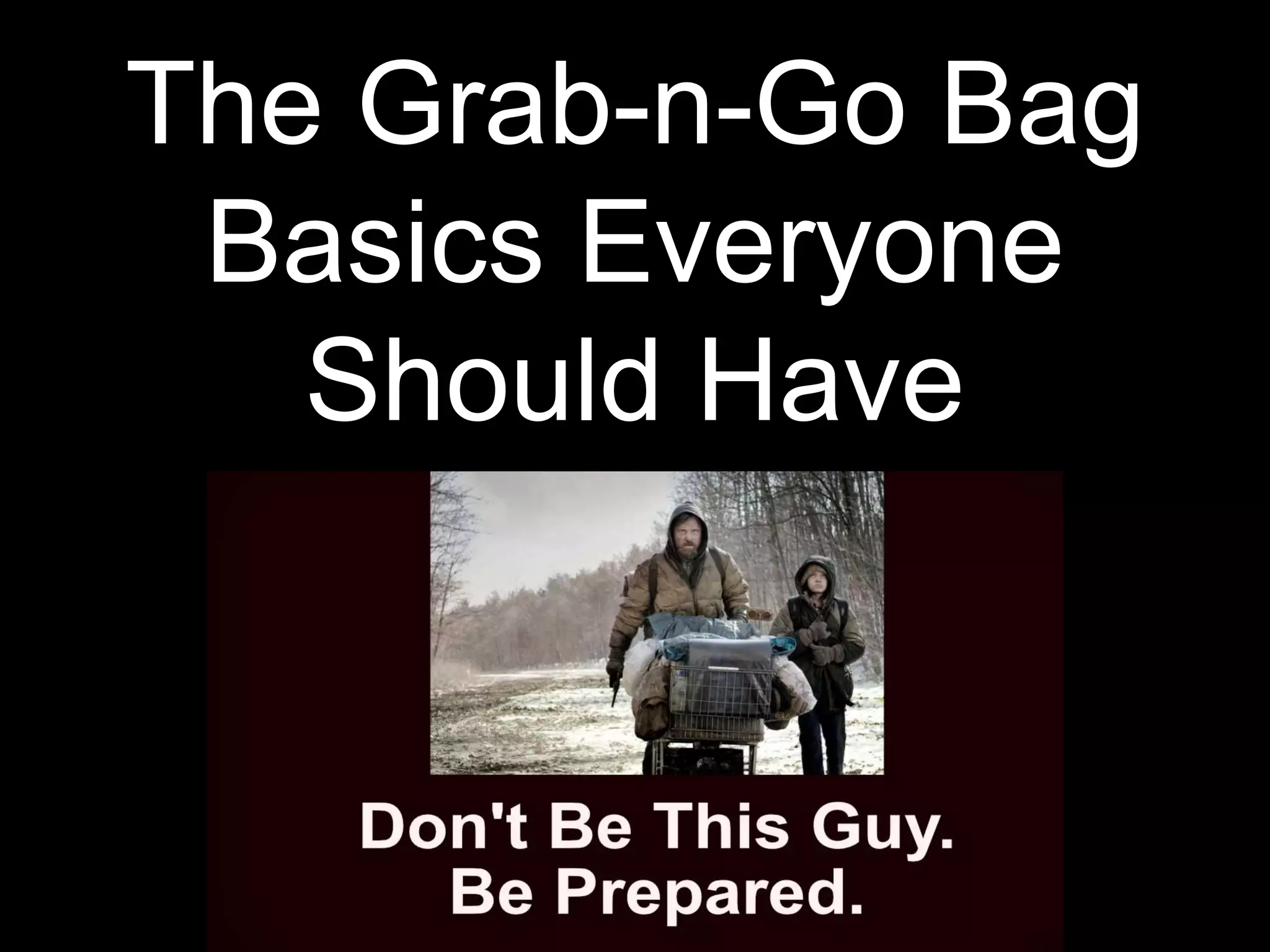
The Grab-n-Go Bag
Basics Everyone
Should Have
A grab-n-go bag is a staple of survival and emergency
preparedness. It’s something you can take with you,
and is your survival kit in your house, in your car and at
your work.
It’s too late to prepare once the emergency is on you.
There will also be a huge run of panicked people buying
many of these same items and they won’t be available;
get it together NOW so you have it ready.
Please remember, there are an infinite number of
emergencies, opinions, equipment, and needs.
The following is a basic template for essentials we all
need.
More Free Information
Since Slideshare no longer supports links,
I’ve also put all the links to free apps, gear and web
pages on my web site at
www.bobmayer.com
Use the pop up from the following image there and
scroll through the document with links for what you
want:
The Grab & Go bag should be tailored to your
locale.
Try to get items that have multiple uses, rather
than just one.
The Grab & Go Bag
How much can you carry?
If you aren’t experienced in backpacks, ask an expert at
your local outdoor store.
No matter the backpack, have waterproof bags to put
everything inside the backpack. Keeping gear (and
yourself) dry is paramount in a survival/emergency
situation.
The Bag Itself
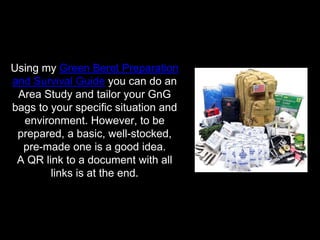
While I list a number of items in the following slides, the
next one shows a pre-packaged kit you can get on
Amazon. I’ve looked it over and bought it as a start for
my son. It includes generic basics and is much better than
having nothing, or waiting until you can do your Area
Study and make your own tailored kit.
I bought it for my son and grandsons.
Prepared for basics today is better than being an expert
tomorrow.
I have purchased all the items I list, but feel free to find
what suits your needs.
All profits from Affiliate links go to the Special
Operations Warrior Foundation, which funds education
for the children of wounded or killed Special Operation
soldiers.
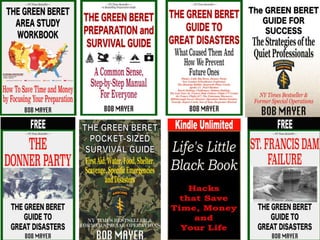
Using my Green Beret Preparation
and Survival Guide you can do an
Area Study and tailor your GnG
bags to your specific situation and
environment. However, to be
prepared, a basic, well-stocked,
pre-made one is a good idea.
A QR link to a document with all
links is at the end.
The following items are for building your own kit.
Remember, the Area Study, will help determine what’s
needed. A free slideshow is available on how to do an
Area Study is at
www.bobmayer.com/workshops
How to do an Area Study is also in
The Green Beret Area Study Workbook.
A key is to figure out your priorities. For some, such as my
son and grandsons in San Diego, water is high on the list.
Building Your Own Bag
4 full 500ml water bottles. This is your immediate
emergency supply if you have no time to fill up your . . .
Containers. Either a built in water supply such as a
Camelbak or separate containers. Most backpacks have
external loops on which you can secure canteens and water
carriers. Your first priority is to fill up these containers with
potable water. The four water bottles are to sustain you to
get to that point. They also then become extra water
containers.
WATER
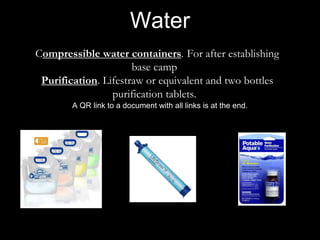
Compressible water containers. For after establishing
base camp
Purification. Lifestraw or equivalent and two bottles
purification tablets.
A QR link to a document with all links is at the end.
Water
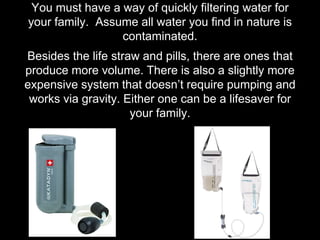
You must have a way of quickly filtering water for
your family. Assume all water you find in nature is
contaminated.
Besides the life straw and pills, there are ones that
produce more volume. There is also a slightly more
expensive system that doesn’t require pumping and
works via gravity. Either one can be a lifesaver for
your family.
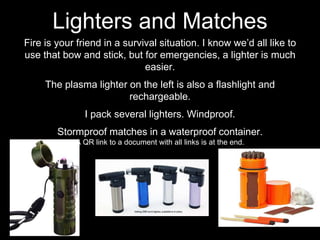
Fire is your friend in a survival situation. I know we’d all like to
use that bow and stick, but for emergencies, a lighter is much
easier.
The plasma lighter on the left is also a flashlight and
rechargeable.
I pack several lighters. Windproof.
Stormproof matches in a waterproof container.
A QR link to a document with all links is at the end.
Lighters and Matches
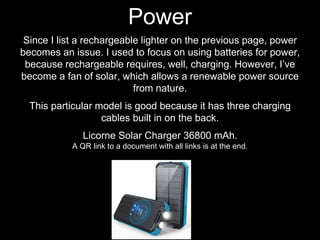
Since I list a rechargeable lighter on the previous page, power
becomes an issue. I used to focus on using batteries for power,
because rechargeable requires, well, charging. However, I’ve
become a fan of solar, which allows a renewable power source
from nature.
This particular model is good because it has three charging
cables built in on the back.
Licorne Solar Charger 36800 mAh.
A QR link to a document with all links is at the end.
Power
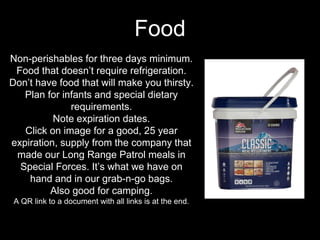
Non-perishables for three days minimum.
Food that doesn’t require refrigeration.
Don’t have food that will make you thirsty.
Plan for infants and special dietary
requirements.
Note expiration dates.
Click on image for a good, 25 year
expiration, supply from the company that
made our Long Range Patrol meals in
Special Forces. It’s what we have on
hand and in our grab-n-go bags.
Also good for camping.
A QR link to a document with all links is at the end.
Food
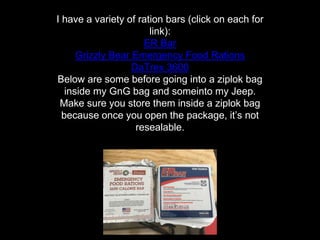
I have a variety of ration bars (click on each for
link):
ER Bar
Grizzly Bear Emergency Food Rations
DaTrex 3600
Below are some before going into a ziplok bag
inside my GnG bag and someinto my Jeep.
Make sure you store them inside a ziplok bag
because once you open the package, it’s not
resealable.
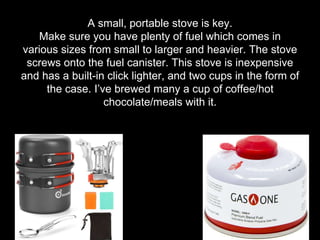
A small, portable stove is key.
Make sure you have plenty of fuel which comes in
various sizes from small to larger and heavier. The stove
screws onto the fuel canister. This stove is inexpensive
and has a built-in click lighter, and two cups in the form of
the case. I’ve brewed many a cup of coffee/hot
chocolate/meals with it.
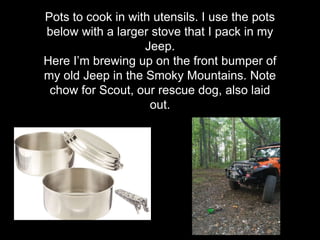
Pots to cook in with utensils. I use the pots
below with a larger stove that I pack in my
Jeep.
Here I’m brewing up on the front bumper of
my old Jeep in the Smoky Mountains. Note
chow for Scout, our rescue dog, also laid
out.
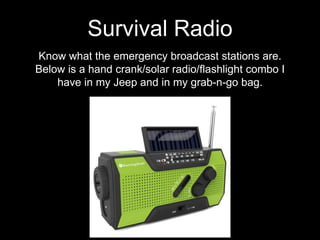
Know what the emergency broadcast stations are.
Below is a hand crank/solar radio/flashlight combo I
have in my Jeep and in my grab-n-go bag.
Survival Radio
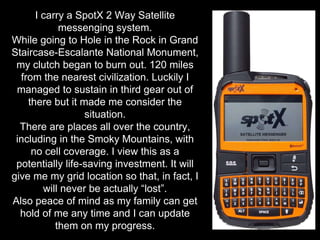
I carry a SpotX 2 Way Satellite
messenging system.
While going to Hole in the Rock in Grand
Staircase-Escalante National Monument,
my clutch began to burn out. 120 miles
from the nearest civilization. Luckily I
managed to sustain in third gear out of
there but it made me consider the
situation.
There are places all over the country,
including in the Smoky Mountains, with
no cell coverage. I view this as a
potentially life-saving investment. It will
give me my grid location so that, in fact, I
will never be actually “lost”.
Also peace of mind as my family can get
hold of me any time and I can update
them on my progress.
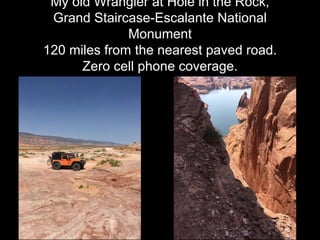
My old Wrangler at Hole in the Rock,
Grand Staircase-Escalante National
Monument
120 miles from the nearest paved road.
Zero cell phone coverage.
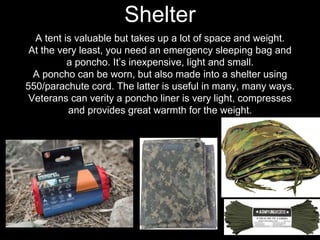
A tent is valuable but takes up a lot of space and weight.
At the very least, you need an emergency sleeping bag and
a poncho. It’s inexpensive, light and small.
A poncho can be worn, but also made into a shelter using
550/parachute cord. The latter is useful in many, many ways.
Veterans can verity a poncho liner is very light, compresses
and provides great warmth for the weight.
Shelter
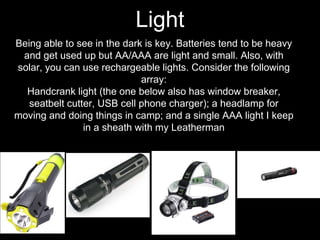
Being able to see in the dark is key. Batteries tend to be heavy
and get used up but AA/AAA are light and small. Also, with
solar, you can use rechargeable lights. Consider the following
array:
Handcrank light (the one below also has window breaker,
seatbelt cutter, USB cell phone charger); a headlamp for
moving and doing things in camp; and a single AAA light I keep
in a sheath with my Leatherman
Light
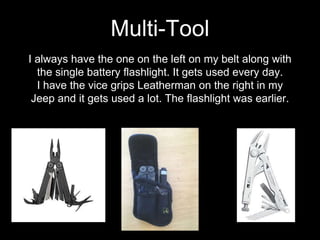
I always have the one on the left on my belt along with
the single battery flashlight. It gets used every day.
I have the vice grips Leatherman on the right in my
Jeep and it gets used a lot. The flashlight was earlier.
Multi-Tool
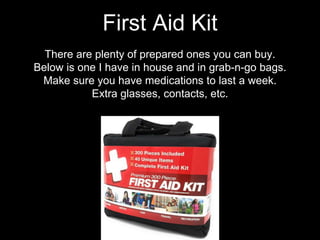
There are plenty of prepared ones you can buy.
Below is one I have in house and in grab-n-go bags.
Make sure you have medications to last a week.
Extra glasses, contacts, etc.
First Aid Kit
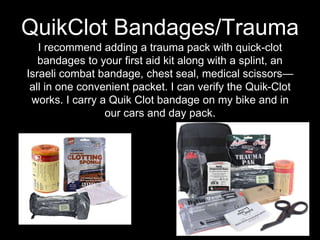
I recommend adding a trauma pack with quick-clot
bandages to your first aid kit along with a splint, an
Israeli combat bandage, chest seal, medical scissors—
all in one convenient packet. I can verify the Quik-Clot
works. I carry a Quik Clot bandage on my bike and in
our cars and day pack.
QuikClot Bandages/Trauma
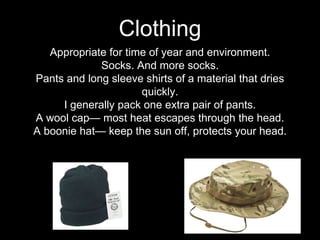
Appropriate for time of year and environment.
Socks. And more socks.
Pants and long sleeve shirts of a material that dries
quickly.
I generally pack one extra pair of pants.
A wool cap— most heat escapes through the head.
A boonie hat— keep the sun off, protects your head.
Clothing
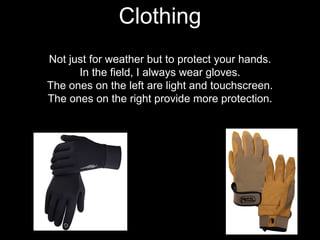
Not just for weather but to protect your hands.
In the field, I always wear gloves.
The ones on the left are light and touchscreen.
The ones on the right provide more protection.
Clothing
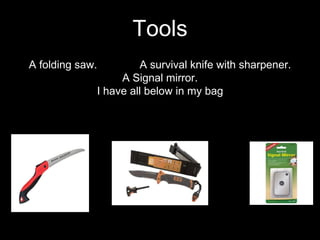
A folding saw. A survival knife with sharpener.
A Signal mirror.
I have all below in my bag
Tools
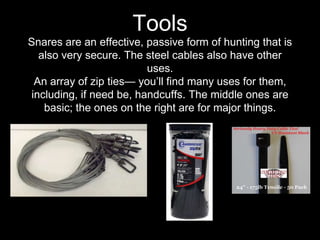
Snares are an effective, passive form of hunting that is
also very secure. The steel cables also have other
uses.
An array of zip ties— you’ll find many uses for them,
including, if need be, handcuffs. The middle ones are
basic; the ones on the right are for major things.
Tools
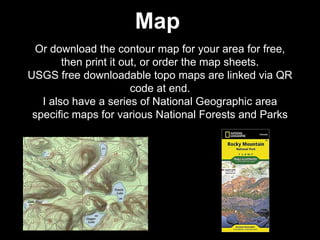
Or download the contour map for your area for free,
then print it out, or order the map sheets.
USGS free downloadable topo maps are linked via QR
code at end.
I also have a series of National Geographic area
specific maps for various National Forests and Parks
Map
Location Apps
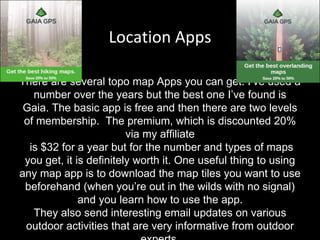
There are several topo map Apps you can get. I’ve used a
number over the years but the best one I’ve found is
Gaia. The basic app is free and then there are two levels
of membership. The premium, which is discounted 20%
via my affiliate
is $32 for a year but for the number and types of maps
you get, it is definitely worth it. One useful thing to using
any map app is to download the map tiles you want to use
beforehand (when you’re out in the wilds with no signal)
and you learn how to use the app.
They also send interesting email updates on various
outdoor activities that are very informative from outdoor
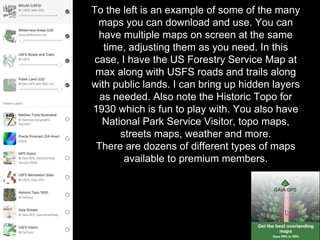
To the left is an example of some of the many
maps you can download and use. You can
have multiple maps on screen at the same
time, adjusting them as you need. In this
case, I have the US Forestry Service Map at
max along with USFS roads and trails along
with public lands. I can bring up hidden layers
as needed. Also note the Historic Topo for
1930 which is fun to play with. You also have
National Park Service Visitor, topo maps,
streets maps, weather and more.
There are dozens of different types of maps
available to premium members.
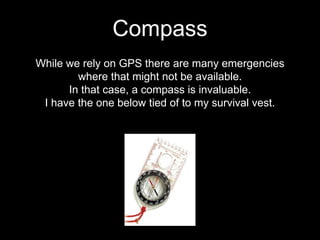
While we rely on GPS there are many emergencies
where that might not be available.
In that case, a compass is invaluable.
I have the one below tied of to my survival vest.
Compass
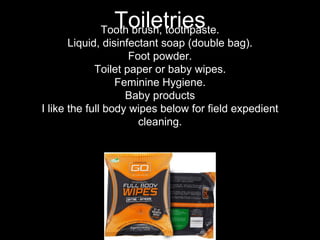
Tooth brush, toothpaste.
Liquid, disinfectant soap (double bag).
Foot powder.
Toilet paper or baby wipes.
Feminine Hygiene.
Baby products
I like the full body wipes below for field expedient
cleaning.
Toiletries
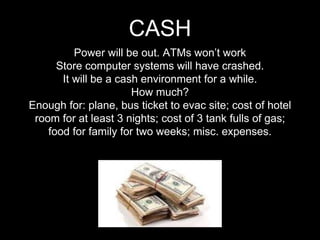
Power will be out. ATMs won’t work
Store computer systems will have crashed.
It will be a cash environment for a while.
How much?
Enough for: plane, bus ticket to evac site; cost of hotel
room for at least 3 nights; cost of 3 tank fulls of gas;
food for family for two weeks; misc. expenses.
CASH
20 Things Every Hiker
Should Have
In Their Day Pack
(which also makes it a basic Grab-n-
Go bag!)
This slideshow is on my web page
and a useful way of upgrading what
you already have.
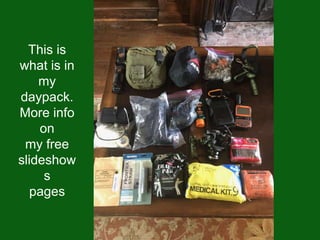
This is
what is in
my
daypack.
More info
on
my free
slideshow
s
pages
This was just the an overview and probably
overwhelming.
In the The Green Beret Preparation and Survival Guide
the GnG bag is broken down into a basic one everyone
should have and then a list of more advanced items.
Grab-n-Go Bag
Your main bag is wherever you spend most
of your time. For most of us, that’s at home.
Have it readily accessible so you can literally
grab it as you run out. You can also toss it in
your car easily.
More Free Information
I constantly update free, downloadable
slideshows like this on my web site for
preparation and survival and other topics.
Use Your Camera on this QR Code
More Free Information
If you want to go directly to a document with live
links to all free apps, gear, library, and Jeep stuff,
use your camera on this QR Code. Or copy and
paste:
https://www.dropbox.com/scl/fi/vwgilkne2vsq4jrhkp
gic/GEAR-
LINKS.docx?dl=0&rlkey=i858w1e2zd3irup2lcvhvlb
ma
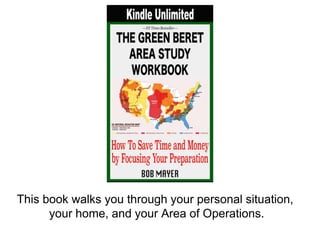
This book walks you through your personal situation,
your home, and your Area of Operations.
AMAZON
New York Times bestselling author, is a graduate of West Point and
former Green Beret. He’s had over 80 books published, including the
#1 bestselling series Green Berets, Time Patrol, Area 51, Survival, and
Atlantis. He’s sold over 5 million books.
He’s hit bestsellers lists in thriller, science fiction, romance, historical
fiction and nonfiction.
He was born in the Bronx and has traveled the world. He’s lived on an
island off the east coast, an island off the west coast, in the Rocky
Mountains, the Smoky Mountains and other places, including time in
East Asia studying martial arts.
They haven’t caught him yet.
www.bobmayer.com

Grab-N-Go Bag Essentials You Must Have

  • 1.
    The Grab-n-Go Bag BasicsEveryone Should Have
  • 2.
    A grab-n-go bagis a staple of survival and emergency preparedness. It’s something you can take with you, and is your survival kit in your house, in your car and at your work. It’s too late to prepare once the emergency is on you. There will also be a huge run of panicked people buying many of these same items and they won’t be available; get it together NOW so you have it ready. Please remember, there are an infinite number of emergencies, opinions, equipment, and needs. The following is a basic template for essentials we all need.
  • 3.
    More Free Information SinceSlideshare no longer supports links, I’ve also put all the links to free apps, gear and web pages on my web site at www.bobmayer.com Use the pop up from the following image there and scroll through the document with links for what you want:
  • 4.
    The Grab &Go bag should be tailored to your locale. Try to get items that have multiple uses, rather than just one. The Grab & Go Bag
  • 5.
    How much canyou carry? If you aren’t experienced in backpacks, ask an expert at your local outdoor store. No matter the backpack, have waterproof bags to put everything inside the backpack. Keeping gear (and yourself) dry is paramount in a survival/emergency situation. The Bag Itself
  • 6.
    While I lista number of items in the following slides, the next one shows a pre-packaged kit you can get on Amazon. I’ve looked it over and bought it as a start for my son. It includes generic basics and is much better than having nothing, or waiting until you can do your Area Study and make your own tailored kit. I bought it for my son and grandsons. Prepared for basics today is better than being an expert tomorrow. I have purchased all the items I list, but feel free to find what suits your needs. All profits from Affiliate links go to the Special Operations Warrior Foundation, which funds education for the children of wounded or killed Special Operation soldiers.
  • 7.
    Using my GreenBeret Preparation and Survival Guide you can do an Area Study and tailor your GnG bags to your specific situation and environment. However, to be prepared, a basic, well-stocked, pre-made one is a good idea. A QR link to a document with all links is at the end.
  • 8.
    The following itemsare for building your own kit. Remember, the Area Study, will help determine what’s needed. A free slideshow is available on how to do an Area Study is at www.bobmayer.com/workshops How to do an Area Study is also in The Green Beret Area Study Workbook. A key is to figure out your priorities. For some, such as my son and grandsons in San Diego, water is high on the list. Building Your Own Bag
  • 9.
    4 full 500mlwater bottles. This is your immediate emergency supply if you have no time to fill up your . . . Containers. Either a built in water supply such as a Camelbak or separate containers. Most backpacks have external loops on which you can secure canteens and water carriers. Your first priority is to fill up these containers with potable water. The four water bottles are to sustain you to get to that point. They also then become extra water containers. WATER
  • 10.
    Compressible water containers.For after establishing base camp Purification. Lifestraw or equivalent and two bottles purification tablets. A QR link to a document with all links is at the end. Water
  • 11.
    You must havea way of quickly filtering water for your family. Assume all water you find in nature is contaminated. Besides the life straw and pills, there are ones that produce more volume. There is also a slightly more expensive system that doesn’t require pumping and works via gravity. Either one can be a lifesaver for your family.
  • 12.
    Fire is yourfriend in a survival situation. I know we’d all like to use that bow and stick, but for emergencies, a lighter is much easier. The plasma lighter on the left is also a flashlight and rechargeable. I pack several lighters. Windproof. Stormproof matches in a waterproof container. A QR link to a document with all links is at the end. Lighters and Matches
  • 13.
    Since I lista rechargeable lighter on the previous page, power becomes an issue. I used to focus on using batteries for power, because rechargeable requires, well, charging. However, I’ve become a fan of solar, which allows a renewable power source from nature. This particular model is good because it has three charging cables built in on the back. Licorne Solar Charger 36800 mAh. A QR link to a document with all links is at the end. Power
  • 14.
    Non-perishables for threedays minimum. Food that doesn’t require refrigeration. Don’t have food that will make you thirsty. Plan for infants and special dietary requirements. Note expiration dates. Click on image for a good, 25 year expiration, supply from the company that made our Long Range Patrol meals in Special Forces. It’s what we have on hand and in our grab-n-go bags. Also good for camping. A QR link to a document with all links is at the end. Food
  • 15.
    I have avariety of ration bars (click on each for link): ER Bar Grizzly Bear Emergency Food Rations DaTrex 3600 Below are some before going into a ziplok bag inside my GnG bag and someinto my Jeep. Make sure you store them inside a ziplok bag because once you open the package, it’s not resealable.
  • 16.
    A small, portablestove is key. Make sure you have plenty of fuel which comes in various sizes from small to larger and heavier. The stove screws onto the fuel canister. This stove is inexpensive and has a built-in click lighter, and two cups in the form of the case. I’ve brewed many a cup of coffee/hot chocolate/meals with it.
  • 17.
    Pots to cookin with utensils. I use the pots below with a larger stove that I pack in my Jeep. Here I’m brewing up on the front bumper of my old Jeep in the Smoky Mountains. Note chow for Scout, our rescue dog, also laid out.
  • 18.
    Know what theemergency broadcast stations are. Below is a hand crank/solar radio/flashlight combo I have in my Jeep and in my grab-n-go bag. Survival Radio
  • 19.
    I carry aSpotX 2 Way Satellite messenging system. While going to Hole in the Rock in Grand Staircase-Escalante National Monument, my clutch began to burn out. 120 miles from the nearest civilization. Luckily I managed to sustain in third gear out of there but it made me consider the situation. There are places all over the country, including in the Smoky Mountains, with no cell coverage. I view this as a potentially life-saving investment. It will give me my grid location so that, in fact, I will never be actually “lost”. Also peace of mind as my family can get hold of me any time and I can update them on my progress.
  • 20.
    My old Wranglerat Hole in the Rock, Grand Staircase-Escalante National Monument 120 miles from the nearest paved road. Zero cell phone coverage.
  • 21.
    A tent isvaluable but takes up a lot of space and weight. At the very least, you need an emergency sleeping bag and a poncho. It’s inexpensive, light and small. A poncho can be worn, but also made into a shelter using 550/parachute cord. The latter is useful in many, many ways. Veterans can verity a poncho liner is very light, compresses and provides great warmth for the weight. Shelter
  • 22.
    Being able tosee in the dark is key. Batteries tend to be heavy and get used up but AA/AAA are light and small. Also, with solar, you can use rechargeable lights. Consider the following array: Handcrank light (the one below also has window breaker, seatbelt cutter, USB cell phone charger); a headlamp for moving and doing things in camp; and a single AAA light I keep in a sheath with my Leatherman Light
  • 23.
    I always havethe one on the left on my belt along with the single battery flashlight. It gets used every day. I have the vice grips Leatherman on the right in my Jeep and it gets used a lot. The flashlight was earlier. Multi-Tool
  • 24.
    There are plentyof prepared ones you can buy. Below is one I have in house and in grab-n-go bags. Make sure you have medications to last a week. Extra glasses, contacts, etc. First Aid Kit
  • 25.
    I recommend addinga trauma pack with quick-clot bandages to your first aid kit along with a splint, an Israeli combat bandage, chest seal, medical scissors— all in one convenient packet. I can verify the Quik-Clot works. I carry a Quik Clot bandage on my bike and in our cars and day pack. QuikClot Bandages/Trauma
  • 26.
    Appropriate for timeof year and environment. Socks. And more socks. Pants and long sleeve shirts of a material that dries quickly. I generally pack one extra pair of pants. A wool cap— most heat escapes through the head. A boonie hat— keep the sun off, protects your head. Clothing
  • 27.
    Not just forweather but to protect your hands. In the field, I always wear gloves. The ones on the left are light and touchscreen. The ones on the right provide more protection. Clothing
  • 28.
    A folding saw.A survival knife with sharpener. A Signal mirror. I have all below in my bag Tools
  • 29.
    Snares are aneffective, passive form of hunting that is also very secure. The steel cables also have other uses. An array of zip ties— you’ll find many uses for them, including, if need be, handcuffs. The middle ones are basic; the ones on the right are for major things. Tools
  • 30.
    Or download thecontour map for your area for free, then print it out, or order the map sheets. USGS free downloadable topo maps are linked via QR code at end. I also have a series of National Geographic area specific maps for various National Forests and Parks Map
  • 31.
    Location Apps There areseveral topo map Apps you can get. I’ve used a number over the years but the best one I’ve found is Gaia. The basic app is free and then there are two levels of membership. The premium, which is discounted 20% via my affiliate is $32 for a year but for the number and types of maps you get, it is definitely worth it. One useful thing to using any map app is to download the map tiles you want to use beforehand (when you’re out in the wilds with no signal) and you learn how to use the app. They also send interesting email updates on various outdoor activities that are very informative from outdoor
  • 32.
    To the leftis an example of some of the many maps you can download and use. You can have multiple maps on screen at the same time, adjusting them as you need. In this case, I have the US Forestry Service Map at max along with USFS roads and trails along with public lands. I can bring up hidden layers as needed. Also note the Historic Topo for 1930 which is fun to play with. You also have National Park Service Visitor, topo maps, streets maps, weather and more. There are dozens of different types of maps available to premium members.
  • 33.
    While we relyon GPS there are many emergencies where that might not be available. In that case, a compass is invaluable. I have the one below tied of to my survival vest. Compass
  • 34.
    Tooth brush, toothpaste. Liquid,disinfectant soap (double bag). Foot powder. Toilet paper or baby wipes. Feminine Hygiene. Baby products I like the full body wipes below for field expedient cleaning. Toiletries
  • 35.
    Power will beout. ATMs won’t work Store computer systems will have crashed. It will be a cash environment for a while. How much? Enough for: plane, bus ticket to evac site; cost of hotel room for at least 3 nights; cost of 3 tank fulls of gas; food for family for two weeks; misc. expenses. CASH
  • 36.
    20 Things EveryHiker Should Have In Their Day Pack (which also makes it a basic Grab-n- Go bag!) This slideshow is on my web page and a useful way of upgrading what you already have.
  • 37.
    This is what isin my daypack. More info on my free slideshow s pages
  • 38.
    This was justthe an overview and probably overwhelming. In the The Green Beret Preparation and Survival Guide the GnG bag is broken down into a basic one everyone should have and then a list of more advanced items. Grab-n-Go Bag Your main bag is wherever you spend most of your time. For most of us, that’s at home. Have it readily accessible so you can literally grab it as you run out. You can also toss it in your car easily.
  • 39.
    More Free Information Iconstantly update free, downloadable slideshows like this on my web site for preparation and survival and other topics. Use Your Camera on this QR Code
  • 40.
    More Free Information Ifyou want to go directly to a document with live links to all free apps, gear, library, and Jeep stuff, use your camera on this QR Code. Or copy and paste: https://www.dropbox.com/scl/fi/vwgilkne2vsq4jrhkp gic/GEAR- LINKS.docx?dl=0&rlkey=i858w1e2zd3irup2lcvhvlb ma
  • 41.
    This book walksyou through your personal situation, your home, and your Area of Operations.
  • 42.
  • 45.
    New York Timesbestselling author, is a graduate of West Point and former Green Beret. He’s had over 80 books published, including the #1 bestselling series Green Berets, Time Patrol, Area 51, Survival, and Atlantis. He’s sold over 5 million books. He’s hit bestsellers lists in thriller, science fiction, romance, historical fiction and nonfiction. He was born in the Bronx and has traveled the world. He’s lived on an island off the east coast, an island off the west coast, in the Rocky Mountains, the Smoky Mountains and other places, including time in East Asia studying martial arts. They haven’t caught him yet. www.bobmayer.com