Opening Prayer
https://www.youtube.com/watch?v=Pmxg2T9
oQBM&ab_channel=TeacherAyaEducaToon
Gentle reminders before we start:
1. Log in to your Schoology account 10 minutes before the time.
2. Wear your uniform during classes.
3. Always turn on your web cam and mute your mic unless told
otherwise.
4. If you wish to answer, clarify something or ask any question, you
may use the chat box.
5. Do not type unnecessary topics not related to the lesson.
6. Be pro-active during the session.
7. Respect each other.
8. Reconnect immediately if you get disconnected.
9. Attendance will be checked.
OUTDOOR
RECREATION
LPO3
�I am a credible, responsive communicator
and team player, building harmonious
community through active collaboration.
EPO6
�Willingly share responsibilities and participate
actively in fostering group collegiality,
cohesion, and effectiveness.
Intended Learning outcomes
At the end of the lesson, we will be able
to:
�Willingly share responsibilities and
participate actively in fostering group
collegiality, cohesion, and effectiveness
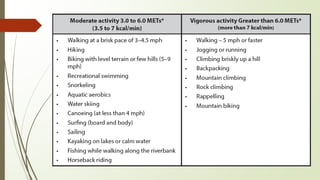
by engaging in moderate to vigorous
physical activities (MVPAs) for at least
60 minutes most days of the week in a
variety of settings in- and out-of- school
� Different Recreational Activities for Every Walk of Life
� https://www.youtube.com/watch?v=92gFx4Cb4us&ab_channel=Buzzle
� The Benefits of Outdoor Activity
� https://www.youtube.com/watch?v=pPwZUL6Dd3Q&ab_channel=myUMR
healthUMR
What Is Outdoor Recreation?
�Outdoor recreation are organized activities
done during one’s free time for his/her own
personal reasons, where an interaction
between man and an element of nature is
present.
Reasons People Engage in Outdoor
Recreational Activity
� Some do it for personal satisfaction and enjoyment. Perhaps, it is a
time away from the day-to-day routine.
� Others do it to be in touch with nature, which they rarely have the
chance to do, especially for those who reside in highly urbanized
areas.
� Whatever reason there may be, people engage in outdoor
recreation for their own sake and pleasure, voluntarily, and of their
own choice.
� Many do it for personal pursuit such as photography, collecting
seashells, reaching the top of Mt. Apo, conquering the rapids of
Cagayan River, or attaining a certain fitness level.
� Some individuals or groups do it as part of outdoor or environmental
education, such as birdwatching, plant naming, etc.
� Whatever reason there may be, people engage in outdoor recreation
for their own sake and pleasure, voluntarily, and of their own choice.
Some Popular Outdoor Recreational
Activities
� LAND
Mountaineering
Trekking/Hiking, Camping
Backpacking
Picnic
Bird-watching
Mountain Biking
Orienteering
Canyoneering
Rock Climbing
Some Popular Outdoor Recreational
Activities
� WATER
Swimming
Snorkeling
Diving
Surfing
Canoeing
Kayaking
Whitewater rafting
Sailing
Fishing
Bamboo rafting
Some Popular Outdoor Recreational
Activities
�AIR
Parasailing
Skydiving
Paragliding
Benefits of Outdoor Recreation
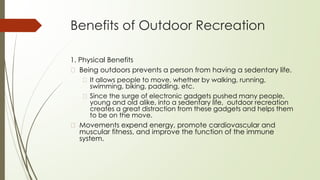
1. Physical Benefits
� Being outdoors prevents a person from having a sedentary life.
� It allows people to move, whether by walking, running,
swimming, biking, paddling, etc.
� Since the surge of electronic gadgets pushed many people,
young and old alike, into a sedentary life, outdoor recreation
creates a great distraction from these gadgets and helps them
to be on the move.
� Movements expend energy, promote cardiovascular and
muscular fitness, and improve the function of the immune
system.
Benefits of Outdoor Recreation
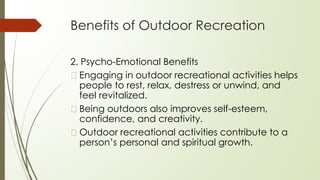
2. Psycho-Emotional Benefits
� Engaging in outdoor recreational activities helps
people to rest, relax, destress or unwind, and
feel revitalized.
� Being outdoors also improves self-esteem,
confidence, and creativity.
� Outdoor recreational activities contribute to a
person’s personal and spiritual growth.
Benefits of Outdoor Recreation
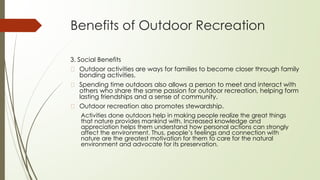
3. Social Benefits
� Outdoor activities are ways for families to become closer through family
bonding activities.
� Spending time outdoors also allows a person to meet and interact with
others who share the same passion for outdoor recreation, helping form
lasting friendships and a sense of community.
� Outdoor recreation also promotes stewardship.
Activities done outdoors help in making people realize the great things
that nature provides mankind with. Increased knowledge and
appreciation helps them understand how personal actions can strongly
affect the environment. Thus, people’s feelings and connection with
nature are the greatest motivation for them to care for the natural
environment and advocate for its preservation.
Benefits of Outdoor Recreation
4. Economic Benefits
�People who have a relaxed body and mind
tend to be more productive at work,
translating into efficiency at the workplace.
�Ecotourism creates jobs and other economic
activities which can, one way or another,
contribute to economic growth.
Benefits of Outdoor Recreation
5. Spiritual Benefits
Positive outdoor experiences can stir up spiritual
values.
� Being one with nature brings certain calmness
within a person.
� Being one with nature strengthens an individual
as it heals, rejuvenates, and soothes the body
and soul.
Do You Need to Be Athletic to Be Able
to Participate in Outdoor Activities?
�No. Outdoor recreation involves a lot of
physical activity, but it does not require you
to have athletic level of skills to be able to
participate. However, you need to be
physically fit to be able to carry out the
activity.
�Are you physically fit?
Questions That Can Help Assess Your
Physical Fitness
Are you able to carry out your day-to-day tasks as a student with
alertness and vigor without undue fatigue?
If not, then perhaps you need to rethink.
� Have you been spending too much time with your gadgets?
� Has your body been getting enough rest and sleep?
� What about your nutrition and eating habits, have you been
dependent on fast food, chips, and sodas?
� Are you eating on time?
� Have you been heavily stressed with schoolwork?
Considerations in Assessing How One
Has Been Eating
What Is the “Leave No Trace Seven
Principles”?
�It is a set of universal outdoor ethics that
guides one in the activities to do with nature.
�It also provides the framework for making
decisions in outdoor recreation.
� What is Leave No Trace? || REI
� https://www.youtube.com/watch?v=Rpq01rO9ZR0&feature=emb_logo&ab_channel=REI
� UP Mountaineers
� https://www.facebook.com/upmountaineers/videos/10154381628942640
The “Leave No Trace Seven Principles” (LNT)
Principles Are…
Principle 1: Plan Ahead and Prepare
� Before going to a place, check if your planned activity is permitted. Make sure
to know the rules, guidelines, and safety procedures they have set. Some places
require certain permits or clearances.
� Make sure you have the needed equipment for your activity and the skills
needed to undertake the activity.
� Plan how to cope in case emergency arises.
� Check the weather forecast and be prepared for changing weather
conditions.
� Learn when areas are most crowded and try to avoid those times.
� To minimize environmental impact and for safety reasons, keep group numbers
small.
� Repack food to minimize waste.
� When trekking, maps and compass must be used to avoid markings or leaving
of marks on rocks and the like.
The “Leave No Trace Seven Principles” (LNT)
Principles Are…
Principle 2: Travel and Camp on Durable Surfaces
� Walk, run, bike, or camp on durable surfaces like established tracks,
rocks, gravel, and dry grasses.
� Avoid walking on soft surfaces like soft plants. You might be trampling
on a young tree or pasture and this will cause vegetation damage.
� Use existing trails or campsites; no need to build a new campsite that
will alter the environment.
� To avoid erosion, walk in single file in the middle of the trail.
� Avoid places where impacts are just beginning to show.
� When camping, keep the campsite small and discreet.
� Camp at least 200 feet from lakes and rivers to protect the waters.
The “Leave No Trace Seven Principles” (LNT)
Principles Are…
Principle 3: Dispose of Waste Properly
� “Pack it in, pack it out” means everything you brought should be
brought back with you including left-over food or fruit peel.
Nothing should be left.
� When camping, cat holes are dug (6–8 inches deep) for human
waste and covered just the same with soil and weeds or leaves
on top.
� Dishes should be washed 200 feet away from lakes or rivers.
Biodegradable soap must be used. Scatter strained dishwater.
The “Leave No Trace Seven Principles” (LNT)
Principles Are…
Principle 4: Leave What You Find
� Examine archeological structures, old walls, and other heritage
artifacts but do not touch nor leave marks on them.
� Leave nature as you found them. Do not take any plant, rock, or
marine animal with you.
� Avoid introducing non-native plants and animals.
� Do not build structures or furniture, or dig trenches.
The “Leave No Trace Seven Principles” (LNT)
Principles Are…
Principle 5: Minimize Campfire Impacts
� Use lightweight stove for cooking; campfires can cause lasting
impacts.
� If fires are permitted, use fire rings or mound fires that are already
set-up.
� Keep fires small and use only sticks from the ground than can be
broken by hand.
� Never burn plastics or other substances that emit toxic fumes.
� Burn all wood to ash and make sure fires are completely out.
Scatter the cool ash.
The “Leave No Trace Seven Principles” (LNT)
Principles Are…
Principle 6: Respect Wildlife
� Observe wild animals from a distance and they should be
avoided during sensitive times such as mating, nesting, or raising
the young.
� Do not feed wild animals or birds as it is not their natural food.
The food might damage their health or alter their natural
behaviors and even expose them to predators.
� Protect wildlife and protect your food as well by storing and
securing the trash well.
� In case you decide to bring your pets along, make sure it is
allowed and you can control them. Otherwise, do not bring
them with you.
The “Leave No Trace Seven Principles” (LNT)
Principles Are…
Principle 7: Be Considerate of Other Visitors
� Respect people who live and work in the countryside.
� Respect other visitors and let them have a momentous
experience as well.
� Allow the sound of nature to prevail, not your noise or your radio.
� Be courteous; yield to others on a trail.
� Camp away from trails and other visitors.
Self-Directed Learning (part 1)
Choosing an Outdoor Recreational Activity.
� Given a chance, what outdoor activity would you like to try?
� Why? Where? Who do you like to be with?
� What benefits can you get from your chosen outdoor activity.
� Research, surf the internet, and read blogs on outdoor activities.
� Put a picture of your chosen outdoor activity.
� Upload your output in Schoology.
� Use “Outdoor recreation_Family name” as your file name.
Self-Directed Learning (part 2)
Choosing an Outdoor Recreational Activity.
� Do you need to be athletic when doing outdoor recreational activities?
� Does your current physical fitness affect your performance in doing outdoor
recreational activities? Why? How?
� Enumerate the LNT principles and cite instances where it is applicable
during outdoor recreation.
� Upload your output in Schoology.
� Use “Outdoor recreation 2_Family name” as your file name.
Closing prayer
Glory be to the Father,
To the Son and to the Holy Spirit,
As it was in the beginning is now and will be
forever, AMEN

gr. 12 day 1-3.pptx

  • 1.
  • 2.
    Gentle reminders beforewe start: 1. Log in to your Schoology account 10 minutes before the time. 2. Wear your uniform during classes. 3. Always turn on your web cam and mute your mic unless told otherwise. 4. If you wish to answer, clarify something or ask any question, you may use the chat box. 5. Do not type unnecessary topics not related to the lesson. 6. Be pro-active during the session. 7. Respect each other. 8. Reconnect immediately if you get disconnected. 9. Attendance will be checked.
  • 3.
  • 4.
    LPO3 �I am acredible, responsive communicator and team player, building harmonious community through active collaboration.
  • 5.
    EPO6 �Willingly share responsibilitiesand participate actively in fostering group collegiality, cohesion, and effectiveness.
  • 6.
    Intended Learning outcomes Atthe end of the lesson, we will be able to: �Willingly share responsibilities and participate actively in fostering group collegiality, cohesion, and effectiveness by engaging in moderate to vigorous physical activities (MVPAs) for at least 60 minutes most days of the week in a variety of settings in- and out-of- school
  • 7.
    � Different RecreationalActivities for Every Walk of Life � https://www.youtube.com/watch?v=92gFx4Cb4us&ab_channel=Buzzle � The Benefits of Outdoor Activity � https://www.youtube.com/watch?v=pPwZUL6Dd3Q&ab_channel=myUMR healthUMR
  • 8.
    What Is OutdoorRecreation? �Outdoor recreation are organized activities done during one’s free time for his/her own personal reasons, where an interaction between man and an element of nature is present.
  • 9.
    Reasons People Engagein Outdoor Recreational Activity � Some do it for personal satisfaction and enjoyment. Perhaps, it is a time away from the day-to-day routine. � Others do it to be in touch with nature, which they rarely have the chance to do, especially for those who reside in highly urbanized areas. � Whatever reason there may be, people engage in outdoor recreation for their own sake and pleasure, voluntarily, and of their own choice. � Many do it for personal pursuit such as photography, collecting seashells, reaching the top of Mt. Apo, conquering the rapids of Cagayan River, or attaining a certain fitness level. � Some individuals or groups do it as part of outdoor or environmental education, such as birdwatching, plant naming, etc. � Whatever reason there may be, people engage in outdoor recreation for their own sake and pleasure, voluntarily, and of their own choice.
  • 10.
    Some Popular OutdoorRecreational Activities � LAND Mountaineering Trekking/Hiking, Camping Backpacking Picnic Bird-watching Mountain Biking Orienteering Canyoneering Rock Climbing
  • 11.
    Some Popular OutdoorRecreational Activities � WATER Swimming Snorkeling Diving Surfing Canoeing Kayaking Whitewater rafting Sailing Fishing Bamboo rafting
  • 12.
    Some Popular OutdoorRecreational Activities �AIR Parasailing Skydiving Paragliding
  • 13.
    Benefits of OutdoorRecreation 1. Physical Benefits � Being outdoors prevents a person from having a sedentary life. � It allows people to move, whether by walking, running, swimming, biking, paddling, etc. � Since the surge of electronic gadgets pushed many people, young and old alike, into a sedentary life, outdoor recreation creates a great distraction from these gadgets and helps them to be on the move. � Movements expend energy, promote cardiovascular and muscular fitness, and improve the function of the immune system.
  • 15.
    Benefits of OutdoorRecreation 2. Psycho-Emotional Benefits � Engaging in outdoor recreational activities helps people to rest, relax, destress or unwind, and feel revitalized. � Being outdoors also improves self-esteem, confidence, and creativity. � Outdoor recreational activities contribute to a person’s personal and spiritual growth.
  • 16.
    Benefits of OutdoorRecreation 3. Social Benefits � Outdoor activities are ways for families to become closer through family bonding activities. � Spending time outdoors also allows a person to meet and interact with others who share the same passion for outdoor recreation, helping form lasting friendships and a sense of community. � Outdoor recreation also promotes stewardship. Activities done outdoors help in making people realize the great things that nature provides mankind with. Increased knowledge and appreciation helps them understand how personal actions can strongly affect the environment. Thus, people’s feelings and connection with nature are the greatest motivation for them to care for the natural environment and advocate for its preservation.
  • 17.
    Benefits of OutdoorRecreation 4. Economic Benefits �People who have a relaxed body and mind tend to be more productive at work, translating into efficiency at the workplace. �Ecotourism creates jobs and other economic activities which can, one way or another, contribute to economic growth.
  • 18.
    Benefits of OutdoorRecreation 5. Spiritual Benefits Positive outdoor experiences can stir up spiritual values. � Being one with nature brings certain calmness within a person. � Being one with nature strengthens an individual as it heals, rejuvenates, and soothes the body and soul.
  • 19.
    Do You Needto Be Athletic to Be Able to Participate in Outdoor Activities? �No. Outdoor recreation involves a lot of physical activity, but it does not require you to have athletic level of skills to be able to participate. However, you need to be physically fit to be able to carry out the activity. �Are you physically fit?
  • 20.
    Questions That CanHelp Assess Your Physical Fitness Are you able to carry out your day-to-day tasks as a student with alertness and vigor without undue fatigue? If not, then perhaps you need to rethink. � Have you been spending too much time with your gadgets? � Has your body been getting enough rest and sleep? � What about your nutrition and eating habits, have you been dependent on fast food, chips, and sodas? � Are you eating on time? � Have you been heavily stressed with schoolwork?
  • 21.
    Considerations in AssessingHow One Has Been Eating
  • 22.
    What Is the“Leave No Trace Seven Principles”? �It is a set of universal outdoor ethics that guides one in the activities to do with nature. �It also provides the framework for making decisions in outdoor recreation. � What is Leave No Trace? || REI � https://www.youtube.com/watch?v=Rpq01rO9ZR0&feature=emb_logo&ab_channel=REI � UP Mountaineers � https://www.facebook.com/upmountaineers/videos/10154381628942640
  • 23.
    The “Leave NoTrace Seven Principles” (LNT) Principles Are… Principle 1: Plan Ahead and Prepare � Before going to a place, check if your planned activity is permitted. Make sure to know the rules, guidelines, and safety procedures they have set. Some places require certain permits or clearances. � Make sure you have the needed equipment for your activity and the skills needed to undertake the activity. � Plan how to cope in case emergency arises. � Check the weather forecast and be prepared for changing weather conditions. � Learn when areas are most crowded and try to avoid those times. � To minimize environmental impact and for safety reasons, keep group numbers small. � Repack food to minimize waste. � When trekking, maps and compass must be used to avoid markings or leaving of marks on rocks and the like.
  • 24.
    The “Leave NoTrace Seven Principles” (LNT) Principles Are… Principle 2: Travel and Camp on Durable Surfaces � Walk, run, bike, or camp on durable surfaces like established tracks, rocks, gravel, and dry grasses. � Avoid walking on soft surfaces like soft plants. You might be trampling on a young tree or pasture and this will cause vegetation damage. � Use existing trails or campsites; no need to build a new campsite that will alter the environment. � To avoid erosion, walk in single file in the middle of the trail. � Avoid places where impacts are just beginning to show. � When camping, keep the campsite small and discreet. � Camp at least 200 feet from lakes and rivers to protect the waters.
  • 25.
    The “Leave NoTrace Seven Principles” (LNT) Principles Are… Principle 3: Dispose of Waste Properly � “Pack it in, pack it out” means everything you brought should be brought back with you including left-over food or fruit peel. Nothing should be left. � When camping, cat holes are dug (6–8 inches deep) for human waste and covered just the same with soil and weeds or leaves on top. � Dishes should be washed 200 feet away from lakes or rivers. Biodegradable soap must be used. Scatter strained dishwater.
  • 26.
    The “Leave NoTrace Seven Principles” (LNT) Principles Are… Principle 4: Leave What You Find � Examine archeological structures, old walls, and other heritage artifacts but do not touch nor leave marks on them. � Leave nature as you found them. Do not take any plant, rock, or marine animal with you. � Avoid introducing non-native plants and animals. � Do not build structures or furniture, or dig trenches.
  • 27.
    The “Leave NoTrace Seven Principles” (LNT) Principles Are… Principle 5: Minimize Campfire Impacts � Use lightweight stove for cooking; campfires can cause lasting impacts. � If fires are permitted, use fire rings or mound fires that are already set-up. � Keep fires small and use only sticks from the ground than can be broken by hand. � Never burn plastics or other substances that emit toxic fumes. � Burn all wood to ash and make sure fires are completely out. Scatter the cool ash.
  • 28.
    The “Leave NoTrace Seven Principles” (LNT) Principles Are… Principle 6: Respect Wildlife � Observe wild animals from a distance and they should be avoided during sensitive times such as mating, nesting, or raising the young. � Do not feed wild animals or birds as it is not their natural food. The food might damage their health or alter their natural behaviors and even expose them to predators. � Protect wildlife and protect your food as well by storing and securing the trash well. � In case you decide to bring your pets along, make sure it is allowed and you can control them. Otherwise, do not bring them with you.
  • 29.
    The “Leave NoTrace Seven Principles” (LNT) Principles Are… Principle 7: Be Considerate of Other Visitors � Respect people who live and work in the countryside. � Respect other visitors and let them have a momentous experience as well. � Allow the sound of nature to prevail, not your noise or your radio. � Be courteous; yield to others on a trail. � Camp away from trails and other visitors.
  • 30.
    Self-Directed Learning (part1) Choosing an Outdoor Recreational Activity. � Given a chance, what outdoor activity would you like to try? � Why? Where? Who do you like to be with? � What benefits can you get from your chosen outdoor activity. � Research, surf the internet, and read blogs on outdoor activities. � Put a picture of your chosen outdoor activity. � Upload your output in Schoology. � Use “Outdoor recreation_Family name” as your file name.
  • 31.
    Self-Directed Learning (part2) Choosing an Outdoor Recreational Activity. � Do you need to be athletic when doing outdoor recreational activities? � Does your current physical fitness affect your performance in doing outdoor recreational activities? Why? How? � Enumerate the LNT principles and cite instances where it is applicable during outdoor recreation. � Upload your output in Schoology. � Use “Outdoor recreation 2_Family name” as your file name.
  • 32.
    Closing prayer Glory beto the Father, To the Son and to the Holy Spirit, As it was in the beginning is now and will be forever, AMEN