Global Navigational Satellite System
(GNSS) and its application for
Earthquake study
By Mahesh N. Shrivastava
Topics That Will Be Covered
GNSS
How GPS Works ?
Errors in GPS measurements
Why For Crustal Study
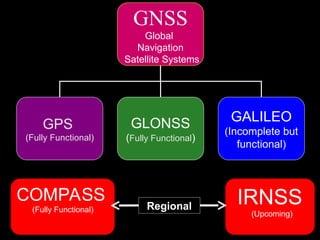
GNSS
Global
Navigation
Satellite Systems
GPS
(Fully Functional)
GLONSS
(Fully Functional)
GALILEO
(Incomplete but
functional)
IRNSS
(Upcoming)
COMPASS
(Fully Functional) Regional
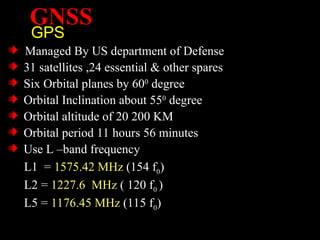
GNSS
GPS
Managed By US department of Defense
31 satellites ,24 essential & other spares
Six Orbital planes by 600
degree
Orbital Inclination about 550
degree
Orbital altitude of 20 200 KM
Orbital period 11 hours 56 minutes
Use L –band frequency
L1 = 1575.42 MHz (154 f0)
L2 = 1227.6 MHz ( 120 f0 )
L5 = 1176.45 MHz (115 f0)
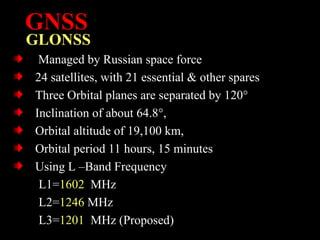
GNSS
GLONSS
Managed by Russian space force
24 satellites, with 21 essential & other spares
Three Orbital planes are separated by 120°
Inclination of about 64.8°,
Orbital altitude of 19,100 km,
Orbital period 11 hours, 15 minutes
Using L –Band Frequency
L1=1602 MHz
L2=1246 MHz
L3=1201 MHz (Proposed)
GNSS
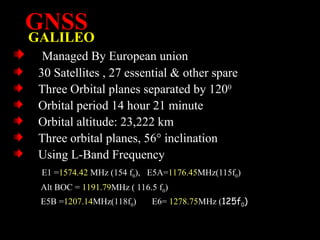
GALILEO
Managed By European union
30 Satellites , 27 essential & other spare
Three Orbital planes separated by 1200
Orbital period 14 hour 21 minute
Orbital altitude: 23,222 km
Three orbital planes, 56° inclination
Using L-Band Frequency
E1 =1574.42 MHz (154 f0), E5A=1176.45MHz(115f0)
Alt BOC = 1191.79MHz ( 116.5 f0)
E5B =1207.14MHz(118f0) E6= 1278.75MHz (125f0)
GNSS
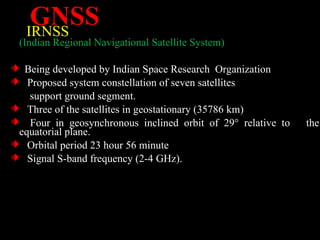
IRNSS
(Indian Regional Navigational Satellite System)
Being developed by Indian Space Research Organization
Proposed system constellation of seven satellites
support ground segment.
Three of the satellites in geostationary (35786 km)
Four in geosynchronous inclined orbit of 29° relative to the
equatorial plane.
Orbital period 23 hour 56 minute
Signal S-band frequency (2-4 GHz).
GPS
GPS consists of the following segments
 Space Segment
 Control Segment
 User Segment
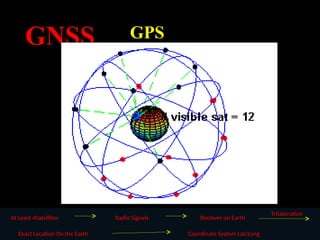
GNSS GPS
Trilateration
Exact Location On the Earth
Receiver on Earth
Radio Signals
At Least 4Satellites
Coordinate System Lat/Long
GPS
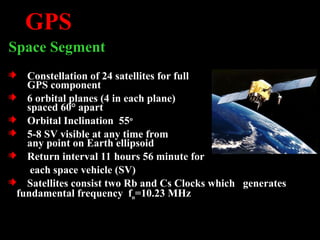
Space Segment
Constellation of 24 satellites for full
GPS component
6 orbital planes (4 in each plane)
spaced 60° apart
Orbital Inclination 55o
5-8 SV visible at any time from
any point on Earth ellipsoid
Return interval 11 hours 56 minute for
each space vehicle (SV)
Satellites consist two Rb and Cs Clocks which generates
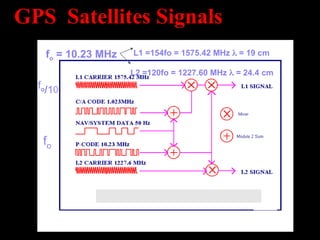
fundamental frequency fo=10.23 MHz
fo = 10.23 MHz
fo
fo/10
L1 =154fo = 1575.42 MHz  = 19 cm
L2 =120fo = 1227.60 MHz  = 24.4 cm
GPS Satellites Signals
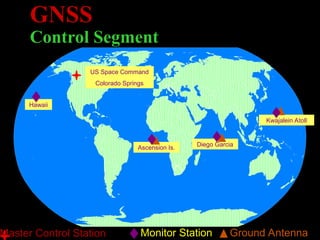
GNSS
Control Segment
US Space Command
Colorado Springs
Hawaii
Ascension Is.
Diego Garcia
Kwajalein Atoll
Monitor Station Ground Antenna
Master Control Station
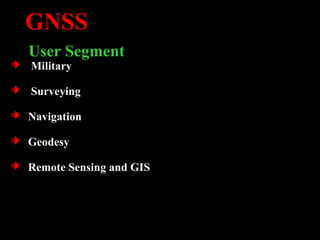
GNSS
User Segment
Military
Surveying
Navigation
Geodesy
Remote Sensing and GIS
GNSS
Two Basic Functions of GPS
Position, which is basic utility in our daily life
Our Magic Numbers are
Longitude, Latitude &Altitude
Accurate time measurement.
Topics That Will Be Covered
GNSS
How GPS Works ?
Errors in GPS Measurements
Why For Crustal Study
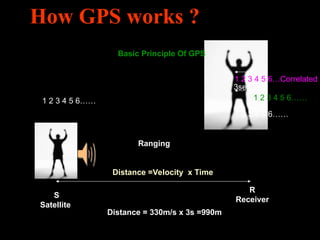
How GPS works ?
1 2 3 4 5 6……
1 2 3 4 5 6……
1 2 3 4 5 6……
1 2 3 4 5 6…Correlated
S
Satellite
R
Receiver
Distance =Velocity x Time
Distance = 330m/s x 3s =990m
Basic Principle Of GPS
Ranging
3sec
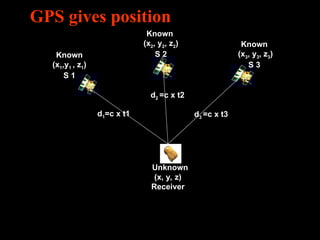
GPS gives position
Known
(x1,y1 , z1)
S 1
Known
(x3, y3, z3)
S 3
Known
(x2, y2, z2)
S 2
Unknown
(x, y, z)
Receiver
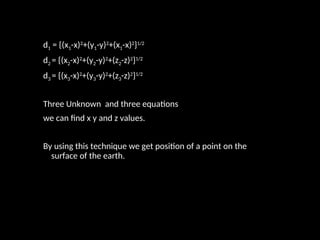
d1=c x t1
d2 =c x t2
d3 =c x t3
d1 = {(x1-x)2
+(y1-y)2
+(x1-x)2
}1/2
d2 = {(x2-x)2
+(y2-y)2
+(z2-z)2
}1/2
d3 = {(x3-x)2
+(y3-y)2
+(z3-z)2
}1/2
Three Unknown and three equations
we can find x y and z values.
By using this technique we get position of a point on the
surface of the earth.
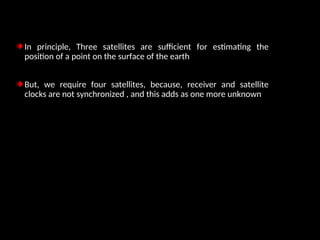
In principle, Three satellites are sufficient for estimating the
position of a point on the surface of the earth
But, we require four satellites, because, receiver and satellite
clocks are not synchronized , and this adds as one more unknown
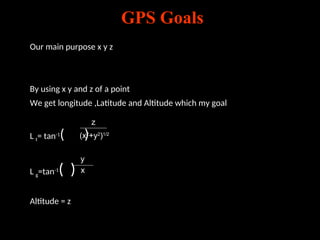
Our main purpose x y z
By using x y and z of a point
We get longitude ,Latitude and Altitude which my goal
L t= tan-1
( )
L g=tan-1
( )
Altitude = z
z
(x2
+y2
)1/2
y
x
GPS Goals
Topics That Will Be Covered
GNSS
How GPS Works ?
Errors in GPS Measurements
Why For Crustal Study
Errors Sources
Satellite Errors
Measured Accurately
Error corrected
Signal Propagation
Ionosphere
Troposphere
Receiver And Antenna
Multipath
Antenna Phase Center
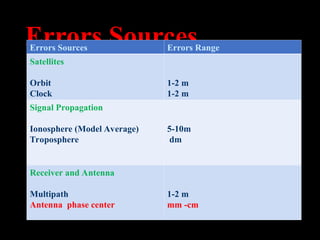
Errors Sources
Errors Sources Errors Range
Satellites
Orbit
Clock
1-2 m
1-2 m
Signal Propagation
Ionosphere (Model Average)
Troposphere
5-10m
dm
Receiver and Antenna
Multipath
Antenna phase center
1-2 m
mm -cm
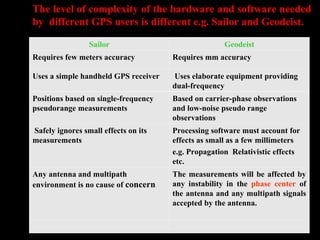
Sailor Geodeist
Requires few meters accuracy Requires mm accuracy
Uses a simple handheld GPS receiver Uses elaborate equipment providing
dual-frequency
Positions based on single-frequency
pseudorange measurements
Based on carrier-phase observations
and low-noise pseudo range
observations
Safely ignores small effects on its
measurements
Processing software must account for
effects as small as a few millimeters
e.g. Propagation Relativistic effects
etc.
Any antenna and multipath
environment is no cause of concern
The measurements will be affected by
any instability in the phase center of
the antenna and any multipath signals
accepted by the antenna.
The level of complexity of the hardware and software needed
by different GPS users is different e.g. Sailor and Geodeist.
Antenna
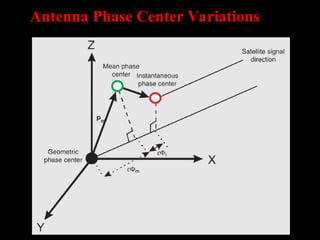
Phase Center Variations
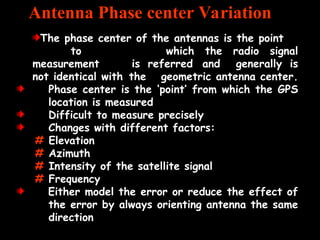
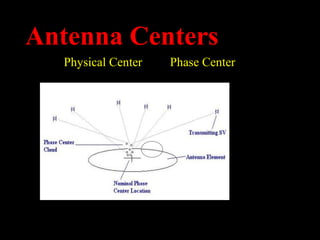
The phase center of the antennas is the point
to which the radio signal
measurement is referred and generally is
not identical with the geometric antenna center.
Phase center is the ‘point’ from which the GPS
location is measured
Difficult to measure precisely
Changes with different factors:
# Elevation
# Azimuth
# Intensity of the satellite signal
# Frequency
Either model the error or reduce the effect of
the error by always orienting antenna the same
direction
Antenna Phase center Variation
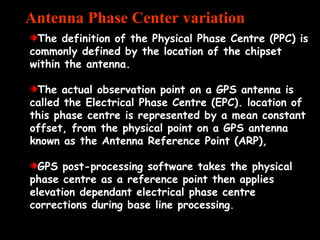
The definition of the Physical Phase Centre (PPC) is
commonly defined by the location of the chipset
within the antenna.
The actual observation point on a GPS antenna is
called the Electrical Phase Centre (EPC). location of
this phase centre is represented by a mean constant
offset, from the physical point on a GPS antenna
known as the Antenna Reference Point (ARP),
GPS post-processing software takes the physical
phase centre as a reference point then applies
elevation dependant electrical phase centre
corrections during base line processing.
Antenna Phase Center variation
Antenna Phase center Variations
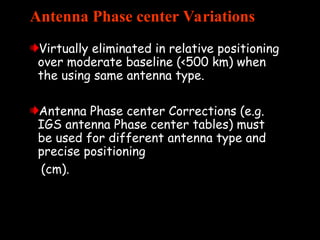
Virtually eliminated in relative positioning
over moderate baseline (<500 km) when
the using same antenna type.
Antenna Phase center Corrections (e.g.
IGS antenna Phase center tables) must
be used for different antenna type and
precise positioning
(cm).
Antenna Phase center Variations
Why GPS Antenna Calibration
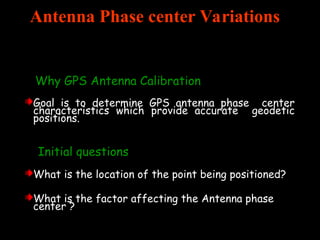
Goal is to determine GPS antenna phase center
characteristics which provide accurate geodetic
positions.
Initial questions
What is the location of the point being positioned?
What is the factor affecting the Antenna phase
center ?
Antenna Centers
Physical Center Phase Center
Antenna Phase Center Variations
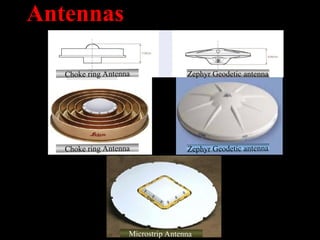
Antennas
Choke ring Antenna Zephyr Geodetic antenna
Microstrip Antenna
Choke ring Antenna Zephyr Geodetic antenna
Topics That Will Be Covered
GNSS
How GPS Works ?
Errors in GPS Measurements
Why For Crustal Study
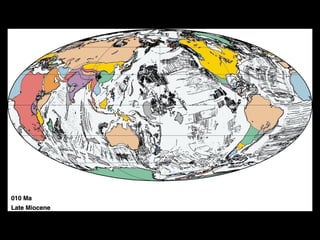
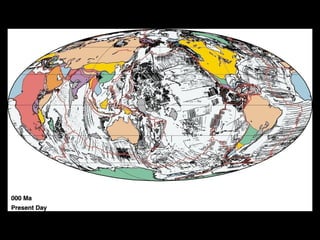
Crustal Deformation
Every crustal plate is moving in random
direction With very low speed in cm
range.
We can not measure it globally.
GNSS is only tool which can provide to
estimate low velocities of these crustal
plates.
Conclusion
A phase center may vary and can be
estimated
An offset and phase center variation
(PCV) must be applied to yield correct
distance to the source
Different phase centers, when corrected
for offset and PCV give identical results
There is no phase center for which PCV is
zero but can be minimized
Conclusion…
Antennas that are manufactured the same
way will usually have the phase center
in the same place.
in the same place.
In requiring extreme accuracy, the same
model of antenna will be used on both the
base station and the rover. Each antenna
is then aimed north to insure that the
phase center of each antenna is located in
the same place with respect to each other
every time.
every time.
GPS Laboratory
Asperity model and deformation
pattern
Lay, [2015]
Seismic cycle
Seismic cycle
Reid,
[1910]
coseismic coseismic
interseismic
post
seismic
permanent
deformation
displacement
time
(A)
(B)
(C)
Ideal seismic
cycle
(elastic
behaviour)
Observed seismic cycle
(Viscoelastics
behaviour)
coseismic coseismic
interseismic
displacement
time
coseismic coseismic
interseismic
post
seismic
permanent
deformation
displacement
time
Interseismic
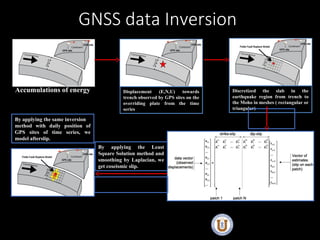
Accumulations of energy
Coseismic
Displacement (E,N,U) towards
trench observed by GPS sites on the
overriding plate from the time
series
Discretized the slab in the
earthquake region from trench to
the Moho in meshes ( rectangular or
triangular)
i
j
j s
G
u 
  u
C
G
G
C
G
s u
T
u
T 1
1
1
ˆ 



By applying the Least
Square Solution method and
smoothing by Laplacian, we
get coseismic slip.
By applying the same inversion
method with daily position of
GPS sites of time series, we
model afterslip.
GNSS data Inversion
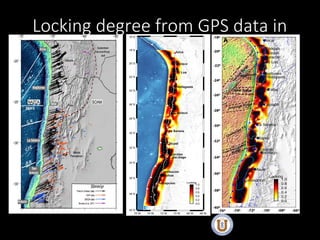
Locking degree from GPS data in
Chile
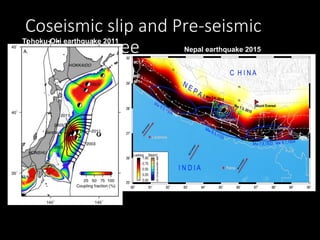
Coseismic slip and Pre-seismic
locking degree
Tohoku-Oki earthquake 2011
Nepal earthquake 2015
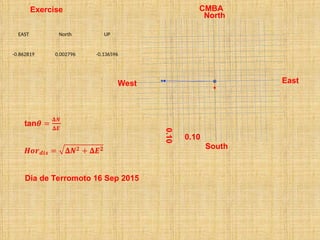
EAST North UP
-0.862819 0.002796 -0.136596
North
South
East
West
0.10
0.10
Dia de Terromoto 16 Sep 2015
Exercise CMBA
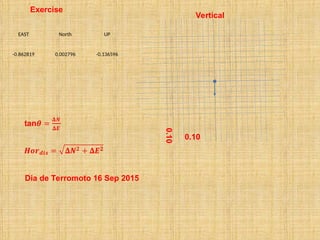
EAST North UP
-0.862819 0.002796 -0.136596
Vertical
0.10
0.10
Dia de Terromoto 16 Sep 2015
Exercise
GPS technique...........................

GPS technique...........................

  • 1.
    Global Navigational SatelliteSystem (GNSS) and its application for Earthquake study By Mahesh N. Shrivastava
  • 2.
    Topics That WillBe Covered GNSS How GPS Works ? Errors in GPS measurements Why For Crustal Study
  • 3.
    GNSS Global Navigation Satellite Systems GPS (Fully Functional) GLONSS (FullyFunctional) GALILEO (Incomplete but functional) IRNSS (Upcoming) COMPASS (Fully Functional) Regional
  • 4.
    GNSS GPS Managed By USdepartment of Defense 31 satellites ,24 essential & other spares Six Orbital planes by 600 degree Orbital Inclination about 550 degree Orbital altitude of 20 200 KM Orbital period 11 hours 56 minutes Use L –band frequency L1 = 1575.42 MHz (154 f0) L2 = 1227.6 MHz ( 120 f0 ) L5 = 1176.45 MHz (115 f0)
  • 5.
    GNSS GLONSS Managed by Russianspace force 24 satellites, with 21 essential & other spares Three Orbital planes are separated by 120° Inclination of about 64.8°, Orbital altitude of 19,100 km, Orbital period 11 hours, 15 minutes Using L –Band Frequency L1=1602 MHz L2=1246 MHz L3=1201 MHz (Proposed)
  • 6.
    GNSS GALILEO Managed By Europeanunion 30 Satellites , 27 essential & other spare Three Orbital planes separated by 1200 Orbital period 14 hour 21 minute Orbital altitude: 23,222 km Three orbital planes, 56° inclination Using L-Band Frequency E1 =1574.42 MHz (154 f0), E5A=1176.45MHz(115f0) Alt BOC = 1191.79MHz ( 116.5 f0) E5B =1207.14MHz(118f0) E6= 1278.75MHz (125f0)
  • 7.
    GNSS IRNSS (Indian Regional NavigationalSatellite System) Being developed by Indian Space Research Organization Proposed system constellation of seven satellites support ground segment. Three of the satellites in geostationary (35786 km) Four in geosynchronous inclined orbit of 29° relative to the equatorial plane. Orbital period 23 hour 56 minute Signal S-band frequency (2-4 GHz).
  • 8.
    GPS GPS consists ofthe following segments  Space Segment  Control Segment  User Segment
  • 9.
    GNSS GPS Trilateration Exact LocationOn the Earth Receiver on Earth Radio Signals At Least 4Satellites Coordinate System Lat/Long
  • 10.
    GPS Space Segment Constellation of24 satellites for full GPS component 6 orbital planes (4 in each plane) spaced 60° apart Orbital Inclination 55o 5-8 SV visible at any time from any point on Earth ellipsoid Return interval 11 hours 56 minute for each space vehicle (SV) Satellites consist two Rb and Cs Clocks which generates fundamental frequency fo=10.23 MHz
  • 11.
    fo = 10.23MHz fo fo/10 L1 =154fo = 1575.42 MHz  = 19 cm L2 =120fo = 1227.60 MHz  = 24.4 cm GPS Satellites Signals
  • 12.
    GNSS Control Segment US SpaceCommand Colorado Springs Hawaii Ascension Is. Diego Garcia Kwajalein Atoll Monitor Station Ground Antenna Master Control Station
  • 13.
  • 14.
    GNSS Two Basic Functionsof GPS Position, which is basic utility in our daily life Our Magic Numbers are Longitude, Latitude &Altitude Accurate time measurement.
  • 15.
    Topics That WillBe Covered GNSS How GPS Works ? Errors in GPS Measurements Why For Crustal Study
  • 16.
    How GPS works? 1 2 3 4 5 6…… 1 2 3 4 5 6…… 1 2 3 4 5 6…… 1 2 3 4 5 6…Correlated S Satellite R Receiver Distance =Velocity x Time Distance = 330m/s x 3s =990m Basic Principle Of GPS Ranging 3sec
  • 17.
    GPS gives position Known (x1,y1, z1) S 1 Known (x3, y3, z3) S 3 Known (x2, y2, z2) S 2 Unknown (x, y, z) Receiver d1=c x t1 d2 =c x t2 d3 =c x t3
  • 18.
    d1 = {(x1-x)2 +(y1-y)2 +(x1-x)2 }1/2 d2= {(x2-x)2 +(y2-y)2 +(z2-z)2 }1/2 d3 = {(x3-x)2 +(y3-y)2 +(z3-z)2 }1/2 Three Unknown and three equations we can find x y and z values. By using this technique we get position of a point on the surface of the earth.
  • 19.
    In principle, Threesatellites are sufficient for estimating the position of a point on the surface of the earth But, we require four satellites, because, receiver and satellite clocks are not synchronized , and this adds as one more unknown
  • 20.
    Our main purposex y z By using x y and z of a point We get longitude ,Latitude and Altitude which my goal L t= tan-1 ( ) L g=tan-1 ( ) Altitude = z z (x2 +y2 )1/2 y x GPS Goals
  • 21.
    Topics That WillBe Covered GNSS How GPS Works ? Errors in GPS Measurements Why For Crustal Study
  • 22.
    Errors Sources Satellite Errors MeasuredAccurately Error corrected Signal Propagation Ionosphere Troposphere Receiver And Antenna Multipath Antenna Phase Center
  • 23.
    Errors Sources Errors SourcesErrors Range Satellites Orbit Clock 1-2 m 1-2 m Signal Propagation Ionosphere (Model Average) Troposphere 5-10m dm Receiver and Antenna Multipath Antenna phase center 1-2 m mm -cm
  • 24.
    Sailor Geodeist Requires fewmeters accuracy Requires mm accuracy Uses a simple handheld GPS receiver Uses elaborate equipment providing dual-frequency Positions based on single-frequency pseudorange measurements Based on carrier-phase observations and low-noise pseudo range observations Safely ignores small effects on its measurements Processing software must account for effects as small as a few millimeters e.g. Propagation Relativistic effects etc. Any antenna and multipath environment is no cause of concern The measurements will be affected by any instability in the phase center of the antenna and any multipath signals accepted by the antenna. The level of complexity of the hardware and software needed by different GPS users is different e.g. Sailor and Geodeist.
  • 25.
  • 26.
    The phase centerof the antennas is the point to which the radio signal measurement is referred and generally is not identical with the geometric antenna center. Phase center is the ‘point’ from which the GPS location is measured Difficult to measure precisely Changes with different factors: # Elevation # Azimuth # Intensity of the satellite signal # Frequency Either model the error or reduce the effect of the error by always orienting antenna the same direction Antenna Phase center Variation
  • 27.
    The definition ofthe Physical Phase Centre (PPC) is commonly defined by the location of the chipset within the antenna. The actual observation point on a GPS antenna is called the Electrical Phase Centre (EPC). location of this phase centre is represented by a mean constant offset, from the physical point on a GPS antenna known as the Antenna Reference Point (ARP), GPS post-processing software takes the physical phase centre as a reference point then applies elevation dependant electrical phase centre corrections during base line processing. Antenna Phase Center variation
  • 28.
    Antenna Phase centerVariations Virtually eliminated in relative positioning over moderate baseline (<500 km) when the using same antenna type. Antenna Phase center Corrections (e.g. IGS antenna Phase center tables) must be used for different antenna type and precise positioning (cm).
  • 29.
    Antenna Phase centerVariations Why GPS Antenna Calibration Goal is to determine GPS antenna phase center characteristics which provide accurate geodetic positions. Initial questions What is the location of the point being positioned? What is the factor affecting the Antenna phase center ?
  • 30.
  • 31.
  • 32.
    Antennas Choke ring AntennaZephyr Geodetic antenna Microstrip Antenna Choke ring Antenna Zephyr Geodetic antenna
  • 33.
    Topics That WillBe Covered GNSS How GPS Works ? Errors in GPS Measurements Why For Crustal Study
  • 53.
    Crustal Deformation Every crustalplate is moving in random direction With very low speed in cm range. We can not measure it globally. GNSS is only tool which can provide to estimate low velocities of these crustal plates.
  • 54.
    Conclusion A phase centermay vary and can be estimated An offset and phase center variation (PCV) must be applied to yield correct distance to the source Different phase centers, when corrected for offset and PCV give identical results There is no phase center for which PCV is zero but can be minimized
  • 55.
    Conclusion… Antennas that aremanufactured the same Antennas that are manufactured the same way will usually have the phase center way will usually have the phase center in the same place. in the same place. In requiring extreme accuracy, the same In requiring extreme accuracy, the same model of antenna will be used on both the model of antenna will be used on both the base station and the rover. Each antenna base station and the rover. Each antenna is then aimed north to insure that the is then aimed north to insure that the phase center of each antenna is located in phase center of each antenna is located in the same place with respect to each other the same place with respect to each other every time. every time.
  • 56.
  • 57.
    Asperity model anddeformation pattern Lay, [2015]
  • 58.
    Seismic cycle Seismic cycle Reid, [1910] coseismiccoseismic interseismic post seismic permanent deformation displacement time (A) (B) (C) Ideal seismic cycle (elastic behaviour) Observed seismic cycle (Viscoelastics behaviour) coseismic coseismic interseismic displacement time coseismic coseismic interseismic post seismic permanent deformation displacement time
  • 59.
    Interseismic Accumulations of energy Coseismic Displacement(E,N,U) towards trench observed by GPS sites on the overriding plate from the time series Discretized the slab in the earthquake region from trench to the Moho in meshes ( rectangular or triangular) i j j s G u    u C G G C G s u T u T 1 1 1 ˆ     By applying the Least Square Solution method and smoothing by Laplacian, we get coseismic slip. By applying the same inversion method with daily position of GPS sites of time series, we model afterslip. GNSS data Inversion
  • 60.
    Locking degree fromGPS data in Chile
  • 61.
    Coseismic slip andPre-seismic locking degree Tohoku-Oki earthquake 2011 Nepal earthquake 2015
  • 62.
    EAST North UP -0.8628190.002796 -0.136596 North South East West 0.10 0.10 Dia de Terromoto 16 Sep 2015 Exercise CMBA
  • 63.
    EAST North UP -0.8628190.002796 -0.136596 Vertical 0.10 0.10 Dia de Terromoto 16 Sep 2015 Exercise