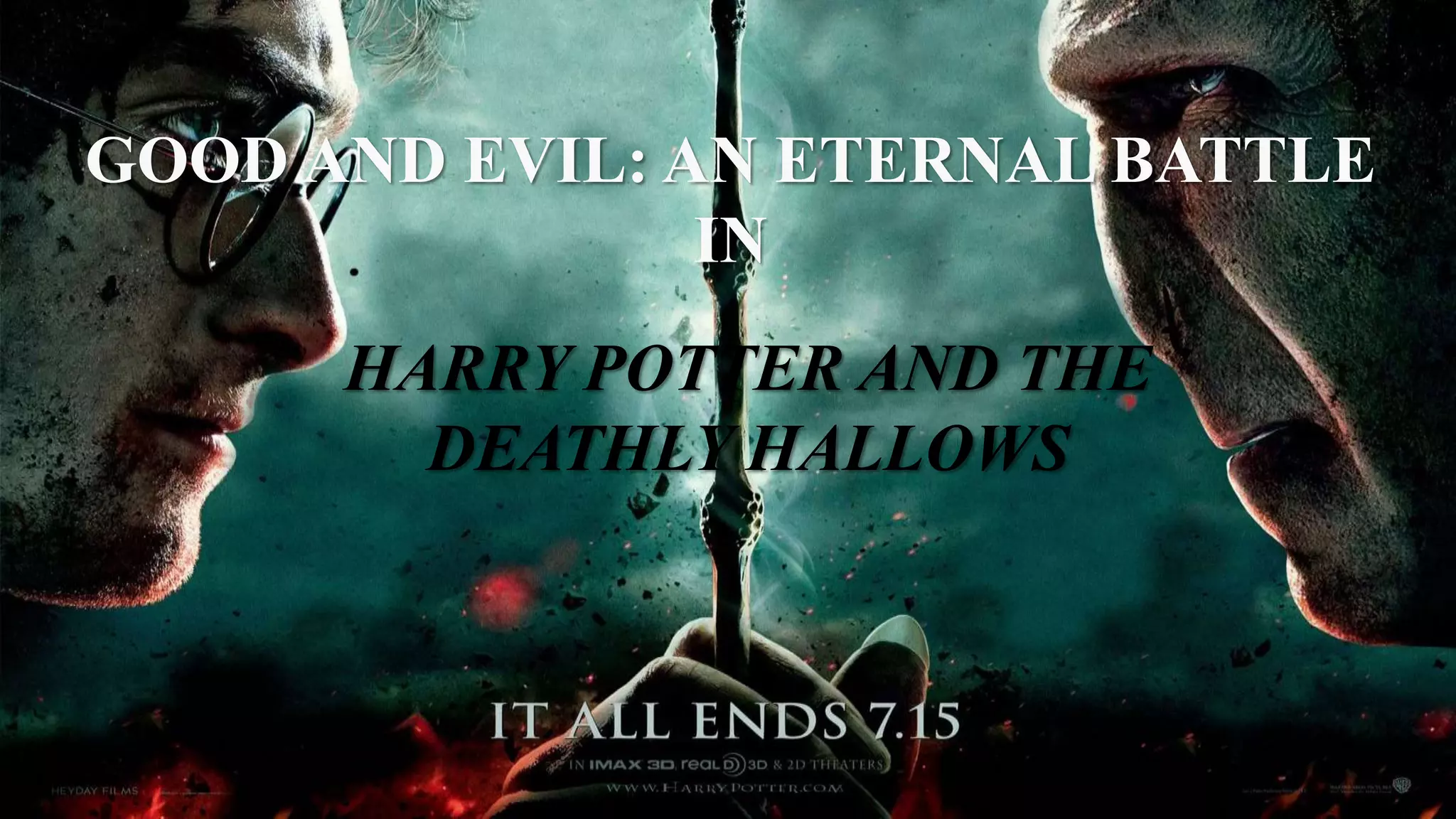
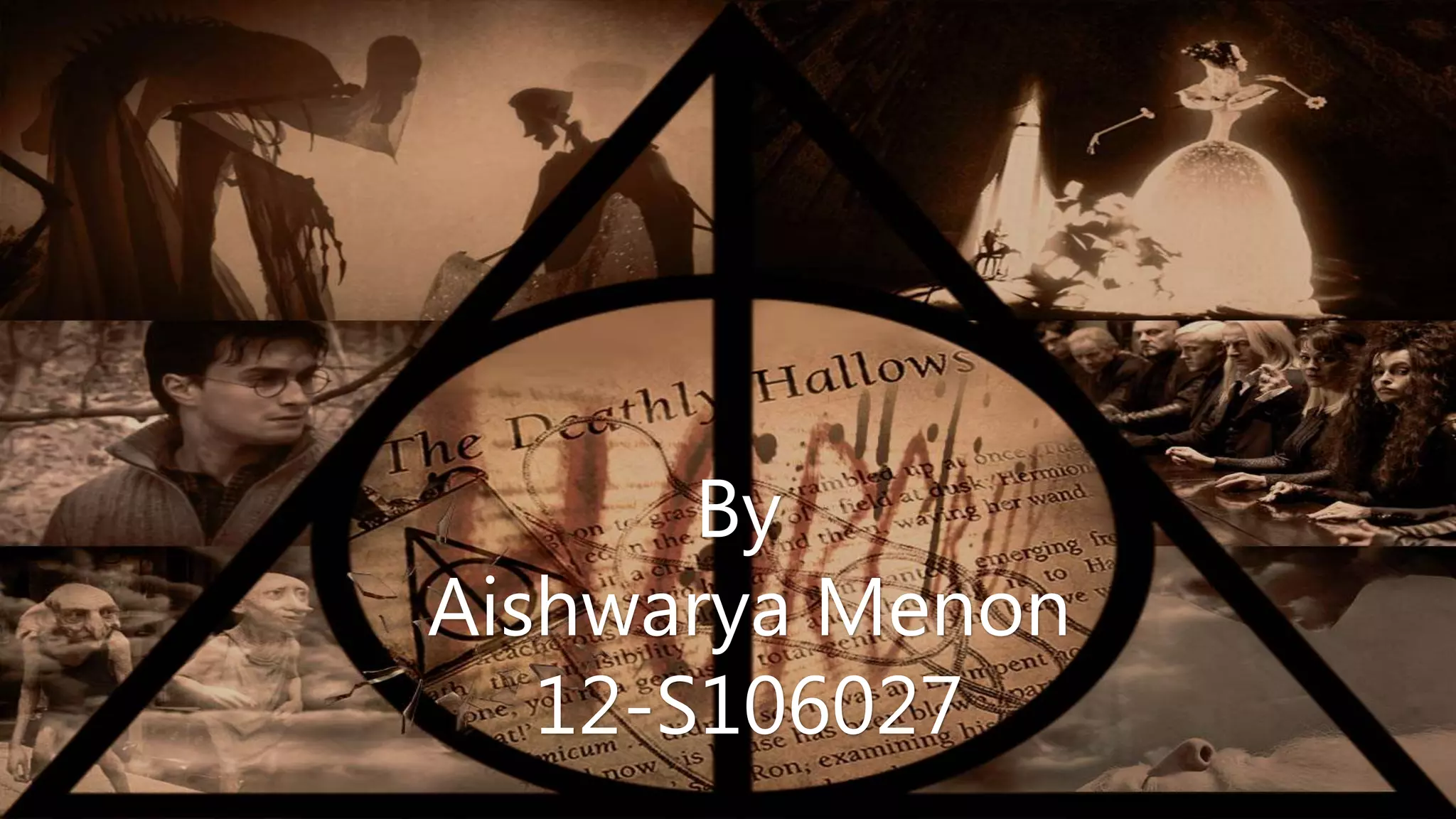
GOOD AND EVIL: AN ETERNAL BATTLE
IN
HARRY POTTER AND THE
DEATHLY HALLOWS
Fantasy Genre
 Traditional fantasy : Oral tradition (myths,
legends, folk stories, tall tales, etc.)
 Modern fantasy : Written stories where we know
the author (literary fairy tales, fantasy novels,
fantasy picture books, etc.)
The Wizard Behind Harry Potter
 Her books completely redefined children’s
literature.
 Acclaimed as a writer who promoted reading
among various age groups around the world.
 Founded the children’s charity ‘Lumos’.
 Shaped the genre of young adult fiction.
 Some of them are The Edinburgh Award (2008),
British book lifetime achievement award (2008),
Nestle Smarties Book Prize (Gold Award), Harry
Potter and the philosopher’s stone, 9-11 years
category (1997).
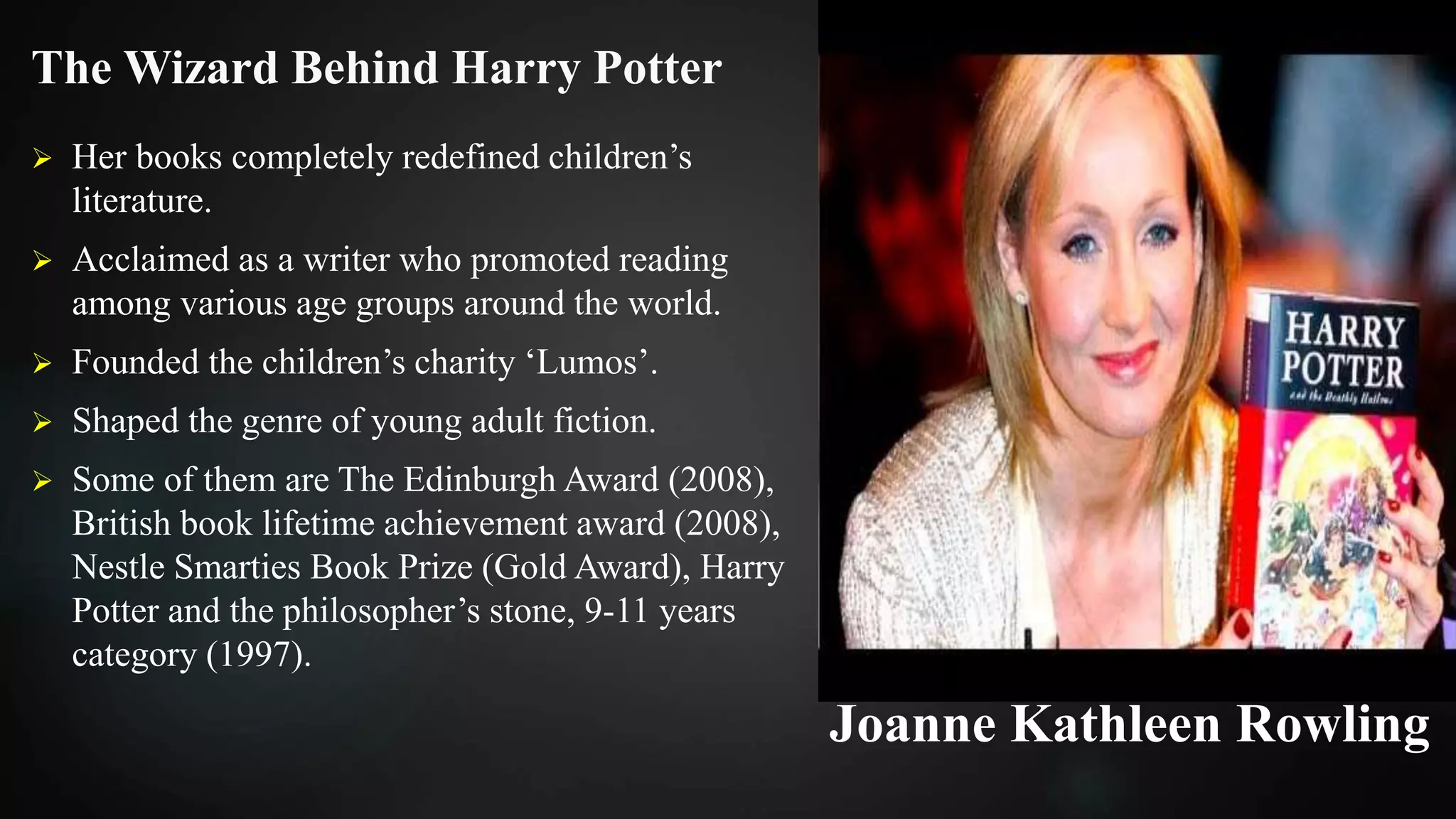
Joanne Kathleen Rowling
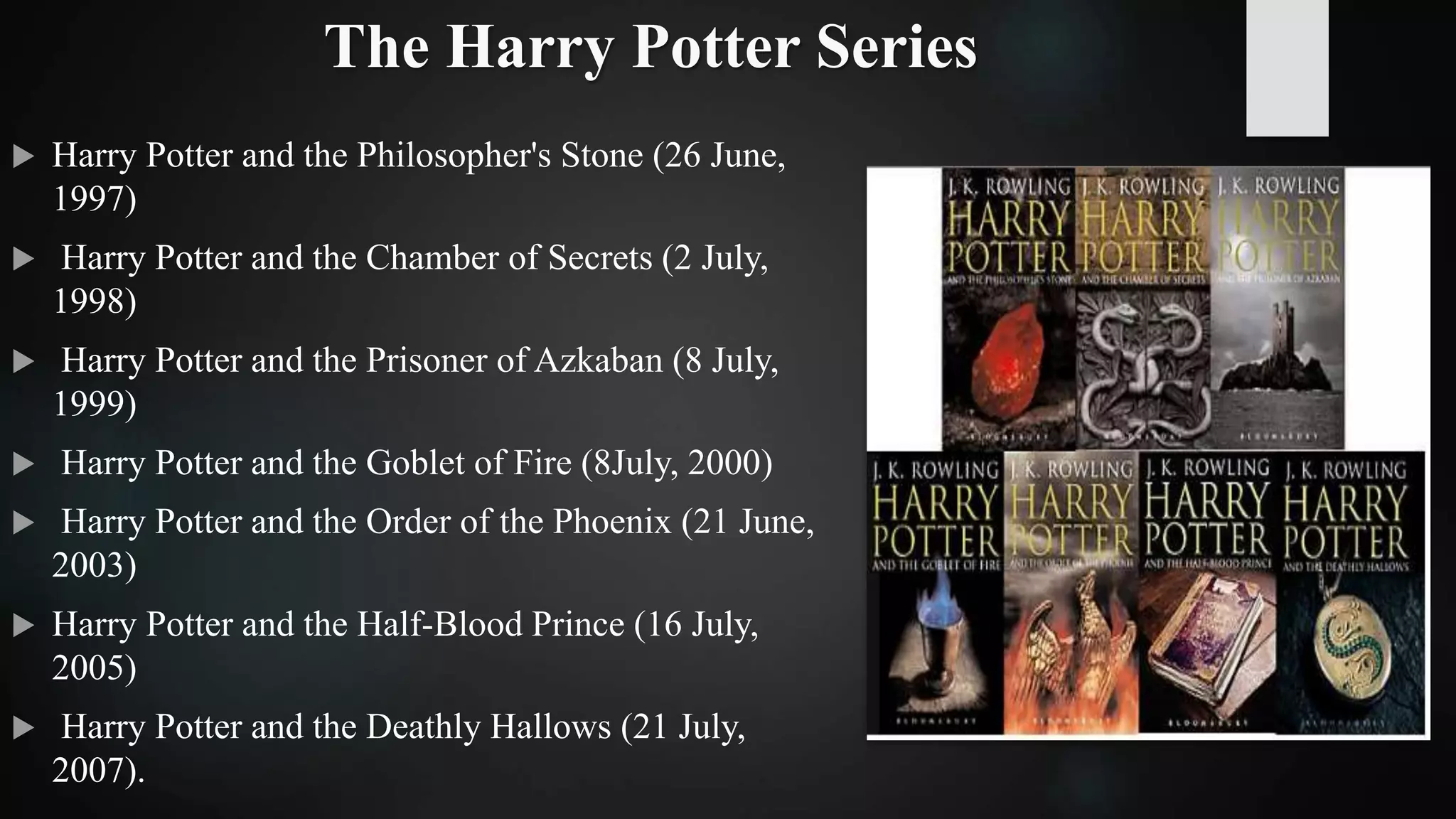
The Harry Potter Series
 Harry Potter and the Philosopher's Stone (26 June,
1997)
 Harry Potter and the Chamber of Secrets (2 July,
1998)
 Harry Potter and the Prisoner of Azkaban (8 July,
1999)
 Harry Potter and the Goblet of Fire (8July, 2000)
 Harry Potter and the Order of the Phoenix (21 June,
2003)
 Harry Potter and the Half-Blood Prince (16 July,
2005)
 Harry Potter and the Deathly Hallows (21 July,
2007).
 The concept of good and evil is as old as mankind.
 Perception of the Zoroastrian faith, enshrined by Zarathustra over 3000 years ago.
 There are several variations on this conflict, one being the battle between
individuals or ideologies, with one side Good and the other side Evil. Another
variation is the inner struggle in characters (and by extension, humans in reality)
between good and evil.
 In Beowulf, Lord of The Flies, Grendel and Harry Potter, characters have
changed over the course of the novel becoming evil or over coming evil but the
effects of evil on these characters are immense.
 Good is a broad concept but it typically deals with an association with life,
charity, continuity, happiness, love and justice.
 Evil is associated with discrimination designed to harm others and acts of
unnecessary or indiscriminate violence.
“It is our choices that show what we truly are, far more than our
abilities”
- J.K.Rowling
 Rowling personifies Good and Evil.
 In Deathly Hallows, it’s the Order of Phoenix against the Death Eaters, with Death Eaters
promoting intolerance and cruelty towards Muggles and wizards with Muggle blood.
 Good and evil is clear-cut as demonstrated by characters like Snape, Voldemort, Harry, and
Dumbledore.
 Good traits and flaws humanize a protagonist and an antagonist.
 The antagonist, Voldemort, embodies evil and is a clear benchmark for the protagonist, Harry
Potter, to fight against.
 The battle human beings wage between good and evil goes on into imperishability.
 Good and Evil are the concepts that represent the essential rules of behaviour without which
no society can survive.
“People are not mirrors. They see you completely different than the
way you see yourself”.
 The theme good and evil helps an individual inculcate basic moral values.
 An individual is the beginning point of good and evil.
 Food, spoken words, thoughts and actions are also for good and evil.
 An amazing fact to know is that a person can shift from good side to the evil one in
a second, but to go from the evil side to the good one is not that easy. It requires
time and effort.
 Our choices make us what we are.
 It’s our choices in life that define us because we and only we are responsible for the
choices we make as every choice has a consequence ahead.
 Good is a thing which will not hurt anyone but evil does.
Critical Comments
 Alice Fordham from The Times wrote that "Rowling's genius is not just her total realization
of a fantasy world, but the quieter skill of creating characters that bounce off the page, real
and flawed and brave and lovable".
 The New York Times writer Michiko Kakutani praises Rowling's ability to make Harry both a
hero and a character that can be related to.
 Amanda Craig said that, while Rowling was "not an original, high concept author", she was
"right up there with other greats of children's fiction".
 Craig went on to say that the novel was "beautifully judged, and a triumphant return to form",
and that Rowling's imagination changed the perception of an entire generation, which
"is more than all but a handful of living authors, in any genre, have achieved in the past
half-century".
By
Aishwarya Menon
12-S106027

GOOD AND EVIL

  • 1.
    GOOD AND EVIL:AN ETERNAL BATTLE IN HARRY POTTER AND THE DEATHLY HALLOWS
  • 2.
    Fantasy Genre  Traditionalfantasy : Oral tradition (myths, legends, folk stories, tall tales, etc.)  Modern fantasy : Written stories where we know the author (literary fairy tales, fantasy novels, fantasy picture books, etc.)
  • 3.
    The Wizard BehindHarry Potter  Her books completely redefined children’s literature.  Acclaimed as a writer who promoted reading among various age groups around the world.  Founded the children’s charity ‘Lumos’.  Shaped the genre of young adult fiction.  Some of them are The Edinburgh Award (2008), British book lifetime achievement award (2008), Nestle Smarties Book Prize (Gold Award), Harry Potter and the philosopher’s stone, 9-11 years category (1997). Joanne Kathleen Rowling
  • 4.
    The Harry PotterSeries  Harry Potter and the Philosopher's Stone (26 June, 1997)  Harry Potter and the Chamber of Secrets (2 July, 1998)  Harry Potter and the Prisoner of Azkaban (8 July, 1999)  Harry Potter and the Goblet of Fire (8July, 2000)  Harry Potter and the Order of the Phoenix (21 June, 2003)  Harry Potter and the Half-Blood Prince (16 July, 2005)  Harry Potter and the Deathly Hallows (21 July, 2007).
  • 5.
     The conceptof good and evil is as old as mankind.  Perception of the Zoroastrian faith, enshrined by Zarathustra over 3000 years ago.  There are several variations on this conflict, one being the battle between individuals or ideologies, with one side Good and the other side Evil. Another variation is the inner struggle in characters (and by extension, humans in reality) between good and evil.  In Beowulf, Lord of The Flies, Grendel and Harry Potter, characters have changed over the course of the novel becoming evil or over coming evil but the effects of evil on these characters are immense.  Good is a broad concept but it typically deals with an association with life, charity, continuity, happiness, love and justice.  Evil is associated with discrimination designed to harm others and acts of unnecessary or indiscriminate violence.
  • 6.
    “It is ourchoices that show what we truly are, far more than our abilities” - J.K.Rowling  Rowling personifies Good and Evil.  In Deathly Hallows, it’s the Order of Phoenix against the Death Eaters, with Death Eaters promoting intolerance and cruelty towards Muggles and wizards with Muggle blood.  Good and evil is clear-cut as demonstrated by characters like Snape, Voldemort, Harry, and Dumbledore.  Good traits and flaws humanize a protagonist and an antagonist.  The antagonist, Voldemort, embodies evil and is a clear benchmark for the protagonist, Harry Potter, to fight against.  The battle human beings wage between good and evil goes on into imperishability.  Good and Evil are the concepts that represent the essential rules of behaviour without which no society can survive.
  • 7.
    “People are notmirrors. They see you completely different than the way you see yourself”.  The theme good and evil helps an individual inculcate basic moral values.  An individual is the beginning point of good and evil.  Food, spoken words, thoughts and actions are also for good and evil.  An amazing fact to know is that a person can shift from good side to the evil one in a second, but to go from the evil side to the good one is not that easy. It requires time and effort.  Our choices make us what we are.  It’s our choices in life that define us because we and only we are responsible for the choices we make as every choice has a consequence ahead.  Good is a thing which will not hurt anyone but evil does.
  • 8.
    Critical Comments  AliceFordham from The Times wrote that "Rowling's genius is not just her total realization of a fantasy world, but the quieter skill of creating characters that bounce off the page, real and flawed and brave and lovable".  The New York Times writer Michiko Kakutani praises Rowling's ability to make Harry both a hero and a character that can be related to.  Amanda Craig said that, while Rowling was "not an original, high concept author", she was "right up there with other greats of children's fiction".  Craig went on to say that the novel was "beautifully judged, and a triumphant return to form", and that Rowling's imagination changed the perception of an entire generation, which "is more than all but a handful of living authors, in any genre, have achieved in the past half-century".
  • 9.