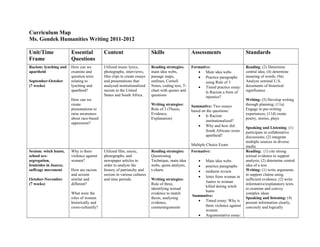
Curriculum Map
Ms. Gondek Humanities Writing 2011-2012
Unit/Time
Frame
Essential
Questions
Content Skills Assessments Standards
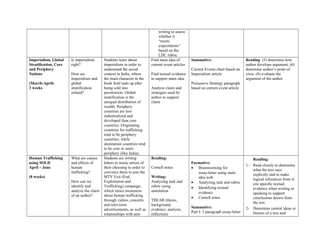
Racism: lynching and
apartheid
September-October
(7 weeks)
How can we
examine and
question texts
relating to
lynching and
apartheid?
How can we
create
presentations to
raise awareness
about race-based
oppression?
Utilized music lyrics,
photographs, interviews,
film clips to create essays
and presentations that
analyzed institutionalized
racism in the United
States and South Africa.
Reading strategies:
main idea webs,
passage maps,
outlines, Cornell
Notes, coding text, T-
chart with quotes and
questions
Writing strategies:
Rule of 3 (Thesis,
Evidence,
Explanation)
Formative:
• Main idea webs
• Practice paragraphs
using Rule of 3
• Timed practice essay:
Is Racism a form of
injustice?
Summative: Two essays
based on the questions:
• Is Racism
institutionalized?
• Why and how did
South Africans resist
apartheid?
Multiple Choice Exam
Reading: (2) Determine
central idea; (4) determine
meaning of words; (9a)
Analyze seminal U.S.
documents of historical
significance
Writing: (5) Develop writing
through planning; (11a)
Engage in pre-writing
experiences; (11d) create
poetry, stories, plays
Speaking and Listening: (1)
participate in collaborative
discussions; (2) integrate
multiple sources in diverse
media
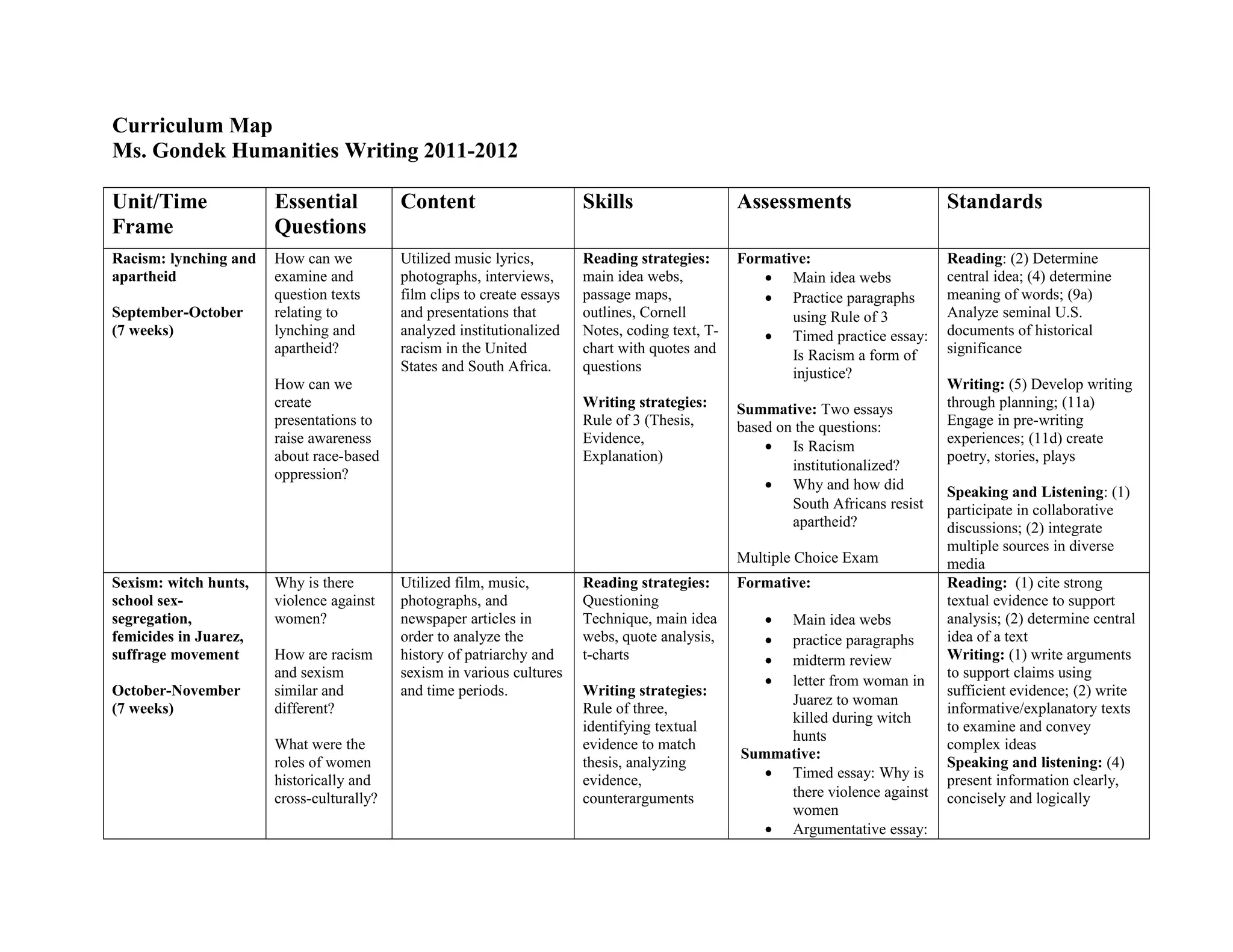
Sexism: witch hunts,
school sex-
segregation,
femicides in Juarez,
suffrage movement
October-November
(7 weeks)
Why is there
violence against
women?
How are racism
and sexism
similar and
different?
What were the
roles of women
historically and
cross-culturally?
Utilized film, music,
photographs, and
newspaper articles in
order to analyze the
history of patriarchy and
sexism in various cultures
and time periods.
Reading strategies:
Questioning
Technique, main idea
webs, quote analysis,
t-charts
Writing strategies:
Rule of three,
identifying textual
evidence to match
thesis, analyzing
evidence,
counterarguments
Formative:
• Main idea webs
• practice paragraphs
• midterm review
• letter from woman in
Juarez to woman
killed during witch
hunts
Summative:
• Timed essay: Why is
there violence against
women
• Argumentative essay:
Reading: (1) cite strong
textual evidence to support
analysis; (2) determine central
idea of a text
Writing: (1) write arguments
to support claims using
sufficient evidence; (2) write
informative/explanatory texts
to examine and convey
complex ideas
Speaking and listening: (4)
present information clearly,
concisely and logically
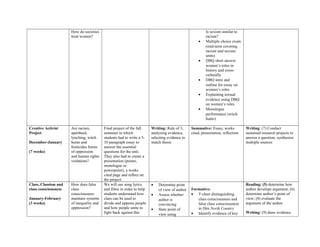
How do societies
treat women?
Is sexism similar to
racism?
• Multiple choice exam
(mid-term covering
racism and sexism
units)
• DBQ short answer
women’s roles in
history and cross-
culturally
• DBQ intro and
outline for essay on
women’s roles
• Explaining textual
evidence using DBQ
on women’s roles
• Monologue
performance (witch
hunts)
Creative Activist
Project
December-January
(7 weeks)
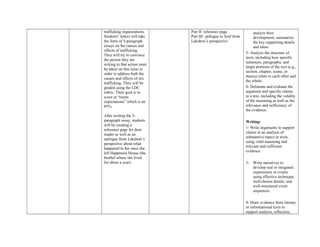
Are racism,
apartheid,
lynching, witch
hunts and
femicides forms
of oppression
and human rights
violations?
Final project of the fall
semester in which
students had to write a 5-
10 paragraph essay to
answer the essential
questions for the unit.
They also had to create a
presentation (poster,
monologue or
powerpoint), a works
cited page and reflect on
the project.
Writing: Rule of 3,
analyzing evidence,
selecting evidence to
match thesis
Summative: Essay, works
cited, presentation, reflection
Writing: (7) Conduct
sustained research projects to
answer a question, synthesize
multiple sources
Class, Classism and
class consciousness
January-February
(3 weeks)
How does false
class
consciousness
maintain systems
of inequality and
oppression?
We will use song lyrics
and films in order to help
students understand how
class can be used to
divide and oppress people
and how people unite to
fight back against this
• Determine point
of view of author
• Assess whether
author is
convincing
• State point of
view using
Formative:
• T-chart distinguishing
class consciousness and
false class consciousness
in film North Country
• Identify evidence of key
Reading: (5) determine how
author develops argument; (6)
determine author’s point of
view; (8) evaluate the
argument of the author
Writing: (9) draw evidence
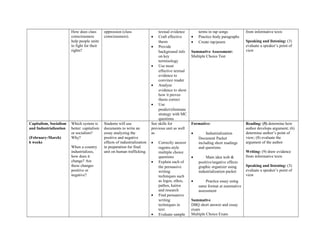
How does class
consciousness
help people unite
to fight for their
rights?
oppression (class
consciousness).
textual evidence
• Craft effective
thesis
• Provide
background info
on key
terminology
• Use most
effective textual
evidence to
convince reader
• Analyze
evidence to show
how it proves
thesis correct
• Use
predict/eliminate
strategy with MC
questions
terms in rap songs
• Practice body paragraphs
• Create rap/poem
Summative Assessment:
Multiple Choice Test
from informative texts
Speaking and listening: (3)
evaluate a speaker’s point of
view
Capitalism, Socialism
and Industrialization
(February-March)
6 weeks
Which system is
better: capitalism
or socialism?
Why?
When a country
industrializes,
how does it
change? Are
these changes
positive or
negative?
Students will use
documents to write an
essay analyzing the
positive and negative
effects of industrialization
in preparation for final
unit on human trafficking.
See skills for
previous unit as well
as
• Correctly answer
regents-style
multiple choice
questions
• Explain each of
the persuasive
writing
techniques such
as logos, ethos,
pathos, kairos
and research
• Find persuasive
writing
techniques in
text
• Evaluate sample
Formative:
• Industrialization
Document Packet
including short readings
and questions
• Main idea web &
positive/negative effects
graphic organizer using
industrialization packet
• Practice essay using
same format at summative
assessment
Summative
DBQ short answer and essay
exam
Multiple Choice Exam
Reading: (5) determine how
author develops argument; (6)
determine author’s point of
view; (8) evaluate the
argument of the author
Writing: (9) draw evidence
from informative texts
Speaking and listening: (3)
evaluate a speaker’s point of
view
writing to assess
whether it
“meets
expectations”
based on the
LDC rubric
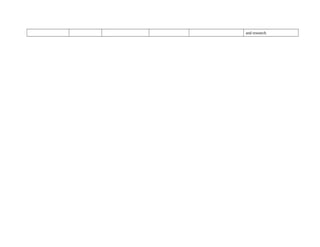
Imperialism, Global
Stratification, Core
and Periphery
Nations
(March-April)
3 weeks
Is imperialism
right?
How are
imperialism and
global
stratification
related?
Students learn about
imperialism in order to
understand the social
context in India, where
the main character in the
book Sold ends up after
being sold into
prostitution. Global
stratification is the
unequal distribution of
wealth. Periphery
countries are less
industrialized and
developed than core
countries. Originating
countries for trafficking
tend to be periphery
countries, while
destination countries tend
to be core or semi-
periphery (like India).
Find main idea of
current event articles
Find textual evidence
to support main idea
Analyze claim and
strategies used by
author to support
claim
Summative:
Current Events chart based on
Imperialism article
Persuasive Strategy paragraph
based on current event article
Reading (5) determine how
author develops argument; (6)
determine author’s point of
view; (8) evaluate the
argument of the author
Human Trafficking
using SOLD
April – June
(8 weeks)
What are causes
and effects of
human
trafficking?
How can we
identify and
analyze the claim
of an author?
Students are writing
letters to music artists of
their choosing in order to
convince them to join the
MTV Exit (End
Exploitation and
Trafficking) campaign,
which raises awareness
about human trafficking
through videos, concerts
and television
advertisements, as well as
relationships with anti-
Reading:
Cornell notes
Writing:
Analyzing task and
rubric using
annotation
TBEAR (thesis,
background,
evidence, analysis,
reflection)
Formative:
• Brainstorming for
essay/letter using main
idea web
• Analyzing task and rubric
• Identifying textual
evidence
• Cornell notes
Summative:
Part I: 5 paragraph essay/letter
Reading:
1- Read closely to determine
what the text says
explicitly and to make
logical inferences from it;
cite specific textual
evidence when writing or
speaking to support
conclusions drawn from
the test.
2- Determine central ideas or
themes of a text and
trafficking organizations.
Students’ letters will take
the form of 5-paragraph
essays on the causes and
effects of trafficking.
They will try to convince
the person they are
writing to that action must
be taken on this issue in
order to address both the
causes and effects of sex
trafficking. They will be
graded using the LDC
rubric. Their goal is to
score at “meets
expectations” which is an
85%.
After writing the 5-
paragraph essay, students
will be creating a
reference page for their
reader as well as an
epilogue from Lakshmi’s
perspective about what
happened to her once she
left Happiness House (the
brothel where she lived
for about a year).
Part II: reference page
Part III: epilogue to Sold from
Lakshmi’s perspective
analyze their
development; summarize
the key supporting details
and ideas.
5- Analyze the structure of
texts, including how specific
sentences, paragraphs, and
larger portions of the text (e.g.,
section, chapter, scene, or
stanza) relate to each other and
the whole.
8- Delineate and evaluate the
argument and specific claims
in a text, including the validity
of the reasoning as well as the
relevance and sufficiency of
the evidence.
Writing:
1- Write arguments to support
claims in an analysis of
substantive topics or texts,
using valid reasoning and
relevant and sufficient
evidence.
3- Write narratives to
develop real or imagined
experiences or events
using effective technique,
well-chosen details, and
well-structured event
sequences.
9- Draw evidence from literary
or informational texts to
support analysis, reflection,
and research.
and research.

Gondek- Curriculum Map-extended

  • 1.
    Curriculum Map Ms. GondekHumanities Writing 2011-2012 Unit/Time Frame Essential Questions Content Skills Assessments Standards Racism: lynching and apartheid September-October (7 weeks) How can we examine and question texts relating to lynching and apartheid? How can we create presentations to raise awareness about race-based oppression? Utilized music lyrics, photographs, interviews, film clips to create essays and presentations that analyzed institutionalized racism in the United States and South Africa. Reading strategies: main idea webs, passage maps, outlines, Cornell Notes, coding text, T- chart with quotes and questions Writing strategies: Rule of 3 (Thesis, Evidence, Explanation) Formative: • Main idea webs • Practice paragraphs using Rule of 3 • Timed practice essay: Is Racism a form of injustice? Summative: Two essays based on the questions: • Is Racism institutionalized? • Why and how did South Africans resist apartheid? Multiple Choice Exam Reading: (2) Determine central idea; (4) determine meaning of words; (9a) Analyze seminal U.S. documents of historical significance Writing: (5) Develop writing through planning; (11a) Engage in pre-writing experiences; (11d) create poetry, stories, plays Speaking and Listening: (1) participate in collaborative discussions; (2) integrate multiple sources in diverse media Sexism: witch hunts, school sex- segregation, femicides in Juarez, suffrage movement October-November (7 weeks) Why is there violence against women? How are racism and sexism similar and different? What were the roles of women historically and cross-culturally? Utilized film, music, photographs, and newspaper articles in order to analyze the history of patriarchy and sexism in various cultures and time periods. Reading strategies: Questioning Technique, main idea webs, quote analysis, t-charts Writing strategies: Rule of three, identifying textual evidence to match thesis, analyzing evidence, counterarguments Formative: • Main idea webs • practice paragraphs • midterm review • letter from woman in Juarez to woman killed during witch hunts Summative: • Timed essay: Why is there violence against women • Argumentative essay: Reading: (1) cite strong textual evidence to support analysis; (2) determine central idea of a text Writing: (1) write arguments to support claims using sufficient evidence; (2) write informative/explanatory texts to examine and convey complex ideas Speaking and listening: (4) present information clearly, concisely and logically
  • 2.
    How do societies treatwomen? Is sexism similar to racism? • Multiple choice exam (mid-term covering racism and sexism units) • DBQ short answer women’s roles in history and cross- culturally • DBQ intro and outline for essay on women’s roles • Explaining textual evidence using DBQ on women’s roles • Monologue performance (witch hunts) Creative Activist Project December-January (7 weeks) Are racism, apartheid, lynching, witch hunts and femicides forms of oppression and human rights violations? Final project of the fall semester in which students had to write a 5- 10 paragraph essay to answer the essential questions for the unit. They also had to create a presentation (poster, monologue or powerpoint), a works cited page and reflect on the project. Writing: Rule of 3, analyzing evidence, selecting evidence to match thesis Summative: Essay, works cited, presentation, reflection Writing: (7) Conduct sustained research projects to answer a question, synthesize multiple sources Class, Classism and class consciousness January-February (3 weeks) How does false class consciousness maintain systems of inequality and oppression? We will use song lyrics and films in order to help students understand how class can be used to divide and oppress people and how people unite to fight back against this • Determine point of view of author • Assess whether author is convincing • State point of view using Formative: • T-chart distinguishing class consciousness and false class consciousness in film North Country • Identify evidence of key Reading: (5) determine how author develops argument; (6) determine author’s point of view; (8) evaluate the argument of the author Writing: (9) draw evidence
  • 3.
    How does class consciousness helppeople unite to fight for their rights? oppression (class consciousness). textual evidence • Craft effective thesis • Provide background info on key terminology • Use most effective textual evidence to convince reader • Analyze evidence to show how it proves thesis correct • Use predict/eliminate strategy with MC questions terms in rap songs • Practice body paragraphs • Create rap/poem Summative Assessment: Multiple Choice Test from informative texts Speaking and listening: (3) evaluate a speaker’s point of view Capitalism, Socialism and Industrialization (February-March) 6 weeks Which system is better: capitalism or socialism? Why? When a country industrializes, how does it change? Are these changes positive or negative? Students will use documents to write an essay analyzing the positive and negative effects of industrialization in preparation for final unit on human trafficking. See skills for previous unit as well as • Correctly answer regents-style multiple choice questions • Explain each of the persuasive writing techniques such as logos, ethos, pathos, kairos and research • Find persuasive writing techniques in text • Evaluate sample Formative: • Industrialization Document Packet including short readings and questions • Main idea web & positive/negative effects graphic organizer using industrialization packet • Practice essay using same format at summative assessment Summative DBQ short answer and essay exam Multiple Choice Exam Reading: (5) determine how author develops argument; (6) determine author’s point of view; (8) evaluate the argument of the author Writing: (9) draw evidence from informative texts Speaking and listening: (3) evaluate a speaker’s point of view
  • 4.
    writing to assess whetherit “meets expectations” based on the LDC rubric Imperialism, Global Stratification, Core and Periphery Nations (March-April) 3 weeks Is imperialism right? How are imperialism and global stratification related? Students learn about imperialism in order to understand the social context in India, where the main character in the book Sold ends up after being sold into prostitution. Global stratification is the unequal distribution of wealth. Periphery countries are less industrialized and developed than core countries. Originating countries for trafficking tend to be periphery countries, while destination countries tend to be core or semi- periphery (like India). Find main idea of current event articles Find textual evidence to support main idea Analyze claim and strategies used by author to support claim Summative: Current Events chart based on Imperialism article Persuasive Strategy paragraph based on current event article Reading (5) determine how author develops argument; (6) determine author’s point of view; (8) evaluate the argument of the author Human Trafficking using SOLD April – June (8 weeks) What are causes and effects of human trafficking? How can we identify and analyze the claim of an author? Students are writing letters to music artists of their choosing in order to convince them to join the MTV Exit (End Exploitation and Trafficking) campaign, which raises awareness about human trafficking through videos, concerts and television advertisements, as well as relationships with anti- Reading: Cornell notes Writing: Analyzing task and rubric using annotation TBEAR (thesis, background, evidence, analysis, reflection) Formative: • Brainstorming for essay/letter using main idea web • Analyzing task and rubric • Identifying textual evidence • Cornell notes Summative: Part I: 5 paragraph essay/letter Reading: 1- Read closely to determine what the text says explicitly and to make logical inferences from it; cite specific textual evidence when writing or speaking to support conclusions drawn from the test. 2- Determine central ideas or themes of a text and
  • 5.
    trafficking organizations. Students’ letterswill take the form of 5-paragraph essays on the causes and effects of trafficking. They will try to convince the person they are writing to that action must be taken on this issue in order to address both the causes and effects of sex trafficking. They will be graded using the LDC rubric. Their goal is to score at “meets expectations” which is an 85%. After writing the 5- paragraph essay, students will be creating a reference page for their reader as well as an epilogue from Lakshmi’s perspective about what happened to her once she left Happiness House (the brothel where she lived for about a year). Part II: reference page Part III: epilogue to Sold from Lakshmi’s perspective analyze their development; summarize the key supporting details and ideas. 5- Analyze the structure of texts, including how specific sentences, paragraphs, and larger portions of the text (e.g., section, chapter, scene, or stanza) relate to each other and the whole. 8- Delineate and evaluate the argument and specific claims in a text, including the validity of the reasoning as well as the relevance and sufficiency of the evidence. Writing: 1- Write arguments to support claims in an analysis of substantive topics or texts, using valid reasoning and relevant and sufficient evidence. 3- Write narratives to develop real or imagined experiences or events using effective technique, well-chosen details, and well-structured event sequences. 9- Draw evidence from literary or informational texts to support analysis, reflection,
  • 6.
  • 7.