Going Under or On the Fringe
Making it in the City, Gangs and Syndicates
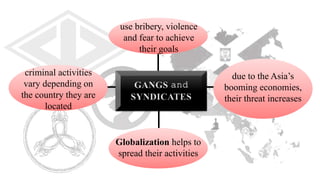
criminal activities
vary depending on
the country they are
located
use bribery, violence
and fear to achieve
their goals
Globalization helps to
spread their activities
GANGS and
SYNDICATES
due to the Asia’s
booming economies,
their threat increases
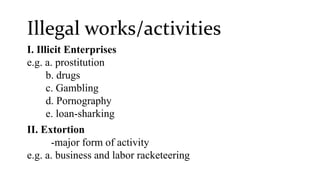
I. Illicit Enterprises
II. Extortion
-major form of activity
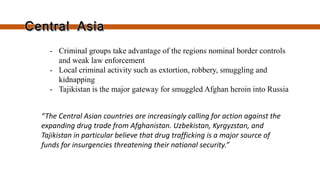
“The Central Asian countries are increasingly calling for action against the expanding drug
trade from Afghanistan, Uzbekistan, Kyrgyzstan, and Tajikistan in particular believe that
drug trafficking is a major source of funds for insurgencies threatening their national
security.”
- Criminal groups take advantage of
the region’s nominal border controls
and weak law enforcement
- Local criminal activity such as
extortion, robbery, smuggling and
kidnapping
- Tajikistan is the major gateway for
smuggled Afghan heroin into Russia
 Primary source of heroin for International drug
trade especially in West Asian and European
markets.
 As reported by the Interpol, 80% of heroin in
Western Europe came from South Asia.
 Mandrax, a drug produced primarily in India
which makes South Asia an important market for
this drug
 Indian crime syndicates may involved in arms
trafficking, alien smuggling and women
trafficking.
• Export-oriented economies –
covers the criminal activities (market
of drugs, counterfeit products and
other contrabands)
• Human Trafficking – nearly 1/3 of
women and children victimized by
worldwide sex industry are from
Southeast Asia
• Singapore’s high-volume seaport –
important hub for drug and
contraband smuggling
• one of Asia's two main and extensive opium-
producing areas together with the Golden Crescent
in Afghanistan
• area of around 950,000 km2 that overlaps the
mountains of three countries of Southeast
Asia: Myanmar, Laos and Thailand.
Most of the world's heroin came from the
Golden Triangle until the early 21st century
when Afghanistan became the world's largest
producer.
• world's second largest producer
of opium after Afghanistan
• produced some 25% of the world's opium,
and forms part of the Golden Triangle.
Opium industry
- monopoly during colonial times
- illegally operated by corrupt officials
in the Burmese military and rebel
fighters, primarily as the basis for heroin
manufacture.
Role as a source area of international
criminal activity
• Guangdong province – major
producers of pirated products
• Beijing’s International Trade and
Investment – attracts Chinese
organized crime syndicates
• Infrastructure Development Project –
designed by China to attract foreign
investors but Chinese criminal
syndicates used this to gain profit
• Corruption – corrupt Chinese officials
supports criminal acts to smug products
especially petroleum to their country
• Death – one of the extreme penalties
for Criminal Activity
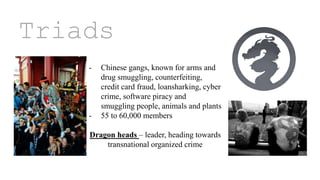
- Chinese gangs, known for arms and
drug smuggling, counterfeiting,
credit card fraud, loansharking, cyber
crime, software piracy and
smuggling people, animals and plants
- 55 to 60,000 members
Dragon heads – leader, heading towards
transnational organized crime
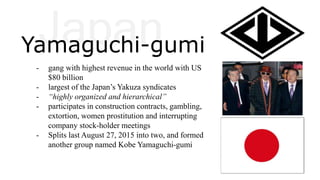
- gang with highest revenue in the world with US $80
billion
- largest of the Japan’s Yakuza syndicates
- “highly organized and hierarchical”
- participates in construction contracts, gambling,
extortion, women prostitution and interrupting
company stock-holder meetings
- Splits last August 27, 2015 into two, and formed
another group named Kobe Yamaguchi-gumi
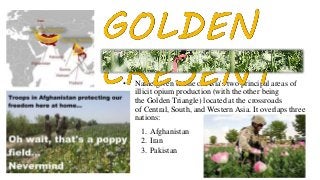
• Name given to one of Asia's two principal areas of
illicit opium production (with the other being
the Golden Triangle) located at the crossroads
of Central, South, and Western Asia. It overlaps three
nations:
1. Afghanistan
2. Iran
3. Pakistan
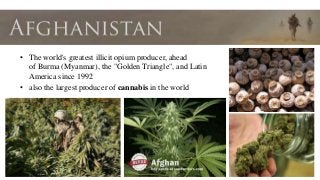
• also the largest producer of cannabis in the world
• The world's greatest illicit opium producer, ahead
of Burma (Myanmar), the "Golden Triangle", and Latin
America since 1992
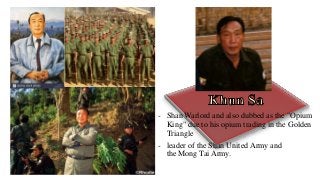
- Shan Warlord and also dubbed as the "Opium
King" due to his opium trading in the Golden
Triangle
- leader of the Shan United Army and
the Mong Tai Army.
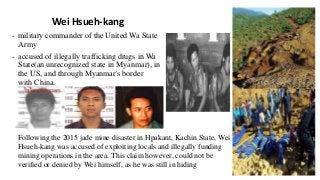
Wei Hsueh-kang
- military commander of the United Wa State
Army
- accused of illegally trafficking drugs in Wa
State(an unrecognized state in Myanmar), in
the US, and through Myanmar's border
with China.
Following the 2015 jade mine disaster in Hpakant, Kachin State, Wei
Hsueh-kang was accused of exploiting locals and illegally funding
mining operations in the area. This claim however, could not be
verified or denied by Wei himself, as he was still in hiding
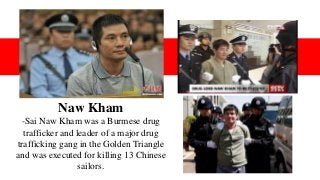
Naw Kham
-Sai Naw Kham was a Burmese drug
trafficker and leader of a major drug
trafficking gang in the Golden Triangle
and was executed for killing 13 Chinese
sailors.
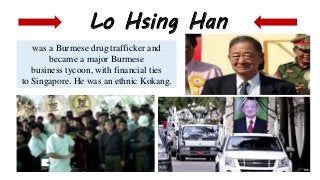
was a Burmese drug trafficker and
became a major Burmese
business tycoon, with financial ties
to Singapore. He was an ethnic Kokang.
Lo Hsing Han
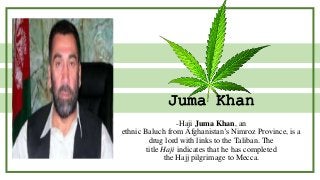
Juma Khan
-Haji Juma Khan, an
ethnic Baluch from Afghanistan’s Nimroz Province, is a
drug lord with links to the Taliban. The
title Haji indicates that he has completed
the Hajj pilgrimage to Mecca.
References
Chavez, Amy. (02 February 2015). Asia’s most notorious gangs: an ever-present
power. Retrieved from http://en.rocketnews24.com/2015/02/02/asia-most-
notorious-gangs/
International Crime Threat Assessment. (14 March 2016). Retrieved from
http://fas.org/irp/threat/pub45270chap3.html#r9
List of criminal enterprises, gangs and syndicates. (2015 December). Retrieved
(2016 March 13) from
https://en.wikipedia.org/wiki/List_of_criminal_enterprises,_gangs_and_s
yndicates

Going under or on the fringe

  • 1.
    Going Under orOn the Fringe Making it in the City, Gangs and Syndicates
  • 2.
    criminal activities vary dependingon the country they are located use bribery, violence and fear to achieve their goals Globalization helps to spread their activities GANGS and SYNDICATES due to the Asia’s booming economies, their threat increases
  • 3.
    I. Illicit Enterprises II.Extortion -major form of activity
  • 4.
    “The Central Asiancountries are increasingly calling for action against the expanding drug trade from Afghanistan, Uzbekistan, Kyrgyzstan, and Tajikistan in particular believe that drug trafficking is a major source of funds for insurgencies threatening their national security.” - Criminal groups take advantage of the region’s nominal border controls and weak law enforcement - Local criminal activity such as extortion, robbery, smuggling and kidnapping - Tajikistan is the major gateway for smuggled Afghan heroin into Russia
  • 5.
     Primary sourceof heroin for International drug trade especially in West Asian and European markets.  As reported by the Interpol, 80% of heroin in Western Europe came from South Asia.  Mandrax, a drug produced primarily in India which makes South Asia an important market for this drug  Indian crime syndicates may involved in arms trafficking, alien smuggling and women trafficking.
  • 6.
    • Export-oriented economies– covers the criminal activities (market of drugs, counterfeit products and other contrabands) • Human Trafficking – nearly 1/3 of women and children victimized by worldwide sex industry are from Southeast Asia • Singapore’s high-volume seaport – important hub for drug and contraband smuggling
  • 7.
    • one ofAsia's two main and extensive opium- producing areas together with the Golden Crescent in Afghanistan • area of around 950,000 km2 that overlaps the mountains of three countries of Southeast Asia: Myanmar, Laos and Thailand. Most of the world's heroin came from the Golden Triangle until the early 21st century when Afghanistan became the world's largest producer.
  • 8.
    • world's secondlargest producer of opium after Afghanistan • produced some 25% of the world's opium, and forms part of the Golden Triangle. Opium industry - monopoly during colonial times - illegally operated by corrupt officials in the Burmese military and rebel fighters, primarily as the basis for heroin manufacture.
  • 9.
    Role as asource area of international criminal activity • Guangdong province – major producers of pirated products • Beijing’s International Trade and Investment – attracts Chinese organized crime syndicates • Infrastructure Development Project – designed by China to attract foreign investors but Chinese criminal syndicates used this to gain profit • Corruption – corrupt Chinese officials supports criminal acts to smug products especially petroleum to their country • Death – one of the extreme penalties for Criminal Activity
  • 10.
    - Chinese gangs,known for arms and drug smuggling, counterfeiting, credit card fraud, loansharking, cyber crime, software piracy and smuggling people, animals and plants - 55 to 60,000 members Dragon heads – leader, heading towards transnational organized crime
  • 11.
    - gang withhighest revenue in the world with US $80 billion - largest of the Japan’s Yakuza syndicates - “highly organized and hierarchical” - participates in construction contracts, gambling, extortion, women prostitution and interrupting company stock-holder meetings - Splits last August 27, 2015 into two, and formed another group named Kobe Yamaguchi-gumi
  • 12.
    • Name givento one of Asia's two principal areas of illicit opium production (with the other being the Golden Triangle) located at the crossroads of Central, South, and Western Asia. It overlaps three nations: 1. Afghanistan 2. Iran 3. Pakistan
  • 13.
    • also thelargest producer of cannabis in the world • The world's greatest illicit opium producer, ahead of Burma (Myanmar), the "Golden Triangle", and Latin America since 1992
  • 14.
    - Shan Warlordand also dubbed as the "Opium King" due to his opium trading in the Golden Triangle - leader of the Shan United Army and the Mong Tai Army.
  • 15.
    Wei Hsueh-kang - militarycommander of the United Wa State Army - accused of illegally trafficking drugs in Wa State(an unrecognized state in Myanmar), in the US, and through Myanmar's border with China. Following the 2015 jade mine disaster in Hpakant, Kachin State, Wei Hsueh-kang was accused of exploiting locals and illegally funding mining operations in the area. This claim however, could not be verified or denied by Wei himself, as he was still in hiding
  • 16.
    Naw Kham -Sai NawKham was a Burmese drug trafficker and leader of a major drug trafficking gang in the Golden Triangle and was executed for killing 13 Chinese sailors.
  • 17.
    was a Burmesedrug trafficker and became a major Burmese business tycoon, with financial ties to Singapore. He was an ethnic Kokang. Lo Hsing Han
  • 18.
    Juma Khan -Haji JumaKhan, an ethnic Baluch from Afghanistan’s Nimroz Province, is a drug lord with links to the Taliban. The title Haji indicates that he has completed the Hajj pilgrimage to Mecca.
  • 19.
    References Chavez, Amy. (02February 2015). Asia’s most notorious gangs: an ever-present power. Retrieved from http://en.rocketnews24.com/2015/02/02/asia-most- notorious-gangs/ International Crime Threat Assessment. (14 March 2016). Retrieved from http://fas.org/irp/threat/pub45270chap3.html#r9 List of criminal enterprises, gangs and syndicates. (2015 December). Retrieved (2016 March 13) from https://en.wikipedia.org/wiki/List_of_criminal_enterprises,_gangs_and_s yndicates

Editor's Notes

  • #13 The Golden Crescent is a mountainous area of Iran, Afghanistan and Pakistan where opium has been grown for hundreds of years. This area has been a main source of supply of heroin to the UK.
  • #18 Mr Lo was a respected businessman. He was also a pillar of the economy. Wherever you looked in Myanmar, he and the sprawling Asia World conglomerate he had founded were involved in some project, often with Chinese partners