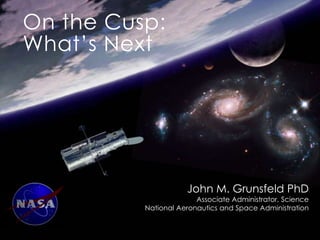
On the Cusp:
What’s Next
John M. Grunsfeld PhD
Associate Administrator, Science
National Aeronautics and Space Administration
Innovate
Explore
Discover
Inspire
www.nasa.gov
Our Mission:
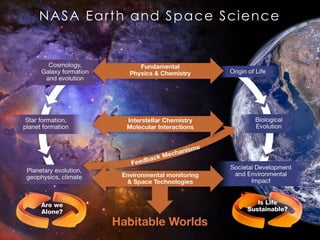
NASA Earth and Space Science
March 12, 2015
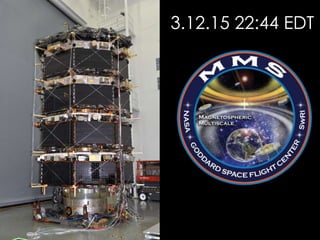
3.12.15 22:44 EDT
3.12.15 22:44 EDT
March 14, 2015
3.14.15 9:26
3.1415926535897932384626433832795028841971693993
7510582097494459230781640628620899862803482534211706
798214808651328230664709384460955058223172535940812
8481117450284102701938521105559644622948954930381964
428810975665933446128475648233786783165271201909145
648566923460348610454326648213393607260249141273724
587006606315588174881520920962829254091715364367892
5903600113305305488204665213841469519415116094330572
7036575959195309218611738193261179310511854807446237
9962749567351885752724891227938183011949129833673362
440656643086021394946395224737190702179860943702770
539217176293176752384674818467669405132000568127145
263560827785771342757789609173637178721468440901224
9534301465495853710507922796892589235420199561121290
2196086403441815981362977477130996051870721134999999
837297804995105973173281609631859502445945534690830
2642522308253344685035261931188171010003137838752886
5875332083814206171776691473035982534904287554687311
Celebrate Mathematics
Pi Day -- 3.14.15
July 18, 2018
7.18.18
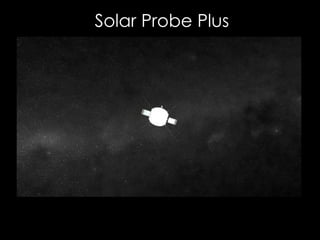
Solar Probe Plus
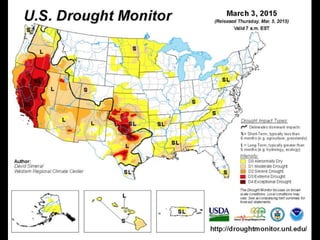
January 31, 2015
1.31.15
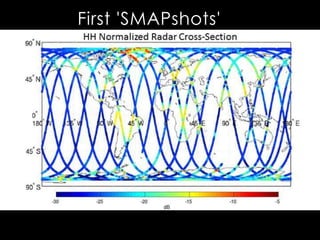
Soil Moisture Active Passive (SMAP)
First 'SMAPshots'
March 6, 2015
3.6.15
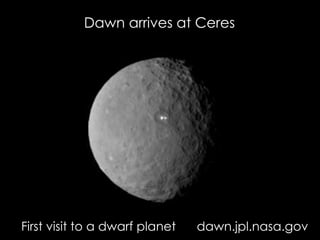
Dawn arrives at Ceres
First visit to a dwarf planet dawn.jpl.nasa.gov
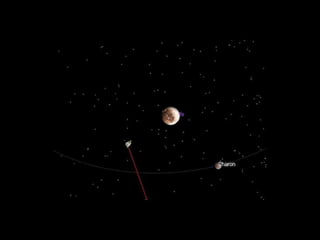
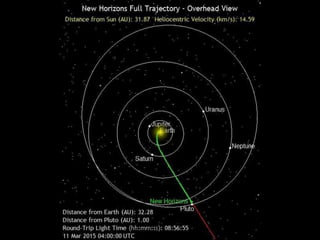
July 14, 2015
7.14.15 7:50 EDT
August 2017
8.17
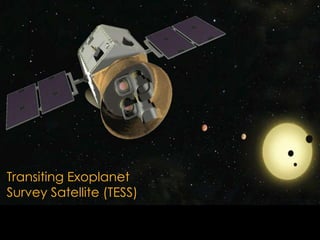
Transiting Exoplanet
Survey Satellite (TESS)
October 2018
10.18
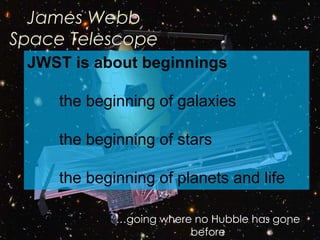
James Webb
Space Telescope
…going where no Hubble has gone
before
JWST is about beginnings
the beginning of galaxies
the beginning of stars
the beginning of planets and life
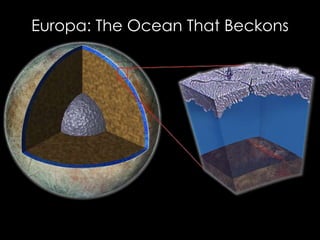
Europa: The Ocean That Beckons
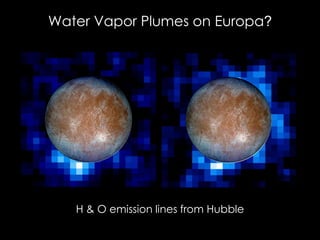
Roth et al. (2013). Science.
Hydrogen Oxygen
H & O emission lines from Hubble
ST with
Superimposed Europa image from Galileo
Water Vapor Plumes on Europa?
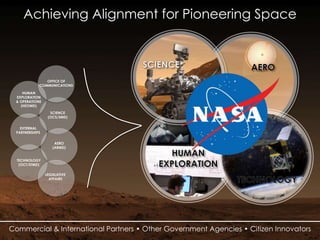
Achieving Alignment for Pioneering Space
HUMAN
EXPLORATION
& OPERATIONS
(HEOMD)
SCIENCE
(OCS/SMD)
TECHNOLOGY
(OCT/STMD)
AERO
(ARMD)
EXTERNAL
PARTNERSHIPS
OFFICE OF
COMMUNICATIONS
LEGISLATIVE
AFFAIRS
Commercial & International Partners • Other Government Agencies • Citizen Innovators
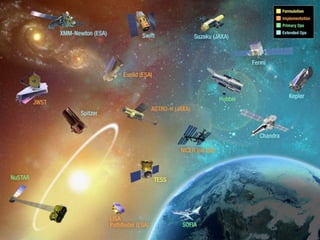
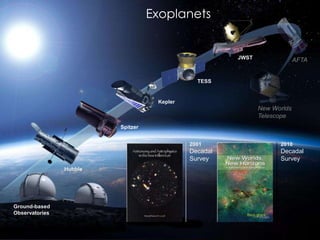
Hubble
Spitzer
Kepler
JWST
TESS
AFTA
New Worlds
Telescope
Ground-based
Observatories
2001
Decadal
Survey
2010
Decadal
Survey
Exoplanets
April 24, 2015
4.24.15 8:33 EDT
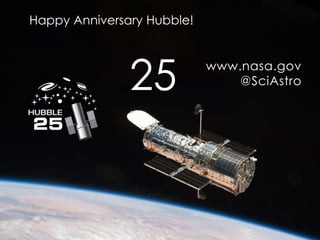
25
Happy Anniversary Hubble!
www.nasa.gov
@SciAstro25

Goddard 2015: John Grunsfeld, NASA

Editor's Notes

  • #2 Hubble PowerPoint Cover A Presentation Abstract In this talk, John Grunsfeld, the lead Hubble repairman, will describe these amazing missions using vivid imagery from high-definition still and video cameras on the final servicing mission. He will present a story about science, politics, and human drive and creativity. The success of the Hubble has depended on teams of engineers, technicians, scientists, and astronauts working together on high performance challenges for the cause of the exploration of the cosmos. The science and inspiration from these efforts have been extraordinary. ------------------------------ SLIDE INFO Added to SMD Multimedia Library on Jan 5, 2015. ID: SL-CP-14-0045
  • #3 No better example than the science from Hubble
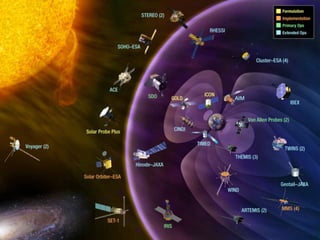
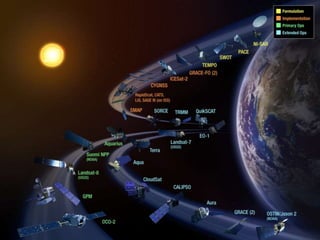
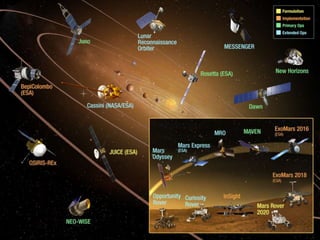
  • #4 NASA Science Is Interconnected ------------------------------ SLIDE INFO Added to SMD Multimedia Library on Dec. 23, 2014. ID: SL-14-0018
  • #30 Observations of Jupiter’s moon Europa, made using the Advanced Camera for Surveys (ACS) on the Hubble Space Telescope, indicate the presence of plumes of water vapor erupting from the surface. Europa, one of the moons of Jupiter, has a water ice shell surface with few craters and huge cracks and a vast liquid water ocean under its icy crust. It has been unclear how deep beneath the surface this ocean lies and how much exchange there is between the ocean and the surface – until now! In Dec. 2012, emissions in the ultraviolet observed over a 7 hour period showed hydrogen and oxygen when Europa is furthest from Jupiter, although they were absent in earlier measurements when Europa is closest to Jupiter. The varying plume activity may be related to changing surface stresses as Europa’s orbits around Jupiter, similar to the observed plume activity on Saturn’s moon Enceladus. These measurements are consistent with 200 km (124 mi) high plumes flowing at 7000 kg/s (7.7 tons/s) – or equivalent to draining 10 Olympic-sized swimming pools every hour.
  • #32 ANIMATION: Achieving Alignment for Pioneering Space
  • #34 Science objectives of the 2010 Decadal Survey (New Worlds, New Horizons in Astronomy and Astrophysics): Cosmic Dawn: Searching for the First Stars, Galaxies, and Black Hole New Worlds: Seeking Nearby, Habitable Planets Physics of the Universe: Understanding Scientific Principles