GOAL SETTING
GOAL SETTING
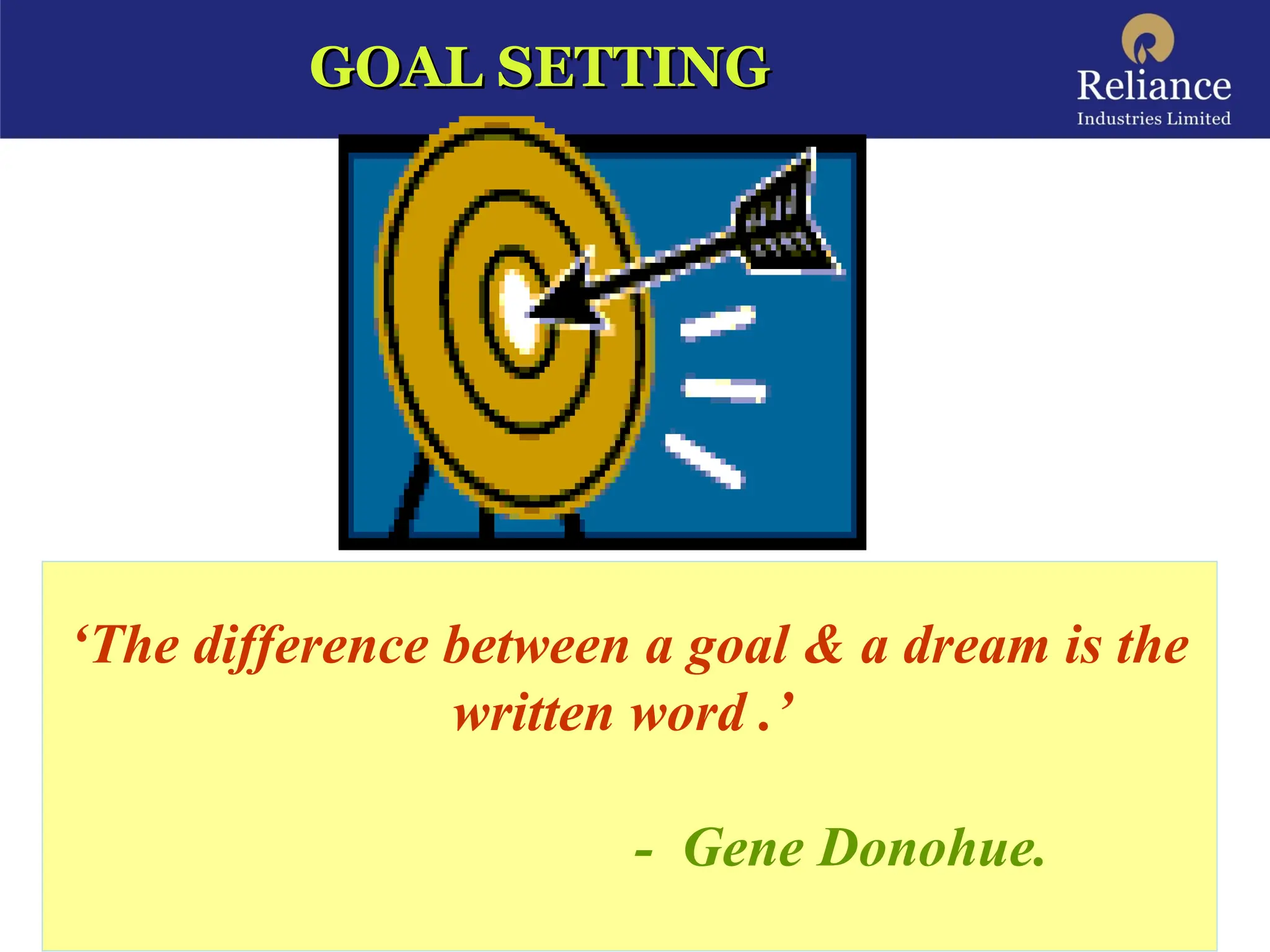
‘The difference between a goal & a dream is the
written word .’
- Gene Donohue.
WHAT IS A GOAL ?
WHAT IS A GOAL ?
A goal is a well-defined target that gives you CLARITY,
DIRECTION, MOTIVATION & FOCUS.
Goals are tools that help you in five main ways –
1. Make a positive change in your life.
2. Form a new habit or change an existing habit.
3. Improve or develop a skill, talent or ability.
4. Realize a dream or other important outcome.
5. Improve your performance on a task or activity.
GOALS
GOALS
The Power Line to Success & Achievement
WHY DO WE NEED GOALS?
• Goals give you direction in all areas of your life – Personal, Professional,
Spiritual & Material life.
• Goals give you a purpose in life. A reason to get up early in the morning
everyday.
• Goals will put drive & passion in your life.
HOW DO I SET GOALS?
• First you must dream ! Dream of everything you want, & have always wanted
in every facet of your life. There are no limits.
• Define your dream precisely. Define which of these goals are most important
to you & why?
• Write down one goal at a time. Write down a dead line for achieving that goal
& be sure that the deadline is realistic.
THE SECRETS OF ACHIEVING YOUR GOALS
The Seven Most Important Secrets of Achieving your Goals are –
• Make your goals Inspirational.
- You need to set goals grand enough to challenge yourself.
- To be successful, & reach your true potential, you must constantly push yourself
to move outside of your ‘comfort zone’.
2. Define your goals with Clarity.
- Be precise in what you want. The more clearly defined your goal is, the easier
it will be for you to attain.
- Once you know the exact outcome you want you will be able to create an
action plan that will ensure your success.
3. Write a Paragraph.
- Write a paragraph or two describing exactly why you absolutely must attain
your goal. Write down all reasons why you are committed to attain your goal.
- Feel the emotion stir up inside of you. Feel the passion & drive.
- This will bring the goal to life.
THE SECRETS OF ACHIEVING YOUR GOALS
Contd . . . .
Contd . . . .
4. Write another Paragraph.
- This should explain what will happen if you don’t attain your goal.
- How will you feel? What will happen to your lifestyle? Will you be
embarrassed? Will you lose self-esteem? Will you lose your job?
- The more emotion you can put behind the reasons why you must succeed &
why you must not fail, the more committed to attaining your goals you will
become.
5. Constantly evaluate your Progress.
- You will have to constantly evaluate your progress in order to be sure you are
on target
- Unforeseen obstacles are sure to arise. Notice what is working& what is not.
- If an approach is not working, don’t waste your time with it, change your
approach.
THE SECRETS OF ACHIEVING YOUR GOALS
Contd . . . .
Contd . . . .
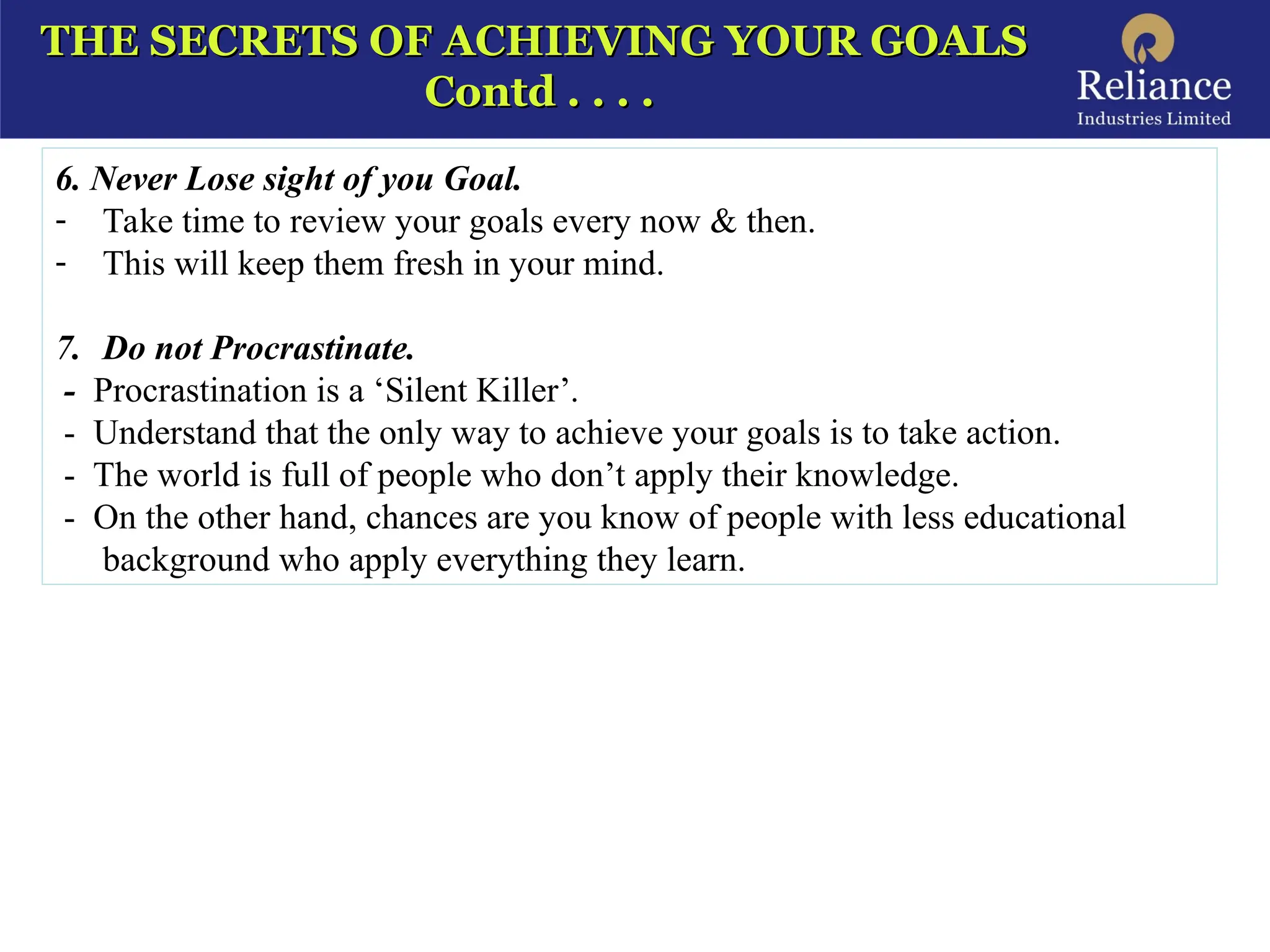
6. Never Lose sight of you Goal.
- Take time to review your goals every now & then.
- This will keep them fresh in your mind.
7. Do not Procrastinate.
- Procrastination is a ‘Silent Killer’.
- Understand that the only way to achieve your goals is to take action.
- The world is full of people who don’t apply their knowledge.
- On the other hand, chances are you know of people with less educational
background who apply everything they learn.
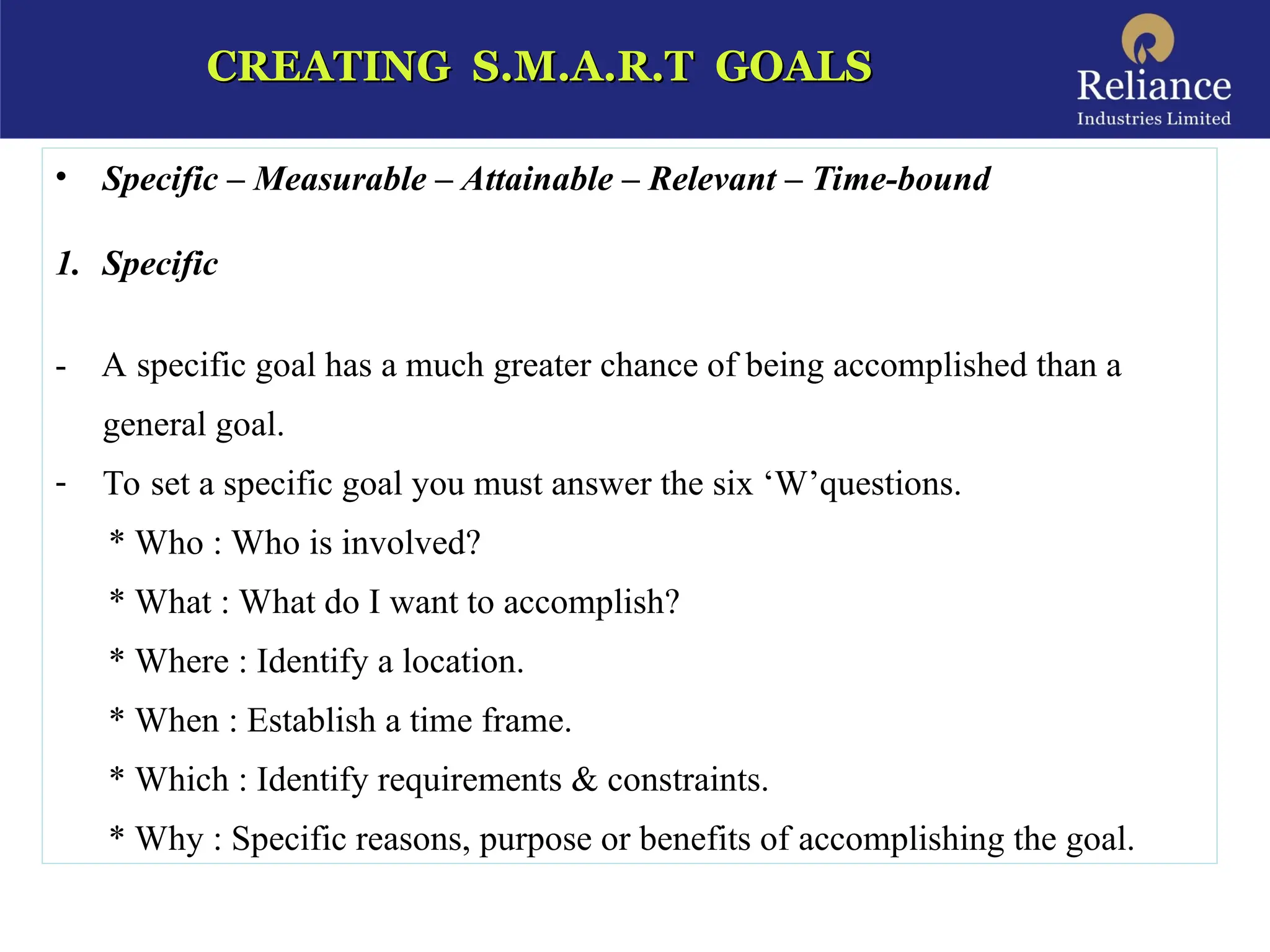
CREATING S.M.A.R.T GOALS
• Specific – Measurable – Attainable – Relevant – Time-bound
1. Specific
- A specific goal has a much greater chance of being accomplished than a
general goal.
- To set a specific goal you must answer the six ‘W’questions.
* Who : Who is involved?
* What : What do I want to accomplish?
* Where : Identify a location.
* When : Establish a time frame.
* Which : Identify requirements & constraints.
* Why : Specific reasons, purpose or benefits of accomplishing the goal.
CREATING S.M.A.R.T GOALS
Contd . . . .
Contd . . . .
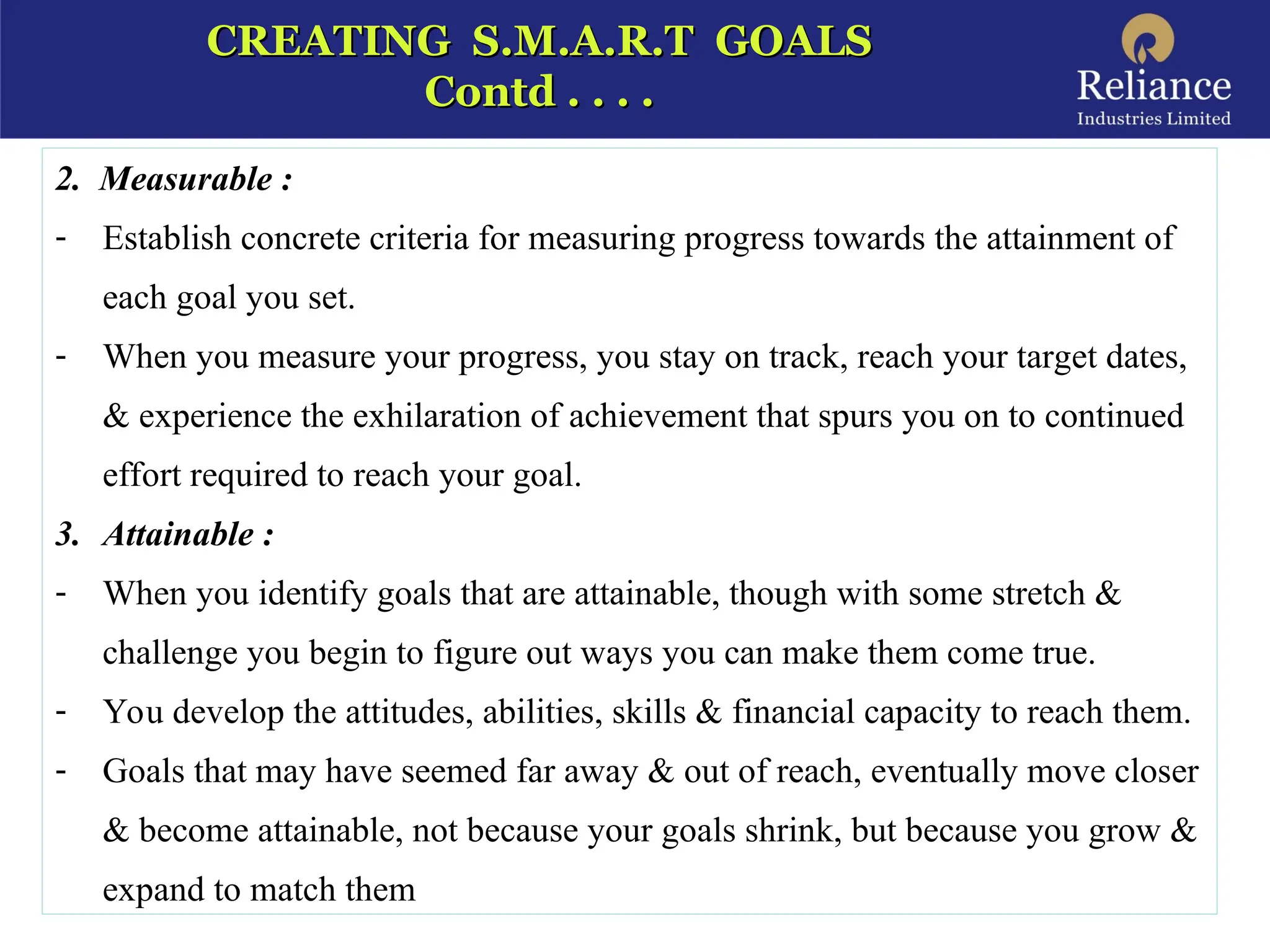
2. Measurable :
- Establish concrete criteria for measuring progress towards the attainment of
each goal you set.
- When you measure your progress, you stay on track, reach your target dates,
& experience the exhilaration of achievement that spurs you on to continued
effort required to reach your goal.
3. Attainable :
- When you identify goals that are attainable, though with some stretch &
challenge you begin to figure out ways you can make them come true.
- You develop the attitudes, abilities, skills & financial capacity to reach them.
- Goals that may have seemed far away & out of reach, eventually move closer
& become attainable, not because your goals shrink, but because you grow &
expand to match them
CREATING S.M.A.R.T GOALS
Contd . . . .
Contd . . . .
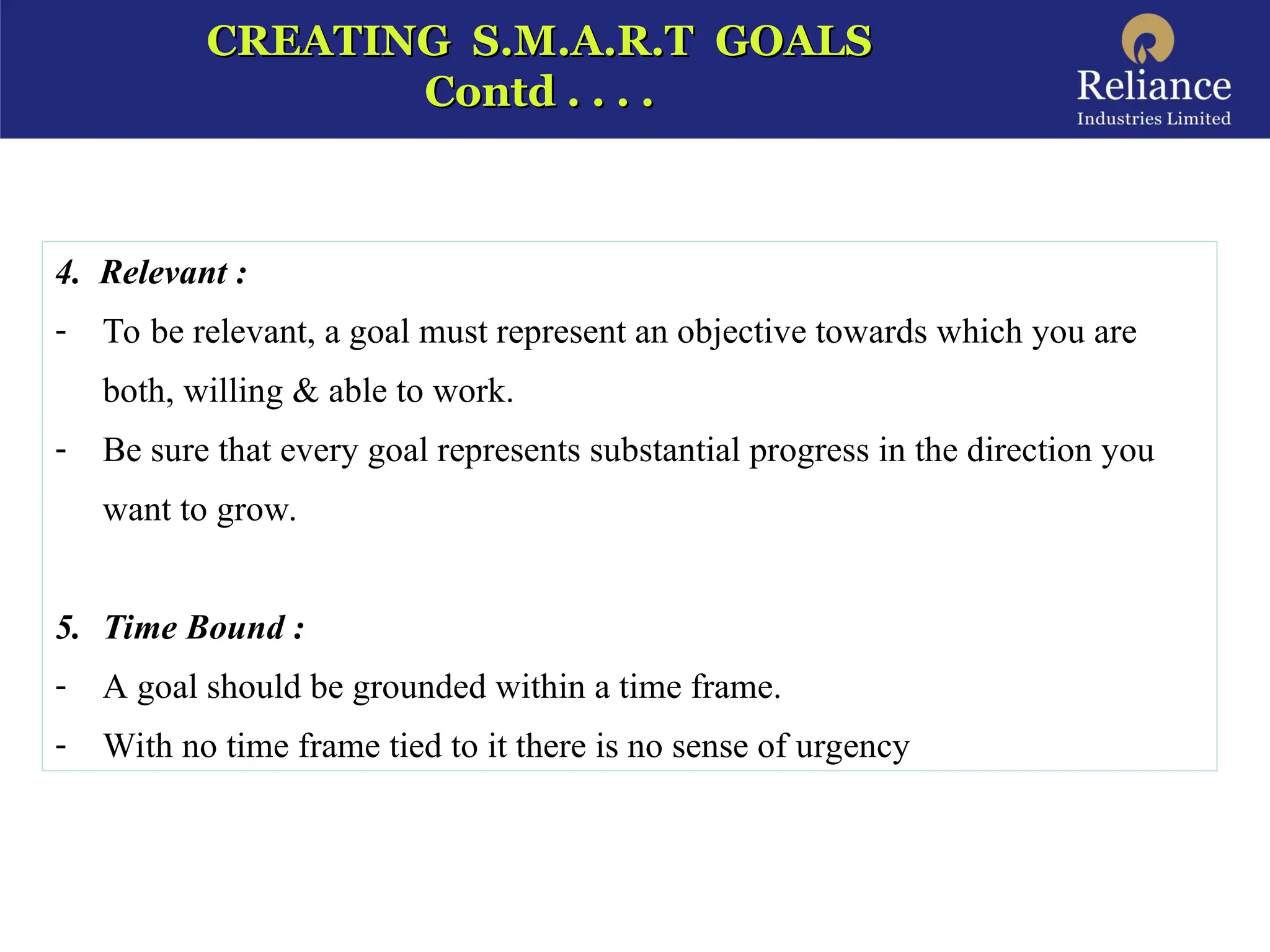
4. Relevant :
- To be relevant, a goal must represent an objective towards which you are
both, willing & able to work.
- Be sure that every goal represents substantial progress in the direction you
want to grow.
5. Time Bound :
- A goal should be grounded within a time frame.
- With no time frame tied to it there is no sense of urgency
“CREATIVITY is not an occupation; it is an approach, a way
of dealing with life’s small & big issues.”
“CREATIVITY is the outcome of our thinking process, our
personality & our motivation.”
THE LANDSCAPE OF CREATIVITY
CREATIVITY CAN BE UNDESTOOD AS
THE ABILITY TO
THE ABILITY TO ……
……
 Come up with a variety of solutions to a given problem.
 Respond to a problem from a variety of view points.
 Come up with unusual but appropriate responses .
 Notice the unexplained, in other words the ability to sense the
problems.
WHAT IS CREATIVITY ? ?
There are many definitions each emphasizing a different facet of creativity.
 Creativity could be described as the discovery of something that is novel, but also
useful or relevant or economical or elegant or valuable.
 It could also be understood in terms of the creative efforts made i.e. wide search or
exploration, leaps of imagination, sometimes strikingly fresh insights.
 In expressing feelings, receptivity to ideas, concern for others, desire to grow as a
person, etc….
The first stage of Creative Process is similar to the disciple’s blind
yet essential endeavor to get the feel of the problem.
 The Creative person prepares himself for his attempts to solve the
problem by getting acquainted with various aspects of it.
 The person tries to solve the problems & returns to it despite repeated
failures.
 His each new endeavor involves redefinition of the problem in a new
perspective. Also involves generation of new data about the problem.
PREPARATION
PREPARATION
• Efforts at problem solving during the stage of preparation do not always
result into a solution. In frustration the person lets the problem go off the
conscious mind.
• The need for a gestation period is required. It is almost as if setting aside
the problem, it facilitates the emergence of the creative insight.
• In this stage, the unconscious mind works on the ideas already stored to
reach new & creative solutions.
INCUBATION
INCUBATION
• It’s a spontaneous, sudden & electrifying flash of ideas.
• A relaxed state of mind is conducive for insights to occur.
• Creative people are patient in persevering, demonstrate a capacity to reject
solutions not to their standards.
• Experience of insight comes as an emotional relief, a moment of ecstasy.
• It provides a new vision, a new direction to the creative energies of the
individual.
INSIGHT – THE
INSIGHT – THE AHA
AHA !!! FEELING
!!! FEELING
• This involves a systematic testing of the original insight.
• It is the evaluation of the solution / insight, it’s refinement,
working out its implications.
VERIFICATION
VERIFICATION
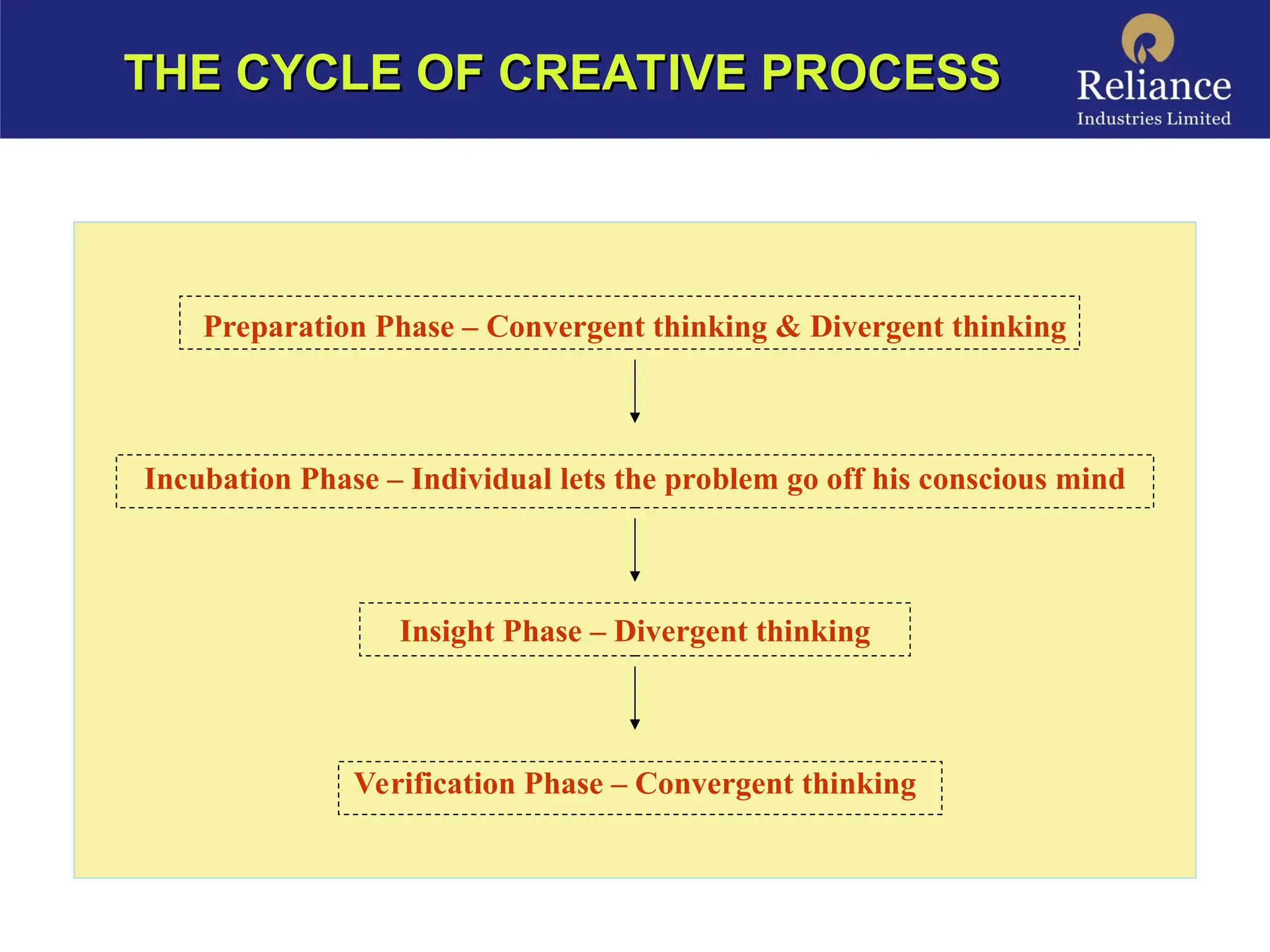
Preparation Phase – Convergent thinking & Divergent thinking
Incubation Phase – Individual lets the problem go off his conscious mind
Insight Phase – Divergent thinking
Verification Phase – Convergent thinking
THE CYCLE OF CREATIVE PROCESS
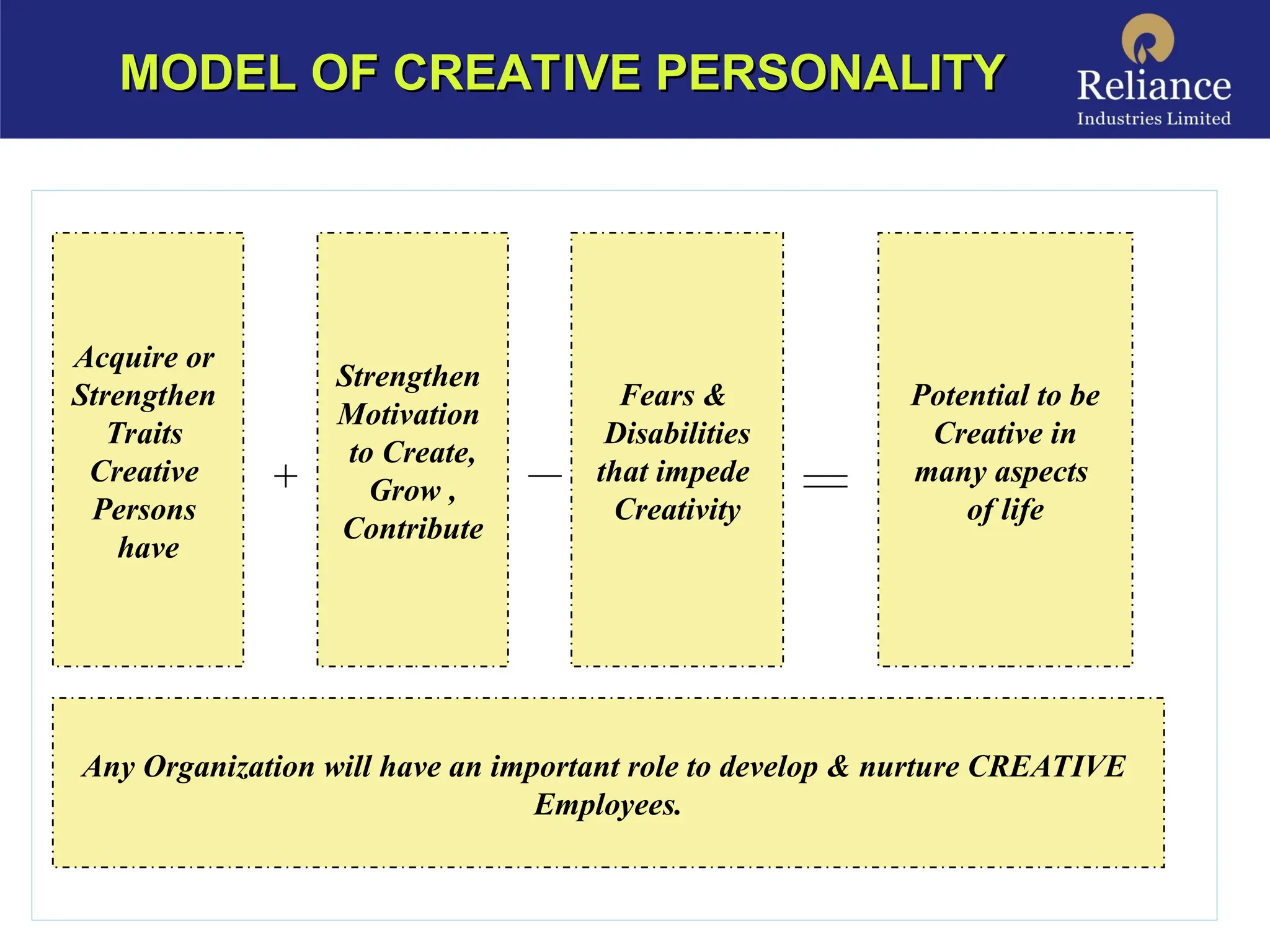
Acquire or
Strengthen
Traits
Creative
Persons
have
Strengthen
Motivation
to Create,
Grow ,
Contribute
Fears &
Disabilities
that impede
Creativity
Potential to be
Creative in
many aspects
of life
Any Organization will have an important role to develop & nurture CREATIVE
Employees.
MODEL OF CREATIVE PERSONALITY
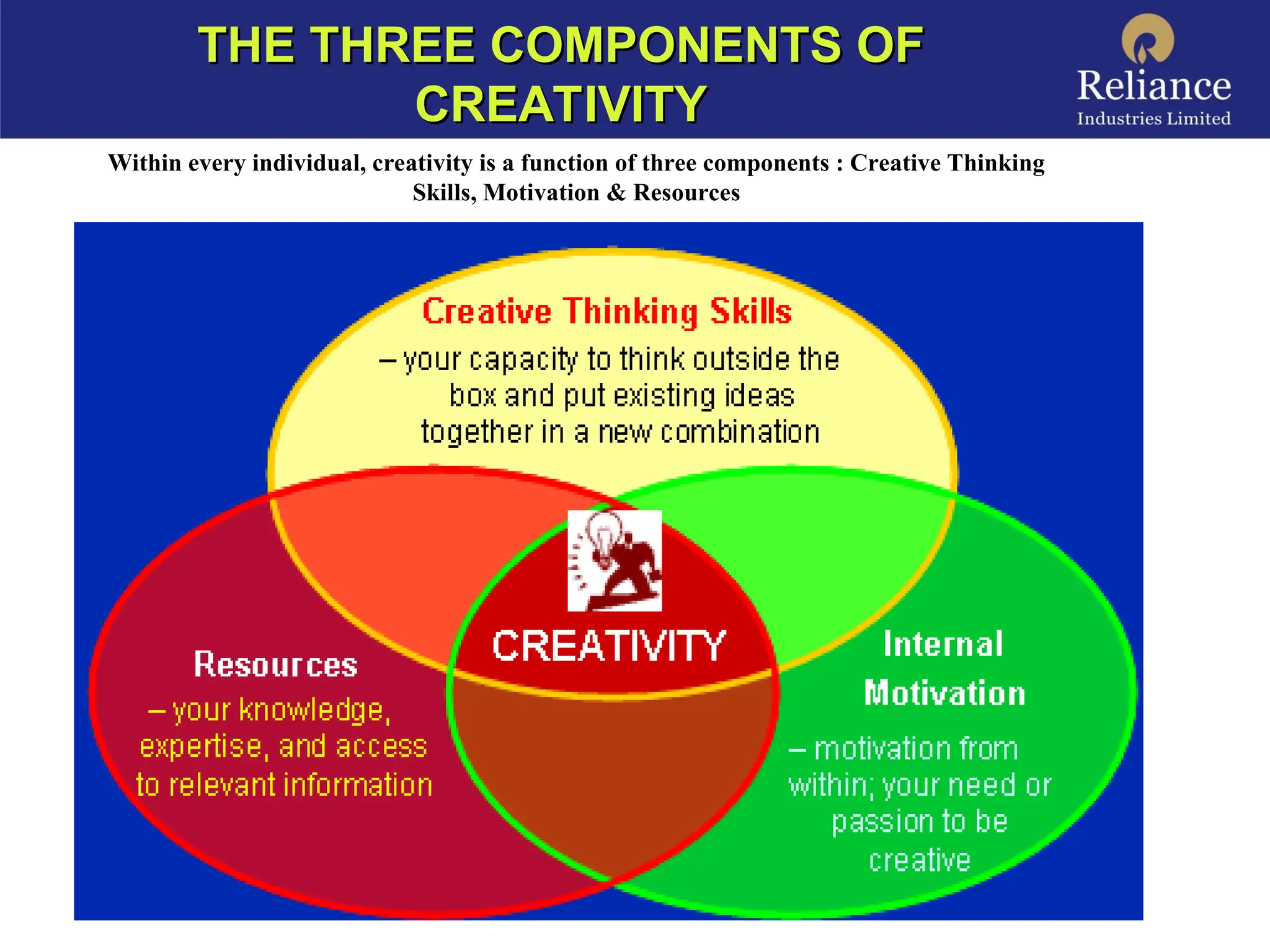
THE THREE COMPONENTS OF
CREATIVITY
CREATIVITY
Within every individual, creativity is a function of three components : Creative Thinking
Skills, Motivation & Resources
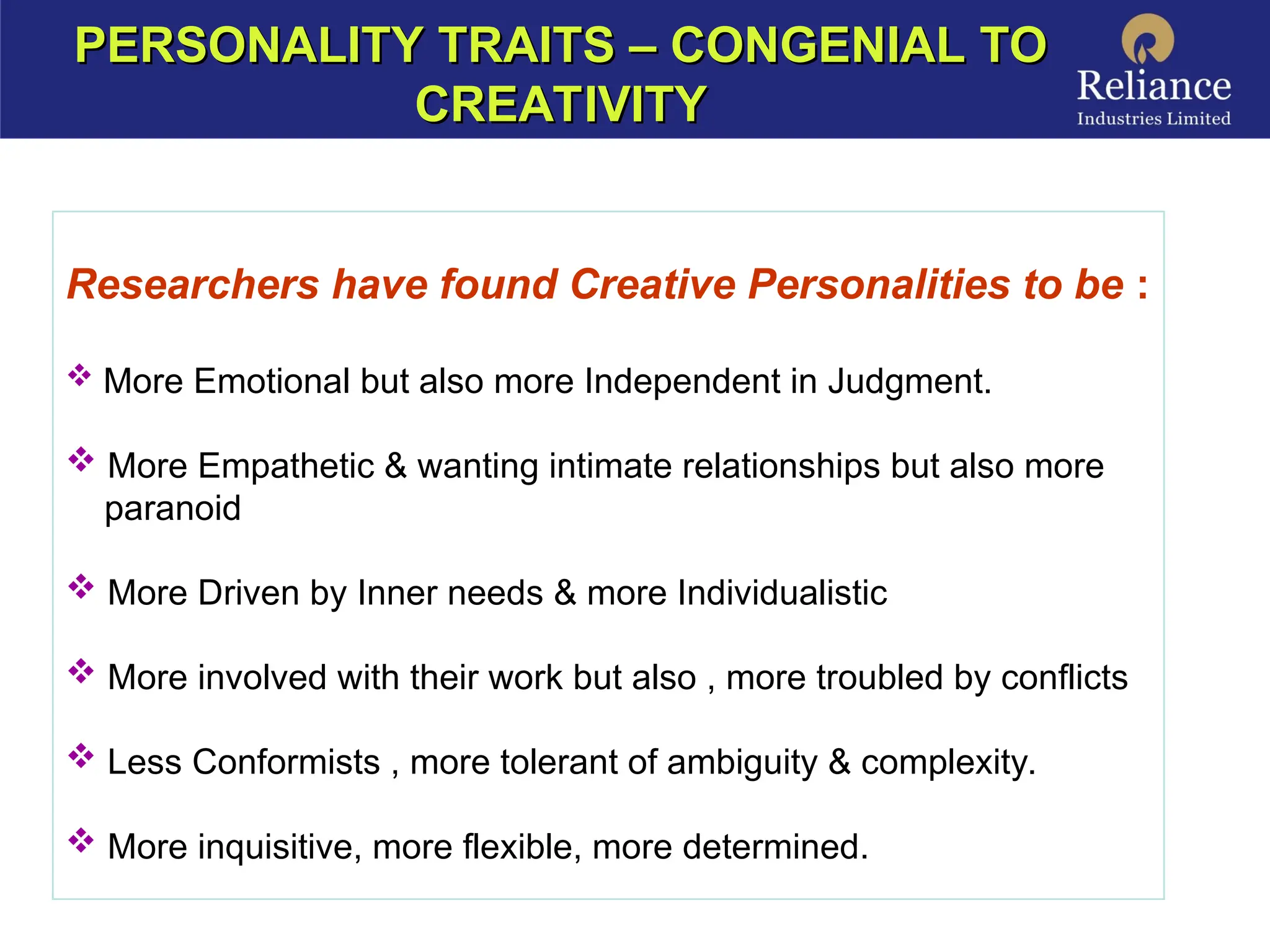
Researchers have found Creative Personalities to be :
 More Emotional but also more Independent in Judgment.
 More Empathetic & wanting intimate relationships but also more
paranoid
 More Driven by Inner needs & more Individualistic
 More involved with their work but also , more troubled by conflicts
 Less Conformists , more tolerant of ambiguity & complexity.
 More inquisitive, more flexible, more determined.
PERSONALITY TRAITS – CONGENIAL TO
CREATIVITY
CREATIVITY
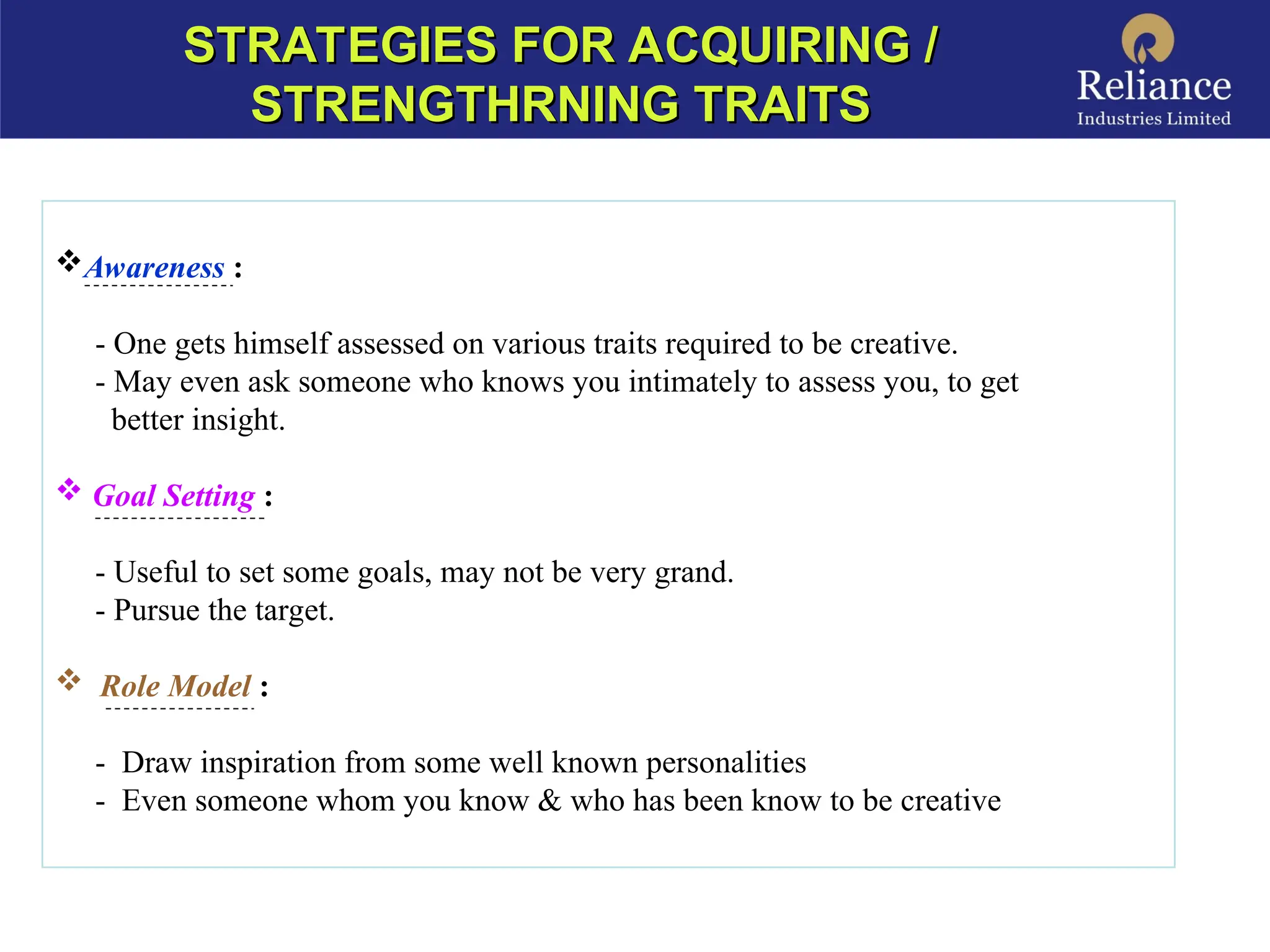
Awareness :
- One gets himself assessed on various traits required to be creative.
- May even ask someone who knows you intimately to assess you, to get
better insight.
 Goal Setting :
- Useful to set some goals, may not be very grand.
- Pursue the target.
 Role Model :
- Draw inspiration from some well known personalities
- Even someone whom you know & who has been know to be creative
STRATEGIES FOR ACQUIRING /
STRENGTHRNING TRAITS
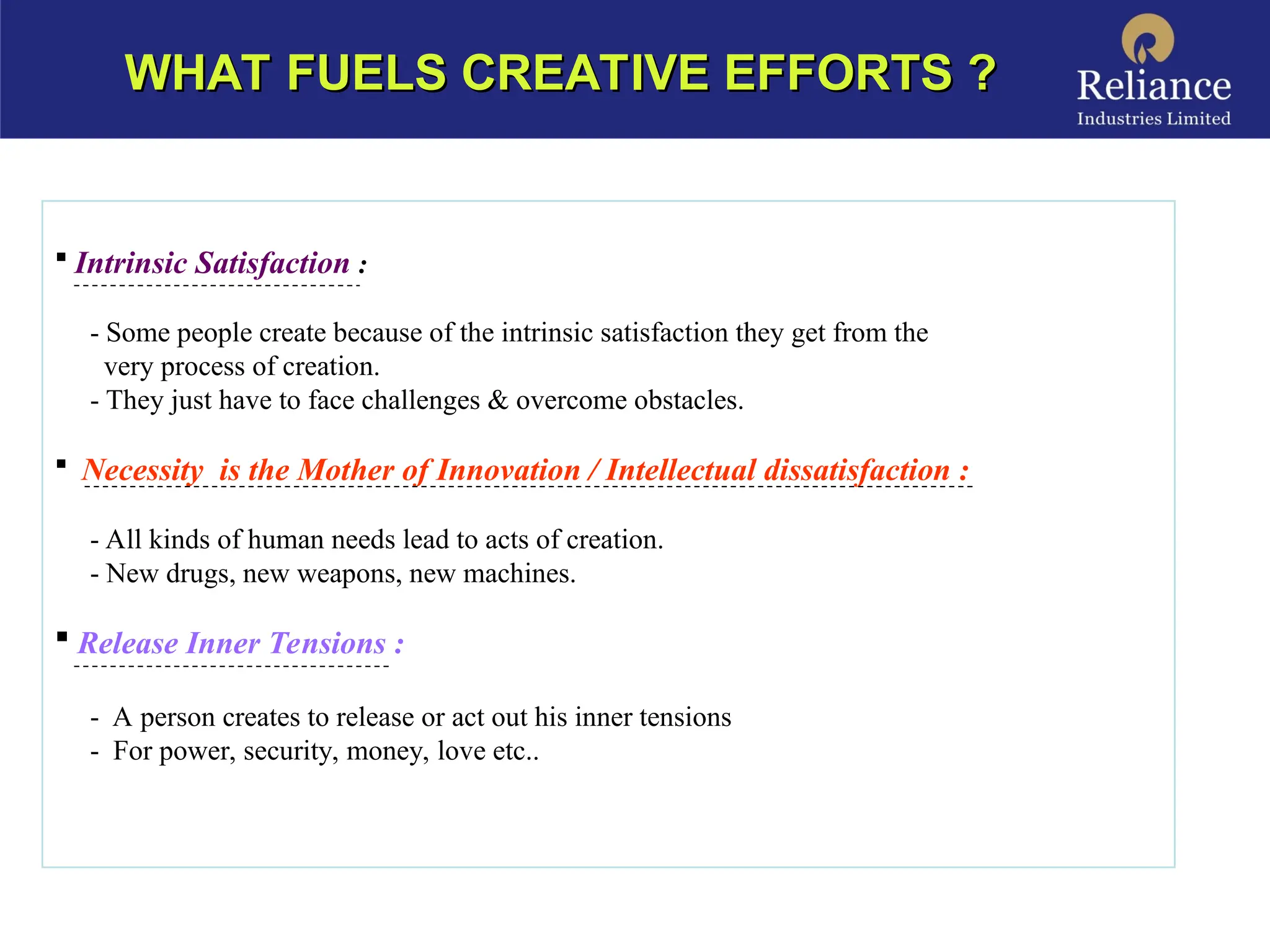
 Intrinsic Satisfaction :
- Some people create because of the intrinsic satisfaction they get from the
very process of creation.
- They just have to face challenges & overcome obstacles.
 Necessity is the Mother of Innovation / Intellectual dissatisfaction :
- All kinds of human needs lead to acts of creation.
- New drugs, new weapons, new machines.
 Release Inner Tensions :
- A person creates to release or act out his inner tensions
- For power, security, money, love etc..
WHAT FUELS CREATIVE EFFORTS ?
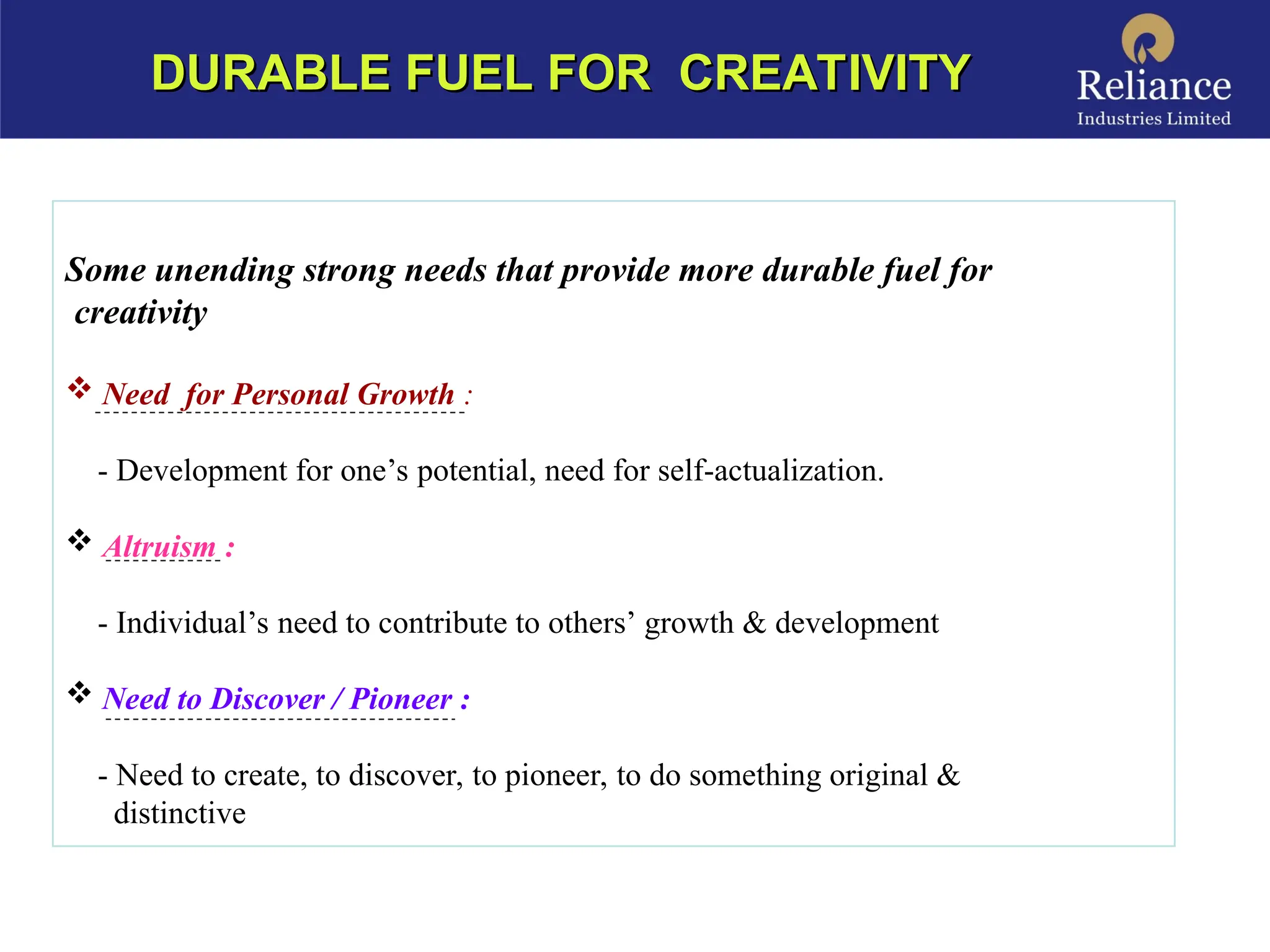
DURABLE FUEL FOR CREATIVITY
Some unending strong needs that provide more durable fuel for
creativity
 Need for Personal Growth :
- Development for one’s potential, need for self-actualization.
 Altruism :
- Individual’s need to contribute to others’ growth & development
 Need to Discover / Pioneer :
- Need to create, to discover, to pioneer, to do something original &
distinctive
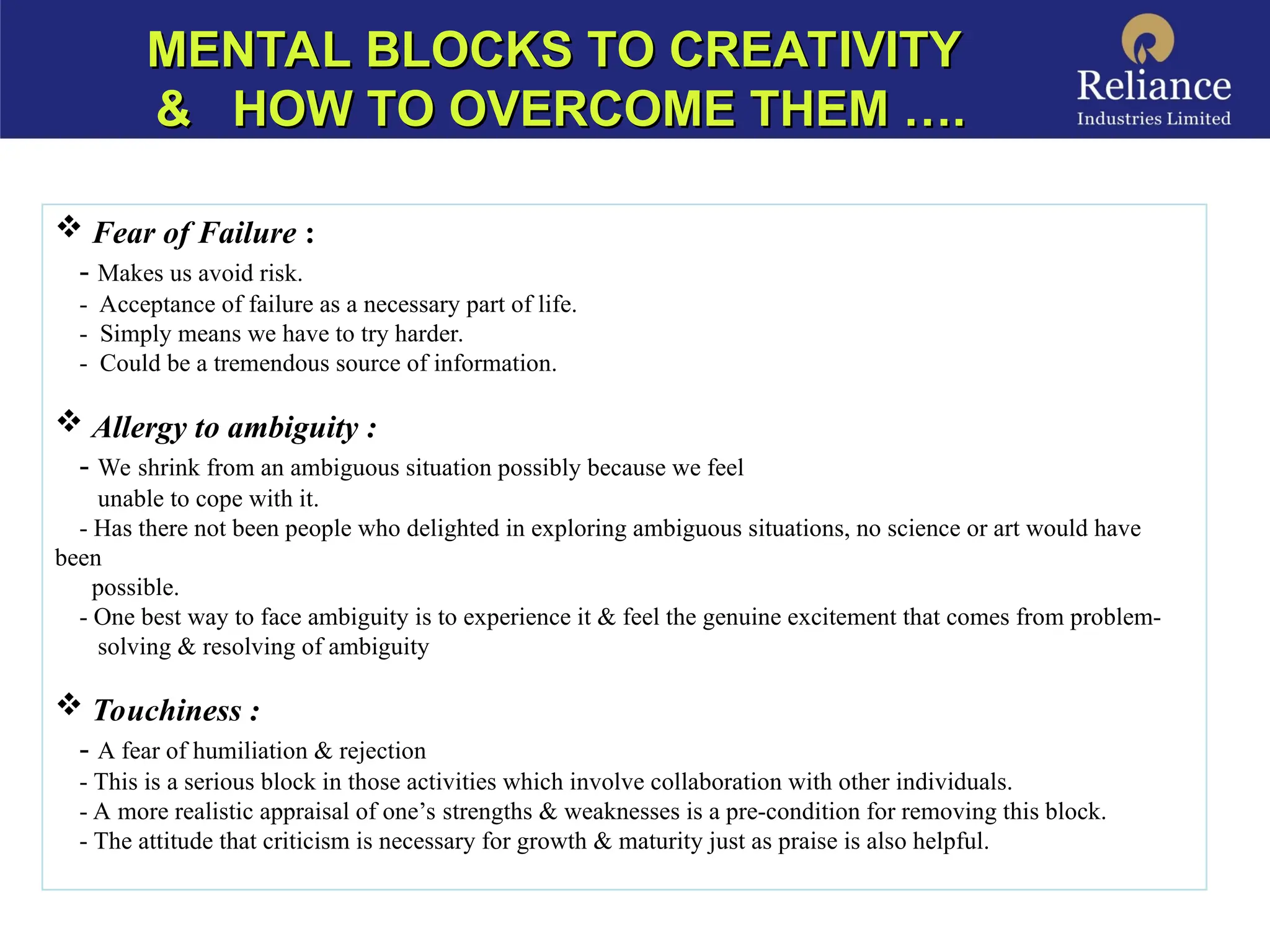
MENTAL BLOCKS TO CREATIVITY
& HOW TO OVERCOME THEM ….
 Fear of Failure :
- Makes us avoid risk.
- Acceptance of failure as a necessary part of life.
- Simply means we have to try harder.
- Could be a tremendous source of information.
 Allergy to ambiguity :
- We shrink from an ambiguous situation possibly because we feel
unable to cope with it.
- Has there not been people who delighted in exploring ambiguous situations, no science or art would have
been
possible.
- One best way to face ambiguity is to experience it & feel the genuine excitement that comes from problem-
solving & resolving of ambiguity
 Touchiness :
- A fear of humiliation & rejection
- This is a serious block in those activities which involve collaboration with other individuals.
- A more realistic appraisal of one’s strengths & weaknesses is a pre-condition for removing this block.
- The attitude that criticism is necessary for growth & maturity just as praise is also helpful.
MENTAL BLOCKS TO CREATIVITY
& HOW TO OVERCOME THEM …. Contd….
Conformity :
- Excessive allegiance to customs, traditions, procedures, social norms.
- Caused by fear of social disapproval.
- Permits a relatively risk free existence through the acceptance of status
quo.
- Active questioning of habits, norms, procedures & broadening of culture
can break the shackles of conformity.
 Resource Myopia :
- An inability to see the resources at our disposal which are usually much
larger than we imagine.
- Being unaware of our strengths.
- The ability to perceive one’s strengths & weaknesses accurately &
awareness of resources in one’s environment is necessary for
overcoming this block.
MENTAL BLOCKS TO CREATIVITY
& HOW TO OVERCOME THEM …. Contd….
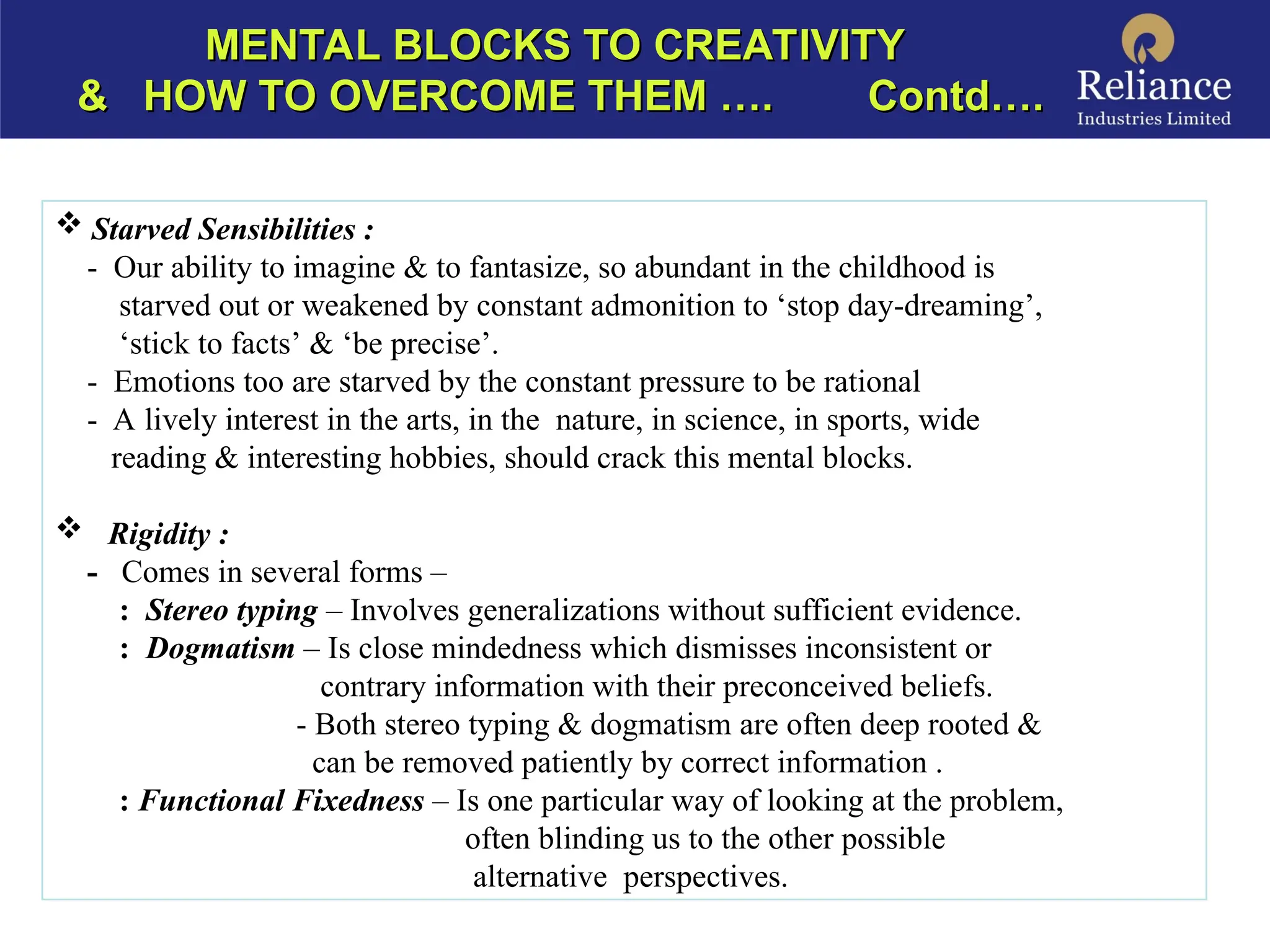
 Starved Sensibilities :
- Our ability to imagine & to fantasize, so abundant in the childhood is
starved out or weakened by constant admonition to ‘stop day-dreaming’,
‘stick to facts’ & ‘be precise’.
- Emotions too are starved by the constant pressure to be rational
- A lively interest in the arts, in the nature, in science, in sports, wide
reading & interesting hobbies, should crack this mental blocks.
 Rigidity :
- Comes in several forms –
: Stereo typing – Involves generalizations without sufficient evidence.
: Dogmatism – Is close mindedness which dismisses inconsistent or
contrary information with their preconceived beliefs.
- Both stereo typing & dogmatism are often deep rooted &
can be removed patiently by correct information .
: Functional Fixedness – Is one particular way of looking at the problem,
often blinding us to the other possible
alternative perspectives.
STRATEGIES FOR UNBLOCKING :
AWARENESS :
- Self-assessment would give you some idea of your blocks.
- Past experiences * incidents can be used for getting much better insight
of your blocks.
 ANALYSIS & DIAGNOSIS :
- Study the blocks in-depth, reflect upon the situation triggering it.
- One could recall the feelings that are aroused when the block is operating
& trace habits that strengthen the blocks.
 GOAL SETTING :
- Must show desire & need to unblock.
- It is useful to set some goals & targets which need not be very grand, but
important thing is to pursue the target.
QUALITIES OF CREATIVE PERSONS
1. Challenge the status quo & confront assumptions.
2. Exhibit curiosity.
3. Like to investigate new possibilities.
4. Tend to take initiative in most matters.
5. Are highly imaginative, tend to think visually.
6. Are future oriented.
7. See possibilities with in the seemingly impossible.
8. Are not afraid of taking risks & are prepared to make mistakes.
9. Are adaptable to different work environments & changing circumstances.
10. See relationships between seemingly disconnected elements.
11. Distil unusual ideas down to their underlying principles.
12. Synthesize diverse elements & are able to cope with paradoxes.
13. Are able to spot underlying patterns in events.
14. Look beyond the first ‘right idea’.
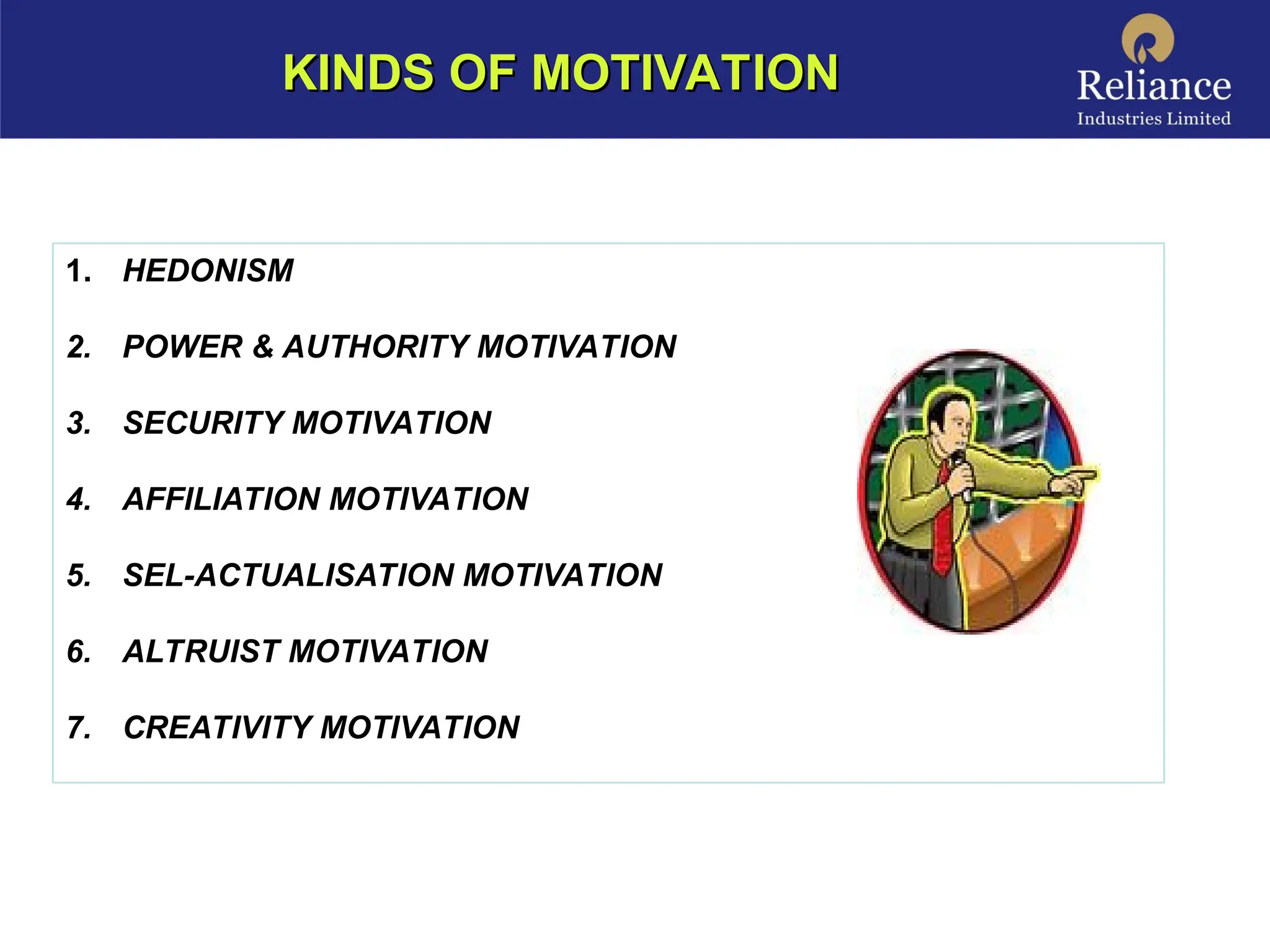
KINDS OF MOTIVATION
KINDS OF MOTIVATION
1. HEDONISM
2. POWER & AUTHORITY MOTIVATION
3. SECURITY MOTIVATION
4. AFFILIATION MOTIVATION
5. SEL-ACTUALISATION MOTIVATION
6. ALTRUIST MOTIVATION
7. CREATIVITY MOTIVATION
STRATEGIES FOR CHANGING
MOTIVATION
MOTIVATION
 Awareness :
- Become aware of the strengths of your motives.
- Exploration into one’s self to seek roots, forces which have shaped
them, forces which are preventing change in them.
 Role Model :
- Identify a person, draw inspiration from famous personalities.
- Expectations of someone, who has trust & faith in one’s performance,
can motivate
 Goal Setting :
- List the number of acts that signify creative or non-defensive
behaviors.
INNOVATION
INNOVATION
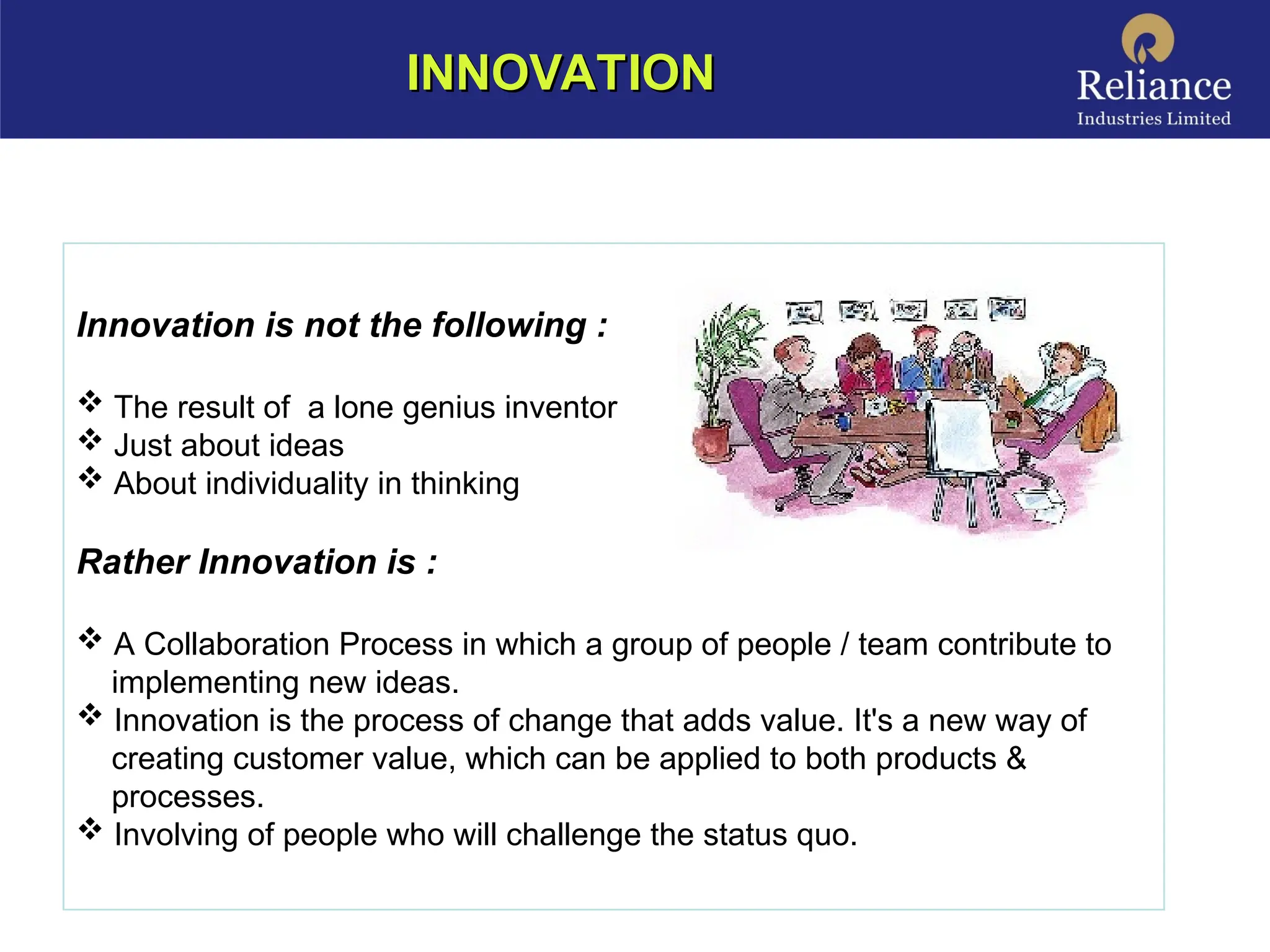
Innovation is not the following :
 The result of a lone genius inventor
 Just about ideas
 About individuality in thinking
Rather Innovation is :
 A Collaboration Process in which a group of people / team contribute to
implementing new ideas.
 Innovation is the process of change that adds value. It's a new way of
creating customer value, which can be applied to both products &
processes.
 Involving of people who will challenge the status quo.
INVENTIONS & INNOVATIONS
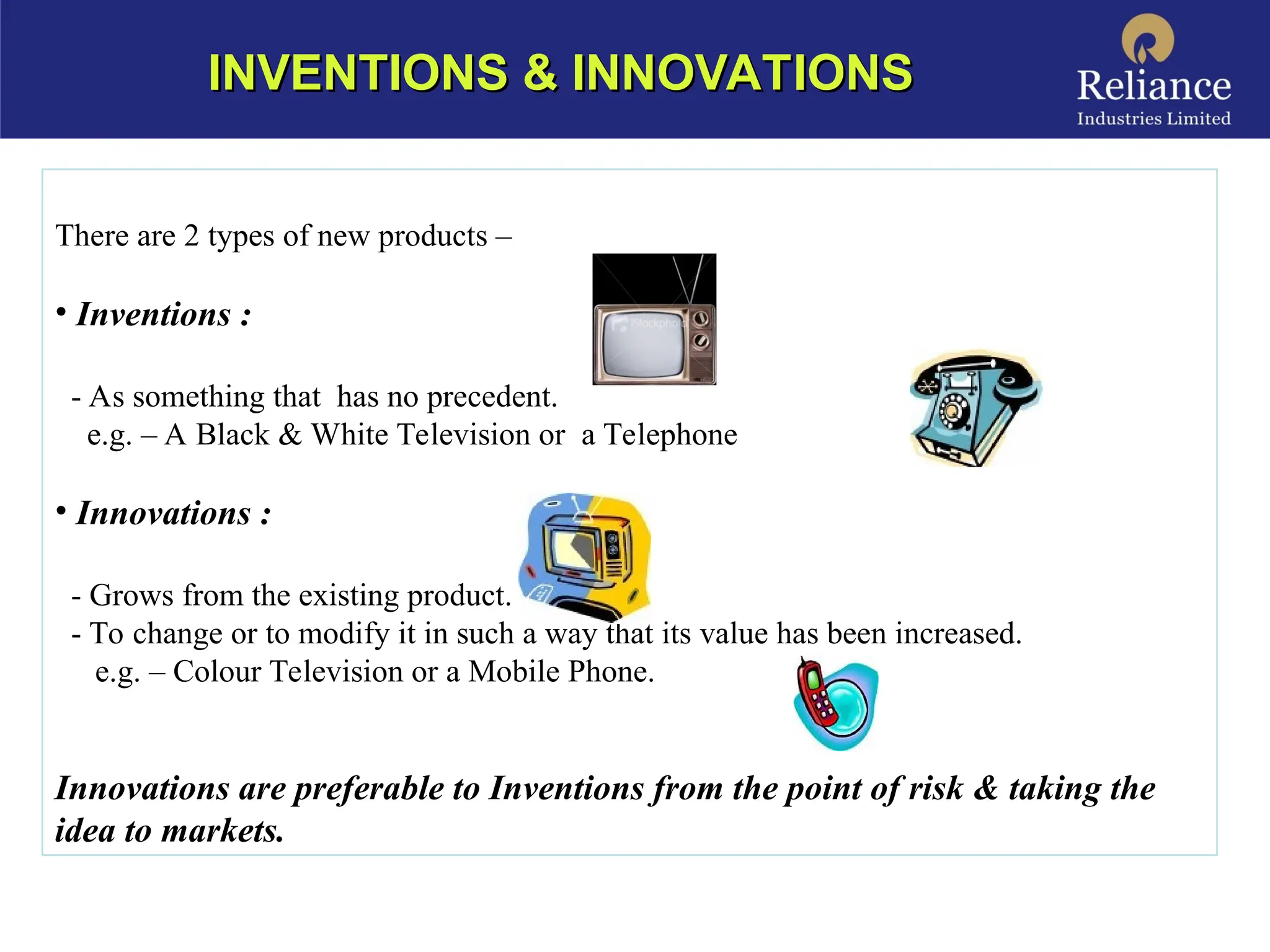
There are 2 types of new products –
• Inventions :
- As something that has no precedent.
e.g. – A Black & White Television or a Telephone
• Innovations :
- Grows from the existing product.
- To change or to modify it in such a way that its value has been increased.
e.g. – Colour Television or a Mobile Phone.
Innovations are preferable to Inventions from the point of risk & taking the
idea to markets.
INNOVATION IS A MAJOR DRIVER OF
FINANCIAL SUCCESS
FINANCIAL SUCCESS
0%
10%
20%
30%
40%
50%
60%
70%
80%
90%
Average Top 25% Top 10%
All Other
Industries
Electronic
Industry
% of Products
Less than
5 yrs old
Financial Performance measured using Growth, Profitability,
& Return on Funds Employed.
2 %
6 %
14 %
26 %
61 %
81 %
GROWTH & INNOVATION
0
20
40
60
80
100
120
0 10 20 30 40 50 60 70 80 90 100
Proportion of Turnover form New Products & Services (%)
Growth
in
Revenue
(%)
10
5
20
15
25
30
GROWTH & INNOVATION
GROWTH & INNOVATION
COMMERCIAL OBJECTIVES LEADING TO
INNOVATION
There are three main objectives that successful companies have
pursued
that have led to increased innovation.
 Improved Product Quality
 Extending Product Range
 Maintaining & Increasing Market Share
POOR PERSON – JOB FIT
- Square Peg Persons & Round Hole Jobs) Contd … .
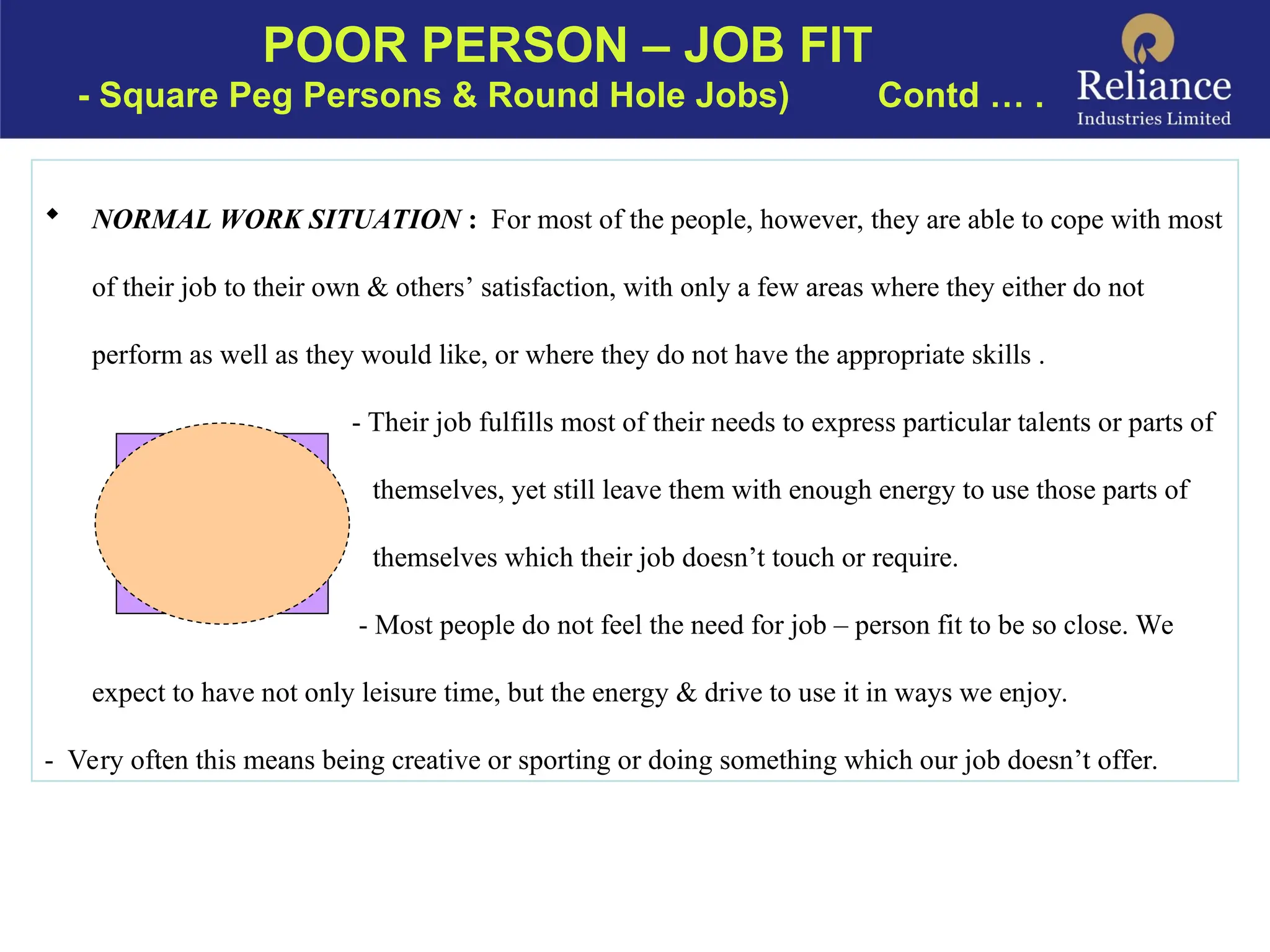
 NORMAL WORK SITUATION : For most of the people, however, they are able to cope with most
of their job to their own & others’ satisfaction, with only a few areas where they either do not
perform as well as they would like, or where they do not have the appropriate skills .
- Their job fulfills most of their needs to express particular talents or parts of
themselves, yet still leave them with enough energy to use those parts of
themselves which their job doesn’t touch or require.
- Most people do not feel the need for job – person fit to be so close. We
expect to have not only leisure time, but the energy & drive to use it in ways we enjoy.
- Very often this means being creative or sporting or doing something which our job doesn’t offer.
GOAL SETTING for success in life and business

GOAL SETTING for success in life and business

  • 1.
    GOAL SETTING GOAL SETTING ‘Thedifference between a goal & a dream is the written word .’ - Gene Donohue.
  • 2.
    WHAT IS AGOAL ? WHAT IS A GOAL ? A goal is a well-defined target that gives you CLARITY, A goal is a well-defined target that gives you CLARITY, DIRECTION, MOTIVATION & FOCUS. DIRECTION, MOTIVATION & FOCUS. Goals are tools that help you in five main ways – 1. Make a positive change in your life. 2. Form a new habit or change an existing habit. 3. Improve or develop a skill, talent or ability. 4. Realize a dream or other important outcome. 5. Improve your performance on a task or activity.
  • 3.
    GOALS GOALS The Power Lineto Success & Achievement The Power Line to Success & Achievement WHY DO WE NEED GOALS? • Goals give you direction in all areas of your life – Personal, Professional, Spiritual & Material life. • Goals give you a purpose in life. A reason to get up early in the morning everyday. • Goals will put drive & passion in your life. HOW DO I SET GOALS? • First you must dream ! Dream of everything you want, & have always wanted in every facet of your life. There are no limits. • Define your dream precisely. Define which of these goals are most important to you & why? • Write down one goal at a time. Write down a dead line for achieving that goal & be sure that the deadline is realistic.
  • 4.
    THE SECRETS OFACHIEVING YOUR GOALS THE SECRETS OF ACHIEVING YOUR GOALS The Seven Most Important Secrets of Achieving your Goals are – • Make your goals Inspirational. - You need to set goals grand enough to challenge yourself. - To be successful, & reach your true potential, you must constantly push yourself to move outside of your ‘comfort zone’. 2. Define your goals with Clarity. - Be precise in what you want. The more clearly defined your goal is, the easier it will be for you to attain. - Once you know the exact outcome you want you will be able to create an action plan that will ensure your success. 3. Write a Paragraph. - Write a paragraph or two describing exactly why you absolutely must attain your goal. Write down all reasons why you are committed to attain your goal. - Feel the emotion stir up inside of you. Feel the passion & drive. - This will bring the goal to life.
  • 5.
    THE SECRETS OFACHIEVING YOUR GOALS THE SECRETS OF ACHIEVING YOUR GOALS Contd . . . . Contd . . . . 4. Write another Paragraph. - This should explain what will happen if you don’t attain your goal. - How will you feel? What will happen to your lifestyle? Will you be embarrassed? Will you lose self-esteem? Will you lose your job? - The more emotion you can put behind the reasons why you must succeed & why you must not fail, the more committed to attaining your goals you will become. 5. Constantly evaluate your Progress. - You will have to constantly evaluate your progress in order to be sure you are on target - Unforeseen obstacles are sure to arise. Notice what is working& what is not. - If an approach is not working, don’t waste your time with it, change your approach.
  • 6.
    THE SECRETS OFACHIEVING YOUR GOALS THE SECRETS OF ACHIEVING YOUR GOALS Contd . . . . Contd . . . . 6. Never Lose sight of you Goal. - Take time to review your goals every now & then. - This will keep them fresh in your mind. 7. Do not Procrastinate. - Procrastination is a ‘Silent Killer’. - Understand that the only way to achieve your goals is to take action. - The world is full of people who don’t apply their knowledge. - On the other hand, chances are you know of people with less educational background who apply everything they learn.
  • 7.
    CREATING S.M.A.R.T GOALS CREATINGS.M.A.R.T GOALS • Specific – Measurable – Attainable – Relevant – Time-bound 1. Specific - A specific goal has a much greater chance of being accomplished than a general goal. - To set a specific goal you must answer the six ‘W’questions. * Who : Who is involved? * What : What do I want to accomplish? * Where : Identify a location. * When : Establish a time frame. * Which : Identify requirements & constraints. * Why : Specific reasons, purpose or benefits of accomplishing the goal.
  • 8.
    CREATING S.M.A.R.T GOALS CREATINGS.M.A.R.T GOALS Contd . . . . Contd . . . . 2. Measurable : - Establish concrete criteria for measuring progress towards the attainment of each goal you set. - When you measure your progress, you stay on track, reach your target dates, & experience the exhilaration of achievement that spurs you on to continued effort required to reach your goal. 3. Attainable : - When you identify goals that are attainable, though with some stretch & challenge you begin to figure out ways you can make them come true. - You develop the attitudes, abilities, skills & financial capacity to reach them. - Goals that may have seemed far away & out of reach, eventually move closer & become attainable, not because your goals shrink, but because you grow & expand to match them
  • 9.
    CREATING S.M.A.R.T GOALS CREATINGS.M.A.R.T GOALS Contd . . . . Contd . . . . 4. Relevant : - To be relevant, a goal must represent an objective towards which you are both, willing & able to work. - Be sure that every goal represents substantial progress in the direction you want to grow. 5. Time Bound : - A goal should be grounded within a time frame. - With no time frame tied to it there is no sense of urgency
  • 10.
    “CREATIVITY is notan occupation; it is an approach, a way of dealing with life’s small & big issues.” “CREATIVITY is the outcome of our thinking process, our personality & our motivation.” THE LANDSCAPE OF CREATIVITY THE LANDSCAPE OF CREATIVITY
  • 11.
    CREATIVITY CAN BEUNDESTOOD AS CREATIVITY CAN BE UNDESTOOD AS THE ABILITY TO THE ABILITY TO …… ……  Come up with a variety of solutions to a given problem.  Respond to a problem from a variety of view points.  Come up with unusual but appropriate responses .  Notice the unexplained, in other words the ability to sense the problems.
  • 12.
    WHAT IS CREATIVITY? ? WHAT IS CREATIVITY ? ? There are many definitions each emphasizing a different facet of creativity.  Creativity could be described as the discovery of something that is novel, but also useful or relevant or economical or elegant or valuable.  It could also be understood in terms of the creative efforts made i.e. wide search or exploration, leaps of imagination, sometimes strikingly fresh insights.  In expressing feelings, receptivity to ideas, concern for others, desire to grow as a person, etc….
  • 13.
    The first stageof Creative Process is similar to the disciple’s blind yet essential endeavor to get the feel of the problem.  The Creative person prepares himself for his attempts to solve the problem by getting acquainted with various aspects of it.  The person tries to solve the problems & returns to it despite repeated failures.  His each new endeavor involves redefinition of the problem in a new perspective. Also involves generation of new data about the problem. PREPARATION PREPARATION
  • 14.
    • Efforts atproblem solving during the stage of preparation do not always result into a solution. In frustration the person lets the problem go off the conscious mind. • The need for a gestation period is required. It is almost as if setting aside the problem, it facilitates the emergence of the creative insight. • In this stage, the unconscious mind works on the ideas already stored to reach new & creative solutions. INCUBATION INCUBATION
  • 15.
    • It’s aspontaneous, sudden & electrifying flash of ideas. • A relaxed state of mind is conducive for insights to occur. • Creative people are patient in persevering, demonstrate a capacity to reject solutions not to their standards. • Experience of insight comes as an emotional relief, a moment of ecstasy. • It provides a new vision, a new direction to the creative energies of the individual. INSIGHT – THE INSIGHT – THE AHA AHA !!! FEELING !!! FEELING
  • 16.
    • This involvesa systematic testing of the original insight. • It is the evaluation of the solution / insight, it’s refinement, working out its implications. VERIFICATION VERIFICATION
  • 17.
    Preparation Phase –Convergent thinking & Divergent thinking Incubation Phase – Individual lets the problem go off his conscious mind Insight Phase – Divergent thinking Verification Phase – Convergent thinking THE CYCLE OF CREATIVE PROCESS THE CYCLE OF CREATIVE PROCESS
  • 18.
    Acquire or Strengthen Traits Creative Persons have Strengthen Motivation to Create, Grow, Contribute Fears & Disabilities that impede Creativity Potential to be Creative in many aspects of life Any Organization will have an important role to develop & nurture CREATIVE Employees. MODEL OF CREATIVE PERSONALITY MODEL OF CREATIVE PERSONALITY
  • 19.
    THE THREE COMPONENTSOF THE THREE COMPONENTS OF CREATIVITY CREATIVITY Within every individual, creativity is a function of three components : Creative Thinking Skills, Motivation & Resources
  • 20.
    Researchers have foundCreative Personalities to be :  More Emotional but also more Independent in Judgment.  More Empathetic & wanting intimate relationships but also more paranoid  More Driven by Inner needs & more Individualistic  More involved with their work but also , more troubled by conflicts  Less Conformists , more tolerant of ambiguity & complexity.  More inquisitive, more flexible, more determined. PERSONALITY TRAITS – CONGENIAL TO PERSONALITY TRAITS – CONGENIAL TO CREATIVITY CREATIVITY
  • 21.
    Awareness : - Onegets himself assessed on various traits required to be creative. - May even ask someone who knows you intimately to assess you, to get better insight.  Goal Setting : - Useful to set some goals, may not be very grand. - Pursue the target.  Role Model : - Draw inspiration from some well known personalities - Even someone whom you know & who has been know to be creative STRATEGIES FOR ACQUIRING / STRATEGIES FOR ACQUIRING / STRENGTHRNING TRAITS STRENGTHRNING TRAITS
  • 22.
     Intrinsic Satisfaction: - Some people create because of the intrinsic satisfaction they get from the very process of creation. - They just have to face challenges & overcome obstacles.  Necessity is the Mother of Innovation / Intellectual dissatisfaction : - All kinds of human needs lead to acts of creation. - New drugs, new weapons, new machines.  Release Inner Tensions : - A person creates to release or act out his inner tensions - For power, security, money, love etc.. WHAT FUELS CREATIVE EFFORTS ? WHAT FUELS CREATIVE EFFORTS ?
  • 23.
    DURABLE FUEL FORCREATIVITY DURABLE FUEL FOR CREATIVITY Some unending strong needs that provide more durable fuel for creativity  Need for Personal Growth : - Development for one’s potential, need for self-actualization.  Altruism : - Individual’s need to contribute to others’ growth & development  Need to Discover / Pioneer : - Need to create, to discover, to pioneer, to do something original & distinctive
  • 24.
    MENTAL BLOCKS TOCREATIVITY MENTAL BLOCKS TO CREATIVITY & HOW TO OVERCOME THEM …. & HOW TO OVERCOME THEM ….  Fear of Failure : - Makes us avoid risk. - Acceptance of failure as a necessary part of life. - Simply means we have to try harder. - Could be a tremendous source of information.  Allergy to ambiguity : - We shrink from an ambiguous situation possibly because we feel unable to cope with it. - Has there not been people who delighted in exploring ambiguous situations, no science or art would have been possible. - One best way to face ambiguity is to experience it & feel the genuine excitement that comes from problem- solving & resolving of ambiguity  Touchiness : - A fear of humiliation & rejection - This is a serious block in those activities which involve collaboration with other individuals. - A more realistic appraisal of one’s strengths & weaknesses is a pre-condition for removing this block. - The attitude that criticism is necessary for growth & maturity just as praise is also helpful.
  • 25.
    MENTAL BLOCKS TOCREATIVITY MENTAL BLOCKS TO CREATIVITY & HOW TO OVERCOME THEM …. Contd…. & HOW TO OVERCOME THEM …. Contd…. Conformity : - Excessive allegiance to customs, traditions, procedures, social norms. - Caused by fear of social disapproval. - Permits a relatively risk free existence through the acceptance of status quo. - Active questioning of habits, norms, procedures & broadening of culture can break the shackles of conformity.  Resource Myopia : - An inability to see the resources at our disposal which are usually much larger than we imagine. - Being unaware of our strengths. - The ability to perceive one’s strengths & weaknesses accurately & awareness of resources in one’s environment is necessary for overcoming this block.
  • 26.
    MENTAL BLOCKS TOCREATIVITY MENTAL BLOCKS TO CREATIVITY & HOW TO OVERCOME THEM …. Contd…. & HOW TO OVERCOME THEM …. Contd….  Starved Sensibilities : - Our ability to imagine & to fantasize, so abundant in the childhood is starved out or weakened by constant admonition to ‘stop day-dreaming’, ‘stick to facts’ & ‘be precise’. - Emotions too are starved by the constant pressure to be rational - A lively interest in the arts, in the nature, in science, in sports, wide reading & interesting hobbies, should crack this mental blocks.  Rigidity : - Comes in several forms – : Stereo typing – Involves generalizations without sufficient evidence. : Dogmatism – Is close mindedness which dismisses inconsistent or contrary information with their preconceived beliefs. - Both stereo typing & dogmatism are often deep rooted & can be removed patiently by correct information . : Functional Fixedness – Is one particular way of looking at the problem, often blinding us to the other possible alternative perspectives.
  • 27.
    STRATEGIES FOR UNBLOCKING: STRATEGIES FOR UNBLOCKING : AWARENESS : - Self-assessment would give you some idea of your blocks. - Past experiences * incidents can be used for getting much better insight of your blocks.  ANALYSIS & DIAGNOSIS : - Study the blocks in-depth, reflect upon the situation triggering it. - One could recall the feelings that are aroused when the block is operating & trace habits that strengthen the blocks.  GOAL SETTING : - Must show desire & need to unblock. - It is useful to set some goals & targets which need not be very grand, but important thing is to pursue the target.
  • 28.
    QUALITIES OF CREATIVEPERSONS QUALITIES OF CREATIVE PERSONS 1. Challenge the status quo & confront assumptions. 2. Exhibit curiosity. 3. Like to investigate new possibilities. 4. Tend to take initiative in most matters. 5. Are highly imaginative, tend to think visually. 6. Are future oriented. 7. See possibilities with in the seemingly impossible. 8. Are not afraid of taking risks & are prepared to make mistakes. 9. Are adaptable to different work environments & changing circumstances. 10. See relationships between seemingly disconnected elements. 11. Distil unusual ideas down to their underlying principles. 12. Synthesize diverse elements & are able to cope with paradoxes. 13. Are able to spot underlying patterns in events. 14. Look beyond the first ‘right idea’.
  • 30.
    KINDS OF MOTIVATION KINDSOF MOTIVATION 1. HEDONISM 2. POWER & AUTHORITY MOTIVATION 3. SECURITY MOTIVATION 4. AFFILIATION MOTIVATION 5. SEL-ACTUALISATION MOTIVATION 6. ALTRUIST MOTIVATION 7. CREATIVITY MOTIVATION
  • 31.
    STRATEGIES FOR CHANGING STRATEGIESFOR CHANGING MOTIVATION MOTIVATION  Awareness : - Become aware of the strengths of your motives. - Exploration into one’s self to seek roots, forces which have shaped them, forces which are preventing change in them.  Role Model : - Identify a person, draw inspiration from famous personalities. - Expectations of someone, who has trust & faith in one’s performance, can motivate  Goal Setting : - List the number of acts that signify creative or non-defensive behaviors.
  • 32.
    INNOVATION INNOVATION Innovation is notthe following :  The result of a lone genius inventor  Just about ideas  About individuality in thinking Rather Innovation is :  A Collaboration Process in which a group of people / team contribute to implementing new ideas.  Innovation is the process of change that adds value. It's a new way of creating customer value, which can be applied to both products & processes.  Involving of people who will challenge the status quo.
  • 34.
    INVENTIONS & INNOVATIONS INVENTIONS& INNOVATIONS There are 2 types of new products – • Inventions : - As something that has no precedent. e.g. – A Black & White Television or a Telephone • Innovations : - Grows from the existing product. - To change or to modify it in such a way that its value has been increased. e.g. – Colour Television or a Mobile Phone. Innovations are preferable to Inventions from the point of risk & taking the idea to markets.
  • 35.
    INNOVATION IS AMAJOR DRIVER OF INNOVATION IS A MAJOR DRIVER OF FINANCIAL SUCCESS FINANCIAL SUCCESS 0% 10% 20% 30% 40% 50% 60% 70% 80% 90% Average Top 25% Top 10% All Other Industries Electronic Industry % of Products Less than 5 yrs old Financial Performance measured using Growth, Profitability, & Return on Funds Employed. 2 % 6 % 14 % 26 % 61 % 81 %
  • 36.
    GROWTH & INNOVATION 0 20 40 60 80 100 120 010 20 30 40 50 60 70 80 90 100 Proportion of Turnover form New Products & Services (%) Growth in Revenue (%) 10 5 20 15 25 30 GROWTH & INNOVATION GROWTH & INNOVATION
  • 37.
    COMMERCIAL OBJECTIVES LEADINGTO INNOVATION There are three main objectives that successful companies have pursued that have led to increased innovation.  Improved Product Quality  Extending Product Range  Maintaining & Increasing Market Share
  • 38.
    POOR PERSON –JOB FIT - Square Peg Persons & Round Hole Jobs) Contd … .  NORMAL WORK SITUATION : For most of the people, however, they are able to cope with most of their job to their own & others’ satisfaction, with only a few areas where they either do not perform as well as they would like, or where they do not have the appropriate skills . - Their job fulfills most of their needs to express particular talents or parts of themselves, yet still leave them with enough energy to use those parts of themselves which their job doesn’t touch or require. - Most people do not feel the need for job – person fit to be so close. We expect to have not only leisure time, but the energy & drive to use it in ways we enjoy. - Very often this means being creative or sporting or doing something which our job doesn’t offer.