UN pushes “smart crops” as an
alternative to tackle hunger in Asia
Asia needs to make extra efforts to defeat hunger after progress
has slowed in the last five years, including promoting so-called
“smart crops” as an alternative to rice, the head of the UN food
agency in the region said.
Kundhavi Kadiresan, representative of the Food and Agriculture
Organisation (FAO) in Asia, said the region needs to focus on
reaching the most marginalised people, such as the very poor or
those living in mountainous areas.
We are calling them smart crops to get people not to think about
them as poor people’s food but smart people’s food.
Kundhavi Kadiresan, representative, Food and Agriculture
Organisation (FAO) in Asia
She said government and businesses needed to develop policies
to help make food more affordable, while changing Asians’ diets
that rely heavily on rice.
“We have focused so much on rice that we haven’t really looked
at some of those crops like millets, sorghum and beans,” she
said.
A campaign is underway to promote these alternatives as “smart
crops” to make them more attractive, Kadiresan said.
“We are calling them smart crops to get people not to think
about them as poor people’s food but smart people’s food,” she
said, adding that they are not only nutritious but also more
adaptable to climate change.
Soaring rice prices, slowing economic expansion and poorer
growth in agricultural productivity have been blamed.
SCIENTIST INVENT THIN INEXPENSIVE MATERIAL THAT
ACTS AS AN AIR CONDITIONER
Scientists have developed a thin, inexpensive material with
extraordinary properties not found in nature - to act as a kind of
air conditioning system for structures with the ability to cool
objects even under direct sunlight with zero energy and water
consumption. When applied to a surface, the metamaterial film
cools the object underneath by efficiently reflecting incoming
solar energy back into the space while simultaneously allowing
the surface to shed its own heat in the form of infrared thermal
radiation.
Ecoult’s lead-acid UltraBattery is being tested in the
harsh heat of India for its potential to wean the
world off diesel.
Enduring solutions prove themselves under tough conditions. If
Ecoult’s UltraBattery can cut the dependence on diesel in rural
India, where it is being tested by the Institute for Transformative
Technologies, then it may be able to do the same in Africa and
South-East Asia.
“Today diesel is a fuel of convenience,” says Ecoult CEO John
Wood. “Tomorrow it could be the fuel of last resort.”
There are half a million diesel generators in India and millions of
litres of diesel are also used each day to power mobile
communications stations around the world.
German Architect Andre Broessel believes he has a solution that
can “squeeze more juice out of the sun”, even during the night
hours and in low-light regions. His company Rawlemon has
created a spherical sun power generator prototype called the
beta.ray. His technology will combine spherical geometry
principles with a dual axis tracking system, allowing twice the
yield of a conventional solar panel in a much smaller surface
area. The futuristic design is fully rotational and is suitable for
inclined surfaces, walls of buildings, and anywhere with access
to the sky. It can even be used as an electric car charging
station.
THE SPHERICAL SUN POWER GENERATOR
HOW IT WORKS
India looking at solar power storage
technology from Belgium
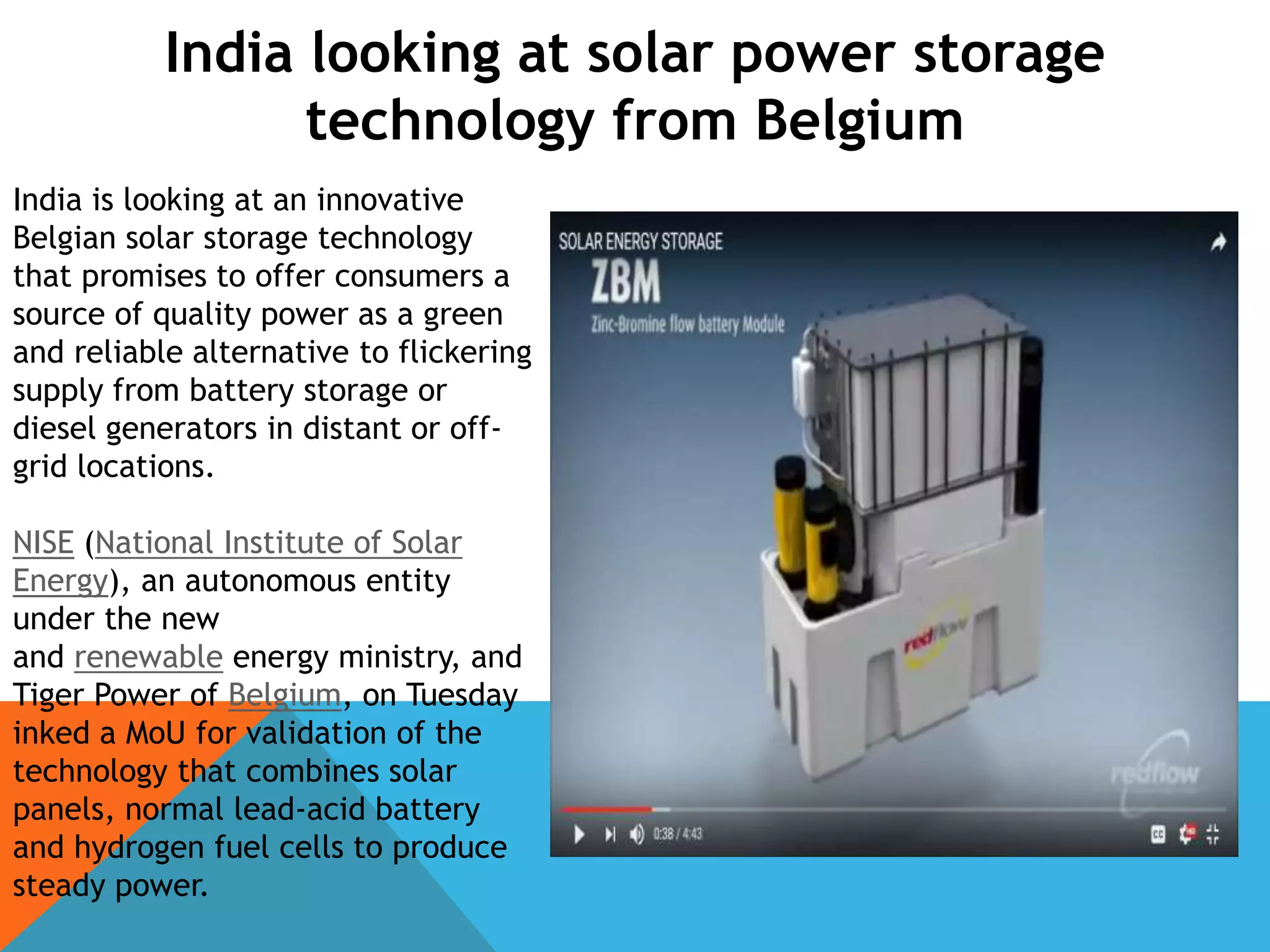
India is looking at an innovative
Belgian solar storage technology
that promises to offer consumers a
source of quality power as a green
and reliable alternative to flickering
supply from battery storage or
diesel generators in distant or off-
grid locations.
NISE (National Institute of Solar
Energy), an autonomous entity
under the new
and renewable energy ministry, and
Tiger Power of Belgium, on Tuesday
inked a MoU for validation of the
technology that combines solar
panels, normal lead-acid battery
and hydrogen fuel cells to produce
steady power.
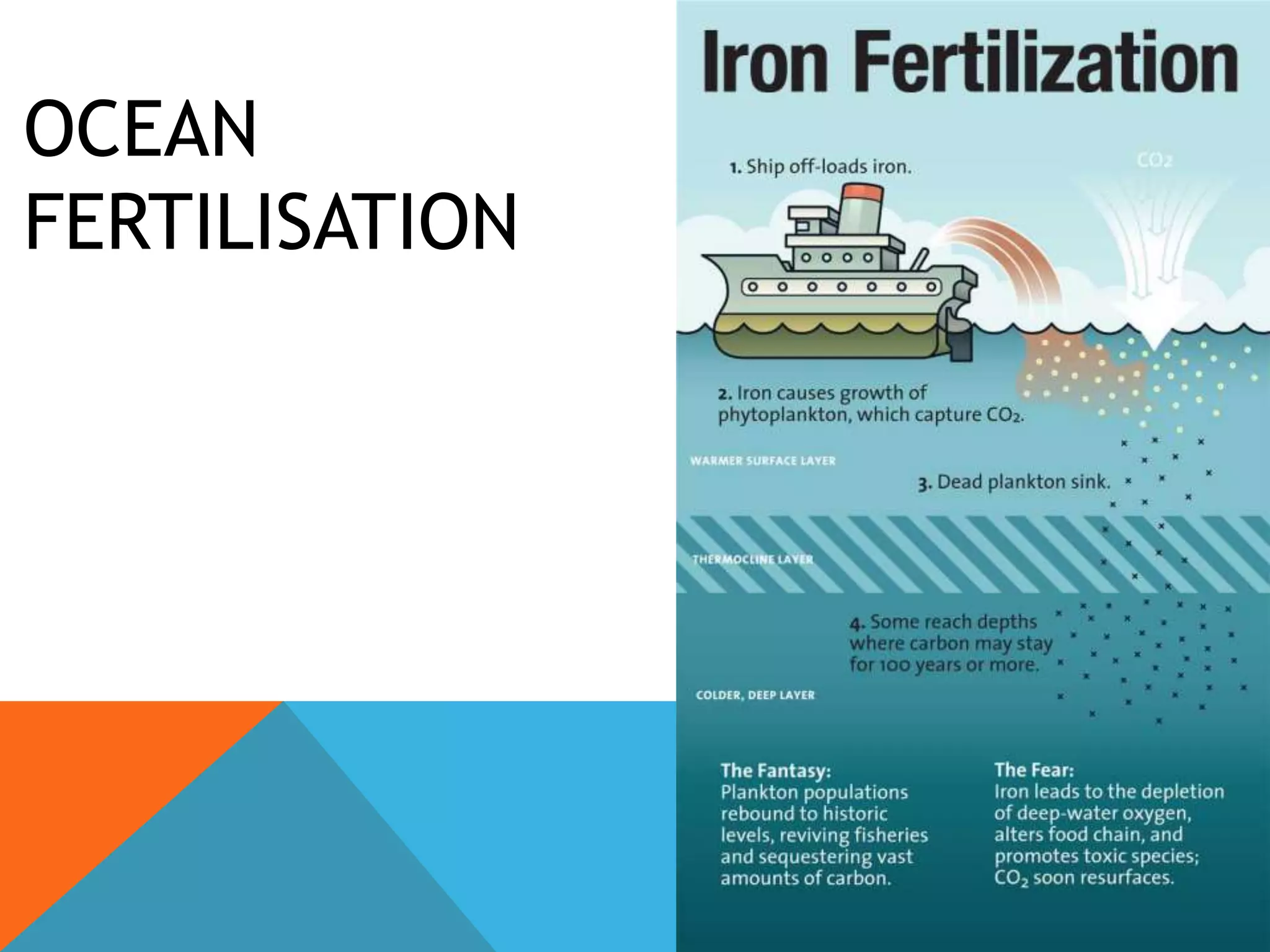
OCEAN
FERTILISATION
The designer Mike Thompson asked himself “What if
power came at a cost to the individual?” and ended up
creating THE BLOOD LAMP
This single use lamp requires a drop of blood to be
activated – a personal sacrifice that will make you
think twice before turning it on.
The secret ingredient is luminol, it turns blue on
reacting with the red blood cells.
BLOOD LAMP
THANK YOU
PREPARED BY
DISHANT PARIKH (160110107035)

Go green

  • 2.
    UN pushes “smartcrops” as an alternative to tackle hunger in Asia Asia needs to make extra efforts to defeat hunger after progress has slowed in the last five years, including promoting so-called “smart crops” as an alternative to rice, the head of the UN food agency in the region said. Kundhavi Kadiresan, representative of the Food and Agriculture Organisation (FAO) in Asia, said the region needs to focus on reaching the most marginalised people, such as the very poor or those living in mountainous areas.
  • 3.
    We are callingthem smart crops to get people not to think about them as poor people’s food but smart people’s food. Kundhavi Kadiresan, representative, Food and Agriculture Organisation (FAO) in Asia She said government and businesses needed to develop policies to help make food more affordable, while changing Asians’ diets that rely heavily on rice. “We have focused so much on rice that we haven’t really looked at some of those crops like millets, sorghum and beans,” she said. A campaign is underway to promote these alternatives as “smart crops” to make them more attractive, Kadiresan said. “We are calling them smart crops to get people not to think about them as poor people’s food but smart people’s food,” she said, adding that they are not only nutritious but also more adaptable to climate change. Soaring rice prices, slowing economic expansion and poorer growth in agricultural productivity have been blamed.
  • 4.
    SCIENTIST INVENT THININEXPENSIVE MATERIAL THAT ACTS AS AN AIR CONDITIONER Scientists have developed a thin, inexpensive material with extraordinary properties not found in nature - to act as a kind of air conditioning system for structures with the ability to cool objects even under direct sunlight with zero energy and water consumption. When applied to a surface, the metamaterial film cools the object underneath by efficiently reflecting incoming solar energy back into the space while simultaneously allowing the surface to shed its own heat in the form of infrared thermal radiation.
  • 5.
    Ecoult’s lead-acid UltraBatteryis being tested in the harsh heat of India for its potential to wean the world off diesel. Enduring solutions prove themselves under tough conditions. If Ecoult’s UltraBattery can cut the dependence on diesel in rural India, where it is being tested by the Institute for Transformative Technologies, then it may be able to do the same in Africa and South-East Asia. “Today diesel is a fuel of convenience,” says Ecoult CEO John Wood. “Tomorrow it could be the fuel of last resort.” There are half a million diesel generators in India and millions of litres of diesel are also used each day to power mobile communications stations around the world.
  • 6.
    German Architect AndreBroessel believes he has a solution that can “squeeze more juice out of the sun”, even during the night hours and in low-light regions. His company Rawlemon has created a spherical sun power generator prototype called the beta.ray. His technology will combine spherical geometry principles with a dual axis tracking system, allowing twice the yield of a conventional solar panel in a much smaller surface area. The futuristic design is fully rotational and is suitable for inclined surfaces, walls of buildings, and anywhere with access to the sky. It can even be used as an electric car charging station. THE SPHERICAL SUN POWER GENERATOR
  • 7.
  • 8.
    India looking atsolar power storage technology from Belgium India is looking at an innovative Belgian solar storage technology that promises to offer consumers a source of quality power as a green and reliable alternative to flickering supply from battery storage or diesel generators in distant or off- grid locations. NISE (National Institute of Solar Energy), an autonomous entity under the new and renewable energy ministry, and Tiger Power of Belgium, on Tuesday inked a MoU for validation of the technology that combines solar panels, normal lead-acid battery and hydrogen fuel cells to produce steady power.
  • 9.
  • 10.
    The designer MikeThompson asked himself “What if power came at a cost to the individual?” and ended up creating THE BLOOD LAMP This single use lamp requires a drop of blood to be activated – a personal sacrifice that will make you think twice before turning it on. The secret ingredient is luminol, it turns blue on reacting with the red blood cells. BLOOD LAMP
  • 12.
    THANK YOU PREPARED BY DISHANTPARIKH (160110107035)