Globe Theatre Amy TamakloeMs. TameratGrade 9
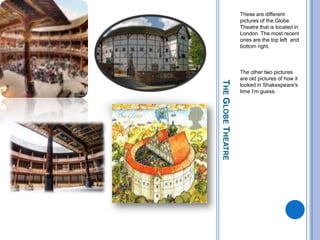
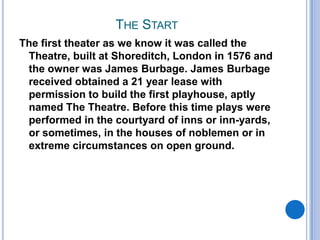
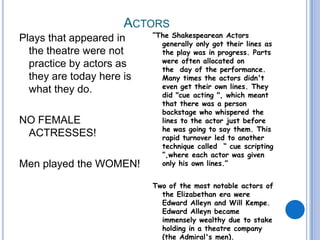
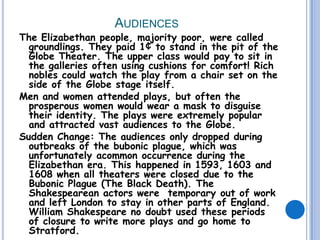
The Globe TheatreThese are different pictures of the Globe Theatre that is located in London. The most recent ones are the top left  and bottom right.The other two pictures are old pictures of how it looked in Shakespeare's time I’m guess.
The Start The first theater as we know it was called the Theatre, built at Shoreditch, London in 1576 and the owner was James Burbage. James Burbage received obtained a 21 year lease with permission to build the first playhouse, aptly named The Theatre. Before this time plays were performed in the courtyard of inns or inn-yards, or sometimes, in the houses of noblemen or in extreme circumstances on open ground.
Actors Plays that appeared in the theatre were not practice by actors as they are today here is what they do.   NO FEMALE   ACTRESSES!Men played the WOMEN!“The Shakespearean Actors generally only got their lines as the play was in progress. Parts were often allocated on the  day of the performance. Many times the actors didn't even get their own lines. They did "cue acting ", which meant that there was a person backstage who whispered the lines to the actor just before he was going to say them. This rapid turnover led to another technique called  “ cue scripting ”,where each actor was given only his own lines.”Two of the most notable actors of the Elizabethan era were Edward Alleyn and Will Kempe. Edward Alleyn became immensely wealthy due to stake holding in a theatre company (the Admiral's men).
Audiences The Elizabethan people, majority poor, were called groundlings. They paid 1¢ to stand in the pit of the Globe Theater. The upper class would pay to sit in the galleries often using cushions for comfort! Rich nobles could watch the play from a chair set on the side of the Globe stage itself.Men and women attended plays, but often the prosperous women would wear a mask to disguise their identity. The plays were extremely popular and attracted vast audiences to the Globe.Sudden Change: The audiences only dropped during outbreaks of the bubonic plague, which was unfortunately acommon occurrence during the Elizabethan era. This happened in 1593, 1603 and 1608 when all theaters were closed due to the Bubonic Plague (The Black Death). The Shakespearean actors were  temporary out of work and left London to stay in other parts of England. William Shakespeare no doubt used these periods of closure to write more plays and go home to Stratford.
Box Office-Globe audiences had to put one penny in a box by the door which would pay for a view of the play by standing on the ground, in front of the stage.-To sit on the first gallery would cost another penny in the box which was held by a collector on the front of the stairs. -To sit on the second gallery, you put another penny in the box held by the man at the second flight of stairs.-Then when the show started, the men went and put the boxes in the Elizabethan box office. -Profits there were shared between members of the Globe company and the owners of the theatre, who included the James and his son the actor Richard Burbage and five others, one of them was William Shakespeare. -Shakespeare received approximately 10% of the profit although he had a 20% stake holding in the troupe as James Burbage owned the lease for the land that the Globe theater was built on.
The Sudden Fall Of GTQueen Elizabeth, ever concerned about her popularity with the people, realized that although it would be prudent to enforce some regulations that it would be foolhardy to apply too many restrictions. 
 In 1572 there was a rule passed which was to have a granting license by royal patent to organize acting companies, and initiating legitimate troupes such as Earl of Leicester's Men.

Globe Theatre

  • 1.
    Globe Theatre AmyTamakloeMs. TameratGrade 9
  • 2.
    The Globe TheatreTheseare different pictures of the Globe Theatre that is located in London. The most recent ones are the top left and bottom right.The other two pictures are old pictures of how it looked in Shakespeare's time I’m guess.
  • 3.
    The Start Thefirst theater as we know it was called the Theatre, built at Shoreditch, London in 1576 and the owner was James Burbage. James Burbage received obtained a 21 year lease with permission to build the first playhouse, aptly named The Theatre. Before this time plays were performed in the courtyard of inns or inn-yards, or sometimes, in the houses of noblemen or in extreme circumstances on open ground.
  • 4.
    Actors Plays thatappeared in the theatre were not practice by actors as they are today here is what they do. NO FEMALE ACTRESSES!Men played the WOMEN!“The Shakespearean Actors generally only got their lines as the play was in progress. Parts were often allocated on the  day of the performance. Many times the actors didn't even get their own lines. They did "cue acting ", which meant that there was a person backstage who whispered the lines to the actor just before he was going to say them. This rapid turnover led to another technique called  “ cue scripting ”,where each actor was given only his own lines.”Two of the most notable actors of the Elizabethan era were Edward Alleyn and Will Kempe. Edward Alleyn became immensely wealthy due to stake holding in a theatre company (the Admiral's men).
  • 5.
    Audiences The Elizabethanpeople, majority poor, were called groundlings. They paid 1¢ to stand in the pit of the Globe Theater. The upper class would pay to sit in the galleries often using cushions for comfort! Rich nobles could watch the play from a chair set on the side of the Globe stage itself.Men and women attended plays, but often the prosperous women would wear a mask to disguise their identity. The plays were extremely popular and attracted vast audiences to the Globe.Sudden Change: The audiences only dropped during outbreaks of the bubonic plague, which was unfortunately acommon occurrence during the Elizabethan era. This happened in 1593, 1603 and 1608 when all theaters were closed due to the Bubonic Plague (The Black Death). The Shakespearean actors were temporary out of work and left London to stay in other parts of England. William Shakespeare no doubt used these periods of closure to write more plays and go home to Stratford.
  • 6.
    Box Office-Globe audienceshad to put one penny in a box by the door which would pay for a view of the play by standing on the ground, in front of the stage.-To sit on the first gallery would cost another penny in the box which was held by a collector on the front of the stairs. -To sit on the second gallery, you put another penny in the box held by the man at the second flight of stairs.-Then when the show started, the men went and put the boxes in the Elizabethan box office. -Profits there were shared between members of the Globe company and the owners of the theatre, who included the James and his son the actor Richard Burbage and five others, one of them was William Shakespeare. -Shakespeare received approximately 10% of the profit although he had a 20% stake holding in the troupe as James Burbage owned the lease for the land that the Globe theater was built on.
  • 7.
    The Sudden FallOf GTQueen Elizabeth, ever concerned about her popularity with the people, realized that although it would be prudent to enforce some regulations that it would be foolhardy to apply too many restrictions. 
  • 8.
    In 1572there was a rule passed which was to have a granting license by royal patent to organize acting companies, and initiating legitimate troupes such as Earl of Leicester's Men.
  • 9.
    Plays stillhowever often led to heated debates in the theaters and arguments erupted. The subject matter of the plays would often be vulgar and bawdy. The behavior of some the audience was the worse!
  • 10.
    The theatres didn’tjust show plays. Some also served as a bear pit, brothel and gambling house.
  • 11.
    Crime increased atthe theaters and following the performances the crowds were noisy and unruly. 
  • 12.
    The vast crowdsand the popularity of the London Theaters needed some additional controls. Published plays soon required a license, which provided a form of censorship by the state. Soon on plays and theatrical acts were banned.
  • 13.
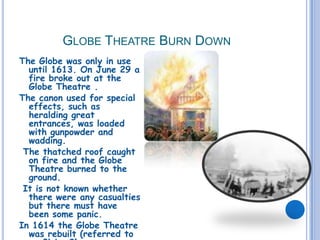
    Globe Theatre BurnDownThe Globe was only in use until 1613. On June 29 a fire broke out at the Globe Theatre . The canon used for special effects, such as heralding great entrances, was loaded with gunpowder and wadding.The thatched roof caught on fire and the Globe Theatre burned to the ground.It is not known whether there were any casualties but there must have been some panic. In 1614 the Globe Theatre was rebuilt (referred to as Globe 2).