THE
CONTEMPORAR
Y WORLD
GE 113
- Discuss on globalization, global economy(1ST WORLD) ,market
integration (Global financial institution), global interstate system(UN, ,
legal basis of intl relations, SDGs
- Relevant to history
Concepts:
• -widely considered to have begun in 1945( end of WW II) up to present
AXIS (Japan, Italy, Germany), ALLIED (
• - the WAR brought about dramatic changes to technological, political and
social conditions(cold war, korean war, kasunduan)
• Modern world 1501 to 1945
• Present world, current world(kasalukuyang mundo)
• general overview of what is happening in present situation: PANGYAYARI SA
MAKABAGONG PANAHON economic , language, social and political issues
• So, Why it is important to talk about the contemporary world?
• To be more conscious and to enhance our knowledge, understanding on
what the relevant issues of the world and its effects to the people.
Activity 1:
Create an act that reflects the topic assigned to your group. Show how
this is carried out or manifested in the present time. Min. 5 mins. ,
max. 10 minutes.
1. Politics in the present time- G 3
2. Economy in the present time- G4
3. Culture in the present- G1
4. Communication in the present time-G2
How are you connected
with the world?
GLOBALIZATO
N
Defining Globalization
• Globalization is a term used to describe the increasing connectedness and
interdependence of world cultures and economies.
• Describe how trade and technology have made the world into a more
connected and interdependent place.
• “process of world shrinkage, of distances getting shorter, things moving
closer. -Thomas Larson
• Onset of borderless world- Ohmae
• Diffusion of practices,values and technology that have influence
worldwide.
• Changes in the temporal connections of people.- Scholte
Metaphors of
Globalization
Solidity Liquidity
-barriers that prevent or make
difficult the movement of things.
-natural or man-made
- modern man-made solid( nine-
dash-line)-
-increasing ease of movement
of people, things, information ,
and places in the
contemporary world.
GlobalizationTheories
-increasing sameness in the
world: culture, economy, and
politics.
-cultural imperialism
-mcdonaldization
-Celebration, technology, music, sports,
language/literature, education & curriculum
HETEROGENEITY
-creation of various cultural
practices, new economies,
and political groups.
-language, ethnicity,class
Difficult to communicate, trust/ cooperate.
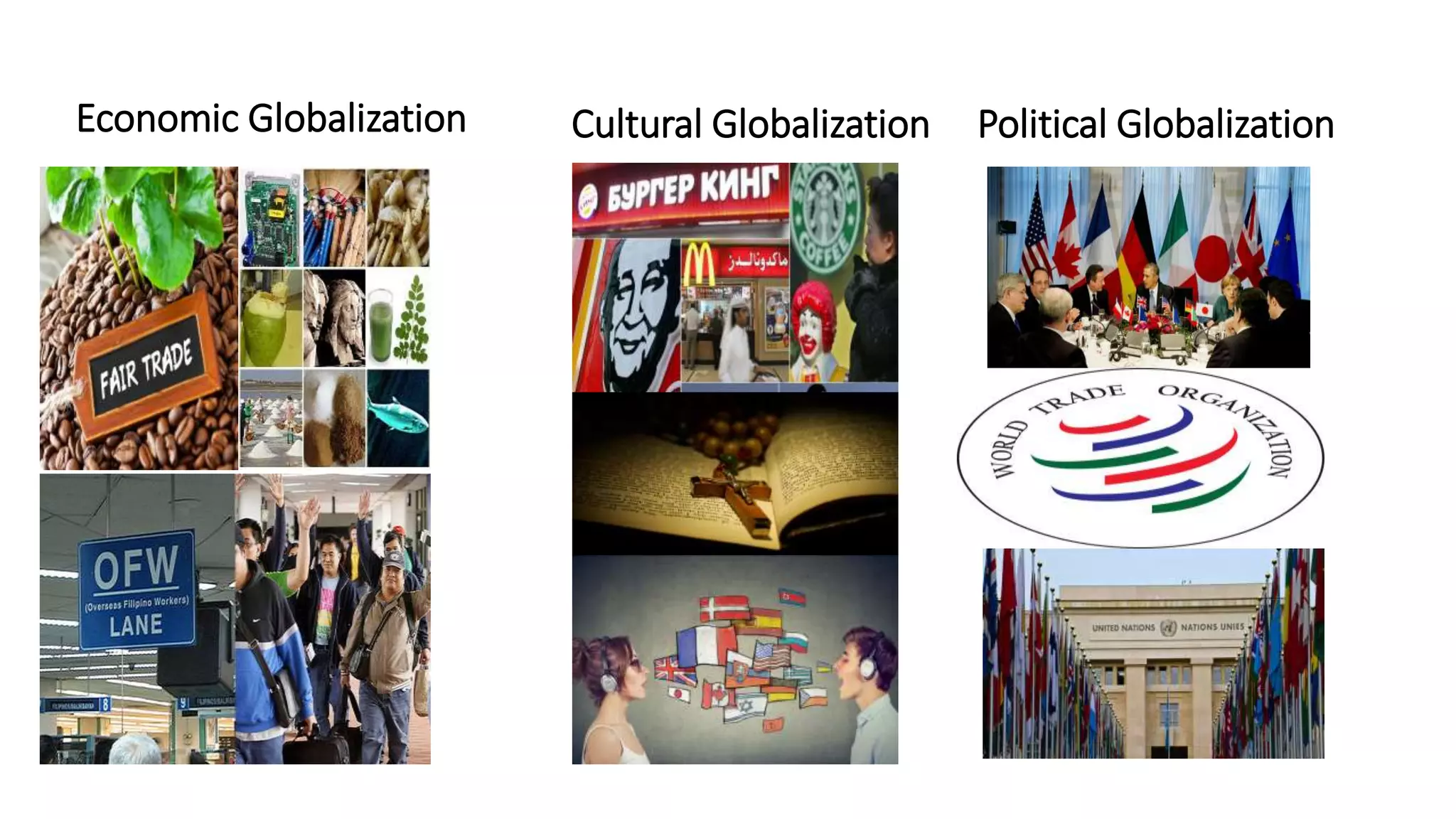
Economic Globalization Cultural Globalization Political Globalization
Pros of Globalization Cons of Globalization
Exploitation of Labor and Resources
Monopolization of multi-national companies
Advancement leads to unemployment
Environmental Degradation
Helps in the development of
underdeveloped or developing countries.
Enhanced Global Cooperation , relation
and Tolerance
(as people are exposed to new cultures
and network with others across the globe.)
Spread of Knowledge and Technology
Increase level of employment
Perspectives on Global Cultural Flows
Cultural differentialism Cultural hybridization Cultural convergence
-cultures are
essentially different
and are only
superficially affected
by global flows
-Integration of local and
global cultures -stresses homogeneity

Globalization.pptx

  • 1.
  • 2.
    - Discuss onglobalization, global economy(1ST WORLD) ,market integration (Global financial institution), global interstate system(UN, , legal basis of intl relations, SDGs - Relevant to history
  • 3.
    Concepts: • -widely consideredto have begun in 1945( end of WW II) up to present AXIS (Japan, Italy, Germany), ALLIED ( • - the WAR brought about dramatic changes to technological, political and social conditions(cold war, korean war, kasunduan) • Modern world 1501 to 1945 • Present world, current world(kasalukuyang mundo) • general overview of what is happening in present situation: PANGYAYARI SA MAKABAGONG PANAHON economic , language, social and political issues • So, Why it is important to talk about the contemporary world? • To be more conscious and to enhance our knowledge, understanding on what the relevant issues of the world and its effects to the people.
  • 4.
    Activity 1: Create anact that reflects the topic assigned to your group. Show how this is carried out or manifested in the present time. Min. 5 mins. , max. 10 minutes. 1. Politics in the present time- G 3 2. Economy in the present time- G4 3. Culture in the present- G1 4. Communication in the present time-G2
  • 5.
    How are youconnected with the world?
  • 6.
  • 7.
    Defining Globalization • Globalizationis a term used to describe the increasing connectedness and interdependence of world cultures and economies. • Describe how trade and technology have made the world into a more connected and interdependent place. • “process of world shrinkage, of distances getting shorter, things moving closer. -Thomas Larson • Onset of borderless world- Ohmae • Diffusion of practices,values and technology that have influence worldwide. • Changes in the temporal connections of people.- Scholte
  • 8.
    Metaphors of Globalization Solidity Liquidity -barriersthat prevent or make difficult the movement of things. -natural or man-made - modern man-made solid( nine- dash-line)- -increasing ease of movement of people, things, information , and places in the contemporary world.
  • 9.
    GlobalizationTheories -increasing sameness inthe world: culture, economy, and politics. -cultural imperialism -mcdonaldization -Celebration, technology, music, sports, language/literature, education & curriculum HETEROGENEITY -creation of various cultural practices, new economies, and political groups. -language, ethnicity,class Difficult to communicate, trust/ cooperate.
  • 10.
    Economic Globalization CulturalGlobalization Political Globalization
  • 11.
    Pros of GlobalizationCons of Globalization Exploitation of Labor and Resources Monopolization of multi-national companies Advancement leads to unemployment Environmental Degradation Helps in the development of underdeveloped or developing countries. Enhanced Global Cooperation , relation and Tolerance (as people are exposed to new cultures and network with others across the globe.) Spread of Knowledge and Technology Increase level of employment
  • 12.
    Perspectives on GlobalCultural Flows Cultural differentialism Cultural hybridization Cultural convergence -cultures are essentially different and are only superficially affected by global flows -Integration of local and global cultures -stresses homogeneity