GLOBALIZATION
I S I T G O O D O R B A D F O R
M A N K I N D ?
INTRO
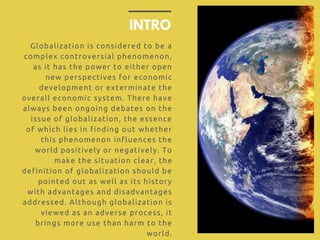
Globalization is considered to be a
complex controversial phenomenon,
as it has the power to either open
new perspectives for economic
development or exterminate the
overall economic system. There have
always been ongoing debates on the
issue of globalization, the essence
of which lies in finding out whether
this phenomenon influences the
world positively or negatively. To
make the situation clear, the
definition of globalization should be
pointed out as well as its history
with advantages and disadvantages
addressed. Although globalization is
viewed as an adverse process, it
brings more use than harm to the
world.
DEFINITION OF
GLOBALIZATION
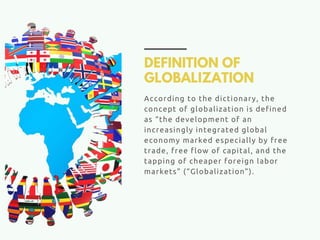
According to the dictionary, the
concept of globalization is defined
as “the development of an
increasingly integrated global
economy marked especially by free
trade, free flow of capital, and the
tapping of cheaper foreign labor
markets” (“Globalization”).
HISTORY OF GLOBALIZATION
Since ancient times, people have been in the pursuit of
new opportunities and territories for settling and
trading due to advances in the fields of transportation
and technologies (Kolb).
ECONOMIC ADVANTAGES OF
GLOBALIZATION
There is a possibility to exchange the goods internationally.
Free trade is targeted to decrease the barriers between the
countries such as “tariffs, value-added taxes, subsidies”
(Collins).
Free trade is considered to be a trigger of economic
development as it enhances job creation, competition, and
consumer satisfaction.
Globalization decreases the level of poverty and unemployment
by means of international investments and technological
support (Collins).
POLITICAL ADVANTAGES OF
GLOBALIZATION
Globalization reinforces democracy, excluding the colonialist
model.
Globalization unites the compartmentalized power sectors
transforming them into a world power. It results in the merging
of politics, influencing political decisions and their targets.
Globalization provides access to international and financial
support.
Globalization allows governments to borrow useful experience
from each other (Collins).
SOCIAL ADVANTAGES OF
GLOBALIZATION TIMELINE
Globalization unites people all over the world.
Globalization ensures a more profound comprehension of
foreign cultures, traditions, and values.
Globalization has promoted the development of people’s
openness and tolerance to each other.
ECONOMIC DISADVANTAGES OF
GLOBALIZATION
Globalization leads to a struggle for competition.
Globalization can result in economic collapse for a developing
country, making it poorer. (Many companies in developed
countries, Apple Inc. for example, use the cheap labor force of
developing countries, such as in China.)
Globalization can cause a global imbalance, as multinational
companies have more bargaining power than local ones (“9
Advantages and Disadvantages of Globalization”).
POLITICAL DISADVANTAGES OF
GLOBALIZATION
Globalization is considered to be similar to the processes of
industrialization and colonization, as it can provide one country
with more power than others (“9 Advantages and Disadvantages
of Globalization”).
As all the countries participate in the decision-making process,
it is more difficult to achieve proper cooperation and
coordination, being expensive and not always effective.
FINAL POINT
It is obvious that globalization has both negative and positive
aspects. On the one hand, it is a significant process which
produces considerable economic, political, and social effects on
humanity and the world. Nevertheless, there is also an opposing
side of this phenomenon, as the majority of its advantages have
side effects and can lead to negative consequences if
globalization is guided improperly.
In general, the world needs constant changes and improvements
which can be offered by globalization; that is why this process is
considered to play a crucial role for humanity, having more
advantages than disadvantages.

globalization-190220130634 (1).pdf.pptx

  • 1.
    GLOBALIZATION I S IT G O O D O R B A D F O R M A N K I N D ?
  • 2.
    INTRO Globalization is consideredto be a complex controversial phenomenon, as it has the power to either open new perspectives for economic development or exterminate the overall economic system. There have always been ongoing debates on the issue of globalization, the essence of which lies in finding out whether this phenomenon influences the world positively or negatively. To make the situation clear, the definition of globalization should be pointed out as well as its history with advantages and disadvantages addressed. Although globalization is viewed as an adverse process, it brings more use than harm to the world.
  • 3.
    DEFINITION OF GLOBALIZATION According tothe dictionary, the concept of globalization is defined as “the development of an increasingly integrated global economy marked especially by free trade, free flow of capital, and the tapping of cheaper foreign labor markets” (“Globalization”).
  • 4.
    HISTORY OF GLOBALIZATION Sinceancient times, people have been in the pursuit of new opportunities and territories for settling and trading due to advances in the fields of transportation and technologies (Kolb).
  • 5.
    ECONOMIC ADVANTAGES OF GLOBALIZATION Thereis a possibility to exchange the goods internationally. Free trade is targeted to decrease the barriers between the countries such as “tariffs, value-added taxes, subsidies” (Collins). Free trade is considered to be a trigger of economic development as it enhances job creation, competition, and consumer satisfaction. Globalization decreases the level of poverty and unemployment by means of international investments and technological support (Collins).
  • 6.
    POLITICAL ADVANTAGES OF GLOBALIZATION Globalizationreinforces democracy, excluding the colonialist model. Globalization unites the compartmentalized power sectors transforming them into a world power. It results in the merging of politics, influencing political decisions and their targets. Globalization provides access to international and financial support. Globalization allows governments to borrow useful experience from each other (Collins).
  • 7.
    SOCIAL ADVANTAGES OF GLOBALIZATIONTIMELINE Globalization unites people all over the world. Globalization ensures a more profound comprehension of foreign cultures, traditions, and values. Globalization has promoted the development of people’s openness and tolerance to each other.
  • 8.
    ECONOMIC DISADVANTAGES OF GLOBALIZATION Globalizationleads to a struggle for competition. Globalization can result in economic collapse for a developing country, making it poorer. (Many companies in developed countries, Apple Inc. for example, use the cheap labor force of developing countries, such as in China.) Globalization can cause a global imbalance, as multinational companies have more bargaining power than local ones (“9 Advantages and Disadvantages of Globalization”).
  • 9.
    POLITICAL DISADVANTAGES OF GLOBALIZATION Globalizationis considered to be similar to the processes of industrialization and colonization, as it can provide one country with more power than others (“9 Advantages and Disadvantages of Globalization”). As all the countries participate in the decision-making process, it is more difficult to achieve proper cooperation and coordination, being expensive and not always effective.
  • 10.
    FINAL POINT It isobvious that globalization has both negative and positive aspects. On the one hand, it is a significant process which produces considerable economic, political, and social effects on humanity and the world. Nevertheless, there is also an opposing side of this phenomenon, as the majority of its advantages have side effects and can lead to negative consequences if globalization is guided improperly. In general, the world needs constant changes and improvements which can be offered by globalization; that is why this process is considered to play a crucial role for humanity, having more advantages than disadvantages.