ISWA’s Task Force on Globalization &
Waste Management
Decision taken from September 2010
Four focus areas: megacities, informal sector, global
recycling markets & international aid tools
Members: Antonis Mavropoulos, David Wilson, Jeff
Cooper, Bjorn Appelqvist, Costas Velis, &
partnerships
1st phase completed in June 2012 – first report in
Florence
Outputs up to now
Contents


Understanding Globalization

Global Facts & Figures for Waste Management

Globalization Footprint to Waste Management

Conclusions
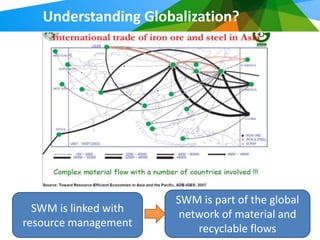
Understanding Globalization?


          


                       SWM is part of the global
  SWM is linked with    network of material and
resource management        recyclable flows
There are certain waste problems that can’t be
resolved locally e.g. e-waste management, waste
trafficking
Climate Change & Waste Management linkages
provide a global canvas to understand the global
impacts of local waste management
Urbanization, as a major global trend, is directly
linked with the globalization process – megacities are
the nodes of the globalization network
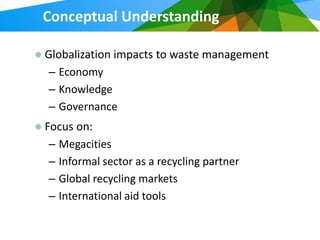
Conceptual Understanding

Globalization impacts to waste management
 – Economy
 – Knowledge
 – Governance
Focus on:
 – Megacities
 – Informal sector as a recycling partner
 – Global recycling markets
 – International aid tools
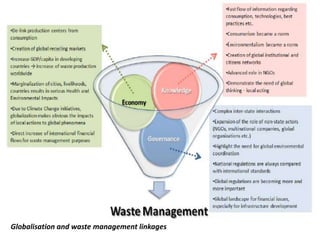
Globalisation and waste management linkages
Defining Globalization…
Globalisation as Internationalisation : the increase of
international exchange and the interdependence of countries.
Globalisation as liberation: the reduction of constraints that
are imposed by governments for transfers among countries.
Globalisation as universalization: the procedure of expanding
ideas and experiences for people in every corner of the world.
Globalization as modernization: the expansion of the social
structures of modernity (capitalist relations, industrial system,
etc.) all over the world, as well as the procedure of
destruction of special ways of production and the loss of local
identity.
Globalisation as “deterritorialization”: the release procedure
from the geographical space, as the social space can no longer
be entirely mapped with territorial terms.
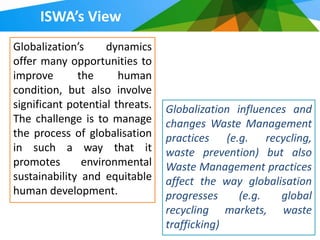
ISWA’s View
Globalization’s     dynamics
offer many opportunities to
improve       the      human
condition, but also involve
significant potential threats.   Globalization influences and
The challenge is to manage       changes Waste Management
the process of globalisation     practices (e.g. recycling,
in such a way that it            waste prevention) but also
promotes       environmental     Waste Management practices
sustainability and equitable     affect the way globalisation
human development.               progresses     (e.g.   global
                                 recycling markets, waste
                                 trafficking)
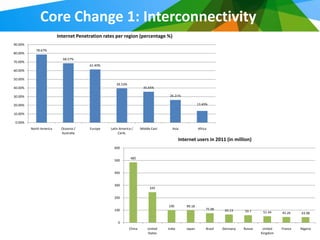
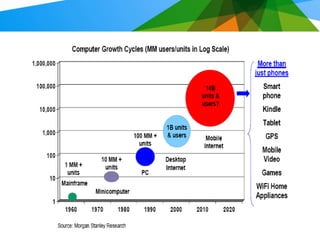
Core Change 1: Interconnectivity
                         Internet Penetration rates per region (percentage %)
90.00%
            78.67%
80.00%
                            68.57%
70.00%
                                       61.40%
60.00%

50.00%
                                                    39.53%
40.00%                                                                 35.65%

30.00%                                                                              26.21%

20.00%                                                                                                 13.49%

10.00%

 0.00%
         North America     Oceania /   Europe    Latin America /     Middle East      Asia             Africa
                           Australia                  Carib.
                                                                                           Internet users in 2011 (in million)
                                                   600

                                                              485
                                                   500


                                                   400


                                                   300
                                                                           245

                                                   200

                                                                                   100         99.18
                                                   100                                                      75.98     65.13    59.7      51.44    45.26    43.98

                                                     0
                                                             China       United    India       Japan        Brazil   Germany   Russia    United   France   Nigeria
                                                                         States                                                         Kingdom
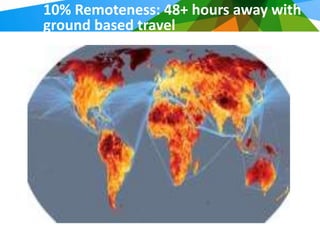
10% Remoteness: 48+ hours away with
ground based travel
Impacts to Governance


A key – intervention

Global stakeholders increase their influence

Local stakeholders are more open to global input

Megacities are deeply involved and influenced
by governance patterns
Impacts to Waste Management

Globalisation  increasingly difficult for states to
rely only on national regulation e.g. recycling &
zero waste
Growing demand for global regulation, e.g. waste
trafficking, raw materials
Globalisation involvement of a growing diversity
of participants and their coalitions in addressing
SWM
Direct increase of international financial flows
dedicated to SWM creates a new arena for
decision-making
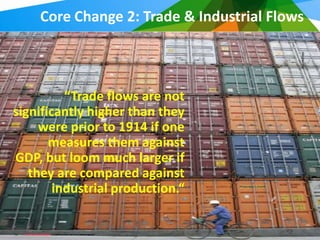
Core Change 2: Trade & Industrial Flows


          “Trade flows are not
significantly higher than they
     were prior to 1914 if one
       measures them against
GDP, but loom much larger if
   they are compared against
        industrial production.“
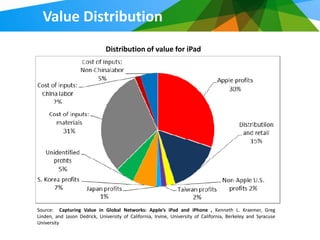
Value Distribution
                               Distribution of value for iPad


Source: Capturing Value in Global Networks: Apple’s iPad and iPhone , Kenneth L. Kraemer, Greg
Linden, and Jason Dedrick, University of California, Irvine, University of California, Berkeley and Syracuse
University
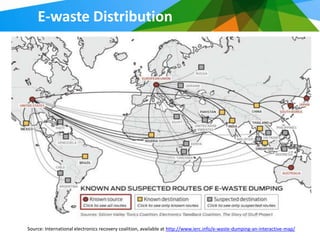
E-waste Distribution


Source: International electronics recovery coalition, available at http://www.ierc.info/e-waste-dumping-an-interactive-map/
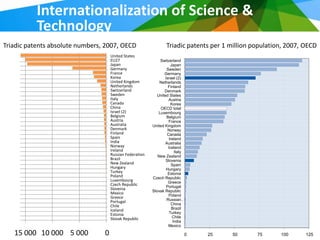
Internationalization of Science &
           Technology
Triadic patents absolute numbers, 2007, OECD                      Triadic patents per 1 million population, 2007, OECD
                                     United States
                                     EU27                     Switzerland
                                     Japan                           Japan
                                     Germany                      Sweden
                                     France                     Germany
                                     Korea                       Israel (2)
                                     United Kingdom           Netherlands
                                     Netherlands                   Finland
                                     Switzerland                 Denmark
                                     Sweden                 United States
                                     Italy                         Austria
                                     Canada                          Korea
                                     China                    OECD total
                                     Israel (2)              Luxembourg
                                     Belgium                      Belgium
                                     Austria                       France
                                     Australia            United Kingdom
                                     Denmark                       Norway
                                     Finland                      Canada
                                     Spain                          Ireland
                                     India                       Australia
                                     Norway                        Iceland
                                     Ireland                            Italy
                                     Russian Federation      New Zealand
                                     Brazil                      Slovenia
                                     New Zealand                      Spain
                                     Hungary                      Hungary
                                     Turkey                        Estonia
                                     Poland               Czech Republic
                                     Luxembourg                    Greece
                                     Czech Republic               Portugal
                                     Slovenia             Slovak Republic
                                     Mexico                        Poland
                                     Greece
                                                                  Russian…
                                     Portugal
                                     Chile                            China
                                     Iceland                          Brazil
                                     Estonia                        Turkey
                                     Slovak Republic                  Chile
                                                                       India
                                                                   Mexico

   15 000 10 000 5 000           0                                          0   25      50       75      100      125
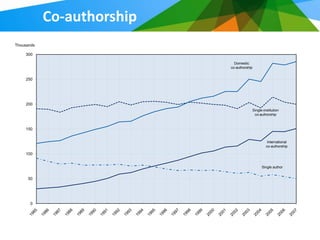
Co-authorship
Thousands

    300

                              Domestic
                            co-authorship


    250


    200
                                        Single-institution
                                         co-authorship


    150


                                                  International
                                                 co-authorship

    100


                                              Single author


     50


      0
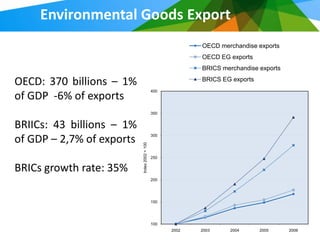
Environmental Goods Export
                                                           OECD merchandise exports
                                                           OECD EG exports
                                                           BRICS merchandise exports

OECD: 370 billions – 1%                                    BRICS EG exports
                                              400
of GDP -6% of exports
                                              350


BRIICs: 43 billions – 1%
of GDP – 2,7% of exports   Index 2002 = 100
                                              300


                                              250


BRICs growth rate: 35%
                                              200


                                              150


                                              100
                                                    2002   2003    2004       2005     2006
Global Facts Regarding SWM
Annual waste generation exceeds 4 billion tons / almost
half of them are municipal
The growth of population and GDP/cap will result in
increased waste generation


  Source: Veolia, Cyclope (2009) From waste to resource: an abstract of world waste survey 2009, Paris.
  [Available: http://www.uncrd.or.jp/env/spc/docs/plenary3/PS3-F-Veolia_Hierso-Print%20abstract.pdf]
Key – Figures

Around 70% of the municipal waste produced is driven to
landfills and dumpsites
Almost 11% of the global municipal waste is treated in
thermal and WtE units
19% is led to recycling and Mechanical and Biological
Treatment (MBT)
Climate change Initiatives are drivers for better waste
management
Waste Management industry is one of the most dynamic
ones on a global scale, with more than 350 billion Euros
turnover and around 40 million workers
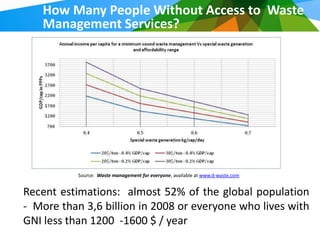
How Many People Without Access to Waste
   Management Services?


           Source: Waste management for everyone, available at www.d-waste.com


Recent estimations: almost 52% of the global population
- More than 3,6 billion in 2008 or everyone who lives with
GNI less than 1200 -1600 $ / year
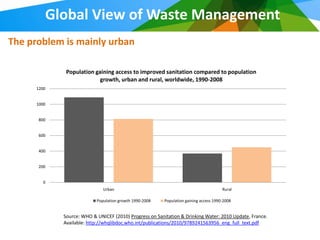
Global View of Waste Management
The problem is mainly urban

              Population gaining access to improved sanitation compared to population
                           growth, urban and rural, worldwide, 1990-2008
      1200


      1000


       800


       600


       400


       200


         0
                              Urban                                                    Rural

                           Population growth 1990-2008   Population gaining access 1990-2008


             Source: WHO & UNICEF (2010) Progress on Sanitation & Drinking Water: 2010 Update, France.
             Available: http://whqlibdoc.who.int/publications/2010/9789241563956_eng_full_text.pdf
Instead of Conclusions

Lack of relevant data and approaches

Major problem: data inconsistency – no
benchmarking available

Positive reception from several entities
and groups

The importance of governance

The importance of megacities

D-Waste Presentation: Globalization and Waste Management

  • 2.
    ISWA’s Task Forceon Globalization & Waste Management Decision taken from September 2010 Four focus areas: megacities, informal sector, global recycling markets & international aid tools Members: Antonis Mavropoulos, David Wilson, Jeff Cooper, Bjorn Appelqvist, Costas Velis, & partnerships 1st phase completed in June 2012 – first report in Florence Outputs up to now
  • 3.
    Contents Understanding Globalization Global Facts& Figures for Waste Management Globalization Footprint to Waste Management Conclusions
  • 4.
    Understanding Globalization?  SWM is part of the global SWM is linked with network of material and resource management recyclable flows
  • 5.
    There are certainwaste problems that can’t be resolved locally e.g. e-waste management, waste trafficking Climate Change & Waste Management linkages provide a global canvas to understand the global impacts of local waste management Urbanization, as a major global trend, is directly linked with the globalization process – megacities are the nodes of the globalization network
  • 6.
    Conceptual Understanding Globalization impactsto waste management – Economy – Knowledge – Governance Focus on: – Megacities – Informal sector as a recycling partner – Global recycling markets – International aid tools
  • 7.
    Globalisation and wastemanagement linkages
  • 8.
    Defining Globalization… Globalisation asInternationalisation : the increase of international exchange and the interdependence of countries. Globalisation as liberation: the reduction of constraints that are imposed by governments for transfers among countries. Globalisation as universalization: the procedure of expanding ideas and experiences for people in every corner of the world. Globalization as modernization: the expansion of the social structures of modernity (capitalist relations, industrial system, etc.) all over the world, as well as the procedure of destruction of special ways of production and the loss of local identity. Globalisation as “deterritorialization”: the release procedure from the geographical space, as the social space can no longer be entirely mapped with territorial terms.
  • 9.
    ISWA’s View Globalization’s dynamics offer many opportunities to improve the human condition, but also involve significant potential threats. Globalization influences and The challenge is to manage changes Waste Management the process of globalisation practices (e.g. recycling, in such a way that it waste prevention) but also promotes environmental Waste Management practices sustainability and equitable affect the way globalisation human development. progresses (e.g. global recycling markets, waste trafficking)
  • 10.
    Core Change 1:Interconnectivity Internet Penetration rates per region (percentage %) 90.00% 78.67% 80.00% 68.57% 70.00% 61.40% 60.00% 50.00% 39.53% 40.00% 35.65% 30.00% 26.21% 20.00% 13.49% 10.00% 0.00% North America Oceania / Europe Latin America / Middle East Asia Africa Australia Carib. Internet users in 2011 (in million) 600 485 500 400 300 245 200 100 99.18 100 75.98 65.13 59.7 51.44 45.26 43.98 0 China United India Japan Brazil Germany Russia United France Nigeria States Kingdom
  • 12.
    10% Remoteness: 48+hours away with ground based travel
  • 13.
    Impacts to Governance Akey – intervention Global stakeholders increase their influence Local stakeholders are more open to global input Megacities are deeply involved and influenced by governance patterns
  • 14.
    Impacts to WasteManagement Globalisation  increasingly difficult for states to rely only on national regulation e.g. recycling & zero waste Growing demand for global regulation, e.g. waste trafficking, raw materials Globalisation involvement of a growing diversity of participants and their coalitions in addressing SWM Direct increase of international financial flows dedicated to SWM creates a new arena for decision-making
  • 15.
    Core Change 2:Trade & Industrial Flows “Trade flows are not significantly higher than they were prior to 1914 if one measures them against GDP, but loom much larger if they are compared against industrial production.“
  • 16.
    Value Distribution Distribution of value for iPad Source: Capturing Value in Global Networks: Apple’s iPad and iPhone , Kenneth L. Kraemer, Greg Linden, and Jason Dedrick, University of California, Irvine, University of California, Berkeley and Syracuse University
  • 17.
    E-waste Distribution Source: Internationalelectronics recovery coalition, available at http://www.ierc.info/e-waste-dumping-an-interactive-map/
  • 18.
    Internationalization of Science& Technology Triadic patents absolute numbers, 2007, OECD Triadic patents per 1 million population, 2007, OECD United States EU27 Switzerland Japan Japan Germany Sweden France Germany Korea Israel (2) United Kingdom Netherlands Netherlands Finland Switzerland Denmark Sweden United States Italy Austria Canada Korea China OECD total Israel (2) Luxembourg Belgium Belgium Austria France Australia United Kingdom Denmark Norway Finland Canada Spain Ireland India Australia Norway Iceland Ireland Italy Russian Federation New Zealand Brazil Slovenia New Zealand Spain Hungary Hungary Turkey Estonia Poland Czech Republic Luxembourg Greece Czech Republic Portugal Slovenia Slovak Republic Mexico Poland Greece Russian… Portugal Chile China Iceland Brazil Estonia Turkey Slovak Republic Chile India Mexico 15 000 10 000 5 000 0 0 25 50 75 100 125
  • 19.
    Co-authorship Thousands 300 Domestic co-authorship 250 200 Single-institution co-authorship 150 International co-authorship 100 Single author 50 0
  • 20.
    Environmental Goods Export OECD merchandise exports OECD EG exports BRICS merchandise exports OECD: 370 billions – 1% BRICS EG exports 400 of GDP -6% of exports 350 BRIICs: 43 billions – 1% of GDP – 2,7% of exports Index 2002 = 100 300 250 BRICs growth rate: 35% 200 150 100 2002 2003 2004 2005 2006
  • 21.
    Global Facts RegardingSWM Annual waste generation exceeds 4 billion tons / almost half of them are municipal The growth of population and GDP/cap will result in increased waste generation Source: Veolia, Cyclope (2009) From waste to resource: an abstract of world waste survey 2009, Paris. [Available: http://www.uncrd.or.jp/env/spc/docs/plenary3/PS3-F-Veolia_Hierso-Print%20abstract.pdf]
  • 22.
    Key – Figures Around70% of the municipal waste produced is driven to landfills and dumpsites Almost 11% of the global municipal waste is treated in thermal and WtE units 19% is led to recycling and Mechanical and Biological Treatment (MBT) Climate change Initiatives are drivers for better waste management Waste Management industry is one of the most dynamic ones on a global scale, with more than 350 billion Euros turnover and around 40 million workers
  • 23.
    How Many PeopleWithout Access to Waste Management Services? Source: Waste management for everyone, available at www.d-waste.com Recent estimations: almost 52% of the global population - More than 3,6 billion in 2008 or everyone who lives with GNI less than 1200 -1600 $ / year
  • 24.
    Global View ofWaste Management The problem is mainly urban Population gaining access to improved sanitation compared to population growth, urban and rural, worldwide, 1990-2008 1200 1000 800 600 400 200 0 Urban Rural Population growth 1990-2008 Population gaining access 1990-2008 Source: WHO & UNICEF (2010) Progress on Sanitation & Drinking Water: 2010 Update, France. Available: http://whqlibdoc.who.int/publications/2010/9789241563956_eng_full_text.pdf
  • 25.
    Instead of Conclusions Lackof relevant data and approaches Major problem: data inconsistency – no benchmarking available Positive reception from several entities and groups The importance of governance The importance of megacities