GLOBAL MARKETING MANAGEMENT
DR. ZILLUR RAHMAN
PROFESSOR
DEPARTMENT OF MANAGEMENT STUDIES, IIT ROORKEE
1
MODULE - 53
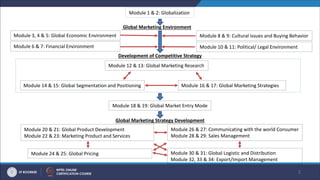
Module 18 & 19: Global Market Entry Mode
Global Marketing Environment
Module 10 & 11: Political/ Legal Environment
Module 3, 4 & 5: Global Economic Environment
Module 6 & 7: Financial Environment
Development of Competitive Strategy
Module 8 & 9: Cultural issues and Buying Behavior
Module 12 & 13: Global Marketing Research
Module 14 & 15: Global Segmentation and Positioning Module 16 & 17: Global Marketing Strategies
Module 1 & 2: Globalization
2
Global Marketing Strategy Development
Module 20 & 21: Global Product Development
Module 22 & 23: Marketing Product and Services
Module 26 & 27: Communicating with the world Consumer
Module 28 & 29: Sales Management
Module 24 & 25: Global Pricing Module 30 & 31: Global Logistic and Distribution
Module 32, 33 & 34: Export/Import Management
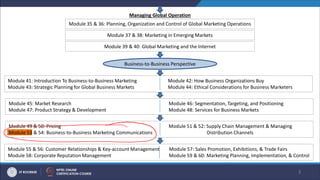
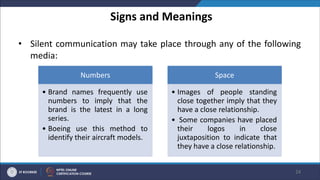
Managing Global Operation
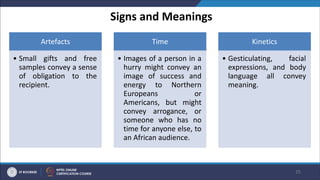
Module 35 & 36: Planning, Organization and Control of Global Marketing Operations
Module 37 & 38: Marketing in Emerging Markets
Module 39 & 40: Global Marketing and the Internet
3
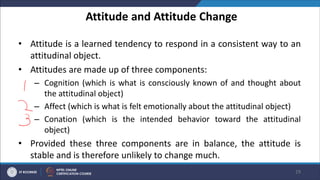
Business-to-Business Perspective
Module 41: Introduction To Business-to-Business Marketing Module 42: How Business Organizations Buy
Module 43: Strategic Planning for Global Business Markets Module 44: Ethical Considerations for Business Marketers
Module 45: Market Research Module 46: Segmentation, Targeting, and Positioning
Module 47: Product Strategy & Development Module 48: Services for Business Markets
Module 49 & 50: Pricing Module 51 & 52: Supply Chain Management & Managing
Module 53 & 54: Business-to-Business Marketing Communications Distribution Channels
Module 55 & 56: Customer Relationships & Key-account Management Module 57: Sales Promotion, Exhibitions, & Trade Fairs
Module 58: Corporate Reputation Management Module 59 & 60: Marketing Planning, Implementation, & Control
Business-to-Business Marketing Communications
MODULE - 53
4
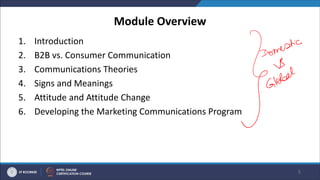
Module Overview
1. Introduction
2. B2B vs. Consumer Communication
3. Communications Theories
4. Signs and Meanings
5. Attitude and Attitude Change
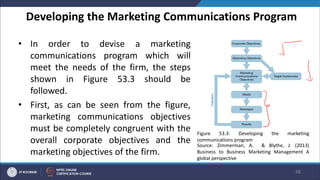
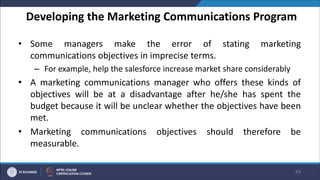
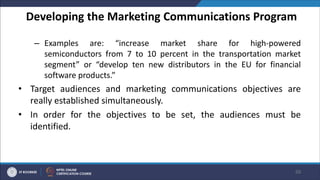
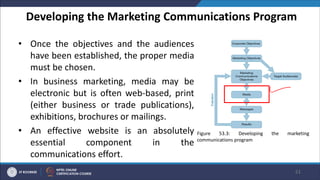
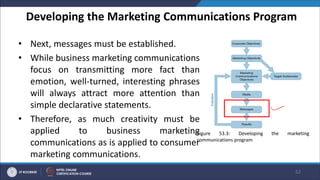
6. Developing the Marketing Communications Program
5
Introduction
• This module is about ways of communicating in business-to-
business markets.
• The major difference between business to business and consumer
marketing communications is the lack of mass media for businesses.
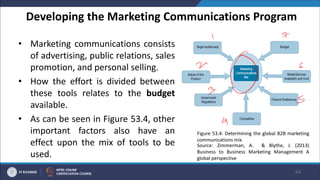
• Consumer marketing communications are heavily dominated by
Internet, television, radio, and press advertising, but business-to-
business advertising is less likely to use these media due to the
much smaller number of buyers involved.
6
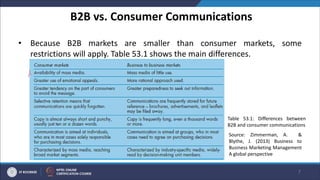
B2B vs. Consumer Communications
• Because B2B markets are smaller than consumer markets, some
restrictions will apply. Table 53.1 shows the main differences.
7
Table 53.1: Differences between
B2B and consumer communications
Source: Zimmerman, A. &
Blythe, J. (2013) Business to
Business Marketing Management
A global perspective
B2B vs. Consumer Communications
• Of course, B2B and consumer advertising also have a great deal in
common.
• Advertising aims to reach people with its message and change its
target market in some way – changing attitudes or behavior,
increasing the level of knowledge, or whatever the advertiser hopes
to achieve.
• Ultimately advertisers hope to change behavior, because they hope
to influence the audience to buy the products on offer.
• Other marketing communications are intended to have a similar
effect.
8
B2B vs. Consumer Communications
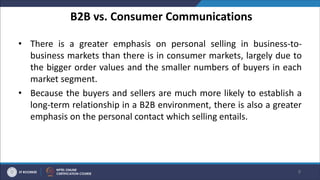
• There is a greater emphasis on personal selling in business-to-
business markets than there is in consumer markets, largely due to
the bigger order values and the smaller numbers of buyers in each
market segment.
• Because the buyers and sellers are much more likely to establish a
long-term relationship in a B2B environment, there is also a greater
emphasis on the personal contact which selling entails.
9
Communications Theories
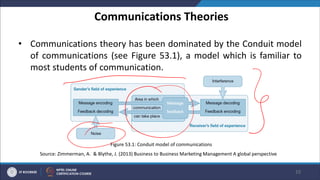
• Communications theory has been dominated by the Conduit model
of communications (see Figure 53.1), a model which is familiar to
most students of communication.
10
Figure 53.1: Conduit model of communications
Source: Zimmerman, A. & Blythe, J. (2013) Business to Business Marketing Management A global perspective
Communications Theories
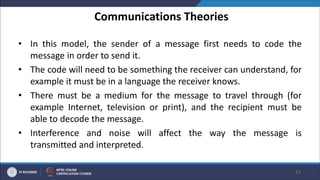
• In this model, the sender of a message first needs to code the
message in order to send it.
• The code will need to be something the receiver can understand, for
example it must be in a language the receiver knows.
• There must be a medium for the message to travel through (for
example Internet, television or print), and the recipient must be
able to decode the message.
• Interference and noise will affect the way the message is
transmitted and interpreted.
11
Communications Theories
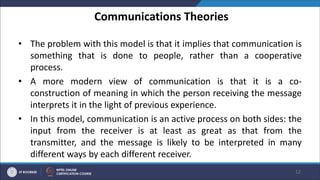
• The problem with this model is that it implies that communication is
something that is done to people, rather than a cooperative
process.
• A more modern view of communication is that it is a co-
construction of meaning in which the person receiving the message
interprets it in the light of previous experience.
• In this model, communication is an active process on both sides: the
input from the receiver is at least as great as that from the
transmitter, and the message is likely to be interpreted in many
different ways by each different receiver.
12
Communications Theories
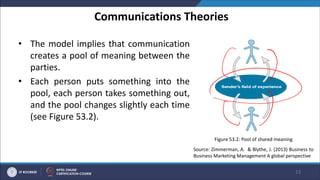
• The model implies that communication
creates a pool of meaning between the
parties.
• Each person puts something into the
pool, each person takes something out,
and the pool changes slightly each time
(see Figure 53.2).
13
Figure 53.2: Pool of shared meaning
Source: Zimmerman, A. & Blythe, J. (2013) Business to
Business Marketing Management A global perspective
Communications Theories
• To stretch the analogy further, when either party puts something
into the pool the new input mixes with everything that is already in
the pool.
• What the other party draws from the pool therefore includes some
of what already existed.
• Provided the new material is not wildly at odds with what is already
in the pool, the shared meaning will remain close: if the new
material is very different from that which already exists between the
parties, the person who put the material in may have to add a lot
more before the meaning becomes clear.
14
Communications Theories
• This model of communications is particularly relevant to personal
selling.
• The personal selling function is, by its nature, a dialogue in which
the seller may control the process, but the bulk of the
communication comes from the buyer.
• Salespeople who lose sight of this end up doing most of the talking
and lose the sale.
• The model also explains another phenomenon in communication,
which is that some communications are actively sought out by
customers, whereas others are not.
15
Communications Theories
• Unsought communications are those which the seller sends out in
the optimistic hope that a buyer will respond: unsought mass e-
mailings, display advertising, TV advertising, billboards, etc.
• Sought communications are those which a buyer specifically looks
for: classified advertising, exhibitions, brochures, and even sales
pitches.
16
It is important to distinguish between the two, since the approach needs to
be very different: an unsought communication needs to be persuasive and
attention-grabbing, whereas sought communication should be informative
and factual, because the buyer is already persuaded to a large extent.
Communications Theories
• Considered in terms of the decision-making process (See module
42), buyers who are at the need identification stage may be
approached using unsought communication.
• A business publication advertisement, suitably placed, may make
companies realize that they have a problem which had not
previously been identified.
– For example, in the wake of the September 11 attacks on New York,
British Airways ran a highly successful campaign on UK television
aimed at encouraging business travellers back onto BA North Atlantic
services.
17
Communications Theories
– The advertisements contrasted one company pitching for business by
sending a beautifully-produced glossy brochure to its New York
customer, with another company whose executive arrives in person.
– The executive making the personal visit is quickly on first-name terms
with the customer, and is greeted as a friend: the brochure is left on
the table.
– The executives who sent the brochure, meanwhile, are congratulating
themselves because, in the course of a telephone call, the New York
customer said that he “liked the spreadsheets.”
• This advertisement was unusual in several respects.
18
Communications Theories
– First, it appeared on television, which is rare for B2B advertising.
– Second, it was aimed at a general problem for any business, which is
the failure to attach enough importance to personal contacts.
– Third, the product itself is generic – airplane rides across the Atlantic
are provided by a very large number of airlines, any of whom might
benefit from BA’s advertising, since all it did was flag up the problem.
• Later BA advertising became much more brand-specific, delineating
the advantages of using BA rather than its rivals.
19
Communications Theories
• Buyers who are at the information search stage may use display
advertising because they will be sensitized to look out for it, but will
rapidly move toward seeking out communications such as websites,
brochures or sales presentations in order to obtain hard facts on
which to base decisions.
• At this point an emotive sales pitch is likely to be of a lot less
interest than a factual presentation.
20
Signs and Meanings
• A sign is anything that stands for something (its object) to
somebody (its interpreter) in some respect (its context).
• Signs fall into three categories:
– icon, index, and symbol.
• An icon is a sign that looks like the object, or represents it visually in
a way that most people would relate to.
– For example, an agricultural machinery manufacturer might use a
stylized picture of a tractor as a symbol, or might use a picture of a
head of wheat.
21
Signs and Meanings
• An index is a sign that relates to the object by a causal connection.
– A man dressed in a white lab coat wearing a stethoscope represents
healthcare. Most people are familiar with the image of a doctor.
• A symbol is an artificial sign which has been created for the purpose
of conveying meaning.
– The intertwined arrows used to indicate recycled or recyclable materials
are familiar to most people: they convey an impression of greenness or
environmental friendliness.
• Likewise many global companies use symbols to identify their brands.
– For example, the Golden Arches of McDonald’s is familiar worldwide.
22
Signs and Meanings
• In fact, communication is carried out in many other ways than
simply the words themselves.
• Only around 30 percent of communication uses words.
• In other words, companies communicate by using pictures, non-
verbal sounds (e.g. the Intel four-note jingle), smell, touch,
numbers, artefacts, time, and kinetics.
• Sales people know the value of body language and non-verbal
communication: facial expressions and gesture are widely used to
create meaning in advertising.
23
Signs and Meanings
• Silent communication may take place through any of the following
media:
24
Numbers
• Brand names frequently use
numbers to imply that the
brand is the latest in a long
series.
• Boeing use this method to
identify their aircraft models.
Space
• Images of people standing
close together imply that they
have a close relationship.
• Some companies have placed
their logos in close
juxtaposition to indicate that
they have a close relationship.
Signs and Meanings
25
Artefacts
• Small gifts and free
samples convey a sense
of obligation to the
recipient.
Time
• Images of a person in a
hurry might convey an
image of success and
energy to Northern
Europeans or
Americans, but might
convey arrogance, or
someone who has no
time for anyone else, to
an African audience.
Kinetics
• Gesticulating, facial
expressions, and body
language all convey
meaning.
Signs and Meanings
• Meaning is conveyed not just by words, but by the way the words
are used, and by the peripheral cues that surround them.
• Much human communication is made for effect, rather than as a
literal statement: people become adept at reading between the
lines.
• The main problem with silent languages is that they are not
culturally universal.
• Body language and gesture does not transfer well to other cultures,
even when the cultures are relatively close.
26
Signs and Meanings
– Some well-known examples are the circle of forefinger and thumb
which means “OK” in the US but is a rude gesture in Brazil; and
showing the soles of the feet in Thailand.
– More subtly, Japanese people tend to show their emotions less in
public than do Americans, Indians tend to regard shabby clothes as
denoting poverty whereas Northern Europeans associate this with
freedom and independence, and numbers which are considered lucky
in some cultures are considered unlucky in others.
• Unfortunately, these cultural differences often go unrecognized
because people tend to regard body language as universal.
27
Signs and Meanings
• While a foreigner might easily be forgiven for an error in speaking
the language (in fact such errors might even be seen as charming),
the same courtesy does not usually extend to errors of body
language or behavior.
• The problem of misunderstanding arises because of ethnocentrism,
which is the belief that one’s own culture is the “right” one and
everyone else’s is a poor copy. Ethnocentrism is one of the few
features of human behavior that belongs to all cultures.
• In practice, marketing communications can be applied worldwide
only with great care.
28
Attitude and Attitude Change
• Attitude is a learned tendency to respond in a consistent way to an
attitudinal object.
• Attitudes are made up of three components:
– Cognition (which is what is consciously known of and thought about
the attitudinal object)
– Affect (which is what is felt emotionally about the attitudinal object)
– Conation (which is the intended behavior toward the attitudinal
object)
• Provided these three components are in balance, the attitude is
stable and is therefore unlikely to change much.
29
Attitude and Attitude Change
– For example, a buyer might say, “I like Godrej. They are nice people to
deal with, the products are always up to specification, and I think we’ll
probably always buy from them rather than from anyone else.”
• The first part of this statement is affective (I like them, they are nice
people), the second part is cognitive (the products are always up to
specification), and the third part is conative (we’ll probably always
buy from them).
• Note that conation is only intended behavior – other factors may
intervene to prevent the behavior being carried out.
30
Attitude and Attitude Change
• Because attitudes tend to be stable, the first essential for attitude
change is to destabilize the attitude.
• This means changing one or more elements of the attitude.
• The cognitive element of attitude comes about because the
individual develops salient beliefs about the company and its
products.
• Salient beliefs are those which are the most important to the buyer,
and which relate to the products concerned.
31
Attitude and Attitude Change
– For example, a buyer may believe that a company is 100 percent
reliable on its delivery times, and because this is important to the
buyer it will be a salient belief.
• The buyer may also believe that the same company provides very
good working conditions for its staff, but may not care about this
particularly and therefore the belief is not salient.
• If the company subsequently becomes unreliable, the salient belief
will change and thus the attitude will change: if the company
behaves badly toward its staff, this will not affect the buyer’s
attitude.
32
Attitude and Attitude Change
• There are three ways to change attitudes, as follows:
33
Add a new salient belief
• For example, the BA advertisement mentioned earlier tried to add the belief that
a personal contact is worth far more than even the glossiest brochure.
Change the strength of a salient belief
• If the belief is a negative one, it can be discounted or played down.
• If it is a positive one, it can be given greater importance.
• For example, a buyer may believe that a firm is reliable, and this may be
important, but a set of statistics showing that the firm is 99.7 percent reliable
will strengthen the belief by providing factual evidence.
Attitude and Attitude Change
34
Change the evaluation of an existing belief
• The importance of an existing belief can be strengthened.
• Using the reliability example, a buyer may accept that the firm is reliable, but
has not realized that this in turn means that the buying firm’s production has
never been halted due to a failure on the part of the supplier – unlike other
suppliers whose unreliability has resulted in large losses of production.
• This type of argument moves reliability much higher in the buyer’s perception.
Attitude and Attitude Change
• Changing a salient belief is not always about factual presentations
aimed at cognition.
• Changes in salience can also come about through emotive appeals.
– For example, in the BA advertisement mentioned earlier, the executive
who travelled to New York appeared smart, confident, young,
organized, and generally admirable. The group who did not travel were
huddled round a table in a poorly-lit room and appeared disorganized,
unattractively-dressed, overweight, and lacking in confidence.
• This was clearly intended as an emotional appeal, implying that all
the sensible people use British Airways.
35
Attitude and Attitude Change
• This type of association would help in some ways to overcome the
problem of promoting travel generally rather than the BA brand
(there is more on modeling later in the next module).
• Obviously new information does not always change attitudes.
• As the inconsistency between the existing attitude and evidence
brought about by reality increases, there will come a point where
the individual buyer needs to re-evaluate the attitude and go
through some kind of mental readjustment to restore stability.
36
Attitude and Attitude Change
• This can come about through three main mechanisms:
1. Stimulus rejection
– The individual discounts the new information or rejects it
entirely.
– This can easily come about if the new information is presented
by an incompetent sales person who manages to come across as
unreliable.
37
Attitude and Attitude Change
2. Attitude splitting
– This involves only accepting that part of the new information
which does not cause an inconsistency.
– The individual might accept that the new information is true, but
that the firm’s own circumstances are exceptional.
3. Accommodating the new attitude
– Essentially this means accepting the new attitude in its entirety.
38
Attitude and Attitude Change
• The three elements of attitude are so closely linked that a change in
one is likely to lead to a change in both the others.
• Attitudes can basically be changed via two routes.
• The first route (the central route) involves an appeal to the rational,
cognitive element of attitude. This generally will be more prevalent
in business marketing than in consumer marketing (see Module 42).
• The second route is the peripheral route, which involves an appeal
to the affective element, usually by associating the brand with
another attitudinal object.
39
Attitude and Attitude Change
– For example, B2B marketers often refer to their products as the Rolls
Royce of the product category, in order to tap into buyers’ perceptions
of the quality and reliability of Rolls Royce.
– In the BA example, the peripheral route is used by associating the
brand with the smart-looking individual who is using it.
– No-one would believe that flying with BA will make someone more
confident, better dressed, and thirty pounds lighter, but the emotional
association is clearly drawn.
• Because of the interdependence of the elements of attitude, the
peripheral route is effective in changing attitudes.
40
Attitude and Attitude Change
• Obviously new information may conflict with the information the
buyer already holds.
• Cognitive dissonance theory states that if an individual holds two
conflicting cognitions, he or she will experience discomfort and will
try to resolve the dissonance either by changing one or other of the
views, or by introducing a third viewpoint which will reconcile the
differences.
• The most interesting aspect of dissonance theory is that attitudes
can apparently be changed more easily by offering low rewards
than by offering high ones.
41
Attitude and Attitude Change
– For instance, in an experiment, researchers induced students to lie to
each other by telling them it was part of a psychological experiment,
and offering them payment varying from $1 to $20.
– The students who were offered the lower amount actually began to
believe the lie, whereas those offered the higher amount tended not
to.
– The higher-paid students were able to justify lying on the basis that
they were receiving a substantial reward (at then prevelant prices).
The lesser-paid students had no such external justification, and
therefore had to resolve the dissonance by believing the lie
themselves.
42
Attitude and Attitude Change
• The reason for the power of cognitive dissonance is that the arousal
of dissonance always contains personal involvement.
• Therefore, the reduction of dissonance always involves some form
of self-justification.
• Self-justification is necessary because the individual usually feels
that the dissonance has arisen as a result of an action or thought
which is immoral or stupid or both.
• In the marketing context, cognitive dissonance may reveal itself as
post-purchase dissonance.
43
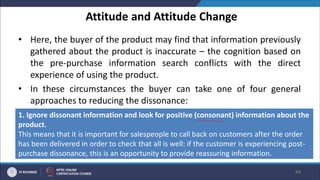
Attitude and Attitude Change
• Here, the buyer of the product may find that information previously
gathered about the product is inaccurate – the cognition based on
the pre-purchase information search conflicts with the direct
experience of using the product.
• In these circumstances the buyer can take one of four general
approaches to reducing the dissonance:
44
1. Ignore dissonant information and look for positive (consonant) information about the
product.
This means that it is important for salespeople to call back on customers after the order
has been delivered in order to check that all is well: if the customer is experiencing post-
purchase dissonance, this is an opportunity to provide reassuring information.
Attitude and Attitude Change
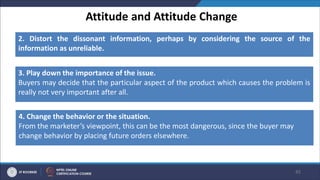
45
2. Distort the dissonant information, perhaps by considering the source of the
information as unreliable.
3. Play down the importance of the issue.
Buyers may decide that the particular aspect of the product which causes the problem is
really not very important after all.
4. Change the behavior or the situation.
From the marketer’s viewpoint, this can be the most dangerous, since the buyer may
change behavior by placing future orders elsewhere.
Attitude and Attitude Change
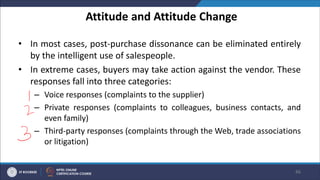
• In most cases, post-purchase dissonance can be eliminated entirely
by the intelligent use of salespeople.
• In extreme cases, buyers may take action against the vendor. These
responses fall into three categories:
– Voice responses (complaints to the supplier)
– Private responses (complaints to colleagues, business contacts, and
even family)
– Third-party responses (complaints through the Web, trade associations
or litigation)
46
Attitude and Attitude Change
• Of the three, private responses are likely to be the most damaging,
because these damage corporate reputation without the supplier
having the opportunity to put their side of the case.
• The least damaging is a voiced response, so it may be advisable for
companies to encourage customers to complain if anything is even
remotely wrong with the products (see Module 42).
47
Developing the Marketing Communications Program
• In order to devise a marketing
communications program which will
meet the needs of the firm, the steps
shown in Figure 53.3 should be
followed.
• First, as can be seen from the figure,
marketing communications objectives
must be completely congruent with the
overall corporate objectives and the
marketing objectives of the firm.
48
Figure 53.3: Developing the marketing
communications program
Source: Zimmerman, A. & Blythe, J. (2013)
Business to Business Marketing Management A
global perspective
Developing the Marketing Communications Program
• Some managers make the error of stating marketing
communications objectives in imprecise terms.
– For example, help the salesforce increase market share considerably
• A marketing communications manager who offers these kinds of
objectives will be at a disadvantage after he/she has spent the
budget because it will be unclear whether the objectives have been
met.
• Marketing communications objectives should therefore be
measurable.
49
Developing the Marketing Communications Program
– Examples are: “increase market share for high-powered
semiconductors from 7 to 10 percent in the transportation market
segment” or “develop ten new distributors in the EU for financial
software products.”
• Target audiences and marketing communications objectives are
really established simultaneously.
• In order for the objectives to be set, the audiences must be
identified.
50
Developing the Marketing Communications Program
• Once the objectives and the audiences
have been established, the proper media
must be chosen.
• In business marketing, media may be
electronic but is often web-based, print
(either business or trade publications),
exhibitions, brochures or mailings.
• An effective website is an absolutely
essential component in the
communications effort.
51
Figure 53.3: Developing the marketing
communications program
Developing the Marketing Communications Program
• Next, messages must be established.
• While business marketing communications
focus on transmitting more fact than
emotion, well-turned, interesting phrases
will always attract more attention than
simple declarative statements.
• Therefore, as much creativity must be
applied to business marketing
communications as is applied to consumer
marketing communications.
52
Figure 53.3: Developing the marketing
communications program
Developing the Marketing Communications Program
• Once the messages have been established and placements made,
results must be measured.
• If the objectives have been set as has been described above, the
manager will be able to compare the results with the objectives,
evaluate any shortfalls and change the objectives, audiences, media
or messages in order to improve results.
• Approaching business marketing communications in this way makes
the effort an investment rather than simply an expense.
53
Developing the Marketing Communications Program
• Marketing communications consists
of advertising, public relations, sales
promotion, and personal selling.
• How the effort is divided between
these tools relates to the budget
available.
• As can be seen in Figure 53.4, other
important factors also have an
effect upon the mix of tools to be
used.
54
Figure 53.4: Determining the global B2B marketing
communications mix
Source: Zimmerman, A. & Blythe, J. (2013)
Business to Business Marketing Management A
global perspective
Developing the Marketing Communications Program
• An important area is media and/or services availability and cost.
• While a firm might feel comfortable placing ads in a trade
publication in large markets such as the United States or Brazil, it
may find that no such publication exists in a particular foreign
market.
– For instance, while there may be a publication focusing on hospital
waste disposal in the large markets, it might not be possible to find
such a publication in Swedish or Danish.
• Also to be considered are services availability and cost.
55
Developing the Marketing Communications Program
– For example, a firm might be comfortable with rapid public relations
help or the ability to hire a firm to make videos. In Nigeria, firms like
this might be far less available.
• The cost of these media or services may also be prohibitive where
there is little competition in smaller markets.
• A key factor determining the marketing communications mix is
channel preferences.
• Distributors and agents often have strong opinions about how
communications should be conducted.
56
Developing the Marketing Communications Program
• In some cases, these individuals wish to review and rewrite
advertising messages.
• While they often have technical knowledge, many are not capable
of clear communications using the written word.
• Nevertheless, a prudent manager will take into account the
opinions of agents and distributors in local markets.

• Another determining factor is competition. Should a major
competitor advertise heavily in a particular journal or establish a
presence at a particular trade exposition, a marketing manager may
be forced to match that competitor.
57
Developing the Marketing Communications Program
• Government regulations have some effect upon communications,
although they are more prevalent in the consumer area.
• In some countries, direct comparisons between products are not
permitted and some kinds of promotion are not allowed (for
example, up until 2007 retailers were not allowed to advertise on
French TV, and there are severe restrictions on advertising financial
products such as hedge funds in the United States).
• The marketing manager must be acutely aware of these regulations
so that he/she would not violate one of them.
58
Developing the Marketing Communications Program
• The next influence is the nature of the product itself.
• Some products are easily explained in print media while others
need direct demonstration either at an exposition or through the
salesforce.
• Using inappropriate media is simply a waste of expenditure.
• Target audiences are not the same as target segments.
• Segments are those to whom the firm will sell. But target audiences
also include those who influence the purchase.
59
Developing the Marketing Communications Program
– For instance, a firm may have decided its target segment for computer
access flooring products is information systems managers in large
multinational corporations.
– However, the firm may also find that independent consultants,
whether for interiors, security or computer design may be equally
important in making the buying decision.
– In other words, these are influencers in the buying center. These
consultants must be included as target audience members, even if
they are not identified as part of the segment design.
• The target audience is obviously of critical importance.
60
Developing the Marketing Communications Program
• Should a particular target audience in a particular market seem to
gather all its information from one source, a marketing manager
would be intelligent to place heavy emphasis on that source in
his/her communications budget.
• Determining the preferences of target audiences is often somewhat
difficult but can be accomplished through primary research.
• The firm may also face some other obstacles in its global
communications program.
61
Developing the Marketing Communications Program
• First, language can have a major effect upon the size and shape of
print ads and catalogs.
• English is an economical language which takes up less space on a
page than most others.
• Should the firm choose to develop television commercials for a
global audience, no on-screen spokesman should be used.
• Also, adequate time must be allowed for translation and insertion
of “voice over material” with no spokesman on-screen.
62
Conclusion
• In this module, we described the communications theory.
• Next, we described the main problems in planning a campaign.
• We also explained how attitude change models can be used in
planning a campaign.
• Finally, we described the factors that impact the marketing
communications mix.
63
References
1. Kotabe, M. & Helsen, K. (2012) Global Marketing Management,
Wiley India(P.) Ltd., Fifth Edition.
2. Keegan, W.J. (2004) Global Marketing Management, Pearson
Education, Inc., Seventh Edition.
3. Zimmerman, A. & Blythe, J. (2013) Business to Business Marketing
Management A global perspective, Routledge, Second Edition.
64
Thank You
65

Global marketing management minor project.

  • 1.
    GLOBAL MARKETING MANAGEMENT DR.ZILLUR RAHMAN PROFESSOR DEPARTMENT OF MANAGEMENT STUDIES, IIT ROORKEE 1 MODULE - 53
  • 2.
    Module 18 &19: Global Market Entry Mode Global Marketing Environment Module 10 & 11: Political/ Legal Environment Module 3, 4 & 5: Global Economic Environment Module 6 & 7: Financial Environment Development of Competitive Strategy Module 8 & 9: Cultural issues and Buying Behavior Module 12 & 13: Global Marketing Research Module 14 & 15: Global Segmentation and Positioning Module 16 & 17: Global Marketing Strategies Module 1 & 2: Globalization 2 Global Marketing Strategy Development Module 20 & 21: Global Product Development Module 22 & 23: Marketing Product and Services Module 26 & 27: Communicating with the world Consumer Module 28 & 29: Sales Management Module 24 & 25: Global Pricing Module 30 & 31: Global Logistic and Distribution Module 32, 33 & 34: Export/Import Management
  • 3.
    Managing Global Operation Module35 & 36: Planning, Organization and Control of Global Marketing Operations Module 37 & 38: Marketing in Emerging Markets Module 39 & 40: Global Marketing and the Internet 3 Business-to-Business Perspective Module 41: Introduction To Business-to-Business Marketing Module 42: How Business Organizations Buy Module 43: Strategic Planning for Global Business Markets Module 44: Ethical Considerations for Business Marketers Module 45: Market Research Module 46: Segmentation, Targeting, and Positioning Module 47: Product Strategy & Development Module 48: Services for Business Markets Module 49 & 50: Pricing Module 51 & 52: Supply Chain Management & Managing Module 53 & 54: Business-to-Business Marketing Communications Distribution Channels Module 55 & 56: Customer Relationships & Key-account Management Module 57: Sales Promotion, Exhibitions, & Trade Fairs Module 58: Corporate Reputation Management Module 59 & 60: Marketing Planning, Implementation, & Control
  • 4.
  • 5.
    Module Overview 1. Introduction 2.B2B vs. Consumer Communication 3. Communications Theories 4. Signs and Meanings 5. Attitude and Attitude Change 6. Developing the Marketing Communications Program 5
  • 6.
    Introduction • This moduleis about ways of communicating in business-to- business markets. • The major difference between business to business and consumer marketing communications is the lack of mass media for businesses. • Consumer marketing communications are heavily dominated by Internet, television, radio, and press advertising, but business-to- business advertising is less likely to use these media due to the much smaller number of buyers involved. 6
  • 7.
    B2B vs. ConsumerCommunications • Because B2B markets are smaller than consumer markets, some restrictions will apply. Table 53.1 shows the main differences. 7 Table 53.1: Differences between B2B and consumer communications Source: Zimmerman, A. & Blythe, J. (2013) Business to Business Marketing Management A global perspective
  • 8.
    B2B vs. ConsumerCommunications • Of course, B2B and consumer advertising also have a great deal in common. • Advertising aims to reach people with its message and change its target market in some way – changing attitudes or behavior, increasing the level of knowledge, or whatever the advertiser hopes to achieve. • Ultimately advertisers hope to change behavior, because they hope to influence the audience to buy the products on offer. • Other marketing communications are intended to have a similar effect. 8
  • 9.
    B2B vs. ConsumerCommunications • There is a greater emphasis on personal selling in business-to- business markets than there is in consumer markets, largely due to the bigger order values and the smaller numbers of buyers in each market segment. • Because the buyers and sellers are much more likely to establish a long-term relationship in a B2B environment, there is also a greater emphasis on the personal contact which selling entails. 9
  • 10.
    Communications Theories • Communicationstheory has been dominated by the Conduit model of communications (see Figure 53.1), a model which is familiar to most students of communication. 10 Figure 53.1: Conduit model of communications Source: Zimmerman, A. & Blythe, J. (2013) Business to Business Marketing Management A global perspective
  • 11.
    Communications Theories • Inthis model, the sender of a message first needs to code the message in order to send it. • The code will need to be something the receiver can understand, for example it must be in a language the receiver knows. • There must be a medium for the message to travel through (for example Internet, television or print), and the recipient must be able to decode the message. • Interference and noise will affect the way the message is transmitted and interpreted. 11
  • 12.
    Communications Theories • Theproblem with this model is that it implies that communication is something that is done to people, rather than a cooperative process. • A more modern view of communication is that it is a co- construction of meaning in which the person receiving the message interprets it in the light of previous experience. • In this model, communication is an active process on both sides: the input from the receiver is at least as great as that from the transmitter, and the message is likely to be interpreted in many different ways by each different receiver. 12
  • 13.
    Communications Theories • Themodel implies that communication creates a pool of meaning between the parties. • Each person puts something into the pool, each person takes something out, and the pool changes slightly each time (see Figure 53.2). 13 Figure 53.2: Pool of shared meaning Source: Zimmerman, A. & Blythe, J. (2013) Business to Business Marketing Management A global perspective
  • 14.
    Communications Theories • Tostretch the analogy further, when either party puts something into the pool the new input mixes with everything that is already in the pool. • What the other party draws from the pool therefore includes some of what already existed. • Provided the new material is not wildly at odds with what is already in the pool, the shared meaning will remain close: if the new material is very different from that which already exists between the parties, the person who put the material in may have to add a lot more before the meaning becomes clear. 14
  • 15.
    Communications Theories • Thismodel of communications is particularly relevant to personal selling. • The personal selling function is, by its nature, a dialogue in which the seller may control the process, but the bulk of the communication comes from the buyer. • Salespeople who lose sight of this end up doing most of the talking and lose the sale. • The model also explains another phenomenon in communication, which is that some communications are actively sought out by customers, whereas others are not. 15
  • 16.
    Communications Theories • Unsoughtcommunications are those which the seller sends out in the optimistic hope that a buyer will respond: unsought mass e- mailings, display advertising, TV advertising, billboards, etc. • Sought communications are those which a buyer specifically looks for: classified advertising, exhibitions, brochures, and even sales pitches. 16 It is important to distinguish between the two, since the approach needs to be very different: an unsought communication needs to be persuasive and attention-grabbing, whereas sought communication should be informative and factual, because the buyer is already persuaded to a large extent.
  • 17.
    Communications Theories • Consideredin terms of the decision-making process (See module 42), buyers who are at the need identification stage may be approached using unsought communication. • A business publication advertisement, suitably placed, may make companies realize that they have a problem which had not previously been identified. – For example, in the wake of the September 11 attacks on New York, British Airways ran a highly successful campaign on UK television aimed at encouraging business travellers back onto BA North Atlantic services. 17
  • 18.
    Communications Theories – Theadvertisements contrasted one company pitching for business by sending a beautifully-produced glossy brochure to its New York customer, with another company whose executive arrives in person. – The executive making the personal visit is quickly on first-name terms with the customer, and is greeted as a friend: the brochure is left on the table. – The executives who sent the brochure, meanwhile, are congratulating themselves because, in the course of a telephone call, the New York customer said that he “liked the spreadsheets.” • This advertisement was unusual in several respects. 18
  • 19.
    Communications Theories – First,it appeared on television, which is rare for B2B advertising. – Second, it was aimed at a general problem for any business, which is the failure to attach enough importance to personal contacts. – Third, the product itself is generic – airplane rides across the Atlantic are provided by a very large number of airlines, any of whom might benefit from BA’s advertising, since all it did was flag up the problem. • Later BA advertising became much more brand-specific, delineating the advantages of using BA rather than its rivals. 19
  • 20.
    Communications Theories • Buyerswho are at the information search stage may use display advertising because they will be sensitized to look out for it, but will rapidly move toward seeking out communications such as websites, brochures or sales presentations in order to obtain hard facts on which to base decisions. • At this point an emotive sales pitch is likely to be of a lot less interest than a factual presentation. 20
  • 21.
    Signs and Meanings •A sign is anything that stands for something (its object) to somebody (its interpreter) in some respect (its context). • Signs fall into three categories: – icon, index, and symbol. • An icon is a sign that looks like the object, or represents it visually in a way that most people would relate to. – For example, an agricultural machinery manufacturer might use a stylized picture of a tractor as a symbol, or might use a picture of a head of wheat. 21
  • 22.
    Signs and Meanings •An index is a sign that relates to the object by a causal connection. – A man dressed in a white lab coat wearing a stethoscope represents healthcare. Most people are familiar with the image of a doctor. • A symbol is an artificial sign which has been created for the purpose of conveying meaning. – The intertwined arrows used to indicate recycled or recyclable materials are familiar to most people: they convey an impression of greenness or environmental friendliness. • Likewise many global companies use symbols to identify their brands. – For example, the Golden Arches of McDonald’s is familiar worldwide. 22
  • 23.
    Signs and Meanings •In fact, communication is carried out in many other ways than simply the words themselves. • Only around 30 percent of communication uses words. • In other words, companies communicate by using pictures, non- verbal sounds (e.g. the Intel four-note jingle), smell, touch, numbers, artefacts, time, and kinetics. • Sales people know the value of body language and non-verbal communication: facial expressions and gesture are widely used to create meaning in advertising. 23
  • 24.
    Signs and Meanings •Silent communication may take place through any of the following media: 24 Numbers • Brand names frequently use numbers to imply that the brand is the latest in a long series. • Boeing use this method to identify their aircraft models. Space • Images of people standing close together imply that they have a close relationship. • Some companies have placed their logos in close juxtaposition to indicate that they have a close relationship.
  • 25.
    Signs and Meanings 25 Artefacts •Small gifts and free samples convey a sense of obligation to the recipient. Time • Images of a person in a hurry might convey an image of success and energy to Northern Europeans or Americans, but might convey arrogance, or someone who has no time for anyone else, to an African audience. Kinetics • Gesticulating, facial expressions, and body language all convey meaning.
  • 26.
    Signs and Meanings •Meaning is conveyed not just by words, but by the way the words are used, and by the peripheral cues that surround them. • Much human communication is made for effect, rather than as a literal statement: people become adept at reading between the lines. • The main problem with silent languages is that they are not culturally universal. • Body language and gesture does not transfer well to other cultures, even when the cultures are relatively close. 26
  • 27.
    Signs and Meanings –Some well-known examples are the circle of forefinger and thumb which means “OK” in the US but is a rude gesture in Brazil; and showing the soles of the feet in Thailand. – More subtly, Japanese people tend to show their emotions less in public than do Americans, Indians tend to regard shabby clothes as denoting poverty whereas Northern Europeans associate this with freedom and independence, and numbers which are considered lucky in some cultures are considered unlucky in others. • Unfortunately, these cultural differences often go unrecognized because people tend to regard body language as universal. 27
  • 28.
    Signs and Meanings •While a foreigner might easily be forgiven for an error in speaking the language (in fact such errors might even be seen as charming), the same courtesy does not usually extend to errors of body language or behavior. • The problem of misunderstanding arises because of ethnocentrism, which is the belief that one’s own culture is the “right” one and everyone else’s is a poor copy. Ethnocentrism is one of the few features of human behavior that belongs to all cultures. • In practice, marketing communications can be applied worldwide only with great care. 28
  • 29.
    Attitude and AttitudeChange • Attitude is a learned tendency to respond in a consistent way to an attitudinal object. • Attitudes are made up of three components: – Cognition (which is what is consciously known of and thought about the attitudinal object) – Affect (which is what is felt emotionally about the attitudinal object) – Conation (which is the intended behavior toward the attitudinal object) • Provided these three components are in balance, the attitude is stable and is therefore unlikely to change much. 29
  • 30.
    Attitude and AttitudeChange – For example, a buyer might say, “I like Godrej. They are nice people to deal with, the products are always up to specification, and I think we’ll probably always buy from them rather than from anyone else.” • The first part of this statement is affective (I like them, they are nice people), the second part is cognitive (the products are always up to specification), and the third part is conative (we’ll probably always buy from them). • Note that conation is only intended behavior – other factors may intervene to prevent the behavior being carried out. 30
  • 31.
    Attitude and AttitudeChange • Because attitudes tend to be stable, the first essential for attitude change is to destabilize the attitude. • This means changing one or more elements of the attitude. • The cognitive element of attitude comes about because the individual develops salient beliefs about the company and its products. • Salient beliefs are those which are the most important to the buyer, and which relate to the products concerned. 31
  • 32.
    Attitude and AttitudeChange – For example, a buyer may believe that a company is 100 percent reliable on its delivery times, and because this is important to the buyer it will be a salient belief. • The buyer may also believe that the same company provides very good working conditions for its staff, but may not care about this particularly and therefore the belief is not salient. • If the company subsequently becomes unreliable, the salient belief will change and thus the attitude will change: if the company behaves badly toward its staff, this will not affect the buyer’s attitude. 32
  • 33.
    Attitude and AttitudeChange • There are three ways to change attitudes, as follows: 33 Add a new salient belief • For example, the BA advertisement mentioned earlier tried to add the belief that a personal contact is worth far more than even the glossiest brochure. Change the strength of a salient belief • If the belief is a negative one, it can be discounted or played down. • If it is a positive one, it can be given greater importance. • For example, a buyer may believe that a firm is reliable, and this may be important, but a set of statistics showing that the firm is 99.7 percent reliable will strengthen the belief by providing factual evidence.
  • 34.
    Attitude and AttitudeChange 34 Change the evaluation of an existing belief • The importance of an existing belief can be strengthened. • Using the reliability example, a buyer may accept that the firm is reliable, but has not realized that this in turn means that the buying firm’s production has never been halted due to a failure on the part of the supplier – unlike other suppliers whose unreliability has resulted in large losses of production. • This type of argument moves reliability much higher in the buyer’s perception.
  • 35.
    Attitude and AttitudeChange • Changing a salient belief is not always about factual presentations aimed at cognition. • Changes in salience can also come about through emotive appeals. – For example, in the BA advertisement mentioned earlier, the executive who travelled to New York appeared smart, confident, young, organized, and generally admirable. The group who did not travel were huddled round a table in a poorly-lit room and appeared disorganized, unattractively-dressed, overweight, and lacking in confidence. • This was clearly intended as an emotional appeal, implying that all the sensible people use British Airways. 35
  • 36.
    Attitude and AttitudeChange • This type of association would help in some ways to overcome the problem of promoting travel generally rather than the BA brand (there is more on modeling later in the next module). • Obviously new information does not always change attitudes. • As the inconsistency between the existing attitude and evidence brought about by reality increases, there will come a point where the individual buyer needs to re-evaluate the attitude and go through some kind of mental readjustment to restore stability. 36
  • 37.
    Attitude and AttitudeChange • This can come about through three main mechanisms: 1. Stimulus rejection – The individual discounts the new information or rejects it entirely. – This can easily come about if the new information is presented by an incompetent sales person who manages to come across as unreliable. 37
  • 38.
    Attitude and AttitudeChange 2. Attitude splitting – This involves only accepting that part of the new information which does not cause an inconsistency. – The individual might accept that the new information is true, but that the firm’s own circumstances are exceptional. 3. Accommodating the new attitude – Essentially this means accepting the new attitude in its entirety. 38
  • 39.
    Attitude and AttitudeChange • The three elements of attitude are so closely linked that a change in one is likely to lead to a change in both the others. • Attitudes can basically be changed via two routes. • The first route (the central route) involves an appeal to the rational, cognitive element of attitude. This generally will be more prevalent in business marketing than in consumer marketing (see Module 42). • The second route is the peripheral route, which involves an appeal to the affective element, usually by associating the brand with another attitudinal object. 39
  • 40.
    Attitude and AttitudeChange – For example, B2B marketers often refer to their products as the Rolls Royce of the product category, in order to tap into buyers’ perceptions of the quality and reliability of Rolls Royce. – In the BA example, the peripheral route is used by associating the brand with the smart-looking individual who is using it. – No-one would believe that flying with BA will make someone more confident, better dressed, and thirty pounds lighter, but the emotional association is clearly drawn. • Because of the interdependence of the elements of attitude, the peripheral route is effective in changing attitudes. 40
  • 41.
    Attitude and AttitudeChange • Obviously new information may conflict with the information the buyer already holds. • Cognitive dissonance theory states that if an individual holds two conflicting cognitions, he or she will experience discomfort and will try to resolve the dissonance either by changing one or other of the views, or by introducing a third viewpoint which will reconcile the differences. • The most interesting aspect of dissonance theory is that attitudes can apparently be changed more easily by offering low rewards than by offering high ones. 41
  • 42.
    Attitude and AttitudeChange – For instance, in an experiment, researchers induced students to lie to each other by telling them it was part of a psychological experiment, and offering them payment varying from $1 to $20. – The students who were offered the lower amount actually began to believe the lie, whereas those offered the higher amount tended not to. – The higher-paid students were able to justify lying on the basis that they were receiving a substantial reward (at then prevelant prices). The lesser-paid students had no such external justification, and therefore had to resolve the dissonance by believing the lie themselves. 42
  • 43.
    Attitude and AttitudeChange • The reason for the power of cognitive dissonance is that the arousal of dissonance always contains personal involvement. • Therefore, the reduction of dissonance always involves some form of self-justification. • Self-justification is necessary because the individual usually feels that the dissonance has arisen as a result of an action or thought which is immoral or stupid or both. • In the marketing context, cognitive dissonance may reveal itself as post-purchase dissonance. 43
  • 44.
    Attitude and AttitudeChange • Here, the buyer of the product may find that information previously gathered about the product is inaccurate – the cognition based on the pre-purchase information search conflicts with the direct experience of using the product. • In these circumstances the buyer can take one of four general approaches to reducing the dissonance: 44 1. Ignore dissonant information and look for positive (consonant) information about the product. This means that it is important for salespeople to call back on customers after the order has been delivered in order to check that all is well: if the customer is experiencing post- purchase dissonance, this is an opportunity to provide reassuring information.
  • 45.
    Attitude and AttitudeChange 45 2. Distort the dissonant information, perhaps by considering the source of the information as unreliable. 3. Play down the importance of the issue. Buyers may decide that the particular aspect of the product which causes the problem is really not very important after all. 4. Change the behavior or the situation. From the marketer’s viewpoint, this can be the most dangerous, since the buyer may change behavior by placing future orders elsewhere.
  • 46.
    Attitude and AttitudeChange • In most cases, post-purchase dissonance can be eliminated entirely by the intelligent use of salespeople. • In extreme cases, buyers may take action against the vendor. These responses fall into three categories: – Voice responses (complaints to the supplier) – Private responses (complaints to colleagues, business contacts, and even family) – Third-party responses (complaints through the Web, trade associations or litigation) 46
  • 47.
    Attitude and AttitudeChange • Of the three, private responses are likely to be the most damaging, because these damage corporate reputation without the supplier having the opportunity to put their side of the case. • The least damaging is a voiced response, so it may be advisable for companies to encourage customers to complain if anything is even remotely wrong with the products (see Module 42). 47
  • 48.
    Developing the MarketingCommunications Program • In order to devise a marketing communications program which will meet the needs of the firm, the steps shown in Figure 53.3 should be followed. • First, as can be seen from the figure, marketing communications objectives must be completely congruent with the overall corporate objectives and the marketing objectives of the firm. 48 Figure 53.3: Developing the marketing communications program Source: Zimmerman, A. & Blythe, J. (2013) Business to Business Marketing Management A global perspective
  • 49.
    Developing the MarketingCommunications Program • Some managers make the error of stating marketing communications objectives in imprecise terms. – For example, help the salesforce increase market share considerably • A marketing communications manager who offers these kinds of objectives will be at a disadvantage after he/she has spent the budget because it will be unclear whether the objectives have been met. • Marketing communications objectives should therefore be measurable. 49
  • 50.
    Developing the MarketingCommunications Program – Examples are: “increase market share for high-powered semiconductors from 7 to 10 percent in the transportation market segment” or “develop ten new distributors in the EU for financial software products.” • Target audiences and marketing communications objectives are really established simultaneously. • In order for the objectives to be set, the audiences must be identified. 50
  • 51.
    Developing the MarketingCommunications Program • Once the objectives and the audiences have been established, the proper media must be chosen. • In business marketing, media may be electronic but is often web-based, print (either business or trade publications), exhibitions, brochures or mailings. • An effective website is an absolutely essential component in the communications effort. 51 Figure 53.3: Developing the marketing communications program
  • 52.
    Developing the MarketingCommunications Program • Next, messages must be established. • While business marketing communications focus on transmitting more fact than emotion, well-turned, interesting phrases will always attract more attention than simple declarative statements. • Therefore, as much creativity must be applied to business marketing communications as is applied to consumer marketing communications. 52 Figure 53.3: Developing the marketing communications program
  • 53.
    Developing the MarketingCommunications Program • Once the messages have been established and placements made, results must be measured. • If the objectives have been set as has been described above, the manager will be able to compare the results with the objectives, evaluate any shortfalls and change the objectives, audiences, media or messages in order to improve results. • Approaching business marketing communications in this way makes the effort an investment rather than simply an expense. 53
  • 54.
    Developing the MarketingCommunications Program • Marketing communications consists of advertising, public relations, sales promotion, and personal selling. • How the effort is divided between these tools relates to the budget available. • As can be seen in Figure 53.4, other important factors also have an effect upon the mix of tools to be used. 54 Figure 53.4: Determining the global B2B marketing communications mix Source: Zimmerman, A. & Blythe, J. (2013) Business to Business Marketing Management A global perspective
  • 55.
    Developing the MarketingCommunications Program • An important area is media and/or services availability and cost. • While a firm might feel comfortable placing ads in a trade publication in large markets such as the United States or Brazil, it may find that no such publication exists in a particular foreign market. – For instance, while there may be a publication focusing on hospital waste disposal in the large markets, it might not be possible to find such a publication in Swedish or Danish. • Also to be considered are services availability and cost. 55
  • 56.
    Developing the MarketingCommunications Program – For example, a firm might be comfortable with rapid public relations help or the ability to hire a firm to make videos. In Nigeria, firms like this might be far less available. • The cost of these media or services may also be prohibitive where there is little competition in smaller markets. • A key factor determining the marketing communications mix is channel preferences. • Distributors and agents often have strong opinions about how communications should be conducted. 56

  • 57.
    Developing the MarketingCommunications Program • In some cases, these individuals wish to review and rewrite advertising messages. • While they often have technical knowledge, many are not capable of clear communications using the written word. • Nevertheless, a prudent manager will take into account the opinions of agents and distributors in local markets. • Another determining factor is competition. Should a major competitor advertise heavily in a particular journal or establish a presence at a particular trade exposition, a marketing manager may be forced to match that competitor. 57
  • 58.
    Developing the MarketingCommunications Program • Government regulations have some effect upon communications, although they are more prevalent in the consumer area. • In some countries, direct comparisons between products are not permitted and some kinds of promotion are not allowed (for example, up until 2007 retailers were not allowed to advertise on French TV, and there are severe restrictions on advertising financial products such as hedge funds in the United States). • The marketing manager must be acutely aware of these regulations so that he/she would not violate one of them. 58
  • 59.
    Developing the MarketingCommunications Program • The next influence is the nature of the product itself. • Some products are easily explained in print media while others need direct demonstration either at an exposition or through the salesforce. • Using inappropriate media is simply a waste of expenditure. • Target audiences are not the same as target segments. • Segments are those to whom the firm will sell. But target audiences also include those who influence the purchase. 59
  • 60.
    Developing the MarketingCommunications Program – For instance, a firm may have decided its target segment for computer access flooring products is information systems managers in large multinational corporations. – However, the firm may also find that independent consultants, whether for interiors, security or computer design may be equally important in making the buying decision. – In other words, these are influencers in the buying center. These consultants must be included as target audience members, even if they are not identified as part of the segment design. • The target audience is obviously of critical importance. 60
  • 61.
    Developing the MarketingCommunications Program • Should a particular target audience in a particular market seem to gather all its information from one source, a marketing manager would be intelligent to place heavy emphasis on that source in his/her communications budget. • Determining the preferences of target audiences is often somewhat difficult but can be accomplished through primary research. • The firm may also face some other obstacles in its global communications program. 61
  • 62.
    Developing the MarketingCommunications Program • First, language can have a major effect upon the size and shape of print ads and catalogs. • English is an economical language which takes up less space on a page than most others. • Should the firm choose to develop television commercials for a global audience, no on-screen spokesman should be used. • Also, adequate time must be allowed for translation and insertion of “voice over material” with no spokesman on-screen. 62
  • 63.
    Conclusion • In thismodule, we described the communications theory. • Next, we described the main problems in planning a campaign. • We also explained how attitude change models can be used in planning a campaign. • Finally, we described the factors that impact the marketing communications mix. 63
  • 64.
    References 1. Kotabe, M.& Helsen, K. (2012) Global Marketing Management, Wiley India(P.) Ltd., Fifth Edition. 2. Keegan, W.J. (2004) Global Marketing Management, Pearson Education, Inc., Seventh Edition. 3. Zimmerman, A. & Blythe, J. (2013) Business to Business Marketing Management A global perspective, Routledge, Second Edition. 64
  • 65.