Social Networking, 2016, 5, 118-127
http://www.scirp.org/journal/sn
ISSN Online: 2169-3323
ISSN Print: 2169-3285
DOI: 10.4236/sn.2016.54012 October 31, 2016
GLIMPSE: Using Social Media to
Identify the Barriers Facing Farmers’
Quest to Feed the World
Aidan J. Connolly, Luiz R. Sodre, Alexa D. Potocki
Alltech, Inc., Nicholasville, KY, USA
Abstract
The ubiquitous nature of social media in today’s world offers unparalleled insights
into human thinking. When people write Facebook posts, blogs, Tweet, Instagram
and WeChat they allow their real feelings and reflections to be exhibited, unvar-
nished and unfiltered. From this perspective the use of data analytical tools such as
Wordle word association mapping and other tools can truly show through frequency
of word used, word connections and consumer insights. The example of farming and
food production is instructive. Five years ago a new acronym GLIMPSE in IFAMR
was proposed to summarize the barriers faced by agriculture in its quest to feed the
world. This was based on a Delphi analysis of 25 expert interviews. In order to con-
firm GLIMPSE, a larger research effort interviewed 57 experts, conducted an online
survey with almost 600 experts and for the first time ever in this sector algorithms
were applied to over 1.3 million qualified social media postings on the internet refer-
ring to the challenge of feeding a growing world population. This allowed the com-
parison to confirm the factors that most clearly depict the general public’s concerns
with respect to food production and agriculture. The value for policy makers is clear.
While international policy makers, governments, non-governmental organizations
(NGOs), charities, industry organizations, integrated food companies and farmers
often struggle to explain to the general population the challenges of increasing food
production of both large and small scale farming the social media analysis is unique
and original in its ability to confirm the GLIMPSE framework as a manner to en-
compass the main challenges agriculture faces on its journey to feed over 9 billion
people by 2050.
Keywords
Food, World, Sustainability, Agriculture, Agribusiness, Farming, Policy
How to cite this paper: Connolly, A.J.,
Sodre, L.R. and Potocki, A.D. (2016)
GLIMPSE: Using Social Media to Identify
the Barriers Facing Farmers’ Quest to Feed
the World. Social Networking, 5, 118-127.
http://dx.doi.org/10.4236/sn.2016.54012
Received: September 28, 2016
Accepted: October 28, 2016
Published: October 31, 2016
Copyright © 2016 by authors and
Scientific Research Publishing Inc.
This work is licensed under the Creative
Commons Attribution International
License (CC BY 4.0).
http://creativecommons.org/licenses/by/4.0/
Open Access
A. J. Connolly et al.
119
1. Introduction
Thomas Malthus once predicted that population growth would outpace the food supply
[1]. While this hasn’t happened yet, it’s no secret that the world is well on its way to
meeting the 9 billion people anticipated to be living by 2050 [2]. While the amount of
food that will have to be produced by then may be susceptible to variations—the Food
and Agriculture Organization of the United Nations estimates a 60% increase—it is
unquestionable that it will rise [2]. Those of us in the agriculture sector found ourselves
asking: Will agribusiness be able to support the necessity for increased food produc-
tion?
Concomitant to such a questioning scenario, agriculture has drawn peculiar atten-
tion from the general public in recent years [3]. Spikes in food prices such as those oc-
curring during the 2007-2008 world food price crisis, food safety concerns such as dis-
ease outbreaks, food contaminations, environmental issues, and many others, have all
raised awareness among general society [4]. A population, which has shifted away from
rural areas and food production techniques, is now concerned with how and where
food is produced.
Thanks to the internet, there is a wealth of information readily available to consum-
ers who are now able to monitor production actions across the globe and are more
conscious and exigent in decision-making. Alternatively, the outlet of social media is
further catapulting information to the fingertips of consumers [5].
This has all come about as a result of social media and the ability of consumers to
now voice their opinions and tastes all over the web using a variety of tools and me-
thods [6]. Businesses now know that they must manage social media [5] [7], but what
the research here demonstrates is a company or sector can look to determine like-
mindedness in the virtual world. Through appropriate data analysis, this could be used
to future proof businesses in preparation of changes in consumer preferences and
trends.
2. The GLIMPSE Framework
The use of technology and the internet is ever increasing throughout the world and the
agribusiness industry is no different. Still, the sector wrestled with what consumers re-
ally want or expect and needed a way to determine trends.
The acronym GLIMPSE was created to help the agribusiness community determine
the obstacles it faces [8]. The original research (published in 2012) was conducted to
determine the GLIMPSE framework. It was, however, more thoroughly revisited in
2015 in an effort to determine its efficacy over time.
During the second study, the researchers completed a two part analysis. Phase one
was a series of interviews with 58 members of the agribusiness community. The group
ranged from academic experts to industry leaders and they were asked to discuss the
concerns and obstacles facing the agribusiness community.
Taking this collected data, the researchers then conducted a survey of 527 agribusi-
ness professionals. These answers were culled down and found to follow similar con-
A. J. Connolly et al.
120
cerns as those posed by the interview phase. Ultimately, it was found that for a second
time, the acronym GLIMPSE resembled the primary obstacles the sector faced, but with
a few changes (Figure 1 and Figure 2).
3. The Inclusion of People
The most obvious change in the revised GLIMPSE is that it now more clearly
represents people. This is most obvious as it has been identified as its own category, but
several of the other categories have also been altered to show the reflection of people in
the form of consumers. For example, “Markets” has now been labeled “Consumer
Markets” and “Losses in the food and ingredient supply chain” was adjusted to simply
“Losses”, to reflect losses at the consumption level, as well as retail and production le-
vels.
Because people have now been identified as an integral part the food chain and thus
agriculture itself, it stands to reason that they should be included in the research as well.
Given the advancements and spread of the internet and social media in recent years, it
was considered relevant to analyze the content of posts published in these vehicles as a
proxy of general public opinion. The purpose was to identify and evaluate discussions
about the challenges of agribusiness and possibly draw connections to the topics pre-
viously categorized. Basically, does public opinion, represented here by social media,
reflect the same obstacles and concerns as formerly identified in the interviews with
academic experts and industry professionals?
4. GLIMPSE in Social Media
4.1. Crimson Hexagon
Knowing how extensive the amount of data collected could be, it became the objective
to evaluate trends and patterns across the data rather than accurately measuring and
classifying each and every post obtained from the sources. Therefore the analysis was
mostly done based on frequency of particular words and recurrence of topics automat-
ically classified by an artificial intelligence device known as crimson hexagon. It is a li-
censed commercial application that stores and searches social media content, and al-
lows users to customize categories and analyze results.
Figure 1. The original GLIMPSE (2012) [8].
Figure 2. Revised GLIMPSE (2015).
A. J. Connolly et al.
121
The sources of social media content analyzed included Twitter, Facebook, blogs, fo-
rums and others. The data analyzed had been posted during a three year period, from
July 10th
, 2012 to July 9th
, 2015. Over one million social media posts were analyzed
spanning this timeframe.
4.2. Methodology
The engine searched for posts containing main keywords such as “food production” or
“agribusiness”, with the objective of identifying the industry subject to discussions. This
was accompanied by an auxiliary keyword, such as “challenge” or “barrier”, with the
purpose of identifying themes and topics within discussions related to the industry
(Table 1). Posts containing “http” were excluded from the search given the objective of
searching for discussions per se, and not referrals to third party websites and/or adver-
tisements.
Upon the manual categorization of smaller samples, the system aggregates the re-
maining data based on similarities between the content and determined by an intrinsic
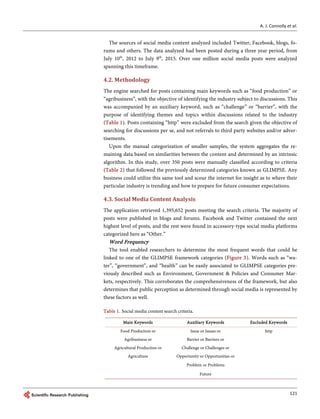
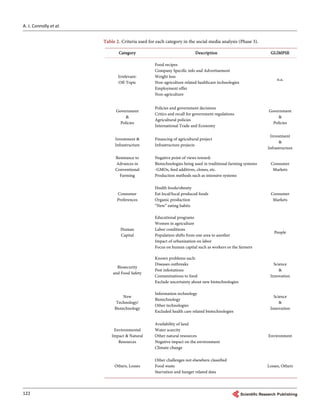
algorithm. In this study, over 350 posts were manually classified according to criteria
(Table 2) that followed the previously determined categories known as GLIMPSE. Any
business could utilize this same tool and scour the internet for insight as to where their
particular industry is trending and how to prepare for future consumer expectations.
4.3. Social Media Content Analysis
The application retrieved 1,395,652 posts meeting the search criteria. The majority of
posts were published in blogs and forums. Facebook and Twitter contained the next
highest level of posts, and the rest were found in accessory-type social media platforms
categorized here as “Other.”
Word Frequency
The tool enabled researchers to determine the most frequent words that could be
linked to one of the GLIMPSE framework categories (Figure 3). Words such as “wa-
ter”, “government”, and “health” can be easily associated to GLIMPSE categories pre-
viously described such as Environment, Government & Policies and Consumer Mar-
kets, respectively. This corroborates the comprehensiveness of the framework, but also
determines that public perception as determined through social media is represented by
these factors as well.
Table 1. Social media content search criteria.
Main Keywords Auxiliary Keywords Excluded Keywords
Food Production or Issue or Issues or http
Agribusiness or Barrier or Barriers or
Agricultural Production or Challenge or Challenges or
Agriculture Opportunity or Opportunities or
Problem or Problems
Future
A. J. Connolly et al.
122
Table 2. Criteria used for each category in the social media analysis (Phase 3).
Category Description GLIMPSE
Irrelevant:
Off-Topic
Food recipes
Company Specific info and Advertisement
Weight loss
Non-agriculture related healthcare technologies
Employment offer
Non-agriculture
n.a.
Government
&
Policies
Policies and government decisions
Critics and recall for government regulations
Agricultural policies
International Trade and Economy
Government
&
Policies
Investment &
Infrastructure
Financing of agricultural project
Infrastructure projects
Investment
&
Infrastructure
Resistance to
Advances in
Conventional
Farming
Negative point of views toward:
Biotechnologies being used in traditional farming systems
-GMOs, feed additives, clones, etc.
Production methods such as intensive systems
Consumer
Markets
Consumer
Preferences
Health foods/obesity
Eat local/local produced foods
Organic production
“New” eating habits
Consumer
Markets
Human
Capital
Educational programs
Women in agriculture
Labor conditions
Population shifts from one area to another
Impact of urbanization on labor
Focus on human capital such as workers or the farmers
People
Biosecurity
and Food Safety
Known problems such:
Diseases outbreaks
Pest infestations
Contaminations to food
Exclude uncertainty about new biotechnologies
Science
&
Innovation
New
Technology/
Biotechnology
Information technology
Biotechnology
Other technologies
Excluded health care related biotechnologies
Science
&
Innovation
Environmental
Impact & Natural
Resources
Availability of land
Water scarcity
Other natural resources
Negative impact on the environment
Climate change
Environment
Others, Losses
Other challenges not elsewhere classified
Food waste
Starvation and hunger related data
Losses, Others
A. J. Connolly et al.
123
Figure 3. Word frequency among posts [07/10/2012 to 07/09/2015].
Word Clusters
Another way of analyzing the data is through clusters of words. In this analysis, the
relationships of words that frequently appear together in posts are represented by in-
terconnected bubbles. When observing these clusters (Figure 4), researchers were able
to easily identify GLIMPSE categories in several of them.
World Clouds
The major data analysis referred to the frequency of which particular words were
stated in posts. Word cloud illustrations were used to identify frequency (larger fonts
represented higher frequency). Naturally, the most frequent words of the study were
keywords identified within the search criteria. When evaluating results, therefore, key-
words have been excluded from the analysis. By observing the remaining data, empiri-
cal association can be conducted with the remaining words toward topics representing
challenges. Once again, these words may not accurately represent the sole content of
the posts but on an aggregated basis, they serve as fair proxies of trends or patterns ob-
served in the data.
When breaking down the data into different periods within the three years of con-
tent, word clouds were used to identify slight differences in trends or patterns across
time. More words related to Environment and Consumer Markets categories are identi-
fied in the word cloud from 2014 to 2015, while relatively more words related to Gov-
ernment & Policies and Science & Innovation can be identified in the 2012-2013 word
cloud (Figure 5).
When the data is segmented according to the source in which they were posted, some
variations in the content can also be noted (Figure 6). Given that most of the overall
A. J. Connolly et al.
124
Figure 4. Cluster [07/10/2012 to 07/09/2015; sample of 10,000 posts].
Figure 5. Word cloud without keywords [07/10/2012 to 07/09/2013 and 07/10/2014 to 07/09/2015; sample of 10,000 posts].
A. J. Connolly et al.
125
Figure 6. Word cloud without keywords for different content sources [07/10/2012 to 07/09/2015; sample of 10,000 posts each].
data were found in blogs, the word cloud from these sources is more representative of
the overall word cloud presented before. In the word clouds of Twitter and Facebook
content words related to Government & Policies and Science & Innovation are hardly
observed, while those related to Consumer Markets and People are predominant. It is
important to note that the present analysis does not take into consideration the number
of views or engagements (likes, shares, etc.) of posts, but only their content.
By observing the word clouds from each of the categories, correlation between the
most frequent words and category theme can be observed. This demonstrates that the
application did a fairly satisfactory job categorizing the posts. Nonetheless, some words
are recurrently shown in different word clouds. The researchers believe this shows in-
ter-relationship between GLIMPSE categories.
More importantly than the breakdown over the period is how this breakdown
changed over the time or how the trend and pattern changed over time. These changes
in pattern over time demonstrate changes in how people perceive the issue. Greater
amount of posts related to People and Science & Innovation categories were observed
in more recent posts (Figure 7).
5. Social Media Analysis Conclusions & Potential
The researchers of this subject found the social media analysis supported the findings
and conclusions obtained in the previous analysis. While this was of course good news,
it became increasingly evident just how beneficial this type of analysis could be for any
business, government entity or policy maker, NGO, or company looking to gain pers-
pective into the consumer mindset. The content collected from social media was top of
mind to consumers; it was unprompted and completely clear of any bias from the part
of the researchers.
While this particular research used Crimson Hexagon, there are other platforms
available that will analyze across a wide array of information, allowing for easier deci-
A. J. Connolly et al.
126
Figure 7. Breakdown (%) of challenges categories in 2012/13 and 2013/14.
phering of the data. With the onset of big data, there is only to be more gain in eva-
luating data of this nature. As more and more consumers take their discussions, per-
ceptions, interests, kudos or complaints to the internet, the vast amounts of data availa-
ble for study are ever increasing. The information is readily available, it is up to the
business world to lend a virtual ear toward social media and hear it.
Acknowledgements
A special thanks to Luiz Roberto Sodre for his dedication of time and energy regarding
the social media content analysis.
References
[1] Malthus, T.R. (1978) An Essay on the Principle of Population. J. Johnson, London.
[2] FAO. How to Feed the World 2050. Food and Agriculture Organization.
http://www.fao.org/fileadmin/templates/wsfs/docs/expert_paper/How_to_Feed_the_World
_in_2050.pdf
[3] Foley, J. (2015) A Five Step Plan to Feed the World. National Geographic.
http://www.nationalgeographic.com/foodfeatures/feeding-9-billion/
[4] United Nations. Chapter IV: The Global Food Crisis. The Global Social Crisis.
http://www.un.org/esa/socdev/rwss/docs/2011/chapter4.pdf
[5] Lieberman, M. (2014) Visualizing Big Data: Social Network Analysis.
https://c.ymcdn.com/sites/www.casro.org/resource/collection/E0F10496-BE87-48E8-8746-5
21D403EE4A2/Paper_-_Michael_Lieberman_-_Multivariate_Solutions.pdf
[6] Adami, E. (2013) National Centre for Research Methods Working Paper: A Social Semiotic
Multimodal Analysis Framework for Website Interactivity.
http://eprints.ncrm.ac.uk/3074/4/website_interactivity_Adami.pdf
[7] The Use of Social Media for Research and Analysis: A Feasibility Study.
https://www.gov.uk/government/uploads/system/uploads/attachment_data/file/387591/use
A. J. Connolly et al.
127
-of-social-media-for-research-and-analysis.pdf
[8] Connolly, A.J. and Phillips-Connolly, K. (2012) Can Agribusiness Feed 3 Billion New
People...and Save the Planet? A GLIMPSE into the Future. International Food and Agribu-
siness Management Review, 15, 139-152.
Submit or recommend next manuscript to SCIRP and we will provide best service
for you:
Accepting pre-submission inquiries through Email, Facebook, LinkedIn, Twitter, etc.
A wide selection of journals (inclusive of 9 subjects, more than 200 journals)
Providing 24-hour high-quality service
User-friendly online submission system
Fair and swift peer-review system
Efficient typesetting and proofreading procedure
Display of the result of downloads and visits, as well as the number of cited articles
Maximum dissemination of your research work
Submit your manuscript at: http://papersubmission.scirp.org/
Or contact sn@scirp.org

GLIMPSE Social Media

  • 1.
    Social Networking, 2016,5, 118-127 http://www.scirp.org/journal/sn ISSN Online: 2169-3323 ISSN Print: 2169-3285 DOI: 10.4236/sn.2016.54012 October 31, 2016 GLIMPSE: Using Social Media to Identify the Barriers Facing Farmers’ Quest to Feed the World Aidan J. Connolly, Luiz R. Sodre, Alexa D. Potocki Alltech, Inc., Nicholasville, KY, USA Abstract The ubiquitous nature of social media in today’s world offers unparalleled insights into human thinking. When people write Facebook posts, blogs, Tweet, Instagram and WeChat they allow their real feelings and reflections to be exhibited, unvar- nished and unfiltered. From this perspective the use of data analytical tools such as Wordle word association mapping and other tools can truly show through frequency of word used, word connections and consumer insights. The example of farming and food production is instructive. Five years ago a new acronym GLIMPSE in IFAMR was proposed to summarize the barriers faced by agriculture in its quest to feed the world. This was based on a Delphi analysis of 25 expert interviews. In order to con- firm GLIMPSE, a larger research effort interviewed 57 experts, conducted an online survey with almost 600 experts and for the first time ever in this sector algorithms were applied to over 1.3 million qualified social media postings on the internet refer- ring to the challenge of feeding a growing world population. This allowed the com- parison to confirm the factors that most clearly depict the general public’s concerns with respect to food production and agriculture. The value for policy makers is clear. While international policy makers, governments, non-governmental organizations (NGOs), charities, industry organizations, integrated food companies and farmers often struggle to explain to the general population the challenges of increasing food production of both large and small scale farming the social media analysis is unique and original in its ability to confirm the GLIMPSE framework as a manner to en- compass the main challenges agriculture faces on its journey to feed over 9 billion people by 2050. Keywords Food, World, Sustainability, Agriculture, Agribusiness, Farming, Policy How to cite this paper: Connolly, A.J., Sodre, L.R. and Potocki, A.D. (2016) GLIMPSE: Using Social Media to Identify the Barriers Facing Farmers’ Quest to Feed the World. Social Networking, 5, 118-127. http://dx.doi.org/10.4236/sn.2016.54012 Received: September 28, 2016 Accepted: October 28, 2016 Published: October 31, 2016 Copyright © 2016 by authors and Scientific Research Publishing Inc. This work is licensed under the Creative Commons Attribution International License (CC BY 4.0). http://creativecommons.org/licenses/by/4.0/ Open Access
  • 2.
    A. J. Connollyet al. 119 1. Introduction Thomas Malthus once predicted that population growth would outpace the food supply [1]. While this hasn’t happened yet, it’s no secret that the world is well on its way to meeting the 9 billion people anticipated to be living by 2050 [2]. While the amount of food that will have to be produced by then may be susceptible to variations—the Food and Agriculture Organization of the United Nations estimates a 60% increase—it is unquestionable that it will rise [2]. Those of us in the agriculture sector found ourselves asking: Will agribusiness be able to support the necessity for increased food produc- tion? Concomitant to such a questioning scenario, agriculture has drawn peculiar atten- tion from the general public in recent years [3]. Spikes in food prices such as those oc- curring during the 2007-2008 world food price crisis, food safety concerns such as dis- ease outbreaks, food contaminations, environmental issues, and many others, have all raised awareness among general society [4]. A population, which has shifted away from rural areas and food production techniques, is now concerned with how and where food is produced. Thanks to the internet, there is a wealth of information readily available to consum- ers who are now able to monitor production actions across the globe and are more conscious and exigent in decision-making. Alternatively, the outlet of social media is further catapulting information to the fingertips of consumers [5]. This has all come about as a result of social media and the ability of consumers to now voice their opinions and tastes all over the web using a variety of tools and me- thods [6]. Businesses now know that they must manage social media [5] [7], but what the research here demonstrates is a company or sector can look to determine like- mindedness in the virtual world. Through appropriate data analysis, this could be used to future proof businesses in preparation of changes in consumer preferences and trends. 2. The GLIMPSE Framework The use of technology and the internet is ever increasing throughout the world and the agribusiness industry is no different. Still, the sector wrestled with what consumers re- ally want or expect and needed a way to determine trends. The acronym GLIMPSE was created to help the agribusiness community determine the obstacles it faces [8]. The original research (published in 2012) was conducted to determine the GLIMPSE framework. It was, however, more thoroughly revisited in 2015 in an effort to determine its efficacy over time. During the second study, the researchers completed a two part analysis. Phase one was a series of interviews with 58 members of the agribusiness community. The group ranged from academic experts to industry leaders and they were asked to discuss the concerns and obstacles facing the agribusiness community. Taking this collected data, the researchers then conducted a survey of 527 agribusi- ness professionals. These answers were culled down and found to follow similar con-
  • 3.
    A. J. Connollyet al. 120 cerns as those posed by the interview phase. Ultimately, it was found that for a second time, the acronym GLIMPSE resembled the primary obstacles the sector faced, but with a few changes (Figure 1 and Figure 2). 3. The Inclusion of People The most obvious change in the revised GLIMPSE is that it now more clearly represents people. This is most obvious as it has been identified as its own category, but several of the other categories have also been altered to show the reflection of people in the form of consumers. For example, “Markets” has now been labeled “Consumer Markets” and “Losses in the food and ingredient supply chain” was adjusted to simply “Losses”, to reflect losses at the consumption level, as well as retail and production le- vels. Because people have now been identified as an integral part the food chain and thus agriculture itself, it stands to reason that they should be included in the research as well. Given the advancements and spread of the internet and social media in recent years, it was considered relevant to analyze the content of posts published in these vehicles as a proxy of general public opinion. The purpose was to identify and evaluate discussions about the challenges of agribusiness and possibly draw connections to the topics pre- viously categorized. Basically, does public opinion, represented here by social media, reflect the same obstacles and concerns as formerly identified in the interviews with academic experts and industry professionals? 4. GLIMPSE in Social Media 4.1. Crimson Hexagon Knowing how extensive the amount of data collected could be, it became the objective to evaluate trends and patterns across the data rather than accurately measuring and classifying each and every post obtained from the sources. Therefore the analysis was mostly done based on frequency of particular words and recurrence of topics automat- ically classified by an artificial intelligence device known as crimson hexagon. It is a li- censed commercial application that stores and searches social media content, and al- lows users to customize categories and analyze results. Figure 1. The original GLIMPSE (2012) [8]. Figure 2. Revised GLIMPSE (2015).
  • 4.
    A. J. Connollyet al. 121 The sources of social media content analyzed included Twitter, Facebook, blogs, fo- rums and others. The data analyzed had been posted during a three year period, from July 10th , 2012 to July 9th , 2015. Over one million social media posts were analyzed spanning this timeframe. 4.2. Methodology The engine searched for posts containing main keywords such as “food production” or “agribusiness”, with the objective of identifying the industry subject to discussions. This was accompanied by an auxiliary keyword, such as “challenge” or “barrier”, with the purpose of identifying themes and topics within discussions related to the industry (Table 1). Posts containing “http” were excluded from the search given the objective of searching for discussions per se, and not referrals to third party websites and/or adver- tisements. Upon the manual categorization of smaller samples, the system aggregates the re- maining data based on similarities between the content and determined by an intrinsic algorithm. In this study, over 350 posts were manually classified according to criteria (Table 2) that followed the previously determined categories known as GLIMPSE. Any business could utilize this same tool and scour the internet for insight as to where their particular industry is trending and how to prepare for future consumer expectations. 4.3. Social Media Content Analysis The application retrieved 1,395,652 posts meeting the search criteria. The majority of posts were published in blogs and forums. Facebook and Twitter contained the next highest level of posts, and the rest were found in accessory-type social media platforms categorized here as “Other.” Word Frequency The tool enabled researchers to determine the most frequent words that could be linked to one of the GLIMPSE framework categories (Figure 3). Words such as “wa- ter”, “government”, and “health” can be easily associated to GLIMPSE categories pre- viously described such as Environment, Government & Policies and Consumer Mar- kets, respectively. This corroborates the comprehensiveness of the framework, but also determines that public perception as determined through social media is represented by these factors as well. Table 1. Social media content search criteria. Main Keywords Auxiliary Keywords Excluded Keywords Food Production or Issue or Issues or http Agribusiness or Barrier or Barriers or Agricultural Production or Challenge or Challenges or Agriculture Opportunity or Opportunities or Problem or Problems Future
  • 5.
    A. J. Connollyet al. 122 Table 2. Criteria used for each category in the social media analysis (Phase 3). Category Description GLIMPSE Irrelevant: Off-Topic Food recipes Company Specific info and Advertisement Weight loss Non-agriculture related healthcare technologies Employment offer Non-agriculture n.a. Government & Policies Policies and government decisions Critics and recall for government regulations Agricultural policies International Trade and Economy Government & Policies Investment & Infrastructure Financing of agricultural project Infrastructure projects Investment & Infrastructure Resistance to Advances in Conventional Farming Negative point of views toward: Biotechnologies being used in traditional farming systems -GMOs, feed additives, clones, etc. Production methods such as intensive systems Consumer Markets Consumer Preferences Health foods/obesity Eat local/local produced foods Organic production “New” eating habits Consumer Markets Human Capital Educational programs Women in agriculture Labor conditions Population shifts from one area to another Impact of urbanization on labor Focus on human capital such as workers or the farmers People Biosecurity and Food Safety Known problems such: Diseases outbreaks Pest infestations Contaminations to food Exclude uncertainty about new biotechnologies Science & Innovation New Technology/ Biotechnology Information technology Biotechnology Other technologies Excluded health care related biotechnologies Science & Innovation Environmental Impact & Natural Resources Availability of land Water scarcity Other natural resources Negative impact on the environment Climate change Environment Others, Losses Other challenges not elsewhere classified Food waste Starvation and hunger related data Losses, Others
  • 6.
    A. J. Connollyet al. 123 Figure 3. Word frequency among posts [07/10/2012 to 07/09/2015]. Word Clusters Another way of analyzing the data is through clusters of words. In this analysis, the relationships of words that frequently appear together in posts are represented by in- terconnected bubbles. When observing these clusters (Figure 4), researchers were able to easily identify GLIMPSE categories in several of them. World Clouds The major data analysis referred to the frequency of which particular words were stated in posts. Word cloud illustrations were used to identify frequency (larger fonts represented higher frequency). Naturally, the most frequent words of the study were keywords identified within the search criteria. When evaluating results, therefore, key- words have been excluded from the analysis. By observing the remaining data, empiri- cal association can be conducted with the remaining words toward topics representing challenges. Once again, these words may not accurately represent the sole content of the posts but on an aggregated basis, they serve as fair proxies of trends or patterns ob- served in the data. When breaking down the data into different periods within the three years of con- tent, word clouds were used to identify slight differences in trends or patterns across time. More words related to Environment and Consumer Markets categories are identi- fied in the word cloud from 2014 to 2015, while relatively more words related to Gov- ernment & Policies and Science & Innovation can be identified in the 2012-2013 word cloud (Figure 5). When the data is segmented according to the source in which they were posted, some variations in the content can also be noted (Figure 6). Given that most of the overall
  • 7.
    A. J. Connollyet al. 124 Figure 4. Cluster [07/10/2012 to 07/09/2015; sample of 10,000 posts]. Figure 5. Word cloud without keywords [07/10/2012 to 07/09/2013 and 07/10/2014 to 07/09/2015; sample of 10,000 posts].
  • 8.
    A. J. Connollyet al. 125 Figure 6. Word cloud without keywords for different content sources [07/10/2012 to 07/09/2015; sample of 10,000 posts each]. data were found in blogs, the word cloud from these sources is more representative of the overall word cloud presented before. In the word clouds of Twitter and Facebook content words related to Government & Policies and Science & Innovation are hardly observed, while those related to Consumer Markets and People are predominant. It is important to note that the present analysis does not take into consideration the number of views or engagements (likes, shares, etc.) of posts, but only their content. By observing the word clouds from each of the categories, correlation between the most frequent words and category theme can be observed. This demonstrates that the application did a fairly satisfactory job categorizing the posts. Nonetheless, some words are recurrently shown in different word clouds. The researchers believe this shows in- ter-relationship between GLIMPSE categories. More importantly than the breakdown over the period is how this breakdown changed over the time or how the trend and pattern changed over time. These changes in pattern over time demonstrate changes in how people perceive the issue. Greater amount of posts related to People and Science & Innovation categories were observed in more recent posts (Figure 7). 5. Social Media Analysis Conclusions & Potential The researchers of this subject found the social media analysis supported the findings and conclusions obtained in the previous analysis. While this was of course good news, it became increasingly evident just how beneficial this type of analysis could be for any business, government entity or policy maker, NGO, or company looking to gain pers- pective into the consumer mindset. The content collected from social media was top of mind to consumers; it was unprompted and completely clear of any bias from the part of the researchers. While this particular research used Crimson Hexagon, there are other platforms available that will analyze across a wide array of information, allowing for easier deci-
  • 9.
    A. J. Connollyet al. 126 Figure 7. Breakdown (%) of challenges categories in 2012/13 and 2013/14. phering of the data. With the onset of big data, there is only to be more gain in eva- luating data of this nature. As more and more consumers take their discussions, per- ceptions, interests, kudos or complaints to the internet, the vast amounts of data availa- ble for study are ever increasing. The information is readily available, it is up to the business world to lend a virtual ear toward social media and hear it. Acknowledgements A special thanks to Luiz Roberto Sodre for his dedication of time and energy regarding the social media content analysis. References [1] Malthus, T.R. (1978) An Essay on the Principle of Population. J. Johnson, London. [2] FAO. How to Feed the World 2050. Food and Agriculture Organization. http://www.fao.org/fileadmin/templates/wsfs/docs/expert_paper/How_to_Feed_the_World _in_2050.pdf [3] Foley, J. (2015) A Five Step Plan to Feed the World. National Geographic. http://www.nationalgeographic.com/foodfeatures/feeding-9-billion/ [4] United Nations. Chapter IV: The Global Food Crisis. The Global Social Crisis. http://www.un.org/esa/socdev/rwss/docs/2011/chapter4.pdf [5] Lieberman, M. (2014) Visualizing Big Data: Social Network Analysis. https://c.ymcdn.com/sites/www.casro.org/resource/collection/E0F10496-BE87-48E8-8746-5 21D403EE4A2/Paper_-_Michael_Lieberman_-_Multivariate_Solutions.pdf [6] Adami, E. (2013) National Centre for Research Methods Working Paper: A Social Semiotic Multimodal Analysis Framework for Website Interactivity. http://eprints.ncrm.ac.uk/3074/4/website_interactivity_Adami.pdf [7] The Use of Social Media for Research and Analysis: A Feasibility Study. https://www.gov.uk/government/uploads/system/uploads/attachment_data/file/387591/use
  • 10.
    A. J. Connollyet al. 127 -of-social-media-for-research-and-analysis.pdf [8] Connolly, A.J. and Phillips-Connolly, K. (2012) Can Agribusiness Feed 3 Billion New People...and Save the Planet? A GLIMPSE into the Future. International Food and Agribu- siness Management Review, 15, 139-152. Submit or recommend next manuscript to SCIRP and we will provide best service for you: Accepting pre-submission inquiries through Email, Facebook, LinkedIn, Twitter, etc. A wide selection of journals (inclusive of 9 subjects, more than 200 journals) Providing 24-hour high-quality service User-friendly online submission system Fair and swift peer-review system Efficient typesetting and proofreading procedure Display of the result of downloads and visits, as well as the number of cited articles Maximum dissemination of your research work Submit your manuscript at: http://papersubmission.scirp.org/ Or contact sn@scirp.org