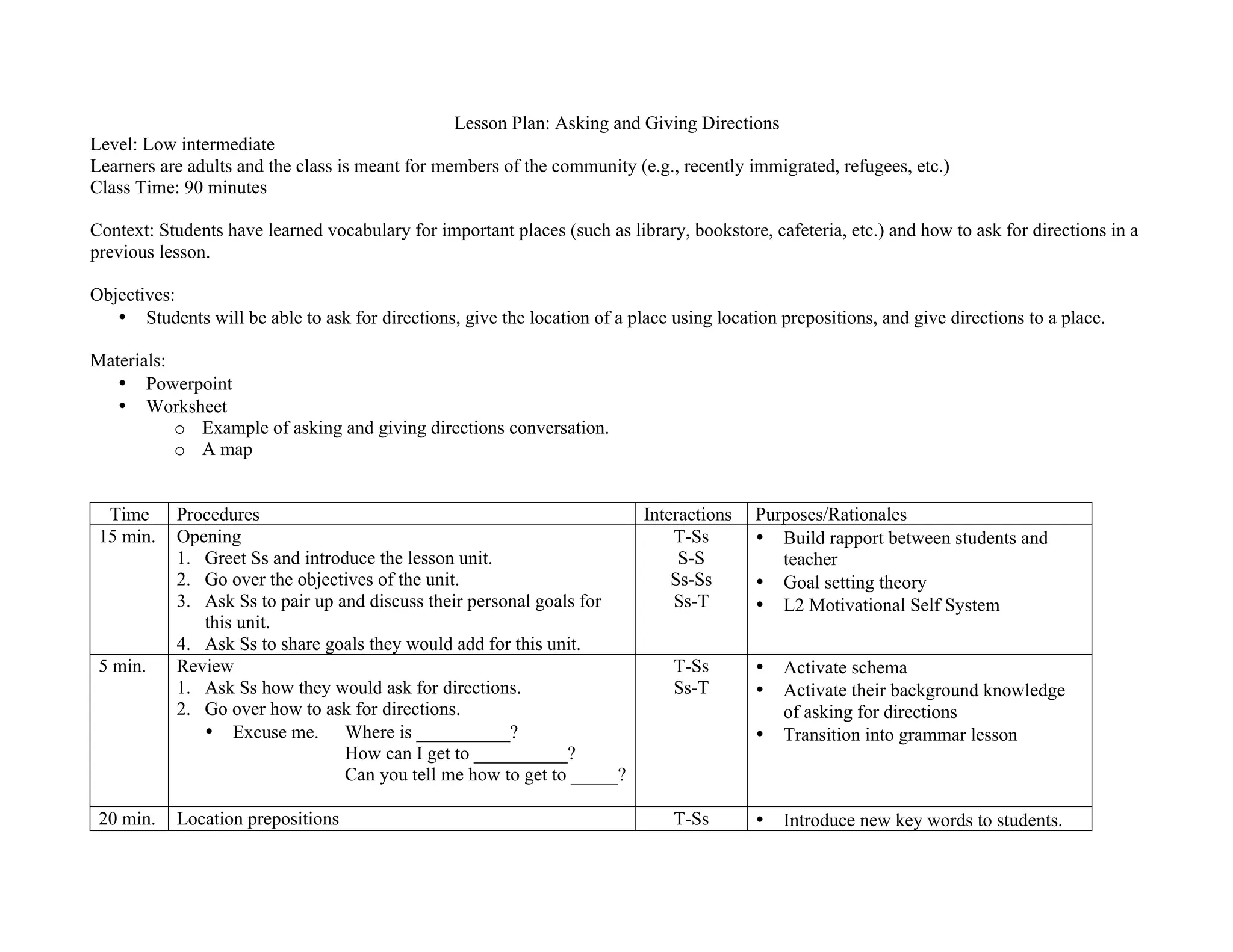
Lesson Plan: Asking and Giving Directions
Level: Low intermediate
Learners are adults and the class is meant for members of the community (e.g., recently immigrated, refugees, etc.)
Class Time: 90 minutes
Context: Students have learned vocabulary for important places (such as library, bookstore, cafeteria, etc.) and how to ask for directions in a
previous lesson.
Objectives:
• Students will be able to ask for directions, give the location of a place using location prepositions, and give directions to a place.
Materials:
• Powerpoint
• Worksheet
o Example of asking and giving directions conversation.
o A map
Time Procedures Interactions Purposes/Rationales
15 min. Opening
1. Greet Ss and introduce the lesson unit.
2. Go over the objectives of the unit.
3. Ask Ss to pair up and discuss their personal goals for
this unit.
4. Ask Ss to share goals they would add for this unit.
T-Ss
S-S
Ss-Ss
Ss-T
• Build rapport between students and
teacher
• Goal setting theory
• L2 Motivational Self System
5 min. Review
1. Ask Ss how they would ask for directions.
2. Go over how to ask for directions.
• Excuse me. Where is __________?
How can I get to __________?
Can you tell me how to get to _____?
T-Ss
Ss-T
• Activate schema
• Activate their background knowledge
of asking for directions
• Transition into grammar lesson
20 min. Location prepositions T-Ss • Introduce new key words to students.
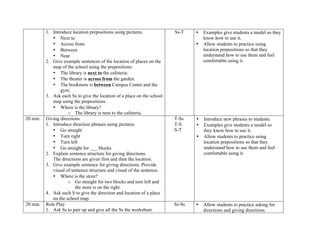
1. Introduce location prepositions using pictures.
• Next to
• Across from
• Between
• Near
2. Give example sentences of the location of places on the
map of the school using the prepositions:
• The library is next to the cafeteria.
• The theater is across from the garden.
• The bookstore is between Campus Center and the
gym.
3. Ask each Ss to give the location of a place on the school
map using the prepositions.
• Where is the library?
o The library is next to the cafeteria.
Ss-T • Examples give students a model so they
know how to use it.
• Allow students to practice using
location prepositions so that they
understand how to use them and feel
comfortable using it.
20 min. Giving directions
1. Introduce direction phrases using pictures.
• Go straight
• Turn right
• Turn left
• Go straight for ___ blocks
2. Explain sentence structure for giving directions.
The directions are given first and then the location.
3. Give example sentence for giving directions. Provide
visual of sentence structure and visual of the sentence.
• Where is the store?
o Go straight for two blocks and turn left and
the store is on the right.
4. Ask each S to give the direction and location of a place
on the school map.
T-Ss
T-S
S-T
• Introduce new phrases to students.
• Examples give students a model so
they know how to use it.
• Allow students to practice using
location prepositions so that they
understand how to use them and feel
comfortable using it.
20 min. Role Play
1. Ask Ss to pair up and give all the Ss the worksheet.
Ss-Ss • Allow students to practice asking for
directions and giving directions.
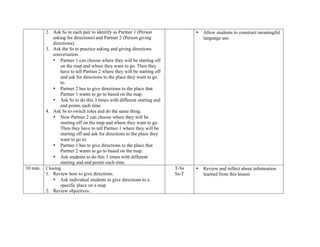
2. Ask Ss in each pair to identify as Partner 1 (Person
asking for directions) and Partner 2 (Person giving
directions).
3. Ask the Ss to practice asking and giving directions
conversation.
• Partner 1 can choose where they will be starting off
on the map and where they want to go. Then they
have to tell Partner 2 where they will be starting off
and ask for directions to the place they want to go
to.
• Partner 2 has to give directions to the place that
Partner 1 wants to go to based on the map.
• Ask Ss to do this 3 times with different starting and
end points each time.
4. Ask Ss to switch roles and do the same thing.
• Now Partner 2 can choose where they will be
starting off on the map and where they want to go.
Then they have to tell Partner 1 where they will be
starting off and ask for directions to the place they
want to go to.
• Partner 1 has to give directions to the place that
Partner 2 wants to go to based on the map.
• Ask students to do this 3 times with different
starting and end points each time.
• Allow students to construct meaningful
language use.
10 min. Closing
1. Review how to give directions.
• Ask individual students to give directions to a
specific place on a map
2. Review objectives.
T-Ss
Ss-T
• Review and reflect about information
learned from this lesson

giving_directions_lesson_plan. poerpointpdf

  • 1.
    Lesson Plan: Askingand Giving Directions Level: Low intermediate Learners are adults and the class is meant for members of the community (e.g., recently immigrated, refugees, etc.) Class Time: 90 minutes Context: Students have learned vocabulary for important places (such as library, bookstore, cafeteria, etc.) and how to ask for directions in a previous lesson. Objectives: • Students will be able to ask for directions, give the location of a place using location prepositions, and give directions to a place. Materials: • Powerpoint • Worksheet o Example of asking and giving directions conversation. o A map Time Procedures Interactions Purposes/Rationales 15 min. Opening 1. Greet Ss and introduce the lesson unit. 2. Go over the objectives of the unit. 3. Ask Ss to pair up and discuss their personal goals for this unit. 4. Ask Ss to share goals they would add for this unit. T-Ss S-S Ss-Ss Ss-T • Build rapport between students and teacher • Goal setting theory • L2 Motivational Self System 5 min. Review 1. Ask Ss how they would ask for directions. 2. Go over how to ask for directions. • Excuse me. Where is __________? How can I get to __________? Can you tell me how to get to _____? T-Ss Ss-T • Activate schema • Activate their background knowledge of asking for directions • Transition into grammar lesson 20 min. Location prepositions T-Ss • Introduce new key words to students.
  • 2.
    1. Introduce locationprepositions using pictures. • Next to • Across from • Between • Near 2. Give example sentences of the location of places on the map of the school using the prepositions: • The library is next to the cafeteria. • The theater is across from the garden. • The bookstore is between Campus Center and the gym. 3. Ask each Ss to give the location of a place on the school map using the prepositions. • Where is the library? o The library is next to the cafeteria. Ss-T • Examples give students a model so they know how to use it. • Allow students to practice using location prepositions so that they understand how to use them and feel comfortable using it. 20 min. Giving directions 1. Introduce direction phrases using pictures. • Go straight • Turn right • Turn left • Go straight for ___ blocks 2. Explain sentence structure for giving directions. The directions are given first and then the location. 3. Give example sentence for giving directions. Provide visual of sentence structure and visual of the sentence. • Where is the store? o Go straight for two blocks and turn left and the store is on the right. 4. Ask each S to give the direction and location of a place on the school map. T-Ss T-S S-T • Introduce new phrases to students. • Examples give students a model so they know how to use it. • Allow students to practice using location prepositions so that they understand how to use them and feel comfortable using it. 20 min. Role Play 1. Ask Ss to pair up and give all the Ss the worksheet. Ss-Ss • Allow students to practice asking for directions and giving directions.
  • 3.
    2. Ask Ssin each pair to identify as Partner 1 (Person asking for directions) and Partner 2 (Person giving directions). 3. Ask the Ss to practice asking and giving directions conversation. • Partner 1 can choose where they will be starting off on the map and where they want to go. Then they have to tell Partner 2 where they will be starting off and ask for directions to the place they want to go to. • Partner 2 has to give directions to the place that Partner 1 wants to go to based on the map. • Ask Ss to do this 3 times with different starting and end points each time. 4. Ask Ss to switch roles and do the same thing. • Now Partner 2 can choose where they will be starting off on the map and where they want to go. Then they have to tell Partner 1 where they will be starting off and ask for directions to the place they want to go to. • Partner 1 has to give directions to the place that Partner 2 wants to go to based on the map. • Ask students to do this 3 times with different starting and end points each time. • Allow students to construct meaningful language use. 10 min. Closing 1. Review how to give directions. • Ask individual students to give directions to a specific place on a map 2. Review objectives. T-Ss Ss-T • Review and reflect about information learned from this lesson