GIMP and Linux in Hollywood Michael J. Hammel [email_address] www.graphics-muse.org
GIMP Origins
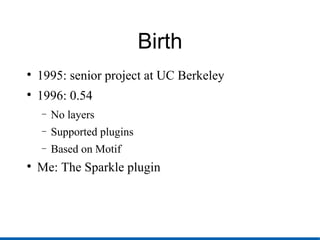
Birth 1995: senior project at UC Berkeley 1996: 0.54 No layers Supported plugins Based on Motif Me: The Sparkle plugin
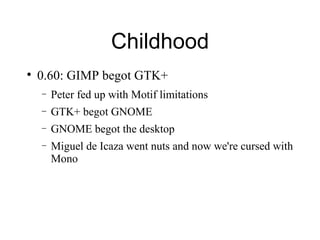
Childhood 0.60: GIMP begot GTK+ Peter fed up with Motif limitations GTK+ begot GNOME GNOME begot the desktop Miguel de Icaza went nuts and now we're cursed with Mono
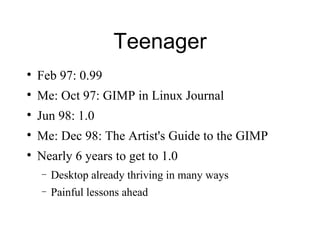
Teenager Feb 97: 0.99  Me: Oct 97: GIMP in Linux Journal Jun 98: 1.0 Me: Dec 98: The Artist's Guide to the GIMP Nearly 6 years to get to 1.0 Desktop already thriving in many ways Painful lessons ahead
The Visual Effects Society
1998: Film-GIMP Rythm and Hues Visual Effects company Run by head of Visual Effects Society Paid GIMP developers for deep paint support 16bit and 32bit channels HOLLYWOOD branch of CVS Never merged with mainline GEGL was better choice
2002: Cinepaint Robin Rowe Resurrected HOLLYWOOD branch Changed name to Cinepaint Supported by industry Robin is in Hollywood Visual Effects members can meet about the product
2008: GEGL in GIMP 10 years after 1.0: Finally, work starts on merging GEGL in GIMP Expected for 2.6 release (2.5.x are developer releases) GEGL: Generic Graphics Library graph based image processing framework supports deep paint (16, 32bit color channels) Multiple color models/spaces (re: CMYK, etc.) Text rendering improvements Layer effects
Linux in Hollywood
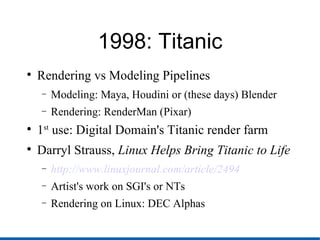
1998: Titanic Rendering vs Modeling Pipelines Modeling: Maya, Houdini or (these days) Blender Rendering: RenderMan (Pixar) 1 st  use: Digital Domain's Titanic render farm Darryl Strauss,  Linux Helps Bring Titanic to Life http://www.linuxjournal.com/article/2494 Artist's work on SGI's or NTs Rendering on Linux: DEC Alphas
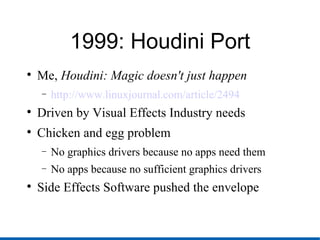
1999: Houdini Port Me,  Houdini: Magic doesn't just happen http://www.linuxjournal.com/article/2494 Driven by Visual Effects Industry needs Chicken and egg problem No graphics drivers because no apps need them No apps because no sufficient graphics drivers Side Effects Software pushed the envelope
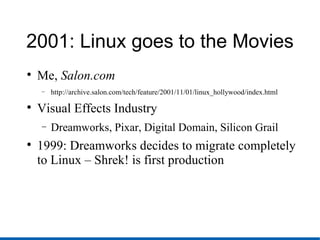
2001: Linux goes to the Movies Me,  Salon.com http://archive.salon.com/tech/feature/2001/11/01/linux_hollywood/index.html Visual Effects Industry Dreamworks, Pixar, Digital Domain, Silicon Grail 1999: Dreamworks decides to migrate completely to Linux – Shrek! is first production
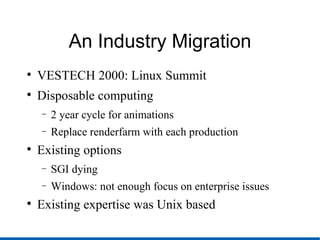
An Industry Migration VESTECH 2000: Linux Summit Disposable computing 2 year cycle for animations Replace renderfarm with each production Existing options SGI dying Windows: not enough focus on enterprise issues Existing expertise was Unix based
A Lesson For All Lessons from the Visual Effects Industry Share information Open Source “wrong behaviours” are not easily forgiven The end users are in charge.

Gimp And Linux In Hollywood

  • 1.
    GIMP and Linuxin Hollywood Michael J. Hammel [email_address] www.graphics-muse.org
  • 2.
  • 3.
    Birth 1995: seniorproject at UC Berkeley 1996: 0.54 No layers Supported plugins Based on Motif Me: The Sparkle plugin
  • 4.
    Childhood 0.60: GIMPbegot GTK+ Peter fed up with Motif limitations GTK+ begot GNOME GNOME begot the desktop Miguel de Icaza went nuts and now we're cursed with Mono
  • 5.
    Teenager Feb 97:0.99 Me: Oct 97: GIMP in Linux Journal Jun 98: 1.0 Me: Dec 98: The Artist's Guide to the GIMP Nearly 6 years to get to 1.0 Desktop already thriving in many ways Painful lessons ahead
  • 6.
  • 7.
    1998: Film-GIMP Rythmand Hues Visual Effects company Run by head of Visual Effects Society Paid GIMP developers for deep paint support 16bit and 32bit channels HOLLYWOOD branch of CVS Never merged with mainline GEGL was better choice
  • 8.
    2002: Cinepaint RobinRowe Resurrected HOLLYWOOD branch Changed name to Cinepaint Supported by industry Robin is in Hollywood Visual Effects members can meet about the product
  • 9.
    2008: GEGL inGIMP 10 years after 1.0: Finally, work starts on merging GEGL in GIMP Expected for 2.6 release (2.5.x are developer releases) GEGL: Generic Graphics Library graph based image processing framework supports deep paint (16, 32bit color channels) Multiple color models/spaces (re: CMYK, etc.) Text rendering improvements Layer effects
  • 10.
  • 11.
    1998: Titanic Renderingvs Modeling Pipelines Modeling: Maya, Houdini or (these days) Blender Rendering: RenderMan (Pixar) 1 st use: Digital Domain's Titanic render farm Darryl Strauss, Linux Helps Bring Titanic to Life http://www.linuxjournal.com/article/2494 Artist's work on SGI's or NTs Rendering on Linux: DEC Alphas
  • 12.
    1999: Houdini PortMe, Houdini: Magic doesn't just happen http://www.linuxjournal.com/article/2494 Driven by Visual Effects Industry needs Chicken and egg problem No graphics drivers because no apps need them No apps because no sufficient graphics drivers Side Effects Software pushed the envelope
  • 13.
    2001: Linux goesto the Movies Me, Salon.com http://archive.salon.com/tech/feature/2001/11/01/linux_hollywood/index.html Visual Effects Industry Dreamworks, Pixar, Digital Domain, Silicon Grail 1999: Dreamworks decides to migrate completely to Linux – Shrek! is first production
  • 14.
    An Industry MigrationVESTECH 2000: Linux Summit Disposable computing 2 year cycle for animations Replace renderfarm with each production Existing options SGI dying Windows: not enough focus on enterprise issues Existing expertise was Unix based
  • 15.
    A Lesson ForAll Lessons from the Visual Effects Industry Share information Open Source “wrong behaviours” are not easily forgiven The end users are in charge.